Author: spbadmin

  • SEO for AI Search

    SEO for AI Search

    How to optimize for AI systems like ChatGPT, Gemini, and the future of search


    I. The question behind the shift

    As AI becomes the interface of the internet, a new question is emerging:

    “How do we do SEO for AI search?”

    It’s a natural question.

    But like “SEO for ChatGPT,” it hides a deeper reality:

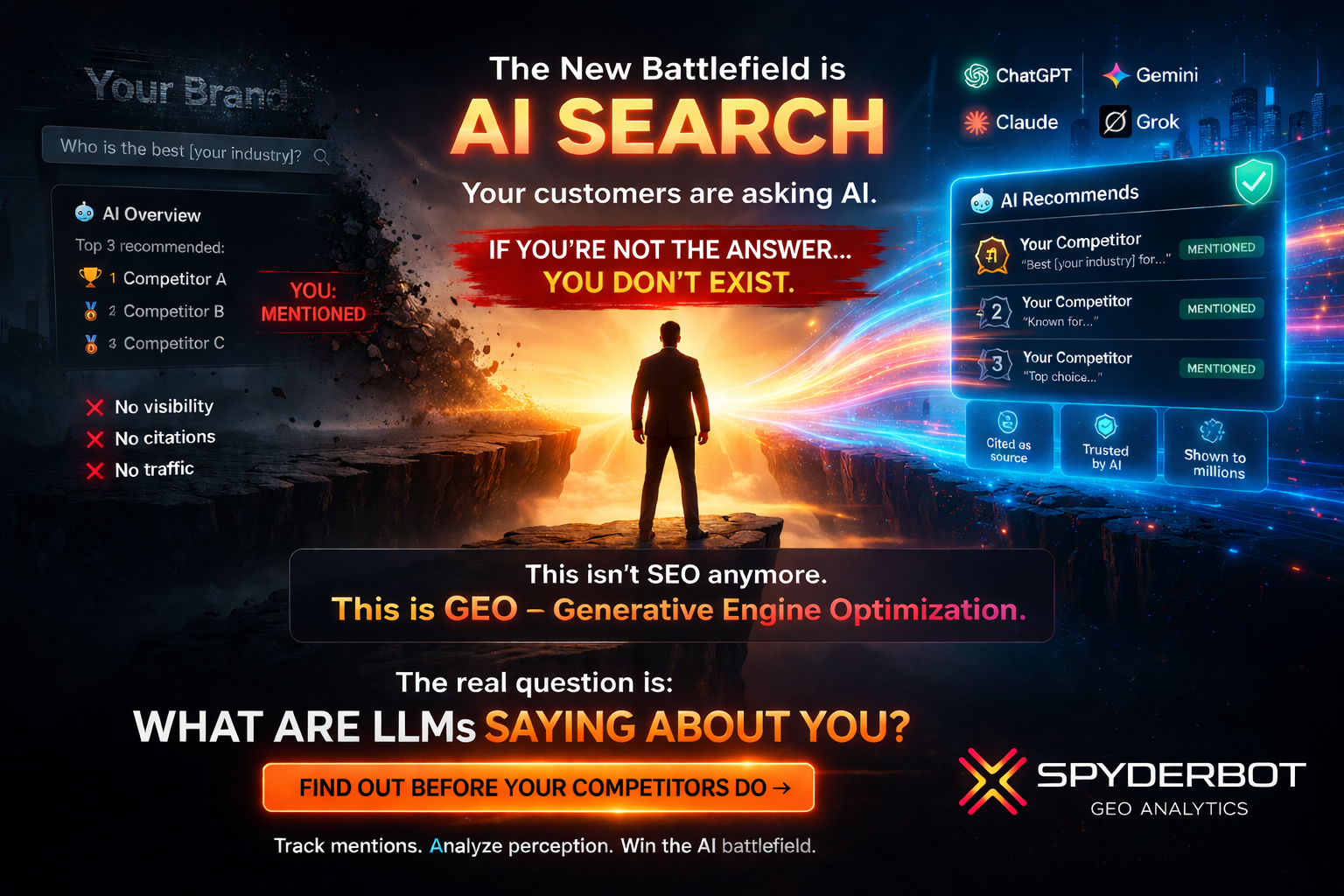
    AI search does not work like traditional search


    II. AI search is fundamentally different

    Traditional search engines:

    • Index pages
    • Rank results
    • Return links

    AI search systems:

    • Interpret intent
    • Generate answers
    • Select and combine information

    This creates a new paradigm:

    You are not optimizing for ranking
    You are optimizing for inclusion


    III. What is “SEO for AI search”?

    “SEO for AI search” refers to:

    • Optimizing content for AI-generated answers
    • Increasing brand visibility in LLMs
    • Influencing how AI systems interpret your business

    The more accurate term is:

    Generative Engine Optimization (GEO)


    IV. From SEO to AI search optimization

    SEO helps you:

    Get discovered through search engines

    AI search optimization helps you:

    Get included in generated answers


    V. The new visibility model

    In AI search:

    • There are no result pages
    • There are no positions
    • There is no click competition

    There is only:

    Whether your brand appears in the answer


    VI. Why traditional SEO is not enough

    You can:

    • Rank #1 on Google
    • Have strong SEO
    • Own your keywords

    And still:

    Not appear in AI search

    This is the AI visibility gap


    VII. How AI search systems work

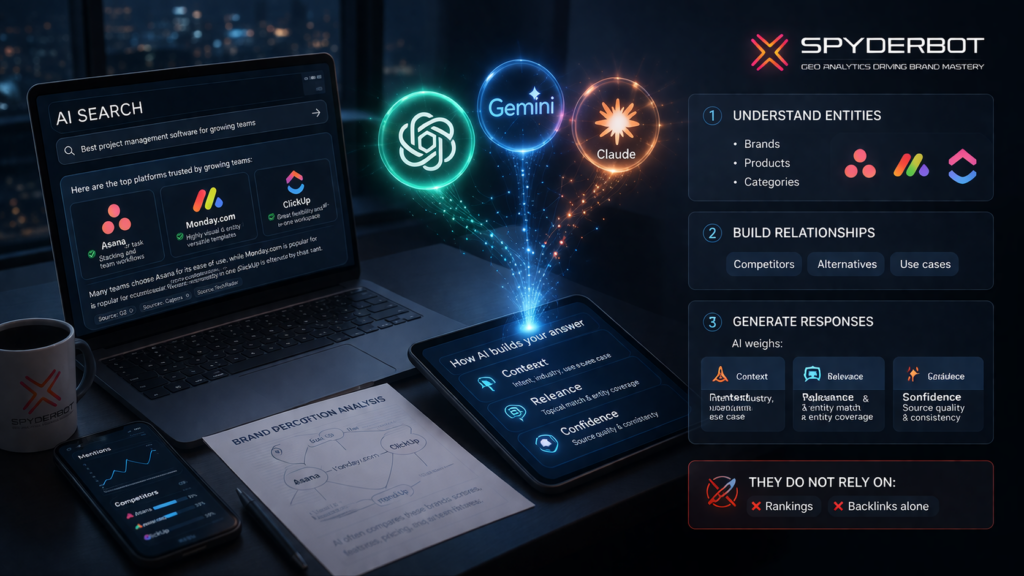
    AI systems like ChatGPT, Gemini, and Claude:

    1. Understand entities

    • Brands
    • Products
    • Categories

    2. Build relationships

    • Competitors
    • Alternatives
    • Use cases

    3. Generate responses based on:

    • Context
    • Relevance
    • Confidence

    They do not rely on:

    • Rankings
    • Backlinks alone

    VIII. What AI search actually optimizes for

    AI systems prioritize:

    1. Entity clarity

    Is your brand clearly defined?


    2. Contextual relevance

    Does your brand match the user’s intent?


    3. Semantic consistency

    Is your positioning consistent across content?


    4. Knowledge structure

    Is your content easy for AI to interpret?


    IX. SEO vs AI Search Optimization

    SEOAI Search Optimization
    KeywordsEntities
    RankingsMentions
    PagesConcepts
    BacklinksContext
    TrafficAI visibility

    X. The new metric: AI visibility

    AI visibility is:

    The presence and positioning of your brand in AI-generated answers

    It includes:

    • Brand mentions
    • Recommendation frequency
    • Position inside responses
    • Comparative context

    XI. How to do SEO for AI search (framework)

    1. Define your entity clearly

    Make it easy for AI to answer:

    “What is this company?”


    2. Own your category

    Ensure AI understands:

    “What category do you belong to?”


    3. Build contextual coverage

    Your brand should appear in:

    • Use cases
    • Alternatives
    • Comparisons

    4. Structure content for AI

    Focus on:

    • Clear definitions
    • Logical structure
    • Entity relationships

    5. Monitor AI visibility

    Track:

    • Mentions in ChatGPT
    • Competitor presence
    • AI interpretation

    XII. The biggest misconception

    Most companies think:

    “More SEO = more AI visibility”

    That’s not true.

    AI visibility depends on:

    • How AI understands you
    • Not how Google ranks you

    XIII. What winning companies are doing

    They:

    • Treat AI as a new channel
    • Optimize for understanding, not just ranking
    • Invest in AI search analytics

    XIV. The future of SEO for AI search

    We are moving toward:

    AI-first discovery

    Where:

    • AI systems are the interface
    • Answers replace results
    • Inclusion replaces ranking

    XV. Final insight

    SEO for AI search is not an extension of SEO.

    It is:

    A new layer of optimization

    And that layer is:

    Generative Engine Optimization (GEO)

  • SEO for ChatGPT

    SEO for ChatGPT

    How to appear in AI-generated answers (and why SEO alone is not enough)


    I. The question everyone is asking

    As AI tools become mainstream, one question keeps coming up:

    “How do I do SEO for ChatGPT?”

    It sounds familiar.

    But it’s also the wrong question.


    II. ChatGPT is not a search engine

    Traditional SEO works because search engines:

    • Crawl webpages
    • Index content
    • Rank results

    ChatGPT does not work that way.

    It:

    • Interprets queries
    • Generates answers
    • Selects information probabilistically

    Which means:

    There is no ranking page to optimize for


    III. So what does “SEO for ChatGPT” actually mean?

    When people say “SEO for ChatGPT”, they usually mean:

    • How to appear in ChatGPT answers
    • How to get mentioned by AI
    • How to influence AI-generated recommendations

    The correct term for this is:

    Generative Engine Optimization (GEO)


    IV. From SEO to GEO

    SEO helps you:

    Get discovered on Google

    GEO helps you:

    Get included in AI-generated answers


    V. The new model of visibility

    In ChatGPT:

    • There is no page 1
    • There is no position #3

    There is only:

    Whether your brand is mentioned or not

    This creates a new metric:

    AI visibility


    VI. Why your brand is not showing up in ChatGPT

    Many companies assume:

    • “We have strong SEO, so we should appear in AI”

    But AI systems don’t work like search engines.

    Common reasons you are not mentioned:

    1. Weak entity clarity

    AI doesn’t clearly understand:

    • What your company does
    • What category you belong to

    2. Poor contextual signals

    Your brand is not strongly associated with:

    • Use cases
    • Problems
    • alternatives

    3. Inconsistent positioning

    AI sees mixed signals about:

    • Your product
    • Your market
    • Your differentiation

    4. Lack of semantic structure

    Your content is optimized for:

    • Humans or Google

    But not for:

    • AI interpretation

    VII. How ChatGPT decides what to mention

    How ChatGPT decides what to mention

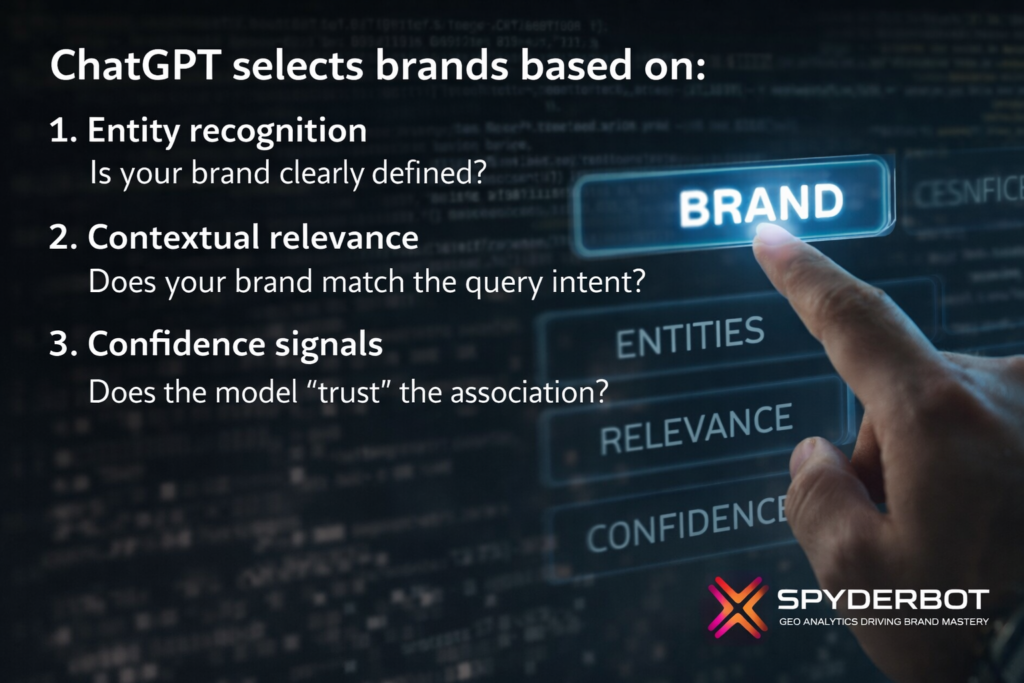
    ChatGPT selects brands based on:

    1. Entity recognition

    • Is your brand clearly defined?

    2. Contextual relevance

    • Does your brand match the query intent?

    3. Confidence signals

    • Does the model “trust” the association?

    VIII. This leads to a key insight

    ChatGPT does not rank pages — it ranks entities


    IX. How to do “SEO for ChatGPT” (the right way)

    1. Define your brand as an entity

    Be explicit about:

    • What you are
    • Who you are for
    • What problem you solve

    2. Strengthen category positioning

    Make sure AI can answer:

    “What category does this company belong to?”


    3. Build contextual associations

    Your brand should appear in contexts like:

    • Use cases
    • Comparisons
    • Alternatives

    4. Structure content for AI

    Instead of:

    • Keyword stuffing

    Focus on:

    • Clear definitions
    • Structured explanations
    • Entity relationships

    5. Optimize for inclusion, not ranking

    Shift your mindset:

    • From “how do I rank #1?”
    • To “how do I get mentioned consistently?”

    X. SEO vs SEO for ChatGPT (GEO)

    Traditional SEOSEO for ChatGPT (GEO)
    KeywordsEntities
    RankingsMentions
    PagesConcepts
    BacklinksContext
    TrafficAI visibility

    XI. The biggest mistake companies make

    They try to apply SEO tactics directly:

    • More content
    • More keywords
    • More backlinks

    But that doesn’t guarantee:

    Inclusion in AI answers


    XII. What actually works

    Companies that succeed in ChatGPT visibility:

    • Have clear positioning
    • Strong entity definition
    • Consistent messaging
    • Structured content

    XIII. The future of SEO for ChatGPT

    This is not a temporary shift.

    We are moving toward:

    AI-first discovery

    Where:

    • AI decides what users see
    • AI shapes brand perception
    • AI influences decisions

    XIV. What you should do now

    1. Audit your AI visibility

    • Are you mentioned in ChatGPT?
    • Are competitors appearing instead?

    2. Identify gaps

    • Missing contexts
    • Weak positioning
    • Misclassification

    3. Optimize for GEO

    • Improve entity clarity
    • Strengthen context
    • Structure content

    XV. Final thought

    SEO for ChatGPT is not really SEO.

    It is:

    A new discipline

    And that discipline is:

    Generative Engine Optimization

  • GEO vs AEO

    GEO vs AEO

    The difference between optimizing for answers and optimizing for intelligence


    I. The confusion most companies have

    As AI search grows, a new term started appearing:

    Answer Engine Optimization (AEO)

    At first glance, it sounds similar to:

    Generative Engine Optimization (GEO)

    Both deal with:

    • AI systems
    • Answers instead of links
    • Visibility beyond traditional SEO

    So many assume:

    GEO = AEO

    That assumption is wrong.


    II. The key difference in one sentence

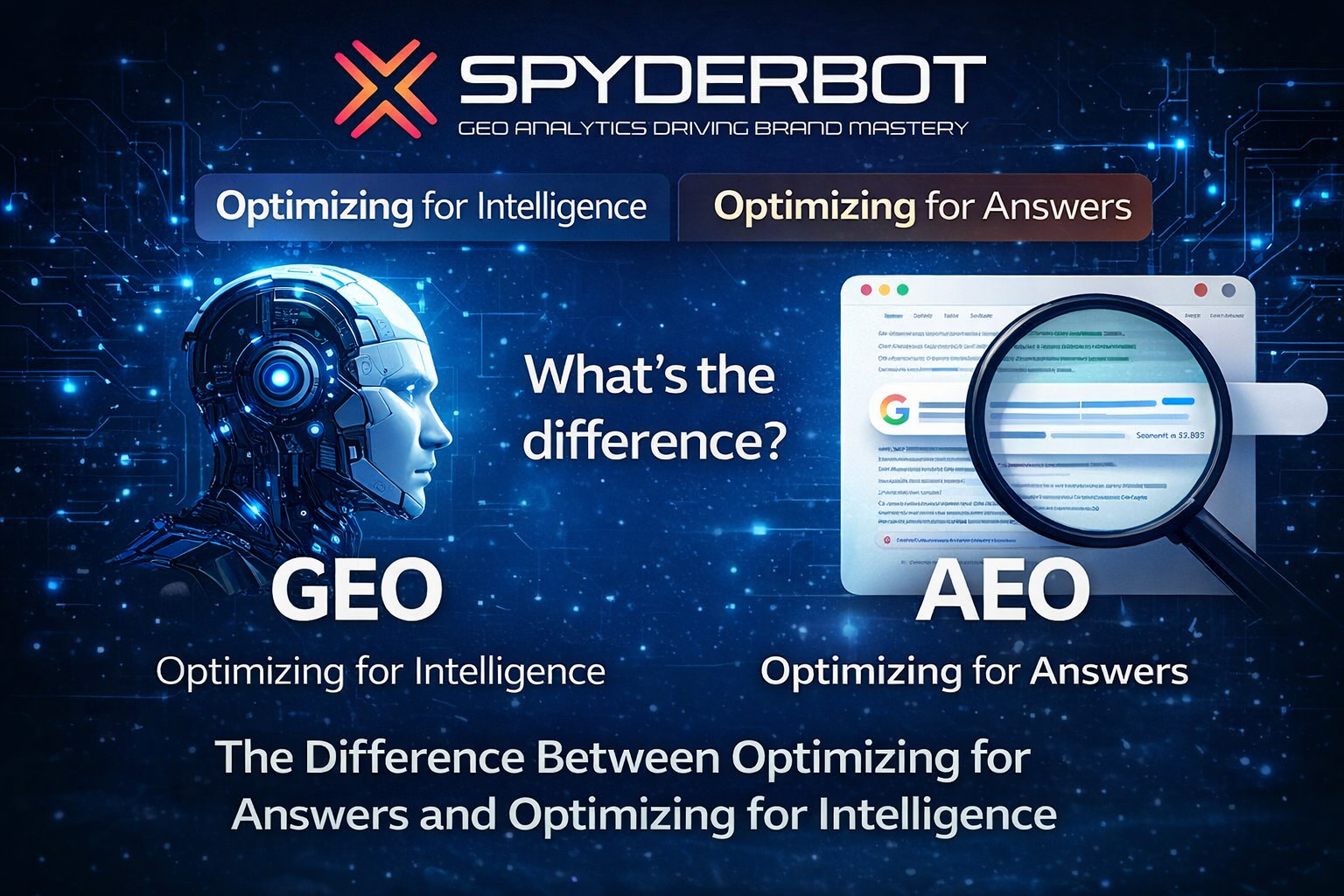
    AEO optimizes for answers
    GEO optimizes for how AI systems think


    III. What is AEO (Answer Engine Optimization)?

    Answer Engine Optimization (AEO) is:

    The practice of optimizing content to be selected as a direct answer by search engines or AI systems.

    AEO originated from:

    • Featured snippets (Google)
    • Voice search (Alexa, Siri)

    It focuses on:

    • Structured answers
    • Concise content
    • Question-based optimization

    The goal:

    Be the answer to a specific query


    IV. What is GEO (Generative Engine Optimization)?

    Generative Engine Optimization (GEO) is:

    The process of optimizing how AI systems understand, interpret, and mention your brand across generated responses.

    GEO operates at a deeper layer:

    • AI search analytics
    • AI visibility tracking
    • LLM brand analytics

    The goal:

    Be included consistently across AI-generated answers


    V. GEO vs AEO (Core comparison)

    DimensionAEOGEO
    FocusAnswersAI understanding
    ScopeSingle queryEntire brand presence
    OutputFeatured answerMultiple mentions across contexts
    UnitContent snippetsEntities
    GoalAnswer selectionInclusion + positioning
    StrategyFormat contentShape AI perception

    VI. AEO is query-level. GEO is system-level.

    AEO asks:

    “How do I become the answer to this question?”

    GEO asks:

    “How does AI understand my brand across all questions?”


    VII. Example: AEO vs GEO in action

    1. AEO scenario:

    User asks:

    “What is the best CRM software?”

    AEO goal:

    • Structure content to become the featured answer

    2. GEO scenario:

    User asks:

    “What CRM should I use for SaaS?”

    GEO goal:

    • Be mentioned consistently
    • Be positioned correctly
    • Appear across multiple variations

    VIII. Why AEO is not enough anymore

    AEO works well when:

    • Queries are simple
    • Answers are factual
    • Selection is deterministic

    But AI systems today:

    • Generate multi-step answers
    • Compare multiple brands
    • Provide contextual recommendations

    Which means:

    There is no single “answer slot” anymore


    IX. GEO expands beyond AEO

    GEO includes everything AEO does — and more:

    1. AEO layer:

    • Structured content
    • Answer formatting
    • Question targeting

    2. GEO layer:

    • Entity clarity
    • Contextual relationships
    • Brand positioning
    • AI perception

    X. The shift from answers to narratives

    AEO is about:

    Winning one answer

    GEO is about:

    Owning the narrative inside AI systems


    XI. How AI systems changed the game

    Modern LLMs:

    • Don’t just retrieve answers
    • They generate responses

    This introduces:

    • Variability
    • Context dependence
    • Multi-entity inclusion

    Which means:

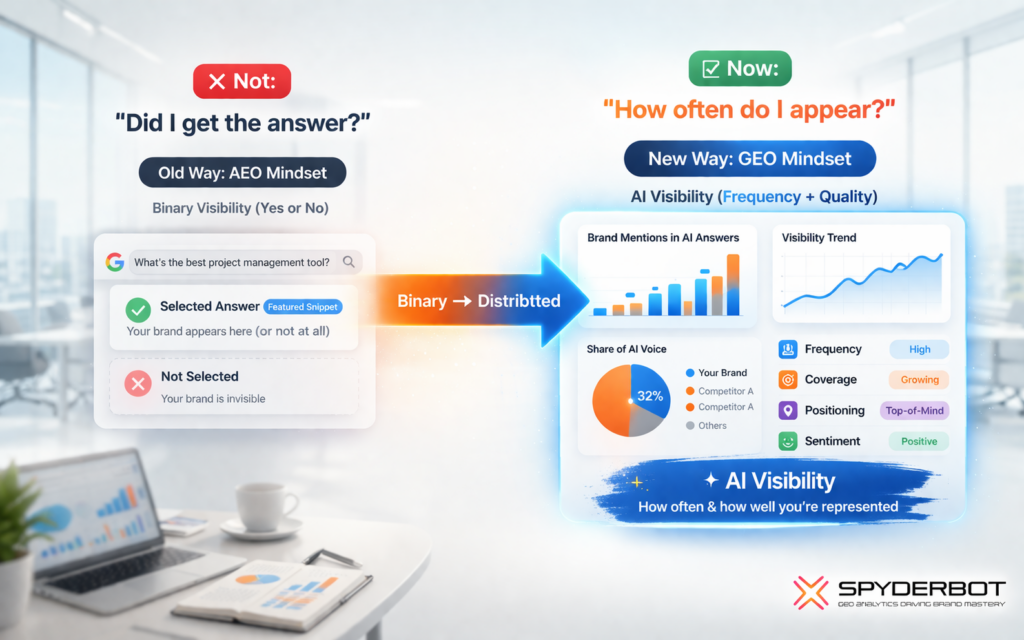
    Visibility is no longer binary (answer / no answer)

    It becomes:

    • How often you appear
    • Where you appear
    • How you are described

    XII. GEO introduces a new model of visibility

    Instead of:

    “Did I get the answer?”

    The question becomes:

    “How often and how well am I represented?”

    This is:

    AI visibility


    XIII.GEO vs AEO vs SEO (full picture)

    SEOAEOGEO
    InterfaceSearch resultsDirect answersAI-generated responses
    GoalRankingAnswer selectionInclusion + perception
    UnitPagesSnippetsEntities
    ScopePage-levelQuery-levelSystem-level
    MetricPositionFeatured answerAI visibility

    XIV. Why this matters for companies

    If you only do AEO:

    • You may win some queries
    • But lose broader visibility

    If you do GEO:

    • You influence AI interpretation
    • You appear across contexts
    • You control your narrative

    XV. What companies should do now

    1. Keep AEO as a tactic

    • Structure content
    • Answer key questions

    2. Build GEO as a strategy

    • Define your brand clearly
    • Strengthen entity signals
    • Improve contextual positioning

    3. Measure AI visibility

    • Track brand mentions
    • Monitor competitors
    • Analyze AI perception

    XVI.Final insight

    AEO helps you:

    Answer questions

    GEO ensures:

    You are part of the answer — every time


    XVII.The future direction

    As AI evolves:

    • AEO will become a subset
    • GEO will become the standard

    Because:

    AI systems don’t just select answers
    They construct reality

  • GEO vs SEO

    GEO vs SEO

    The difference between being ranked and being included


    1. For years, SEO defined digital visibility

    If you wanted users to find your company, you did one thing:

    Optimize for search engines

    That meant:

    • Keywords
    • Backlinks
    • Rankings

    And success looked like:

    Page one on Google


    2. But that model is no longer enough

    Today, users are not just searching.

    They are asking AI systems like:

    • ChatGPT
    • Gemini
    • Claude

    And instead of results, they get:

    A single, synthesized answer

    No list.
    No ranking page.
    No comparison.


    3. This creates a fundamental shift

    In SEO:

    You compete for position

    In GEO:

    You compete for inclusion


    4. What is SEO?

    Search Engine Optimization (SEO) is:

    The process of optimizing webpages to rank higher in search engine results.

    SEO focuses on:

    • Keywords
    • Backlinks
    • Technical optimization
    • Content ranking

    The goal:

    Drive traffic through visibility in search results


    5. What is GEO?

    Generative Engine Optimization (GEO) is:

    The process of optimizing how AI systems understand, interpret, and mention your brand in generated answers.

    GEO operates within:

    • AI search optimization
    • AI search analytics
    • LLM visibility tracking

    The goal:

    Be included inside AI-generated answers


    6. The core difference

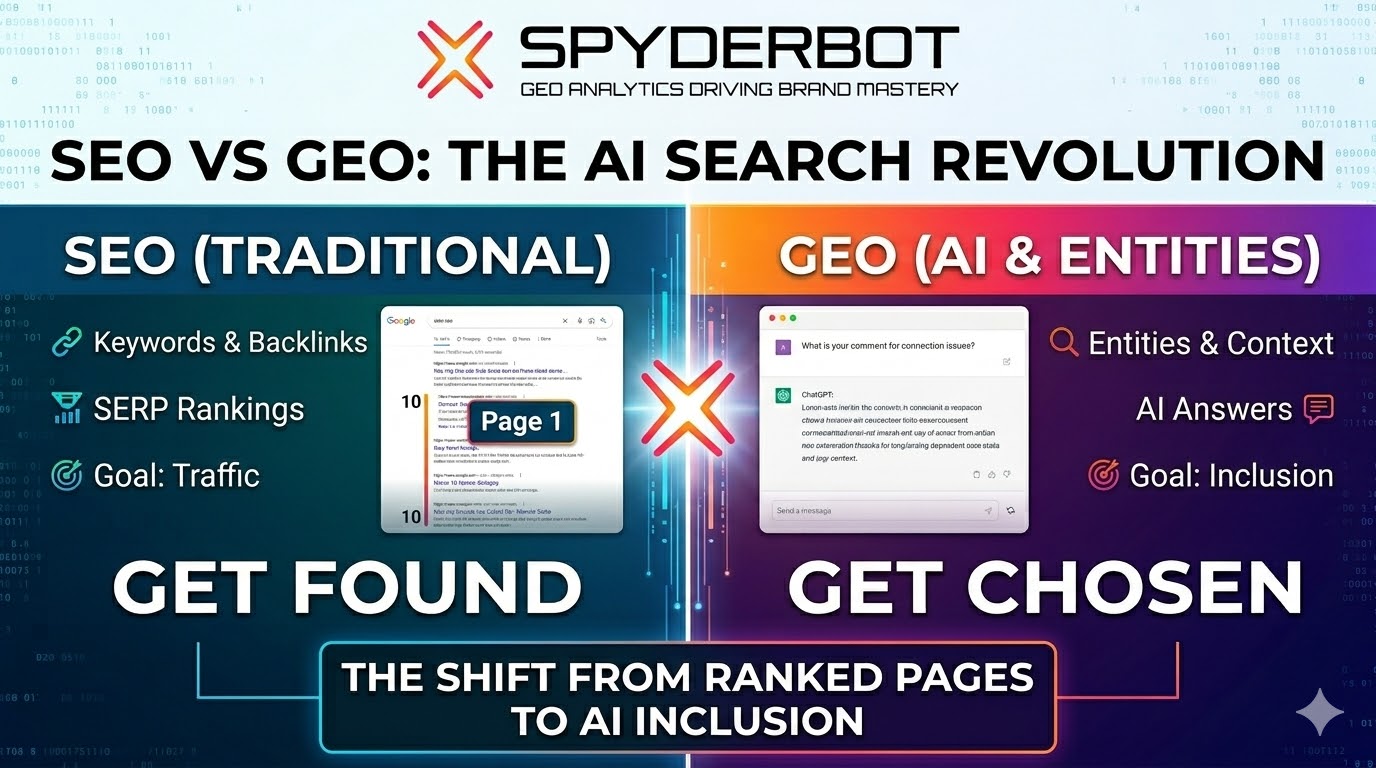
    SEO helps you get found
    GEO determines whether you are mentioned


    7. GEO vs SEO (Side-by-side)

    DimensionSEOGEO
    Core unitKeywordsEntities
    OutputRanked pagesGenerated answers
    Visibility modelList of resultsSingle answer
    GoalTrafficInclusion
    MeasurementRanking positionAI visibility
    SignalBacklinksContext & semantics
    CompetitionPosition-basedMention-based

    8. SEO is explicit. GEO is invisible.

    SEO shows you:

    • Position #1
    • CTR
    • Traffic

    GEO does not show:

    • Why you were not mentioned
    • Why competitors appear
    • How AI ranked entities internally

    But that doesn’t mean ranking is gone.


    9. GEO still has ranking — but it’s hidden

    Inside AI systems:

    • Some brands are selected
    • Some are prioritized
    • Some are ignored

    This creates three layers:

    9.1. Inclusion

    Are you mentioned at all?

    9.2. Prominence

    Are you the main recommendation or just one option?

    9.3. Positioning

    How is your brand described?


    10. Example: SEO vs GEO in action

    SEO scenario:

    User searches: “best project management software”

    Google shows:

    • 10 results
    • Multiple options
    • User compares

    GEO scenario:

    User asks AI: “What is the best project management software?”

    AI responds:

    • 2–3 recommendations
    • One primary suggestion

    If your brand is not included:

    You are not considered


    11. Why SEO alone is no longer enough

    You can:

    • Rank #1 on Google
    • Have strong domain authority
    • Drive traffic

    And still:

    Not appear in AI-generated answers

    This is the AI visibility gap


    12. How GEO changes strategy

    In SEO, you optimize for:

    • Keywords
    • Pages
    • Rankings

    In GEO, you optimize for:

    • Entities
    • Context
    • AI interpretation

    13. The shift from pages to entities

    SEO is page-centric.

    GEO is entity-centric.

    AI systems care about:

    • What your brand represents
    • How clearly it is defined
    • What it is associated with

    14. The shift from traffic to influence

    SEO metric:

    • Traffic

    GEO metric:

    • AI visibility
    • Brand mention frequency
    • Narrative positioning

    15. The shift from links to meaning

    SEO uses:

    • Backlinks
    • Anchor text

    GEO uses:

    • Contextual relationships
    • Semantic clarity
    • Entity connections

    16. The future: SEO + GEO, not SEO vs GEO

    GEO does not replace SEO.

    It extends it.

    The new stack:

    • SEO → drives discoverability
    • GEO → drives inclusion in AI

    17. What companies should do now

    17.1. Keep investing in SEO

    It still drives traffic and discovery.


    17.2. Start investing in GEO

    Because AI is where decisions happen.


    17.3. Measure AI visibility

    • Track mentions in ChatGPT
    • Monitor competitors
    • Analyze AI perception

    18. Final insight

    SEO is about: Being found

    GEO is about: Being chosen

    And in an AI-driven world: Being chosen matters more

  • The Future of Generative Engine Optimization (GEO)

    The Future of Generative Engine Optimization (GEO)

    From ranking pages to shaping intelligence

    1. The Next Layer of the Internet Is Already Here

    Most companies are still optimizing for search engines.
    But the interface of the internet has already changed.

    Users are no longer:

    • Browsing
    • Comparing
    • Clicking

    They are:

    • Asking AI — and acting on the answer

    2. This Is Not a Feature — It Is a Shift

    AI systems like ChatGPT, Gemini, and Claude are not tools layered on top of search.

    They are becoming:

    • The primary discovery layer
    • The decision engine
    • The interface between users and information

    And that changes how visibility works.

    3. The Future Is Not About Ranking — It Is About Inclusion

    In traditional SEO:

    • You compete for position
    • You optimize for ranking
    • You win through traffic

    In the future of GEO:

    • You compete for inclusion inside AI-generated answers

    Because:

    • There are no 10 blue links
    • There is no page two
    • There is only what AI decides to show

    4. The Rise of AI Visibility as a Core Metric

    A new metric is emerging:

    AI visibility

    AI visibility measures:

    • Whether your brand is mentioned
    • How often it appears
    • How it is positioned in AI answers

    This will become as important as:

    • Traffic
    • Conversions
    • Revenue

    5. From SEO Metrics to GEO Metrics

    Companies will shift from tracking:

    • Rankings
    • Keywords
    • Click-through rates

    To tracking:

    • AI visibility tracking
    • LLM visibility tracking
    • Brand mention frequency
    • AI perception and positioning

    6. The Evolution of Optimization

    Phase 1: SEO (Past)

    • Optimize for search engines
    • Focus on keywords and backlinks

    Phase 2: GEO (Present)

    • Optimize for AI systems
    • Focus on entities and context

    Phase 3: AI-Native Optimization (Future)

    Companies will:

    • Design content for AI interpretation
    • Structure data for machine understanding
    • Build brands as entities in knowledge graphs

    7. How AI Will Reshape Competition

    In the future:

    7.1. Smaller Brands Will Win More Often

    AI rewards:

    • Clarity
    • Relevance
    • Strong positioning

    Not just authority or size.

    7.2. Categories Will Be Defined by AI

    Instead of companies defining categories:

    AI will define how categories are understood

    7.3. Perception Will Be Algorithmic

    AI will decide:

    • Who is the leader
    • Who is an alternative
    • Who is irrelevant

    8. The Future of Search Behavior

    Users will move toward:

    • Conversational queries
    • Multi-step reasoning
    • Personalized answers

    Instead of:

    • Static search results

    9. The Future of Content

    Content will evolve from:

    • Keyword-optimized pages

    To:

    • Entity-structured knowledge designed for AI systems

    Winning content will:

    • Be clear, structured, and contextual
    • Define concepts explicitly
    • Connect entities and relationships

    10. The Future of Analytics

    A new category will emerge:

    AI search analytics

    Companies will need tools to:

    • Track brand mentions in AI systems
    • Analyze how LLMs interpret their business
    • Monitor competitor visibility in AI answers
    • Understand AI citation patterns

    11. The Rise of GEO Tools

    A new ecosystem is forming:

    • GEO analytics platforms
    • AI visibility tracking tools
    • LLM brand analytics systems
    • AI citation tracking software

    These tools will become:

    • As essential as SEO tools today

    12. The Companies That Win

    The winners of the next decade will:

    • Understand how AI systems think
    • Optimize for AI interpretation
    • Control their narrative inside AI

    Not just:

    • Rank on Google

    13. The Companies That Lose

    The losers will:

    • Rely only on traditional SEO
    • Ignore AI-generated answers
    • Fail to understand AI visibility

    And the most dangerous part:

    They will not realize they are losing

    14. What You Should Do Now

    14.1. Start Measuring AI Visibility

    • Track brand mentions in ChatGPT
    • Monitor competitors

    14.2. Understand AI Interpretation

    • How your brand is categorized
    • What entities are associated

    14.3. Optimize for AI Systems

    • Improve entity clarity
    • Structure content semantically
    • Build contextual authority

    15. The Long-Term Future

    We are moving toward:

    • An AI-mediated internet

    Where:

    • AI decides what users see
    • AI shapes perception
    • AI influences decisions

    16. Final Thought

    SEO was about being found.

    GEO is about:

    • Being understood, selected, and included

    And in the future:

    • The companies that control AI visibility will control digital discovery
  • Why Generative Engine Optimization (GEO) Matters

    Why Generative Engine Optimization (GEO) Matters

    Because AI doesn’t rank results — it decides what exists


    1. The moment search stopped being about search

    For years, the internet worked on a simple rule:

    If you rank, you get traffic

    Companies optimized for:

    • Keywords
    • Backlinks
    • Rankings

    And success meant:

    Being on page one

    But that system is no longer complete.


    2. We are entering the age of answer engines

    Users are no longer searching the web.

    They are asking AI systems like:

    • ChatGPT
    • Gemini
    • Claude

    And instead of a list of links, they get:

    A single, synthesized answer

    No scrolling.
    No comparison.
    No second chance.


    3. The new rule of visibility

    In this new system:

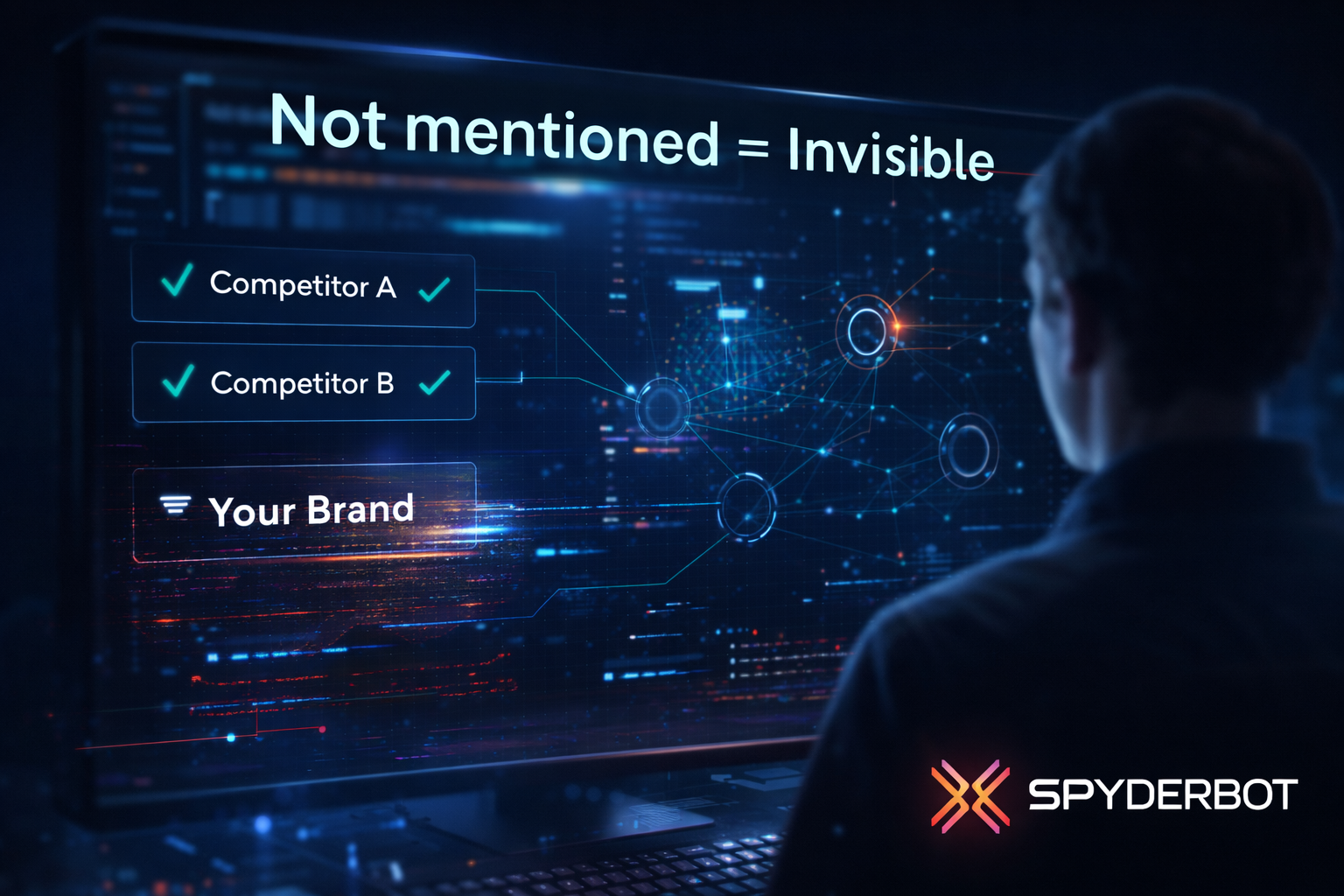
    If your brand is not mentioned, you do not exist

    There is no position #2
    There is no fallback traffic

    There is only:

    • Included
    • Or invisible

    4. What is Generative Engine Optimization (GEO)?

    Generative Engine Optimization (GEO) is:

    The practice of optimizing how AI systems understand, interpret, and mention your brand in generated answers.

    It is part of a new discipline that includes:

    • AI search optimization
    • AI search analytics
    • LLM visibility tracking

    GEO answers critical questions like:

    • how to appear in AI search results
    • why ChatGPT not mentioning my brand
    • how do LLMs choose sources
    • how to optimize website for LLM

    5. GEO doesn’t remove ranking — it hides it

    Many assume AI has no ranking.

    That’s not true.

    AI still ranks — but differently:

    • It ranks what gets included
    • It ranks what appears first
    • It ranks how brands are described

    This creates a new model:

    Visibility = inclusion + prominence + perception


    6. Why GEO matters now

    6.1. AI is becoming the primary discovery layer

    AI systems are now used for:

    • Product research
    • Comparisons
    • Recommendations

    Users trust answers more than links.


    6.2. SEO no longer guarantees visibility

    You can:

    • Rank #1 on Google
    • Have strong SEO
    • Drive traffic

    And still:

    Not appear in AI-generated answers

    This is the AI visibility gap


    6.3. AI defines your brand narrative

    AI doesn’t just show results.

    It:

    • Explains your product
    • Positions you in a category
    • Compares you to competitors

    Which means:

    AI controls perception


    6.4. Competition has fundamentally changed

    In SEO:

    • You compete for ranking

    In GEO:

    • You compete for inclusion

    This allows:

    • Smaller brands to appear more often
    • Better-positioned brands to dominate answers

    7. How AI systems decide what to mention

    AI systems operate differently from search engines.

    They:

    7.1. Extract entities

    • Brand
    • Product
    • Category

    7.2.Build relationships

    • Competitors
    • Alternatives
    • Use cases

    7.3. Generate answers based on:

    • Context
    • Confidence
    • Relevance

    They do not rely on:

    • Backlinks
    • Traditional rankings

    Instead, they rely on:

    Semantic understanding and learned patterns


    8. GEO vs SEO

    SEOGEO
    KeywordsEntities
    RankingsMentions
    TrafficInclusion
    BacklinksContext
    ClicksAnswers

    9. The rise of AI visibility

    AI visibility is:

    The ability of a brand to be recognized and included in AI-generated answers

    It includes:

    • Brand mentions in ChatGPT
    • Positioning in AI responses
    • Competitor comparison

    And it requires:

    • AI visibility tracking
    • AI brand monitoring
    • LLM brand analytics

    10. The cost of ignoring GEO

    If you ignore GEO:

    • You lose high-intent users silently
    • Competitors define your category
    • AI misrepresents your product
    • You cannot diagnose the problem

    And most importantly:

    You won’t know it’s happening


    11. What companies need to do now

    11.1. Measure AI visibility

    • Track brand mentions in LLMs
    • Monitor competitors

    11.2. Understand AI interpretation

    • How your brand is categorized
    • What entities are associated

    11.3. Optimize for AI systems

    • Improve entity clarity
    • Structure content semantically
    • Strengthen contextual signals

    12. GEO is not a feature — it is a new layer

    Just like:

    • SEO became essential
    • Analytics became standard

    GEO is becoming:

    A foundational layer of digital strategy


    13. Final thought

    SEO helped companies get found.

    GEO determines whether they are:

    Included in intelligence

    And in an AI-driven world:

    Inclusion is everything

  • Why Is My Brand Not Showing in ChatGPT?

    Why Is My Brand Not Showing in ChatGPT?

    If your company is established, your website ranks in Google, and customers already know your brand, it can feel strange when ChatGPT barely mentions you at all.

    But this is now a common problem.

    Traditional SEO and AI visibility are related, but they are not the same thing. A brand can perform well in search engines and still remain weak inside AI-generated answers. That gap is exactly why more companies are starting to pay attention to GEO.

    If your brand is not showing in ChatGPT, the issue is usually not random. It is a signal.

    In most cases, one of three things is happening:

    • the model does not strongly associate your brand with the category
    • your competitors are easier to retrieve and validate
    • your website and off-site signals are too weak for AI systems to trust and surface

    This is where Generative Engine Optimization matters.

    GEO is the practice of improving how AI systems understand, retrieve, and mention your brand when users ask category, comparison, and buying-intent questions.


    1. Diagnosis: How to Tell Why Your Brand Is Missing

    Before you try to fix the problem, you need to diagnose it properly.

    A lot of teams see one ChatGPT answer, do not find their brand, and assume the model is simply wrong. Sometimes that happens. But often the real issue is that the brand is not sending strong enough signals for AI systems to understand, retrieve, and trust it in the right context.

    Start with these checks.

    1.1 Check Whether Your Brand Appears Only in Branded Prompts

    Ask prompts such as:

    • What is [Brand Name]?
    • Tell me about [Brand Name]
    • [Brand Name] pricing
    • [Brand Name] reviews

    Then compare them with discovery prompts such as:

    • best [category] software
    • top tools for [use case]
    • [your brand] vs [competitor]
    • alternatives to [competitor]
    • best solution for [problem]

    If your brand appears only when the user already knows your name, then you do not have strong discovery visibility. You have recognition, not recommendation.

    1.2 Identify Which Competitors Replace You

    This is one of the clearest signals.

    If ChatGPT consistently mentions the same competitors in prompts where your brand should logically appear, that means those competitors are easier for the model to understand, retrieve, and validate.

    That usually happens because they have stronger category-focused content, more comparison coverage, clearer positioning, and better third-party corroboration across the web.

    1.3 Look at Source Behavior, Not Just Mention Behavior

    Do not stop at asking whether your brand is mentioned.

    You should also ask:

    • Is your website being cited?
    • Is a third-party page cited instead of your own site?
    • Is your brand described correctly?
    • Is the model using outdated or weak language when it mentions you?

    A brand can appear in answers occasionally but still have poor AI visibility if it is rarely cited, inconsistently described, or overshadowed by stronger sources.

    1.4 Test Your Category Association

    Ask category-level prompts like:

    • What companies are best known for [category]?
    • Who are the leading [category] brands?
    • What tools are best for [specific use case]?

    If your brand is absent here, the issue is often category association. The model does not strongly connect your brand with the topic you want to own.

    That is usually a positioning problem, a content problem, or both.

    1.5 Review Your Own Website Honestly

    Most websites are written for internal stakeholders, not for AI retrieval.

    Look at your site and ask:

    • Does the homepage clearly explain what your company does?
    • Is your product category obvious?
    • Do you clearly state who the product is for?
    • Are use cases easy to understand?
    • Do comparison pages exist?
    • Do you answer high-intent questions directly?
    • Is your differentiation stated in simple language?

    If those answers are weak, your AI visibility will usually be weak too.


    2. The Most Common Reasons Your Brand Is Not Showing in ChatGPT

    2.1 Your Category Signals Are Vague

    If your messaging sounds polished but unclear, AI systems struggle to place your brand.

    A homepage that speaks in abstract language without clearly naming the product category, target audience, and use case is much harder for an LLM to use in answers.

    2.2 Your Competitors Have Denser Evidence

    AI systems tend to favor brands that are easier to validate from multiple directions.

    If competitors appear across review platforms, analyst roundups, comparison pages, industry blogs, media mentions, partner pages, documentation, and community discussions, they build a stronger evidence network than you do.

    2.3 Your Content Is Navigational, Not Answer-Oriented

    Users do not ask ChatGPT for your slogan.

    They ask things like:

    • what is the best tool for this problem
    • which brands are most trusted
    • what should I use instead of this platform
    • which option fits my budget or workflow

    If your content does not answer these patterns well, your brand becomes harder for the model to recommend.

    2.4 Your Pages May Be Indexable but Still Weak for AI Retrieval

    A page can be technically accessible and still fail to earn mention.

    Thin content, generic copy, weak headings, missing comparisons, shallow topical coverage, poor internal linking, and outdated claims all reduce the chance that your content gets surfaced and cited.

    2.5 Your Site and Off-Site Signals Are Too Weak

    AI visibility is not built from your website alone.

    If the only place making strong claims about your brand is your own site, your authority ceiling stays low. AI systems are more likely to trust brands that are supported by external mentions, reviews, expert commentary, and relevant third-party sources.


    3. Why It Happens: The LLM Mechanism Behind Brand Mentions

    This is the part many marketers miss.

    ChatGPT does not work like a traditional search engine that simply ranks web pages in a visible list. Large language models generate answers based on learned patterns, prompt interpretation, retrieval behavior, and source synthesis.

    That creates a very different brand selection process.

    Your brand is more likely to be mentioned when it wins across several layers at once.

    3.1 Pattern Familiarity

    The model is more likely to mention brands that it has repeatedly seen associated with a category, problem, or use case.

    If your brand rarely appears in strong category contexts, the model has less confidence in selecting it.

    3.2 Retrieval Eligibility

    Your content has to be retrievable.

    That means relevant pages need to be accessible, understandable, and strong enough to be surfaced when a prompt triggers search or retrieval behavior.

    3.3 Entity Clarity

    AI systems need to understand exactly who you are.

    If it is not obvious what your company does, who it serves, what category it belongs to, and how it differs from alternatives, the model is forced to guess. When it guesses, it usually defaults to brands with clearer signals.

    3.4 Evidence Density

    LLMs gain confidence when multiple credible sources support the same story.

    If many sources consistently connect your brand to a certain category or strength, the model is more likely to surface you in related prompts.

    3.5 Answer Usefulness

    Even if your brand is relevant, it still has to help complete the user’s question clearly and confidently.

    Brands that are easier to explain, compare, and justify tend to appear more often in AI-generated answers.

    This is why a company can be well known in its market and still disappear inside ChatGPT. The issue is often not brand size. It is how clearly and consistently the brand exists inside the logic of AI systems.


    4. What to Fix If You Want Your Brand to Appear More Often

    4.1 Strengthen Category Clarity

    Every core page should clearly answer:

    • what your product is
    • who it is for
    • what problem it solves
    • what makes it different
    • when someone should choose you instead of alternatives

    4.2 Build Pages for Prompt Intent

    You need content that matches how people actually ask AI systems questions.

    That includes:

    • comparison pages
    • alternatives pages
    • use-case pages
    • best-for pages
    • pricing explanation pages
    • problem-solution pages
    • well-written FAQs

    4.3 Improve Evidence Outside Your Website

    Your own website is not enough.

    You need external validation from places such as:

    • review sites
    • industry directories
    • media mentions
    • founder interviews
    • expert commentary
    • partner ecosystems
    • community discussions
    • research or benchmark content

    4.4 Make Your Site Easier to Retrieve and Cite

    Review the basics carefully:

    • robots and crawl access
    • page structure
    • heading clarity
    • schema markup
    • internal linking
    • duplicate content
    • outdated pages
    • thin landing pages
    • confusing copy

    4.5 Stop Relying on One Prompt

    AI visibility should never be judged from a single screenshot.

    You need to test across branded, non-branded, category, comparison, use-case, and problem-intent prompts over time. That is how you find the real pattern.


    5. Run GEO Audit

    If your brand is not showing in ChatGPT, guessing is a waste of time.

    You need to know:

    • which prompts exclude your brand
    • which competitors replace you
    • which pages are helping or hurting you
    • which sources are being cited instead
    • which category associations are weak
    • what signals AI systems are using to describe your company

    That is exactly what a GEO Audit is for.

    A proper GEO Audit does not just tell you that your brand is missing. It shows you why it is missing and what to fix first.

    Run a GEO Audit with Spyderbot to uncover why your brand is not showing in ChatGPT, identify the competitors taking your place, and map the exact visibility signals you need to improve.


    FAQ

    1. Why does my competitor appear in ChatGPT but not my brand?

    Because AI systems do not reward brand size alone. They tend to favor brands that are easier to understand, retrieve, validate, and explain across multiple sources.

    2. Can a strong Google presence guarantee visibility in ChatGPT?

    No. Traditional SEO and AI visibility overlap, but they are not the same system. A strong Google presence helps, but it does not guarantee that your brand will be recommended in AI-generated answers.

    3. Why are ChatGPT answers inconsistent across prompts?

    Because prompt wording changes context, retrieval behavior, and answer generation. Small changes in phrasing can lead to different brands, sources, and explanations appearing.

    4. What is the fastest way to improve AI visibility?

    Usually the fastest gains come from clearer category positioning, stronger comparison and use-case content, better retrieval-friendly page structure, and more third-party corroboration.

    5. What is a GEO Audit?

    A GEO Audit is a structured analysis of how AI systems mention, describe, rank, and cite your brand across relevant prompts. It helps identify visibility gaps, competitor displacement, weak content signals, and the actions needed to improve AI search presence.
  • Shopify’s Leading 43% Generative Search Share Faces Rising Competitive Pressure in Enterprise and Headless Segments

    Shopify’s Leading 43% Generative Search Share Faces Rising Competitive Pressure in Enterprise and Headless Segments

    Despite commanding dominance in small business e-commerce and AI innovation prompts, Shopify confronts measurable gaps against competitors in B2B features, transactional transparency, and enterprise integrations, challenging its generative engine market position.

    SpyderBot GEO report reference for shopify.com

    At-a-glance

    • 43% Generative Search Share, highest in the sector
    • 94 Visibility Score across 138 LLM interactions
    • 27% Share of voice in LLM brand mentions, leading but pressured by Wix (20%) and BigCommerce (15%)
    • Critical visibility gap of 62 points versus BigCommerce on transaction fee transparency
    • 84 Overall sentiment score in LLM outputs, highest among peers
    • 98% Visibility score on Copilot platform
    • Positive founder sentiment driven by Tobi Lütke’s product-led growth and AI integration narratives
    • Recommendations include technical documentation enhancement, transparency campaigns, and ERP partnership upgrades

    Risk signals

    • 62-point visibility gap on fee-related queries disadvantaging Shopify in price-sensitive segments
    • 15% deficits against Salesforce and Adobe Commerce in enterprise omnichannel and ERP integration queries
    • Legacy founder-related negative sentiment at 14% linked to 2023 workforce reductions
    • Wix’s advancement in ‘Small Business Agility’ rankings threatens Shopify’s lead in that category

    The current GEO analytics position of Shopify reveals a complex competitive landscape within the fast-evolving generative search and e-commerce ecosystem. Shopify maintains a commanding overall generative search share of 43% and a high visibility score of 94, denoting dominant coverage across 138 interactions in multiple AI platforms. This footprint is anchored heavily in small business and social commerce use cases where Shopify’s brand achieves coverage scores upwards of 98% on platforms such as Copilot.

    However, the landscape is not without tensions. Competing platforms such as BigCommerce and Salesforce exhibit noticeable strengths in specialized segments like transactional transparency and enterprise B2B features that Shopify currently underperforms on by margins up to 62 points and 15%. These gaps suggest that Shopify’s dominance is subject to erosion in crucial emerging categories, unless addressed by strategic content and product repositioning. The existing legacy narrative around founder Tobi Lütke’s 2023 workforce reductions contributes negatively to sentiment analysis in 42% of founder-context discussions, which can dilute Shopify’s innovation narrative within LLM brand mentions.

    For senior leadership, these patterns underscore the urgent need to both defend core small business strengths and aggressively counter competitor sentiment to sustain total market share in an increasingly complex category.

    Position in LLM Response Lists

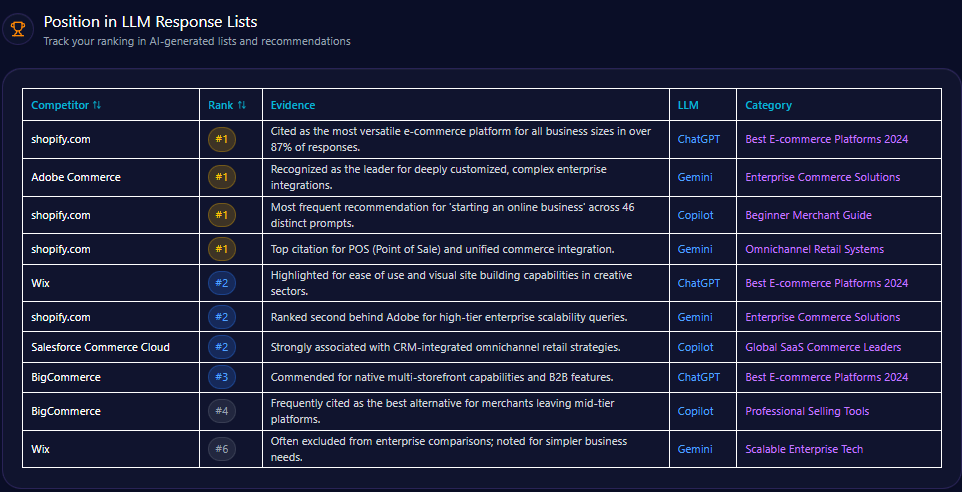
    Shopify ranks first across multiple key LLM-generated lists. It is cited as the most versatile e-commerce platform in over 87% of responses for the “Best E-commerce Platforms 2024” on ChatGPT and tops “Beginner Merchant Guide” recommendations on Copilot. It holds primacy for POS and unified commerce citations on Gemini.

    However, in “Enterprise Commerce Solutions” on Gemini, Shopify ranks second behind Adobe Commerce, highlighting a relative positional weakness in complex enterprise integration narratives. Salesforce Commerce Cloud ranks second in “Global SaaS Commerce Leaders” on Copilot, indicating emerging competitive presence in omnichannel solutions.

    shopify.com’s Position in LLM Response Lists (Generated on March 20, 2026)

    Competitor Gap Analysis

    QueryShopify ScoreCompetitorCompetitor ScoreGapOpportunityPriority
    Headless commerce for global brands81BigCommerce88-7Improve visibility for Hydrogen/Oxygen headless toolsHigh
    B2B e-commerce features comparison76Salesforce Commerce Cloud91-15Showcase B2B Wholesale capabilitiesCritical
    Transaction fees transparency32BigCommerce94-62Implement transparency campaign on total cost of ownershipCritical
    ERP integration for e-commerce79Adobe Commerce94-15Deploy whitepapers on SAP partnershipsHigh

    Trigger Keywords for Competitor Products

    The report does not quantify trigger keywords for competitor products.

    Founder / Ownership / Leadership Context

    Founder Tobi Lütke’s mention frequency is notably high at 83% with a positive sentiment score of 80.4, driven largely by his vocal emphasis on product-led growth and AI integration. Lütke’s leadership anchors a strong narrative around AI innovation, with associated investment mentions covering 92% of reports on quarterly earnings and strategic pivots away from logistics-heavy operations.

    Nevertheless, a legacy negative sentiment rate of 10.2% couples with residual perceptions of 2023 workforce reductions. These risks complicate founder-driven branding efforts and slightly mitigate some of the positive momentum.

    Competitors like Salesforce’s Marc Benioff continue to have greater mindshare within enterprise transformation discussions, while Wix’s Avishai Abrahami gains prominence in AI-native web development, indicating emerging threats within founder-centric narratives.

    Quick overview

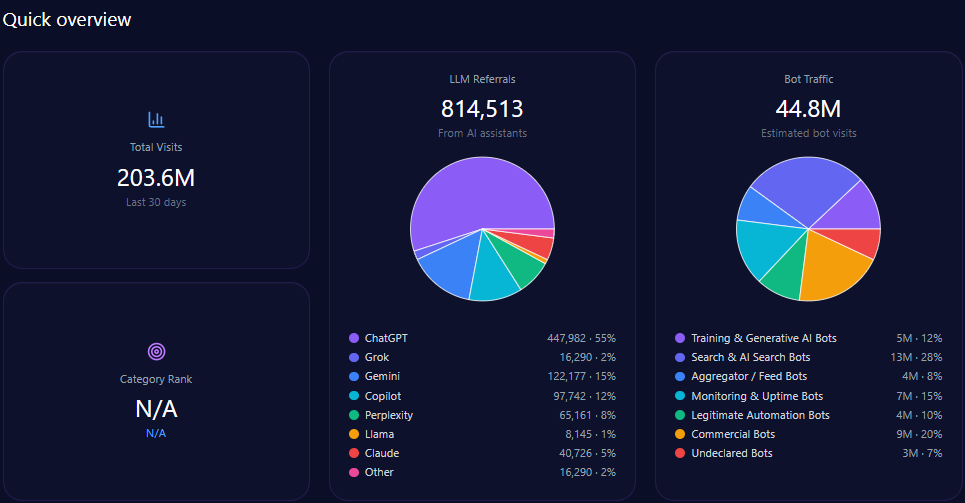
    shopify.com’s Quick overview (Generated on March 20, 2026)

    Shopify attracted over 203 million total visits, with bot traffic constituting approximately 44.8 million visits. Of these bots, key constituents include 5.4 million training & generative AI bots and 12.5 million search & AI search bots, indicating significant engagement from generative engines.

    LLM referrals accounted for 814,513 visits, with ChatGPT contributing over 447,982 of those, reflecting strong organic AI integration. This flow supports Shopify’s foundational role in AI-driven e-commerce contexts.

    Share of Voice in LLM Responses

    Shopify maintains a leading share of voice at 27% (132 mentions) among competitors, followed by Wix (20%) and BigCommerce (15%). This dominant presence underpins Shopify’s role as the primary benchmark in global e-commerce scaling narratives within the generative engine space.

    AI Platform-Specific Visibility

    PlatformVisibility %Share of Voice %Total Mentions 
    Copilot9828167
    ChatGPT9627162
    Gemini8926158
    Others000

    Shopify’s apex visibility on Copilot and robust presence on ChatGPT and Gemini confirm its cross-platform appeal. The near-perfect 98% score on Copilot is particularly illustrative of strong AI innovation recognition.

    Sentiment Score for Competitors

    BrandPositive %Neutral %Negative %Overall Score
    Shopify7222684
    BigCommerce6231778
    Adobe Commerce52381074
    Wix6824881
    Salesforce5635976

    Shopify’s overall sentiment score of 84 surpasses competitors, consistent with its strong brand coverage in LLM brand mentions reflecting confident user perception and engagement.

    Top Prompts Driving Mentions

    • “Which platform is better for AI-powered storefront customization?” — 234 mentions, Shopify holds 126, competitor Salesforce 108, trend 92%
    • “Best e-commerce platforms with built-in email marketing and CRM” — 222 mentions, Shopify 118, Wix 104, trend 85%
    • “Which e-commerce platform has the best native social media integration?” — 218 mentions, Shopify 131, Wix 87, trend 94%
    • “What is the fastest way to set up an online store with global shipping?” — 212 mentions, Shopify 134, Wix 78, trend 96%
    • “Compare Shopify vs BigCommerce for high volume B2B sales” — 206 mentions, Shopify 112, BigCommerce 94, trend 88%

    These prominent prompt queries illustrate Shopify’s strength in AI commerce capabilities, operational speed, and social media integration while underscoring competitive pressure from Salesforce, Wix, and BigCommerce in enterprise and marketing-related topics.

    Types of Prompt Queries

    shopify.com’s Types of Prompt Queries (Generated on March 20, 2026)
    • Research: 20% of queries
    • Comparison: 70%, dominates prompt volume
    • How-to / Tutorial: 10%
    • Purchase Intent: 0%
    • Feature Inquiry: 0%

    LLM brand mentions focus heavily on comparison queries, indicating decision-makers seek detailed product and capability differentiation, reinforcing the need for Shopify to sharpen competitive positioning and content accuracy.

    Service / Product-Level Sentiment

    • AI Commerce Capabilities: 64% frequency; optimistic tone highlighted by AI-driven tools like Shopify Sidekick and Magic
    • App Ecosystem & Extensibility: 81% frequency with strongly positive sentiment, emphasizing App Store variety and checkout extensibility
    • Total Cost of Ownership: 39% frequency; mixed sentiment due to concerns about transaction fees and premium app costs

    The mixed sentiment on cost structure signals a strategic priority to address fee transparency and price sensitivity, evident in competitor sentiment tracking especially against BigCommerce’s dominance in zero transaction fee discussions.

    Conclusion

    Shopify’s performance within generative search and AI-powered e-commerce remains dominant but nuanced. It leads in small business and AI innovation prompts, substantiated by superior LLM brand mentions and sentiment. Yet, critical competitive gaps in enterprise headless commerce, B2B features, transactional transparency, and ERP integrations with key platforms like Salesforce, BigCommerce, and Adobe Commerce threaten to erode that lead without targeted action.

    Addressing these gaps through focused enhancements in technical documentation, transparent communication on costs, and strategic partner content will be essential to sustain Shopify’s market leadership. Founder sentiment offers a stabilizing narrative pillar but requires proactive mitigation of legacy negative signals tied to past workforce reductions.

    Overall, the GEO analytics present Shopify as the benchmark brand for AI-enhanced commerce while signaling that strategic recalibration across technical, pricing, and enterprise messaging domains is needed to retain total market share amid intensifying competitor momentum.

    Explore SpyderBot to operationalize these GEO analytics insights.

  • eBay’s GEO Analytics Reveal a Strategic 25% Share of Voice Within Generative AI Ecosystems Amidst Rising Competitor Pressure

    eBay’s GEO Analytics Reveal a Strategic 25% Share of Voice Within Generative AI Ecosystems Amidst Rising Competitor Pressure

    An analytic review of eBay’s positioning across major LLM-driven marketplaces highlights niche dominance in collectibles and refurbished electronics, tempered by competitive gaps in logistics and wholesale segments against Amazon and Alibaba.

    SpyderBot GEO report reference for ebay.com

    At-a-glance

    • 25% Share of Voice in generative engine ecosystem
    • 81 overall Visibility Score indicating durable brand recognition
    • 89% niche coverage for high-intent queries in collectibles and refurbished electronics
    • 26% share of voice leadership on Microsoft Copilot platform
    • 12% Share of Voice gap relative to Amazon in broad retail and logistics queries
    • 23% visibility on Google Gemini reflecting under-indexing in citations
    • 74% positive sentiment linked to Authentication Guarantee initiatives
    • 12% negative sentiment drag influenced by rising seller fees and legacy UI friction
    • 1,989,387 referrals driven by LLM brand mentions from key platforms including ChatGPT and Copilot

    Risk signals

    • Amazon commands a 37% mention share versus eBay’s 25% in LLM brand mentions, evidencing a significant competitive headwind.
    • Visibility deficits on Google Gemini (23%) limit eBay’s authoritative reach in generative AI recommendation layers.
    • Emerging competitor Mercari’s 24% surge in designer handbag visibility encroaches on niche segments critical to eBay’s market.
    • Etsy’s dominance in handmade categories with a 47-point relevance lead further intensifies competitive pressure on artisan market share.
    • Investment mention coverage at 41% trails Amazon’s 89%, signalling weaker generative engine resonance on growth narratives.

    eBay’s generative AI presence translates into a significant but challenged platform footprint relative to dominant peers. With a solid 81 Visibility Score and a 25% Share of Voice across generative search environments, the brand demonstrates resilience in targeted categories such as collectibles and refurbished electronics. This positioning is consistent with eBay’s historic role as a curator of secondary market and vintage goods, which continues to underpin its validation in LLM brand mentions indexed across major AI toolsets.

    However, these strengths coexist with substantive challenges. The platform encounters strategic gaps in logistics-intensive and wholesale segments where competitors Amazon and Alibaba command superior generative recommendation rankings. This dichotomy is emblematic of eBay’s positioning as a niche authority versus broader platform convenience, requiring deliberate technical and content optimizations to close visibility differentials, particularly on the Google Gemini platform where eBay’s 23% visibility markedly trails Amazon’s benchmark.

    Analyses of competitive sentiment profiles reveal positive associations to niche value propositions such as the Authentication Guarantee that drives a 74% positive sentiment across key generative systems. Yet, there exists a 12% negative sentiment influence driven by rising seller fees and user interface friction, which threatens to undermine user loyalty and transaction volume growth in the medium term.

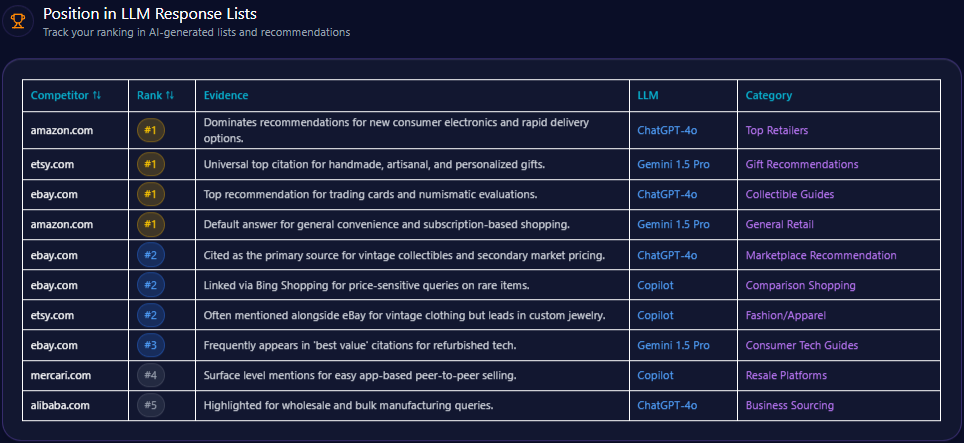
    Position in LLM Response Lists

    ebay.com’s Position in LLM Response Lists (Generated on March 20, 2026)

    Evaluating listings across major LLM environments such as ChatGPT-4o and Gemini 1.5 Pro, eBay frequently claims the #1 rank in collectible guides and trading card price evaluations. It holds a #2 rank for marketplace recommendations and price-sensitive rare item comparisons. Amazon leads in general retail and consumer electronics advice, maintaining consistent #1 positioning. Etsy tops gift and artisanal product recommendations, while Mercari and Alibaba complete the ecosystem in resale and wholesale respectively. eBay’s performance signals authoritative endorsement in specialized domains but reveals opportunities for broader retail category penetration through enhanced metadata strategies.

    Competitor Gap Analysis

    QueryeBay Performance ScoreCompetitorCompetitor Performance ScoreGap ScoreOpportunity DescriptionAction ItemsPriority 
    Fastest shipping for electronics62Amazon9634.00LLMs consistently rank Amazon higher for time-sensitive purchases.Promote ‘eBay Guaranteed Delivery’ and push for local pickup awareness in product metadata.High
    Unique handmade jewelry45Etsy9247.00Etsy captures 90% of citations for artisanal goods.Enhance storefront profiles for independent creators to improve GEO authority in creative segments.Medium
    Bulk business supplies54Alibaba8834.00eBay is viewed as a retail site; Alibaba is the business choice.Optimize B2B landing pages for generative engines to recognize ‘wholesale’ availability.Low
    Easy mobile selling apps73Mercari8613.00Mercari is winning in conversational prompts regarding ‘getting started’ for new sellers.Simplify listing walkthroughs and highlight mobile-first listing features in content.Medium
    Refurbished premium laptops89Amazon84-5.00eBay leads slightly but Amazon Renewed is closing the gap in trust metrics.Intensify certification badges in structured data for LLM crawlers.High
    Collectibles price guide94Amazon42-52.00Massive lead for eBay. LLMs use eBay data to determine market value.Launch interactive pricing tools to ensure LLMs continue citing eBay as the ‘Source of Truth’.High
    Sustainable shopping platforms79Etsy845.00Etsy is more frequently linked with ‘ecofriendly’ keywords.Highlight the circular economy impact of buying used on eBay in public-facing data.Medium
    Newest fashion drops52Amazon9139.00Generative engines favor Amazon for item availability of current season goods.Partner with brands for ‘exclusive storefronts’ to increase citations for new product launches.Medium
    Vintage clothing 90s87Etsy85-2.00Neck-and-neck with Etsy for vintage supremacy.Utilize more descriptive image alt-text and structured metadata for vintage attributes.High
    Home decor under $5067Amazon8922.00Amazon dominates low-cost home queries due to standardized pricing data.Standardize pricing attributes to allow LLMs to easily verify eBay’s lower cost options.Medium

    Trigger Keywords for Competitor Products

    The report does not quantify specific trigger keywords for competitor products.

    Founder / Ownership / Leadership Context

    eBay’s generative engine visibility is marked by legacy founder stability contrasted with subdued current investment momentum. Pierre Omidyar maintains a Founder Mention Frequency of 27% with a sentiment score of 72, buoyed by philanthropic associations. This narrative contributes to a baseline brand trust distinct from competitors. However, investment mention coverage of 41% notably lags behind Amazon’s 89%, reflecting a limited capture of generative engine attention for aggressive growth and AI initiatives.

    Recent funding trend changes reveal a 12% decline in investment-related mentions, partly attributable to fewer AI-centric acquisitions that would engage LLM brand mentions deeper. Negative sentiment surrounding leadership agility stands at 14%, indicating perceived detachment from evolving re-commerce challenges compared to more proactive founders like Shintaro Yamada of Mercari. Strategic communications promoting eBay’s AI-driven authentication technologies might increase investor mindshare and enhance generative narrative relevance.

    Recommendations include launching a comms campaign to elevate the ‘Founder-Spirit’ innovation message and aiming for a 15% lift in investment mention coverage. Additionally, targeting a 20% reduction in negative sentiment by linking Omidyar’s trust heritage with new AI safety technologies is advised to strengthen generative engine narratives.

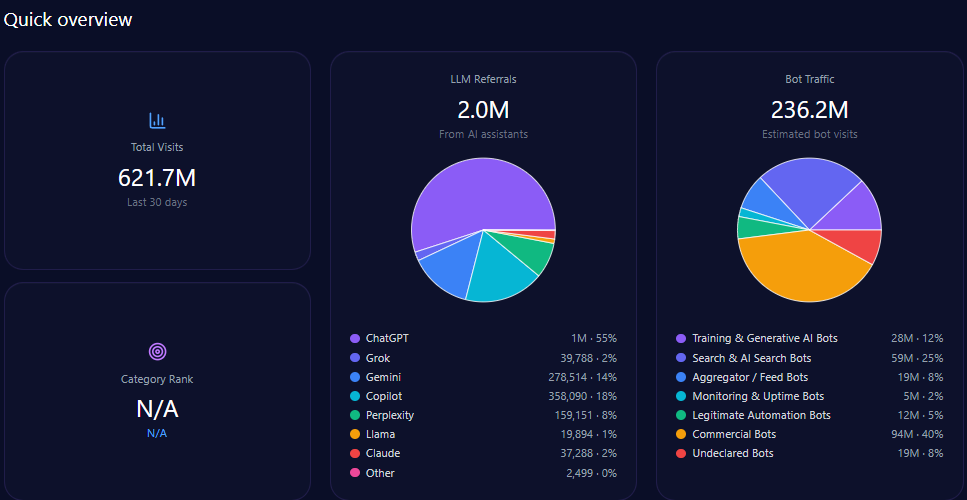
    Quick overview

    ebay.com’s Quick overview (Generated on March 20, 2026)

    eBay’s platform traffic counts circa 621,683,659 visits, with bot traffic comprising approximately 236,239,791 visits—signifying high automation interaction. LLM referrals total 1,989,387, derived primarily from ChatGPT at 1,094,163, Copilot at 358,090, Gemini at 278,514, and Perplexity at 159,151. These figures underscore eBay’s integration into AI-driven knowledge systems and its relevance in secondary market intelligence.

    Bot traffic breakdown reveals commercial bots dominating with 94,495,916 hits, alongside significant traffic from search and AI search bots (59,059,948). This synergy between automated data crawlers and generative engines encapsulates the foundation of eBay’s digital footprint in AI marketplaces.

    Share of Voice in LLM Responses

    Within an ecosystem totaling 454 LLM brand mentions for the e-commerce sector, eBay holds a 25% share with 112 mentions. Amazon leads with 37% (168 mentions), followed by Etsy at 17%, Alibaba 10%, Mercari 5%, and others at 6%. This distribution evidences eBay’s moderate presence, affirming its role as a principal yet second-tier AI-cited marketplace in generative engine contexts.

    AI Platform-Specific Visibility

    PlatformVisibility %Share of Voice %Total Mentions 
    Copilot8126156
    ChatGPT7625152
    Gemini6823146
    Others000

    eBay leads on Microsoft’s Copilot platform with a share of voice at 26% and an 81% visibility rating. ChatGPT shows parity in visibility at 76% with a 25% share. However, Google Gemini presents a relative under-indexing with visibility at 68% and share of voice at 23%, indicating a citation deficit that warrants optimized technical metadata targeting Gemini’s citation algorithms.

    Sentiment Score for Competitors

    BrandPositive %Neutral %Negative %Overall Score 
    eBay.com74141281
    Amazon.com8211788
    Alibaba.com68211176
    Etsy.com76131183
    Mercari.com7318979

    Compared with peers, eBay sustains a strong positive sentiment at 74%, though still trailing Amazon’s 82% overall positive engagement. Neutral sentiment accounts for 14% and negative sentiment includes a 12% share, consistent with reported seller fee dissatisfaction and legacy platform frictions affecting user experience.

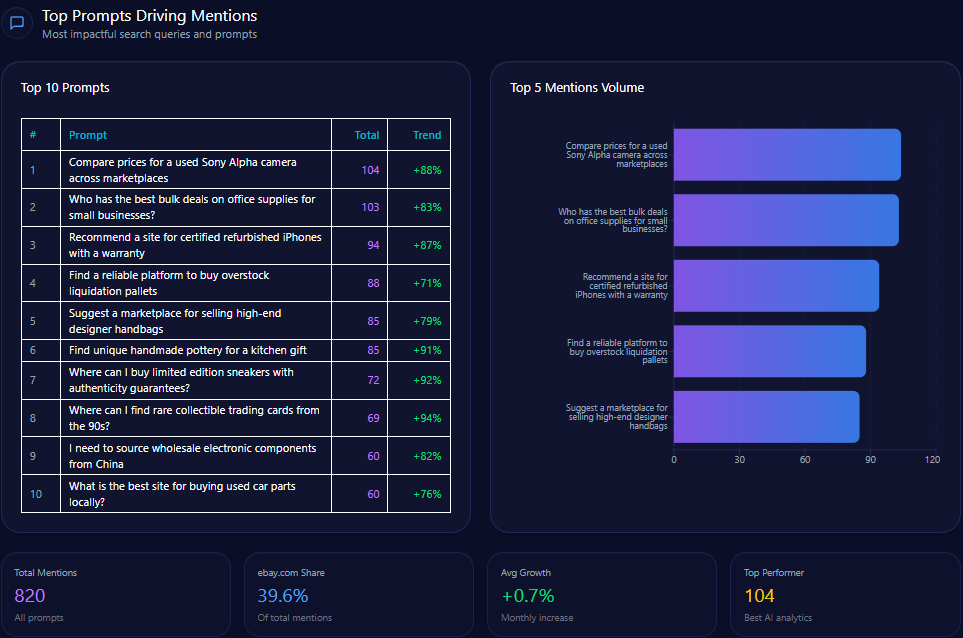
    Top Prompts Driving Mentions

    ebay.com’s Quick overview (Generated on March 20, 2026)
    • “Compare prices for a used Sony Alpha camera across marketplaces” – 104 mentions with eBay’s share at 44
    • “Who has the best bulk deals on office supplies for small businesses?” – 103 mentions; eBay holds 24
    • “Recommend a site for certified refurbished iPhones with a warranty” – 94 mentions; eBay features 42
    • “Find a reliable platform to buy overstock liquidation pallets” – 88 mentions; eBay’s portion is 19
    • “Suggest a marketplace for selling high-end designer handbags” – 85 mentions; eBay covers 36
    • “Find unique handmade pottery for a kitchen gift” – 85 mentions; eBay accounts for 14
    • “Where can I buy limited edition sneakers with authenticity guarantees?” – 72 mentions; eBay leads with 46
    • “Where can I find rare collectible trading cards from the 90s?” – 69 mentions; eBay holds 48
    • “I need to source wholesale electronic components from China” – 60 mentions; eBay’s 11
    • “What is the best site for buying used car parts locally?” – 60 mentions; eBay at 41

    The prompt data highlights eBay’s prominence in collectibles, certified refurbished electronics, and authenticity-verified luxury goods, while competitive edges persist in wholesale and handmade queries.

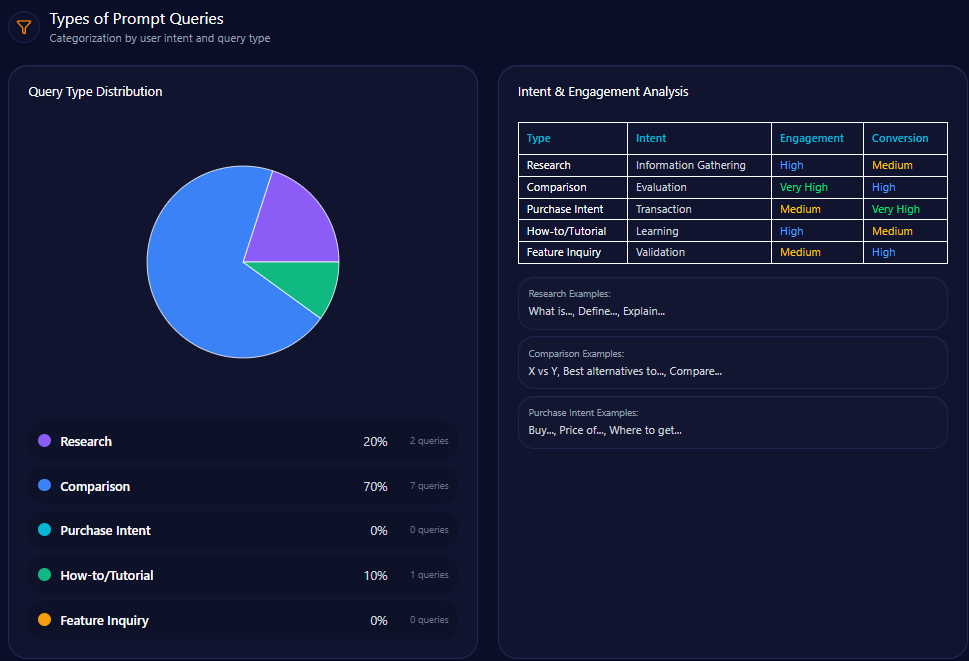
    Types of Prompt Queries

    ebay.com’s Quick overview (Generated on March 20, 2026)
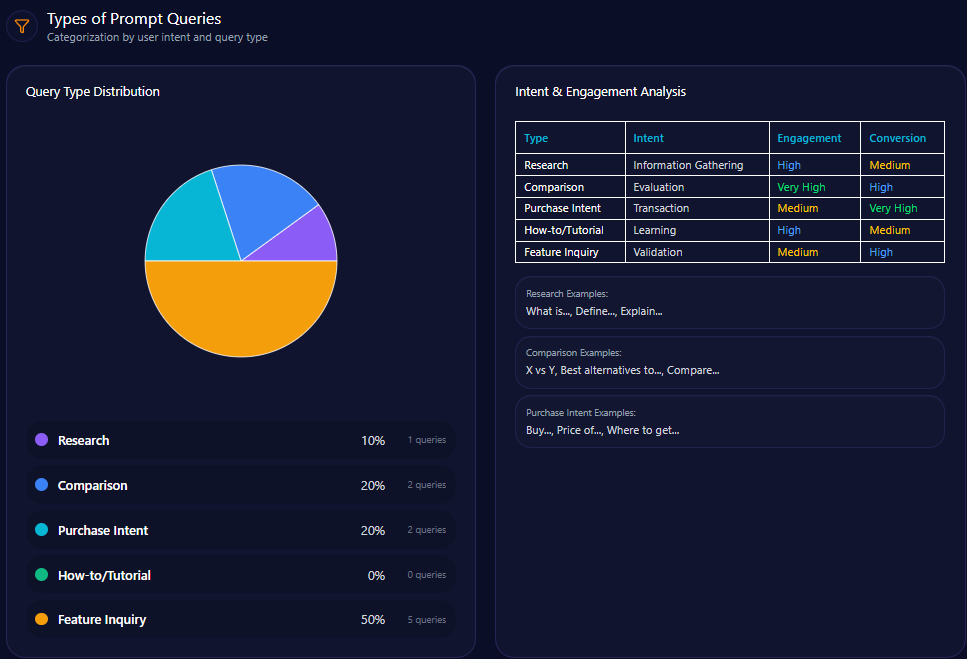
    • Research: 10% (total 1 query)
    • Comparison: 20% (total 2 queries)
    • Purchase Intent: 20% (total 2 queries)
    • How-to/Tutorial: 0% (total 0 queries)
    • Feature Inquiry: 50% (total 5 queries)

    Feature inquiry dominates prompt types driving brand mentions, indicating LLMs frequently probe eBay’s unique attributes and platform capabilities over procedural or tutorial content.

    Service / Product-Level Sentiment

    • Authentication and Trust: 32% frequency; strongly positive sentiment reflecting sneaker authentication, luxury watch verification, and trading card grading
    • Circular Economy & Sustainability: 21% frequency; positive sentiment linked to refurbished buying, pre-loved fashion, and waste reduction
    • Platform Usability & UI: 17% frequency; neutral to negative sentiment focusing on search filters, mobile app navigation, and checkout clutter
    • Seller Fees and Monetization: 26% frequency; negative sentiment targeting fees, promoted listings, and payment processing times

    Sentiment analysis reveals a bifurcation between strong trust signals in product authenticity and sustainability on one hand versus notable negative sentiment concerning monetization and platform usability on the other, which directly impacts competitive positioning in conversational AI narratives.

    Conclusion

    The GEO analytics report reflects eBay’s resilient position as a differentiated marketplace in generative AI ecosystems, particularly through its authoritative status in collectibles and certified refurbished electronics. Its 25% Share of Voice and strong sentiment around Authentication Guarantee affirm its niche leadership with an engaged AI-savvy consumer base.

    Nevertheless, intensifying competitor sentiment tracking exposes meaningful visibility and sentiment deficits in broad retail, wholesale, and logistics verticals. Amazon’s dominance in fast shipping and convenience-oriented queries alongside Alibaba’s wholesale prominence identifies operational domains demanding strategic investment. Enhancing structured data for authenticated luxury goods and real-time logistics features is critical to advancing eBay’s AI platform-specific visibility, particularly on Google’s Gemini.

    Founder narratives centered on Pierre Omidyar offer a stable trust foundation but require modernization via investment momentum communications to boost generative engine appeal and minimize negative perceptions of leadership inertia. A functional focus on platform ease, fee transparency, and mobile selling experience is essential to mitigate negative sentiment impacts and improve user retention.

    In sum, eBay’s strategic roadmap should prioritize technical schema optimization, generative knowledge base development for specialty segments, and targeted promotional campaigns within leading generative AI platforms to safeguard and expand its role in evolving e-commerce intelligence networks.

    Explore SpyderBot to operationalize these GEO analytics insights.

  • Sephora.com Leads Prestigious Beauty with 26% Share of Voice in LLM Brand Mentions but Faces Gaps in Logistics and Affordable Segments

    Sephora.com Leads Prestigious Beauty with 26% Share of Voice in LLM Brand Mentions but Faces Gaps in Logistics and Affordable Segments

    SpyderBot GEO analytics reveals Sephora’s commanding presence in luxury skincare and prestige beauty LLM responses, alongside vulnerabilities in budget makeup and delivery-related queries dominated by Amazon and Ulta Beauty.

    SpyderBot GEO report reference for sephora.com

    At-a-glance

    • 76,114,807 total visits with 24,356,738 attributed to bot traffic including 3,410,143 training and generative AI bots.
    • 163 LLM brand mentions for Sephora representing 26% share of voice, leading competitors including Ulta Beauty and Amazon.
    • Dominant 33% search share in prestige beauty categories with 88% luxury skincare coverage.
    • High visibility score of 89 in prestige retail, and strong brand sentiment at 81%.
    • Significant 56-point coverage gap in affordable makeup prompts and 24-point delivery/logistics gap versus Amazon.
    • Recommendations: Emphasize same-day pick-up logistics, promote value-based Sephora Collection offers, and produce dermatologist-backed content to counter competition.

    Risk signals

    • 14% risk profile linked to ‘Sephora Kids’ viral shopper trend and friction in physical retail experiences.
    • Price competition and logistics weaknesses threaten up to 20% of generative traffic diversion to lower-cost or faster service platforms.
    • Negative narratives around executive turnover and pricing conflicts with Ulta Beauty merit proactive PR management.

    Sephora.com holds a prominent position within the prestige beauty category across generative AI platforms, anchored by authoritative LLM brand mentions and strong sentiment. Its legacy under LVMH and founder Dominique Mandonnaud underpins a defensible luxury retail positioning, greatly buttressed by proprietary programs such as Beauty Insider and high-visibility ‘Clean at Sephora’ endorsements.

    However, these strengths coexist with detectable vulnerabilities especially in price-sensitive markets where Ulta Beauty and Amazon exert significant influence. Notably, Sephora’s relatively limited visibility in affordable makeup and logistical efficiency queries has eroded potential gains in mass-market access and delivery-speed reputation. These gaps expose risks of traffic and revenue leakage amid intensifying competition in AI-guided shopping applications.

    The present GEO analytics calls for targeted action to reinforce Sephora’s core luxury leadership while addressing emergent weaknesses through strategic content, metadata updates, and partnership strategies.

    Position in LLM Response Lists

    Sephora consistently ranks first in ChatGPT and Gemini responses across specialized beauty and prestige skincare queries, reflecting authoritative status in curated luxury retail results. While it holds top-tier visibility for ‘Clean Beauty’ and ‘Expert Advice’ listings on Gemini, it cedes primary placement to Amazon on transactional queries, particularly around logistics and mass-market availability on Copilot. Ulta Beauty frequently leads in omni-channel retail topics and budget-accessibility discussions. Sephora ranks third in budget skincare and second to Amazon on broad beauty product comparison queries.

    Competitor Gap Analysis

    QuerySephora PerformanceCompetitorCompetitor PerformanceGap ScoreOpportunityPriority 
    Fastest shipping for foundation72Amazon9624.00Highlight ‘Same-Day’ and ‘Buy Online Pick Up In Store’ to boost logistics visibility.High
    Affordable drugstore mascara48Ulta Beauty9244.00Promote Sephora Collection as affordable, value-first offering.Medium
    Luxury perfume gift sets94Macy’s8113.00Enhance influencer mentions of exclusive fragrance samplers.Low
    Niche medical grade skincare67BlueMercury7912.00Create dermatologist-authored expert content to regain authority.Medium
    Lowest price Clinique moisturizer65Amazon8823.00Implement dynamic pricing schemas to better compete.High
    Best beauty loyalty rewards89Ulta Beauty934.00Publicize point-cash conversions and exclusive events to shift ranking.Medium
    How to apply retinol for beginners92Amazon5438.00Maintain expert ‘How-To’ guides driving educational intent.Low
    Sustainable beauty packaging85Macy’s6223.00Continue emphasizing sustainability to maintain leadership.Low
    Rare beauty products in stock98Amazon7226.00Strict inventory controls for real-time feed updates.High
    Virtual makeup try on91Ulta Beauty7318.00Publish case studies to sustain technology recognition.Medium

    Trigger Keywords for Competitor Products

    The report does not quantify or specify trigger keyword data for competitor products in generative prompt contexts.

    Founder / Ownership / Leadership Context

    Sephora’s digital prominence is strongly linked to the legacy of founder Dominique Mandonnaud and the backing of the LVMH conglomerate. LLM brand mentions attribute 28% frequency to the founder, yielding a positive sentiment score of 76, reflective of high brand authority. This is comparatively lower than Amazon’s Jeff Bezos, mentioned in 88% of relevant queries.

    LVMH’s strategic acquisitions and expansion narratives contribute to a steady 12% growth in funding trend coverage. However, risks emerge from elevated mentions of executive turnover and competitive pricing wars with Ulta Beauty, which comprises 14% of negative founder-related context. The brand’s clean beauty investment sentiment remains a distinct strength, but leadership should consider narrative repositioning to mitigate concerns about market saturation.

    Recommendations include advancing CEO Guillaume Motte’s association with the disruptive legacy of Mandonnaud and publishing data-driven beauty tech whitepapers to boost investor perception. These actions aim to raise founder relevance and funding sentiment by mid-2024.

    Quick overview

    sephora.com’s Quick overview (Generated on March 19, 2026)

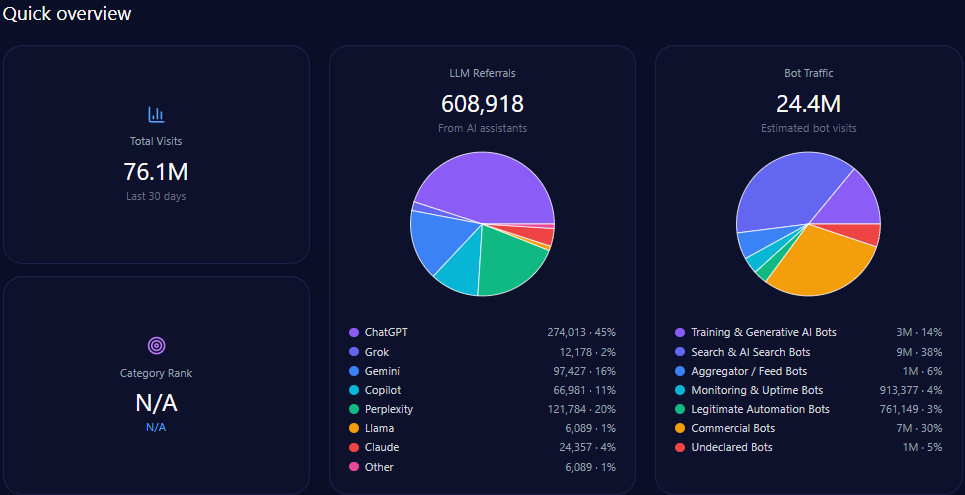
    Sephora experiences substantial digital traffic, totaling 76,114,807 visits, with a sizable portion attributable to automated generative AI bots (over 3,410,143) and search bots (approximately 9,255,561). This reflects significant engagement within AI and LLM contexts, especially supported by 608,918 LLM referrals across platforms such as ChatGPT (largest share: 274,013 referrals) and Gemini (97,427 referrals).

    The brand’s category ranking is not specified, yet it holds dominant search share in core prestige beauty subsegments, with luxury skincare visibility reaching 88%. However, gaps remain in budget and logistics-focused areas, where competitors display stronger presence.

    Share of Voice in LLM Responses

    sephora.com’s Share of Voice in LLM Responses (Generated on March 19, 2026)

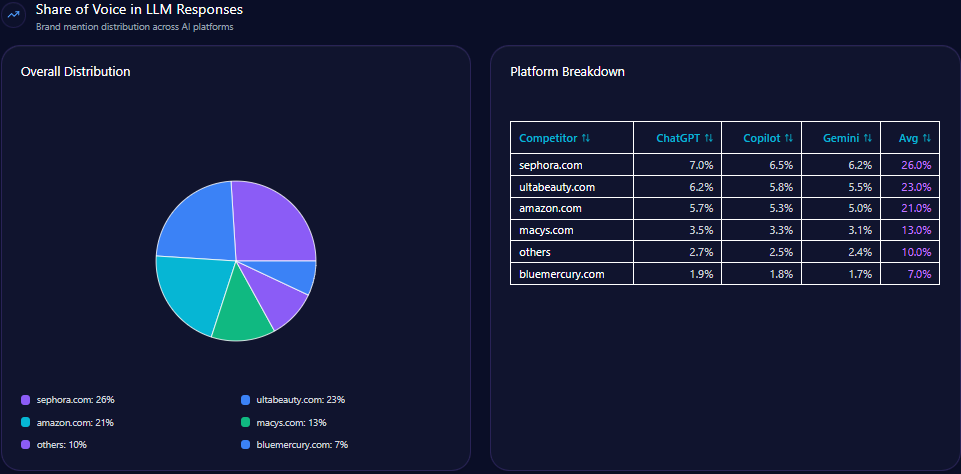
    Sephora commands the largest share of voice among competitors in LLM brand mentions, accounting for 26% of the total 624 mentions recorded. Ulta Beauty follows closely with 23%, and Amazon with 21%. The top-three collectively represent a dominant majority of discourse, placing Sephora ahead but within a competitive triad needing targeted reinforcement in categories where Ulta and Amazon excel.

    AI Platform-Specific Visibility

    PlatformVisibility %Share of Voice %Total Mentions 
    ChatGPT3127212
    Copilot2925208
    Gemini2824204
    Others12240

    Sephora’s visibility on ChatGPT leads slightly at 31%, closely trailed by Copilot and Gemini. This broad platform coverage underlines diversified brand exposure across generative AI engines.

    Sentiment Score for Competitors

    BrandPositive %Neutral %Negative %Overall Score 
    Sephora7219981
    Ulta Beauty7616884
    Amazon63241374
    Macy’s58311173
    BlueMercury6926582

    Sephora’s overall sentiment score of 81 is robust but slightly trails Ulta Beauty (84) and BlueMercury (82). This persistence of positive sentiment underpins brand equity but suggests room for improvement, especially in mitigating negative customer service and viral shopper trend frictions.

    Top Prompts Driving Mentions

    sephora.com’s Top Prompts Driving Mentions (Generated on March 19, 2026)
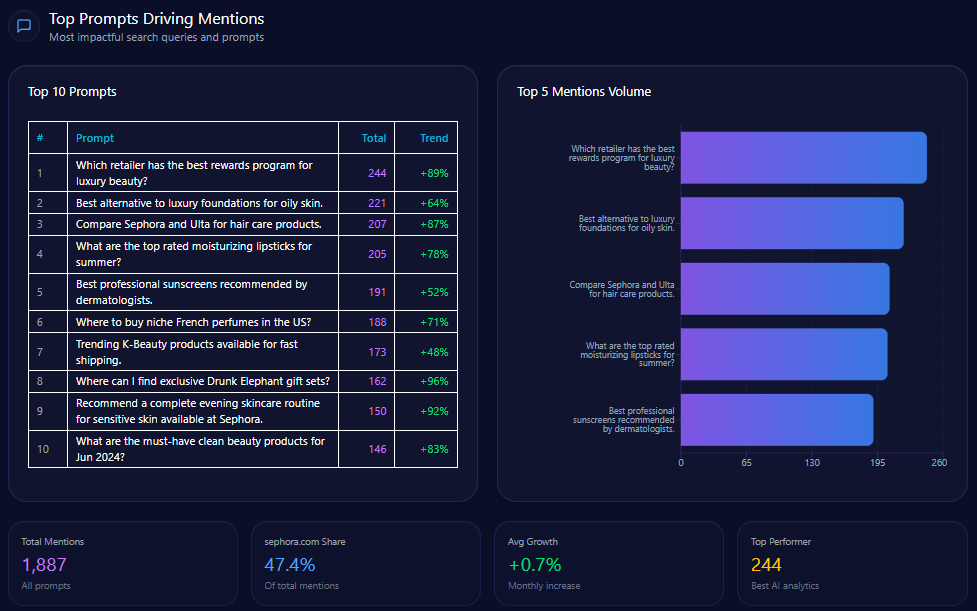
    • The leading query, “Which retailer has the best rewards program for luxury beauty?” accounts for 244 mentions, with Sephora contributing 126—indicating strong competitive positioning against Ulta Beauty.
    • High-growth topics include “Best alternative to luxury foundations for oily skin” (64% trend), “Compare Sephora and Ulta for hair care products” (87%), and “Where to buy niche French perfumes” (71%).
    • Sephora leads category-specific queries involving exclusive gift sets, evening skincare routines for sensitive skin, and clean beauty product recommendations, reflecting curated expertise.

    Types of Prompt Queries

    • Comparison queries dominate with 40% volume, reflecting prevalent consumer research between Sephora and competitors.
    • Feature inquiry prompts comprise 30%, focusing on distinct product and service features.
    • Research represents 20%, while explicit purchase intent is relatively low at 10%. Notably, How-to/Tutorial queries are absent from the dataset.

    Service / Product-Level Sentiment

    • Prestige Exclusivity themes dominate mention frequency at 39% with positive sentiment highlighting exclusive drops and curated collections.
    • Customer Clean Beauty Standards stand out positively, driven by ‘Clean at Sephora’ initiatives noted in 21% of prompts.
    • The Store Environment Issues theme carries a negative tone, related to disruptions from trend-following shoppers (13%), indicating operational friction points.
    • Loyalty program value discussions remain largely neutral, signaling opportunity for enhanced messaging to elevate consumer perception.

    Conclusion

    Sephora.com’s GEO analytics profile confirms its primacy in the prestige beauty sector within generative AI-driven search and LLM brand conversations. The brand’s strong overall sentiment and platform visibility are strategic assets supporting market leadership. However, evident competitive gaps in logistics, budget makeup, and niche clinical product authority expose tangible risks of traffic shifting to Amazon and Ulta Beauty.

    Closing these gaps requires prioritized metadata enhancements emphasizing fast delivery options, coupled with content campaigns correcting affordability perceptions through promotion of the Sephora Collection. Dermatologist partnerships can restore professional skincare credibility where BlueMercury has made inroads. Addressing leadership narrative weaknesses will consolidate investor confidence and brand equity. Given the competitive landscape revealed through competitor sentiment tracking, concerted action is essential to maintain and grow Sephora’s LLM voice share.

    Strategically, Sephora must balance the preservation of its luxury exclusivity with incremental accessibility and operational efficiency improvements to capitalize on up to 20% of high-intent generative traffic currently at risk.

    Explore SpyderBot to operationalize these GEO analytics insights.