A Step-by-Step System to Improve AI Visibility
Most companies do not fail because they misunderstand GEO.
They fail because they do not know how to implement it.
They understand the trend.
They know users are asking ChatGPT, Gemini, Claude, Perplexity, Copilot, Grok, and Google AI Overviews for answers.
They know competitors are being mentioned in AI-generated responses.
They know traditional SEO alone no longer explains the full visibility picture.
But when it is time to act, they get stuck.
Should they write more content?
Should they optimize existing pages?
Should they build backlinks?
Should they create comparison pages?
Should they track ChatGPT mentions?
Should they improve brand positioning?
Should they focus on third-party sources?
The answer is not one tactic.
The answer is a system.
That is the real meaning of GEO implementation.
Generative Engine Optimization, or GEO, is not just “SEO for AI.” It is the process of improving how AI systems understand, select, mention, cite, and represent your brand in generated answers.
The original GEO research paper introduced Generative Engine Optimization as a framework for improving visibility in generative engine responses and reported visibility improvements of up to 40% in tested settings.
That means GEO is not just theory.
It is becoming an operational layer for modern visibility.
The companies that win will not only be the ones that understand GEO.
They will be the ones that operationalize it.
I. What GEO Implementation Actually Means
Implementing GEO does not mean publishing more blog posts without direction.
It does not mean stuffing pages with AI keywords.
It does not mean replacing SEO.
It does not mean trying to trick ChatGPT into mentioning your brand.
A better definition is this:
GEO implementation is the process of building a repeatable system that improves how generative AI systems select and represent your brand.
That system includes:
- Defining where your brand should appear
- Measuring where it currently appears
- Auditing why it is missing
- Prioritizing the most valuable gaps
- Improving entity, category, content, and authority signals
- Tracking whether AI visibility improves over time
The uploaded draft frames this correctly: GEO is not a single tactic, it is an operational system for improving how AI selects your brand.
That distinction matters.
A tactic can produce activity.
A system produces progress.
II. Why GEO Requires a Different Operating Model
Traditional SEO usually starts with keywords and rankings.
The workflow often looks like this:
Keyword research → content creation → technical optimization → backlinks → rankings → traffic
That model still matters for search engines.
But AI-generated answers work differently.
Google explains that AI Overviews provide AI-generated snapshots with links so users can explore more on the web.
Google’s Search Central documentation also explains how AI features such as AI Overviews and AI Mode work from a site owner’s perspective.
This shows that AI-powered search experiences are becoming part of the web discovery journey.
But in AI answers, the competition is not only page-level.
It is brand-level, entity-level, and context-level.
That means GEO needs a different operating model:
Measure → Analyze → Optimize → Re-test → Repeat
This is the core GEO loop.
Without measurement, you are guessing.
Without analysis, you are optimizing blindly.
Without prioritization, you waste effort.
Without iteration, improvements do not compound.
III. The GEO Implementation Framework
A practical GEO implementation system has six phases:
- Define visibility targets
- Map current AI visibility
- Run a GEO audit
- Prioritize optimization
- Execute signal improvements
- Measure and iterate
Let’s break each phase down.
Phase 1: Define Your Visibility Targets
The first question is not:
“What content should we create?”
The first question is:
Where do we need to appear?
AI visibility is prompt-driven.
Users do not always type short keywords. They ask full questions, make comparisons, request recommendations, and describe problems.
That means your GEO strategy should begin by mapping the prompts where your brand should be selected.
Target prompt types
Start with these prompt groups:
Category prompts
- “Best [category] tools”
- “Top [category] platforms”
- “Best software for [industry]”
- “Leading companies in [category]”
Competitor prompts
- “Best alternatives to [competitor]”
- “[Competitor] vs [your brand]”
- “Tools similar to [competitor]”
- “Which is better, [competitor] or [your brand]?”
Use-case prompts
- “Tools for [specific workflow]”
- “Best software for [specific business problem]”
- “Platforms for [team type]”
- “Solutions for [industry use case]”
Problem-based prompts
- “Why is my brand not showing in ChatGPT?”
- “How do I track AI brand mentions?”
- “How do I optimize for AI search?”
- “How do I know if AI recommends my competitor?”
Buying-intent prompts
- “Best [category] tool for startups”
- “Best [category] platform for enterprise”
- “Most trusted [category] software”
- “Affordable alternatives to [competitor]”
What to do
Build a prompt map.
Do not start with 500 prompts.
Start with 50 to 100 high-value prompts grouped by intent.
For each prompt, define:
- Business value
- Buyer intent
- Target audience
- Expected competitors
- Desired positioning
- Priority level
Output
At the end of this phase, you should have a visibility target map.
This map tells your team where AI visibility matters most.
Phase 2: Map Your Current AI Visibility
After defining target prompts, measure where your brand actually appears.
This is your baseline.
A baseline prevents guesswork.
Without it, your team may optimize pages that do not matter, target weak contexts, or chase low-value mentions.
What to measure
For each prompt, track:
- Does your brand appear?
- Which competitors appear?
- Is your brand mentioned first, later, or not at all?
- How is your brand described?
- Is the tone positive, neutral, or negative?
- Is your brand cited or only mentioned?
- Are you grouped with the right competitors?
- Does the answer change across AI systems?
You should test across multiple AI systems, not only ChatGPT.
Important systems may include:
- ChatGPT
- Gemini
- Claude
- Perplexity
- Copilot
- Grok
- Google AI Overviews
- Google AI Mode
OpenAI explains that ChatGPT Search can use web sources to provide timely answers with links, which makes brand visibility in these generated answers strategically important.
Output
At the end of this phase, you should have a baseline AI visibility report.
This report should show:
- Inclusion rate
- Mention share
- Competitor dominance
- Context coverage
- Positioning patterns
- Missing prompt groups
- Cross-model differences
This baseline becomes the reference point for all future GEO work.
Phase 3: Run a GEO Audit
The baseline tells you what is happening.
The GEO audit explains why it is happening.
This is the diagnosis phase.
Most companies skip this step and go straight to content production.
That is a mistake.
If your brand is missing from AI answers, the problem may not be content volume.
It may be weak entity clarity, poor category alignment, inconsistent descriptions, weak third-party validation, or competitor dominance.
What to audit
A serious GEO audit should inspect these areas:
1. Entity clarity
Can AI clearly understand your brand?
Check whether your website and public profiles explain:
- What your company is
- What your product does
- Who it serves
- What problem it solves
- What category it belongs to
- What makes it different
If this is unclear, your brand is harder to select.
2. Category alignment
Does AI know where your brand belongs?
A company may describe itself as an AI platform, SEO tool, analytics product, visibility tracker, marketing software, or intelligence layer.
If the category language is inconsistent, AI confidence drops.
3. Concept associations
Is your brand linked to the right topics?
For example, a GEO analytics brand should be associated with:
- AI visibility
- Generative Engine Optimization
- ChatGPT brand monitoring
- LLM brand mentions
- AI search analytics
- AI competitor tracking
- AI citation tracking
If these associations are weak, your brand may not appear in relevant prompts.
4. Context coverage
Where are you missing?
Check whether your brand appears in:
- Category prompts
- Use-case prompts
- Competitor prompts
- Alternative prompts
- Buying-intent prompts
- Industry-specific prompts
A brand that appears only in branded prompts has weak AI visibility.
5. Competitor dominance
Which competitors appear instead of you?
Identify:
- Who appears most often
- Who appears in high-intent prompts
- Who is framed as the leader
- Who is cited or referenced
- Who is grouped with your brand
- Who replaces your brand in alternatives prompts
6. Positioning strength
How does AI describe your brand?
AI-generated answers may frame your brand as:
- A leader
- A specialist
- An emerging tool
- A basic option
- A niche alternative
- A weak competitor
- An unclear product
A mention is not enough.
The framing matters.
Output
At the end of this phase, you should have a GEO audit report that identifies root causes.
Not just:
“We are missing from ChatGPT.”
But:
“We are missing from high-intent competitor prompts because our category positioning is unclear, our third-party references are weak, and competitors have stronger public association with the buyer problem.”
That is actionable.
Phase 4: Prioritize Optimization
Not all GEO gaps have equal value.
Some gaps are strategic.
Some are minor.
A brand missing from “best tools” prompts has a serious visibility problem.
A brand missing from a niche informational prompt may not need urgent attention.
This is why prioritization matters.
Prioritization criteria
Use four criteria:
1. Business impact
Does this prompt influence buyer decisions?
High-intent prompts should receive higher priority.
2. Visibility gap
Are you missing completely, or only weakly positioned?
A complete absence in a critical prompt is more urgent than a minor wording issue.
3. Competitive pressure
Are competitors dominating this context?
If competitors repeatedly appear where you should, the gap is strategic.
4. Fixability
Can the issue be improved with clear actions?
Some gaps require content updates.
Others require third-party validation, reviews, partnerships, or PR.
Priority examples
High priority
- Missing from “best [category] tools”
- Missing from “[competitor] alternatives”
- Weak or wrong category description
- Competitor dominates high-intent buying prompts
- AI misclassifies your brand
Medium priority
- Mentioned but poorly positioned
- Weak use-case visibility
- Missing from some comparison prompts
- Inconsistent descriptions across sources
Low priority
- Missing from low-intent informational prompts
- Minor wording issues
- Low-volume edge cases
- Prompts unrelated to business goals
Output
At the end of this phase, create a GEO roadmap.
Your roadmap should include:
- Priority issue
- Affected prompt group
- Root cause
- Recommended action
- Owner
- Timeline
- Success metric
This turns GEO from a vague idea into an execution plan.
Phase 5: Execute Optimization
This is where most companies fail.
They do too much, without direction.
They publish random content.
They update pages without measuring impact.
They chase backlinks without fixing positioning.
They add AI keywords without strengthening entity clarity.
Effective GEO execution focuses on the signals that influence selection.
1. Improve Entity Clarity
Start with your core brand definition.
Your website should make your identity obvious.
A clear entity statement should include:
- Brand name
- Category
- Main function
- Target audience
- Core use case
- Differentiator
Example:
“SpyderBot is a GEO analytics platform that helps brands track how they are mentioned, positioned, and compared across AI systems such as ChatGPT, Gemini, Claude, Perplexity, Grok, and Copilot.”
This is stronger than vague messaging because it clearly defines the entity.
Action items
- Rewrite homepage positioning
- Improve About page
- Add clear product explanation
- Align feature pages
- Update metadata
- Create FAQ sections
- Add structured data where relevant
- Make brand descriptions consistent across external profiles
2. Strengthen Category Alignment
Your category should be consistent across all public signals.
If you are building a GEO analytics product, say that clearly.
Do not describe the same product as:
- SEO software on one page
- AI analytics on another
- Marketing intelligence elsewhere
- Brand monitoring in directories
- Search tracking in social bios
Too much variation creates confusion.
Action items
- Choose one primary category
- Define secondary category terms
- Update product pages
- Update social bios
- Update SaaS directory profiles
- Create a “What is [category]?” page
- Create “GEO vs SEO” and “AI visibility vs SEO visibility” content
- Align third-party profiles with the same category language
3. Build Stronger Associations
AI systems need to connect your brand with the right concepts.
For SpyderBot, strong associations should include:
- Generative Engine Optimization
- GEO analytics
- AI visibility tracking
- ChatGPT brand monitoring
- LLM brand mentions
- AI search optimization
- AI competitor monitoring
- AI citation tracking
- AI brand sentiment analysis
Action items
Create content around high-intent prompts:
- How to track ChatGPT mentions
- Why ChatGPT recommends competitors
- How to improve AI visibility
- GEO vs SEO
- Best GEO analytics tools
- AI visibility checklist
- ChatGPT SEO strategy
- How LLMs choose brands
- How to appear in AI search results
This content should be written for real questions, not just keywords.
Google’s AI optimization guide advises site owners to focus on helpful, reliable content and normal Search fundamentals for generative AI features in Search.
That aligns well with GEO: helpful, specific, clear content improves the signals AI systems can interpret.
4. Expand Context Coverage
A brand should not only appear in one narrow context.
It should appear across multiple relevant prompt types.
Action items
Create or improve pages for:
- Use cases
- Industries
- Competitor alternatives
- Comparison content
- Problem-based guides
- Buyer decision guides
- Case studies
- Technical documentation
- Public reports
- Data-backed insights
Examples:
- GEO for SaaS
- GEO for ecommerce
- AI visibility for agencies
- SpyderBot vs traditional SEO tools
- Best tools to track ChatGPT mentions
- Why AI search ignores your website
- How to recover AI brand visibility
Each piece expands the context in which AI can understand your brand.
5. Improve Positioning Strength
Visibility without strong positioning is weak.
A brand can be mentioned and still lose if AI frames competitors more favorably.
Action items
Strengthen your positioning by clarifying:
- What you do better
- Who you are best for
- Why your category matters
- What problem you solve uniquely
- How you compare with alternatives
- What proof supports your claims
- Which use cases you own
Avoid generic claims like:
“Powerful AI platform for modern teams.”
Use specific claims like:
“SpyderBot helps brands measure AI visibility by tracking how LLMs mention, compare, and position them across high-intent prompts.”
Specificity improves understanding.
6. Build Third-Party Validation
Your website matters, but AI visibility is influenced by the broader web.
Third-party signals can help reinforce credibility and category association.
Action items
Build presence across:
- Review platforms
- SaaS directories
- Founder interviews
- Guest posts
- Partner pages
- Comparison articles
- Public reports
- Industry newsletters
- Community discussions
- Product launch platforms
The goal is not fake mentions.
The goal is consistent, credible validation.
AI systems are more likely to trust a brand when multiple sources describe it consistently.
Phase 6: Measure and Iterate
GEO does not work as a one-time campaign.
It is a continuous improvement loop.
After executing optimizations, re-run your prompt set.
Compare results against the baseline.
What to track
Track:
- Inclusion rate
- Mention share
- Context coverage
- Competitor co-occurrence
- Positioning strength
- Sentiment
- Source patterns
- Cross-model consistency
- Prompt-level gaps
What to compare
Compare:
- Before vs after optimization
- Your brand vs competitors
- Branded vs non-branded prompts
- Category vs use-case prompts
- ChatGPT vs Gemini vs Claude vs Perplexity vs Grok vs Copilot
- High-intent vs low-intent prompts
Output
At the end of each cycle, create a visibility improvement report.
It should answer:
- What improved?
- What stayed the same?
- Which competitors gained visibility?
- Which prompt groups remain weak?
- What should be optimized next?
This creates the operating loop:
Measure → Analyze → Optimize → Repeat
Without this loop, GEO becomes guesswork.
With this loop, GEO becomes a measurable growth system.
IV. Who Should Own GEO Internally?
GEO is cross-functional.
It should not belong to only one team.
It touches SEO, content, product marketing, PR, analytics, leadership, and growth.
Recommended ownership model
Product Marketing
Owns:
- Positioning
- Messaging
- Category definition
- Competitive framing
- Use-case clarity
SEO and Content
Owns:
- Content execution
- Technical structure
- Internal linking
- Helpful guides
- Prompt-based content
- Search discoverability
Growth
Owns:
- Experimentation
- Tracking
- Campaign execution
- Conversion paths
- Demand generation
PR and Partnerships
Owns:
- Third-party mentions
- Founder interviews
- Review coverage
- Industry validation
- External authority
Leadership
Owns:
- Strategic category narrative
- Market positioning
- Priority decisions
- Resource allocation
GEO works best when it becomes a shared visibility discipline, not a side project.
V. Manual vs Scalable GEO Implementation
You can implement GEO manually at the beginning.
Manual work helps you understand the problem.
But manual implementation does not scale.
Manual approach
You:
- Test a few prompts
- Screenshot answers
- Record mentions in a spreadsheet
- Compare competitors manually
- Guess what changed
This is useful for early exploration.
But it has limits:
- Too few prompts
- No consistency
- Hard to compare over time
- No cross-model scale
- Limited pattern detection
- High manual workload
Scalable approach
You:
- Track large prompt sets
- Monitor multiple AI systems
- Measure inclusion rate
- Compare competitors
- Analyze positioning
- Detect missing contexts
- Re-test regularly
- Turn gaps into actions
This is the difference between checking AI answers and building AI visibility infrastructure.
The uploaded draft makes the key point directly: GEO requires infrastructure because scalable implementation needs multi-LLM coverage, larger prompt sets, and pattern analysis.
That is exactly where most brands will need tools.
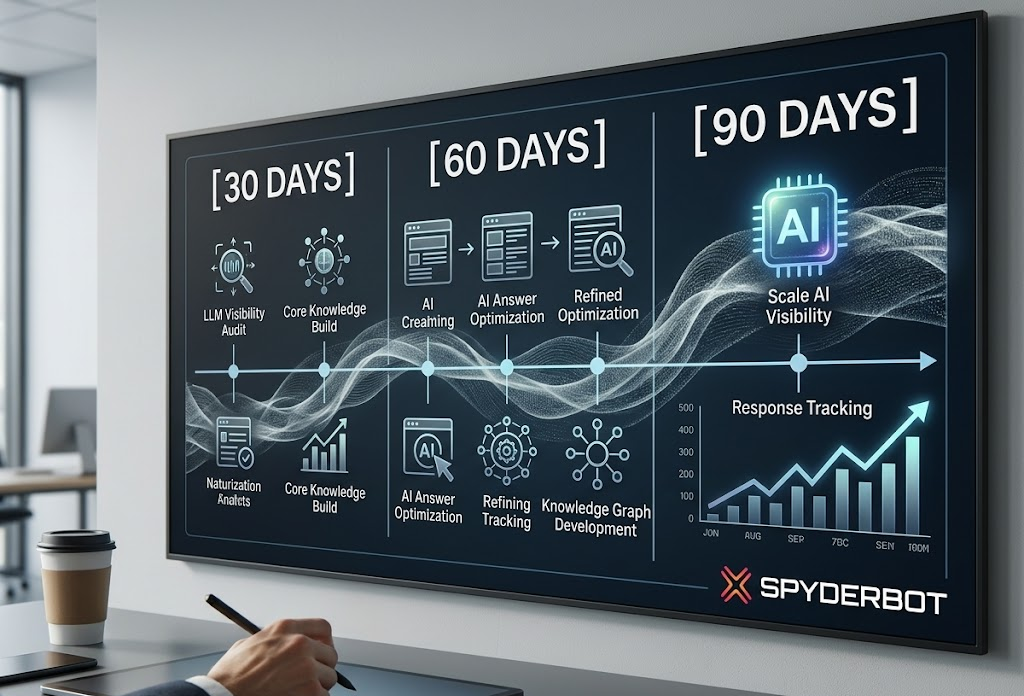
VI. A Realistic GEO Implementation Timeline
A practical GEO rollout does not need to be complicated.
Start focused.
Then expand.
Week 1 to 2: Define and Baseline
Tasks:
- Define target prompt groups
- Select priority competitors
- Run baseline tests
- Measure inclusion rate
- Record competitor mentions
- Analyze how AI describes your brand
- Identify missing contexts
Output:
- Visibility target map
- Baseline AI visibility report
- Initial competitor map
Week 3 to 4: Audit and Prioritize
Tasks:
- Run entity audit
- Run category audit
- Analyze competitor dominance
- Identify weak positioning
- Find missing use cases
- Prioritize optimization actions
- Build GEO roadmap
Output:
- GEO audit report
- Priority roadmap
- Ownership plan
Month 2 to 3: Execute Optimization
Tasks:
- Improve core messaging
- Update website pages
- Create prompt-based content
- Add comparison pages
- Build use-case pages
- Strengthen third-party validation
- Align external profiles
- Improve structured information
Output:
- Stronger entity clarity
- Better category alignment
- Expanded context coverage
- Improved selection signals
Ongoing: Track and Iterate
Tasks:
- Re-run prompt sets monthly
- Compare against baseline
- Monitor competitor movement
- Identify new gaps
- Update content and positioning
- Expand prompt coverage
- Report visibility gains
Output:
- Continuous GEO improvement loop
VII. The Biggest GEO Implementation Mistakes
Most GEO failures are not technical.
They are operational.
Mistake 1: Starting Without Measurement
If you do not know where you currently appear, you cannot know what to improve.
Baseline first.
Optimize second.
Mistake 2: Doing Random Optimizations
More content does not automatically mean more AI visibility.
Optimize based on diagnosed gaps.
Mistake 3: Ignoring Competitors
AI visibility is competitive.
You need to know who appears instead of you and why.
Mistake 4: Not Prioritizing
Not all prompts matter equally.
Prioritize high-intent, high-impact contexts.
Mistake 5: Treating GEO as a One-Time Campaign
AI visibility changes.
Competitors move.
Models evolve.
GEO must be ongoing.
Mistake 6: Confusing GEO With Keyword Stuffing
AI systems do not reward shallow keyword repetition.
They reward clarity, relevance, authority, and useful context.
Mistake 7: Ignoring Third-Party Signals
Your website is important, but your brand’s broader public footprint also matters.
If competitors are validated across more credible sources, they may be selected more often.
VIII. When GEO Implementation Works
You know GEO is working when your AI visibility improves in measurable ways.
Signs of progress include:
1. Increased Mentions
Your brand appears in more relevant prompts.
2. Higher Inclusion Rate
A larger percentage of target prompts include your brand.
3. Better Mention Share
Your visibility improves compared with competitors.
4. Broader Context Coverage
You appear across more use cases, industries, and buying-intent prompts.
5. Stronger Positioning
AI describes your brand more accurately and favorably.
6. Better Competitive Presence
You appear more often in comparison and alternative prompts.
7. More Consistency
Your brand appears more reliably across models and prompt variations.
These are better metrics than traditional “ranking” when measuring GEO success.
IX. Where SpyderBot Fits
SpyderBot is built to help brands operationalize GEO.
Instead of manually checking a few prompts and guessing what happened, SpyderBot helps teams track AI visibility across prompts, competitors, and AI systems.
SpyderBot supports the core GEO workflow:
Define targets → Measure visibility → Analyze gaps → Track competitors → Improve positioning → Re-test over time
It helps brands understand:
- Where they appear
- Where they are missing
- Which competitors dominate
- Which prompts matter
- How AI systems describe them
- Whether sentiment is positive, neutral, or negative
- Which contexts need optimization
- How visibility changes across ChatGPT, Gemini, Claude, Perplexity, Grok, Copilot, and other LLMs
This turns GEO from theory into an operating system.
The practical value is simple:
You cannot improve AI visibility if you cannot measure it.
SpyderBot gives teams the measurement layer needed to make GEO actionable.
Final Conclusion
GEO implementation is not about doing more.
It is about doing the right things in the right order.
The strongest GEO programs follow a system:
- Define where visibility matters
- Measure where you currently appear
- Diagnose why you are missing
- Prioritize the highest-impact gaps
- Improve entity, category, context, positioning, and validation signals
- Re-measure and iterate
The old SEO model focused on ranking pages.
The GEO model focuses on being selected in AI-generated answers.
That is the strategic shift.
Search is becoming more conversational.
Answers are becoming more compressed.
Brand discovery is moving from lists of links to generated recommendations.
In this environment, the winners will not be the companies that only understand GEO.
The winners will be the companies that implement it as an operational system.
Because in the AI search era, visibility is not just about being found.
It is about being selected.