
How to identify why your brand is not showing in AI answers
The problem
Most companies trying GEO ask:
- “Why are we not showing up in ChatGPT?”
- “Why are competitors always recommended?”
But they don’t have a clear way to diagnose it
They:
- Test a few prompts
- See inconsistent results
- Make assumptions
The result
No clarity, no direction, no improvement
What is a GEO audit?
A GEO audit is:
A structured analysis of how AI systems see, select, and represent your brand
It answers:
- Where you appear
- Where you don’t
- Why competitors are selected
- What signals you are missing
Key insight
GEO is not guesswork
It is diagnosable
The GEO Audit Framework (7 steps)
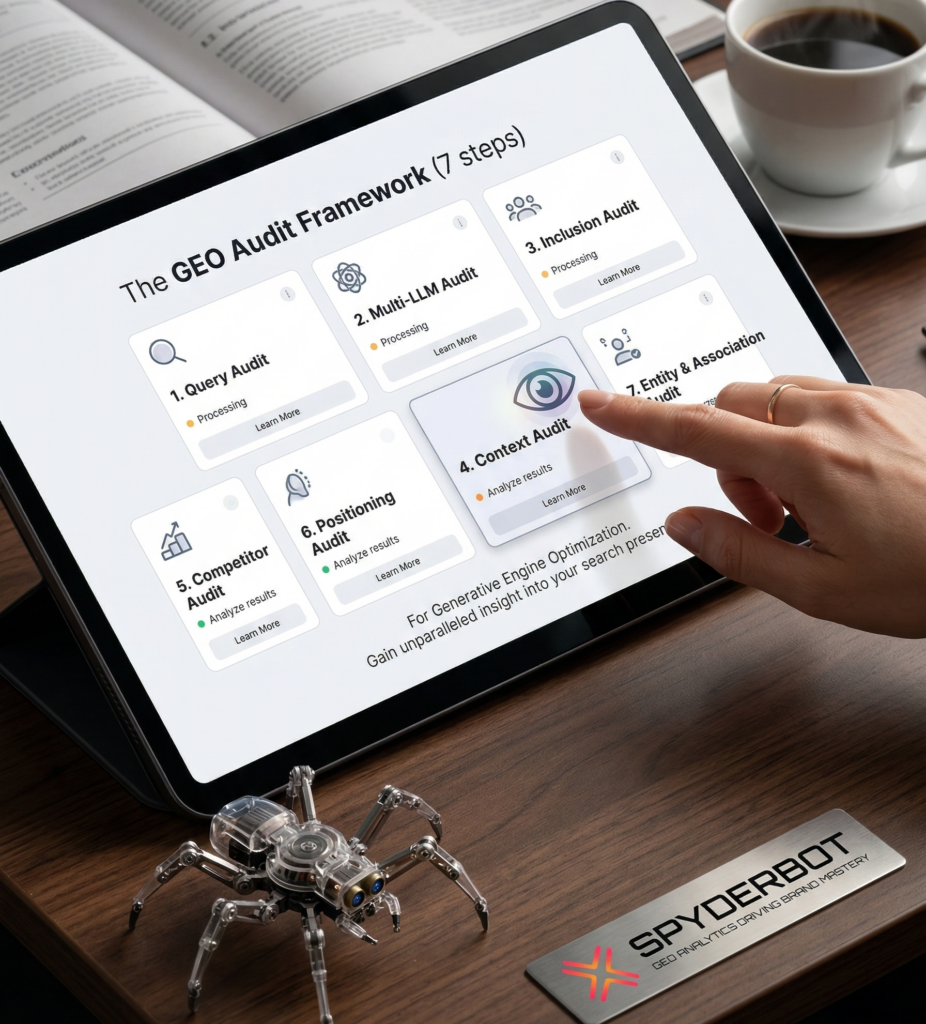
1. Query Audit
“Where should you appear?”
Start by defining:
Core query types:
- “best [category] tools”
- “alternatives to [competitor]”
- “tools for [use case]”
What to check:
- Do you appear?
- How often?
Red flag:
- Missing in high-intent queries
2. Multi-LLM Audit
“Do you appear across AI systems?”
Check across:
- ChatGPT
- Gemini
- Perplexity
- Copilot
- Claude
- Grok
- Llama
What to check:
- Consistency
- Differences
Red flag:
- Visible in one model, missing in others
3. Inclusion Audit
“How often are you selected?”
Measure:
- Inclusion rate
- Frequency
What to check:
- % of prompts where you appear
Red flag:
- Low inclusion rate (<20–30%)
4. Context Audit
“Where do you appear vs not appear?”
Analyze:
- Use cases
- Intent types
What to check:
- Strong vs weak contexts
Red flag:
- Only appearing in niche queries
5. Competitor Audit
“Who replaces you?”
Identify:
- Which brands appear instead of you
What to check:
- Dominant competitors
- Co-occurring brands
Red flag:
- Same competitors appear repeatedly
6. Positioning Audit
“How are you described?”
Look at:
- Descriptions
- Roles
What to check:
- Leader vs alternative vs niche
Red flag:
- Weak or unclear positioning
7. Entity & Association Audit
“Does AI understand your brand?”
Evaluate:
- Category clarity
- Associations
- Use cases
What to check:
- Is your brand clearly defined?
Red flag:
- Confused or inconsistent representation
GEO Audit Scorecard (simple version)

You can score each area:
- ✅ Strong
- ⚠️ Moderate
- ❌ Weak
Example:
- Query coverage → ❌
- Inclusion rate → ⚠️
- Competitor positioning → ❌
Result:
Clear priority areas
A realistic audit example
Company situation:
- Strong SEO
- Good content
Audit results:
- Missing in “best tools” queries
- Competitors dominate comparisons
- Weak category alignment
Diagnosis:
- Not a content issue
- A positioning + association issue
Outcome:
Clear direction for optimization
Common mistakes in GEO audits
1. Testing too few prompts
→ Not reliable
2. Using only one AI system
→ Incomplete view
3. Focusing only on mentions
→ Missing context
4. Ignoring competitors
→ No benchmark
5. No structured framework
→ No clarity
Manual audit vs system-driven audit
Manual:
- Limited prompts
- No scale
- No consistency
System-driven:
- Large-scale coverage
- Pattern detection
- Reliable insights
Key insight
Enterprise GEO requires scale
Not manual testing
When should you run a GEO audit?
1. You are not showing in ChatGPT
2. Competitors dominate AI answers
3. You launch a new category
4. You see unexplained pipeline drop
What to do after a GEO audit
1. Fix entity clarity
2. Improve category positioning
3. Expand context coverage
4. Strengthen associations
5. Track and iterate
Final conclusion
A GEO audit gives you:
- Clarity
- Direction
- Prioritization
Final insight
You cannot fix what you don’t understand
GEO audit is the first step to:
Winning in AI search