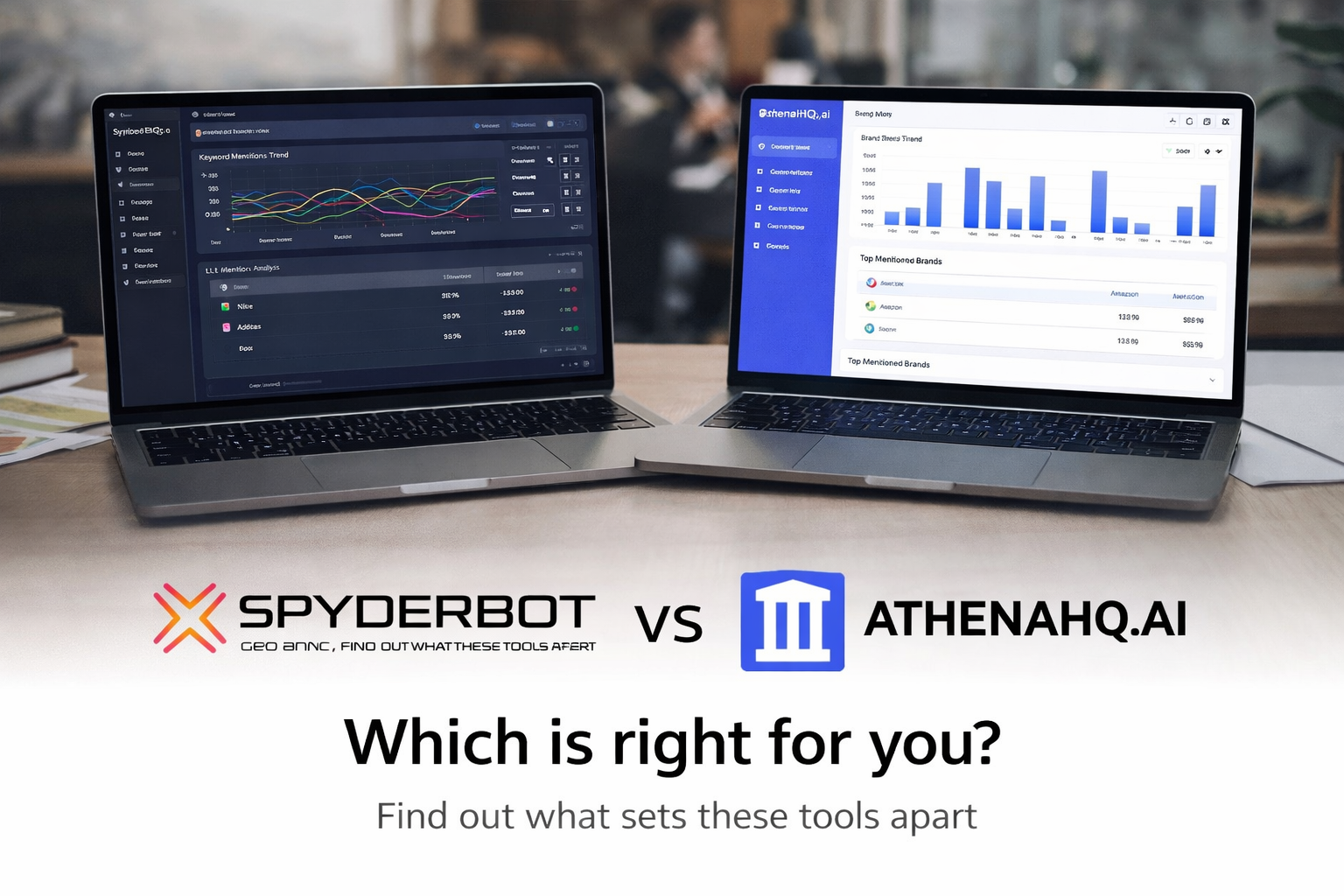
A clear, honest comparison between AI content optimization and AI visibility analytics
This is not a traditional tool comparison
At first glance, SpyderBot and AthenaHQ seem similar:
- Both are related to AI search
- Both mention GEO (Generative Engine Optimization)
- Both aim to help brands appear in AI systems
But underneath:
They are built for different stages of the same problem
The simplest way to understand the difference
AthenaHQ helps you optimize content for AI
SpyderBot helps you understand how AI actually behaves
What AthenaHQ actually does
AthenaHQ focuses on:
- AI-driven content optimization
- Helping brands structure content for LLMs
- Improving chances of being picked by AI systems
Core capabilities of AthenaHQ:
- Content recommendations for AI optimization
- Structured writing guidance (LLM-friendly content)
- SEO + AI hybrid optimization workflows
- Content scoring and suggestions
What AthenaHQ is really good at:
- Answering:
- “How should we write content for AI?”
- “How can we optimize pages for LLMs?”
- Helping teams:
- Produce AI-friendly content
- Improve structure and clarity
What SpyderBot actually does
SpyderBot focuses on:
- Measuring and analyzing AI outcomes
- Understanding how LLMs interpret brands
- Diagnosing visibility issues
Core capabilities of SpyderBot:
- AI mention tracking (ChatGPT, Gemini, etc.)
- LLM interpretation analysis
- Entity positioning insights
- Competitor analysis inside AI answers
- Prompt-level visibility tracking
- Diagnostic insights (why you are / aren’t mentioned)
What SpyderBot is really good at:
- Answering:
- “Why are we not appearing in AI?”
- “How does AI understand our brand?”
- “Why does AI prefer competitors?”
The fundamental difference
| Dimension | AthenaHQ | SpyderBot |
| Category | AI content optimization | GEO analytics |
| Focus | Content creation | AI behavior analysis |
| Layer | Input (what you publish) | Output (what AI generates) |
| Goal | Improve content for AI | Understand AI decisions |
| Output | Recommendations | Diagnostics + insights |
| Key question | “What should we write?” | “What is AI doing?” |
The key insight
AthenaHQ optimizes what you feed into AI
SpyderBot analyzes what AI produces
Where AthenaHQ is objectively stronger
AthenaHQ is the better tool for:
1. Content optimization workflows
- Writing AI-friendly content
- Structuring pages for LLM readability
- Improving clarity and formatting
2. Execution layer
- Helping teams produce content
- Guiding SEO + AI hybrid strategies
- Integrating into content pipelines
3. Speed of implementation
- Immediate recommendations
- Actionable content suggestions
- Faster iteration
Where SpyderBot is objectively stronger
SpyderBot is the better tool for:
1. Understanding AI outcomes
- Are you mentioned?
- How often?
- In what context?
2. Diagnosing problems
- Why you are not included
- Where AI misinterprets your brand
- What signals are missing
3. Competitive intelligence in AI
- Why competitors are chosen
- How they are positioned
- Where you lose
4. System-level visibility
- Across prompts
- Across contexts
- Across AI systems
Where AthenaHQ may fall short
AthenaHQ may not fully answer:
- Whether optimizations actually worked in AI outputs
- How AI interprets your brand after publishing
- Why competitors still dominate
Because:
Optimization without measurement is incomplete
Where SpyderBot may feel less actionable (initially)
SpyderBot may:
- Provide insights without direct “content suggestions”
- Require interpretation before execution
- Be more analytical than prescriptive
Because:
It focuses on diagnosis, not content generation
A real-world scenario
A team uses AthenaHQ to:
- Optimize content
- Improve structure
- Publish AI-friendly pages
What AthenaHQ shows:
- Content score improved
- Structure is optimized
- Recommendations implemented
What SpyderBot reveals:
- Still not mentioned in AI answers
- AI misclassifies the product
- Competitors dominate positioning
This is the real gap
Content optimization ≠ AI visibility
How the tools fit together
The correct model:
| Layer | Tool |
| Content optimization | AthenaHQ |
| AI visibility analysis | SpyderBot |
When you should use AthenaHQ
Use AthenaHQ if:
- You are creating or optimizing content
- You want guidance on AI-friendly structure
- You need execution support
- You are early in GEO adoption
When you should use SpyderBot
Use SpyderBot if:
- You want to measure AI visibility
- You need to diagnose why you are not mentioned
- You want to understand LLM behavior
- You want deeper GEO insights
When you should use both
Most advanced teams will benefit from both:
- AthenaHQ → optimize input
- SpyderBot → analyze output
The honest conclusion
AthenaHQ is strong at:
Helping you write better content for AI
SpyderBot is built for:
Understanding whether that content actually works in AI systems
Final insight
AthenaHQ answers:
“How should we optimize our content?”
SpyderBot answers:
“Did it work — and why or why not?”
The deeper positioning
We are moving toward a full GEO stack:
- Optimization layer (content)
- Analytics layer (AI behavior)