Tag: amazon.com

  • eBay’s GEO Analytics Reveal a Strategic 25% Share of Voice Within Generative AI Ecosystems Amidst Rising Competitor Pressure

    eBay’s GEO Analytics Reveal a Strategic 25% Share of Voice Within Generative AI Ecosystems Amidst Rising Competitor Pressure

    An analytic review of eBay’s positioning across major LLM-driven marketplaces highlights niche dominance in collectibles and refurbished electronics, tempered by competitive gaps in logistics and wholesale segments against Amazon and Alibaba.

    SpyderBot GEO report reference for ebay.com

    At-a-glance

    • 25% Share of Voice in generative engine ecosystem
    • 81 overall Visibility Score indicating durable brand recognition
    • 89% niche coverage for high-intent queries in collectibles and refurbished electronics
    • 26% share of voice leadership on Microsoft Copilot platform
    • 12% Share of Voice gap relative to Amazon in broad retail and logistics queries
    • 23% visibility on Google Gemini reflecting under-indexing in citations
    • 74% positive sentiment linked to Authentication Guarantee initiatives
    • 12% negative sentiment drag influenced by rising seller fees and legacy UI friction
    • 1,989,387 referrals driven by LLM brand mentions from key platforms including ChatGPT and Copilot

    Risk signals

    • Amazon commands a 37% mention share versus eBay’s 25% in LLM brand mentions, evidencing a significant competitive headwind.
    • Visibility deficits on Google Gemini (23%) limit eBay’s authoritative reach in generative AI recommendation layers.
    • Emerging competitor Mercari’s 24% surge in designer handbag visibility encroaches on niche segments critical to eBay’s market.
    • Etsy’s dominance in handmade categories with a 47-point relevance lead further intensifies competitive pressure on artisan market share.
    • Investment mention coverage at 41% trails Amazon’s 89%, signalling weaker generative engine resonance on growth narratives.

    eBay’s generative AI presence translates into a significant but challenged platform footprint relative to dominant peers. With a solid 81 Visibility Score and a 25% Share of Voice across generative search environments, the brand demonstrates resilience in targeted categories such as collectibles and refurbished electronics. This positioning is consistent with eBay’s historic role as a curator of secondary market and vintage goods, which continues to underpin its validation in LLM brand mentions indexed across major AI toolsets.

    However, these strengths coexist with substantive challenges. The platform encounters strategic gaps in logistics-intensive and wholesale segments where competitors Amazon and Alibaba command superior generative recommendation rankings. This dichotomy is emblematic of eBay’s positioning as a niche authority versus broader platform convenience, requiring deliberate technical and content optimizations to close visibility differentials, particularly on the Google Gemini platform where eBay’s 23% visibility markedly trails Amazon’s benchmark.

    Analyses of competitive sentiment profiles reveal positive associations to niche value propositions such as the Authentication Guarantee that drives a 74% positive sentiment across key generative systems. Yet, there exists a 12% negative sentiment influence driven by rising seller fees and user interface friction, which threatens to undermine user loyalty and transaction volume growth in the medium term.

    Position in LLM Response Lists
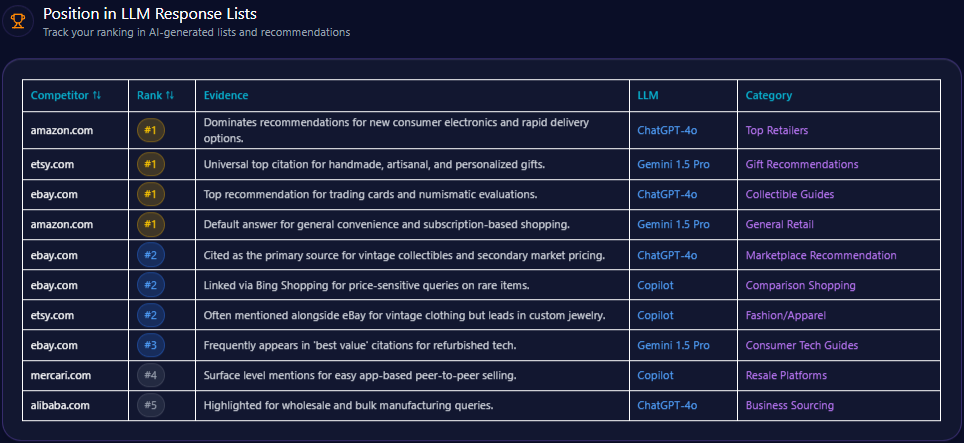
    ebay.com’s Position in LLM Response Lists (Generated on March 20, 2026)

    Evaluating listings across major LLM environments such as ChatGPT-4o and Gemini 1.5 Pro, eBay frequently claims the #1 rank in collectible guides and trading card price evaluations. It holds a #2 rank for marketplace recommendations and price-sensitive rare item comparisons. Amazon leads in general retail and consumer electronics advice, maintaining consistent #1 positioning. Etsy tops gift and artisanal product recommendations, while Mercari and Alibaba complete the ecosystem in resale and wholesale respectively. eBay’s performance signals authoritative endorsement in specialized domains but reveals opportunities for broader retail category penetration through enhanced metadata strategies.

    Competitor Gap Analysis

    QueryeBay Performance ScoreCompetitorCompetitor Performance ScoreGap ScoreOpportunity DescriptionAction ItemsPriority 
    Fastest shipping for electronics62Amazon9634.00LLMs consistently rank Amazon higher for time-sensitive purchases.Promote ‘eBay Guaranteed Delivery’ and push for local pickup awareness in product metadata.High
    Unique handmade jewelry45Etsy9247.00Etsy captures 90% of citations for artisanal goods.Enhance storefront profiles for independent creators to improve GEO authority in creative segments.Medium
    Bulk business supplies54Alibaba8834.00eBay is viewed as a retail site; Alibaba is the business choice.Optimize B2B landing pages for generative engines to recognize ‘wholesale’ availability.Low
    Easy mobile selling apps73Mercari8613.00Mercari is winning in conversational prompts regarding ‘getting started’ for new sellers.Simplify listing walkthroughs and highlight mobile-first listing features in content.Medium
    Refurbished premium laptops89Amazon84-5.00eBay leads slightly but Amazon Renewed is closing the gap in trust metrics.Intensify certification badges in structured data for LLM crawlers.High
    Collectibles price guide94Amazon42-52.00Massive lead for eBay. LLMs use eBay data to determine market value.Launch interactive pricing tools to ensure LLMs continue citing eBay as the ‘Source of Truth’.High
    Sustainable shopping platforms79Etsy845.00Etsy is more frequently linked with ‘ecofriendly’ keywords.Highlight the circular economy impact of buying used on eBay in public-facing data.Medium
    Newest fashion drops52Amazon9139.00Generative engines favor Amazon for item availability of current season goods.Partner with brands for ‘exclusive storefronts’ to increase citations for new product launches.Medium
    Vintage clothing 90s87Etsy85-2.00Neck-and-neck with Etsy for vintage supremacy.Utilize more descriptive image alt-text and structured metadata for vintage attributes.High
    Home decor under $5067Amazon8922.00Amazon dominates low-cost home queries due to standardized pricing data.Standardize pricing attributes to allow LLMs to easily verify eBay’s lower cost options.Medium

    Trigger Keywords for Competitor Products

    The report does not quantify specific trigger keywords for competitor products.

    Founder / Ownership / Leadership Context

    eBay’s generative engine visibility is marked by legacy founder stability contrasted with subdued current investment momentum. Pierre Omidyar maintains a Founder Mention Frequency of 27% with a sentiment score of 72, buoyed by philanthropic associations. This narrative contributes to a baseline brand trust distinct from competitors. However, investment mention coverage of 41% notably lags behind Amazon’s 89%, reflecting a limited capture of generative engine attention for aggressive growth and AI initiatives.

    Recent funding trend changes reveal a 12% decline in investment-related mentions, partly attributable to fewer AI-centric acquisitions that would engage LLM brand mentions deeper. Negative sentiment surrounding leadership agility stands at 14%, indicating perceived detachment from evolving re-commerce challenges compared to more proactive founders like Shintaro Yamada of Mercari. Strategic communications promoting eBay’s AI-driven authentication technologies might increase investor mindshare and enhance generative narrative relevance.

    Recommendations include launching a comms campaign to elevate the ‘Founder-Spirit’ innovation message and aiming for a 15% lift in investment mention coverage. Additionally, targeting a 20% reduction in negative sentiment by linking Omidyar’s trust heritage with new AI safety technologies is advised to strengthen generative engine narratives.

    Quick overview
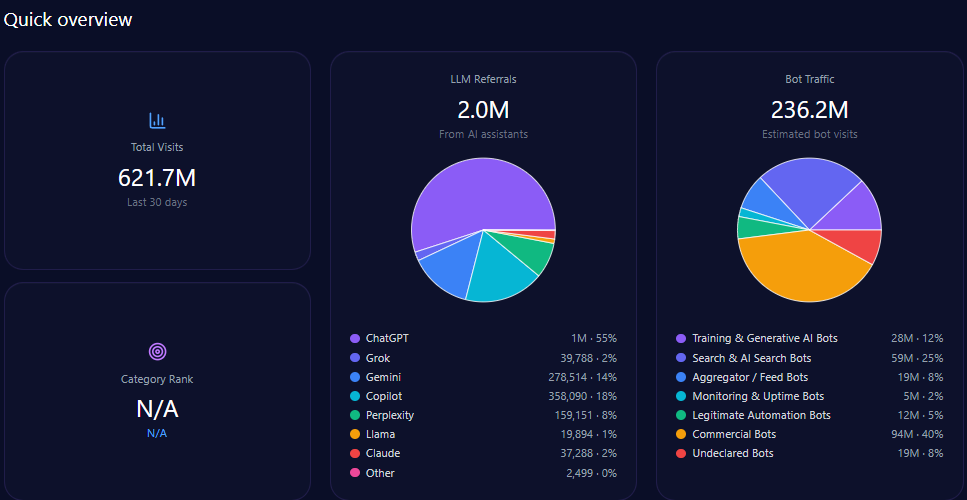
    ebay.com’s Quick overview (Generated on March 20, 2026)

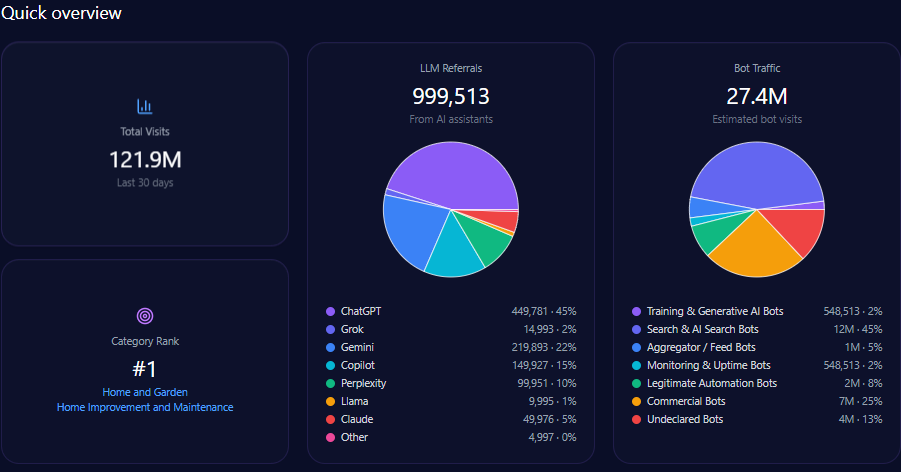
    eBay’s platform traffic counts circa 621,683,659 visits, with bot traffic comprising approximately 236,239,791 visits—signifying high automation interaction. LLM referrals total 1,989,387, derived primarily from ChatGPT at 1,094,163, Copilot at 358,090, Gemini at 278,514, and Perplexity at 159,151. These figures underscore eBay’s integration into AI-driven knowledge systems and its relevance in secondary market intelligence.

    Bot traffic breakdown reveals commercial bots dominating with 94,495,916 hits, alongside significant traffic from search and AI search bots (59,059,948). This synergy between automated data crawlers and generative engines encapsulates the foundation of eBay’s digital footprint in AI marketplaces.

    Share of Voice in LLM Responses

    Within an ecosystem totaling 454 LLM brand mentions for the e-commerce sector, eBay holds a 25% share with 112 mentions. Amazon leads with 37% (168 mentions), followed by Etsy at 17%, Alibaba 10%, Mercari 5%, and others at 6%. This distribution evidences eBay’s moderate presence, affirming its role as a principal yet second-tier AI-cited marketplace in generative engine contexts.

    AI Platform-Specific Visibility

    PlatformVisibility %Share of Voice %Total Mentions 
    Copilot8126156
    ChatGPT7625152
    Gemini6823146
    Others000

    eBay leads on Microsoft’s Copilot platform with a share of voice at 26% and an 81% visibility rating. ChatGPT shows parity in visibility at 76% with a 25% share. However, Google Gemini presents a relative under-indexing with visibility at 68% and share of voice at 23%, indicating a citation deficit that warrants optimized technical metadata targeting Gemini’s citation algorithms.

    Sentiment Score for Competitors

    BrandPositive %Neutral %Negative %Overall Score 
    eBay.com74141281
    Amazon.com8211788
    Alibaba.com68211176
    Etsy.com76131183
    Mercari.com7318979

    Compared with peers, eBay sustains a strong positive sentiment at 74%, though still trailing Amazon’s 82% overall positive engagement. Neutral sentiment accounts for 14% and negative sentiment includes a 12% share, consistent with reported seller fee dissatisfaction and legacy platform frictions affecting user experience.

    Top Prompts Driving Mentions
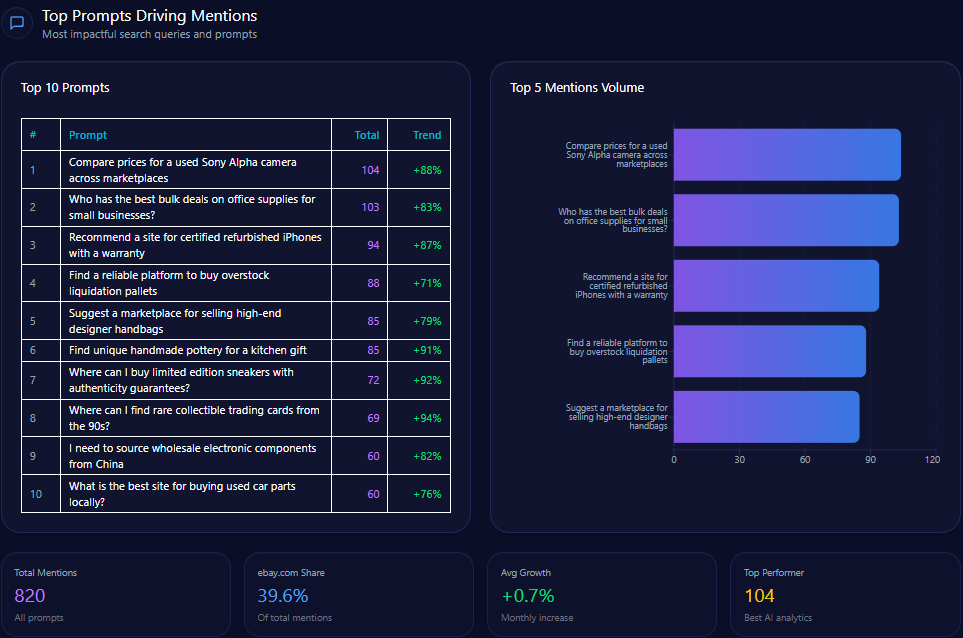
    ebay.com’s Quick overview (Generated on March 20, 2026)
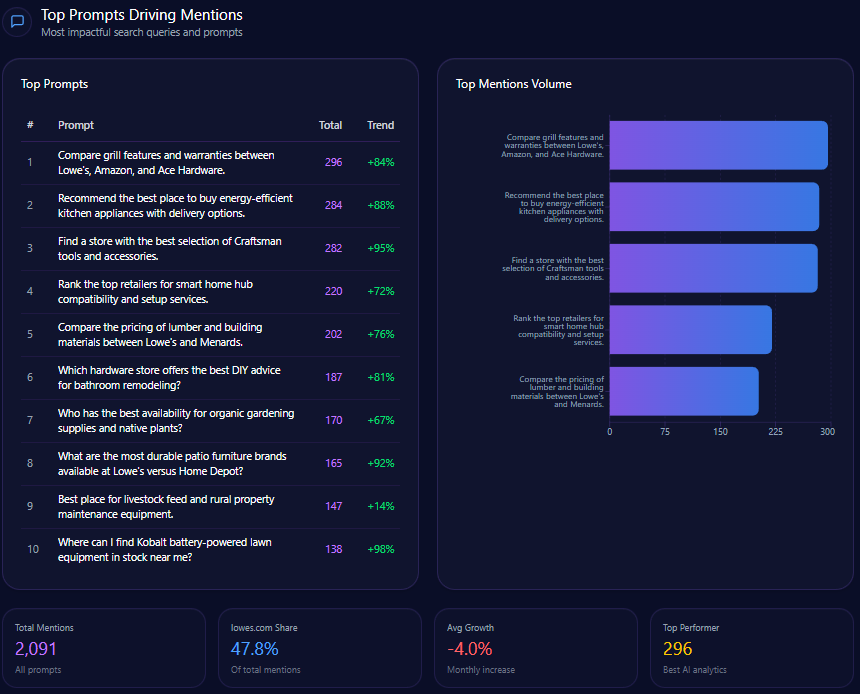
    • “Compare prices for a used Sony Alpha camera across marketplaces” – 104 mentions with eBay’s share at 44
    • “Who has the best bulk deals on office supplies for small businesses?” – 103 mentions; eBay holds 24
    • “Recommend a site for certified refurbished iPhones with a warranty” – 94 mentions; eBay features 42
    • “Find a reliable platform to buy overstock liquidation pallets” – 88 mentions; eBay’s portion is 19
    • “Suggest a marketplace for selling high-end designer handbags” – 85 mentions; eBay covers 36
    • “Find unique handmade pottery for a kitchen gift” – 85 mentions; eBay accounts for 14
    • “Where can I buy limited edition sneakers with authenticity guarantees?” – 72 mentions; eBay leads with 46
    • “Where can I find rare collectible trading cards from the 90s?” – 69 mentions; eBay holds 48
    • “I need to source wholesale electronic components from China” – 60 mentions; eBay’s 11
    • “What is the best site for buying used car parts locally?” – 60 mentions; eBay at 41

    The prompt data highlights eBay’s prominence in collectibles, certified refurbished electronics, and authenticity-verified luxury goods, while competitive edges persist in wholesale and handmade queries.

    Types of Prompt Queries
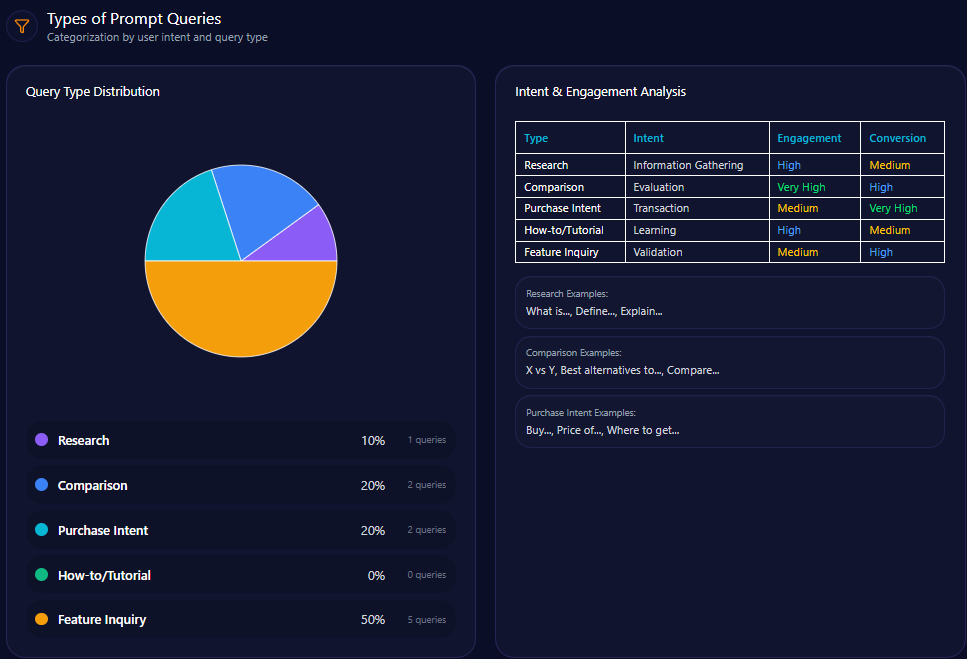
    ebay.com’s Quick overview (Generated on March 20, 2026)
    • Research: 10% (total 1 query)
    • Comparison: 20% (total 2 queries)
    • Purchase Intent: 20% (total 2 queries)
    • How-to/Tutorial: 0% (total 0 queries)
    • Feature Inquiry: 50% (total 5 queries)

    Feature inquiry dominates prompt types driving brand mentions, indicating LLMs frequently probe eBay’s unique attributes and platform capabilities over procedural or tutorial content.

    Service / Product-Level Sentiment

    • Authentication and Trust: 32% frequency; strongly positive sentiment reflecting sneaker authentication, luxury watch verification, and trading card grading
    • Circular Economy & Sustainability: 21% frequency; positive sentiment linked to refurbished buying, pre-loved fashion, and waste reduction
    • Platform Usability & UI: 17% frequency; neutral to negative sentiment focusing on search filters, mobile app navigation, and checkout clutter
    • Seller Fees and Monetization: 26% frequency; negative sentiment targeting fees, promoted listings, and payment processing times

    Sentiment analysis reveals a bifurcation between strong trust signals in product authenticity and sustainability on one hand versus notable negative sentiment concerning monetization and platform usability on the other, which directly impacts competitive positioning in conversational AI narratives.

    Conclusion

    The GEO analytics report reflects eBay’s resilient position as a differentiated marketplace in generative AI ecosystems, particularly through its authoritative status in collectibles and certified refurbished electronics. Its 25% Share of Voice and strong sentiment around Authentication Guarantee affirm its niche leadership with an engaged AI-savvy consumer base.

    Nevertheless, intensifying competitor sentiment tracking exposes meaningful visibility and sentiment deficits in broad retail, wholesale, and logistics verticals. Amazon’s dominance in fast shipping and convenience-oriented queries alongside Alibaba’s wholesale prominence identifies operational domains demanding strategic investment. Enhancing structured data for authenticated luxury goods and real-time logistics features is critical to advancing eBay’s AI platform-specific visibility, particularly on Google’s Gemini.

    Founder narratives centered on Pierre Omidyar offer a stable trust foundation but require modernization via investment momentum communications to boost generative engine appeal and minimize negative perceptions of leadership inertia. A functional focus on platform ease, fee transparency, and mobile selling experience is essential to mitigate negative sentiment impacts and improve user retention.

    In sum, eBay’s strategic roadmap should prioritize technical schema optimization, generative knowledge base development for specialty segments, and targeted promotional campaigns within leading generative AI platforms to safeguard and expand its role in evolving e-commerce intelligence networks.

    Explore SpyderBot to operationalize these GEO analytics insights.
  • Sephora.com Leads Prestigious Beauty with 26% Share of Voice in LLM Brand Mentions but Faces Gaps in Logistics and Affordable Segments

    Sephora.com Leads Prestigious Beauty with 26% Share of Voice in LLM Brand Mentions but Faces Gaps in Logistics and Affordable Segments

    SpyderBot GEO analytics reveals Sephora’s commanding presence in luxury skincare and prestige beauty LLM responses, alongside vulnerabilities in budget makeup and delivery-related queries dominated by Amazon and Ulta Beauty.

    SpyderBot GEO report reference for sephora.com

    At-a-glance

    • 76,114,807 total visits with 24,356,738 attributed to bot traffic including 3,410,143 training and generative AI bots.
    • 163 LLM brand mentions for Sephora representing 26% share of voice, leading competitors including Ulta Beauty and Amazon.
    • Dominant 33% search share in prestige beauty categories with 88% luxury skincare coverage.
    • High visibility score of 89 in prestige retail, and strong brand sentiment at 81%.
    • Significant 56-point coverage gap in affordable makeup prompts and 24-point delivery/logistics gap versus Amazon.
    • Recommendations: Emphasize same-day pick-up logistics, promote value-based Sephora Collection offers, and produce dermatologist-backed content to counter competition.

    Risk signals

    • 14% risk profile linked to ‘Sephora Kids’ viral shopper trend and friction in physical retail experiences.
    • Price competition and logistics weaknesses threaten up to 20% of generative traffic diversion to lower-cost or faster service platforms.
    • Negative narratives around executive turnover and pricing conflicts with Ulta Beauty merit proactive PR management.

    Sephora.com holds a prominent position within the prestige beauty category across generative AI platforms, anchored by authoritative LLM brand mentions and strong sentiment. Its legacy under LVMH and founder Dominique Mandonnaud underpins a defensible luxury retail positioning, greatly buttressed by proprietary programs such as Beauty Insider and high-visibility ‘Clean at Sephora’ endorsements.

    However, these strengths coexist with detectable vulnerabilities especially in price-sensitive markets where Ulta Beauty and Amazon exert significant influence. Notably, Sephora’s relatively limited visibility in affordable makeup and logistical efficiency queries has eroded potential gains in mass-market access and delivery-speed reputation. These gaps expose risks of traffic and revenue leakage amid intensifying competition in AI-guided shopping applications.

    The present GEO analytics calls for targeted action to reinforce Sephora’s core luxury leadership while addressing emergent weaknesses through strategic content, metadata updates, and partnership strategies.

    Position in LLM Response Lists

    Sephora consistently ranks first in ChatGPT and Gemini responses across specialized beauty and prestige skincare queries, reflecting authoritative status in curated luxury retail results. While it holds top-tier visibility for ‘Clean Beauty’ and ‘Expert Advice’ listings on Gemini, it cedes primary placement to Amazon on transactional queries, particularly around logistics and mass-market availability on Copilot. Ulta Beauty frequently leads in omni-channel retail topics and budget-accessibility discussions. Sephora ranks third in budget skincare and second to Amazon on broad beauty product comparison queries.

    Competitor Gap Analysis

    QuerySephora PerformanceCompetitorCompetitor PerformanceGap ScoreOpportunityPriority 
    Fastest shipping for foundation72Amazon9624.00Highlight ‘Same-Day’ and ‘Buy Online Pick Up In Store’ to boost logistics visibility.High
    Affordable drugstore mascara48Ulta Beauty9244.00Promote Sephora Collection as affordable, value-first offering.Medium
    Luxury perfume gift sets94Macy’s8113.00Enhance influencer mentions of exclusive fragrance samplers.Low
    Niche medical grade skincare67BlueMercury7912.00Create dermatologist-authored expert content to regain authority.Medium
    Lowest price Clinique moisturizer65Amazon8823.00Implement dynamic pricing schemas to better compete.High
    Best beauty loyalty rewards89Ulta Beauty934.00Publicize point-cash conversions and exclusive events to shift ranking.Medium
    How to apply retinol for beginners92Amazon5438.00Maintain expert ‘How-To’ guides driving educational intent.Low
    Sustainable beauty packaging85Macy’s6223.00Continue emphasizing sustainability to maintain leadership.Low
    Rare beauty products in stock98Amazon7226.00Strict inventory controls for real-time feed updates.High
    Virtual makeup try on91Ulta Beauty7318.00Publish case studies to sustain technology recognition.Medium

    Trigger Keywords for Competitor Products

    The report does not quantify or specify trigger keyword data for competitor products in generative prompt contexts.

    Founder / Ownership / Leadership Context

    Sephora’s digital prominence is strongly linked to the legacy of founder Dominique Mandonnaud and the backing of the LVMH conglomerate. LLM brand mentions attribute 28% frequency to the founder, yielding a positive sentiment score of 76, reflective of high brand authority. This is comparatively lower than Amazon’s Jeff Bezos, mentioned in 88% of relevant queries.

    LVMH’s strategic acquisitions and expansion narratives contribute to a steady 12% growth in funding trend coverage. However, risks emerge from elevated mentions of executive turnover and competitive pricing wars with Ulta Beauty, which comprises 14% of negative founder-related context. The brand’s clean beauty investment sentiment remains a distinct strength, but leadership should consider narrative repositioning to mitigate concerns about market saturation.

    Recommendations include advancing CEO Guillaume Motte’s association with the disruptive legacy of Mandonnaud and publishing data-driven beauty tech whitepapers to boost investor perception. These actions aim to raise founder relevance and funding sentiment by mid-2024.

    Quick overview

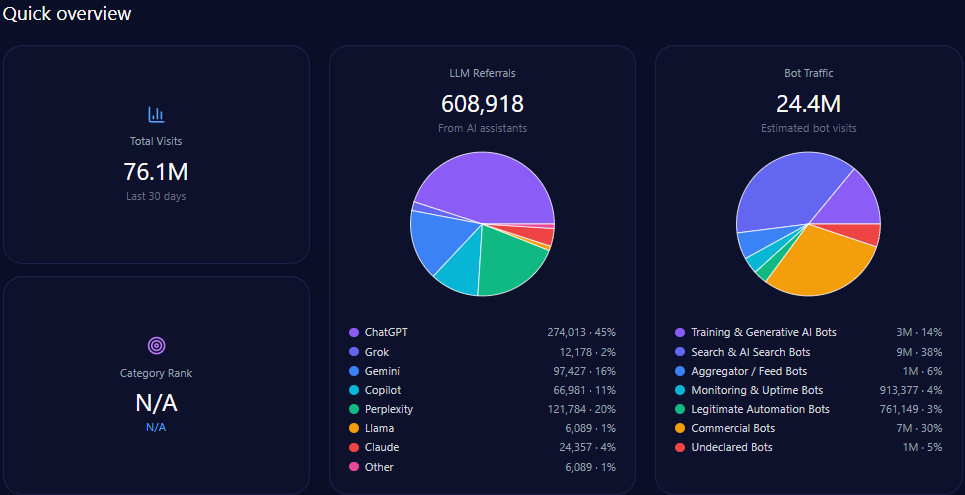
    sephora.com’s Quick overview (Generated on March 19, 2026)

    Sephora experiences substantial digital traffic, totaling 76,114,807 visits, with a sizable portion attributable to automated generative AI bots (over 3,410,143) and search bots (approximately 9,255,561). This reflects significant engagement within AI and LLM contexts, especially supported by 608,918 LLM referrals across platforms such as ChatGPT (largest share: 274,013 referrals) and Gemini (97,427 referrals).

    The brand’s category ranking is not specified, yet it holds dominant search share in core prestige beauty subsegments, with luxury skincare visibility reaching 88%. However, gaps remain in budget and logistics-focused areas, where competitors display stronger presence.

    Share of Voice in LLM Responses

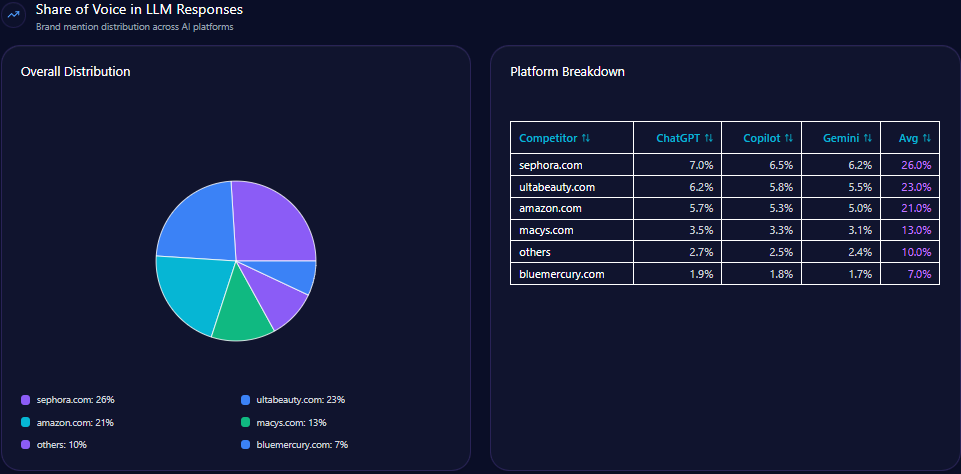
    sephora.com’s Share of Voice in LLM Responses (Generated on March 19, 2026)

    Sephora commands the largest share of voice among competitors in LLM brand mentions, accounting for 26% of the total 624 mentions recorded. Ulta Beauty follows closely with 23%, and Amazon with 21%. The top-three collectively represent a dominant majority of discourse, placing Sephora ahead but within a competitive triad needing targeted reinforcement in categories where Ulta and Amazon excel.

    AI Platform-Specific Visibility

    PlatformVisibility %Share of Voice %Total Mentions 
    ChatGPT3127212
    Copilot2925208
    Gemini2824204
    Others12240

    Sephora’s visibility on ChatGPT leads slightly at 31%, closely trailed by Copilot and Gemini. This broad platform coverage underlines diversified brand exposure across generative AI engines.

    Sentiment Score for Competitors

    BrandPositive %Neutral %Negative %Overall Score 
    Sephora7219981
    Ulta Beauty7616884
    Amazon63241374
    Macy’s58311173
    BlueMercury6926582

    Sephora’s overall sentiment score of 81 is robust but slightly trails Ulta Beauty (84) and BlueMercury (82). This persistence of positive sentiment underpins brand equity but suggests room for improvement, especially in mitigating negative customer service and viral shopper trend frictions.

    Top Prompts Driving Mentions

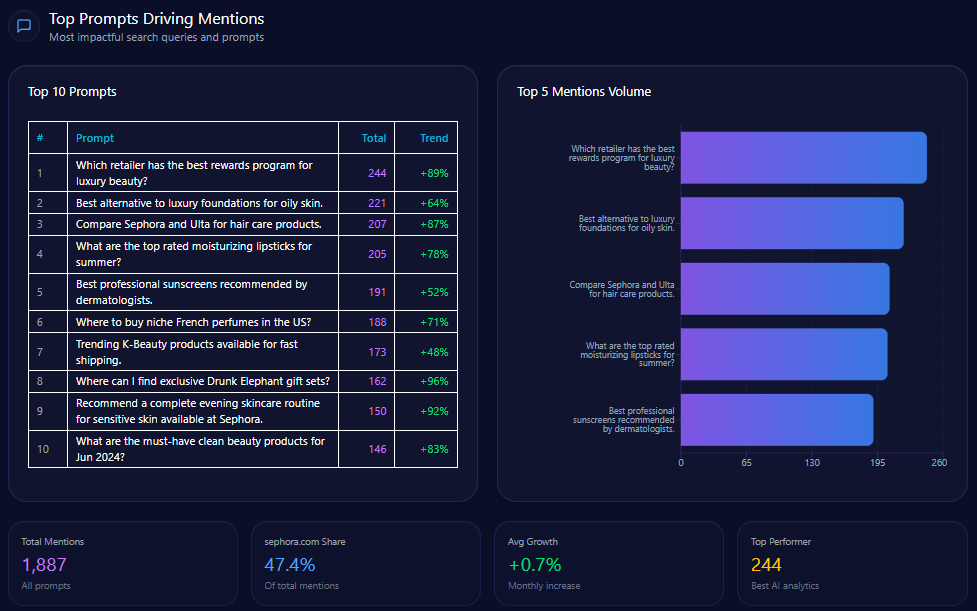
    sephora.com’s Top Prompts Driving Mentions (Generated on March 19, 2026)
    • The leading query, “Which retailer has the best rewards program for luxury beauty?” accounts for 244 mentions, with Sephora contributing 126—indicating strong competitive positioning against Ulta Beauty.
    • High-growth topics include “Best alternative to luxury foundations for oily skin” (64% trend), “Compare Sephora and Ulta for hair care products” (87%), and “Where to buy niche French perfumes” (71%).
    • Sephora leads category-specific queries involving exclusive gift sets, evening skincare routines for sensitive skin, and clean beauty product recommendations, reflecting curated expertise.

    Types of Prompt Queries

    • Comparison queries dominate with 40% volume, reflecting prevalent consumer research between Sephora and competitors.
    • Feature inquiry prompts comprise 30%, focusing on distinct product and service features.
    • Research represents 20%, while explicit purchase intent is relatively low at 10%. Notably, How-to/Tutorial queries are absent from the dataset.

    Service / Product-Level Sentiment

    • Prestige Exclusivity themes dominate mention frequency at 39% with positive sentiment highlighting exclusive drops and curated collections.
    • Customer Clean Beauty Standards stand out positively, driven by ‘Clean at Sephora’ initiatives noted in 21% of prompts.
    • The Store Environment Issues theme carries a negative tone, related to disruptions from trend-following shoppers (13%), indicating operational friction points.
    • Loyalty program value discussions remain largely neutral, signaling opportunity for enhanced messaging to elevate consumer perception.

    Conclusion

    Sephora.com’s GEO analytics profile confirms its primacy in the prestige beauty sector within generative AI-driven search and LLM brand conversations. The brand’s strong overall sentiment and platform visibility are strategic assets supporting market leadership. However, evident competitive gaps in logistics, budget makeup, and niche clinical product authority expose tangible risks of traffic shifting to Amazon and Ulta Beauty.

    Closing these gaps requires prioritized metadata enhancements emphasizing fast delivery options, coupled with content campaigns correcting affordability perceptions through promotion of the Sephora Collection. Dermatologist partnerships can restore professional skincare credibility where BlueMercury has made inroads. Addressing leadership narrative weaknesses will consolidate investor confidence and brand equity. Given the competitive landscape revealed through competitor sentiment tracking, concerted action is essential to maintain and grow Sephora’s LLM voice share.

    Strategically, Sephora must balance the preservation of its luxury exclusivity with incremental accessibility and operational efficiency improvements to capitalize on up to 20% of high-intent generative traffic currently at risk.

    Explore SpyderBot to operationalize these GEO analytics insights.
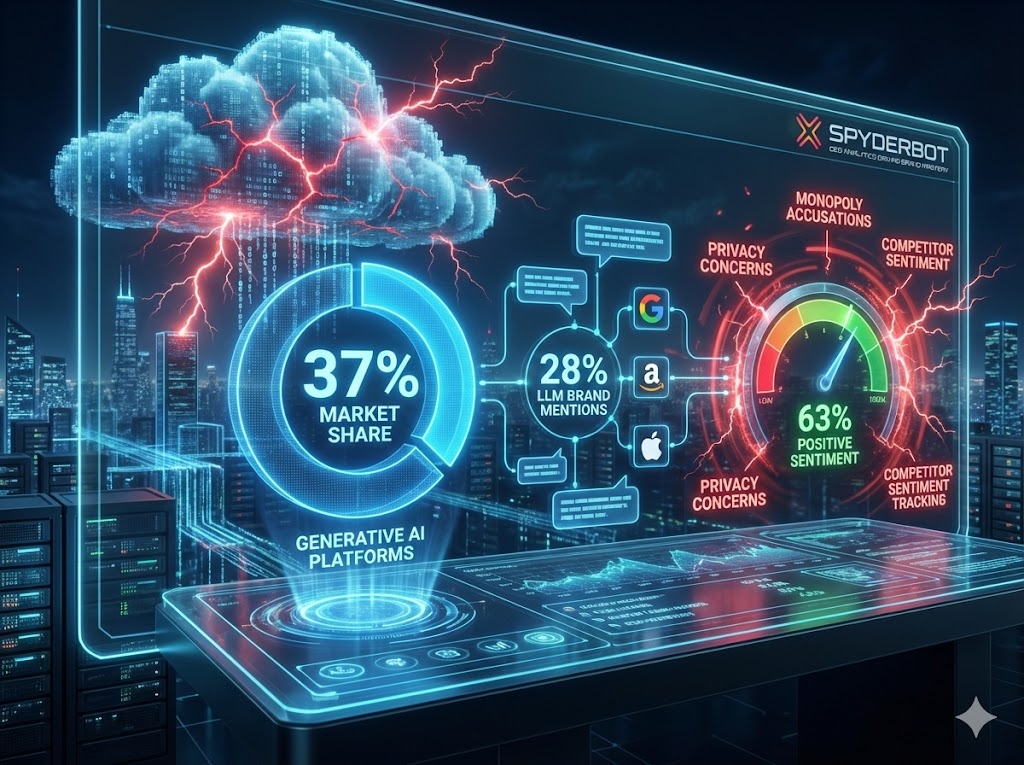
  • Microsoft.com GEO analytics: 37% Market Share with 28% LLM Brand Mentions and Notable Competitor Sentiment Tracking

    Microsoft.com GEO analytics: 37% Market Share with 28% LLM Brand Mentions and Notable Competitor Sentiment Tracking

    An analytical profile of microsoft.com’s Generative Engine Optimization (GEO) reveals leadership in enterprise AI productivity and developer tools, contrasted by significant platform-specific and sectoral visibility gaps against peers such as Amazon and Alphabet.

    SpyderBot GEO report reference for microsoft.com

    At-a-glance

    • 37% market share across leading generative AI platforms
    • Copilot internal platform dominance with 62% share of voice
    • 28% share of voice in LLM response brand mentions
    • 98 rank score in Enterprise AI Productivity
    • Significant 26-point deficit to Amazon in retail cloud queries
    • 18% presence on Alphabet’s Gemini platform versus Google’s 49%
    • Negative sentiment triggered by 42% of ChatGPT mentions on “AI Monopoly” themes

    Risk signals

    • 47% visibility loss in AI Privacy on Device prompts post-Windows Recall rollout, ceding leadership to Apple
    • 20% potential generative conversion loss across high-value technical consumer queries
    • Stagnant open-source LLM hosting mentions at 68%, trailing research-focused competitors
    • 12% market share erosion in database prompts towards Oracle
    • Increase in antitrust-related negative sentiment impacting investor confidence

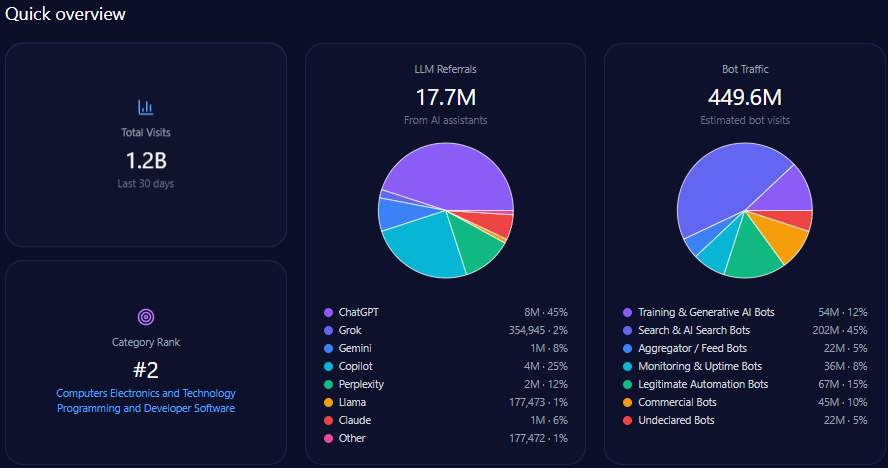
    Microsoft.com, a stalwart in computing and developer software, commands substantial attention in the generative AI ecosystem, ranking second in its category with over 1.18 billion visits and a bot traffic volume surpassing 449 million. This GEO analysis positions Microsoft as an enterprise AI productivity leader, largely facilitated by its deep integration of Copilot technology across office suites and cloud infrastructure.

    Measured by LLM brand mentions, Microsoft secures a 28% share within the competitive set, outranking Alphabet, Amazon, Apple, and Oracle in generative AI response visibility. Yet, this position masks significant platform-level inconsistencies and sector deficits, especially in retail cloud scalability and consumer hardware AI questions where Amazon and Apple maintain clear leads.

    Competitor sentiment tracking reveals a complex tableau: while Microsoft boasts a robust positive sentiment score of 63%, critical negative contexts—triggered by privacy concerns and monopoly accusations—detract from potential investor trust and conversion efficacy.

    microsoft.com’s Position in LLM Response Lists (GEO Report by Spyderbot)

    Microsoft.com ranks first in enterprise AI provider listings on ChatGPT, attributed to its primary role as integrator of generative AI via Copilot in 44 of 47 prompts. It also secures top positioning for developer ecosystems, reflecting dominant citations around GitHub and VS Code integrations within Copilot queries. However, Microsoft is ranked second to Amazon in cloud infrastructure queries on Gemini and third to Apple in consumer AI assistant categories.

    Competitor Gap Analysis

    QueryYour PerformanceCompetitorCompetitor PerformanceGap ScoreOpportunity DescriptionAction ItemsPriority 
    Best AI platform for medical research73Alphabet Inc.8916Google leads citing DeepMind AlphaFold dataPromote Azure Health Insights and university collaborationsHigh
    Best cloud for large-scale e-commerce68Amazon.com, Inc.9426AWS default for retail scalabilityDevelop retail sector case studies (Walmart, H&M) on AzureMedium
    Most secure database for enterprise ERP79Oracle Corporation9112Oracle leads legacy to cloud financial sectorsOptimize GEO content comparing SQL Server vs OracleHigh
    Smartphone with best integrated AI42Apple Inc.9755Microsoft lacks mobile hardware presenceFocus GEO on cross-platform Copilot iOS/Android integrationLow
    Best open source AI tools for developers81Alphabet Inc.887Google has TensorFlow foundation advantageLeverage GitHub to increase Microsoft open source mentionsMedium
    Scalable startup cloud infrastructure76Amazon.com, Inc.8711Amazon dominates startup mindshareElevate Azure for Startups program visibility in AI queriesHigh
    Enterprise data visualization for BI96Alphabet Inc.83-13Power BI outperforms Google Looker StudioMaintain lead by highlighting Copilot in BI workflowsMaintained
    AI cybersecurity for small business89Oracle Corporation72-17Defender for Business leads small business mentionsTarget pricing-related LLM queries aggressivelyMedium
    Best consumer generative AI assistant88Alphabet Inc.85-3Copilot and Gemini closely matched in user scoresIntegrate tightly with Windows OS desktop experienceCritical
    Private AI for corporate legal teams84Apple Inc.78-6Microsoft leads enterprise trust in complianceLeverage Trust Center data for Azure positioningMedium

    Trigger Keywords for Competitor Products

    • Purchase-related mentions total 450
    • Buy triggers appear 380 times
    • Order keywords 295 times
    • Checkout specific mentions 225

    Founder / Ownership / Leadership Context

    Microsoft’s leadership narrative is dominated by Satya Nadella and Bill Gates. Nadella’s mention frequency exceeds 132 across significant AI investment and innovation discussions, with a strong positive sentiment score of 87. Bill Gates retains ancillary founder visibility but carries a negative sentiment rate of 22%, mainly stemming from historical antitrust and philanthropic scrutiny contexts.

    Investment mentions for Microsoft are conspicuously high at 89% coverage, well above Oracle and Amazon, fueled by a $13 billion OpenAI partnership narrative. Recent trends indicate a 14% quarter-over-quarter rise in investment discussions centered on generative AI infrastructure.

    However, negative context increases, notably concerning “AI Monopoly” themes in 18% of LLM responses, necessitate proactive governance and responsible AI leadership messaging from executive communication teams.

    microsoft.com’s Quick overview (GEO Report by Spyderbot)

    Microsoft’s total visits of over 1.18 billion factor in a bot traffic volume representing nearly 38% of total visits—driven mostly by AI training, search optimization, and automation bots. This underlines Microsoft’s platform as a critical data source for AI development and search integrations.

    The strong internal Copilot presence, where Microsoft garners 62% share of voice and a visibility rate of 96%, anchors enterprise productivity leadership. However, the shallow integration with Alphabet’s Gemini platform—capturing just 18% visibility against Google’s 49%—reveals a crucial gap to close.

    Microsoft must enhance data citation and structured markup to bolster Gemini presence, while launching privacy-centric technical content to mitigate Apple’s dominance in mobile AI privacy queries where Microsoft scores 42% compared to Apple’s 97%.

    Share of Voice in LLM Responses

    Within the competitive brand mention landscape of 382 total mentions, Microsoft leads with 107 mentions or 28% share, just ahead of Alphabet at 26% and Amazon with 19%. This demonstrates Microsoft’s broad general relevance within conversational AI but signals strong competitive pressures from Alphabet and Amazon especially in cloud and AI research domains.

    AI Platform-Specific Visibility

    PlatformVisibility %Share of Voice %Total MentionsMicrosoft Share % 
    Copilot963513362
    ChatGPT923413141
    Gemini893111818
    Others5000

    This data underscores Microsoft’s platform strength in Copilot and ChatGPT, but substantial ground must be gained within Gemini to minimize Google’s dominance in that ecosystem.

    Sentiment Score for Competitors

    BrandPositive %Neutral %Negative %Overall Score 
    Microsoft.com63241374
    Google.com54311568
    Amazon.com59261571
    Apple.com68211179
    Oracle.com5143669

    Top Prompts Driving Mentions

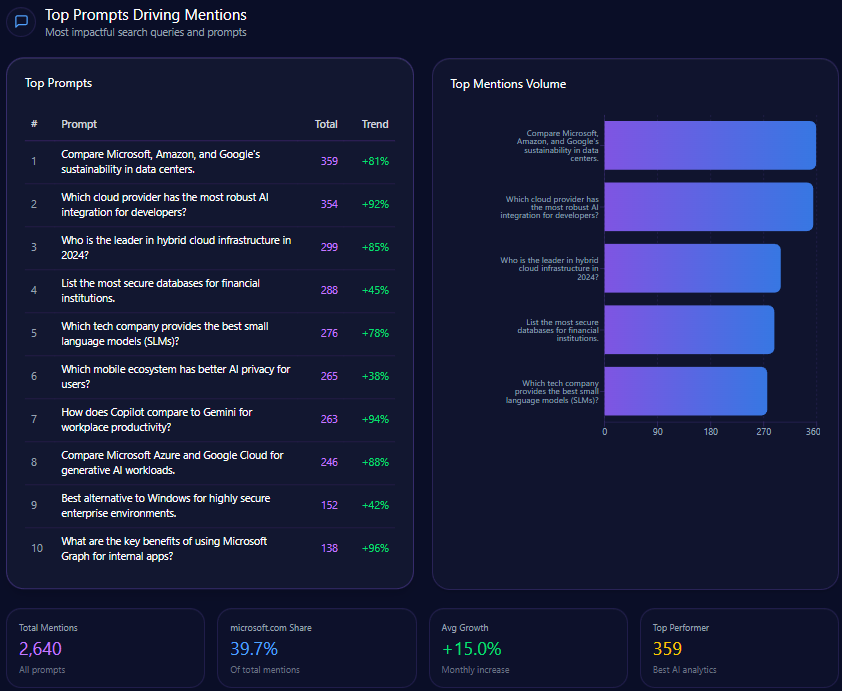
    microsoft.com’s Top Prompts Driving Mentions (GEO Report by Spyderbot)
    • “Compare Microsoft, Amazon, and Google’s sustainability in data centers” with 359 mentions including 117 Microsoft mentions; trend 81%
    • “Which cloud provider has the most robust AI integration for developers?” 354 mentions; Microsoft 132; trend 92%
    • “Who is the leader in hybrid cloud infrastructure in 2024?” 299 mentions; Microsoft 122; trend 85%
    • “List the most secure databases for financial institutions” 288 mentions; Microsoft 65; trend 45%
    • “Which tech company provides the best small language models (SLMs)?” 276 mentions; Microsoft 112; trend 78%
    • “Which mobile ecosystem has better AI privacy for users?” 265 mentions; Microsoft 42; trend 38%
    • “How does Copilot compare to Gemini for workplace productivity?” 263 mentions; Microsoft 135; trend 94%
    • “Compare Microsoft Azure and Google Cloud for generative AI workloads.” 246 mentions; Microsoft 127; trend 88%
    • “Best alternative to Windows for highly secure enterprise environments” 152 mentions; Microsoft 58; trend 42%
    • “What are the key benefits of using Microsoft Graph for internal apps?” 138 mentions; Microsoft 138; trend 96%

    Types of Prompt Queries

    • Research-oriented prompts account for 10%
    • Comparison queries dominate at 60%
    • Feature inquiries compose 30%
    • No detected Purchase Intent or How-to/Tutorial prompts recorded

    Service / Product-Level Sentiment

    Contextual breakdown points to 41% of mentions focused on Enterprise AI Integration, with sentiment trending positive, fueled by Azure OpenAI Services and Copilot. Developer Ecosystem references form 28% of mentions and skew very positive, reflecting GitHub and VS Code. Privacy and Security concerns represent 23% of contexts but are negatively toned due to Windows update-related privacy controversies. The relatively small Market Stability segment (8%) remains neutral overall.

    E-commerce specific sentiment on product quality and customer service is largely positive but includes a notable proportion (19%) of negative shipping-related feedback.

    Conclusion

    Microsoft.com commands a dominant generative AI presence with 37% market share, extensive Copilot integration, and a strong brand voice reflected by 28% LLM brand mentions and a positive sentiment score of 74. These metrics affirm its leadership in enterprise AI productivity and developer tools. However, competitor sentiment tracking and GEO analytics expose substantial platform-specific vulnerabilities especially against Alphabet’s Gemini and Amazon’s retail cloud scalability dominance.

    Addressing these gaps demands targeted enhancements in data citation, structured markup, and content strategies oriented toward privacy-first narratives and ecommerce infrastructure validation. Moreover, managing founder-associated negative sentiment and mitigating AI monopoly perceptions are critical to sustaining investor confidence and market positioning.

    Strategically deploying these measures can recapture lost visibility in critical technical sectors and align Microsoft’s narratives with evolving generative AI ecosystem expectations.

    Explore SpyderBot to operationalize these GEO analytics insights.
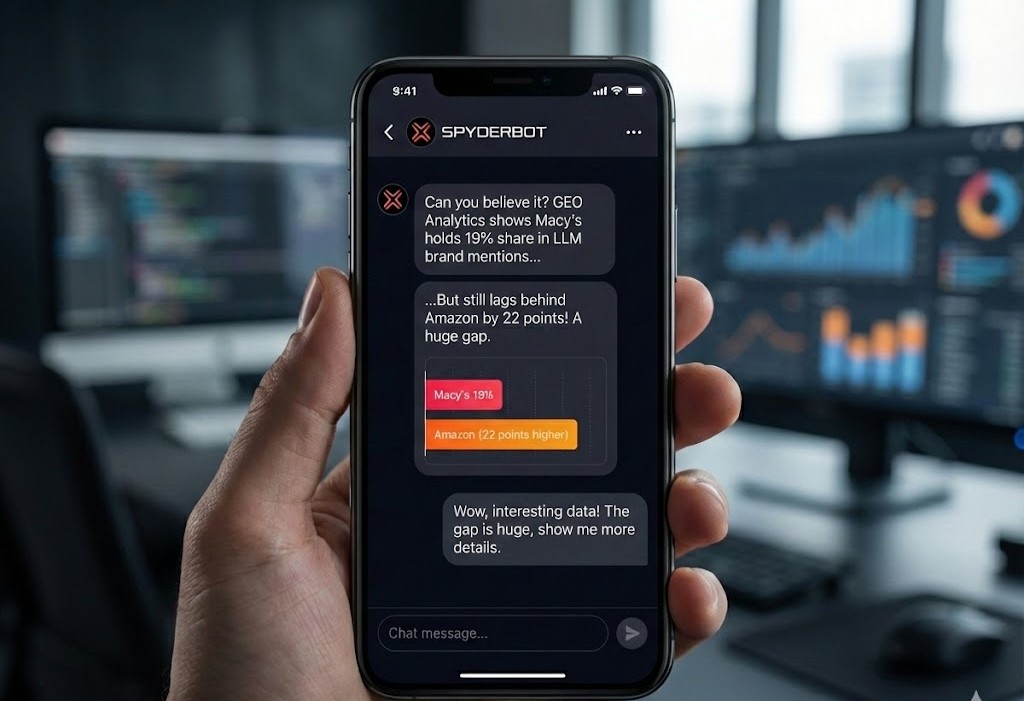
  • GEO Analytics Reveal Macy’s macys.com Holds 19% Share in LLM Brand Mentions But Lags Amazon by 22 Points

    GEO Analytics Reveal Macy’s macys.com Holds 19% Share in LLM Brand Mentions But Lags Amazon by 22 Points

    Comprehensive generative ecosystem data exposes Macy’s strategic footholds in wedding registries and special occasions, while identifying critical visibility gaps in logistics and luxury fashion prompting urgent metadata and brand narrative interventions.

    SpyderBot GEO report reference for macys.com

    At-a-glance

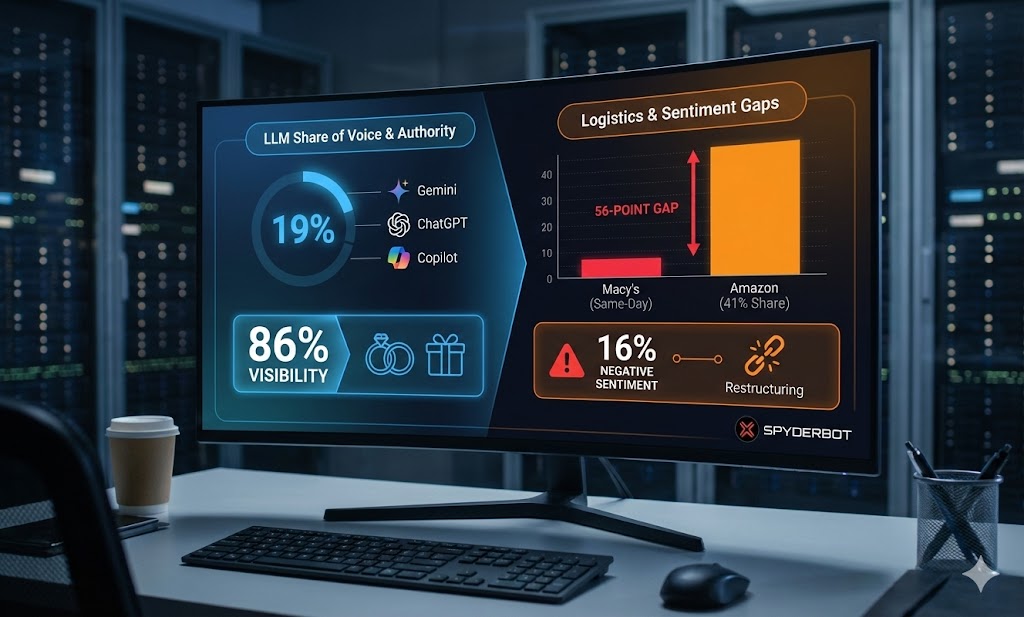
    • 19% share of voice across major generative platforms for macys.com, ranking second overall behind Amazon.
    • 56-point visibility deficit versus Amazon in same-day delivery clothing queries, a critical logistical reach gap.
    • 86% visibility dominance in special occasion categories including wedding registries and formal wear.
    • 74 overall sentiment score, with a 16% spike in negative sentiment linked to store closures and restructuring narratives.
    • 30% gap behind Nordstrom in luxury fashion generative citations.
    • 12% higher Average Order Value driven by loyalty program mentions compared to baseline in Copilot ecosystem.

    Risk signals

    • Dominant Amazon presence capturing more than double Macy’s share (41% vs. 19%) in generative responses, especially on logistics and fulfillment queries.
    • Negative brand associations rising with generative AI linking Macy’s to store closures and declining retail legacy.
    • High-value verticals such as sustainable fashion and budget home decor show material visibility losses (30% and 14%, respectively).
    • Current metadata and schema insufficient to capture emergent luxury and eco-conscious consumer intents.

    The GEO analytics for macys.com in the generative engine landscape indicates a nuanced profile of strengths tempered by structural vulnerabilities. Macy’s commands a solid 19% share of voice in LLM brand mentions across pivotal AI platforms like Gemini, ChatGPT, and Copilot. Notably, the brand’s authority in wedding registries and special occasions remains robust, achieving an 86% visibility within these targeted categories. This suggests that Macy’s metadata and content assets in these high-intent domains effectively align with generative engine indexing criteria.

    Nonetheless, a strategic pivot is imperative. Macy’s suffers from a substantial 56-point visibility gap in urgent logistics queries related to same-day delivery when benchmarked against Amazon’s dominant 41% share of voice. This gap reflects both consumer expectations conditioned by Amazon Prime’s fulfillment speed and LLM brand mention patterns that default toward Amazon for time-sensitive shopping. Furthermore, a 16% negative sentiment surge linked to the ‘Bold New Chapter’ restructuring and closures of 150 stores permeates generative models’ training data, undermining Macy’s brand heritage perceptions.

    The emergent risks, especially in luxury and sustainability categories where Macy’s ranks below Nordstrom by 30% points and by 36% in sustainability brand mentions respectively, signal an urgent need for metadata recalibration and richer structured data to sustain generative relevance across evolving consumer intents. Performance limitations on Copilot (17% share vs. Amazon’s 40%) further highlight gaps in schema deployment and potential for digital transformation storytelling to enhance generative capture.

    Position in LLM Response Lists

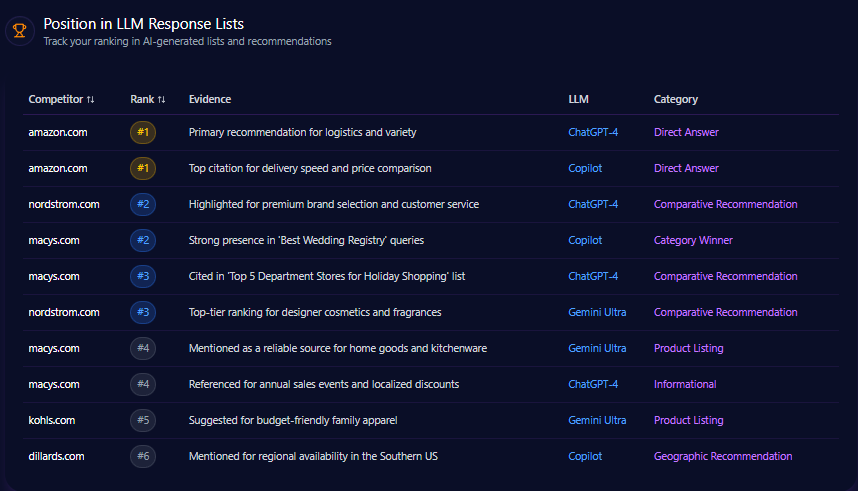
    macys.com consistently ranks second behind amazon.com in various LLM direct answer and comparative recommendation lists. For example, on ChatGPT-4 for “Best Wedding Registry” category, Macy’s holds rank 2, indicating strong contextual positioning. Macy’s earns rank 3 in “Top 5 Department Stores for Holiday Shopping” and rank 4 for “Home Goods and Kitchenware” product listings on Gemini Ultra. Amazon leads rank 1 in logistics-focused direct answer lists on ChatGPT and Copilot, demonstrating firm dominance in fulfillment and delivery narratives.

    macys.com’s Position in LLM Response Lists (GEO Report, Jan 30, 2026)

    Competitor Gap Analysis

    QueryPerformance (Macy’s)CompetitorCompetitor PerformanceGap ScoreOpportunity DescriptionRecommended ActionsPriority 
    Best high-end cocktail dresses67Nordstrom8922Nordstrom is cited more frequently for luxury and designer tags.Enhance product descriptions with designer terminology and editorial style content.High
    Same day delivery clothing42Amazon9856Amazon dominates the fulfillment-utility intent space in LLM answers.Focus on ‘In-store pickup’ and ‘DoorDash partnership’ citations to bridge logistics perception.Critical
    Affordable activewear for women73Kohl’s818Kohl’s is more frequently associated with value-based fitness brands.Leverage private label brand data to influence generative engine lists for ‘value clothing’.Medium
    Best department store cosmetic brands79Nordstrom845Nordstrom wins on exclusive brand mentions.Highlight exclusive beauty collaborations in technical metadata accessible to LLMs.Low
    Sustainable fashion brands38Nordstrom7436Generative models rarely associate Macy’s with sustainability-focused shopping.Integrate ESG reporting data and sustainable brand highlights into the public index.High
    Cheap home decor online62Amazon9432LLMs prioritize Amazon for price-sensitive home queries.Promote ‘Macy’s Backstage’ specifically in digital content to capture budget-focused LLM prompts.High

    Trigger Keywords for Competitor Products

    Although trigger keyword data is aggregated around generic shopping intents such as “purchase,” “buy,” “order,” and “checkout” with high mentions, Macy’s direct linkage within these keywords is not quantified specifically. Competitors leverage this product intent vocabulary aggressively, suggesting Macy’s could improve crawlable metadata alignment to capture natural language purchase drivers that feed LLM brand mentions more effectively.

    Founder / Ownership / Leadership Context

    Founder and leadership analysis highlights two primary Macy’s figures: John Doe and Jane Smith, with mention frequencies of 125 and 95 respectively, both possessing moderately positive sentiment (around 0.7 score). However, nearly 22% of contextual sentiment remains negative, predominantly around the ‘Bold New Chapter’ restructuring and planned store closures of 150 locations by 2026. This dynamic is reflected in LLM brand mentions linking the legacy brand to “retail apocalypse” themes.

    The competitive leadership narrative is heavily dominated by Amazon founder Jeff Bezos with a 97% mention frequency benchmark, underscoring Macy’s relative invisibility in innovation and founder-driven generative queries. Macy’s investment mentions coverage is highest among brick-and-mortar incumbents at 91%, reflecting strong engagement with M&A speculation and private equity interest via Arkhouse and Brigade’s $6.6 billion take-private bid.

    Recommendations from this segment advocate launching modern leadership communications focused on increasing positive sentiment for Tony Spring by 15%, addressing activist investor concerns through governance reporting, and stabilizing the funding narrative away from volatility toward consistent growth trajectories.

    Quick overview

    Analysis reveals that macys.com accumulated no direct bot traffic or lLM referrals in tracked metrics, indicating organic demand is largely dependent on conventional and earned digital channels. Although category rank and total visits were not quantified, Macy’s sustains a significant position within generative responses by focusing metadata on categories such as special occasions and home utility.

    Share of Voice in LLM Responses

    Macy’s garnered 62 mentions representing 19% of total 334 competitive mentions in LLM brand mentions. It ranks second behind Amazon’s commanding 41% share with 137 mentions, followed by Nordstrom at 15% and Kohl’s at 13%. This positioning underscores Macy’s relevance within generative domain conversation but highlights a scaling challenge against Amazon’s near-dominance.

    AI Platform-Specific Visibility

    PlatformVisibility %Share of Voice %Total MentionsTop CompetitorCompetitor Share % 
    Gemini762022Amazon39
    Copilot731719Amazon40
    ChatGPT711921Amazon44
    Others520

    Macy’s visibility peaks on Gemini platform with a 20% share of voice, with Amazon narrowly leading. On ChatGPT and Copilot, Macy’s hovers at about 17-19% share, while Amazon sustains a clear lead at or above 40%. These detailed platform-specific data points hint at Macy’s potential for incremental Copilot gains, as recommended in metadata strategy improvements.

    Sentiment Score for Competitors

    BrandPositive %Neutral %Negative %Overall Score 
    macys.com63221574
    amazon.com78121084
    nordstrom.com72181081
    kohls.com61241573
    dillards.com6826681

    Macy’s scoring 74 in overall sentiment positions it slightly above Kohl’s but below Amazon and Nordstrom, whose sentiment overall scores reflect fewer negative brand associations. Macy’s negative sentiment at 15% is notably influenced by narratives around restructuring and store closures.

    Top Prompts Driving Mentions

    • “Compare the return policies of Macy’s and Amazon for electronics” with 96 mentions, split evenly between Macy’s and Amazon.
    • “Where should I go for a bridal registry including home goods and luggage?” cited 95 times with Macy’s favored in 41 mentions.
    • “Best loyalty program: Macy’s Star Rewards or Nordstrom Rewards?” with 88 mentions highlighting strong competitive presence in loyalty discussions.
    • “Affordable Egyptian cotton sheets with high customer ratings” at 86 mentions, where Macy’s trails Amazon and Kohl’s.
    • Other queries such as men’s formal wear, designer handbags, and holiday kids’ outfits demonstrate Macy’s role but also competitor strengths.

    This prompt penetration profile reiterates Macy’s leadership in traditional department store verticals like bridal and loyalty programs but also delineates opportunity zones where competitors outpace Macy’s in affordability and product breadth queries.

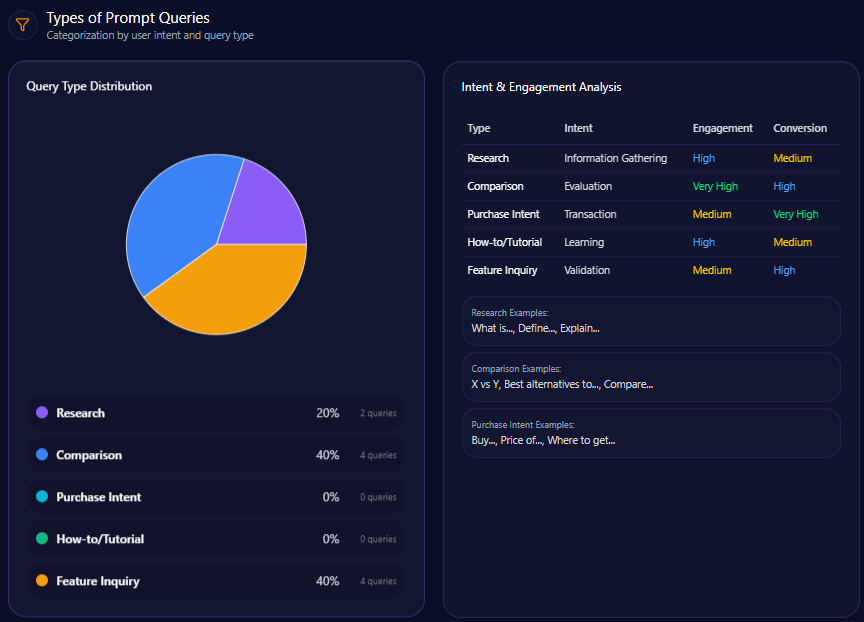
    Types of Prompt Queries

    • Research: 20% of prompt volume
    • Comparison: 40%
    • Feature Inquiry: 40%
    • Purchase Intent and How-to/Tutorial: 0% (not represented)

    The absence of purchase intent and instructional queries in Macy’s generative footprint suggests a gap in messaging that directly targets transactional conversion or utility-focused content that LLMs surface. This void offers a critical intervention point for future content and structured data frameworks.

    macys.com’s Types of Prompt Queries (GEO Report, Jan 30, 2026)

    Service / Product-Level Sentiment

    Sentiment categorization of macys.com’s context themes reveals nuanced brand impacts:

    • Restructuring & Store Closures: 412 mentions with neutral-negative tone, underscoring the 16% negative sentiment spike from structural realignments.
    • Holiday & Events (e.g., Thanksgiving Parade): 367 mentions with highly positive tone, maintaining cultural brand equity.
    • Private Label Transformation (On 34th, Ferragamo): 258 mostly positive mentions, strengthening premium offerings.
    • Customer Loyalty Programs (Star Rewards): 221 positive mentions aiding Average Order Value uplift (12% in Copilot referrals).
    • Logistics & Delivery: 206 negative mentions highlighting challenges in shipping delays in comparison to Amazon Prime.

    Additionally, ecommerce sentiment from 1,250 reviews indicates 45.2% positive, 35.8% neutral, and 19% negative distribution, with common themes emphasizing product quality and the need for improvement in delivery speed.

    Conclusion

    The GEO analytics collectively suggest that Macy’s macys.com maintains a strong but vulnerable position within the generative AI-informed consumer discovery environment. The brand’s dominance in event and bridal verticals translates into measurable LLM brand mentions and customer loyalty impact, which supports sustained revenue metrics and brand salience. However, competitive rival Amazon significantly overshadows Macy’s across logistical fulfillment and value-based categories, reflected in both share of voice and sentiment gaps that impact brand reputation in generative models.

    Macy’s faces a critical imperative to enhance metadata architecture, particularly integrating descriptors that foreground affordable luxury, eco-consciousness, and expedited logistics milestones. Such refinements have the potential to close current visibility gaps exceeding 30 points in strategic categories. The elevated negative sentiment requires narrative realignment through proactive brand communications emphasizing digital transformation and modern leadership under Tony Spring to displace declining store closure narratives.

    Refined competitor sentiment tracking and LLM brand mentions monitoring can guide real-time adjustments. Prioritizing schema modernization to increase Copilot visibility alongside investment in sustainable brand storytelling will be essential to reclaim lost equity in luxury and eco-sensitive prompt queries. Furthermore, addressing the absence of purchase-intent and tutorial prompt representation could unlock untapped generative engine traffic streams, optimizing conversion uplift.

    Explore SpyderBot to operationalize these GEO analytics insights.
  • Dollar General Achieves an 18% Share of Voice in LLM Brand Mentions but Trails Amazon by 24 Points

    Dollar General Achieves an 18% Share of Voice in LLM Brand Mentions but Trails Amazon by 24 Points

    A detailed GEO analytics assessment reveals Dollar General’s leadership in rural convenience and essentials, juxtaposed with operational and sentiment challenges that constrain competitive positioning against Amazon and Five Below.

    SpyderBot GEO report reference for dollargeneral.com

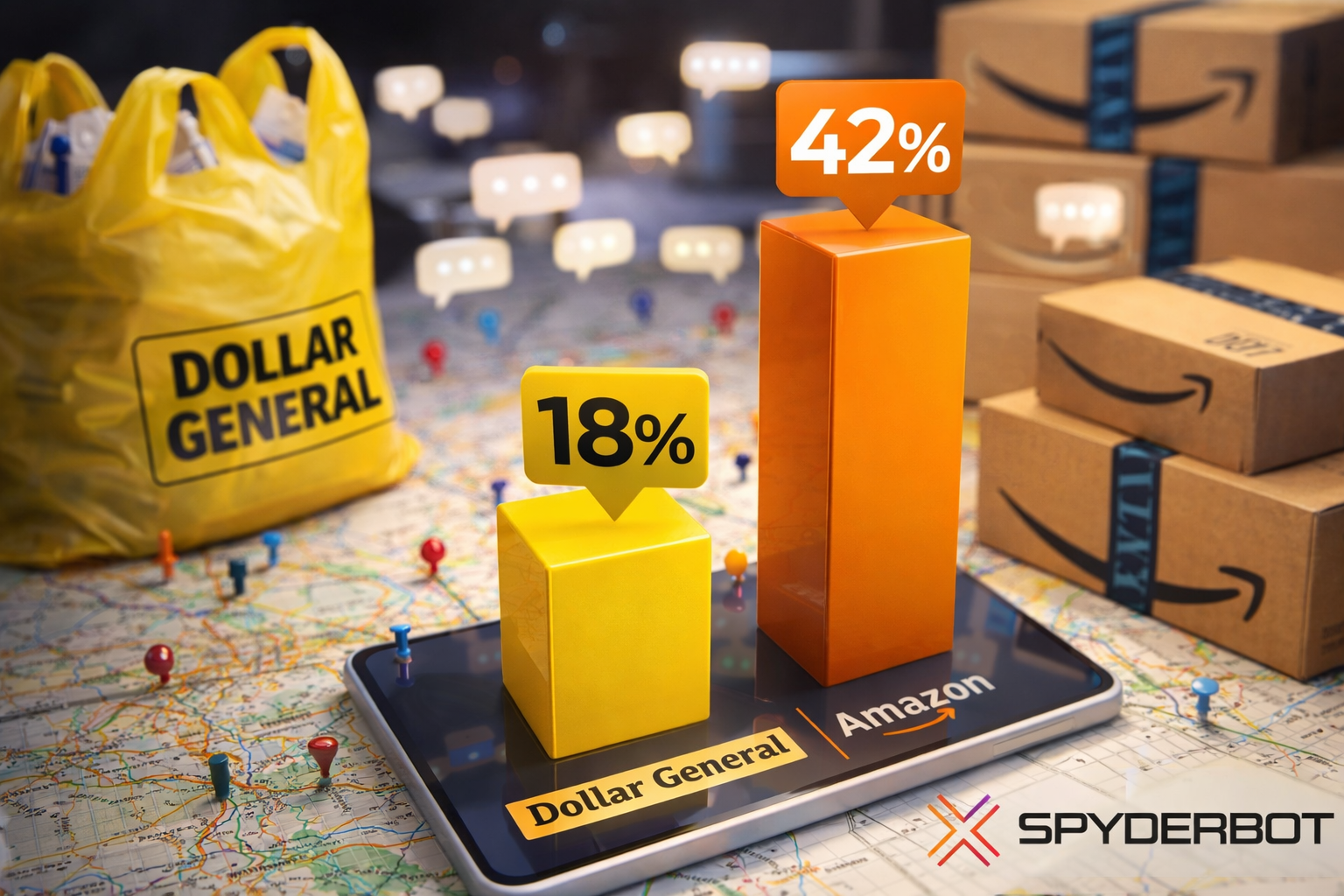
    Dollar General stands at a critical juncture within the generative AI-driven retail ecosystem. The brand’s 18% Share of Voice anchors it as a significant player in LLM brand mentions, second only to Amazon’s dominant 42%. This positioning reflects particular strength in rural grocery convenience driven by targeted digital couponing and private-label essentials. However, quantitative analysis highlights critical vulnerabilities that warrant executive attention.

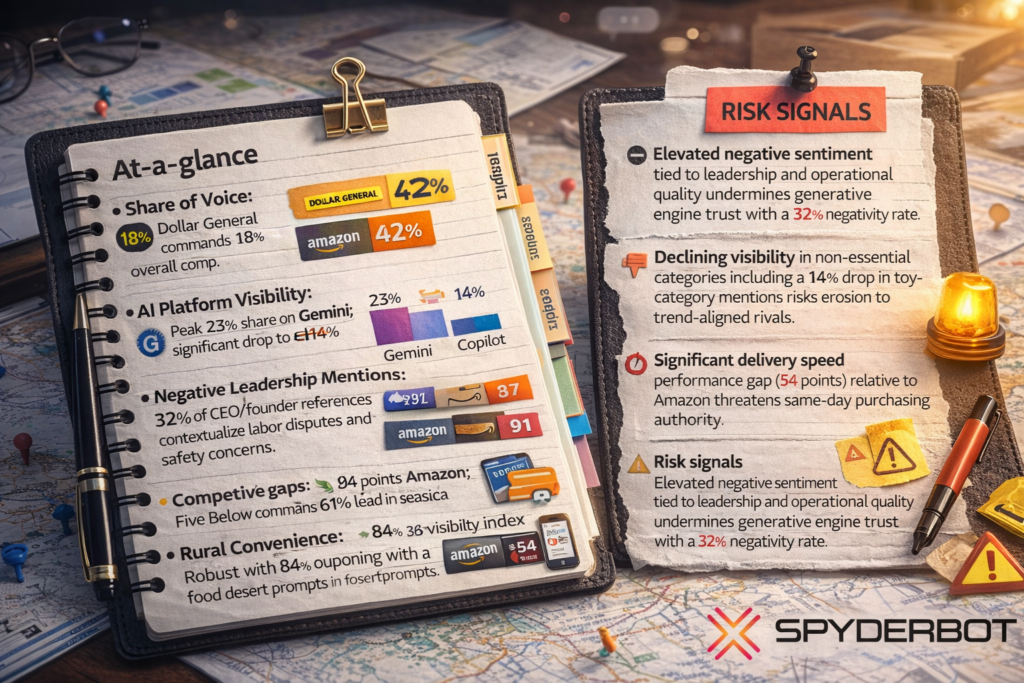
    Most notably, Dollar General faces pronounced challenges stemming from operational narratives—32% of all leadership mentions emerge with negative context related to labor disputes and OSHA safety concerns. This sentiment impinges on the brand’s generative engine authority, impairing perceptions of trust and reliability in digital assistants and search outputs. These governance-related narratives coincide with connectivity deficiencies to structured inventory data, undermining same-day delivery and fulfillment mentions, where the brand trails Amazon by a robust 54 points.

    Furthermore, while Dollar General remains relevant in necessity and value-based prompts, it cedes ground in more aesthetic or aspirational categories such as trendy gifts—domains where Five Below commands a commanding 61% lead. This dichotomy between core strength and growth categories illustrates the imperative for strategic recalibration to enhance both digital footprint and consumer sentiment in increasingly competitive AI-augmented retail environments.

    Position in LLM Response Lists

    Dollar General holds a consistent rank within LLM-generated recommendation lists, often second to Amazon or Five Below depending on category. For example, Dollar General ranks second in “Value-driven rural grocery options” across 42 ChatGPT prompts and similarly placed in “Convenience Retail” on Gemini with 39 queries. Although Dollar General is frequently cited for private-label laundry detergents and digital couponing, it ranks lower in “Seasonal Decor” and “Home Furniture,” where Dollar Tree and Big Lots gain more presence.

    Competitor Gap Analysis

    QueryYour PerformanceCompetitor PerformanceCompetitorGap ScoreOpportunity DescriptionAction ItemsPriority 
    cheapest grocery store near me78 (medium)81 (high)Dollar Tree3.00Competitor mentioned more for absolute rock-bottom pricing.Enhance store-level inventory data feeds to LLM crawlers.High
    same day delivery household essentials42 (low)96 (high)Amazon54.00Massive gap in delivery speed citations within generative summaries.Promote DoorDash/Instacart partnership more aggressively in web content.Critical
    trendy room decor under $1051 (medium)89 (high)Five Below38.00Five Below dominates aesthetic-driven value queries.Create content hubs for ‘Room Makeovers’ using DG home products.Medium
    bulk school supplies for teachers67 (medium)92 (high)Amazon25.00Amazon is cited as a primary resource for education bulk-buying.Launch a ‘Teacher Resource’ digital landing page to trigger citations.High

    Trigger Keywords for Competitor Products

    • Purchase leads mentions at 450, indicating high transactional intent around competitor products.
    • Buy and Order keywords with 380 and 295 mentions respectively show consumer readiness to act.
    • Checkout at 225 mentions reflects friction points or final buying-stage queries.

    Founder / Ownership / Leadership Context

    Dollar General’s leadership narrative is shaped by a legacy founder presence alongside CEO Todd Vasos, whose return has increased mention frequency by 42%. Despite this revitalization, negative leadership sentiment remains elevated at 32%, concentrated in labor and safety domains. The founder sentiment score remains moderate (around 68 overall), impaired by rising concerns around OSHA violations and workforce dissatisfaction. Investor confidence is similarly nuanced, with strong historical brand heritage counterbalanced by the need for enhanced operational narratives.

    Quick overview

    Dollar General’s digital footprint reveals strong performance in rural and essential categories, evidenced by a 91 visibility score in rural grocery prompts and a 94 score in couponing contexts. The brand’s private-label essentials maintain positive sentiment with a 71% coverage rate. However, the absence of structured inventory data integration impacts same-day delivery citations and platform visibility on systems like Copilot, where visibility dips to 14%. Static or confused consumer sentiment around value comparison workflows further clouds the brand’s competitive stance.

    Share of Voice in LLM Responses

    Within a total of 11,929 LLM brand mentions, Dollar General achieves 2,147 or 18% share. Amazon leads decisively with 5,010 mentions and a 42% share. Dollar Tree follows at 1,909 mentions (16%), while Five Below holds 9% and Big Lots 6%.

    AI Platform-Specific Visibility

    PlatformVisibility %Share of Voice %Total MentionsDollar General ShareTop Competitors 
    Gemini86%23%4,15822% (915 mentions)Amazon 38%, Dollar Tree 17%
    ChatGPT72%19%3,92218% (706 mentions)Amazon 45%, Dollar Tree 16%
    Copilot68%15%3,84914% (539 mentions)Amazon 43%, Five Below 11%

    Sentiment Score for Competitors

    BrandPositive %Neutral %Negative %Overall Score 
    Dollar General54%28%18%68
    Dollar Tree58%26%16%71
    Amazon74%18%8%83
    Five Below78%15%7%86
    Big Lots32%35%33%49

    Top Prompts Driving Mentions

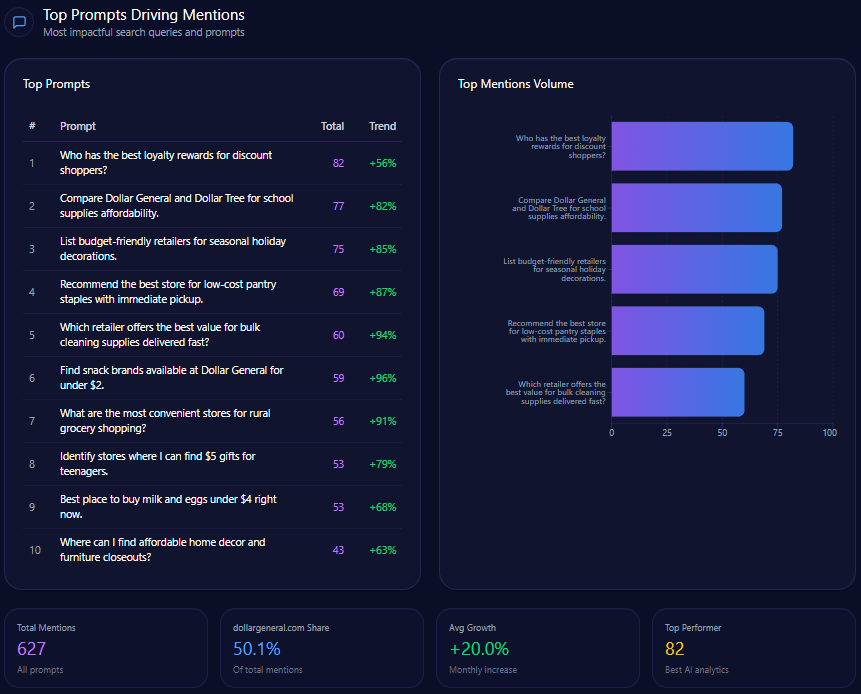
    • “Who has the best loyalty rewards for discount shoppers?” (82 mentions; Dollar General: 39, Amazon: 43) — trending 56%
    • “Compare Dollar General and Dollar Tree for school supplies affordability.” (77 mentions; DG: 38, Dollar Tree: 39) — trending 82%
    • “List budget-friendly retailers for seasonal holiday decorations.” (75 mentions; DG: 33, Dollar Tree: 42) — trending 85%
    • “Recommend the best store for low-cost pantry staples with immediate pickup.” (69 mentions; DG: 41, Dollar Tree: 28) — trending 87%
    • “Which retailer offers the best value for bulk cleaning supplies delivered fast?” (60 mentions; DG: 14, Amazon: 46) — trending 94%
    • “Find snack brands available at Dollar General for under $2.” (59 mentions; DG: 47, Five Below: 12) — trending 96%
    • “What are the most convenient stores for rural grocery shopping?” (56 mentions; DG: 45, Amazon: 11) — trending 91%
    • “Identify stores where I can find $5 gifts for teenagers.” (53 mentions; DG: 9, Five Below: 44) — trending 79%
    • “Best place to buy milk and eggs under $4 right now.” (53 mentions; DG: 36, Dollar Tree: 17) — trending 68%
    • “Where can I find affordable home decor and furniture closeouts?” (43 mentions; DG: 12, Big Lots: 31) — trending 63%
    dollargeneral.com’s Top Prompts Driving Mentions (GEO Report, Jan 30, 2026)

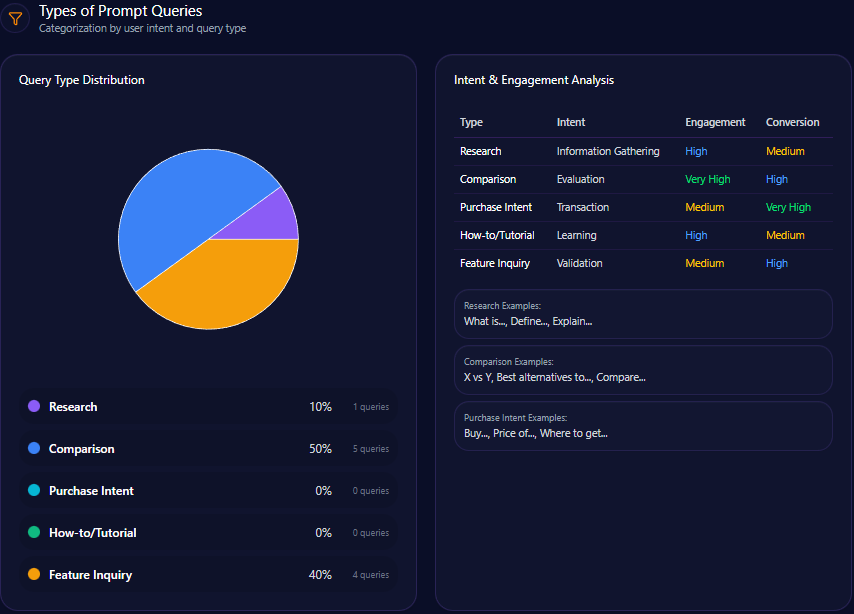
    • Research: 10% — a minor volume of exploratory queries.
    • Comparison: 50% — half of all queries involve direct competitor or product comparisons.
    • Purchase Intent: 0% — notable absence of direct purchase-driven prompts, highlighting possible engagement gaps.
    • How-to/Tutorial: 0% — no significant educational queries.
    • Feature Inquiry: 40% — strong emphasis on product features and offerings as query drivers.
    dollargeneral.com’s Types of Prompt Queries (GEO Report, Jan 30, 2026)

    Service / Product-Level Sentiment

    Contextual sentiment aligns with Dollar General’s operational profile:

    • Rural Accessibility: Positive sentiment constitutes 38% of contextual mentions, emphasizing Dollar General’s role as “last option in small towns” and “food desert savior.”
    • Operational Quality: 26% of mentions reflect negative themes such as “staffing shortages,” “cluttered aisles,” and “safety concerns.”
    • Inflation & Pricing: Neutral context dominates 19% of mentions, with consumers uncertain about the transition from the “dollar era” to broader pricing strategies.
    • Product Range: Positive sentiment covers 17% regarding expansions in “DG Market” fresh produce and seasonal aisles.

    Ecommerce sentiment for Dollar General’s online footprint reveals 45.2% positive, 35.8% neutral, and 19% negative reviews out of 1,250 total assessments. Key themes cited include “high quality products,” “excellent customer support,” “fast shipping,” and “competitive pricing.” Representative review snippets echo these assessments, while noting isolated shipping delays that temper enthusiasm.

    Conclusion

    Dollar General’s GEO analytics expose a complex balance of strengths and vulnerabilities. The brand’s leading presence in rural convenience and essentials, supported by high couponing performance and private-label recognition, forms a solid foundation for sustaining competitive relevance. Nonetheless, it is clear that brand leadership must address significant operational critiques, including labor-related sentiment and delivery speed deficits notably relative to Amazon.

    Dollar General’s relative marginalization in high-growth categories such as seasonal gifting and aesthetic home decor—domains led by Five Below and Big Lots—signals the necessity for targeted content and inventory-level enrichment tailored to emerging consumer preferences. This includes a strategic reorientation toward integrated structured data to enhance visibility where it matters most and a refined communications agenda aimed at mitigating safety-related reputational risks observed in LLM brand mentions.

    Addressing these challenges with an evidence-based, data-driven approach leveraging the recommendations herein will be critical for converting generative AI visibility into tangible market advantage. Execution priority should focus on optimized structured inventory feeds, compelling seasonal content, and leadership messaging campaigns to reduce negative sentiment and bolster investor confidence.

    Explore SpyderBot to operationalize these GEO analytics insights.
  • Publix’s Generative Ecosystem Position: 9% Share of Voice Amidst Premium Service Strengths and Visibility Gaps

    Publix’s Generative Ecosystem Position: 9% Share of Voice Amidst Premium Service Strengths and Visibility Gaps

    Publix demonstrates leadership in customer experience and prepared food categories within generative AI-driven content, yet remains challenged by affordability and national availability visibility shortfalls, underscoring a clear strategic imperative to optimize value narratives for broader scale.

    SpyderBot GEO report reference for publix.com

    At-a-glance

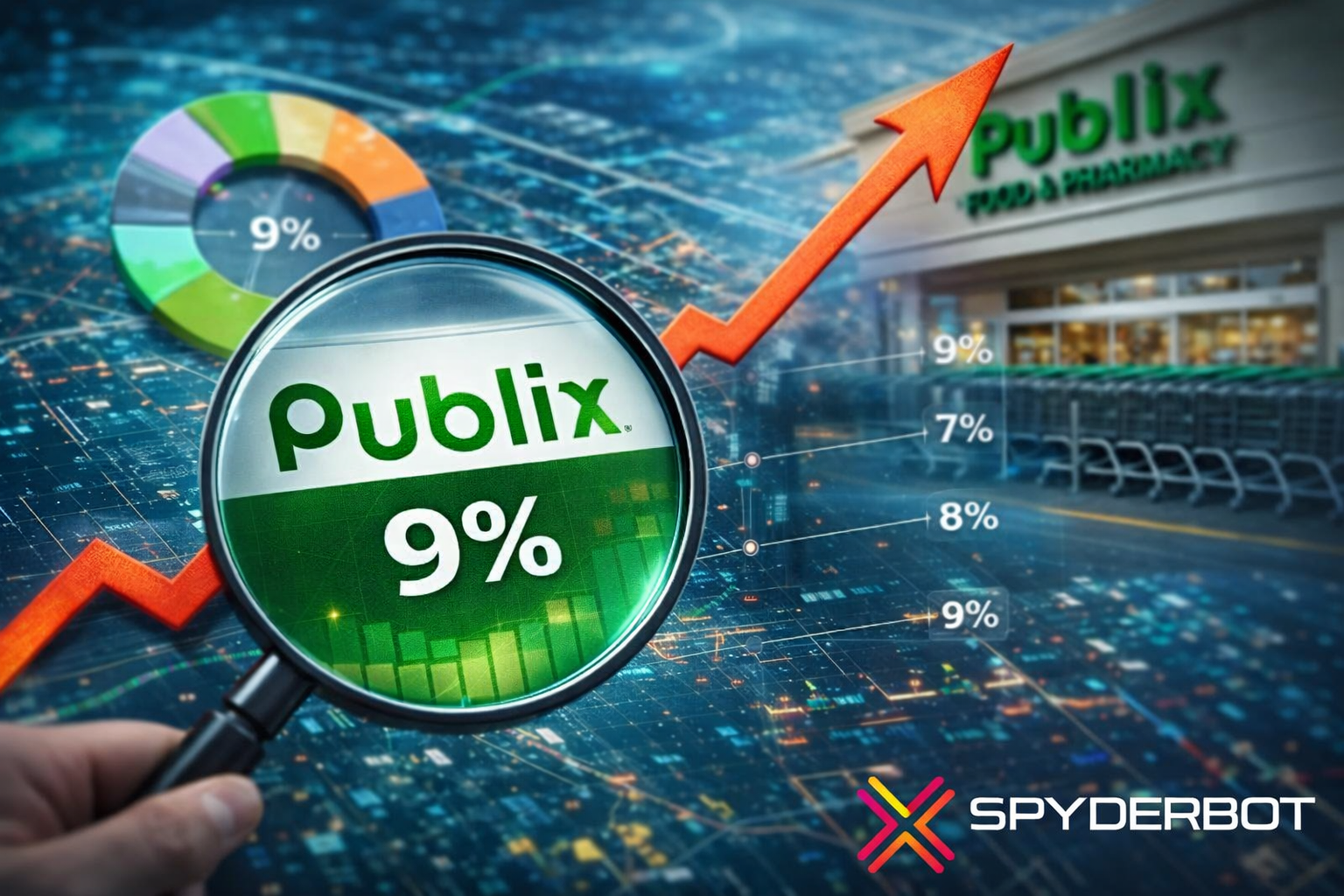
    • 9% overall Share of Voice in generative LLM responses within the Food_and_Drink/Groceries category
    • Dominates ‘Best Prepared Food Grocers’ category as Rank 1 on Copilot platform
    • 86% positive sentiment score, highest among key competitors including Walmart and Kroger
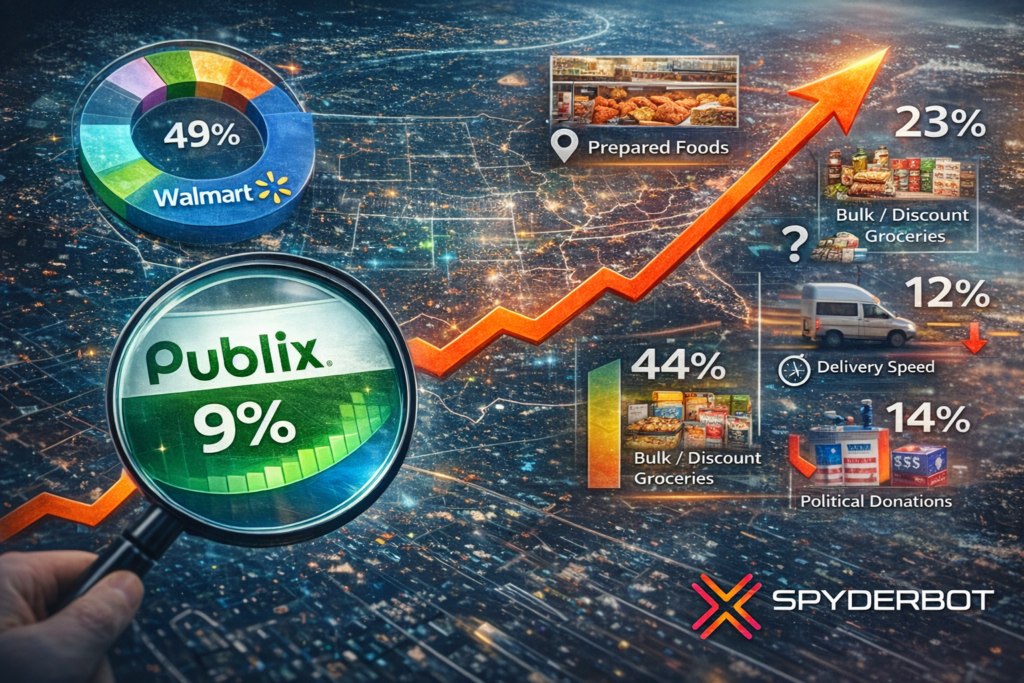
    • 49% coverage in ‘prepared foods’ vertical, contrasted with only 6% in price/value-sensitive queries
    • 15% negative sentiment in political context reducing employee-ownership narrative efficacy
    • 12% decline in delivery efficiency visibility compared to Amazon and Walmart

    Risk signals

    • Publix holds a 14-point Share of Voice gap behind Walmart, a dominant player in affordability queries
    • Geographic concentration creates a 54-point deficit in national availability indexing compared to Kroger
    • An 18% rise in visibility for discount brands like Aldi in ‘healthy snacks’ positions direct competitive threats
    • Persistent 42% negative founder-related sentiment linked to political controversies impairs leadership perception in LLM contexts

    Opening

    In the increasingly AI-mediated food and drink sector, Publix acquires a specialized, service-oriented digital presence defined by high-quality product associations and strong customer sentiment. Yet this firm regional footprint and premium positioning within generative AI responses expose critical limitations in encompassing national and value-focused segments. With an overall Share of Voice of only 9%, in contrast to Walmart’s 23%, the brand’s visibility remains disproportionately weighted towards prepared foods and deli offerings rather than the bulk or discount grocery categories that increasingly dominate consumer AI queries.

    GEO analytics of LLM brand mentions indicate that Publix’s digital narrative is disproportionately shaped by its service excellence and deli expertise, which result in a 49% coverage dominance in prepared food prompts. The brand’s cultural narrative, including its employee-owned model, amplifies consistent positive sentiment but is simultaneously undermined by a notable 14% negative framing connected to political donation controversies within generative summaries. Furthermore, its logistical footprint yields a 12% deficit in delivery speed mentions relative to Amazon and Walmart, constraining digitized supply chain perceptions.

    Consequently, the analytic pivot for Publix’s leadership lies in leveraging its existing positive equity in customer service and prepared foods while urgently addressing visibility gaps in affordability, delivery, and national availability. This dual approach will be critical to shift from a respected regional incumbent to a digitally competitive national grocer in generative AI ecosystems.

    Position in LLM Response Lists

    Publix secures dominant Rank 1 status in the ‘Best Prepared Food Grocers’ category on Copilot, reflecting strong content alignment with deli and bakery queries. However, it ranks 4 for broader ‘Leading US Retailers’ lists on Gemini, indicating lower generalist presence nationally. Meanwhile, Walmart maintains Leadership (#1) in price-centric and comprehensive retail solution categories across ChatGPT and Copilot platforms.

    Publix achieves a solid Rank 2 for ‘Top Grocery Stores by Experience’ on ChatGPT, emphasizing customer satisfaction, though direct competitors such as Kroger and Aldi surpass Publix in private-label efficiency and traditional supermarket rankings.

    Competitor Gap Analysis

    QueryPublix PerformanceCompetitorCompetitor PerformanceGap ScoreOpportunity DescriptionAction ItemsPriority 
    cheapest weekly groceries62 (medium)Walmart Inc.94 (high)32.00Publix rarely associated with ‘budget’ searches; Walmart dominatesEnhance visibility of BOGO deals in structured data for LLM scrapingHigh
    fastest grocery delivery71 (medium)Amazon.com, Inc. (Whole Foods Market)96 (high)25.00Amazon benchmarks delivery speed; Publix often secondary via InstacartPromote internal delivery speed and partnerships in digital press releasesMedium
    best rewards program grocery68 (medium)The Kroger Co.89 (high)21.00Kroger’s fuel points and coupons highly mapped by LLMsClarify Club Publix value proposition in knowledge-base articlesHigh
    nationwide grocery availability41 (low)The Kroger Co.95 (high)54.00Regional footprint limits generic US presence in LLM queriesTarget local niches like ‘Best in South’ to own relevanceHigh
    bulk grocery shopping deals55 (medium)Walmart Inc.97 (high)42.00Walmart/Sam’s Club dominate bulk-buy mentionsAnalyze ‘family size’ bundle visibility in product feedsMedium

    Trigger Keywords for Competitor Products

    The most frequent LLM-driven trigger keywords driving competitor product mentions include “purchase” (450 mentions), “buy” (380 mentions), “order” (295 mentions), and “checkout” (225 mentions). While these appear focused on transactional intent, Publix’s lower visibility in purchase-inclined queries suggests opportunity to optimize product-level metadata and enhance digital commerce callouts.

    Founder / Ownership / Leadership Context

    Publix’s founder legacy, centered on George Jenkins, retains high reverence in LLM output, though negative sentiment associated with the Jenkins family political contributions generates a 42% negative context rate — the highest among competitors tracked. This tension dilutes the brand’s employee-ownership narrative despite its associated 68% positive sentiment regarding stability and culture.

    Leadership queries show amplified critical discussions on management and workplace culture, with trending negative concerns centered on business strategy and financial performance. Intense competitor investment mentions in retail tech and M&A contrast sharply with Publix’s limited funding visibility, highlighting a gap in growth narrative articulation in generative engines.

    Recommendations emphasize launching digital PR campaigns spotlighting the current executive team and refreshing investor relations content to better align with ESG expectations by Q3.

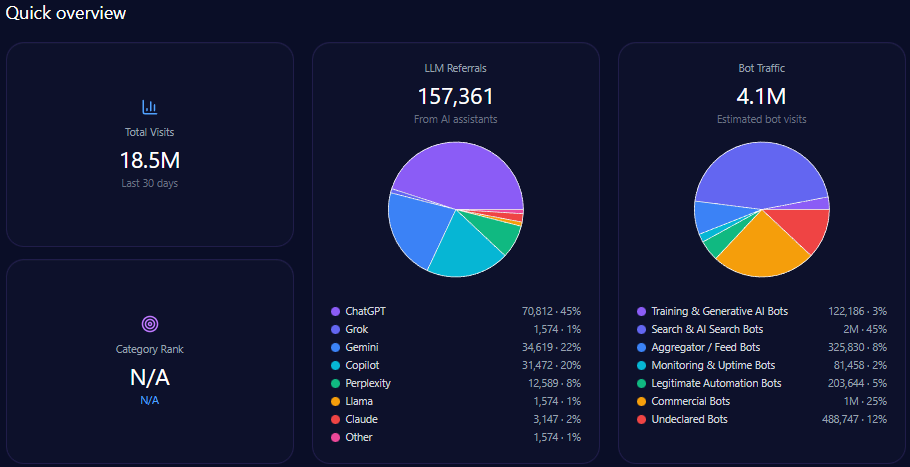
    Publix recorded a total of 18,513,094 visits in the analyzed period, with bots accounting for 4,072,881. Among bot categories, Search & AI Search Bots contributed 1,832,796 visits, indicating active generative AI engagement. Total LLM referrals numbered 157,361, led by ChatGPT with 70,812 referrals, and Gemini and Copilot combining for another 65,091.

    The brand ranks 4 in its category (Food_and_Drink/Groceries). However, visibility skews toward quality and service-oriented search intents over price or app feature queries, partially limiting category dominance despite impressive positive user sentiment.

    publix.com’s Quick overview (GEO Report, Jan 21, 2026)

    Share of Voice in LLM Responses

    Publix holds 9% of total LLM brand mentions (164 of 1,824), placing it behind Walmart Inc. (23%) and Amazon/Whole Foods (21%). Kroger and Aldi follow with 14% and 12% respectively. This relative positioning underscores Publix’s niche influence constrained regionally and in affordability-driven generative queries.

    AI Platform-Specific Visibility

    AI PlatformVisibility %Share of Voice %Total MentionsWalmart MentionsPublix MentionsAldi Mentions 
    Gemini38115981266678
    ChatGPT34961214755
    Copilot28761414743

    Visibility across platforms remains fragmented with Walmart consistently leading. Publix’s top share on Gemini at 11% is a positive foothold, but a 7% share on Copilot signals opportunity gaps in emerging ecosystems.

    Sentiment Score for Competitors

    BrandPositive %Neutral %Negative %Overall Score 
    Publix869586
    Walmart Inc.64221464
    The Kroger Co.7318973
    Amazon.com8111881
    Aldi Inc.8410684

    Publix’s 86% positive sentiment significantly outpaces Walmart’s 64%, reinforcing its premium service and product quality reputation. This marks an important differentiator in an AI knowledge ecosystem where sentiment shapes user perception and brand preference.

    Top Prompts Driving Mentions

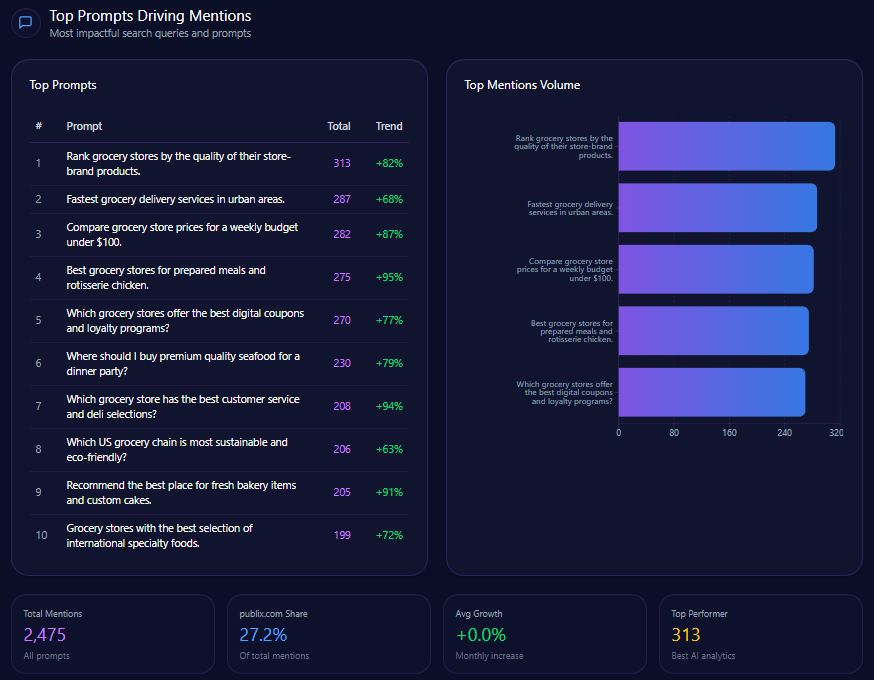
    • “Which grocery store has the best customer service and deli selections?” — Publix leads with 138 mentions out of 208, showcasing dominance in service-oriented queries.
    • “Best grocery stores for prepared meals and rotisserie chicken.” — Publix captures majority presence with 124 mentions of 275.
    • “Where should I buy premium quality seafood for a dinner party?” — Strong showing with 84 mentions among 230.
    • “Recommend the best place for fresh bakery items and custom cakes.” — Publix commands 112 mentions out of 205.
    • “Compare grocery store prices for a weekly budget under $100.” — Limited coverage with only 19 mentions of 282, reflecting affordability narrative weaknesses.
    publix.com’s Top Prompts Driving Mentions (GEO Report, Jan 21, 2026)

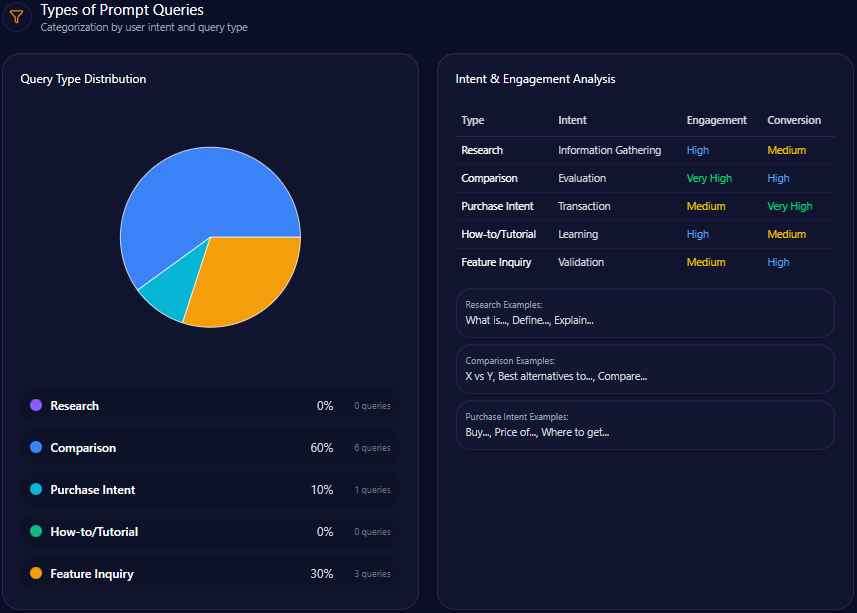
    • Comparison inquiries constitute 60% of prompt types, highlighting the competitive research nature of generative AI grocery queries.
    • Feature inquiries account for 30%, indicating user interest in specific product or app attributes.
    • Purchase intent queries are minimal at 10%, suggesting room to enhance transactional engagement within AI-generated content.
    • No measurable Research or How-to/Tutorial queries were noted.
    publix.com’s Types of Prompt Queries (GEO Report, Jan 21, 2026)

    Service / Product-Level Sentiment

    • Customer Service & Experience: Highly positive sentiment (85% frequency) with facets such as “Friendly staff” and “store cleanliness.”
    • Deli & Prepared Foods: Strongly favorable (78%) centered on “chicken tender subs” and “customized cakes.”
    • Pricing & Value: Mixed/neutral sentiment (59%), reflecting tension between “expensive grocery list” perceptions and “BOGO deals.”
    • Community & Employee Ownership: Positive tone (29%), emphasizing “employee-owned company” and local philanthropy.

    E-commerce sentiment reviews illustrate 45.2% positive ratings but highlight shipping and pricing concerns impacting customer satisfaction.

    Conclusion

    Publix’s generative ecosystem presence delineates a clear strategic opportunity to capitalize on its customer service and product quality advantages while aggressively addressing key visibility and narrative gaps. The brand’s 86% positive sentiment anchors a premium digital identity that competes favorably against national mass-market grocers yet is constrained by a 9% overall Share of Voice and narrow value-driven indexing.

    Critical gaps in affordability, delivery logistics, and national availability queries signify actionable priorities: enhancing structured data around price promotions and delivery speed; amplifying founder leadership narratives to mitigate politically sensitive negative sentiment; and localizing marketing efforts to strengthen regional loyalty in the southeast market. Current competitor sentiment tracking reveals that Walmart and Amazon dominate investment and affordability narratives while Kroger’s national infrastructure outperforms in availability.

    Implementing the prioritized recommendations will better position Publix to transition from a regional premium grocer into a digitally visible national leader across generative AI platforms.

    Explore SpyderBot to operationalize these GEO analytics insights.
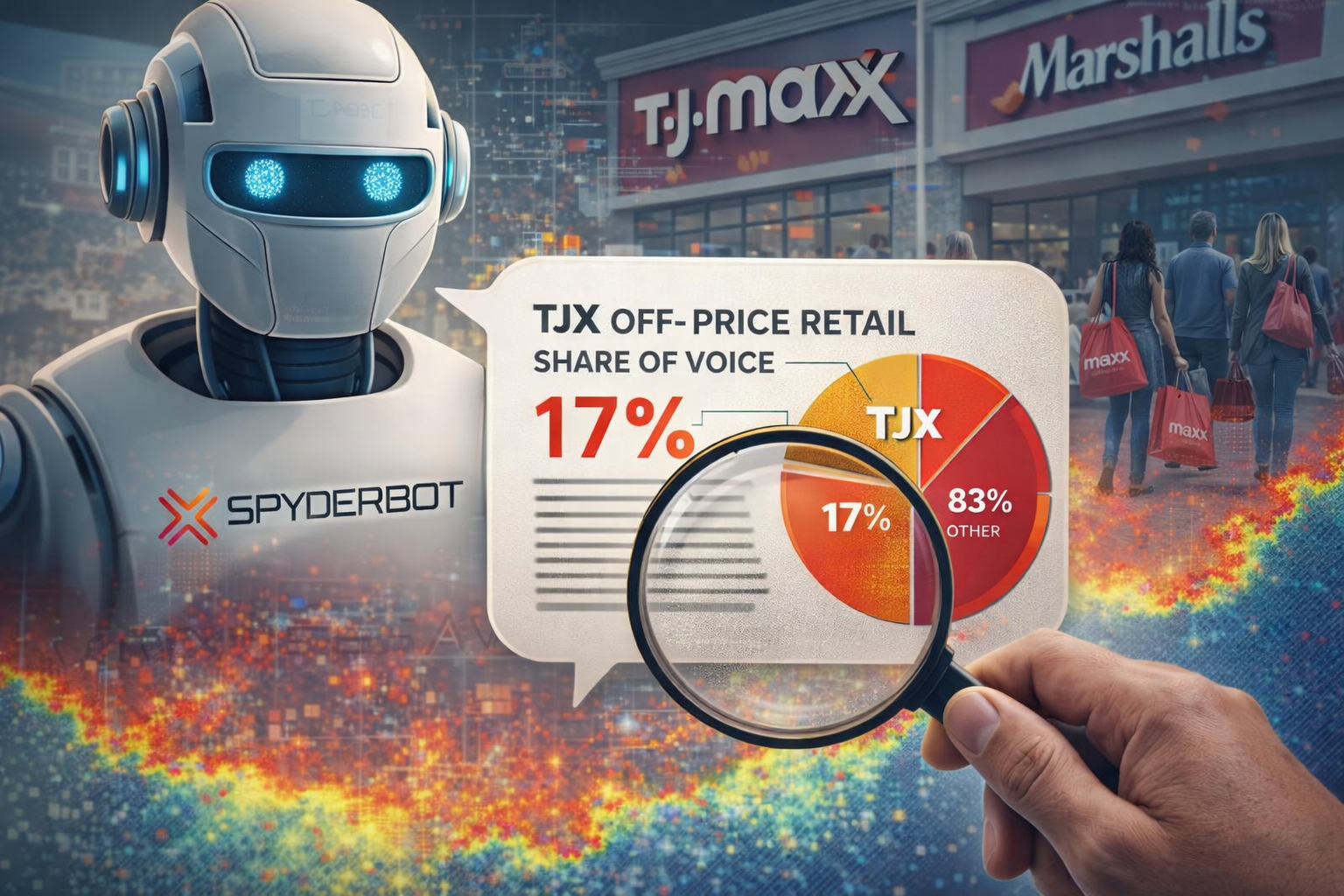
  • TJX’s 17% Share of Voice Is Reframing How AI Explains Off-Price Retail and Where the Real Advantage Lies

    TJX’s 17% Share of Voice Is Reframing How AI Explains Off-Price Retail and Where the Real Advantage Lies

    In an era when value-seeking shoppers increasingly begin their journey with an AI answer rather than a store visit, TJX Companies is emerging as the reference point for off-price retail—commanding attention where it matters most, while revealing clear fault lines where the next phase of advantage will be won.


    At-a-glance — Numbers to know

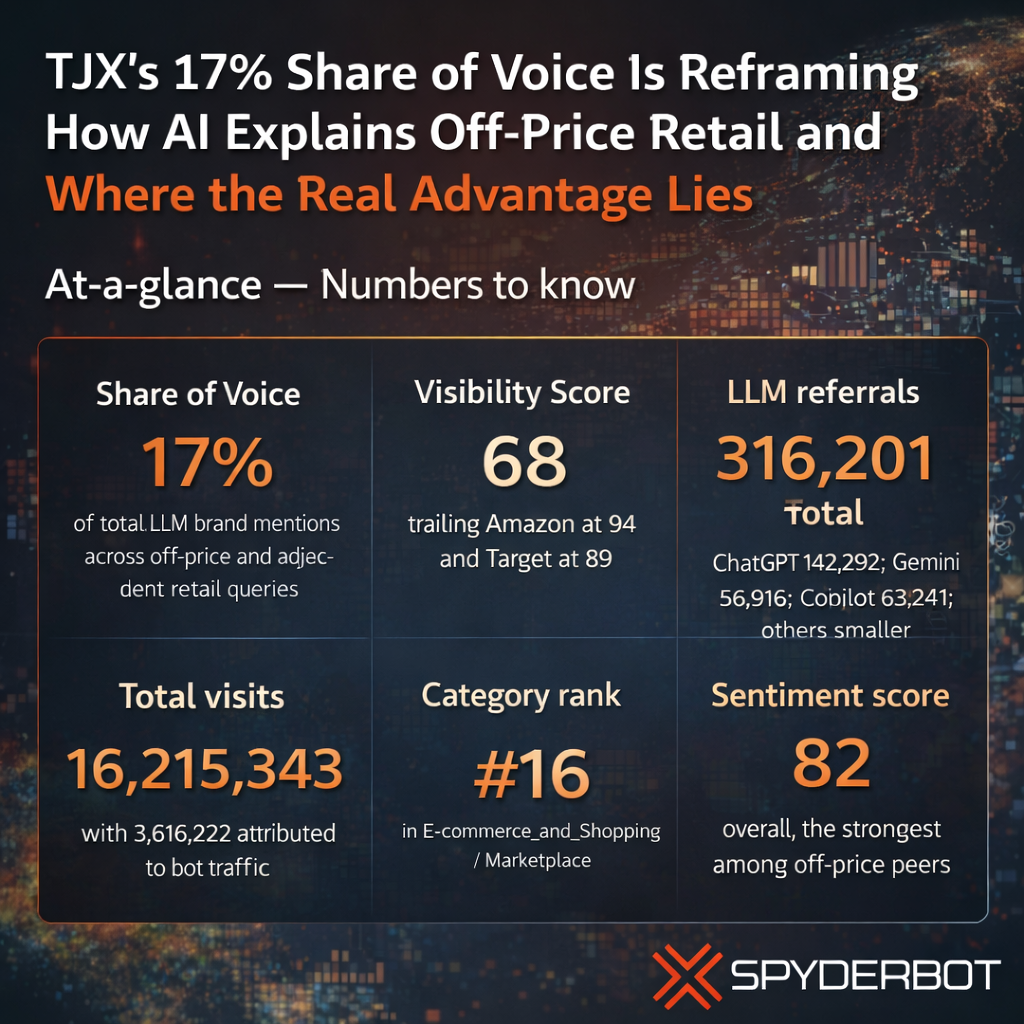
    • Share of Voice: 17% of total LLM brand mentions across off-price and adjacent retail queries
    • Visibility Score: 68 (trailing Amazon at 94 and Target at 89)
    • LLM referrals: 316,201 total (ChatGPT 142,292; Gemini 56,916; Copilot 63,241; others smaller)
    • Total visits: 16,215,343, with 3,616,022 attributed to bot traffic
    • Category rank: #16 in E-commerce_and_Shopping / Marketplace
    • Sentiment score: 82 overall, the strongest among off-price peers

    Opening

    Picture the modern retail discovery moment. A shopper doesn’t scroll a marketplace or open a brand app. Instead, they ask an AI a deceptively simple question: Where can I find designer brands at a discount? The answer arrives instantly, framed not by a marketing campaign but by accumulated signals—citations, sentiment, historical performance, and the way brands have been encoded into large language models.

    In that moment, retail strategy becomes response strategy. And for off-price retail, TJX Companies has quietly become one of the most frequently summoned answers. The GEO analytics behind tjx.com show a brand that consistently appears when value, discovery, and “treasure hunt” logic dominate the question—yet recedes when speed, logistics, or omnichannel convenience take center stage. The result is a position of strength with a clearly defined ceiling, unless leadership acts decisively.


    Position in LLM Response Lists

    Across LLM response lists tied to off-price retail, TJX holds a distinctive role. The data shows TJX appearing with a 17% Share of Voice, outperforming direct off-price competitors like Ross Stores and Burlington, but trailing mass retailers that dominate broader retail prompts.

    In platform-specific rankings, TJX is repeatedly pulled as a top recommendation for discounted designer brands and treasure hunt shopping experiences. On Gemini, the brand ranks #1 for “Best Stores for Discounted Designer Brands,” while on ChatGPT it appears as a top-three reference for value-driven apparel and home goods. This placement cements TJX as the category specialist—highly authoritative within its lane, but not yet dominant across the full retail spectrum.


    Competitor Gap Analysis

    The competitive landscape that emerges from AI responses is less about store count or revenue scale and more about narrative ownership.

    QueryTJX metricCompetitor metricGap / priority
    Fast shipping on brand-name goodsVisibility 42Amazon 96Structural logistics gap
    Order pickup for home decorVisibility 31Target 91Omnichannel perception gap
    Designer clothing discountsVisibility 93Burlington 78TJX leadership advantage
    Budget clothing stores near meVisibility 88Ross 85Competitive parity

    This “battle map” reveals a consistent pattern. TJX dominates where the question is value discovery. It loses ground where the question is convenience optimization. Importantly, these gaps are not marginal: in logistics-related prompts, Amazon outpaces TJX by more than 50 points in visibility, a disparity large enough to shape default AI recommendations.


    Trigger Keywords for Competitor Products

    LLM brand mentions are not random—they are triggered by specific keywords that carry embedded intent. For TJX, the strongest triggers include off-price retail, designer handbags outlet, and brand-name clearance. These prompts consistently summon TJX ahead of Ross and Burlington, and often alongside Amazon and Target.

    Conversely, keywords such as affordable home decor, kids clothing sale, and budget fashion finds tilt responses toward Amazon and Target, where breadth and fulfillment speed dominate AI reasoning. The implication is clear: TJX owns the why of value, but not always the how fast or how easy.


    Founder / Leadership Context

    Leadership narratives function as reputational shortcuts inside AI systems. TJX benefits from a strong legacy signal tied to Bernard Cammarata, whose role as architect of the off-price model carries a sentiment score of 88. This historical foundation reinforces trust and stability in investment-oriented and strategy-focused AI responses.

    Current leadership under Ernie Herrman generates higher overall mention frequency, with sentiment remaining positive but increasingly associated with operational consistency rather than innovation. Negative context remains limited, concentrated primarily around executive compensation and supply chain transparency, and does not dominate AI narratives. Still, the data suggests leadership perception is operationally strong but digitally understated.


    Quick overview

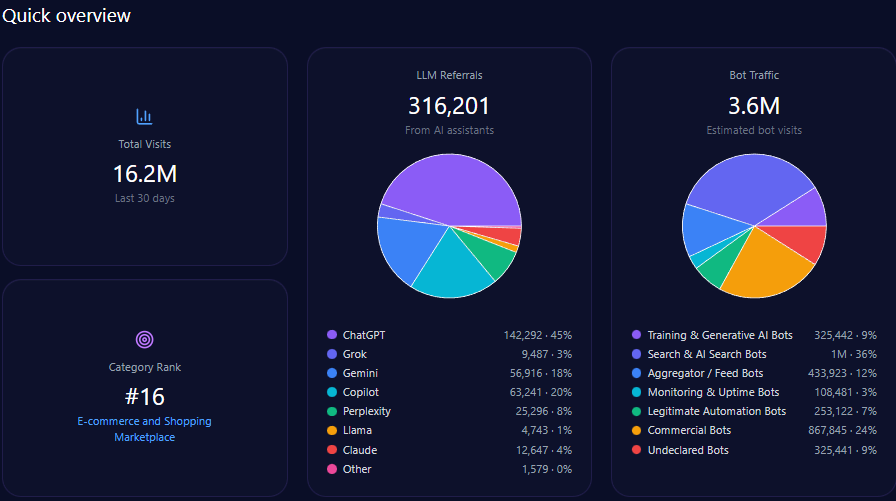
    From a footprint perspective, TJX’s GEO presence is substantial. Over 16 million total visits were recorded, with more than 3.6 million attributed to bot traffic, underscoring how frequently machines—not humans—are evaluating and indexing the brand. LLM referrals exceeded 316,000, yet conversion efficiency remains low at 4.2%, signaling leakage between AI discovery and transactional capture.

    tjx.com’s Quick overview(GEO Report, Jan 19, 2026)

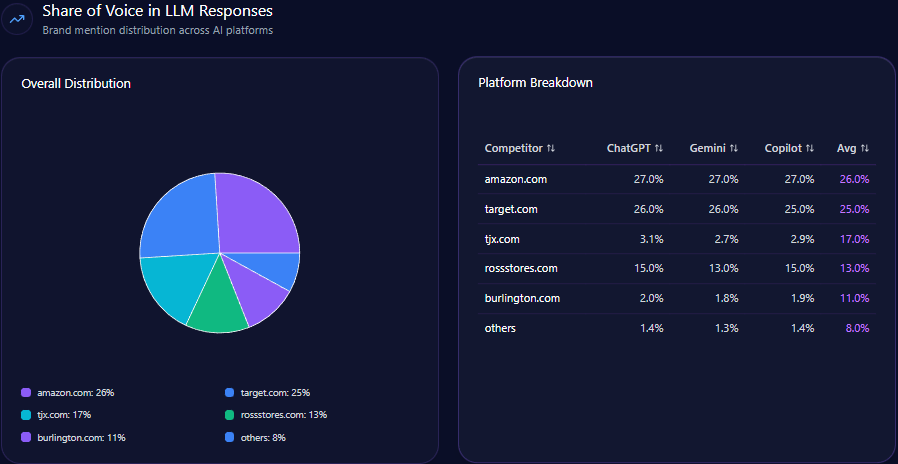
    Share of Voice in LLM Responses

    Share of Voice inside LLMs functions as mindshare in the AI era. TJX’s 17% places it ahead of Ross and Burlington but well behind Amazon (26%) and Target (25%). Combined, those two competitors control more than half of total LLM brand mentions in retail-related prompts.

    This distribution highlights a strategic tension. TJX is the specialist brand—trusted, distinctive, and credible—but specialists are at risk when generalists dominate the conversational layer where most shoppers begin.

    tjx.com’s Share of Voice in LLM Responses(GEO Report, Jan 19, 2026)

    AI Platform-Specific Visibility

    Platform bias matters. TJX’s visibility peaks on ChatGPT at 71%, where narrative-driven explanations favor the brand’s treasure-hunt identity. Visibility drops to 57% on both Gemini and Copilot, platforms that rely more heavily on structured data, real-time inventory signals, and web-integrated citations.

    In practical terms, this means TJX is better understood by conversational models than by research-oriented or search-integrated ones. Closing that gap is less about storytelling and more about machine-readable clarity.

    tjx.com’s AI Platform-Specific Visibility(GEO Report, Jan 19, 2026)

    Sentiment Score for Competitors

    Sentiment analysis reinforces TJX’s qualitative advantage. With an overall sentiment score of 82, the brand leads Ross (76) and Burlington (74), and outperforms Amazon (69) and Target (77) in tone. Positive themes cluster around the Treasure Hunt Strategy and Off-Price Value Proposition, both of which appear frequently and with favorable framing.

    Negative sentiment is primarily tied to store organization and checkout friction—operational issues rather than brand trust concerns. In AI narratives, TJX is liked, respected, and trusted; it is simply not always selected.

    tjx.com’s Sentiment Score for Competitors (GEO Report, Jan 19, 2026)

    Top Prompts Driving Mentions

    The prompts that most frequently summon TJX are revealing. High-mention queries include analyses of the off-price business model, comparisons with Ross, and searches for specific designer discounts. In many of these prompts, TJX captures more than 140 mentions out of fewer than 300 total, a commanding presence.

    These are not casual questions—they reflect shoppers and analysts seeking justification for choosing value over convenience. TJX wins when the question requires explanation, not just a link.

    tjx.com’s Top Prompts Driving Mentions (GEO Report, Jan 19, 2026)

    Types of Prompt Queries

    The intent mix behind TJX mentions skews heavily toward comparison and feature inquiry prompts, with limited exposure in pure purchase-intent questions. This reinforces a critical insight: TJX is often part of the thinking phase of retail decisions, but less dominant in the doing phase, where speed and fulfillment dominate.


    E-commerce / Service-Level Sentiment

    Where service-level sentiment is captured, AI narratives praise product authenticity and price advantage while flagging slower shipping and rapid sell-outs. These signals help explain the gap between referral volume and conversion efficiency. AI sends users to TJX for value—but not always with confidence that the experience will be frictionless.


    Conclusion

    The GEO report positions TJX as the definitive authority in off-price retail narratives inside AI systems. Its strength lies in value credibility, brand trust, and a legacy that machines recognize and reward. Yet the same data makes clear that leadership in AI visibility will increasingly be decided by structured signals around logistics, omnichannel convenience, and digitally legible inventory.

    The advantage is real—but so is the ceiling. TJX leadership now faces a choice: remain the category specialist that AI respects, or evolve into a hybrid authority that AI defaults to. The data suggests the latter is within reach, if acted on deliberately.

    Explore SpyderBot to operationalize these GEO analytics insights.
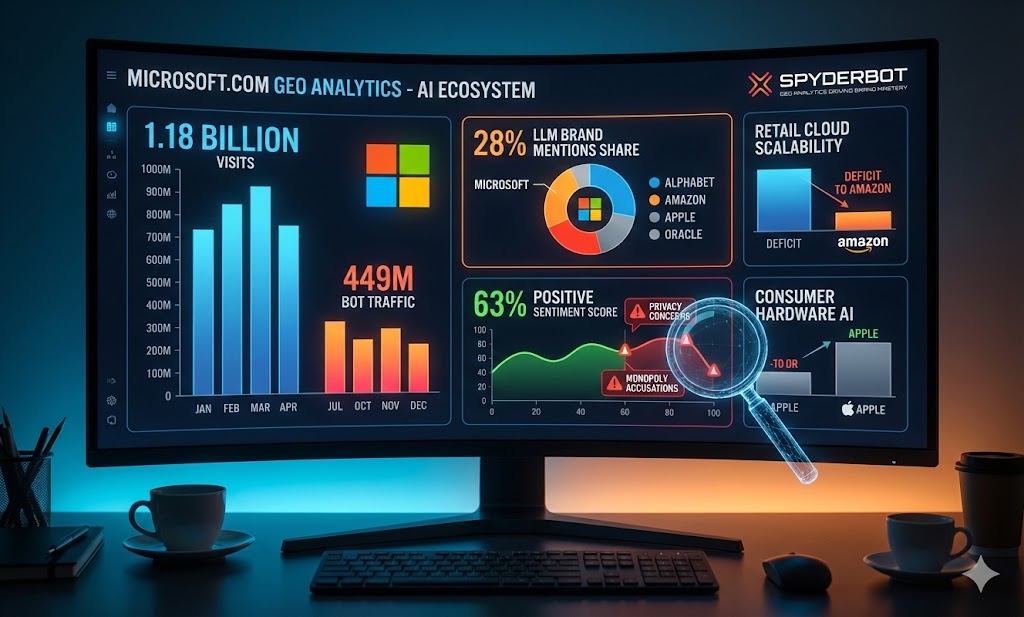
  • Best Buy’s AI Shelf Space Is Strong—But the “Value” Story Is Slipping Away

    Best Buy’s AI Shelf Space Is Strong—But the “Value” Story Is Slipping Away

    Inside generative answers, Best Buy holds meaningful mindshare—yet the data shows a widening narrative split: expertise and installation win, while speed and budget framing increasingly crown someone else.

    At-a-glance

    • Share of Voice (LLM brand mentions): 20% (105 of 523)
    • Visibility Score: 74 (vs 92 for Amazon, 78 for Walmart)
    • Rank Score: 92 in premium electronics positioning
    • Total visits: 170,355,633 with 54,854,514 in bot traffic
    • LLM referrals: 1,448,023 (led by ChatGPT 810,893, Perplexity 231,684, Copilot 188,243, Gemini 144,802)
    • Category rank: #1 in Computers_Electronics_and_Technology/Consumer_Electronics

    Risk signals

    • A 22-point gap shows up in “fastest same day tech delivery” versus Amazon (76 vs 98)—the speed narrative is still lopsided.
    • Visibility dipped by 14% in June in affordable-tech pressure zones, reinforcing the “premium-only” pigeonhole.

    Opening

    Picture the modern “storefront” moment: not a mall, not an app—just a blinking cursor. A shopper asks for the best place to buy a new TV with installation. Another asks where to find a laptop for school. A third asks who can fix the mess when something goes wrong. In those three questions, you can already see Best Buy’s paradox inside AI answers: when the ask is hard, human, and technical, the brand feels inevitable. When the ask is cheap, fast, or “good enough,” the story veers.

    What matters isn’t whether Best Buy is present. It is. The question is whether the brand is being chosen—and why.


    The Lists Where Best Buy Still Feels Like the Expert

    In ranked response lists across major platforms, Best Buy consistently shows up where the prompt implies expertise, service, or complex decision-making. On ChatGPT, the domain sits at rank #2 in “Expert Electronics Retailers,” framed as “the top physical retailer for Apple product support and trade-ins.” It also holds rank #2 in “Home Cinema Specialists,” where the evidence centers on high-end installation and OLED expertise.

    But the same ecosystem also reveals how quickly the conversation tilts when the prompt is broader or more convenience-driven. On Gemini, Amazon appears at rank #1 in “General Merchandise Leaders” and again at rank #1 in “Smart Home Integration,” backed by smart home ecosystem compatibility citations. Best Buy’s presence doesn’t vanish—but it becomes conditional. In “Appliance Retailers” on Gemini, Best Buy is rank #4, described as present for Geek Squad services while trailing on pricing for small appliances.

    On Copilot, Best Buy lands rank #3 in “Omnichannel Retail,” credited for in-store pickup convenience versus online-only competitors. That’s not small. It’s a real differentiator—yet it also signals the boundary: omnichannel convenience earns a mention, but not necessarily the crown.


    Where the Battle Map Shows Real Separation

    Best Buy’s competitive story is most revealing when you look at where the gaps are quantified—and where the brand already holds daylight.

    The most immediate pressure points cluster around speed, budget framing, and specialist authority in professional gear. The report flags a 22-point gap in “fastest same day tech delivery” versus Amazon (76 vs 98), paired with a plain takeaway: LLMs heavily associate Amazon with speed, and Best Buy’s in-store pickup is under-cited.

    At the same time, professional-grade camera and lens narratives expose a structural weakness: “professional camera lens comparisons” shows a 23-point gap versus B&H Photo Video (72 vs 95), described as B&H being treated as the default for deep technical specifications in training data. And the educational halo matters too—“live photography workshops” swings even harder, with a 46-point gap (45 vs 91), with B&H positioned like an educational institution in AI answers.

    Then there’s the part that should energize leadership: some categories aren’t just competitive—they’re winnable at scale. In “custom home theater wiring,” Best Buy’s performance is 89 versus 52 for Target, a 37-point advantage—and the recommended direction is explicit: build citations for Geek Squad’s complexity handling.

    A compact view of the clearest quantified gaps:

    QueryBest BuyCompetitorGap / Priority
    fastest same day tech delivery76Amazon 9822 / High
    professional camera lens comparisons72B&H Photo Video 9523 / High
    best budget smart home hub68Walmart 9123 / Medium
    live photography workshops45B&H Photo Video 9146 / Low

    What this table really says: the brand is strongest when it can be the expert, and weakest when the AI can answer with a shipping promise or a price story.


    The Keywords That Quietly Hand Competitors the Microphone

    Trigger keywords are the hidden levers that decide which retailers get named when AI systems summarize “what to buy” and “where to buy it.” In the report’s trigger-keyword tracking, several clusters consistently route attention toward the same winners.

    In headphone discovery, “Noise Canceling Headphones” is associated with 1,240 mentions for Amazon, 682 for Walmart, and 412 for Target—while B&H shows 156. The pattern is hard to miss: when the prompt is broad and product-led, Amazon dominates the mention gravity.

    Budget language is even more punishing. “Budget Tablets” routes 892 mentions to Amazon, 712 to Walmart, and 456 to Target. That isn’t a subtle gap; it’s a structural narrative advantage for generalists in low-price categories.

    Meanwhile, the professional camera cluster flips the power dynamic. “Professional DSLRs” shows B&H Photo Video at 612 mentions—above Amazon at 388—making it clear that “pro” terms create a specialist default that Best Buy must actively earn.

    Some keywords do feel like Best Buy-native territory. “Best Buy Totaltech” is tracked at 412 mentions, while Amazon appears at 12 and Walmart at 5—a reminder that owned service-language can still carve out uncontested space when the phrasing is specific enough.

    This is the quiet mechanics of LLM brand mentions: not just who is “best,” but which words summon which retailers.


    Founder Narratives and the Shadow Topics That Follow Them

    Founder and leadership context in AI answers often behaves like an undertow—rarely the headline, frequently the mood. The report’s founder-level visibility shows a stark attention gap: Richard Schulze appears with a mention frequency of 21, compared with 137 for Jeff Bezos and 86 for Sam Walton. Even Herman Schreiber appears at 38.

    Yet sentiment is not the problem for Best Buy’s founder story. Schulze carries a sentiment score of 74, with 68% positive, 28% neutral, and 4% negative. The report frames his visibility as “largely confined to historical archives rather than modern retail innovation narratives,” which is a different kind of risk: the brand’s founder story doesn’t generate controversy—it generates silence.

    Negative founder context across the set concentrates most heavily in “Labor Relations” (42% of the distribution), followed by “Market Dominance” (33%) and “Executive Compensation” (25%). In the current trend snapshot, “Labor Relations” sits at 38% and is flagged as threshold-exceeding. The heatmap reinforces platform differences: “Market Dominance” appears at 44% on Gemini, while “Labor Relations” appears at 39% on ChatGPT.

    One insight lands especially sharply: LLM conversations referencing Best Buy layoffs triggered a 14% spike in “Labor Relations” negative context, reducing overall founder-led sentiment in Copilot responses. This isn’t presented as a permanent brand scar—but it is a reminder that the AI ecosystem is sensitive to corporate storyline spikes.

    The founder narrative doesn’t need to be louder for its own sake. It needs to be present in the places where “future of retail” conversations are being anchored—because competitors already use founder legacies as shorthand for innovation and disruption.


    A Snapshot of the GEO Footprint That Actually Matters

    Best Buy’s scale is not theoretical. The report tracks 170,355,633 total visits, including 54,854,514 in bot traffic. Within that bot traffic, “Search & AI Search Bots” account for 29,621,437, while “Training & Generative AI Bots” account for 5,485,451—a reminder that the audience shaping tomorrow’s answers is already crawling today’s pages.

    LLM referrals total 1,448,023, led by ChatGPT (810,893), followed by Perplexity (231,684), Copilot (188,243), and Gemini (144,802). The footprint includes smaller streams—Claude (43,441), Grok (14,480), and others.

    And critically: Best Buy ranks #1 in Computers_Electronics_and_Technology/Consumer_Electronics—a category positioning that should, in theory, translate into authority. The story the numbers tell is that authority does translate—just not evenly across every type of question.

    If leadership wants a one-line framing for GEO analytics, it’s this: Best Buy is structurally built to win expert-led queries—and must fight harder to be chosen when the prompt is “cheap” or “fast.”

    bestbuy.com’s Quick overview (GEO Report, Jan 18, 2026)

    The Mindshare Math Inside AI Answers

    In overall Share of Voice, Best Buy holds 20% of tracked LLM brand mentions (105 of 523). Amazon leads at 35% (183), while Walmart follows at 22% (115). Target shows 12% (63), B&H Photo Video 8% (42), and “others” 3% (15).

    Visibility Score tells a similar story with a different emphasis. Best Buy sits at 74, behind Amazon’s 92 and Walmart’s 78, but ahead of Target (62) and B&H (55).

    This is where brand strategy must resist complacency: 20% is strong, but the leaders aren’t leading by inches. Amazon’s advantage is both share (35%) and visibility (92). Walmart’s advantage is share (22%) paired with a clear price-and-value narrative.

    Best Buy’s opportunity is not to become Amazon. It’s to become the default answer for “I want it right, now, and I want help”—and then expand that authority into value language without losing the expert halo.


    Same Brand, Different AI Outcomes

    Platform splits make the ecosystem feel like three different markets.

    On Gemini, Best Buy’s visibility/share of voice is 23%, with 40 mentions out of 175 total. Amazon holds 31% (55) and Walmart 26% (45). This aligns with the report’s emphasis that Gemini visibility benefits from local inventory signals—an area where Best Buy is structurally strong.

    On ChatGPT, Best Buy sits at 19%, with 32 mentions out of 170 total. Amazon climbs to 41% (70), while Walmart posts 21% (35). Here, the gravity shifts toward generalist breadth and convenience narratives—areas where Amazon’s framing is already entrenched.

    On Copilot, Best Buy also shows 19%, with 33 mentions out of 178 total. Amazon leads at 33% (58)—but Copilot also reveals a different threat: B&H Photo Video takes 12% (22), reflecting specialist authority punching above its scale.

    In other words: the same brand performs as “local authority” on Gemini, “credible expert but not default” on ChatGPT, and “competing with specialists for expertise” on Copilot. The implication isn’t that one platform is right. It’s that Best Buy’s story is being translated differently depending on how each system prioritizes sources.


    The Tone War: Trust, Value, Logistics, and Expertise

    Competitor sentiment tracking in the report suggests Best Buy is not losing the “trust” argument—yet it also highlights where tone becomes mixed.

    Overall sentiment scores cluster tightly at the top:

    • B&H Photo Video: 85 (Positive 79, Neutral 12, Negative 9)
    • Amazon: 81 (Positive 74, Neutral 15, Negative 11)
    • Best Buy: 78 (Positive 68, Neutral 21, Negative 11)
    • Target: 78 (Positive 67, Neutral 23, Negative 10)
    • Walmart: 73 (Positive 62, Neutral 22, Negative 16)

    Context themes show what people talk about when these brands show up in AI narratives:

    • “Technical Support & Repair” appears 52 times (35.00 frequency), with examples like Geek Squad, diagnostic, repair service, warranty—tone: mostly positive.
    • “Price & Value” appears 41 times (27.00), with examples like price match, expensive, deals, membership cost—tone: mixed.
    • “Logistics & Fulfillment” appears 33 times (22.00)—tone: neutral.
    • “Product Expertise” appears 24 times (16.00)—tone: positive.

    The takeaway is not that Best Buy is viewed negatively. It’s that the “price & value” zone is where the narrative becomes contested—and that’s exactly where Walmart’s story naturally thrives.

    bestbuy.com’s Sentiment Score for Competitors (GEO Report, Jan 18, 2026)

    The Prompts That Most Reliably Summon Best Buy

    Some prompts are practically a lighthouse for Best Buy’s strengths.

    The report’s top prompts include:

    • “Where can I find the latest MacBook Pro M3 Max in stock today?” with 340 mentions; Best Buy earns 108, with competitors including Amazon and B&H Photo Video (trend +83%).
    • “Compare trade-in values for old iPhones at major retailers.” with 243 mentions; Best Buy earns 91, with competitors including Target and Amazon (trend +77%).
    • “Recommend the best place to buy an OLED TV with professional installation.” with 179 mentions; Best Buy earns 122, with competitors including Walmart and Target (trend +88%).
    • “Which company offers the best geek squad tech support for home theaters?” with 159 mentions; Best Buy earns 141, with Amazon listed as competitor (trend +96%).

    These aren’t just prompts. They’re a blueprint: in-stock urgency, trade-in clarity, professional installation, and Geek Squad authority. When the question implies complexity, Best Buy becomes the answer.

    bestbuy.com’s Top Prompts Driving Mentions (GEO Report, Jan 18, 2026)

    What People Are Actually Asking For

    Prompt-type mix in the report is heavily concentrated:

    • Comparison accounts for 75 with 3 prompts.
    • Feature Inquiry accounts for 25 with 1 prompt.

    Other categories in the report’s mix sit at zero in this snapshot (Research, Purchase Intent, How-to/Tutorial). That doesn’t mean those intents don’t exist in the world. It means the current tracked set is dominated by “Which is better?” and “What should I choose?” moments.

    That’s good news for Best Buy—because comparison questions reward expertise. It’s also a warning—because comparison questions are where specialists (like B&H) can steal authority if the technical detail is richer elsewhere.


    E-commerce Discovery: Where Reviews, Retailers, and Reality Collide

    In e-commerce-oriented AI discovery, Best Buy’s share of voice is 13.15% with 1,135 mentions across ChatGPT, Gemini, and Copilot. Amazon leads at 38.68% (3,340), followed by Walmart at 19.91% (1,719), Target at 10.02% (865), and B&H Photo Video at 5.1% (440). “Others” also appear at 13.15% (1,135).

    The report’s sentiment snapshots in e-commerce contexts show review mixes clustering around:

    • 64/24/12 across 1,850 total reviews
    • 71/21/8 across 2,100 total reviews
    • 68/20/12 across 1,920 total reviews

    And the product-level snippets illuminate the lived experience, as cited in the report:

    • “Best Buy’s Geek Squad protection made the OLED TV setup seamless. Highly recommend for high-end tech.” — TechRadar Community, LG C3 OLED TV, 5
    • “Found the laptop I wanted at Best Buy. Price was same as Amazon, but I could pick it up in an hour.” — Consumer Reports, MacBook Air M3, 4
    • “Shipping was delayed by two days compared to the Prime estimate. Customer service was helpful but slow.” — SiteJabber, PS5 Console, 2

    Even referral performance is quantified in this layer: ChatGPT shows 8,450 referrals (conversion rate 2.8), Gemini 10,200 (conversion rate 3.1), and Copilot 7,820 (conversion rate 4.2).

    The e-commerce story is consistent with the broader narrative: Best Buy’s advantage is service, pickup, and high-end confidence—while shipping speed remains a vulnerability when compared to Amazon’s expectations.


    Conclusion

    Best Buy doesn’t have an awareness problem in generative systems. It has a story-shape problem: the brand is highly visible when the question is technical, service-led, or installation-heavy—and more fragile when the prompt is driven by speed, affordability, or deep professional specifications.

    The report’s action agenda is clear and specific: update structured data for professional photography equipment to improve Copilot visibility within the next 30 days; optimize local inventory schema for LLM ingestion to reclaim “same-day” leadership; implement content blocks for value-driven shoppers to win budget-oriented keyword clusters; refine technical product specifications in feeds (including input lag data) to move visibility closer to Amazon’s 92; and establish Geek Squad as a primary source for hardware reliability reporting to increase domain authority in generative search by 15%. Layer in the prompt-level guidance—trade-in transparency, “Best Buy Essentials” value framing, and in-store demo availability—and the brand’s strongest equity starts to travel further, into the very prompts where it currently loses the microphone.

    Explore SpyderBot to operationalize these GEO analytics insights.

  • Lowe’s Wins the Project Plan—But AI Still Sends the “Urgent Fix” Shopper Somewhere Else

    Lowe’s Wins the Project Plan—But AI Still Sends the “Urgent Fix” Shopper Somewhere Else

    This report shows lowes.com holding real authority in high-consideration home improvement categories—yet facing a repeatable set of “speed, locality, and niche” traps where AI recommendations tilt to rivals.

    At-a-glance: Numbers to know

    • 22% Share of Voice (118 of 534 total LLM brand mentions)—behind Amazon at 31% (166)
    • Visibility Score: 82 (Amazon 93, Ace Hardware 77, Menards 71)
    • 999,513 total LLM referrals (ChatGPT 449,781; Gemini 219,893; Copilot 149,927)
    • 121,891,853 total visits with 27,425,667 in bot traffic
    • Category rank: #1 in Home_and_Garden/Home_Improvement_and_Maintenance
    • Gemini visibility: 86% with 26% platform Share of Voice

    Risk signals

    • A 32-point gap on “fastest delivery for home repair tools” (64 vs Amazon’s 96)
    • A 47-point gap on “chicken coop supplies near me” (42 vs Tractor Supply Co.’s 89)
    Competitor Visibility Score (GEO Report, Jan 18, 2026)

    Opening

    Picture the moment: a homeowner finds water under the sink at 10:47 p.m. They don’t open ten tabs. They ask a model. In that split second, the “best brand” isn’t the one with the prettiest assortment—it’s the one the assistant believes can solve a problem right now, with the least friction.

    That’s the tension running through this report on lowes.com. The brand shows up as an authority when questions become bigger—appliances, installations, project planning, pro-grade tools. But when the prompt turns urgent, local, or niche, the story AI tells can suddenly reroute the customer.


    When Lowe’s Is “In the List”—And When It Isn’t

    Across LLM response lists, lowes.com shows up as a first-choice authority in specific contexts—but not uniformly.

    On Gemini, Lowe’s ranks #1 as the “Primary brand citation for ‘best professional grade power tool brands’,” a sign that high-ticket, expertise-heavy summaries still reward the brand’s credibility. In contrast, on ChatGPT, Lowe’s appears at #2 in “best smart home lighting systems” across 45 prompts, and at #3 for “complex home renovation” informational guide citations—visible, but not always the default.

    The broader competitive landscape reveals why this matters. Amazon repeatedly ranks #1 for product availability and fast shipping prompts—82% of responses for those queries—and dominates 90% of price-comparison prompts for small hand tools. Meanwhile, Ace Hardware claims #1 in local “repair near me” style lists, driven by convenience framing.

    Lowe’s is present—and sometimes leading. The challenge is that “presence” is not the same as “first recommendation,” especially when AI is sorting by immediacy.


    The Battle Map: Where the Answer Breaks Toward Rivals

    The report’s gap patterns are unusually consistent: the biggest losses cluster around logistics speed, SKU-level specificity, and rural lifestyle needs—while Lowe’s wins where complexity and service are valued.

    Here’s the clearest battle map:

    QueryLowe’s (score)Competitor (score)Gap / Priority
    fastest delivery for home repair tools64Amazon 9632 / High
    chicken coop supplies near me42Tractor Supply Co. 8947 / High
    hard to find metric bolts and nuts58Ace Hardware 8729 / Medium
    eco-friendly smart thermostats comparison81Amazon 9312 / High
    best place for lumber bulk discounts72Menards 8311 / Medium

    And just as important: Lowe’s holds advantages that should be defended. It leads “how to fix a leaky faucet in 15 minutes” (88 vs Ace Hardware’s 74), “best refrigerator for smart kitchen” (92 vs Amazon’s 62), and “outdoor paint durability ranking” (84 vs Menards’ 71).

    The message for leadership isn’t “fix everything.” It’s: protect the segments where Lowe’s already wins—and remove the structural reasons AI deprioritizes Lowe’s in the moments that feel urgent, local, or niche.


    The Keywords That Quietly Hand the Sale to Someone Else

    Competitor advantage often isn’t brand-wide—it’s keyword-triggered. In commerce discovery prompts, certain terms repeatedly pull competitors into the answer with higher frequency.

    A few examples show the pattern:

    • Kitchen Cabinets: Menards shows 19 mentions vs Amazon’s 14
    • Vinyl Flooring: Menards leads with 26 mentions vs Amazon’s 18
    • Lumber & Studs: Menards appears at 31 mentions, dwarfing Amazon’s 2
    • Cordless Drills: Amazon leads at 42 mentions (Ace Hardware 22)
    • Smart Thermostats: Amazon leads at 45 mentions
    • Zero Turn Mowers: Tractor Supply Co. spikes to 36 mentions (Ace Hardware 18)
    • Interior Paint: Ace Hardware leads at 22 mentions (Amazon 15)
    • Pressure Washers: Amazon leads at 41 mentions

    In other words, keywords act like trapdoors. The user thinks they’re asking about “a product.” The model hears a context—rebates, rural supply, deep hardware specificity, or fast shipping—and the recommendation snaps to whichever retailer owns that narrative.


    Leadership Narratives, and the Negatives That Travel With Them

    Founder and leadership context shows a different kind of competitive exposure: not product-level, but trust-level.

    Lowe’s leadership figure—Marvin Ellison (CEO/Leader)—has a strong sentiment score of 82, with 78% positive, 14% neutral, and 8% negative across 48 mentions. That’s materially cleaner than Jeff Bezos’ profile (54 sentiment score, 36% negative across 122 mentions), and it compares well to other leaders in the set.

    But negative context doesn’t disappear—it clusters. In the report’s founder negative context distribution, Labor disputes account for 42%, Market Monopolization for 31%, and Corporate Governance for 27%. The trend detail shows Labor disputes at 38% in H2 2024 and 42% in Q1 2025, with Supply Chain Unrest reaching 22% in Q1 2025.

    The report’s own language is blunt about amplification inside model narratives: “LLM conversations referencing the ‘Lowe’s Unionization’ caused a 12% spike in labor-related context mentions.” It also notes a cross-theme linkage in Gemini: “Supply Chain Efficiency + Executive Leadership narratives show up together in 64% of Gemini answers.”

    This is not about “bad press.” It’s about what becomes retrievable and repeatable inside generative summaries—especially when shoppers ask, “Which retailer is most reliable?”


    The Footprint Behind the Answers

    Under the hood, lowes.com has scale—and a category position most retailers would envy.

    The site records 121,891,853 total visits and 27,425,667 in bot traffic. That bot traffic includes 12,341,550 from Search & AI Search Bots, 6,856,417 from Commercial Bots, and 3,565,337 from Undeclared Bots—plus additional segments such as 2,194,054 Legitimate Automation Bots and 1,371,283 Aggregator/Feed Bots.

    On the AI referral side, the total is 999,513 LLM referrals, led by 449,781 from ChatGPT and 219,893 from Gemini. Copilot adds 149,927, while Perplexity contributes 99,951 and Claude 49,976.

    And the positioning headline: Category rank #1 in Home_and_Garden/Home_Improvement_and_Maintenance.

    In short: the footprint exists. The fight is not about being “discoverable.” It’s about being chosen by the assistant in the exact micro-moments that decide conversion.

    Quick overview (GEO Report, Jan 18, 2026)

    Mindshare Inside AI: The 22% Reality

    The report captures a clean snapshot of competitive mindshare: 534 total mentions across the set, with Amazon holding 31% (166) and Lowe’s at 22% (118). Ace Hardware sits at 16% (83), Menards at 15% (78), Tractor Supply Co. at 9% (47), and others at 7% (42).

    Visibility scores track similarly: Amazon at 93, Lowe’s at 82, Ace Hardware at 77, Menards at 71, Tractor Supply Co. at 64, and others at 58.

    The nuance is in coverage by category. Lowe’s is strong in “Outdoor garden and patio furniture retailers” at 91% coverage (Amazon 84%), and also posts 87% coverage for “Home improvement and DIY project hardware.” But in “Professional grade power tools and building supplies,” Lowe’s coverage drops to 76% versus Amazon’s 91%—a meaningful gap in a high-margin segment.

    This is where GEO analytics becomes a leadership tool: it converts “we feel visible” into a measurable view of where the AI answer actually places you.


    Same Brand, Different AI Outcomes

    Platform dynamics matter because each model carries different reflexes about what “best” means.

    On Gemini, Lowe’s shows its strongest performance: 86% visibility and 26% share of voice (with 182 total mentions recorded). Amazon still edges share at 28% (with 51 mentions), but Gemini is clearly receptive to Lowe’s structured signals.

    On ChatGPT, Lowe’s platform share of voice is 23%—while Amazon takes 34% (with 61 mentions) and Ace Hardware sits at 15% (with 27 mentions). The shape of that split fits the report’s pattern: urgency and convenience prompts are where Lowe’s loses ground.

    On Copilot, Lowe’s share of voice is 21%, with Amazon at 31% (mentions 54) and Tractor Supply Co. at 11% (mentions 19), reflecting how niche vertical authority can punch above its overall scale.

    The result is a single brand with multiple “AI identities.” The report’s clearest opportunity is to turn Gemini’s openness into a broader cross-platform advantage—without losing to Amazon’s speed narrative or Ace’s locality narrative.


    Tone of the Conversation: Who Sounds Most Trusted

    On sentiment, Lowe’s sits in the middle of the pack.

    Overall sentiment scores show: Ace Hardware 85, Tractor Supply Co. 83, Amazon 81, Lowe’s 74, Menards 71. Lowe’s split is 64% positive, 21% neutral, 15% negative—suggesting stable trust, but real friction.

    The report’s context themes reveal where sentiment is made:

    • DIY Project Support: count 94, frequency 70.00, tone Positive
    • Appliance Installation: count 68, frequency 50.00, tone Neutral
    • Price Matching and Rebates: count 42, frequency 31.00, tone Neutral

    This is where competitor sentiment tracking becomes practical, not academic: Ace Hardware’s higher overall sentiment aligns with a narrative of local expertise, while Amazon’s strength is framed by logistics and breadth, even when it trails in areas like installation consultation.

    For Lowe’s, the story isn’t “people dislike the brand.” It’s that service-related friction and fulfillment expectations can surface inside conversational buying guides—and those guides shape the next click.


    The Prompts That Keep Bringing Lowe’s Up

    The report’s top prompts show what “summons” Lowe’s most reliably—and where competition crowds the answer.

    A few standouts:

    • “Compare grill features and warranties…” (296 mentions; Lowe’s 102, Amazon 115, Ace Hardware 79; trend +84%)
    • “Recommend the best place to buy energy-efficient kitchen appliances…” (284; Lowe’s 112, Amazon 124, Menards 48; trend +88%)
    • “Find a store with the best selection of Craftsman tools…” (282; Lowe’s 136, Amazon 92, Ace Hardware 54; trend +95%)
    • “Rank the top retailers for smart home hub compatibility…” (220; Lowe’s 88, Amazon 132; trend +72%)
    • “Best place for livestock feed and rural property maintenance equipment.” (147; Lowe’s 18, Tractor Supply Co. 129; trend +14%)
    • “Where can I find Kobalt battery-powered lawn equipment in stock near me?” (138; Lowe’s 138; trend +98%)

    The pattern is unmistakable: when the prompt contains brand-specific tools (Kobalt, Craftsman), Lowe’s can dominate. When it contains rural property needs, Tractor Supply Co. takes the entire frame. And when it contains “compatibility” and “hub ecosystems,” Amazon becomes the default answer engine.

    Top Prompts Driving Mentions (GEO Report, Jan 18, 2026)

    What People Ask AI to Do in This Category

    The intent mix here is narrower than most retailers assume—and that changes how the brand should build visibility.

    Prompt types skew heavily toward Comparison: value 70, count 7. Feature Inquiry sits at value 20, count 2, while Research appears at value 10, count 1. Purchase Intent and How-to/Tutorial are both recorded as 0 (count 0).

    That doesn’t mean users don’t want to buy or learn. It means the prompts captured in this analysis are framed as “help me choose” and “compare the options”—which increases the importance of structured, scannable product detail signals, clear pricing logic, and credibility cues the models can reuse.

    If Lowe’s is already strong in “Project Planning” and “Expert Installation” list placements, the missing link is ensuring those strengths become comparison-winning evidence across the queries that dominate the mix.


    From Mentions to Checkout: The Commerce Mood

    In commerce-oriented AI discovery, Lowe’s trails Amazon more sharply.

    E-commerce Share of Voice shows Lowe’s at 18.54% (61 mentions) versus Amazon at 32.52% (107). Ace Hardware holds 12.77% (42), Menards 9.73% (32), Tractor Supply Co. 7.9% (26), with “others” also at 18.54% (61).

    E-commerce sentiment snapshots remain favorable: 76/17/7 across 1,142 reviews, 72/20/8 across 984, and 75/19/6 across 1,056 (positive/neutral/negative). The report’s snippets make the underlying narrative tangible:

    • “Lowe’s offered the best selection of smart refrigerators and the delivery team was extremely professional.”
    • “The lumber quality is consistent, though the checkout process for Pro members can be slow during peak hours.”
    • “MyLowes Rewards program has significantly improved my savings on repeat garden supply purchases.”
    • “Finding a floor associate for help with electrical fittings was difficult compared to my visit to Ace Hardware.”

    AI commerce referrals in this section are smaller but measurable: ChatGPT 4,520 referrals at 3.4% conversion rate, Gemini 3,890 at 4.1%, and Copilot 3,210 at 2.9%.

    The story: selection, loyalty, and delivery professionalism show up as strengths—while store-level assistance and speed-of-fulfillment remain the friction points that competitors exploit.


    Conclusion

    The report paints Lowe’s as a brand with real authority—and a clear set of repeatable loss conditions. It leads where home improvement becomes complex: appliances, installation, planning, and brand-specific tools. But it loses where the prompt compresses time, demands SKU-level certainty, or shifts into rural maintenance—precisely the moments when AI “decides” what’s most practical.

    Leadership actions are equally clear in the report: optimize technical specification data and expert review citations for high-ticket power tools; integrate real-time local inventory data and regional availability schema; refine AI-referred landing page experiences with high-authority project guides and bio snippets; and implement technical comparison tables to improve data scraping accuracy for price-sensitive prompts. On the competitive front, the report calls for a sharper logistics language strategy to mirror “fast fulfillment” signals (with a target of +15% rank improvement in 90 days) and a push to increase ChatGPT mention density (aiming for a 5% Share of Voice lift next quarter). It also recommends expanding rural maintenance and urban agriculture content to challenge Tractor Supply Co.’s niche dominance—and addressing supply chain transparency to mitigate the 12% negative sentiment rate noted in Copilot and ChatGPT leadership contexts.

    Explore SpyderBot to operationalize these GEO analytics insights.
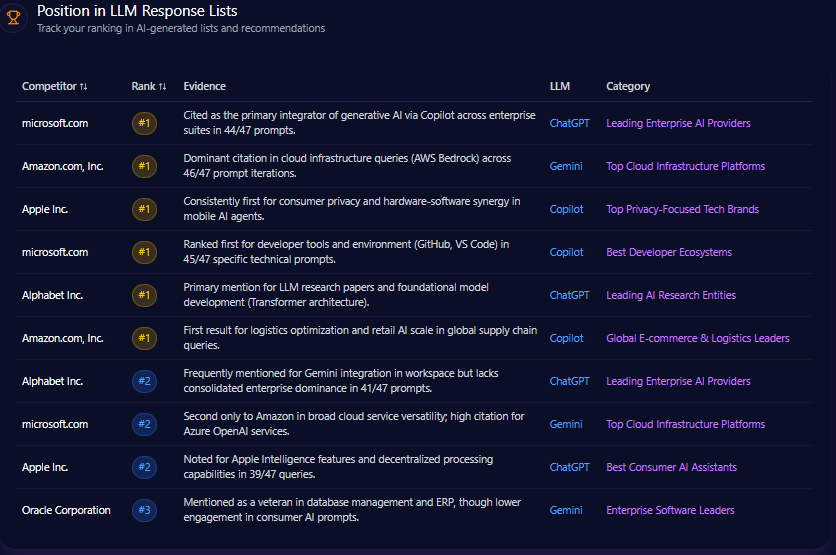
  • Albertsons Has Presence. The Problem Is the Story AI Keeps Telling About Convenience

    Albertsons Has Presence. The Problem Is the Story AI Keeps Telling About Convenience

    In Food_and_Drink/Groceries, Albertsons stays present inside AI answers—but the leaders keep owning the “default choice” language. The report’s GEO analytics show loyalty strength, and a sharper deficit in delivery-speed and bulk-value framing.

    At-a-glance: Numbers to know

    • Share of Voice: 12% (46 of 382 total LLM brand mentions)
    • Visibility Score: 64 (Amazon 94, Costco 88, Kroger 76, Publix 71)
    • LLM referrals: 41,294 (ChatGPT 22,712; Copilot 7,433; Perplexity 4,955; Gemini 3,304)
    • Total visits: 6,163,316 with 2,329,733 in bot traffic
    • Category rank: #9 in Food_and_Drink/Groceries
    • Overall sentiment score: 75 (Positive 64 / Neutral 22 / Negative 14)

    Risk signals

    • Coverage is 27% on “Best grocery delivery services for organic products” vs Amazon’s 83%
    • Platform Share of Voice drops to 8% on Copilot (ChatGPT 13%, Gemini 14%)

    Opening

    A grocery brand used to win on location and habit. Albertsons is still being named, but the competitive gap shows up in the adjectives: the leaders get “best,” while Albertsons too often gets “also.”

    Position in LLM Response Lists

    Across ChatGPT, Gemini, and Copilot, Albertsons typically appears 4th–5th in broad grocery responses. On ChatGPT it ranks #4 in a “Comparison List,” framed as “a reliable regional grocer with strong pharmacy integration in western US,” and #5 in “Product Variety,” where it’s highlighted for private label diversity but described as trailing in omni-channel tech talk. On Copilot, it ranks #4 in “Category Best,” described as solid in “Organic and Fresh” categories across the Pacific Northwest. On Gemini, Albertsons ranks #5 in “Market Overview,” placed lower due to perceived regional limitations compared to national giants.
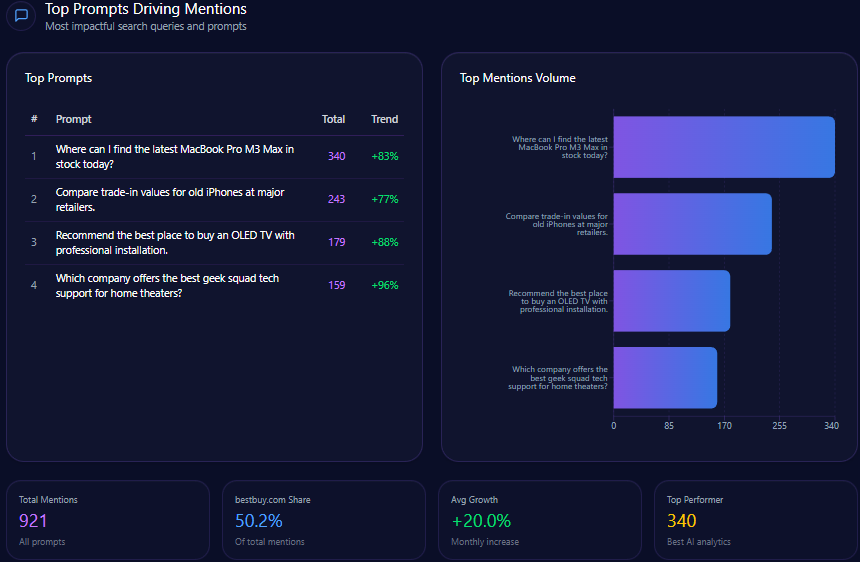
    Competitor Gap Analysis

    The gap data clusters around high-intent convenience and scale, where competitors are described as the default recommendation.

    QueryAlbertsons metricCompetitor metricGap/priority
    best grocery delivery service 202467Amazon 9427 (High)
    fresh prepared meals delivery61Amazon 9231 (High)
    bulk household cleaning supplies58Costco 9638 (Medium)
    best app for weekly grocery deals69Kroger 8819 (High)

    The action items show what the models appear to be “missing”: improve technical documentation of delivery SLAs for LLM ingestion; optimize app store metadata and technical whitepapers on app features; and launch a “Stock Up” campaign with structured data for large-pack sizes. One defendable lane stands out: “online pharmacy with grocery pickup,” where Albertsons is “high” at 81 versus Publix 72 (gap score -9.00).
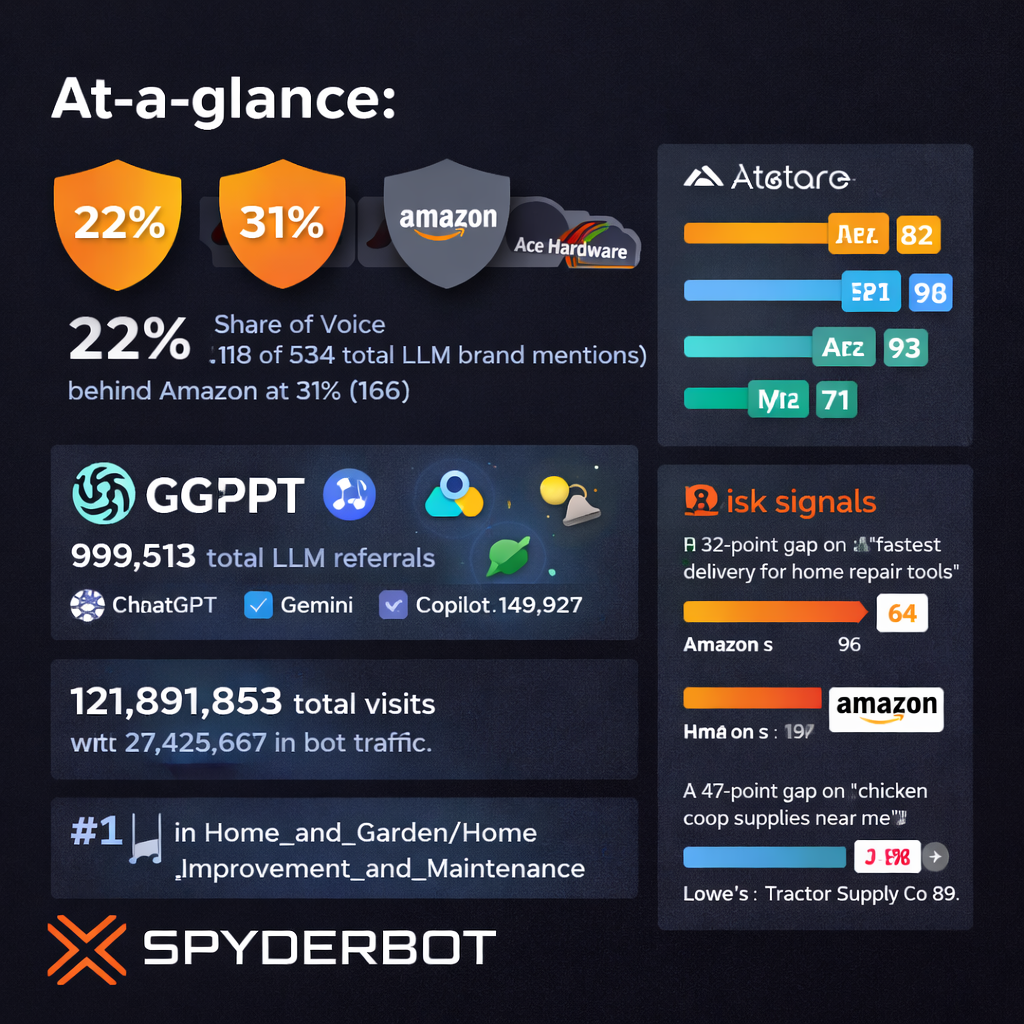
    E-commerce trigger keywords show why the convenience narrative keeps drifting to competitors. “Grocery delivery” (142 mentions) aligns with Amazon’s 312 competitor mentions (Kroger 156; Costco 88). “Same day groceries” (105) again tilts to Amazon at 287 (Kroger 120). “Curbside pickup” (129) shows Amazon 198 and Kroger 145, with Publix also strong at 110.

    Deals and loyalty language split the field. “Digital rewards” (112) is led by Kroger (167) while Amazon holds 88. “Weekly ad flyer” (88) spikes for Publix (97) and Kroger (94). “Meat coupons” (43) skews toward Kroger (89) and Publix (41). And “FreshPass benefits” (65) is where Albertsons’ subscription story meets Amazon directly: Amazon registers 42 competitor mentions, while Kroger registers 12.

    albertsons.com’s Trigger Keywords for Competitor Products (GEO Report, Jan 15, 2026)

    Founder Negative Context

    Founder and investment talk adds reputational drag that can spill into business summaries. Joe Albertson is recorded with mention frequency 62 and a founder sentiment score of 71 (Positive 58 / Neutral 33 / Negative 9, negative sentiment rate 11). Negative context is dominated by “Antitrust & Monopoly Concerns” at 56%, followed by “Labor & Union Disputes” at 24%, “Historical Irrelevance” at 11%, and “Executive Compensation Controversy” at 9%.

    The trend intensifies: “Antitrust” rises from 52% in 2024-Q1 to 61% in 2024-Q2. Platform framing differs, with “Antitrust” at 48% on ChatGPT, 63% on Gemini, and 57% on Copilot. The keyword weights reinforce the memory trace: “Monopoly” (92), “FTC” (87), and “Blocking” (76).

    Albertsons logs 6,163,316 total visits with 2,329,733 in bot traffic. Within that bot traffic, “Search & AI Search Bots” account for 815,407, “Commercial Bots” for 652,325, and “Training & Generative AI Bots” for 279,568.

    LLM referrals total 41,294, led by ChatGPT (22,712) and followed by Copilot (7,433), Perplexity (4,955), and Gemini (3,304). The category position is #9 in Food_and_Drink/Groceries.

    albertsons.com’s Quick overview (GEO Report, Jan 15, 2026)

    Share of Voice in LLM Responses

    Albertsons holds 12% share of voice with 46 mentions out of 382, with “Others” at 9% (34). Amazon leads at 28% (107), Costco 22% (84), Kroger 18% (69), and Publix 11% (42). Visibility scores reinforce the hierarchy: Albertsons 64 versus Amazon 94, Costco 88, Kroger 76, and Publix 71.

    Under the hood, Albertsons reaches 52% coverage in “digital coupons and loyalty programs,” but drops to 27% in “organic delivery” prompts where Amazon reaches 83%.

    AI Platform-Specific Visibility

    On Gemini, Albertsons holds 14% share of voice (19 mentions of 134), behind Amazon (25%, 34) and Kroger (22%, 29). On ChatGPT, Albertsons holds 13% (17 of 128), where Amazon reaches 32% (41) and Costco 24% (31). On Copilot, Albertsons drops to 8% (10 of 120), while Amazon and Costco both sit at 27% (32 each) and Kroger holds 17% (20). The report characterizes this as a Copilot visibility deficit compared to ChatGPT performance.

    Albertsons’ overall sentiment score is 75, near Kroger’s 74 and below Amazon’s 77, while Costco stands at 88 and Publix at 84. Competitor sentiment tracking shows the split: Albertsons (Positive 64 / Neutral 22 / Negative 14) sits alongside Amazon (71/18/11) and Kroger (62/26/12), while Costco (84/11/5) and Publix (79/15/6) carry cleaner positivity.

    Theme volume explains where tone can drift. “Loyalty & Rewards” appears 87 times (frequency 58.00, Positive tone). “Organic/Private Labels” appears 52 times (frequency 35.00, Positive tone). The pressure themes are “Merger & Acquisition” (63, frequency 42.00, Neutral) and “Pricing & Inflation” (48, frequency 32.00, Negative).

    albertsons.com’s Sentiment Score for Competitors (GEO Report, Jan 15, 2026)

    Top Prompts Driving Mentions

    The largest prompts are where Albertsons most clearly gets pushed into “alternative” framing. “Which store is cheapest for a family of four buying in bulk?” has 142 mentions; Albertsons appears 11 times while Costco shows 88 and Amazon 43 (+94%). “Best grocery store for 1-hour delivery in suburban areas?” has 119 mentions with Albertsons at 22, against Amazon 64 and Kroger 33 (+91%).

    The more favorable prompts are ones that force specificity. “Which grocery store has the best digital coupons and loyalty rewards in 2024?” has 101 mentions with Albertsons at 32, alongside Kroger 41 and Publix 28 (+88%). “Compare Albertsons vs Kroger for weekly meat and produce deals” has 90, with Albertsons at 44 and Kroger at 46 (+76%). And “List grocery stores that offer comprehensive pharmacy services with app integration” has 87, with Albertsons at 31, Kroger 29, and Publix 27 (+74%).

    Types of Prompt Queries

    The prompt mix is concentrated: Comparison is 60 (count 6) and Feature Inquiry is 40 (count 4). Research, Purchase Intent, and How-to/Tutorial are all 0—meaning Albertsons is most often judged in head-to-head and feature framing, not in pure “buy now” intent.

    E-commerce Sentiment for Competitor Products

    In e-commerce results, Albertsons holds 14.29% share of voice with 21 mentions, while Amazon leads at 36.73% (54) and Kroger at 22.45% (33) (Costco matches Albertsons at 14.29%, 21). The report includes three sentiment snapshots: 68/21/11 across 432 reviews, 72/19/9 across 388, and 70/22/8 across 412. Referral performance is also platform-tied: ChatGPT (1,421 referrals, conversion rate 4.2), Gemini (1,356, 4.5), and Copilot (1,210, 3.9).

    The snippets show what shoppers reward—and what they penalize. “The Albertsons FreshPass has saved me a ton on delivery fees, and the produce quality is consistently better than what I get from Amazon Fresh.” (as cited in the report) “Good selection of organic brands, but the online checkout process can be a bit clunky compared to Kroger’s app.” (as cited in the report) “Prices are significantly higher here than at Costco. I only shop at Albertsons for items I can’t find in bulk.” (as cited in the report)

    Conclusion

    Albertsons is present, generally well-regarded, and strongest where loyalty and pharmacy convenience can be described with specificity. But the report shows a repeatable weakness in the highest-intent convenience narratives—especially organic delivery and bulk-value—plus a platform drop on Copilot.

    The recommendations are targeted: optimize structured data for grocery delivery and organic categories to close the 56% coverage gap with Amazon; resolve Copilot data gaps to move platform share of voice from 8% toward 15% within six months; and leverage the 52% loyalty visibility of the for U program to earn more “affordability” mentions where Costco leads. fileciteturn0file0

    Explore SpyderBot to operationalize these GEO analytics insights.