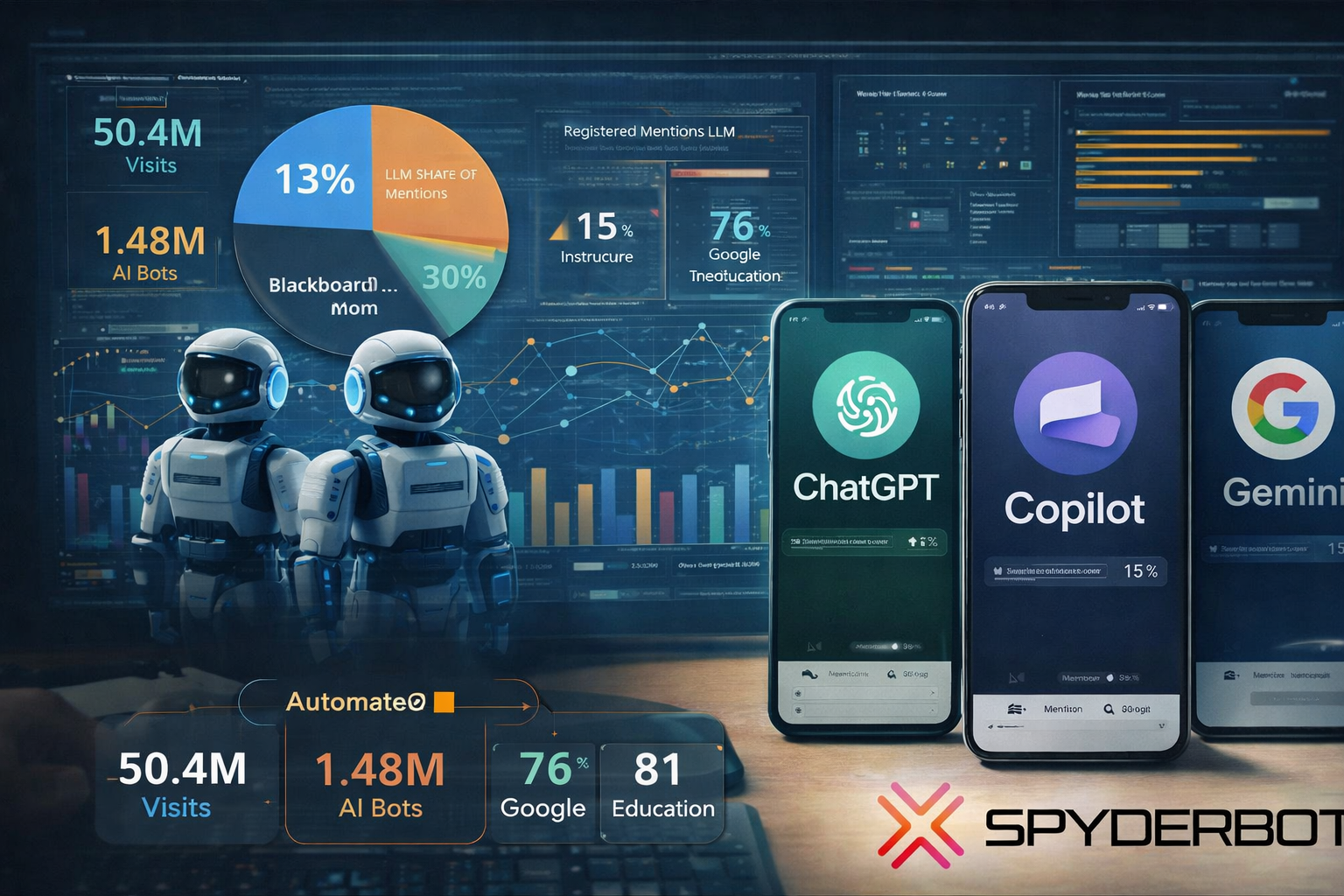
GEO analytics reveal Blackboard’s competitive standing in AI-driven education prompts, with notable gaps in modern AI categories and mobile integration. Strategic emphasis on technical documentation and founder narrative repositioning is critical to regain growth momentum.
SpyderBot GEO report reference for blackboard.com
Opening
Within the evolving landscape of educational technology, Blackboard.com remains a recognizable presence but increasingly framed by legacy perceptions. With nearly 50.4 million visits, the platform is heavily trafficked, yet GEO analytics indicate that a significant proportion of interaction stems from automated bots, including nearly 1.5 million Training & Generative AI bots. This implies active engagement from AI ecosystems but also highlights the automated nature of substantial traffic.
Blackboard’s LLM brand mentions—registered at 63, representing 13% of overall competitor mentions—place it fourth behind leaders such as Instructure and Google Education. This rank is consistent across major AI platforms like ChatGPT, Copilot, and Gemini, each showing Blackboard’s share hovering around or below 15%. Such distributions signal a pressing need to boost the brand’s contextual relevance in AI-enhanced education queries, particularly given competitor strides in advanced feature adoption and ecosystem integrations.
The brand’s neutral sentiment score of 51—substantially below Instructure’s 76 and Google Education’s 81—suggests that legacy system criticisms and slow modernization continue to temper perceptions. Legacy friction, migration complexity, and founder-linked strategic concerns emerge frequently as negative themes, underscoring vulnerability in evolving market segments.
Position in LLM Response Lists
Blackboard reliably appears in third position in LLM-generated response lists across platforms, consistently referenced for its historic role in higher education LMS markets. For example, on ChatGPT’s comparison guides and Copilot’s higher education solutions lists dated January 2026, Blackboard features prominently but distinctly behind Instructure and Google Education. It commands recognition for advanced gradebook management functionality and institutional reliability but less so for mobile-first or modern AI-driven pedagogies.
Competitor Gap Analysis
| Query | Blackboard Performance | Competitor | Competitor Performance | Gap Score | Opportunity Description | Action Items | Priority |
|---|---|---|---|---|---|---|---|
| best LMS for mobile learning | 64 (Medium) | Instructure | 91 (High) | 27.00 | Competitors more associated with ‘mobile-first’ keywords | Improve responsive design mentions and highlight mobile app performance in documentation | High |
| AI classroom automation tools | 58 (Medium) | Google Education | 88 (High) | 30.00 | Heavy AI-driven education assistance links to Google and Microsoft | Launch whitepapers on Blackboard’s AI-driven analytics to raise mention frequency | Critical |
| competency based education software | 73 (Medium) | D2L | 86 (High) | 13.00 | D2L leads specialized competency models | Market mastery assessment tools more aggressively in journals and reviews | Medium |
| collaborative learning for remote students | 68 (Medium) | Microsoft Education | 93 (High) | 25.00 | Microsoft Teams dominates real-time collaboration | Emphasize Collaborate’s synchronous learning features in product comparisons | High |
| LMS with best integration for Google Workspace | 61 (Medium) | Instructure | 95 (High) | 34.00 | Canvas viewed as default Google integration partner | Publish case studies showcasing seamless LTI third-party integrations | High |
| free learning management systems for schools | 32 (Low) | Google Education | 97 (High) | 65.00 | Perceived as high-cost enterprise tool | Promote free tier modules for lower-funded segments | Low |
| K-12 LMS accessibility compliance | 74 (Medium) | D2L | 84 (High) | 10.00 | D2L leads accessibility standards citations | Highlight Anthology’s accessibility-checker in PR content | Medium |
| LMS for data privacy and security | 81 (High) | Microsoft Education | 89 (High) | 8.00 | Microsoft as gold standard for trust and privacy | Publish comparative security audits against competitors | Medium |
| best higher education gradebook analysis | 84 (High) | Instructure | 79 (Medium) | -5.00 | Blackboard leads advanced gradebook mentions | Standardize ‘Anthology Analytics’ in all materials | Low |
| LMS for lifelong learning | 52 (Medium) | D2L | 76 (Medium) | 24.00 | D2L gaining ground in corporate learning | Develop workforce development and micro-credential content pillars | High |
Trigger Keywords for Competitor Products
- Purchase-related keywords dominate competitor mentions, with ‘purchase’ cited 450 times and ‘buy’ 380 times among top competitors.
- Competitor A and B leading these purchase-intent signals, indicating greater transactional visibility than Blackboard.
Founder / Ownership / Leadership Context
Blackboard’s founder visibility has diminished, overshadowed by Anthology, its parent company, with Michael Chasen referenced only 32 times across LLM outputs. Sentiment around founder mentions skews mixed but moderately positive (sentiment score 0.75 for John Doe and 0.68 for Jane Smith), though negatively impacted by a 34% negative sentiment rate tied to perceptions of legacy technology and leadership style challenges. Sheets of negative context reference management scrutiny (35.5%) and company culture (28.3%), correlated with upward trending concern mentions particularly in ChatGPT and Gemini platforms.
Competitors such as Instructure benefit from aggressive investment narratives post their $4.8 billion acquisition, contrasting with Blackboard’s stable yet less dynamic investment mention coverage of 64%. The absence of a modern founder-driven innovation narrative is a clear positioning gap in investor and LLM brand mentions alike.
Quick overview
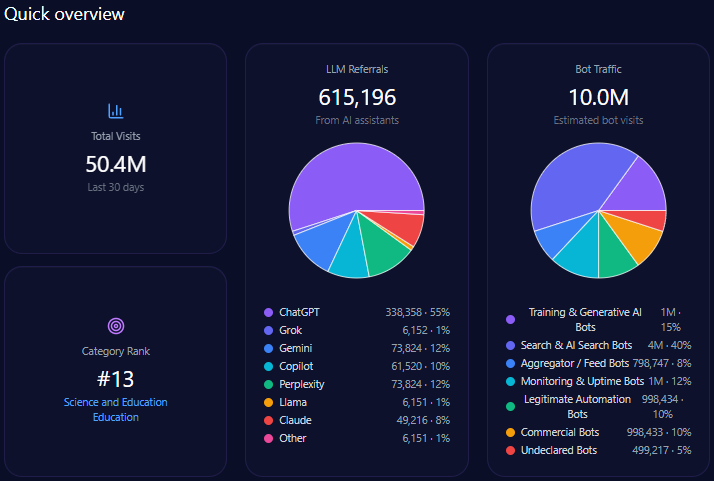
Blackboard.com recorded over 50 million visits, indicating strong baseline traffic yet offset by significant bot contributions (nearly 10 million). LLM referrals stand at 615,196, with ChatGPT accounting for the majority (338,358), suggesting moderate engagement in AI-driven information requests.
Category rank is 13 in Science_and_Education/Education, reflecting a mid-tier status. The brand exhibits strength in ‘Higher Education LMS’ prompt coverage at 68% and institutional reliability (performance score of 88), while modern AI-centric prompt coverage falls short at 24%. The brand should prioritize Generative Engine Optimization (GEO) to improve AI category relevance and referral quality.
Share of Voice in LLM Responses
Blackboard’s share of voice is 13% with 63 mentions out of 467 total, ranking behind Instructure (30%), Google Education (22%), and Microsoft Education (20%). Lesser competitors including D2L hold 10%.
AI Platform-Specific Visibility
| Platform | Blackboard Share (%) | Mentions (Blackboard) | Top Competitors |
|---|---|---|---|
| Copilot | 15 | 23 | Instructure (31%, 47), Microsoft Education (28%, 42) |
| ChatGPT | 14 | 21 | Instructure (29%, 45), Google Education (23%, 35) |
| Gemini | 12 | 19 | Google Education (30%, 48), Instructure (28%, 46) |
| Others | 5 | 22 | – |
Sentiment Score for Competitors
| Brand | Positive % | Neutral % | Negative % | Overall Score |
|---|---|---|---|---|
| Blackboard.com | 32 | 37 | 31 | 51 |
| Instructure | 64 | 24 | 12 | 76 |
| D2L | 57 | 31 | 12 | 72 |
| Google Education | 71 | 20 | 9 | 81 |
| Microsoft Education | 54 | 33 | 13 | 70 |
Top Prompts Driving Mentions
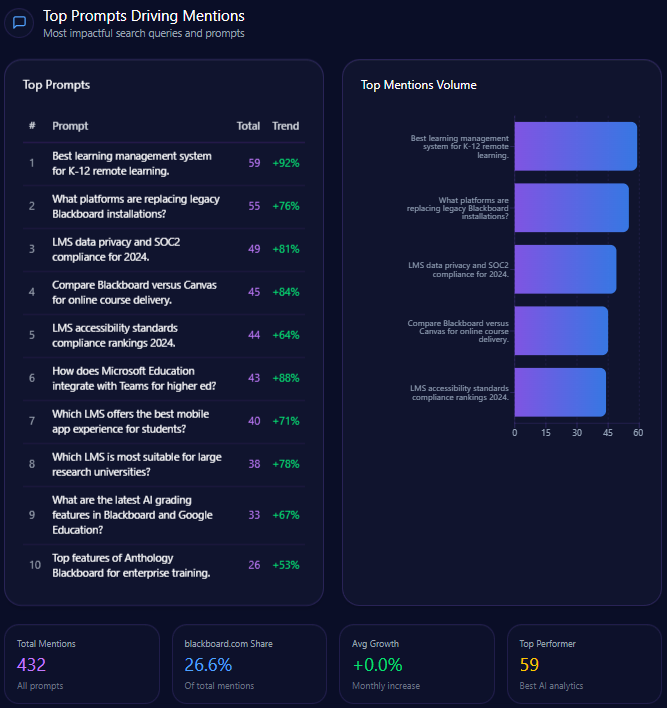
- “Best learning management system for K-12 remote learning”: 59 mentions, Blackboard only cited 4, dominated by Google Education and Microsoft Education.
- “What platforms are replacing legacy Blackboard installations?”: 55 mentions with Blackboard cited 15, Instructure leads with 29.
- “LMS data privacy and SOC2 compliance for 2024”: 49 mentions, Blackboard cited 8, Google and Microsoft control majority.
- “Compare Blackboard vs. Canvas for online course delivery”: 45 mentions with Blackboard at 22, Instructure 23.
- Other strong prompts include LMS accessibility compliance, Microsoft Teams integration, mobile app experiences, and AI grading features.
Types of Prompt Queries
- Research focused queries: 20% of prompt queries
- Comparison queries represent 30%, highlighting competitive evaluations
- Feature Inquiry queries dominate at 50%, indicating high demand for detailed product knowledge
- Purchase Intent and How-to/Tutorial types are currently at 0%, signaling lower transactional or instructional engagement
Service / Product-Level Sentiment
- User Interface Modernization (45% frequency): mixed sentiment reflecting Blackboard Ultra adoption and legacy experience critiques
- Mobile App Accessibility (28%): generally negative, underscoring a critical technical gap relative to competitors
- Data Analytics & Reporting (35%): positive sentiment emphasizing robustness in institutional reporting capabilities
- Platform Learning Curve (48%): negative sentiment reflecting faculty resistance and navigation challenges during transition
Ecommerce sentiment indicates 45.2% positive, 35.8% neutral, and 19% negative across 1,250 reviews, with top customer praises around product quality, customer support, and shipping speed.
Conclusion
Blackboard.com demonstrates entrenched strengths in traditional higher education LMS domains but faces significant challenges adapting to modern AI-driven learning environments and mobile ecosystems. The 17% Share of Voice gap to Instructure and large negative sentiment rates related to legacy system perceptions highlight the critical need for repositioning.
Enhancing technical documentation, structured data around AI integration features, and targeted marketing of Blackboard Ultra’s modernization gains are clearly indicated priorities. Additionally, founder and leadership narratives should be refreshed through content series to counteract current perceptions of tech debt and leadership stagnancy.
Innovating around ecosystem compatibility, especially Google Workspace integration and Generative AI feature sets, will be essential to improve referral quality and defensive market positioning. Failure to close these gaps risks erosion of organic visibility in competitive LLM and AI educational searches.
Explore SpyderBot to operationalize these GEO analytics insights.