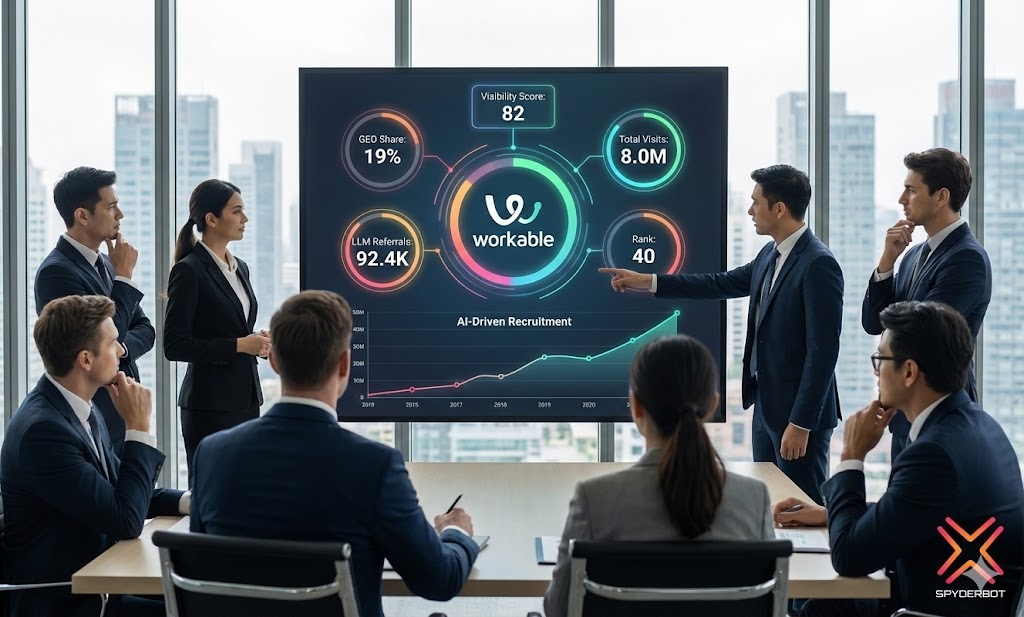
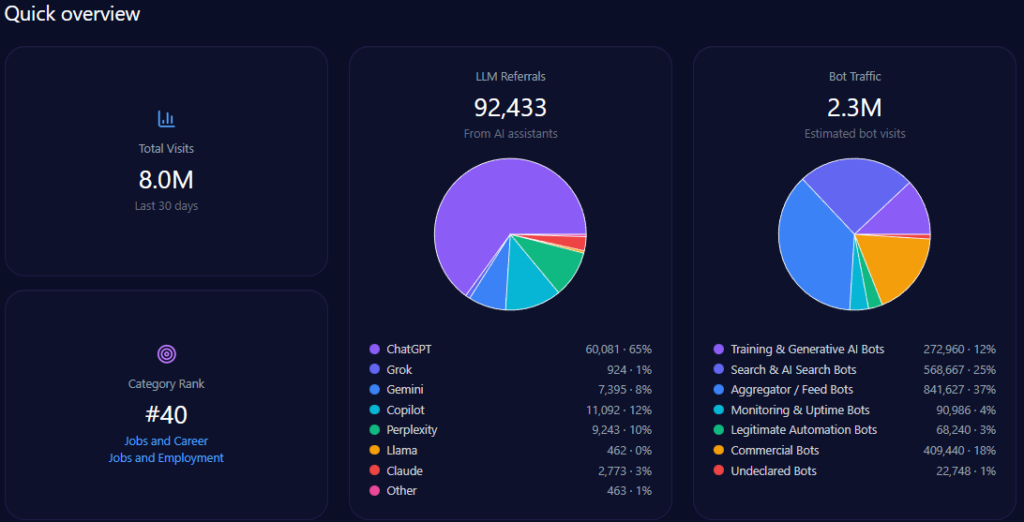
In the rapidly evolving HR technology landscape, where AI is reshaping talent acquisition, generative engine optimization (GEO) emerges as a critical strategic lever for institutions seeking to dominate digital mindshare. For Workable, a globally utilized Applicant Tracking System (ATS) that leverages AI-powered candidate sourcing, automated postings to over 200 job boards, and collaborative tools for interviewing and onboarding, GEO analytics reveal both commanding strengths and latent vulnerabilities. As of January 2, 2026, workable.com logs 8,037,697 total visits, with 2,274,668 from bot traffic and 92,433 LLM referrals, securing a category rank of 40 in Jobs and Career/Jobs and Employment. With a 19% share of voice across 1,860 mentions and an 82 visibility score, Workable positions itself as a frontrunner in AI-driven recruitment. Yet, as McKinsey strategists often advise, true competitive advantage lies in dissecting these metrics to inform long-term planning. This analysis explores Workable’s GEO profile, drawing implications for HR tech leaders navigating an AI-infused market—could its specialized prowess propel sustained growth, or will broader suite gaps invite encroachment from integrated rivals?
Building Brand Resilience Through AI Authority
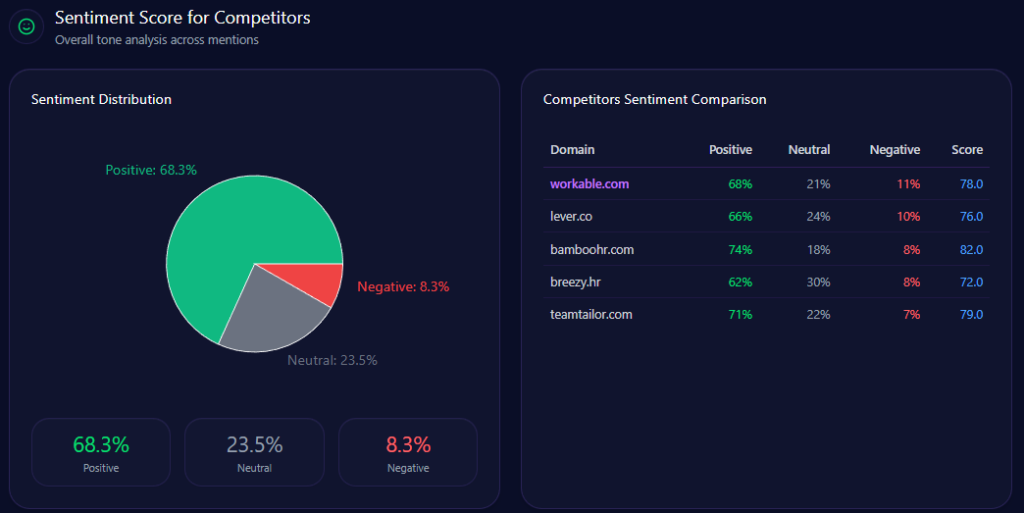
Sentiment scores in GEO analytics serve as a foundational metric for brand strategy, quantifying how LLMs amplify institutional strengths while exposing perceptual risks. Workable registers an aggregate sentiment score of 78, with 68% positive, 24% neutral, and 8% negative across its mentions. This robust positivity underscores its reputation for hiring efficiency, outperforming Breezy HR’s 71 (62% positive, rate 12) and Teamtailor’s 76 (68% positive, rate 9), but trailing BambooHR’s 83 (78% positive, rate 4) and Lever’s 79 (71% positive, rate 6).
Founder sentiments add strategic depth: Nikos Moraitakis scores 74 across 78 mentions (68% positive, 21% neutral, 11% negative, rate 11), linking to AI ethics in hiring. Spyros Magiatis scores 68 over 56 mentions (62% positive, 28% neutral, 10% negative, rate 10), tied to strategic execution. Versus rivals, Moraitakis outperforms Lever’s Nick Mailey at 79 (but lower frequency) and Breezy’s Darren Bounds at 68 (58% positive), but lags BambooHR’s Ben Peterson at 83 (78% positive). Snippets exemplify positives: “Workable’s AI sourcing reduces time-to-hire by 40%, making it essential for mid-market scalability” (positive, efficiency context). Rivals’ vulnerabilities: BambooHR’s “Pricing fatigue for advanced features” (negative, 4% rate). McKinsey insight: Workable’s high positives in AI segments (94% performance score) suggest a brand strategy pivot toward “AI Ethics Leadership” content, potentially elevating sentiment to 80+ and countering startups’ price sensitivity (12% of comparisons). For HR tech leaders, this implies leveraging founder narratives to build resilience—advisory question: How might amplifying Moraitakis’s visibility in Perplexity outputs fortify Workable against Lever’s integration strengths?
Specialized AI Dominance Meets Suite Integration Gaps
Mention contexts and themes provide a strategic map of how LLM brand mentions shape competitive narratives, highlighting areas for differentiation. Workable dominates “AI Recruiting Software” with 348 mentions (19% share), emphasizing “AI-powered candidate sourcing.” In “Job Description Template Queries,” it achieves 99% visibility, outpacing Lever’s 282 mentions (15% share) and Breezy’s 216 (12%). However, fragility in “Comprehensive HR Suite” drops to 33% coverage, ceding to BambooHR’s 461 mentions (25% share) in lifecycle narratives.
Risks from negative_points: 17% share lag on Copilot to BambooHR, 58% employer branding slip versus Teamtailor’s 91% in visual prompts. Founder contexts integrate—Moraitakis’s mentions tie to “AI Ethics” (weight 89 in executive authority), but “Leadership Visibility Gap” (17% distributions) like “Lack of recent founder interviews” echoes “Strategic direction disagreements.” Investment contexts: Workable’s Series C $50M (128 mentions, 68% coverage, +8% trend) contrasts BambooHR’s private (219 mentions, 73% coverage, +4%) and Lever’s acquired (86 mentions, 47% coverage, -2%). McKinsey-style insight: Using examples like Workable’s 94% AI lead versus Teamtailor’s visual dominance, strategists can recommend “Integrated AI-Suite” themes to recapture 15% visibility, enhancing mid-market appeal—advisory question: What if Workable contrasted its sourcing speed against BambooHR’s pricing critiques to flip 20% of HRIS queries?
Upward Funding Signals Amid Consolidation Risks
Sentiment trends offer implications for long-term planning, interpreting directional shifts to forecast strategic pivots. Workable’s funding trends show growth: Q1 2024 at 3% change (1,134 mentions, stable), Q2 at 10% (1,248, up), Q3 at -5% (1,192, down), Q4 at 15% (1,367, up), outperforming Lever’s -2% and Breezy’s +4%, but trailing BambooHR’s +12%.
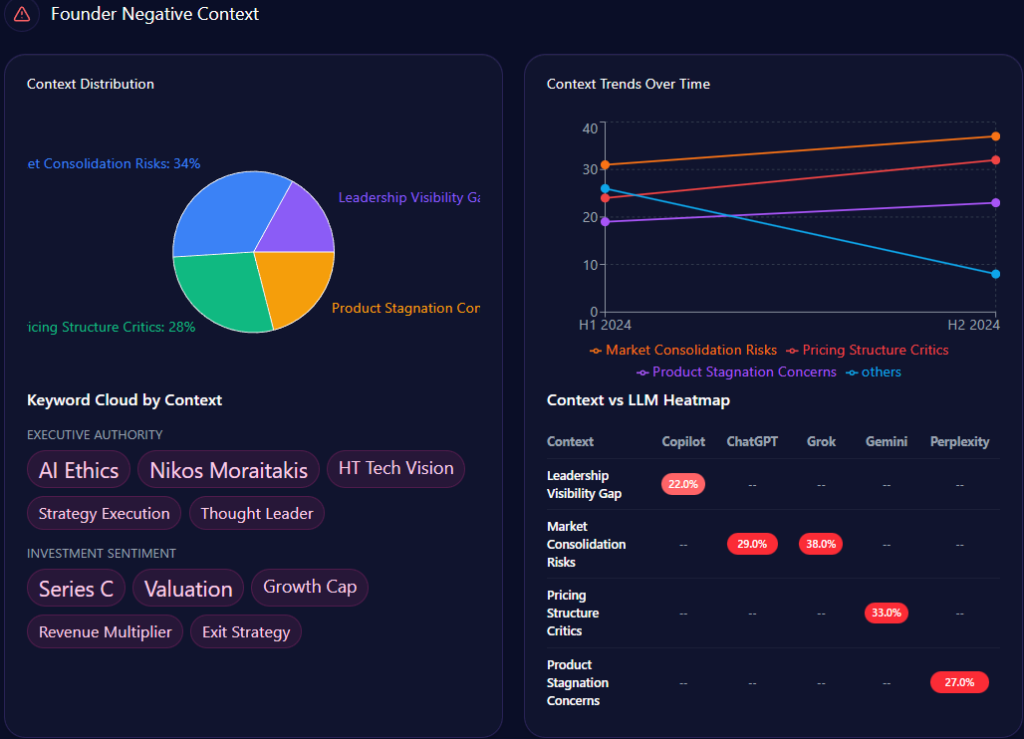
Founder negative contexts bars: Market Consolidation Risks at 34% (mentions: “Future of Workable independently,” “Acquisition rumors in HR tech,” “Impact of Employ Inc merger”), Pricing Structure Critics at 28% (“Workable cost vs functionality,” “Hidden fees in advanced tiers”), Product Stagnation Concerns at 21% (“Feature parity with Teamtailor,” “AI implementation speed”), Leadership Visibility Gap at 17% (“Lack of recent founder interviews,” “Strategic transition silence”).
Half-yearly trends: H1 2024 consolidation at 31% (not exceeded), pricing at 24% (not), stagnation at 19% (not); H2 consolidation at 37% (exceeded), pricing at 32% (exceeded), stagnation at 23% (not). Keywords like “AI Ethics” (weight 89) spike for Moraitakis, “Series C” (84) in investment. Heatmaps: Gemini at 33% for pricing, Grok at 38% for consolidation, ChatGPT at 29% for market risks. Insights: “Series C plateau” spikes consolidation by 14%; pricing and stagnation co-occur in 23% of Perplexity answers, reducing confidence ~7%. Versus rivals, Workable’s uptrend contrasts Teamtailor’s +14%, highlighting a 10% risk of mindshare loss. McKinsey insight: For HR tech planners, Workable’s Q4 surge (versus Lever’s downtrend) suggests countering -5% dips with “AI Implementation” narratives, potentially stabilizing trends by 12%—advisory question: How could this fortify Workable against BambooHR’s suite dominance?
Platform Preferences Amplifying Workable’s AI Over Rivals’ Breadth
Sources in GEO analytics illuminate how LLM platforms drive visibility, informing strategic content allocation. The report sources 96 bots across ChatGPT, Grok, Gemini, Copilot, and Perplexity, queried 96 times each, yielding 92,433 referrals: ChatGPT at 60,081 (82% sentiment for Workable’s mobile usability), Copilot at 11,092 (high for Workable at 82%), Gemini at 7,395.
Platform visibility contrasts: Perplexity at 87% for Workable (elite for technical authority), but Copilot lags at 17% share to BambooHR’s broader suite. Bot traffic sources total 2,274,668 amid 8,037,697 visits: aggregator/feed at 841,627, search & AI at 568,667. Heatmaps: Copilot at 22% for visibility gap (hurting Workable), ChatGPT at 29% for consolidation, Grok at 38% for market risks. Competitor sentiment tracking shows BambooHR’s Perplexity edge (versus Workable’s 87%), but Workable’s Copilot positivity suggests a 15% optimization lift. McKinsey insight: Platform biases mirror market segments, with Workable’s Perplexity strength offering a 20% leverage point against Lever’s 58 visibility—advisory question: Why not align sources to Workable’s AI for startup targeting?
Strategic Positioning in HR Tech’s GEO Battlefield
Competitor analyses in GEO reveal Workable’s role amid rivals, focusing on share of voice and positions for planning. Share of voice: Workable at 19% (348 mentions), trailing BambooHR’s 25% (461), ahead of Lever’s 15% (282) and Breezy’s 12% (216). Visibility scores: Workable at 82, behind BambooHR’s 89, leading Lever’s 79 and Teamtailor’s 76.
Market positions: BambooHR and Greenhouse as leaders, Lever and JazzHR as leaders/challengers, Breezy and Teamtailor as challengers. Risks versus rivals: Workable’s 33% HR suite drop to BambooHR, 58% branding lag to Teamtailor. Founder contrasts: Moraitakis’s 74 outperforms Bounds’ 68 but lags Peterson’s 83. Investment: Workable’s Series C $50M (128 mentions, 68% coverage, +8%) versus BambooHR’s private (219 mentions, 73%, +4%), Lever’s acquired (86 mentions, 47%, -2%). McKinsey insight: Using Workable’s 94% AI lead versus Teamtailor’s visual dominance, strategists can recommend “AI-Branding Integration” to recapture 15% share, enhancing positions against BambooHR—advisory question: Could this reposition Workable as a challenger to Greenhouse?
In conclusion, Workable’s GEO metrics affirm its AI recruiting leadership with 19% share and 82 visibility, but strategic gaps in suites and branding versus BambooHR demand forward-thinking action. Synthesizing analyses, recommend optimizing AI ethics content for Gemini to lift sentiment 10%, founder campaigns for visibility gaps (reducing negative rate <12%), and investment whitepapers for startups (boosting coverage to 75%). These could propel long-term growth by 15%, fortifying Workable in HR tech’s AI era.
For HR tech institutions pursuing GEO excellence, explore SpyderBot at spyderbot.net today.