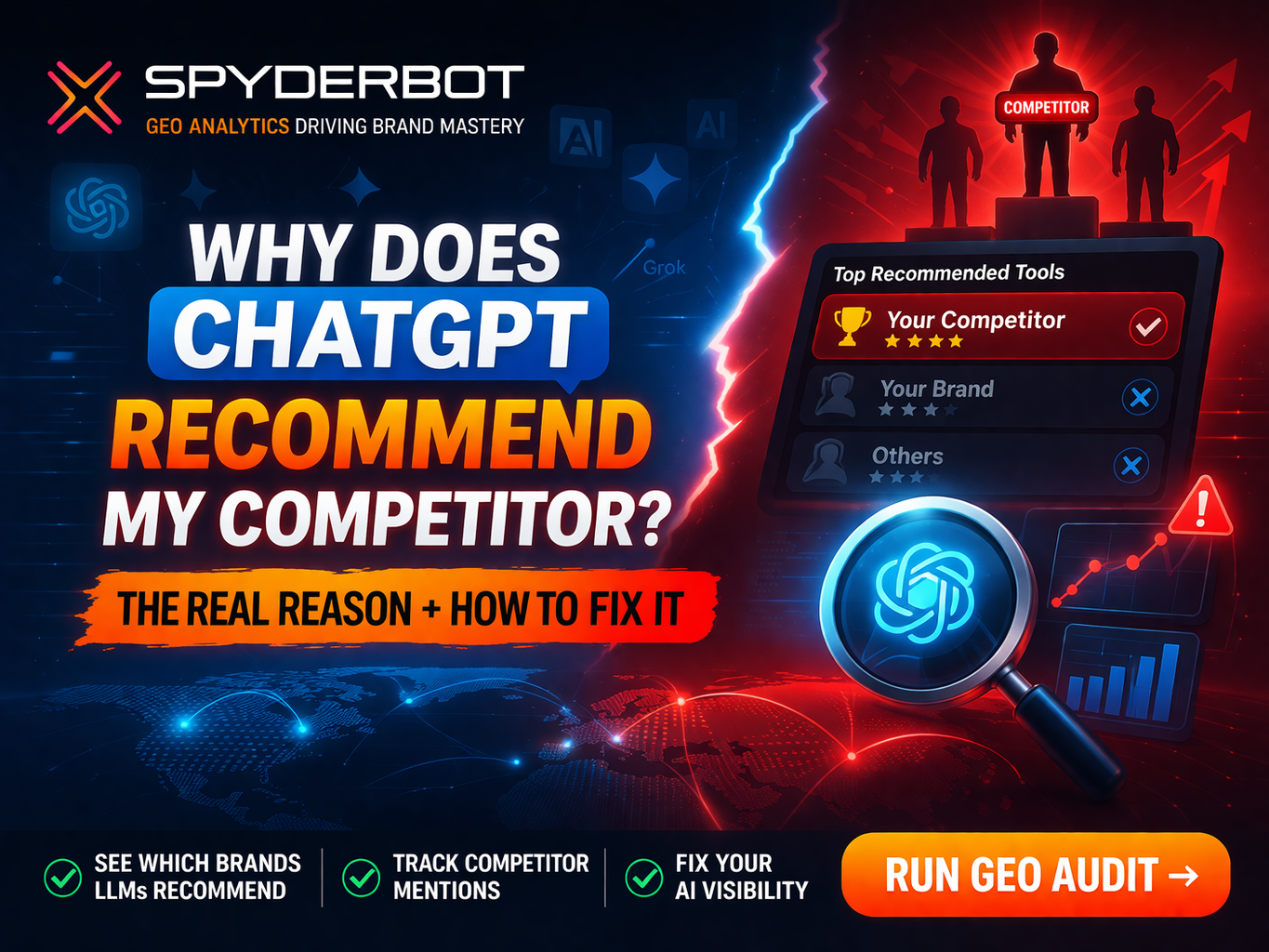
If ChatGPT keeps recommending your competitor instead of your brand, the problem is usually not random. In most cases, it means the model has stronger confidence in your competitor’s entity signals, source consistency, topical authority, and brand-to-query relevance.
This is the new visibility problem in AI search.
In Google Search, brands compete for rankings. In ChatGPT and other LLM-powered systems, brands compete for mentions, citations, and inclusion inside the answer itself. If your competitor is mentioned more often, described more clearly, or connected more strongly to the user’s question, they are more likely to appear in the response.
I. What This Problem Really Means
When ChatGPT recommends your competitor, it usually indicates one or more of these issues:
- Your brand is not strongly associated with the category or use case users ask about.
- Your competitor has clearer, more repeated, and more trusted mentions across the web.
- Your content is visible, but not structured in a way that helps LLMs understand what your brand actually does.
- The model has stronger confidence in your competitor’s relevance for the prompt.
This is not only a content problem. It is a GEO problem.
Generative Engine Optimization is the process of improving how AI systems interpret, retrieve, compare, and mention your brand.
II. Diagnosis
1. Your competitor has stronger entity clarity
If your competitor is easier for AI systems to understand, they will be easier to recommend.
Entity clarity means the model can quickly answer:
- What is this brand?
- What category does it belong to?
- What problems does it solve?
- Who is it best for?
- How is it different from alternatives?
If your site talks in vague marketing language while your competitor uses clear positioning, structured explanations, comparison pages, and category-specific language, the LLM will often prefer them.
2. Your competitor has better source distribution
ChatGPT does not rely on only one page.
It forms brand understanding from patterns across:
- company websites
- product pages
- reviews
- editorial mentions
- industry directories
- comparison articles
- forums
- third-party references
If your competitor is described consistently across many sources, while your brand appears only on your own website, the model has fewer signals to trust.
3. Your website explains features, but not use cases
Many brands describe what they built but fail to explain:
- who it is for
- when it should be used
- how it compares to alternatives
- what category it belongs to
That creates a gap between your internal messaging and the way real users ask questions.
If users ask, “What is the best tool for tracking AI brand mentions?” and your competitor has pages directly tied to that use case, they may be recommended even if your product is stronger.
4. Your competitor is better aligned to prompt intent
ChatGPT often recommends brands that match the prompt more precisely, not brands that are generally “better.”
For example:
- informational prompts favor educational brands
- comparison prompts favor brands with clear positioning
- commercial prompts favor products with strong category framing
- trust-sensitive prompts favor brands with stronger third-party validation
If your competitor has content mapped to those intents and you do not, they will appear more often.
5. Your brand lacks comparison visibility
If your competitor is included in “best tools,” “alternatives,” “vs” pages, analyst summaries, and review ecosystems, they gain repeated comparative exposure.
That matters because LLMs frequently generate answers by synthesizing comparative language. If your brand is absent from the comparison layer of the web, it becomes easier for the model to ignore you.
III. Why It Happens (LLM Mechanism)
1. LLMs do not think like traditional search engines
Google ranks pages. LLMs generate answers.
That means ChatGPT is not simply choosing the “highest ranked website.” It is predicting which brands, facts, and sources are most relevant to include in the response.
This is a major shift.
A brand can rank well in Google and still be weak inside ChatGPT if the model does not strongly connect that brand to the user’s question.
2. LLMs compress the web into patterns
Large language models learn from repeated relationships between terms, entities, categories, and sources.
If the web repeatedly connects your competitor with phrases like:
- best platform for X
- trusted tool for Y
- leading provider in Z
then the model may internalize that competitor as a more natural answer.
If your brand signals are inconsistent, sparse, or too generic, your probability of being mentioned drops.
3. Retrieval systems reward accessible, structured evidence
In many AI experiences, the model is not relying only on memory. It may also use retrieval, browsing, or cited sources.
When that happens, pages with the following tend to perform better:
- strong topical headers
- clear category definitions
- direct answers
- comparison-friendly structure
- schema and supporting context
- brand-service-query alignment
If your competitor publishes content that is easier to retrieve and summarize, the system has a better chance of surfacing them.
4. AI models prefer confidence over ambiguity
LLMs are probabilistic systems. When faced with uncertainty, they lean toward the brand with stronger evidence and cleaner associations.
That is why weak positioning hurts.
If your homepage says you “redefine innovation across digital ecosystems,” but your competitor says they are “an AI search analytics platform for tracking brand mentions in ChatGPT, Gemini, and Claude,” the second brand is far easier for the model to use.
5. Mention frequency compounds visibility
Once a brand is repeatedly associated with a topic, that mention advantage can reinforce itself.
More mentions lead to:
- stronger category association
- more comparison inclusion
- more confidence in future answers
- broader prompt coverage
This is why LLM visibility often feels unfair. The model is not trying to be fair. It is trying to generate the most likely helpful answer.
IV. How to Fix It
1. Tighten your brand positioning
Make your core message explicit across your site:
- what your product is
- who it is for
- what category it belongs to
- which problems it solves
- how it differs from competitors
Do not assume AI systems will infer your positioning correctly.
2. Build pages for prompt intent
Create pages that match the actual questions users ask:
- why ChatGPT is not mentioning my brand
- how to appear in AI search results
- how to optimize website for ChatGPT
- best tool to track ChatGPT mentions
- competitor alternatives pages
- category definition pages
This helps connect your brand to real LLM query patterns.
3. Strengthen off-site validation
You need more than a good homepage.
Build consistent references across:
- industry articles
- software directories
- founder and company profiles
- product comparisons
- podcast or interview mentions
- community discussions
The goal is not just traffic. The goal is machine-readable brand reinforcement.
4. Add structured comparison content
Publish content that helps the model place you in the competitive landscape:
- X vs Y
- alternatives to competitor
- best tools for specific use cases
- category roundups
- buyer guides
If you are not present in comparative content, your competitor will own the recommendation layer.
5. Measure your LLM visibility
You cannot fix what you do not measure.
Track:
- where your brand is mentioned
- which competitors are recommended instead
- which prompts trigger exclusion
- which use cases you dominate or lose
- which sources are influencing outcomes
That is how you move from guessing to diagnosing.
V. Why This Matters for Revenue
If ChatGPT recommends your competitor, the issue is not just branding.
It can affect:
- top-of-funnel discovery
- product consideration
- perceived authority
- buyer trust
- competitive conversion paths
As AI interfaces become part of research and buying behavior, being absent from recommendations becomes a visibility loss with commercial consequences.
VI. Run GEO Audit
If ChatGPT recommends your competitor more often than your brand, do not treat it as a mystery.
Treat it as a measurable visibility problem.
A GEO Audit helps you identify:
- which competitors are being mentioned instead of you
- which prompts expose your weakness
- how AI systems describe your brand
- where your entity positioning is unclear
- which content and source gaps are reducing your inclusion
Run GEO Audit to see how LLMs analyze your brand, where competitors are outperforming you, and what to fix first.
VII. FAQ
1. Is ChatGPT ranking my competitor above my brand?
Not in the same way Google ranks websites. ChatGPT generates answers by selecting the brands and sources it considers most relevant, useful, and trustworthy for the prompt.
2. Can I optimize my website for ChatGPT?
Yes. You can improve your chances of being mentioned by clarifying your positioning, aligning pages to prompt intent, creating comparison content, and strengthening source consistency across the web.
3. Why does my competitor appear in ChatGPT even when I rank higher in Google?
Because Google rankings and LLM mentions are not the same thing. A strong search ranking does not automatically translate into strong AI visibility.
4. Do reviews and third-party mentions affect ChatGPT recommendations?
Yes. Repeated and consistent third-party references help strengthen brand credibility and category association in AI-generated answers.
5. How do I know which prompts favor my competitor?
You need prompt-level monitoring and LLM visibility tracking to see where your brand is missing, where competitors dominate, and which categories or use cases need optimization.