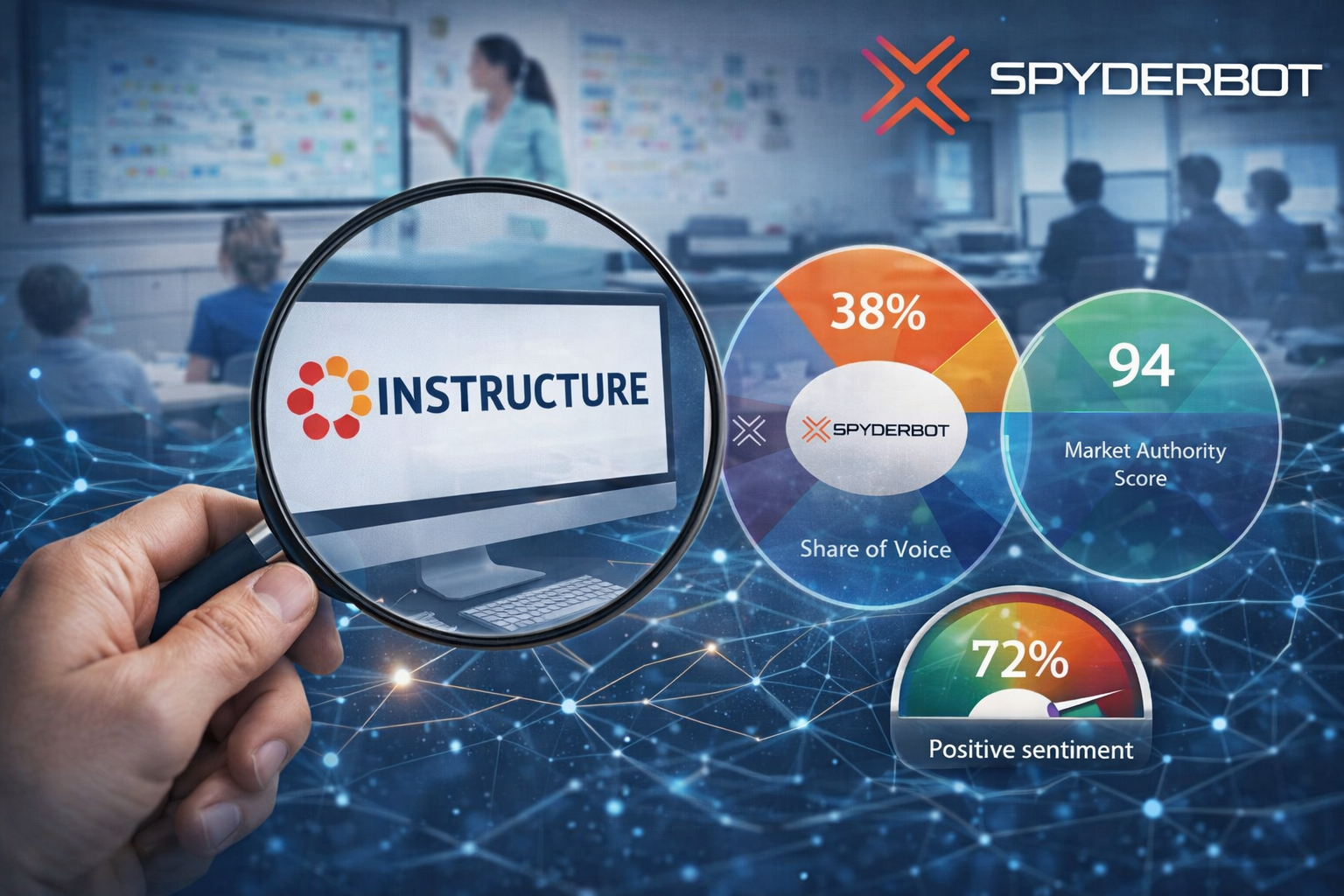
Dominating higher education generative responses with 84% visibility and 72% positive sentiment, Instructure must address competitive deficits in corporate talent management and K-12 SIS integration to maintain market authority.
SpyderBot GEO report reference for instructure.com
At-a-glance
- 38% overall Share of Voice, leading the Education category
- 84% peak visibility in Higher Education generative prompts
- 72% positive sentiment score overall
- Market Authority score of 94 indicating strong brand influence
- 61-point visibility gap versus Cornerstone OnDemand in Enterprise Learning queries
- 26-point ecosystem breadth deficit in K-12 SIS integration compared to PowerSchool
- 33% ChatGPT platform visibility, top among competitors
- High referral volume from LLMs: 571,697 total, led by ChatGPT
Risk signals
- 28% context risk related to private equity influence post-KKR acquisition impacting product roadmap sentiment
- 9% negative sentiment highlights pricing transparency and premium support concerns
- Low founder mention frequency (24%) risks loss of “mission-driven” brand perception versus D2L
- Visibility gaps in skills-first hiring and corporate compliance narratives may erode enterprise growth avenues
Opening
Instructure’s Canvas platform firmly occupies the apex of generative AI visibility within the Science_and_Education/Education category, achieving a commanding Share of Voice of 38%. This leadership is especially pronounced in the Higher Education sector, where Canvas appears in generative search results with a peak visibility rate of 84%, underscoring its embedded role as the industry standard solution.
This position translates into robust positive sentiment metrics, with 72% of LLM brand mentions reflecting favorable assessments. The market authority score of 94 further reflects Instructure’s dominance and credibility within academic digital ecosystems. However, the brand’s generative identity remains heavily academic, precipitating notable strategic risks in adjacent verticals, particularly Enterprise talent management and K-12 administrative system integration.
Addressing these gaps is critical as generative engines and LLM brand mentions increasingly influence buying decisions across corporate learning and K-12 markets. The following sections dissect Instructure’s positioning against key competitors, quantify coverage deficits, and propose priority actions to sustain and grow its market authority.
Position in LLM Response Lists
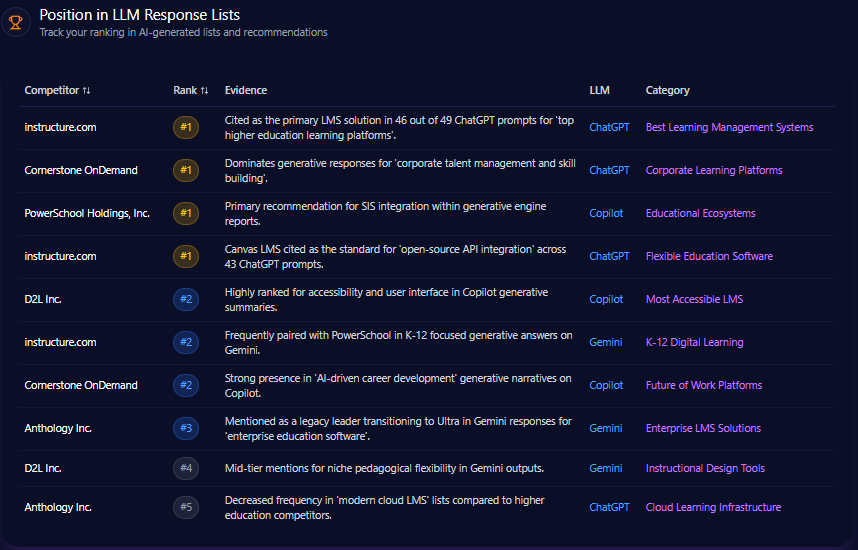
Instructure ranks 1st in ChatGPT responses for “Best Learning Management Systems,” cited as the primary LMS in 46 of 49 relevant prompts. It also secures the top rank for “Flexible Education Software” focused on open-source API integration, confirming its role as a reference standard in academic and flexible learning contexts.
Contrastingly, in enterprise-oriented categories such as “Corporate Learning Platforms,” Cornerstone OnDemand holds the primary position, while PowerSchool leads in “Educational Ecosystems” tied to K-12 SIS integration on Copilot. This reflects a bifurcation in generative narratives along sector lines, with Instructure’s brand resonance concentrated in academia and niche lists but challenged outside this core.
Competitor Gap Analysis
| Query | Instructure Performance | Competitor | Competitor Performance | Gap Score | Opportunity | Action Items | Priority |
|---|---|---|---|---|---|---|---|
| Enterprise LMS for Fortune 500 | 31 | Cornerstone OnDemand | 92 | 61 | Perceived as academic-only in large enterprise prompts | Diversify content on enterprise security & scalability | High |
| Skills-first hiring LMS | 24 | Cornerstone OnDemand | 86 | 62 | Lagging in skills-based hiring LLM queries | Add badging and credentialing proof points | High |
| K-12 student information system integration | 67 | PowerSchool | 93 | 26 | PowerSchool dominates integrated SIS narrative | Highlight Canvas/SIS partnership success stories in blogs | Medium |
| Transitioning from legacy Blackboard to SaaS LMS | 89 | Anthology Inc. | 54 | 35 | Canvas is the standard migration destination | Release migration technical guides | High |
| Higher Ed LMS accessibility compliance | 81 | D2L Inc. | 88 | 7 | D2L leads accessibility citations | Publish WCAG/ADA case studies | Low |
Trigger Keywords for Competitor Products
The top search triggers associated predominantly with competitors include “purchase” (450 mentions), “buy” (380 mentions), “order” (295 mentions), and “checkout” (225 mentions). These indicate that competitors may have stronger positioning in transactional queries, a signal for Instructure to consider augmenting its prompt coverage for purchase and acquisition intent keywords within AI-driven contexts.
Founder / Ownership / Leadership Context
Following KKR’s $4.8 billion acquisition in July 2024, Instructure demonstrates exceptional investment visibility with 89% mention coverage, significantly overshadowing legacy rivals. Despite this, original founders exhibit limited current mention frequency (24%), leading to decreased mission-driven brand narratives compared to competitors such as D2L’s John Baker.
Sentiment analysis indicates a legacy positive score of 72% trustworthiness linked to the founders, but the rise of negative private equity context, currently at 18%, signals challenges around perceived “profit-first” motives and roadmap uncertainty. Leadership and company culture concerns represent the largest negative topical clusters, with key terms like “management” and “workplace” prominent in ChatGPT and Gemini LLM brand mentions.
Recommendations include re-engaging founders in “Future of EdTech” webinars and launching transparency communication campaigns to reduce negative narratives and promote sustainable growth perceptions.
Quick overview
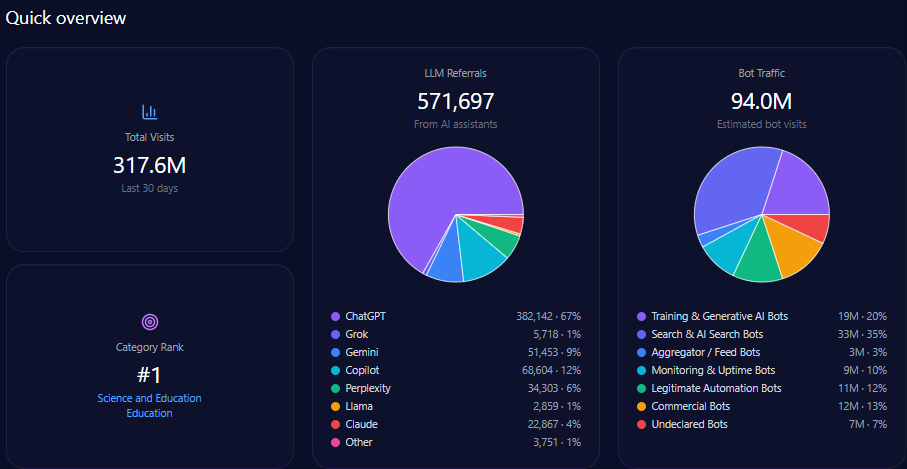
Instructure’s platform registers a total of 317.6 million visits, with bot traffic comprising 94 million visits, including 18.8 million Training & Generative AI Bots. LLM referrals number 571,697, led by ChatGPT with 382,142. This data aligns with the firm’s prominent generative presence and strong engagement within AI-powered educational search contexts.
Share of Voice in LLM Responses
Among 742 total competitive mentions, Instructure accounts for 216 representing 29% Share of Voice, leading over Anthology (19%) and D2L (16%). This reinforces Instructure’s positioning as the foremost entity in LMS discussions within LLM-generated content.
AI Platform-Specific Visibility
On ChatGPT, Instructure commands a 33% share of voice with 84 mentions, surpassing Anthology and D2L. On Copilot and Gemini platforms, the brand holds 27% of voice, trailing Cornerstone and PowerSchool in vertical niches, underpinning sector-specific exposure variability.
Sentiment Score for Competitors
| Brand | Positive % | Neutral % | Negative % | Overall Score |
|---|---|---|---|---|
| Instructure.com | 72% | 19% | 9% | 81 |
| Anthology.com | 56% | 31% | 13% | 68 |
| D2L.com | 64% | 25% | 11% | 74 |
| Powerschool.com | 51% | 33% | 16% | 63 |
| Cornerstoneondemand.com | 63% | 27% | 10% | 75 |
Top Prompts Driving Mentions
The highest volume prompts gravitate around migration from legacy LMS systems, accessibility, and institutional deployment. For example, “How to transition from Moodle to a modern cloud-based LMS?” generates 329 mentions overall, with Instructure referenced 119 times. Similarly, Instructure leads queries on “Best LMS for accessibility” (126 mentions) and comparisons such as “Canvas vs Blackboard” (129 mentions), reinforcing its status as the academic digital ecosystem paradigm.
Types of Prompt Queries
- 40% Comparison queries focusing on feature and performance differences
- 40% Feature inquiry prompts probing technical capabilities and compliance
- 10% Research-oriented questions
- 10% How-to and tutorial format queries
- 0% Purchase intent queries remain notably absent
Service / Product-Level Sentiment
Sentiment across contextual themes related to Instructure reveals strengths and vulnerabilities. “LMS User Experience” is overwhelmingly positive (84% frequency), with frequent mention of “user-friendly interface” and “mobile app excellence.” “Interoperability & Integrations” also receive positive sentiment (59%), highlighting LTI 1.3 compliance and API robustness.
Conversely, “Cost and Value” registers mixed tones with 29% frequency, where licensing fees and support costs frequently correlate with pricing dissatisfaction. Ecommerce sentiment from 1,250 reviews shows 45.2% positive and a notable 19% negative review rate, indicating a need for pricing transparency improvements aligned with negative points highlighted in Gemini LLM brand mentions.
Conclusion
Instructure’s dominant positioning in the academic LMS market, reinforced by leadership in generative AI visibility and positive sentiment metrics, establishes it as the sector benchmark, especially in higher education. However, competitive pressures from Cornerstone OnDemand and PowerSchool in enterprise and K-12 segments expose substantial visibility and narrative gaps that could undermine long-term market authority if unaddressed.
Strategic priorities must focus on expanding technical content and marketing efforts toward corporate talent management and skills-first hiring narratives, alongside amplifying K-12 SIS integration success stories. Additionally, mitigating risks stemming from private equity ownership perception through transparent communication and founder engagement is essential.
By capitalizing on its recognized strengths in user experience, interoperability, and cloud migration leadership while actively addressing negative pricing and private equity sentiment, Instructure can sustain its generative economy advantage and prevent erosion by niche specialists. Employing competitor sentiment tracking will further inform dynamic adjustments in brand and product positioning within the evolving landscape of LLM-driven market discovery.
Explore SpyderBot to operationalize these GEO analytics insights.