Tag: costco.com

  • Albertsons Has Presence. The Problem Is the Story AI Keeps Telling About Convenience

    Albertsons Has Presence. The Problem Is the Story AI Keeps Telling About Convenience

    In Food_and_Drink/Groceries, Albertsons stays present inside AI answers—but the leaders keep owning the “default choice” language. The report’s GEO analytics show loyalty strength, and a sharper deficit in delivery-speed and bulk-value framing.

    At-a-glance: Numbers to know

    • Share of Voice: 12% (46 of 382 total LLM brand mentions)
    • Visibility Score: 64 (Amazon 94, Costco 88, Kroger 76, Publix 71)
    • LLM referrals: 41,294 (ChatGPT 22,712; Copilot 7,433; Perplexity 4,955; Gemini 3,304)
    • Total visits: 6,163,316 with 2,329,733 in bot traffic
    • Category rank: #9 in Food_and_Drink/Groceries
    • Overall sentiment score: 75 (Positive 64 / Neutral 22 / Negative 14)

    Risk signals

    • Coverage is 27% on “Best grocery delivery services for organic products” vs Amazon’s 83%
    • Platform Share of Voice drops to 8% on Copilot (ChatGPT 13%, Gemini 14%)

    Opening

    A grocery brand used to win on location and habit. Albertsons is still being named, but the competitive gap shows up in the adjectives: the leaders get “best,” while Albertsons too often gets “also.”

    Position in LLM Response Lists

    Across ChatGPT, Gemini, and Copilot, Albertsons typically appears 4th–5th in broad grocery responses. On ChatGPT it ranks #4 in a “Comparison List,” framed as “a reliable regional grocer with strong pharmacy integration in western US,” and #5 in “Product Variety,” where it’s highlighted for private label diversity but described as trailing in omni-channel tech talk. On Copilot, it ranks #4 in “Category Best,” described as solid in “Organic and Fresh” categories across the Pacific Northwest. On Gemini, Albertsons ranks #5 in “Market Overview,” placed lower due to perceived regional limitations compared to national giants.

    Competitor Gap Analysis

    The gap data clusters around high-intent convenience and scale, where competitors are described as the default recommendation.

    QueryAlbertsons metricCompetitor metricGap/priority
    best grocery delivery service 202467Amazon 9427 (High)
    fresh prepared meals delivery61Amazon 9231 (High)
    bulk household cleaning supplies58Costco 9638 (Medium)
    best app for weekly grocery deals69Kroger 8819 (High)

    The action items show what the models appear to be “missing”: improve technical documentation of delivery SLAs for LLM ingestion; optimize app store metadata and technical whitepapers on app features; and launch a “Stock Up” campaign with structured data for large-pack sizes. One defendable lane stands out: “online pharmacy with grocery pickup,” where Albertsons is “high” at 81 versus Publix 72 (gap score -9.00).

    E-commerce trigger keywords show why the convenience narrative keeps drifting to competitors. “Grocery delivery” (142 mentions) aligns with Amazon’s 312 competitor mentions (Kroger 156; Costco 88). “Same day groceries” (105) again tilts to Amazon at 287 (Kroger 120). “Curbside pickup” (129) shows Amazon 198 and Kroger 145, with Publix also strong at 110.

    Deals and loyalty language split the field. “Digital rewards” (112) is led by Kroger (167) while Amazon holds 88. “Weekly ad flyer” (88) spikes for Publix (97) and Kroger (94). “Meat coupons” (43) skews toward Kroger (89) and Publix (41). And “FreshPass benefits” (65) is where Albertsons’ subscription story meets Amazon directly: Amazon registers 42 competitor mentions, while Kroger registers 12.
    albertsons.com’s Trigger Keywords for Competitor Products (GEO Report, Jan 15, 2026)

    Founder Negative Context

    Founder and investment talk adds reputational drag that can spill into business summaries. Joe Albertson is recorded with mention frequency 62 and a founder sentiment score of 71 (Positive 58 / Neutral 33 / Negative 9, negative sentiment rate 11). Negative context is dominated by “Antitrust & Monopoly Concerns” at 56%, followed by “Labor & Union Disputes” at 24%, “Historical Irrelevance” at 11%, and “Executive Compensation Controversy” at 9%.

    The trend intensifies: “Antitrust” rises from 52% in 2024-Q1 to 61% in 2024-Q2. Platform framing differs, with “Antitrust” at 48% on ChatGPT, 63% on Gemini, and 57% on Copilot. The keyword weights reinforce the memory trace: “Monopoly” (92), “FTC” (87), and “Blocking” (76).

    Albertsons logs 6,163,316 total visits with 2,329,733 in bot traffic. Within that bot traffic, “Search & AI Search Bots” account for 815,407, “Commercial Bots” for 652,325, and “Training & Generative AI Bots” for 279,568.

    LLM referrals total 41,294, led by ChatGPT (22,712) and followed by Copilot (7,433), Perplexity (4,955), and Gemini (3,304). The category position is #9 in Food_and_Drink/Groceries.
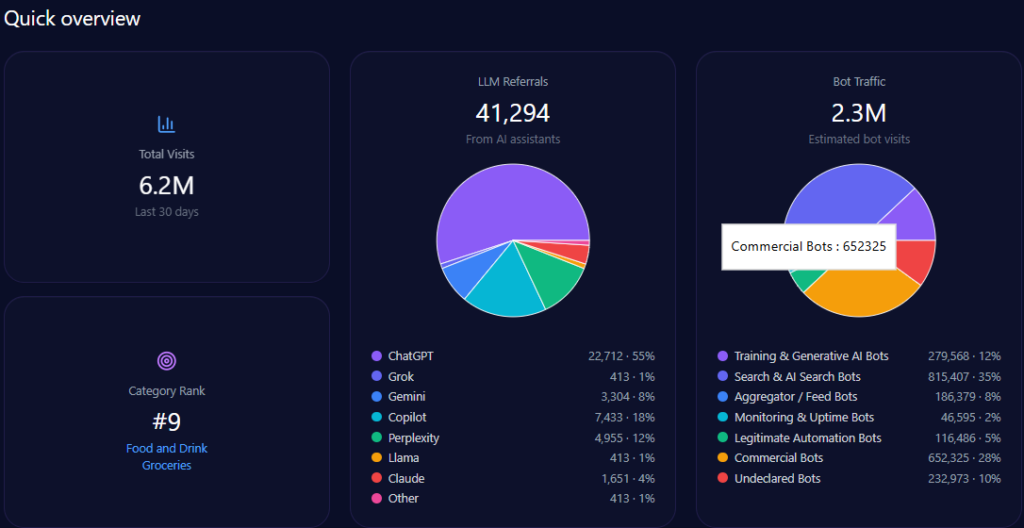
    albertsons.com’s Quick overview (GEO Report, Jan 15, 2026)

    Share of Voice in LLM Responses

    Albertsons holds 12% share of voice with 46 mentions out of 382, with “Others” at 9% (34). Amazon leads at 28% (107), Costco 22% (84), Kroger 18% (69), and Publix 11% (42). Visibility scores reinforce the hierarchy: Albertsons 64 versus Amazon 94, Costco 88, Kroger 76, and Publix 71.

    Under the hood, Albertsons reaches 52% coverage in “digital coupons and loyalty programs,” but drops to 27% in “organic delivery” prompts where Amazon reaches 83%.

    AI Platform-Specific Visibility

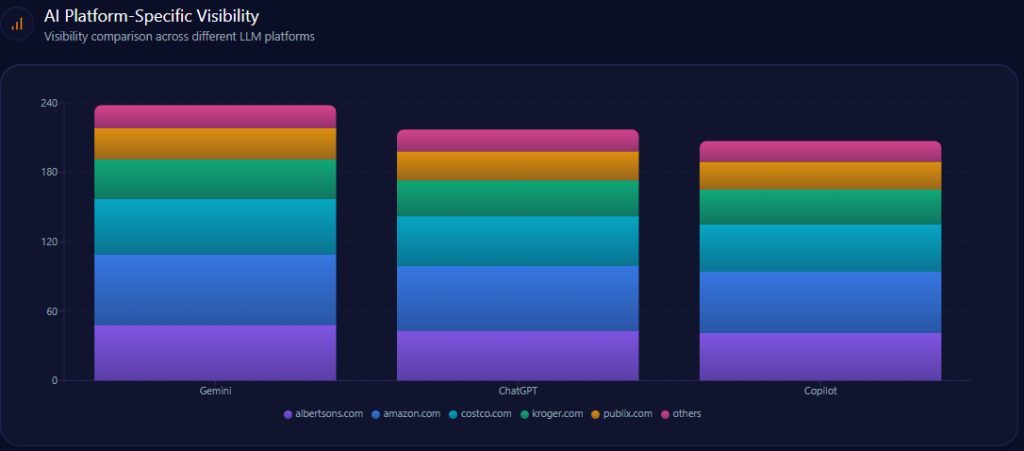
    On Gemini, Albertsons holds 14% share of voice (19 mentions of 134), behind Amazon (25%, 34) and Kroger (22%, 29). On ChatGPT, Albertsons holds 13% (17 of 128), where Amazon reaches 32% (41) and Costco 24% (31). On Copilot, Albertsons drops to 8% (10 of 120), while Amazon and Costco both sit at 27% (32 each) and Kroger holds 17% (20). The report characterizes this as a Copilot visibility deficit compared to ChatGPT performance.

    Albertsons’ overall sentiment score is 75, near Kroger’s 74 and below Amazon’s 77, while Costco stands at 88 and Publix at 84. Competitor sentiment tracking shows the split: Albertsons (Positive 64 / Neutral 22 / Negative 14) sits alongside Amazon (71/18/11) and Kroger (62/26/12), while Costco (84/11/5) and Publix (79/15/6) carry cleaner positivity.

    Theme volume explains where tone can drift. “Loyalty & Rewards” appears 87 times (frequency 58.00, Positive tone). “Organic/Private Labels” appears 52 times (frequency 35.00, Positive tone). The pressure themes are “Merger & Acquisition” (63, frequency 42.00, Neutral) and “Pricing & Inflation” (48, frequency 32.00, Negative).
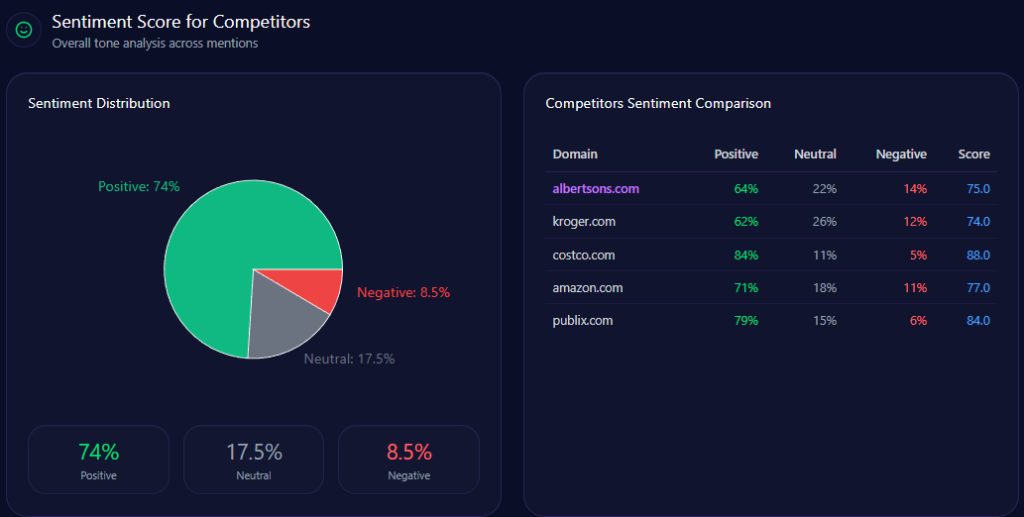
    albertsons.com’s Sentiment Score for Competitors (GEO Report, Jan 15, 2026)

    Top Prompts Driving Mentions

    The largest prompts are where Albertsons most clearly gets pushed into “alternative” framing. “Which store is cheapest for a family of four buying in bulk?” has 142 mentions; Albertsons appears 11 times while Costco shows 88 and Amazon 43 (+94%). “Best grocery store for 1-hour delivery in suburban areas?” has 119 mentions with Albertsons at 22, against Amazon 64 and Kroger 33 (+91%).

    The more favorable prompts are ones that force specificity. “Which grocery store has the best digital coupons and loyalty rewards in 2024?” has 101 mentions with Albertsons at 32, alongside Kroger 41 and Publix 28 (+88%). “Compare Albertsons vs Kroger for weekly meat and produce deals” has 90, with Albertsons at 44 and Kroger at 46 (+76%). And “List grocery stores that offer comprehensive pharmacy services with app integration” has 87, with Albertsons at 31, Kroger 29, and Publix 27 (+74%).

    Types of Prompt Queries

    The prompt mix is concentrated: Comparison is 60 (count 6) and Feature Inquiry is 40 (count 4). Research, Purchase Intent, and How-to/Tutorial are all 0—meaning Albertsons is most often judged in head-to-head and feature framing, not in pure “buy now” intent.

    E-commerce Sentiment for Competitor Products

    In e-commerce results, Albertsons holds 14.29% share of voice with 21 mentions, while Amazon leads at 36.73% (54) and Kroger at 22.45% (33) (Costco matches Albertsons at 14.29%, 21). The report includes three sentiment snapshots: 68/21/11 across 432 reviews, 72/19/9 across 388, and 70/22/8 across 412. Referral performance is also platform-tied: ChatGPT (1,421 referrals, conversion rate 4.2), Gemini (1,356, 4.5), and Copilot (1,210, 3.9).

    The snippets show what shoppers reward—and what they penalize. “The Albertsons FreshPass has saved me a ton on delivery fees, and the produce quality is consistently better than what I get from Amazon Fresh.” (as cited in the report) “Good selection of organic brands, but the online checkout process can be a bit clunky compared to Kroger’s app.” (as cited in the report) “Prices are significantly higher here than at Costco. I only shop at Albertsons for items I can’t find in bulk.” (as cited in the report)

    Conclusion

    Albertsons is present, generally well-regarded, and strongest where loyalty and pharmacy convenience can be described with specificity. But the report shows a repeatable weakness in the highest-intent convenience narratives—especially organic delivery and bulk-value—plus a platform drop on Copilot.

    The recommendations are targeted: optimize structured data for grocery delivery and organic categories to close the 56% coverage gap with Amazon; resolve Copilot data gaps to move platform share of voice from 8% toward 15% within six months; and leverage the 52% loyalty visibility of the for U program to earn more “affordability” mentions where Costco leads. fileciteturn0file0

    Explore SpyderBot to operationalize these GEO analytics insights.
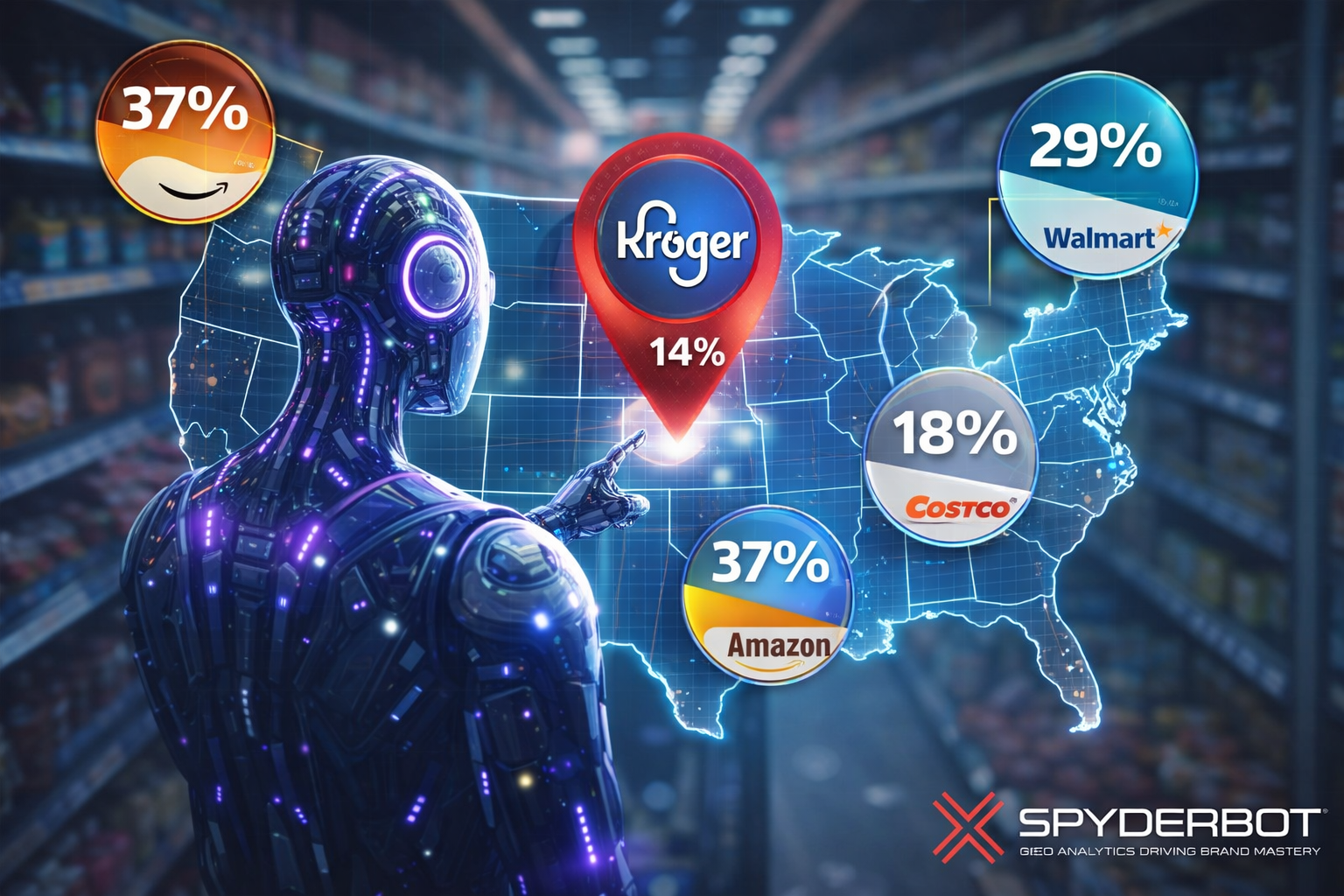
  • Kroger’s 14% Share of Voice Is Holding the Middle of the AI Grocery Map and Exposing Where Speed and Value Still Slip Away

    Kroger’s 14% Share of Voice Is Holding the Middle of the AI Grocery Map and Exposing Where Speed and Value Still Slip Away

    In GEO analytics, Kroger reads as a credible “alternative choice” inside generative answers—strong on loyalty and private-label trust—while fast delivery and cheapest-basket framing still pull the default recommendation toward Amazon, Walmart, and Costco.

    At-a-glance: Numbers to know

    • 42,332,652 total visits, including 13,546,449 in bot traffic
    • 76,199 LLM referrals, led by ChatGPT (34,289), Perplexity (15,240), and Copilot (11,430)
    • 14% Share of Voice (101 of 714 LLM brand mentions) and a Visibility Score of 73
    • Category rank: #2 in Food_and_Drink/Groceries
    • Platform visibility: Copilot 74%, ChatGPT 71%, Gemini 64%
    • Industry rank score: 84.00 in Retail – Grocery (Private Label Dominance)

    Risk signals

    • Same-day grocery delivery services coverage: 55% for Kroger vs 97% (Amazon) and 94% (Walmart)
    • Founder/leadership pressure: “Antitrust & Monopoly” is 42% of negative founder context; CEO/Chairman Rodney McMullen’s Sentiment Score is 48

    Ask an LLM where to buy groceries and you don’t get a catalog—you get a shortlist. Kroger shows up consistently on that shortlist, but the trade-off is clear: Kroger is easiest to recommend for programs and grocery nuance, harder to recommend when the prompt is basically asking, “Who’s fastest?” or “Who’s cheapest?”

    Position in LLM Response Lists

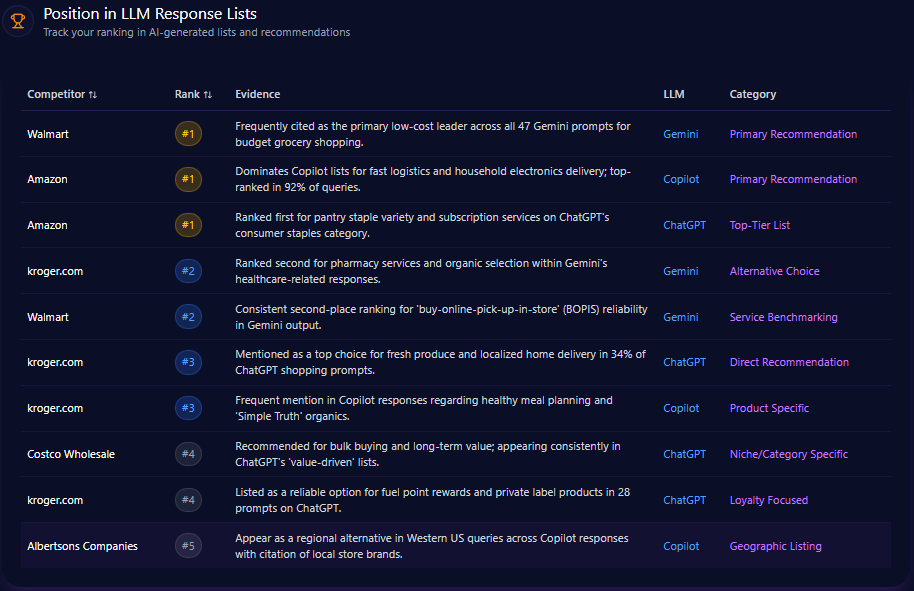
    Kroger’s placements cluster in the middle of ranked outputs. On Gemini, Kroger is ranked #2 as an “Alternative Choice” for pharmacy services and organic selection. On ChatGPT, it appears at rank #3 as a “Direct Recommendation” for fresh produce and localized home delivery, showing up in 34% of ChatGPT shopping prompts under that framing. Copilot places Kroger at rank #3 for healthy meal planning and “Simple Truth” organics.

    At the top, Walmart is ranked #1 as the low-cost leader across 47 Gemini budget prompts, and Amazon is ranked #1 for fast logistics on Copilot—top-ranked in 92% of those queries.

    kroger.com’s Position in LLM Response Lists (GEO Report, Jan 15, 2026)

    Competitor Gap Analysis

    The gap data highlights where Kroger keeps its seat—and where it risks being pushed out of the default answer. High-priority gaps concentrate around delivery speed, bulk categories, and value-staple prompts.

    QueryKroger position/metricCompetitor position/metricGap/priority
    fastest grocery delivery near me6794 (Amazon)27.00 / High
    bulk household cleaning supplies5497 (Costco Wholesale)43.00 / High
    same day grocery pickup8496 (Walmart)12.00 / High
    low cost household staples7893 (Walmart)15.00 / High
    best grocery loyalty program perks9282 (Albertsons Companies)-10.00 / Low

    Trigger Keywords for Competitor Products

    Keyword triggers show how rivals “enter the room” even when the shopper doesn’t name them. “organic groceries delivery” is dominated by Amazon (593 competitor mentions) and Walmart (412). “local supermarket delivery” pulls Walmart (612) and Amazon (534). “bulk grocery savings” routes attention to Costco (892). “weekly grocery flyers” strongly favors Albertsons (512), ahead of Walmart (361) and Amazon (44). Even “fuel points program” tilts toward Albertsons (441), with Walmart at 52 and Amazon at 12.

    Founder Negative Context

    Leadership narratives carry measurable drag. Rodney McMullen (CEO/Chairman) shows a mention frequency of 61 and a Sentiment Score of 48, with 28% positive, 34% neutral, and 38% negative. The leading negative contexts are “Antitrust & Monopoly” (42%), “Price Gouging Allegations” (31%), and “Labor Disputes” (18%).

    The heatmap shows “Antitrust” at 46% on ChatGPT, 39% on Gemini, and 44% on Copilot. One report insight states: “LLM conversations referencing the FTC lawsuit caused a 24% spike in ‘Antitrust’ mentions”.

    Quick overview

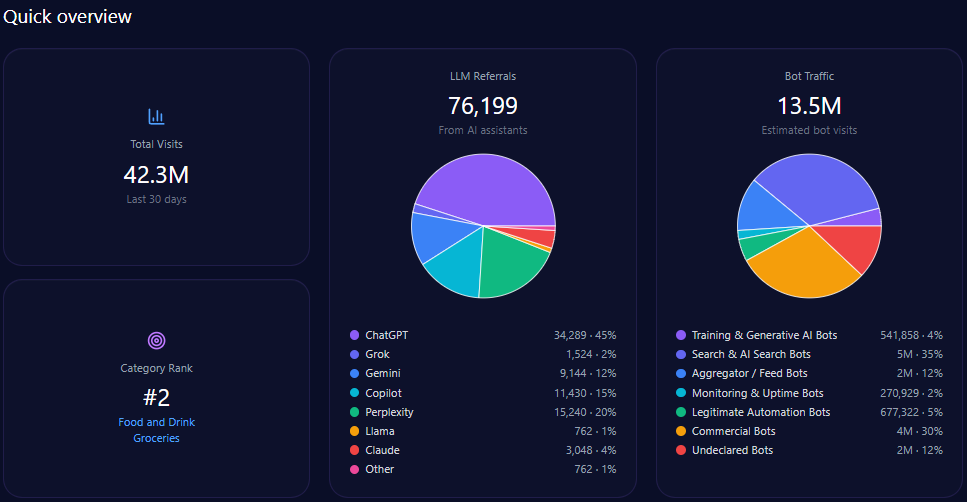
    Kroger records 42,332,652 total visits and 13,546,449 in bot traffic. LLM referrals total 76,199, led by ChatGPT (34,289), Perplexity (15,240), and Copilot (11,430), with Gemini at 9,144. Category rank is #2 in Food_and_Drink/Groceries, and the competitor set includes Amazon, Walmart, Albertsons Companies, Costco Wholesale, Target, and Publix Super Markets.

    kroger.com’s Share of Voice in LLM Responses (GEO Report, Jan 15, 2026)

    Share of Voice in LLM Responses

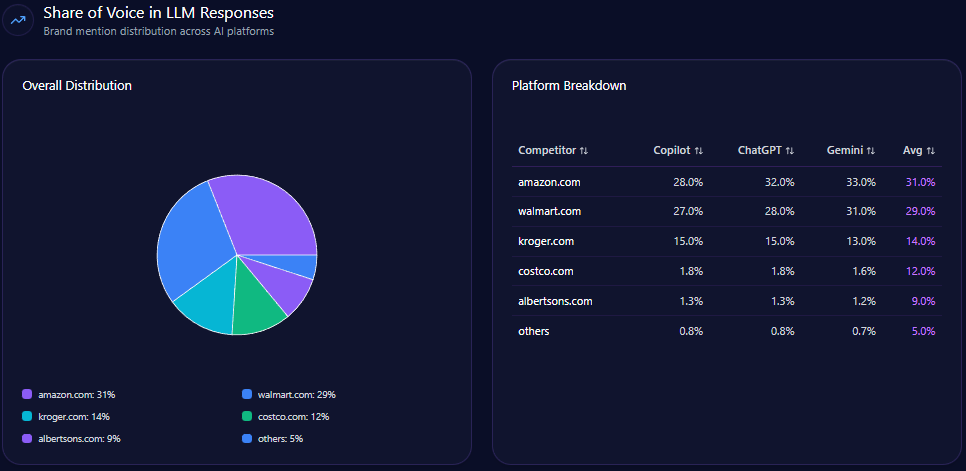
    Across 141 total prompts on ChatGPT, Gemini, and Copilot, the report tracks 714 total mentions. Kroger holds 101 (14%), behind Amazon (218; 31%) and Walmart (204; 29%). Costco Wholesale follows with 83 (12%), and Albertsons Companies has 61 (9%). Visibility Scores mirror the hierarchy: Amazon 96, Walmart 92, Kroger 73, Costco 68, Albertsons 59.

    Kroger’s challenge isn’t being missing—it’s being third. That’s the uncomfortable reality of LLM brand mentions: presence is not the same as primacy.

    kroger.com’s Share of Voice in LLM Responses (GEO Report, Jan 15, 2026)

    AI Platform-Specific Visibility

    Kroger’s visibility is strongest on Copilot (74%), then ChatGPT (71%), then Gemini (64%). Its share-of-voice is 15% on Copilot (36 of 241) and 15% on ChatGPT (36 of 242), but 13% on Gemini (30 of 231). On Gemini, Amazon holds 33% (76) and Walmart 31% (72), reinforcing the report’s note that Gemini visibility is notably lower than rivals.

    Sentiment Score for Competitors

    Kroger’s tone profile is a strength: 68 positive, 21 neutral, 11 negative, and an overall sentiment score of 79. Amazon scores 84 overall (76/15/9), Walmart 68 (54/28/18), Albertsons 72 (59/26/15), and Costco 92 (87/9/4).

    Three themes explain the upside and the friction. “Private Label Quality” leads (count 52, frequency 37.00) with a Positive tone. “Digital Savings & Rewards” is also Positive (count 34, frequency 24.00), with fuel points and digital coupons shaping the narrative. “Delivery & Logistics” is Mixed (count 28, frequency 20.00). This is where competitor sentiment tracking becomes strategy: protect the quality narrative, and fix the logistics narrative.

    Top Prompts Driving Mentions

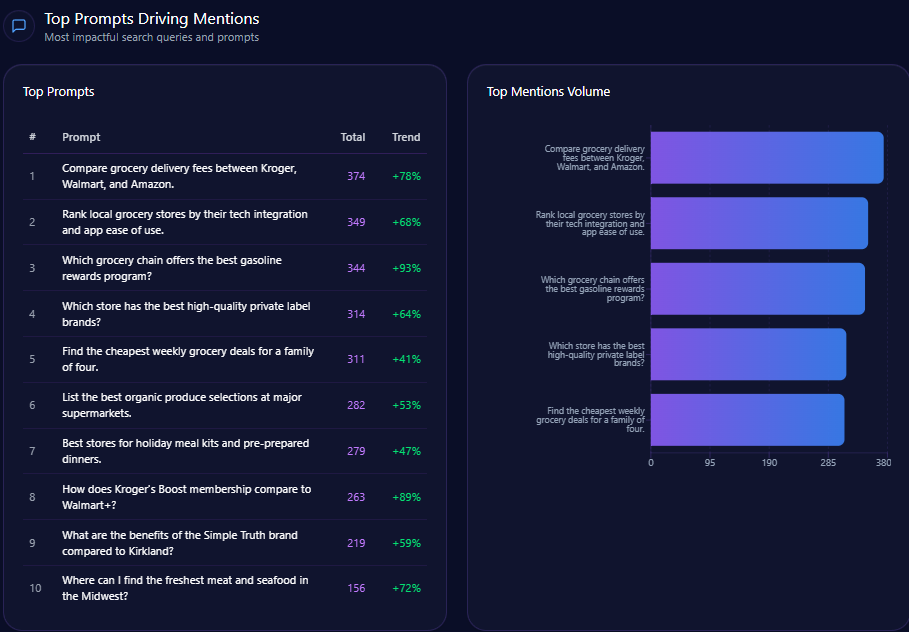
    The biggest “summoners” of Kroger are comparison prompts that force the model to pick winners:

    • “Compare grocery delivery fees between Kroger, Walmart, and Amazon.” (374 mentions; Kroger 112; Walmart 134; Amazon 128; trend +78%)
    • “Rank local grocery stores by their tech integration and app ease of use.” (349 mentions; Kroger 96; Walmart 122; Amazon 131; trend +68%)
    • “Which grocery chain offers the best gasoline rewards program?” (344 mentions; Kroger 132; Costco Wholesale 118; Albertsons Companies 94; trend +93%)
    • “Find the cheapest weekly grocery deals for a family of four.” (311 mentions; Kroger 58; Walmart 141; Costco Wholesale 112; trend +41%)
    kroger.com’s Top Prompts Driving Mentions (GEO Report, Jan 15, 2026)

    Types of Prompt Queries

    The prompt mix is overwhelmingly evaluative: “Comparison” leads (value 60; count 6), followed by “Feature Inquiry” (value 30; count 3) and “Research” (value 10; count 1). “Purchase Intent” and “How-to/Tutorial” are both 0 with count 0. Kroger is being judged, not simply discovered.

    E-commerce Sentiment for Competitor Products

    In e-commerce share of voice, Kroger holds 12.95% with 858 mentions, behind Amazon at 32.16% (2,131) and Walmart at 30.03% (1,990), and close to Costco at 11.02% (730). Referral signals show Gemini at 1,056 with a 3.2 conversion rate, Copilot at 923 with 3.4, and ChatGPT at 842 with 2.8.

    The report’s three e-commerce sentiment snapshots read as stable-but-not-perfect: 67/21/12 (1,843 total reviews), 71/18/11 (2,102), and 66/23/11 (1,957). Snippets, as cited in the report, reinforce both strengths and friction:

    • “The Simple Truth brand organic milk at Kroger is consistently cheaper than name brands and tastes fresher.” (Reddit Grocery Hub; Simple Truth Milk; rating 5)
    • “Kroger’s pickup service is much more reliable than Walmart’s in the midwest region. Very few substitutions.” (Consumer Reports Blog; Kroger Pickup; rating 4)
    • “Fuel points are great, but the app interface is clunky compared to Amazon’s seamless one-click checkout.” (TechRetail Review; Digital App; rating 3)

    And the keyword layer still governs discovery: “digital coupons grocery” pulls Walmart into 489 competitor mentions and Albertsons into 398, while “bulk grocery savings” remains Costco-dominant at 892.

    Conclusion

    Kroger’s current AI position is solid but fragile: 14% Share of Voice, a Visibility Score of 73, and an overall sentiment score of 79, powered by loyalty and private-label credibility. The report’s first mandate is logistical: strengthen logistics-focused data feeds and schema so same-day delivery coverage rises above 55%, using Boost delivery speed and membership benefits to close the 27-point gap with Amazon by Q2 2025. Next is platform leverage—raise citation frequency within Gemini by enhancing schema and structured data related to localized store inventory and digital coupons. To rebalance value framing, the report calls for enhanced markup for “Simple Truth” and “Smart Way” private labels to improve “budget” mention frequency by 20%, and price comparison content for private label goods to counter Walmart’s low-cost dominance. Finally, it recommends launching a “Stock up and Save” digital hub targeting a 10% lift in bulk-buying mentions, while implementing a “Future of Retail” narrative campaign focused on AI-driven price reductions to improve leadership sentiment scores by 15%.

    Explore SpyderBot to operationalize these GEO analytics insights.
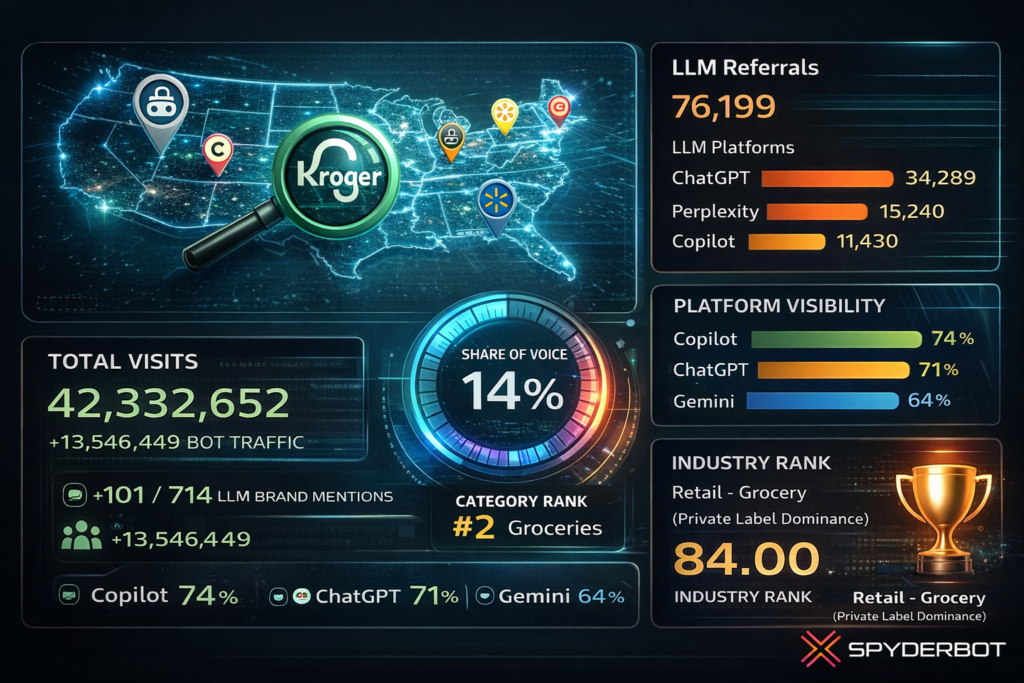
  • Carrefour’s 18% Share of Voice Is Holding the European Grocery Line and Revealing Where the Value Narrative Is Slipping

    Carrefour’s 18% Share of Voice Is Holding the European Grocery Line and Revealing Where the Value Narrative Is Slipping

    Ia generative search landscape increasingly dominated by speed, scale, and price perception, Carrefour’s GEO footprint shows both resilience and quiet erosion—depending on the question an AI is asked.


    Imagine asking an AI assistant a simple question: “Where should I buy groceries in Europe?”
    The answer arrives instantly—compressed, confident, and selective. Only a few brands make it into that response. Fewer still appear consistently when the question shifts from convenience to values, from price to sustainability, from bulk savings to local freshness.

    That compression is the new competitive arena. In this environment, Carrefour does not disappear. In fact, it holds ground with a stable presence across generative platforms. Yet the data also shows something more subtle: the brand’s authority is strongest where European context, sustainability, and regional logistics matter—and weakest where price absolutism and wholesale scale dominate the conversation.

    This is not a story of collapse. It is a story of narrative tension, revealed through GEO analytics and the patterns of LLM brand mentions.


    Position in LLM Response Lists

    Across major generative engines, Carrefour appears reliably in grocery-focused response lists, particularly those tied to European markets. In curated AI answers about supermarkets in France and regional grocery delivery leaders, Carrefour frequently secures a top-tier position or appears just below the category leader.

    However, the pattern shifts when lists broaden into general retail dominance, bulk shopping, or all-in-one convenience. In those contexts, Carrefour is often displaced by global platforms with stronger associations to logistics speed or wholesale economics. The brand’s ranking stability is therefore contextual rather than universal—anchored in geography and category specificity rather than sheer breadth.

    This positioning reflects a brand that LLMs “understand” clearly, but only within certain frames.


    Competitor Gap Analysis

    Viewed as a battle map, Carrefour’s competitive terrain is uneven. Against value-driven discounters, it faces a clear perception gap in price-first prompts. Against warehouse-club models, it lacks narrative depth around bulk purchasing and membership economics. Against global marketplaces, it trails in speed-centric delivery stories.

    Yet the same data shows areas of defensive strength. In sustainability-oriented retail queries, Carrefour outperforms the largest global player. In localized hypermarket searches, it maintains leadership over regional rivals.

    Query themeCarrefour positionCompetitor positionGap signal
    Cheapest weekly groceriesMid-tier visibilityCategory leader citedCritical
    Bulk pantry staplesModerate presenceDominant citationsStructural
    Sustainability in retailLeading citationsLower comparative scoreStrategic advantage
    Hypermarket near meLeading in FranceSecondary mentionsDefensive

    These gaps are not uniform weaknesses; they are narrative absences. Where Carrefour is not telling a story that LLMs can easily summarize, competitors step in.


    Trigger Keywords for Competitor Products

    Certain keywords consistently summon competitors ahead of Carrefour. Price-absolute phrases such as “cheapest weekly groceries” or “best price olive oil” tend to elevate discounters. Bulk-oriented language—“family-size,” “warehouse,” “bulk pantry staples”—pulls warehouse clubs to the forefront. Speed-centric terms like “same-day grocery” tilt answers toward platforms known for logistics velocity.

    By contrast, Carrefour appears more frequently when prompts emphasize sustainability, regional sourcing, or hypermarket accessibility. Keywords tied to organic retail, food transition initiatives, and European grocery delivery maintain relatively high Carrefour coverage.

    The implication is clear: keyword framing, not product reality, determines visibility.


    Founder Negative Context

    Leadership narratives play a quieter but meaningful role in generative perception. References to Carrefour’s executive leadership appear regularly, with sentiment remaining largely stable. However, negative context clusters around three themes: pricing disputes, labor relations, and market restructuring.

    Pricing tensions—particularly those linked to supplier negotiations and inflation labeling—form the largest share of negative mentions. Labor-related narratives surface intermittently, especially during periods of public wage discussions. Market exits and consolidation efforts introduce a third, smaller stream of uncertainty.

    Notably, these contexts are episodic rather than systemic. They flare around specific news cycles, then recede, suggesting reputational sensitivity rather than sustained erosion.


    Quick overview

    From a pure footprint perspective, Carrefour’s GEO presence is substantial. Millions of visits, heavy bot traffic, and tens of thousands of LLM referrals indicate a brand deeply embedded in machine-mediated discovery. Its category ranking places it firmly within the top tier of global e-commerce marketplaces, while its visibility score confirms consistent recognition across generative engines.

    The picture that emerges is not one of obscurity, but of selective prominence.


    Share of Voice in LLM Responses

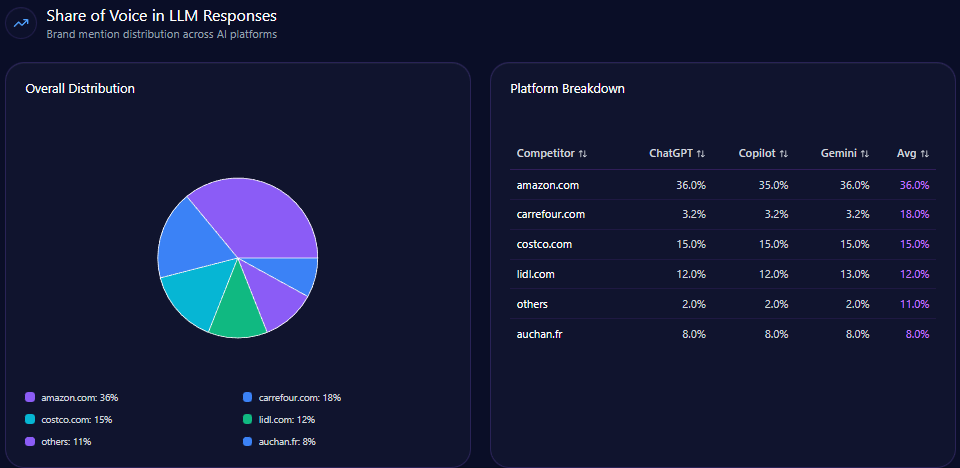
    An 18% Share of Voice positions Carrefour as the second-most visible brand in its competitive set—well behind the category leader, but ahead of most regional peers. This share is remarkably consistent across platforms, indicating balanced exposure rather than reliance on a single model.

    However, share of voice alone masks qualitative differences. Carrefour’s mentions skew toward explanatory and comparative contexts rather than default recommendations. It is cited as a credible option, not always as the obvious choice.

    carrefour.com’s Share of Voice in LLM Responses (GEO Report, Jan 12, 2026)

    That distinction matters in a world where AI answers are short and decisive.


    AI Platform-Specific Visibility

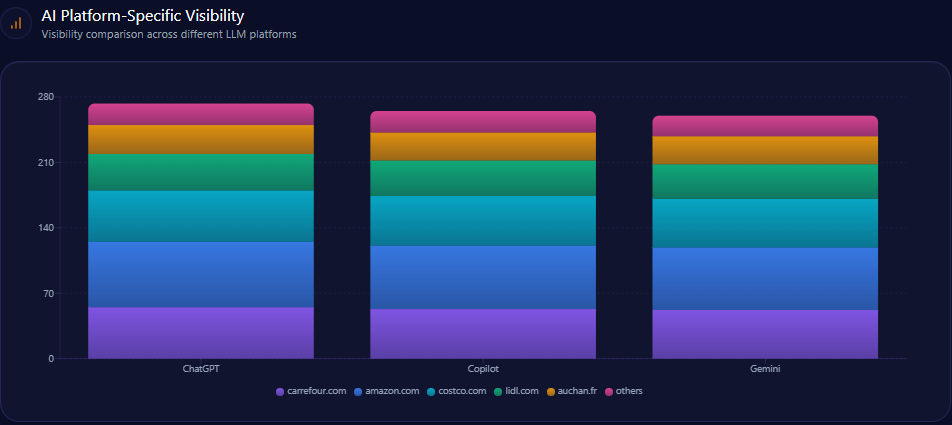
    Platform behavior tells a nuanced story. On ChatGPT, Carrefour benefits from strong historical data density and performs well in grocery-specific prompts. Copilot mirrors this pattern, particularly in regional contexts. Gemini, while still showing solid visibility, lags slightly in conversion signals, suggesting weaker integration with certain shopping-oriented cues.

    Despite these differences, Carrefour’s share remains remarkably stable at around the same level across major platforms. There is no single-platform collapse—only incremental friction where optimization lags.

    carrefour.com’s AI Platform-Specific Visibility GEO Report, Jan 12, 2026

    This consistency reflects a brand that is broadly legible to AI, even if not always favored.


    Sentiment Score for Competitors

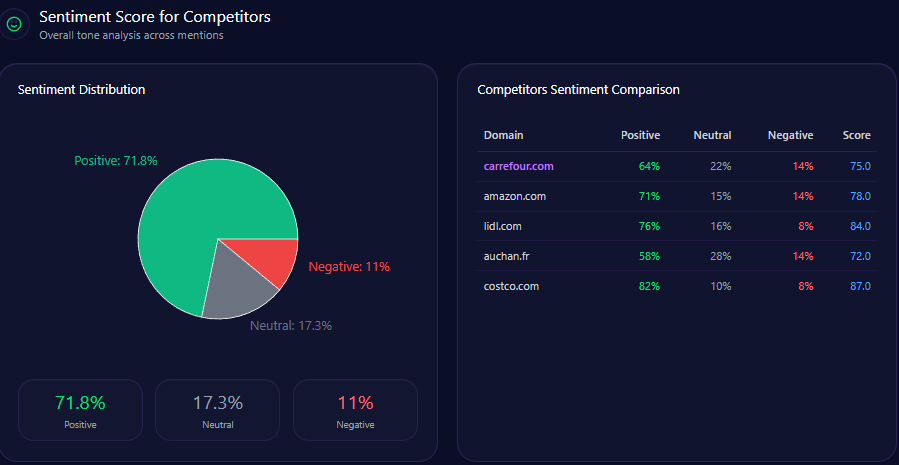
    Sentiment analysis reveals another layer of competitive tension. Carrefour’s overall sentiment score sits comfortably above several regional rivals but below players whose narratives are tightly aligned with either extreme value or premium efficiency.

    Three themes dominate the tone of AI narratives. Sustainability and corporate responsibility skew highly positive, reinforcing Carrefour’s leadership in food transition messaging. Price and affordability generate mixed sentiment, where discounters gain emotional ground. E-commerce and delivery remain largely neutral, reflecting competence without distinction.

    carrefour.com’s Sentiment Score for Competitors GEO Report, Jan 12, 2026

    In contrast, some competitors achieve higher positivity by owning a single, easily summarized promise—be it lowest price or unmatched scale.


    Top Prompts Driving Mentions

    The prompts that most frequently surface Carrefour are revealing. Questions comparing grocery delivery services in France, evaluating sustainability commitments, or seeking organic food options regularly include Carrefour among top mentions.

    Conversely, prompts framed around absolute cheapest pricing or bulk savings tend to dilute its presence. The brand is summoned by values-based curiosity more than bargain-hunting urgency.

    This pattern underscores the importance of prompt framing in GEO analytics.


    Types of Prompt Queries

    Most Carrefour-related prompts fall into comparison and purchase-intent categories. Users ask AIs to weigh options, assess value propositions, or choose between retailers. Informational queries play a smaller role, while tutorial or feature-deep questions are rare.

    This distribution suggests that Carrefour is most visible at decision moments—when consumers are choosing—not during early exploration or post-purchase support.


    E-commerce Sentiment for Competitor Products

    At the product and service level, AI-mediated sentiment toward Carrefour skews positive, particularly for organic produce and fresh food categories. Reviews cited in generative answers frequently praise quality and selection, while neutral and negative snippets focus on electronics pricing or delivery issue resolution.

    Competitors with narrower assortments but clearer price leadership often achieve higher visibility in specific product-level prompts. Carrefour’s breadth, while an operational strength, becomes a narrative challenge when AI systems favor singular advantages.


    Conclusion

    Carrefour’s GEO profile tells a disciplined story. The brand holds its position as Europe’s most credible grocery counterweight in generative discovery, with strong sustainability authority and regional relevance. At the same time, it concedes narrative ground in price absolutism, bulk economics, and speed-first delivery frames.

    The recommendations emerging from the data are pragmatic rather than transformative: strengthen structured data around organic and private-label pricing, expand bulk-buying narratives, and sharpen platform-specific signals—particularly where integration gaps persist. None require a reinvention of the business. All require clarity in how the business is translated into AI-readable stories.

    In an era where competitor sentiment tracking and LLM brand mentions increasingly shape consumer choice, Carrefour’s challenge is not to be louder—but to be simpler, sharper, and more legible where it already competes.


    Explore SpyderBot to operationalize these GEO analytics insights.