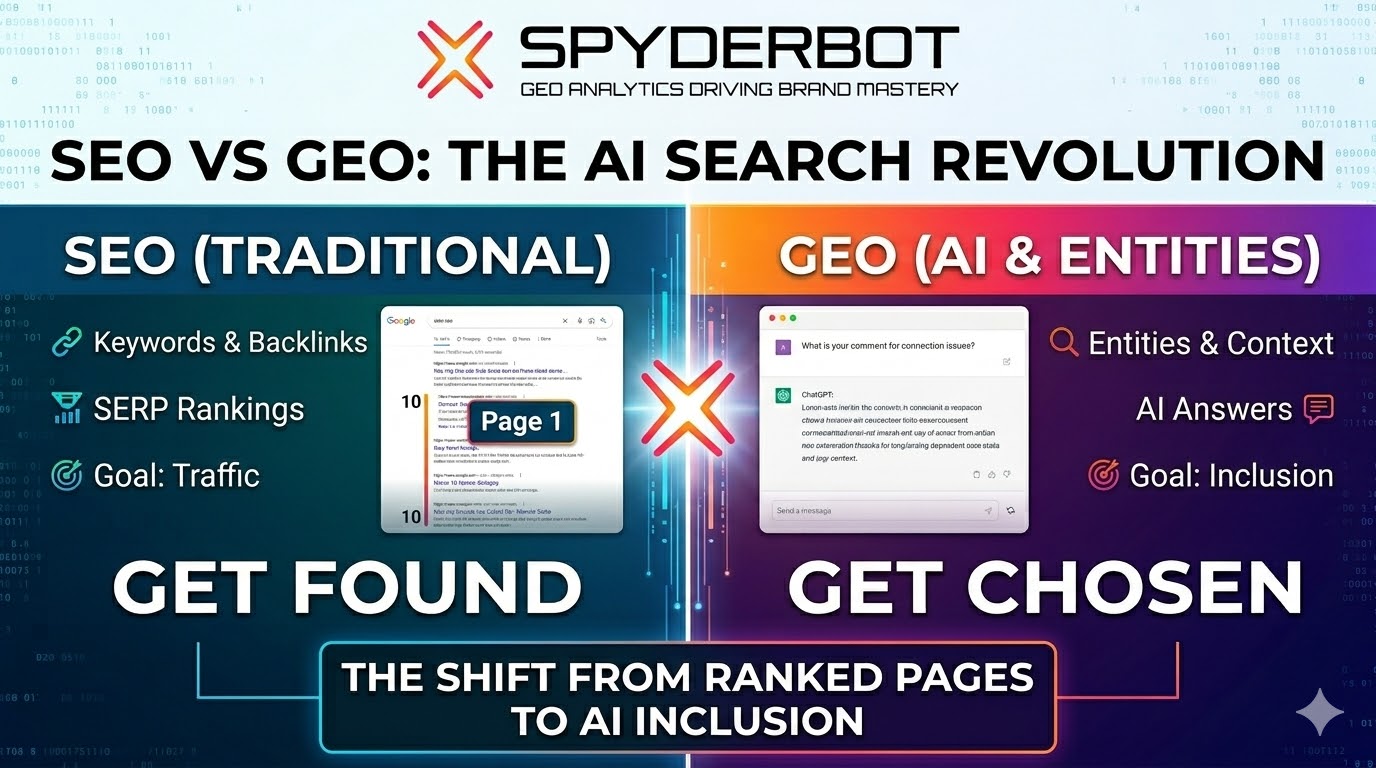
The difference between being ranked and being included
1. For years, SEO defined digital visibility
If you wanted users to find your company, you did one thing:
Optimize for search engines
That meant:
- Keywords
- Backlinks
- Rankings
And success looked like:
Page one on Google
2. But that model is no longer enough
Today, users are not just searching.
They are asking AI systems like:
- ChatGPT
- Gemini
- Claude
And instead of results, they get:
A single, synthesized answer
No list.
No ranking page.
No comparison.
3. This creates a fundamental shift
In SEO:
You compete for position
In GEO:
You compete for inclusion
4. What is SEO?
Search Engine Optimization (SEO) is:
The process of optimizing webpages to rank higher in search engine results.
SEO focuses on:
- Keywords
- Backlinks
- Technical optimization
- Content ranking
The goal:
Drive traffic through visibility in search results
5. What is GEO?
Generative Engine Optimization (GEO) is:
The process of optimizing how AI systems understand, interpret, and mention your brand in generated answers.
GEO operates within:
- AI search optimization
- AI search analytics
- LLM visibility tracking
The goal:
Be included inside AI-generated answers
6. The core difference
SEO helps you get found
GEO determines whether you are mentioned
7. GEO vs SEO (Side-by-side)
| Dimension | SEO | GEO |
| Core unit | Keywords | Entities |
| Output | Ranked pages | Generated answers |
| Visibility model | List of results | Single answer |
| Goal | Traffic | Inclusion |
| Measurement | Ranking position | AI visibility |
| Signal | Backlinks | Context & semantics |
| Competition | Position-based | Mention-based |
8. SEO is explicit. GEO is invisible.
SEO shows you:
- Position #1
- CTR
- Traffic
GEO does not show:
- Why you were not mentioned
- Why competitors appear
- How AI ranked entities internally
But that doesn’t mean ranking is gone.
9. GEO still has ranking — but it’s hidden
Inside AI systems:
- Some brands are selected
- Some are prioritized
- Some are ignored
This creates three layers:
9.1. Inclusion
Are you mentioned at all?
9.2. Prominence
Are you the main recommendation or just one option?
9.3. Positioning
How is your brand described?
10. Example: SEO vs GEO in action
SEO scenario:
User searches: “best project management software”
Google shows:
- 10 results
- Multiple options
- User compares
GEO scenario:
User asks AI: “What is the best project management software?”
AI responds:
- 2–3 recommendations
- One primary suggestion
If your brand is not included:
You are not considered
11. Why SEO alone is no longer enough
You can:
- Rank #1 on Google
- Have strong domain authority
- Drive traffic
And still:
Not appear in AI-generated answers
This is the AI visibility gap
12. How GEO changes strategy
In SEO, you optimize for:
- Keywords
- Pages
- Rankings
In GEO, you optimize for:
- Entities
- Context
- AI interpretation
13. The shift from pages to entities
SEO is page-centric.
GEO is entity-centric.
AI systems care about:
- What your brand represents
- How clearly it is defined
- What it is associated with
14. The shift from traffic to influence
SEO metric:
- Traffic
GEO metric:
- AI visibility
- Brand mention frequency
- Narrative positioning
15. The shift from links to meaning
SEO uses:
- Backlinks
- Anchor text
GEO uses:
- Contextual relationships
- Semantic clarity
- Entity connections
16. The future: SEO + GEO, not SEO vs GEO
GEO does not replace SEO.
It extends it.
The new stack:
- SEO → drives discoverability
- GEO → drives inclusion in AI
17. What companies should do now
17.1. Keep investing in SEO
It still drives traffic and discovery.
17.2. Start investing in GEO
Because AI is where decisions happen.
17.3. Measure AI visibility
- Track mentions in ChatGPT
- Monitor competitors
- Analyze AI perception
18. Final insight
SEO is about: Being found
GEO is about: Being chosen
And in an AI-driven world: Being chosen matters more