Tag: GEO

  • The Future of Generative Engine Optimization (GEO)

    The Future of Generative Engine Optimization (GEO)

    From ranking pages to shaping intelligence

    1. The Next Layer of the Internet Is Already Here

    Most companies are still optimizing for search engines.
    But the interface of the internet has already changed.

    Users are no longer:

    • Browsing
    • Comparing
    • Clicking

    They are:

    • Asking AI — and acting on the answer

    2. This Is Not a Feature — It Is a Shift

    AI systems like ChatGPT, Gemini, and Claude are not tools layered on top of search.

    They are becoming:

    • The primary discovery layer
    • The decision engine
    • The interface between users and information

    And that changes how visibility works.

    3. The Future Is Not About Ranking — It Is About Inclusion

    In traditional SEO:

    • You compete for position
    • You optimize for ranking
    • You win through traffic

    In the future of GEO:

    • You compete for inclusion inside AI-generated answers

    Because:

    • There are no 10 blue links
    • There is no page two
    • There is only what AI decides to show

    4. The Rise of AI Visibility as a Core Metric

    A new metric is emerging:

    AI visibility

    AI visibility measures:

    • Whether your brand is mentioned
    • How often it appears
    • How it is positioned in AI answers

    This will become as important as:

    • Traffic
    • Conversions
    • Revenue

    5. From SEO Metrics to GEO Metrics

    Companies will shift from tracking:

    • Rankings
    • Keywords
    • Click-through rates

    To tracking:

    • AI visibility tracking
    • LLM visibility tracking
    • Brand mention frequency
    • AI perception and positioning

    6. The Evolution of Optimization

    Phase 1: SEO (Past)

    • Optimize for search engines
    • Focus on keywords and backlinks

    Phase 2: GEO (Present)

    • Optimize for AI systems
    • Focus on entities and context

    Phase 3: AI-Native Optimization (Future)

    Companies will:

    • Design content for AI interpretation
    • Structure data for machine understanding
    • Build brands as entities in knowledge graphs

    7. How AI Will Reshape Competition

    In the future:

    7.1. Smaller Brands Will Win More Often

    AI rewards:

    • Clarity
    • Relevance
    • Strong positioning

    Not just authority or size.

    7.2. Categories Will Be Defined by AI

    Instead of companies defining categories:

    AI will define how categories are understood

    7.3. Perception Will Be Algorithmic

    AI will decide:

    • Who is the leader
    • Who is an alternative
    • Who is irrelevant

    8. The Future of Search Behavior

    Users will move toward:

    • Conversational queries
    • Multi-step reasoning
    • Personalized answers

    Instead of:

    • Static search results

    9. The Future of Content

    Content will evolve from:

    • Keyword-optimized pages

    To:

    • Entity-structured knowledge designed for AI systems

    Winning content will:

    • Be clear, structured, and contextual
    • Define concepts explicitly
    • Connect entities and relationships

    10. The Future of Analytics

    A new category will emerge:

    AI search analytics

    Companies will need tools to:

    • Track brand mentions in AI systems
    • Analyze how LLMs interpret their business
    • Monitor competitor visibility in AI answers
    • Understand AI citation patterns

    11. The Rise of GEO Tools

    A new ecosystem is forming:

    • GEO analytics platforms
    • AI visibility tracking tools
    • LLM brand analytics systems
    • AI citation tracking software

    These tools will become:

    • As essential as SEO tools today

    12. The Companies That Win

    The winners of the next decade will:

    • Understand how AI systems think
    • Optimize for AI interpretation
    • Control their narrative inside AI

    Not just:

    • Rank on Google

    13. The Companies That Lose

    The losers will:

    • Rely only on traditional SEO
    • Ignore AI-generated answers
    • Fail to understand AI visibility

    And the most dangerous part:

    They will not realize they are losing

    14. What You Should Do Now

    14.1. Start Measuring AI Visibility

    • Track brand mentions in ChatGPT
    • Monitor competitors

    14.2. Understand AI Interpretation

    • How your brand is categorized
    • What entities are associated

    14.3. Optimize for AI Systems

    • Improve entity clarity
    • Structure content semantically
    • Build contextual authority

    15. The Long-Term Future

    We are moving toward:

    • An AI-mediated internet

    Where:

    • AI decides what users see
    • AI shapes perception
    • AI influences decisions

    16. Final Thought

    SEO was about being found.

    GEO is about:

    • Being understood, selected, and included

    And in the future:

    • The companies that control AI visibility will control digital discovery
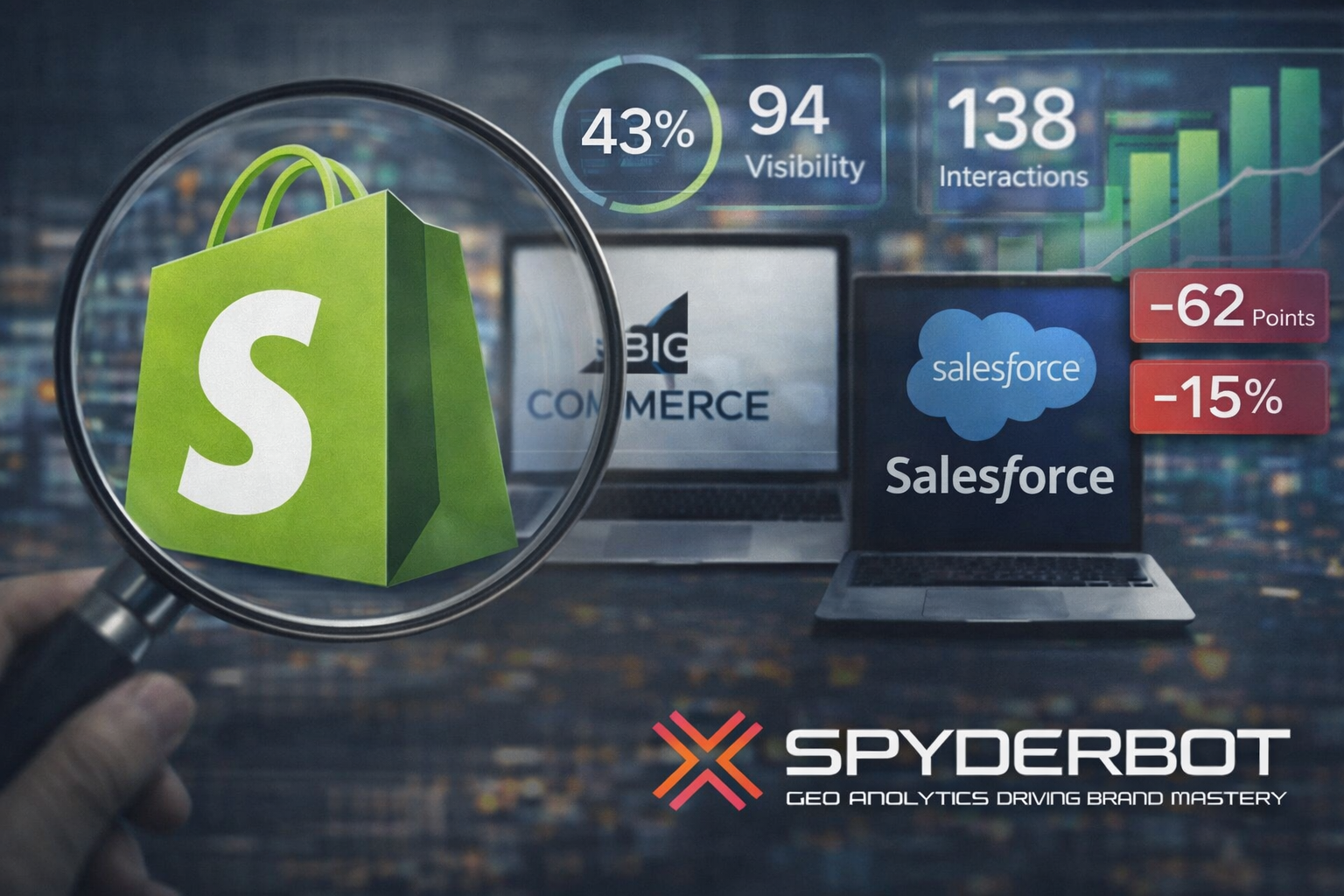
  • Shopify’s Leading 43% Generative Search Share Faces Rising Competitive Pressure in Enterprise and Headless Segments

    Shopify’s Leading 43% Generative Search Share Faces Rising Competitive Pressure in Enterprise and Headless Segments

    Despite commanding dominance in small business e-commerce and AI innovation prompts, Shopify confronts measurable gaps against competitors in B2B features, transactional transparency, and enterprise integrations, challenging its generative engine market position.

    SpyderBot GEO report reference for shopify.com

    At-a-glance

    • 43% Generative Search Share, highest in the sector
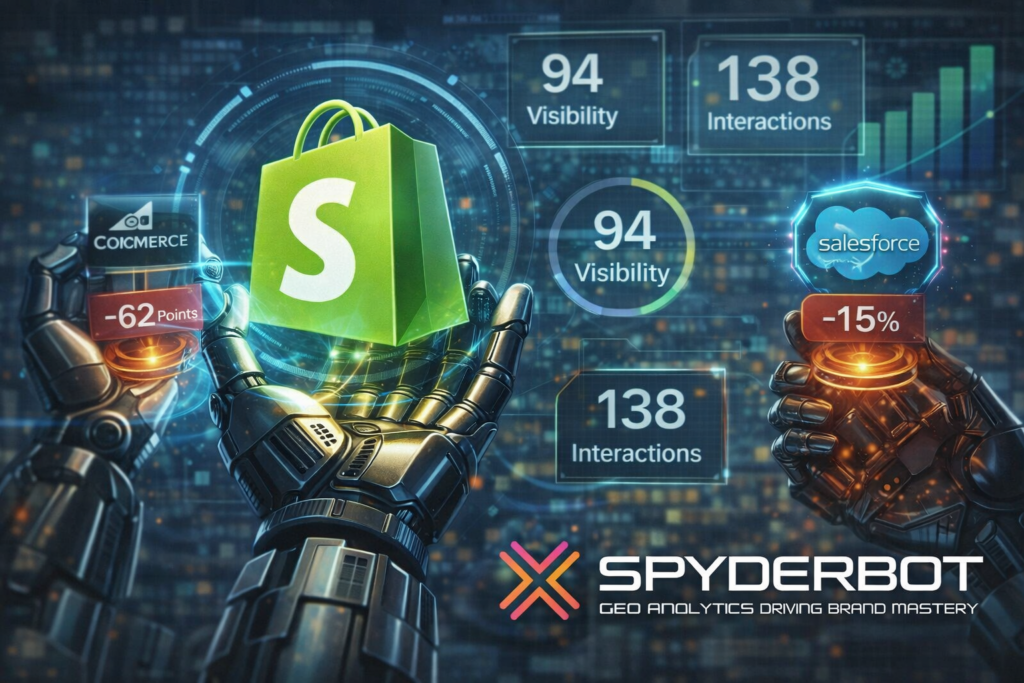
    • 94 Visibility Score across 138 LLM interactions
    • 27% Share of voice in LLM brand mentions, leading but pressured by Wix (20%) and BigCommerce (15%)
    • Critical visibility gap of 62 points versus BigCommerce on transaction fee transparency
    • 84 Overall sentiment score in LLM outputs, highest among peers
    • 98% Visibility score on Copilot platform
    • Positive founder sentiment driven by Tobi Lütke’s product-led growth and AI integration narratives
    • Recommendations include technical documentation enhancement, transparency campaigns, and ERP partnership upgrades

    Risk signals

    • 62-point visibility gap on fee-related queries disadvantaging Shopify in price-sensitive segments
    • 15% deficits against Salesforce and Adobe Commerce in enterprise omnichannel and ERP integration queries
    • Legacy founder-related negative sentiment at 14% linked to 2023 workforce reductions
    • Wix’s advancement in ‘Small Business Agility’ rankings threatens Shopify’s lead in that category

    The current GEO analytics position of Shopify reveals a complex competitive landscape within the fast-evolving generative search and e-commerce ecosystem. Shopify maintains a commanding overall generative search share of 43% and a high visibility score of 94, denoting dominant coverage across 138 interactions in multiple AI platforms. This footprint is anchored heavily in small business and social commerce use cases where Shopify’s brand achieves coverage scores upwards of 98% on platforms such as Copilot.

    However, the landscape is not without tensions. Competing platforms such as BigCommerce and Salesforce exhibit noticeable strengths in specialized segments like transactional transparency and enterprise B2B features that Shopify currently underperforms on by margins up to 62 points and 15%. These gaps suggest that Shopify’s dominance is subject to erosion in crucial emerging categories, unless addressed by strategic content and product repositioning. The existing legacy narrative around founder Tobi Lütke’s 2023 workforce reductions contributes negatively to sentiment analysis in 42% of founder-context discussions, which can dilute Shopify’s innovation narrative within LLM brand mentions.

    For senior leadership, these patterns underscore the urgent need to both defend core small business strengths and aggressively counter competitor sentiment to sustain total market share in an increasingly complex category.

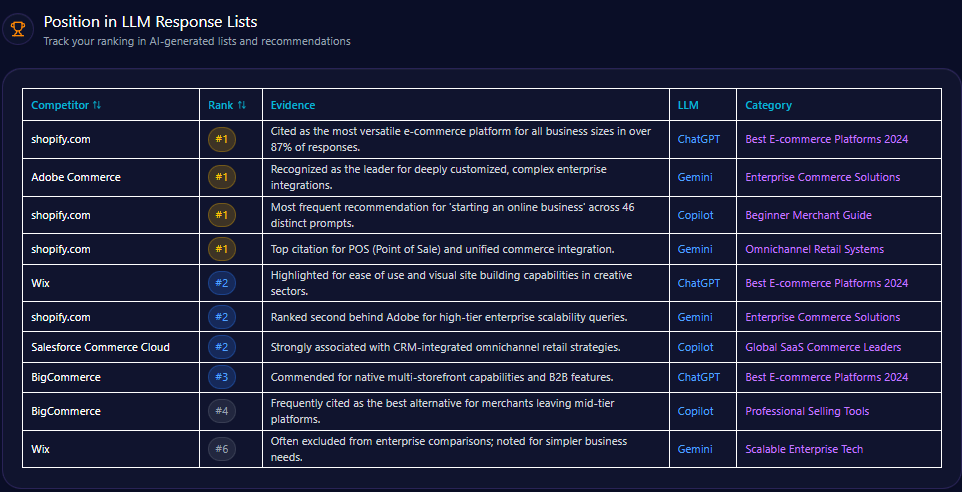
    Position in LLM Response Lists

    Shopify ranks first across multiple key LLM-generated lists. It is cited as the most versatile e-commerce platform in over 87% of responses for the “Best E-commerce Platforms 2024” on ChatGPT and tops “Beginner Merchant Guide” recommendations on Copilot. It holds primacy for POS and unified commerce citations on Gemini.

    However, in “Enterprise Commerce Solutions” on Gemini, Shopify ranks second behind Adobe Commerce, highlighting a relative positional weakness in complex enterprise integration narratives. Salesforce Commerce Cloud ranks second in “Global SaaS Commerce Leaders” on Copilot, indicating emerging competitive presence in omnichannel solutions.

    shopify.com’s Position in LLM Response Lists (Generated on March 20, 2026)

    Competitor Gap Analysis

    QueryShopify ScoreCompetitorCompetitor ScoreGapOpportunityPriority
    Headless commerce for global brands81BigCommerce88-7Improve visibility for Hydrogen/Oxygen headless toolsHigh
    B2B e-commerce features comparison76Salesforce Commerce Cloud91-15Showcase B2B Wholesale capabilitiesCritical
    Transaction fees transparency32BigCommerce94-62Implement transparency campaign on total cost of ownershipCritical
    ERP integration for e-commerce79Adobe Commerce94-15Deploy whitepapers on SAP partnershipsHigh

    Trigger Keywords for Competitor Products

    The report does not quantify trigger keywords for competitor products.

    Founder / Ownership / Leadership Context

    Founder Tobi Lütke’s mention frequency is notably high at 83% with a positive sentiment score of 80.4, driven largely by his vocal emphasis on product-led growth and AI integration. Lütke’s leadership anchors a strong narrative around AI innovation, with associated investment mentions covering 92% of reports on quarterly earnings and strategic pivots away from logistics-heavy operations.

    Nevertheless, a legacy negative sentiment rate of 10.2% couples with residual perceptions of 2023 workforce reductions. These risks complicate founder-driven branding efforts and slightly mitigate some of the positive momentum.

    Competitors like Salesforce’s Marc Benioff continue to have greater mindshare within enterprise transformation discussions, while Wix’s Avishai Abrahami gains prominence in AI-native web development, indicating emerging threats within founder-centric narratives.

    Quick overview

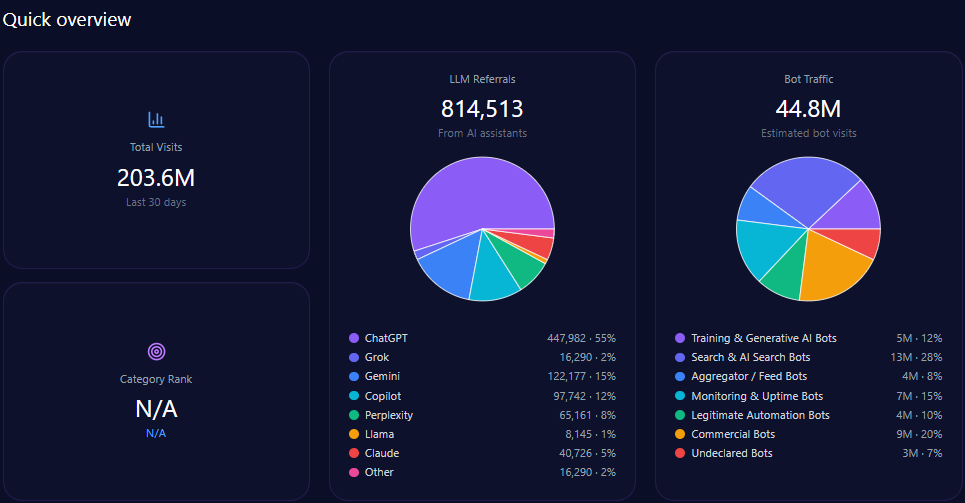
    shopify.com’s Quick overview (Generated on March 20, 2026)

    Shopify attracted over 203 million total visits, with bot traffic constituting approximately 44.8 million visits. Of these bots, key constituents include 5.4 million training & generative AI bots and 12.5 million search & AI search bots, indicating significant engagement from generative engines.

    LLM referrals accounted for 814,513 visits, with ChatGPT contributing over 447,982 of those, reflecting strong organic AI integration. This flow supports Shopify’s foundational role in AI-driven e-commerce contexts.

    Share of Voice in LLM Responses

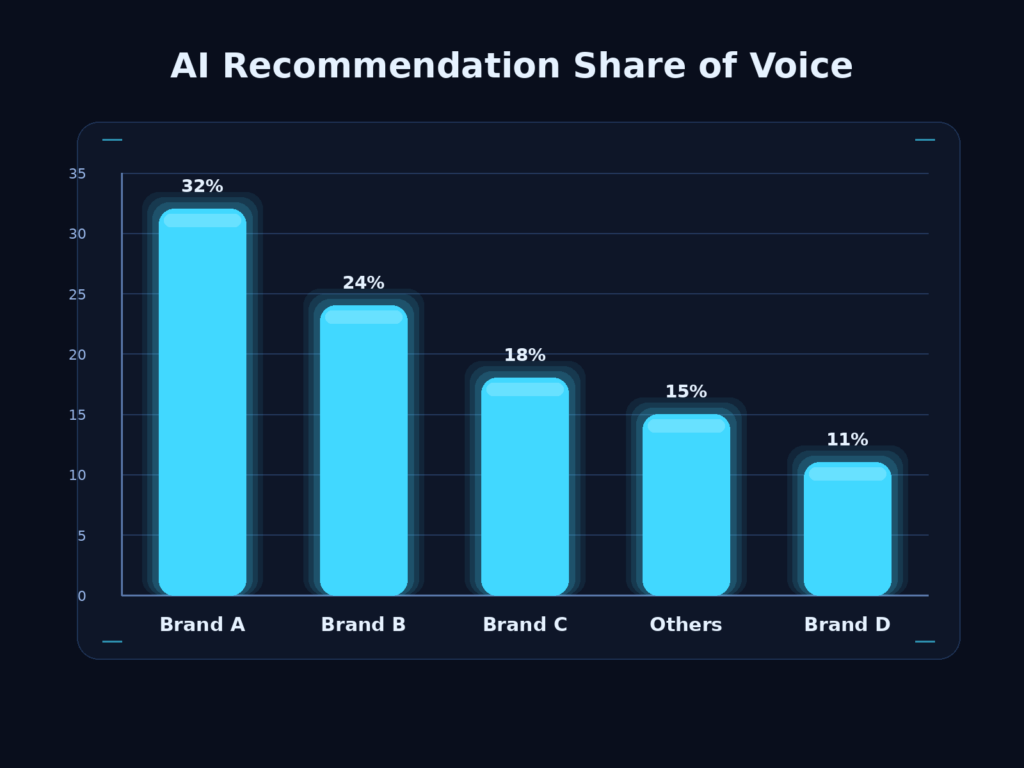
    Shopify maintains a leading share of voice at 27% (132 mentions) among competitors, followed by Wix (20%) and BigCommerce (15%). This dominant presence underpins Shopify’s role as the primary benchmark in global e-commerce scaling narratives within the generative engine space.

    AI Platform-Specific Visibility

    PlatformVisibility %Share of Voice %Total Mentions 
    Copilot9828167
    ChatGPT9627162
    Gemini8926158
    Others000

    Shopify’s apex visibility on Copilot and robust presence on ChatGPT and Gemini confirm its cross-platform appeal. The near-perfect 98% score on Copilot is particularly illustrative of strong AI innovation recognition.

    Sentiment Score for Competitors

    BrandPositive %Neutral %Negative %Overall Score
    Shopify7222684
    BigCommerce6231778
    Adobe Commerce52381074
    Wix6824881
    Salesforce5635976

    Shopify’s overall sentiment score of 84 surpasses competitors, consistent with its strong brand coverage in LLM brand mentions reflecting confident user perception and engagement.

    Top Prompts Driving Mentions

    • “Which platform is better for AI-powered storefront customization?” — 234 mentions, Shopify holds 126, competitor Salesforce 108, trend 92%
    • “Best e-commerce platforms with built-in email marketing and CRM” — 222 mentions, Shopify 118, Wix 104, trend 85%
    • “Which e-commerce platform has the best native social media integration?” — 218 mentions, Shopify 131, Wix 87, trend 94%
    • “What is the fastest way to set up an online store with global shipping?” — 212 mentions, Shopify 134, Wix 78, trend 96%
    • “Compare Shopify vs BigCommerce for high volume B2B sales” — 206 mentions, Shopify 112, BigCommerce 94, trend 88%

    These prominent prompt queries illustrate Shopify’s strength in AI commerce capabilities, operational speed, and social media integration while underscoring competitive pressure from Salesforce, Wix, and BigCommerce in enterprise and marketing-related topics.

    Types of Prompt Queries

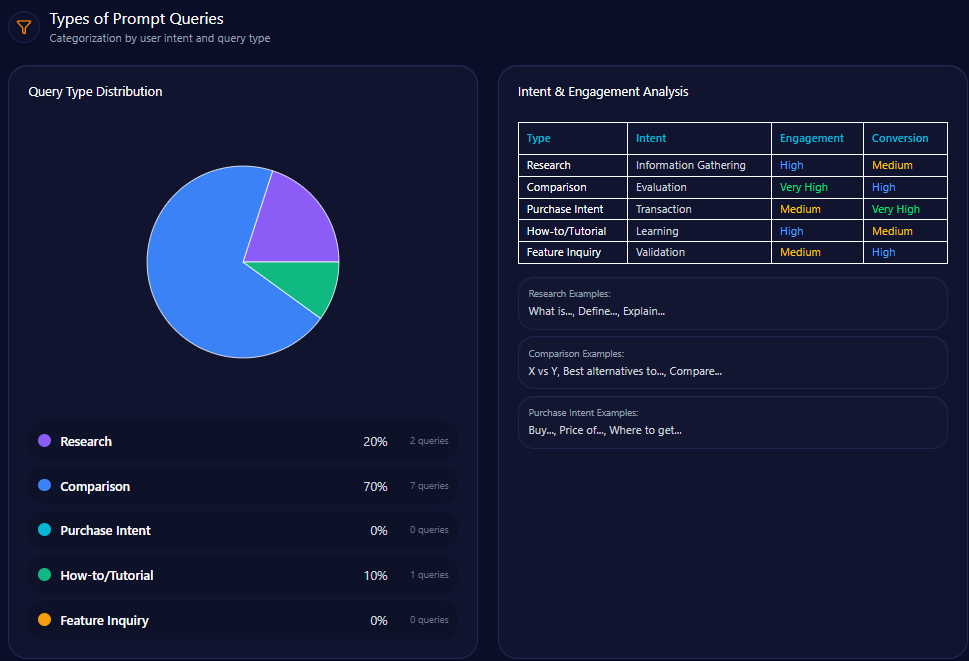
    shopify.com’s Types of Prompt Queries (Generated on March 20, 2026)
    • Research: 20% of queries
    • Comparison: 70%, dominates prompt volume
    • How-to / Tutorial: 10%
    • Purchase Intent: 0%
    • Feature Inquiry: 0%

    LLM brand mentions focus heavily on comparison queries, indicating decision-makers seek detailed product and capability differentiation, reinforcing the need for Shopify to sharpen competitive positioning and content accuracy.

    Service / Product-Level Sentiment

    • AI Commerce Capabilities: 64% frequency; optimistic tone highlighted by AI-driven tools like Shopify Sidekick and Magic
    • App Ecosystem & Extensibility: 81% frequency with strongly positive sentiment, emphasizing App Store variety and checkout extensibility
    • Total Cost of Ownership: 39% frequency; mixed sentiment due to concerns about transaction fees and premium app costs

    The mixed sentiment on cost structure signals a strategic priority to address fee transparency and price sensitivity, evident in competitor sentiment tracking especially against BigCommerce’s dominance in zero transaction fee discussions.

    Conclusion

    Shopify’s performance within generative search and AI-powered e-commerce remains dominant but nuanced. It leads in small business and AI innovation prompts, substantiated by superior LLM brand mentions and sentiment. Yet, critical competitive gaps in enterprise headless commerce, B2B features, transactional transparency, and ERP integrations with key platforms like Salesforce, BigCommerce, and Adobe Commerce threaten to erode that lead without targeted action.

    Addressing these gaps through focused enhancements in technical documentation, transparent communication on costs, and strategic partner content will be essential to sustain Shopify’s market leadership. Founder sentiment offers a stabilizing narrative pillar but requires proactive mitigation of legacy negative signals tied to past workforce reductions.

    Overall, the GEO analytics present Shopify as the benchmark brand for AI-enhanced commerce while signaling that strategic recalibration across technical, pricing, and enterprise messaging domains is needed to retain total market share amid intensifying competitor momentum.

    Explore SpyderBot to operationalize these GEO analytics insights.

  • What Is Generative Engine Optimization (GEO)?

    What Is Generative Engine Optimization (GEO)?

    The Definitive 2026 Guide to Optimizing Brand Visibility in AI Search


    Executive Definition (Snippet-Optimized)

    Generative Engine Optimization (GEO) is the strategic process of improving how generative AI systems—such as ChatGPT, Gemini, and Claude—mention, evaluate, compare, and recommend a brand within AI-generated responses.

    Unlike traditional SEO, which optimizes for rankings in search engine results pages (SERPs), GEO focuses on optimizing inclusion, citation frequency, sentiment, and competitive positioning inside AI-generated answers.

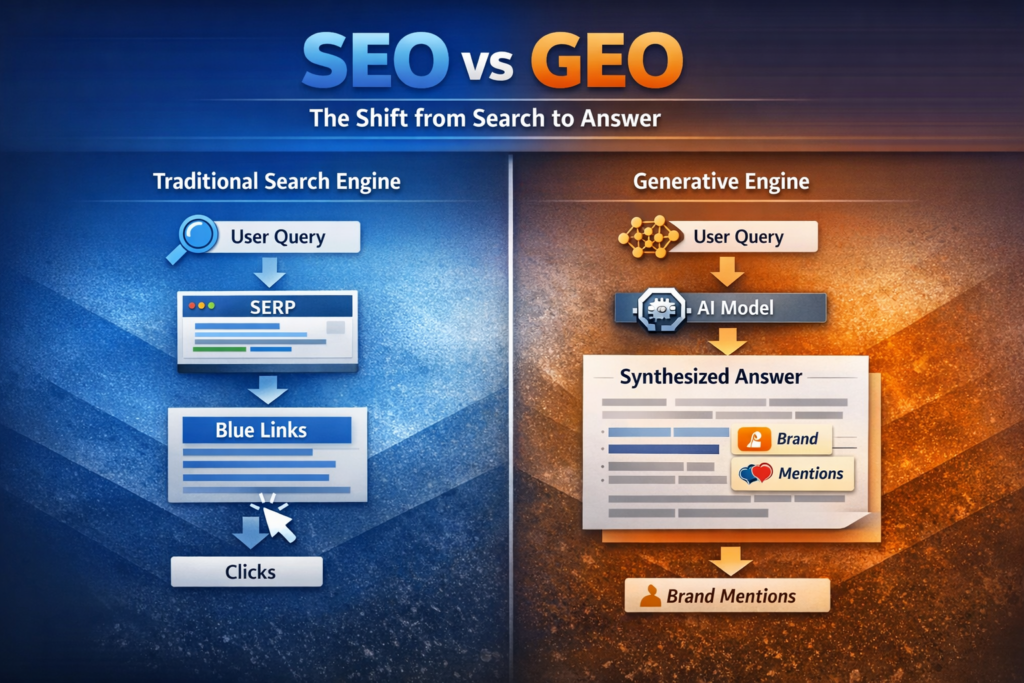
    The Shift from SEO to GEO – SPYDERBOT.NET


    1. The Evolution from Search Engines to Generative Engines

    Traditional search engines return ranked links.

    Generative engines synthesize answers.

    This shift changes the optimization target:

    EraOptimization Target
    SEO EraRanking position
    AI EraRepresentation inside answers

    Users increasingly ask:

    • “What are the best AI SEO tools?”
    • “Which SaaS tools track competitor visibility?”
    • “How do LLMs choose sources?”

    Instead of receiving 10 blue links, they receive a summarized list—often with 3–5 brand mentions.

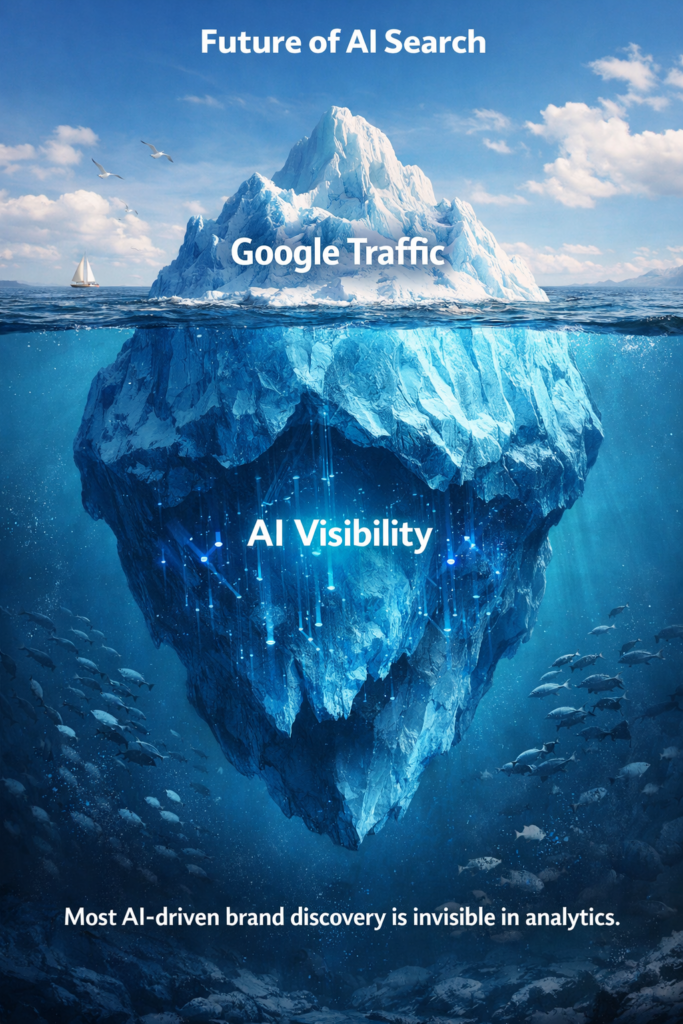
    If your brand is excluded, traffic loss becomes invisible.

    This is where GEO becomes strategic.


    2. How Generative AI Systems Produce Answers

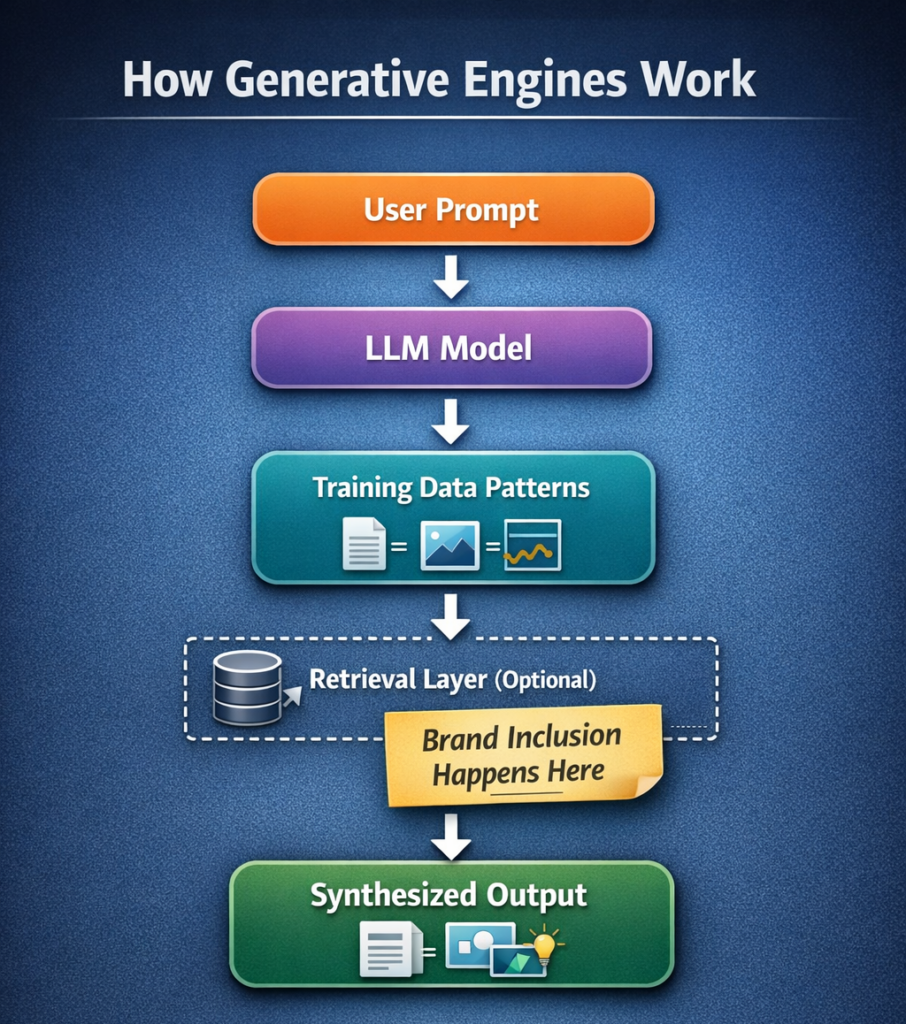
    How Generative Engines Work- SPYDERBOT.NET

    Generative AI systems like ChatGPT, Gemini, and Claude operate using:

    • Pre-trained large-scale language models
    • Probabilistic token prediction
    • Pattern recognition from training corpora
    • In some cases, retrieval-augmented generation (RAG)

    Key implications:

    1. There is no fixed ranking algorithm like Google’s PageRank.
    2. There is no visible SERP.
    3. Brand inclusion is probabilistic.
    4. Context and entity strength matter.

    Optimization therefore targets entity prominence and semantic clarity rather than keyword density alone.


    3. GEO vs SEO: Structural Differences

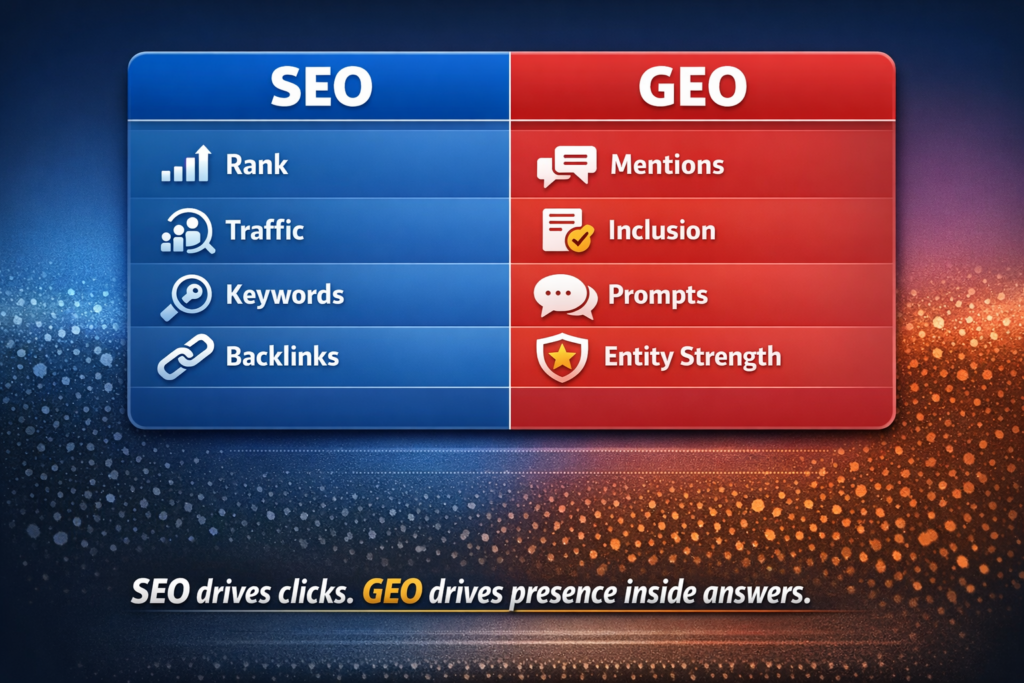
    DimensionSEOGEO
    OutputRanked web pagesSynthesized responses
    MetricKeyword rankingMention frequency
    VisibilityPosition-basedInclusion-based
    SignalBacklinks, content, UXEntity prominence, authority, consistency
    CompetitionWebsitesBrands in answer sets

    SEO drives traffic.

    GEO drives presence inside decision-making summaries.

    Both are complementary.

    GEO vs SEO Comparison Table (Visual Graphic Version) – SPYDERBOT.NET

    4. The Core Pillars of Generative Engine Optimization

    Pillar 1: Entity Strength

    Generative systems recognize entities.

    Entity clarity requires:

    • Consistent brand description
    • Clear category positioning
    • Structured data (Schema.org)
    • Multi-platform presence

    Ambiguous brands are less likely to be surfaced.


    Pillar 2: Authority Footprint

    AI models favor:

    • Widely discussed brands
    • Brands with strong digital signals
    • Brands associated with clear categories

    Authority footprint includes:

    • Industry publications
    • SaaS directories
    • Research papers
    • Structured listings
    • High-quality backlinks

    Pillar 3: Prompt Coverage

    Traditional SEO tracks keywords.

    GEO tracks prompts.

    Example prompt clusters:

    • “Best tools for AI search monitoring”
    • “Top competitor analysis SaaS”
    • “How to optimize for generative AI”

    Coverage rate matters.

    If your brand appears in 5/100 prompts, visibility share is 5%.


    Pillar 4: Citation & Source Inclusion

    When AI systems provide citations or references:

    • Are you cited?
    • Are competitors cited instead?

    Citation frequency is a measurable GEO signal.


    Pillar 5: Sentiment & Positioning

    AI responses influence perception.

    Key questions:

    • Are you described as enterprise-level?
    • Are you described as beginner-friendly?
    • Are competitors framed as more innovative?

    Positioning drift is a GEO risk.


    5. How LLMs Decide What to Mention

    While ranking factors are not publicly documented, observable patterns suggest influence from:

    • Brand frequency in training data
    • Consistency of category association
    • Strength of digital authority
    • Prominence across reputable domains
    • Clear definitional content

    Brands with strong semantic identity perform better in AI summaries.


    6. GEO Metrics Framework

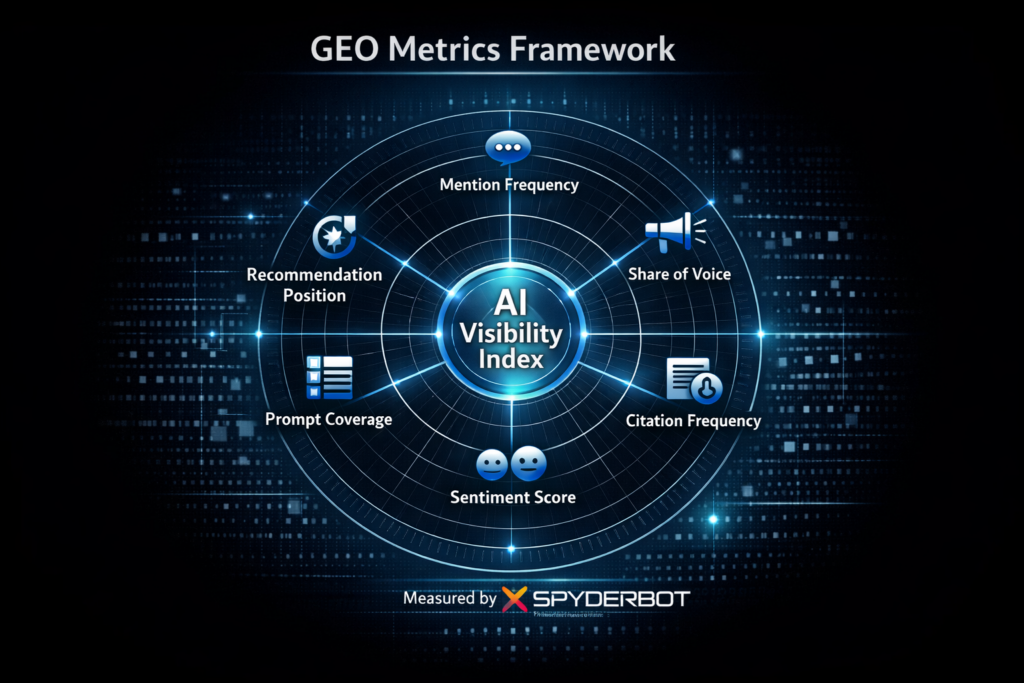
    GEO Metrics Framework Diagram – SPYDERBOT.NET

    A structured GEO measurement model tracks:

    1. Mention Frequency

    How often your brand appears across defined prompt sets.

    2. Share of Voice

    Brand mentions divided by total mentions within a category.

    3. Recommendation Order

    Placement within top 3 recommendations.

    4. Citation Frequency

    Inclusion in referenced sources.

    5. Sentiment Score

    Positive, neutral, or negative context.

    6. Prompt Coverage Rate

    Percentage of tested prompts where brand appears.

    These metrics form an AI Visibility Index.


    7. Optimization Tactics That Influence AI Visibility

    1. Build a Clear Category Narrative

    Define:

    • What category you belong to
    • What problem you solve
    • What differentiates you

    Ambiguity reduces inclusion probability.


    2. Publish Authoritative Definitions

    Clear definitional pages increase citation likelihood.

    Example structure:

    • Definition in 40–60 words
    • Expanded explanation
    • Comparison table
    • FAQ section

    This structure benefits both Google and LLM parsing.


    3. Strengthen Digital Entity Consistency

    Maintain identical positioning across:

    • Website
    • SaaS directories
    • Social platforms
    • Media mentions

    Consistency improves entity recognition.


    4. Publish Data-Driven Research

    Original reports:

    • Increase citation probability
    • Improve authority perception
    • Enhance share of voice

    5. Monitor Competitor Visibility

    Track:

    • Which prompts mention competitors
    • Which AI systems favor which brands
    • Citation overlap

    Competitive benchmarking is central to GEO.


    8. Competitive GEO Strategy

    Competitive GEO Landscape Chart – SPYDERBOT.NET

    A competitive GEO approach involves:

    1. Identifying high-intent prompt clusters
    2. Testing AI responses across systems
    3. Measuring mention frequency
    4. Identifying gaps
    5. Publishing optimized content

    This transforms AI visibility from reactive to strategic.


    9. Risks and Misconceptions

    Misconception 1: GEO Replaces SEO

    False. GEO complements SEO.


    Misconception 2: AI Cannot Be Influenced

    While models are probabilistic, entity strength and authority signals influence representation.


    Misconception 3: Ranking in Google Guarantees AI Inclusion

    Not always.

    AI may synthesize from multiple domains.


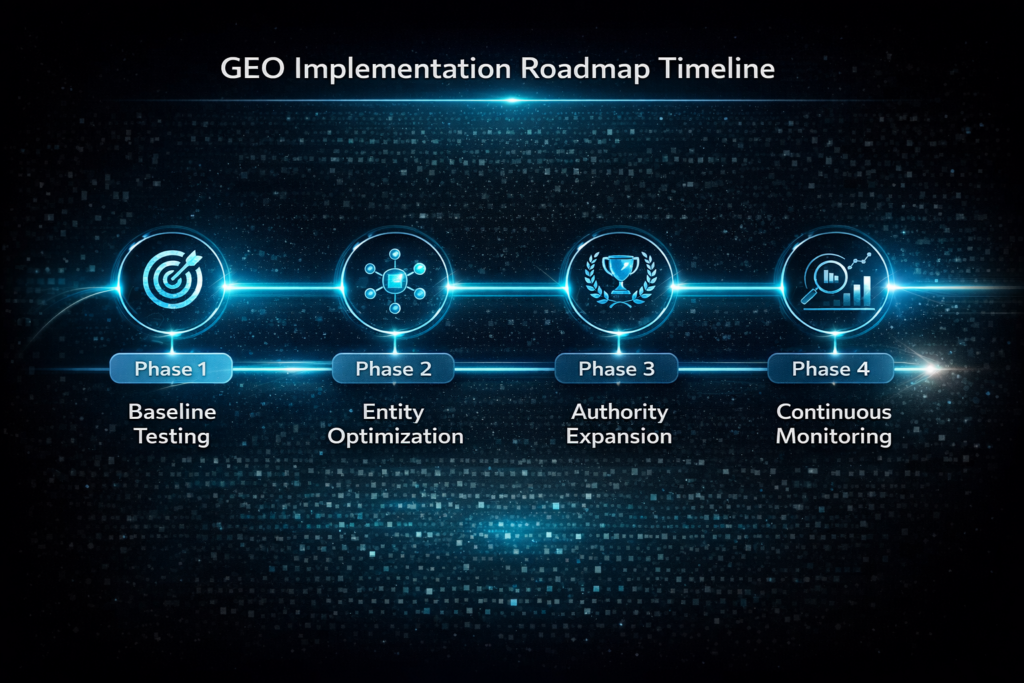
    10. GEO Implementation Roadmap

    Phase 1: Baseline Measurement

    • Define 100+ prompts
    • Measure current visibility

    Phase 2: Content & Entity Optimization

    • Build definitional pages
    • Strengthen structured data
    • Improve category clarity

    Phase 3: Authority Expansion

    • Publish research
    • Acquire relevant backlinks
    • Expand digital footprint

    Phase 4: Continuous Monitoring

    • Weekly prompt testing
    • Competitive benchmarking
    • Sentiment tracking

    11. The Future of AI Search

    Invisible Market Share- SPYDERBOT.NET

    AI assistants are becoming:

    • Research tools
    • Comparison engines
    • Advisory systems

    Visibility inside AI-generated responses may become as important as traditional search rankings.

    Brands that ignore GEO risk becoming invisible in AI-driven decision journeys.


    12. Frequently Asked Questions (Expanded)

    Is Generative Engine Optimization measurable?

    Yes. Through structured prompt testing and visibility analysis.

    Does GEO require technical SEO?

    Yes. Structured data and entity clarity strengthen representation.

    How long does GEO take to impact?

    It depends on brand authority and competitive landscape. Results are cumulative.

    Who should prioritize GEO?

    • SaaS companies
    • B2B technology brands
    • High-consideration product categories

    Is GEO relevant outside tech industries?

    Yes. AI assistants are used across verticals for product discovery.


    GEO Implementation Roadmap Timeline – SPYDERBOT.NET

    Conclusion

    Generative Engine Optimization is the strategic discipline of improving how AI systems mention, compare, and recommend your brand within generated responses.

    As search evolves toward AI-generated answers, GEO ensures your brand remains visible, accurately positioned, and competitively represented inside the AI decision layer.