Tag: GEO analytics platform

  • How to Beat Competitors in AI Search

    How to Beat Competitors in AI Search

    AI search has changed the rules of online visibility. OpenAI says ChatGPT Search ranks results using factors tied to reliable, relevant information and does not guarantee top placement. Google says standard SEO best practices still matter for AI Overviews and AI Mode, and Anthropic says Claude’s web search cites sources from search results directly. That means beating competitors in AI search is no longer just about ranking pages. It is about becoming easier for AI systems to crawl, understand, compare, and cite.

    I. What Winning in AI Search Actually Means

    1. You are competing for inclusion, not just ranking

    In traditional search, a strong ranking can still bring visibility even if your messaging is average. In AI search, the answer is synthesized first, and sources are attached second. Google says AI Overviews and AI Mode show AI-generated responses with links to supporting web resources, and AI Mode can split a question into subtopics and search them simultaneously. That creates a very different battlefield: your brand must be selected as part of the answer, not merely listed near it.

    2. Your competitor can win even when your SEO is decent

    A competitor can outrank you inside AI answers if its site is clearer, easier to cite, better structured, or more directly aligned with comparison-style prompts. Google also says AI experiences can surface a wider range of sources, which means visibility can spread beyond the usual top-ranking pages.

    II. Diagnosis

    1. Your brand entity is too vague

    If your company name, product naming, positioning, or category language changes across pages, AI systems get weaker signals about who you are and what you should be mentioned for. When your entity is fuzzy, competitor entities with cleaner definitions tend to win more mentions.

    2. Your site is indexable for Google, but weak for AI retrieval

    OpenAI explicitly says that inclusion in ChatGPT Search depends on allowing OAI-SearchBot to crawl your site and ensuring infrastructure allows access. If your robots rules, CDN, firewall, or hosting setup blocks that path, your pages become harder to surface in AI search experiences.

    3. Your content is built for keywords, not decision prompts

    Many brands publish pages optimized for search terms, but not for the real prompts users ask AI systems, such as:

    • best alternatives to [competitor]
    • [brand] vs [competitor]
    • which tool is better for [use case]
    • why does AI recommend [competitor]

    If you do not publish direct answers for those prompt shapes, the model has fewer reasons to include you.

    4. Your trust signals are weak or hard to parse

    Google says structured data helps it understand page content and organizations, and its Organization guidance recommends adding useful properties such as name, alternateName, url, logo, contact details, and sameAs references. If your site lacks machine-readable brand signals, AI systems have less structured evidence to work with.

    5. Your competitor has more reusable evidence

    AI systems prefer pages that are easier to summarize. If your competitor has clearer use cases, fresher proof, stronger comparative pages, and simpler factual statements, it becomes easier for the model to reuse their material inside an answer.

    6. Your measurement model is outdated

    If you only track Google rankings, you may miss the real reason you are losing. In AI search, you need to measure mentions, citations, prompt coverage, comparison visibility, and competitor share of voice.

    III. Why It Happens (LLM Mechanism)

    1. LLMs do not think like a classic search engine

    LLM-driven search experiences combine retrieval with synthesis. ChatGPT Search emphasizes reliable and relevant information, Google AI responses are supported by web resources, and Claude’s web search cites source material directly. In practice, the model is not just matching keywords. It is assembling a response from entities, claims, and evidence it can trust enough to present.

    2. AI systems favor pages they can understand quickly

    Google says structured data helps it understand content and gather information about the web and the world. That is why explicit labels, clean headings, strong page purpose, visible facts, and schema markup help reduce ambiguity. The easier your page is to parse, the easier it is to reuse.

    3. Retrieval is prompt-sensitive

    Google says AI Mode can break a query into subtopics and search them simultaneously. This matters because broad prompts like “best B2B AI visibility tool” may trigger a different evidence set than “why does ChatGPT recommend my competitor.” If your content only covers one phrasing, you lose coverage across the rest.

    4. Citation behavior rewards clarity

    Claude’s web search automatically cites sources, and ChatGPT Search and Google AI both emphasize linked supporting resources. That means pages with tight answers, explicit claims, scannable formatting, and supporting proof are more likely to survive the compression step from webpage to AI answer.

    5. There is no guaranteed “top position” shortcut

    OpenAI explicitly says there is no way to guarantee top placement in ChatGPT Search, and Google says there are no special extra requirements just for appearing in AI Overviews or AI Mode beyond strong SEO fundamentals. So the winning move is not a trick. It is operational excellence in crawlability, clarity, structure, and evidence.

    IV. How to Beat Competitors in AI Search

    1. Fix crawl access first

    Make sure your important pages are crawlable, indexable, fast, canonicalized, and not blocked for relevant AI crawlers. If ChatGPT cannot reliably access your content, the rest of your optimization is weaker from the start.

    2. Strengthen your brand entity

    Create one crystal-clear brand story across your homepage, about page, product pages, and documentation:

    • who you are
    • what you do
    • who you serve
    • what category you belong to
    • what makes you different

    Use the same naming system everywhere. Do not make the model guess.

    3. Publish pages for high-intent AI prompts

    Create content specifically for prompts that cause competitive switching:

    • best alternatives to [competitor]
    • [your brand] vs [competitor]
    • why is [competitor] recommended in AI search
    • how to choose a tool for [use case]
    • which platform is best for [industry]

    This is where AI search visibility is won.

    4. Add machine-readable trust signals

    Use structured data where it genuinely fits the page: Organization, ProfilePage, Article, FAQ, Product, LocalBusiness, or other relevant schema. Google states that structured data helps it understand content, and its Organization guidance makes clear that properties like name, logo, url, contact information, and sameAs improve clarity.

    5. Turn claims into evidence

    Do not say you are “better.” Prove it with:

    • comparison tables
    • methodology pages
    • screenshots
    • benchmark summaries
    • customer categories
    • limitations and tradeoffs
    • update dates

    AI systems reuse pages that contain compressible evidence, not vague marketing language.

    6. Build comparison-ready page architecture

    Your site should contain pages that can answer:

    • what you are
    • how you work
    • who you are for
    • how you compare
    • why someone should switch
    • what proof supports that claim

    If those pages do not exist, your competitor has an easier path into AI-generated recommendations.

    7. Monitor prompts, not just pages

    Track which prompts trigger your competitors, which pages get cited, which claims repeat across models, and where your brand disappears. That gives you a real GEO roadmap instead of random content production.

    V. Run GEO Audit

    If competitors keep appearing in AI search while your brand is missing, guessing is the slowest possible strategy.

    Run GEO Audit to identify:

    • which competitors AI systems mention most
    • which prompts trigger those mentions
    • which pages are being cited
    • where your entity signals are weak
    • which comparison gaps are costing you visibility
    • what content should be fixed first

    Run GEO Audit and turn AI search from a black box into a measurable growth channel.

    VI. FAQs

    1. Can I guarantee top placement in AI search?

    No. You can improve your odds, but OpenAI explicitly says there is no guaranteed top placement in ChatGPT Search, and Google says AI visibility still depends on strong overall SEO fundamentals rather than a secret AI-only hack.

    2. Does structured data help with AI search visibility?

    It helps machines understand your content and your organization more clearly. Google explicitly says structured data helps it understand page content and world knowledge, which makes it an important clarity layer.

    3. Why does my competitor appear in ChatGPT but not my brand?

    Usually because the competitor is easier to crawl, easier to identify, easier to compare, or easier to cite. In AI search, clarity often beats noise.

    4. Is traditional SEO still useful for AI search?

    Yes. Google explicitly says standard SEO best practices remain relevant for AI Overviews and AI Mode. AI search does not replace SEO; it raises the bar for structure, evidence, and entity clarity.

  • Why Does ChatGPT Recommend My Competitor?

    Why Does ChatGPT Recommend My Competitor?

    If ChatGPT keeps recommending your competitor instead of your brand, the problem is usually not random. In most cases, it means the model has stronger confidence in your competitor’s entity signals, source consistency, topical authority, and brand-to-query relevance.

    This is the new visibility problem in AI search.

    In Google Search, brands compete for rankings. In ChatGPT and other LLM-powered systems, brands compete for mentions, citations, and inclusion inside the answer itself. If your competitor is mentioned more often, described more clearly, or connected more strongly to the user’s question, they are more likely to appear in the response.

    I. What This Problem Really Means

    When ChatGPT recommends your competitor, it usually indicates one or more of these issues:

    • Your brand is not strongly associated with the category or use case users ask about.
    • Your competitor has clearer, more repeated, and more trusted mentions across the web.
    • Your content is visible, but not structured in a way that helps LLMs understand what your brand actually does.
    • The model has stronger confidence in your competitor’s relevance for the prompt.

    This is not only a content problem. It is a GEO problem.

    Generative Engine Optimization is the process of improving how AI systems interpret, retrieve, compare, and mention your brand.

    II. Diagnosis

    1. Your competitor has stronger entity clarity

    If your competitor is easier for AI systems to understand, they will be easier to recommend.

    Entity clarity means the model can quickly answer:

    • What is this brand?
    • What category does it belong to?
    • What problems does it solve?
    • Who is it best for?
    • How is it different from alternatives?

    If your site talks in vague marketing language while your competitor uses clear positioning, structured explanations, comparison pages, and category-specific language, the LLM will often prefer them.

    2. Your competitor has better source distribution

    ChatGPT does not rely on only one page.

    It forms brand understanding from patterns across:

    • company websites
    • product pages
    • reviews
    • editorial mentions
    • industry directories
    • comparison articles
    • forums
    • third-party references

    If your competitor is described consistently across many sources, while your brand appears only on your own website, the model has fewer signals to trust.

    3. Your website explains features, but not use cases

    Many brands describe what they built but fail to explain:

    • who it is for
    • when it should be used
    • how it compares to alternatives
    • what category it belongs to

    That creates a gap between your internal messaging and the way real users ask questions.

    If users ask, “What is the best tool for tracking AI brand mentions?” and your competitor has pages directly tied to that use case, they may be recommended even if your product is stronger.

    4. Your competitor is better aligned to prompt intent

    ChatGPT often recommends brands that match the prompt more precisely, not brands that are generally “better.”

    For example:

    • informational prompts favor educational brands
    • comparison prompts favor brands with clear positioning
    • commercial prompts favor products with strong category framing
    • trust-sensitive prompts favor brands with stronger third-party validation

    If your competitor has content mapped to those intents and you do not, they will appear more often.

    5. Your brand lacks comparison visibility

    If your competitor is included in “best tools,” “alternatives,” “vs” pages, analyst summaries, and review ecosystems, they gain repeated comparative exposure.

    That matters because LLMs frequently generate answers by synthesizing comparative language. If your brand is absent from the comparison layer of the web, it becomes easier for the model to ignore you.

    III. Why It Happens (LLM Mechanism)

    1. LLMs do not think like traditional search engines

    Google ranks pages. LLMs generate answers.

    That means ChatGPT is not simply choosing the “highest ranked website.” It is predicting which brands, facts, and sources are most relevant to include in the response.

    This is a major shift.

    A brand can rank well in Google and still be weak inside ChatGPT if the model does not strongly connect that brand to the user’s question.

    2. LLMs compress the web into patterns

    Large language models learn from repeated relationships between terms, entities, categories, and sources.

    If the web repeatedly connects your competitor with phrases like:

    • best platform for X
    • trusted tool for Y
    • leading provider in Z

    then the model may internalize that competitor as a more natural answer.

    If your brand signals are inconsistent, sparse, or too generic, your probability of being mentioned drops.

    3. Retrieval systems reward accessible, structured evidence

    In many AI experiences, the model is not relying only on memory. It may also use retrieval, browsing, or cited sources.

    When that happens, pages with the following tend to perform better:

    • strong topical headers
    • clear category definitions
    • direct answers
    • comparison-friendly structure
    • schema and supporting context
    • brand-service-query alignment

    If your competitor publishes content that is easier to retrieve and summarize, the system has a better chance of surfacing them.

    4. AI models prefer confidence over ambiguity

    LLMs are probabilistic systems. When faced with uncertainty, they lean toward the brand with stronger evidence and cleaner associations.

    That is why weak positioning hurts.

    If your homepage says you “redefine innovation across digital ecosystems,” but your competitor says they are “an AI search analytics platform for tracking brand mentions in ChatGPT, Gemini, and Claude,” the second brand is far easier for the model to use.

    5. Mention frequency compounds visibility

    Once a brand is repeatedly associated with a topic, that mention advantage can reinforce itself.

    More mentions lead to:

    • stronger category association
    • more comparison inclusion
    • more confidence in future answers
    • broader prompt coverage

    This is why LLM visibility often feels unfair. The model is not trying to be fair. It is trying to generate the most likely helpful answer.

    IV. How to Fix It

    1. Tighten your brand positioning

    Make your core message explicit across your site:

    • what your product is
    • who it is for
    • what category it belongs to
    • which problems it solves
    • how it differs from competitors

    Do not assume AI systems will infer your positioning correctly.

    2. Build pages for prompt intent

    Create pages that match the actual questions users ask:

    • why ChatGPT is not mentioning my brand
    • how to appear in AI search results
    • how to optimize website for ChatGPT
    • best tool to track ChatGPT mentions
    • competitor alternatives pages
    • category definition pages

    This helps connect your brand to real LLM query patterns.

    3. Strengthen off-site validation

    You need more than a good homepage.

    Build consistent references across:

    • industry articles
    • software directories
    • founder and company profiles
    • product comparisons
    • podcast or interview mentions
    • community discussions

    The goal is not just traffic. The goal is machine-readable brand reinforcement.

    4. Add structured comparison content

    Publish content that helps the model place you in the competitive landscape:

    • X vs Y
    • alternatives to competitor
    • best tools for specific use cases
    • category roundups
    • buyer guides

    If you are not present in comparative content, your competitor will own the recommendation layer.

    5. Measure your LLM visibility

    You cannot fix what you do not measure.

    Track:

    • where your brand is mentioned
    • which competitors are recommended instead
    • which prompts trigger exclusion
    • which use cases you dominate or lose
    • which sources are influencing outcomes

    That is how you move from guessing to diagnosing.

    V. Why This Matters for Revenue

    If ChatGPT recommends your competitor, the issue is not just branding.

    It can affect:

    • top-of-funnel discovery
    • product consideration
    • perceived authority
    • buyer trust
    • competitive conversion paths

    As AI interfaces become part of research and buying behavior, being absent from recommendations becomes a visibility loss with commercial consequences.

    VI. Run GEO Audit

    If ChatGPT recommends your competitor more often than your brand, do not treat it as a mystery.

    Treat it as a measurable visibility problem.

    A GEO Audit helps you identify:

    • which competitors are being mentioned instead of you
    • which prompts expose your weakness
    • how AI systems describe your brand
    • where your entity positioning is unclear
    • which content and source gaps are reducing your inclusion

    Run GEO Audit to see how LLMs analyze your brand, where competitors are outperforming you, and what to fix first.

    VII. FAQ

    1. Is ChatGPT ranking my competitor above my brand?

    Not in the same way Google ranks websites. ChatGPT generates answers by selecting the brands and sources it considers most relevant, useful, and trustworthy for the prompt.

    2. Can I optimize my website for ChatGPT?

    Yes. You can improve your chances of being mentioned by clarifying your positioning, aligning pages to prompt intent, creating comparison content, and strengthening source consistency across the web.

    3. Why does my competitor appear in ChatGPT even when I rank higher in Google?

    Because Google rankings and LLM mentions are not the same thing. A strong search ranking does not automatically translate into strong AI visibility.

    4. Do reviews and third-party mentions affect ChatGPT recommendations?

    Yes. Repeated and consistent third-party references help strengthen brand credibility and category association in AI-generated answers.

    5. How do I know which prompts favor my competitor?

    You need prompt-level monitoring and LLM visibility tracking to see where your brand is missing, where competitors dominate, and which categories or use cases need optimization.

  • SEO for AI Search

    SEO for AI Search

    How to optimize for AI systems like ChatGPT, Gemini, and the future of search


    I. The question behind the shift

    As AI becomes the interface of the internet, a new question is emerging:

    “How do we do SEO for AI search?”

    It’s a natural question.

    But like “SEO for ChatGPT,” it hides a deeper reality:

    AI search does not work like traditional search


    II. AI search is fundamentally different

    Traditional search engines:

    • Index pages
    • Rank results
    • Return links

    AI search systems:

    • Interpret intent
    • Generate answers
    • Select and combine information

    This creates a new paradigm:

    You are not optimizing for ranking
    You are optimizing for inclusion


    III. What is “SEO for AI search”?

    “SEO for AI search” refers to:

    • Optimizing content for AI-generated answers
    • Increasing brand visibility in LLMs
    • Influencing how AI systems interpret your business

    The more accurate term is:

    Generative Engine Optimization (GEO)


    IV. From SEO to AI search optimization

    SEO helps you:

    Get discovered through search engines

    AI search optimization helps you:

    Get included in generated answers


    V. The new visibility model

    In AI search:

    • There are no result pages
    • There are no positions
    • There is no click competition

    There is only:

    Whether your brand appears in the answer


    VI. Why traditional SEO is not enough

    You can:

    • Rank #1 on Google
    • Have strong SEO
    • Own your keywords

    And still:

    Not appear in AI search

    This is the AI visibility gap


    VII. How AI search systems work

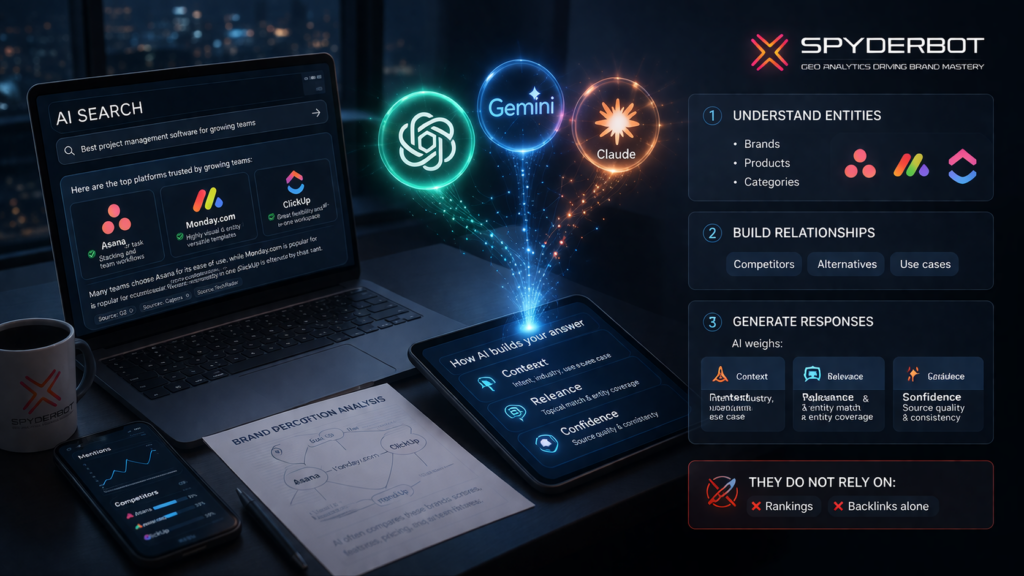
    AI systems like ChatGPT, Gemini, and Claude:

    1. Understand entities

    • Brands
    • Products
    • Categories

    2. Build relationships

    • Competitors
    • Alternatives
    • Use cases

    3. Generate responses based on:

    • Context
    • Relevance
    • Confidence

    They do not rely on:

    • Rankings
    • Backlinks alone

    VIII. What AI search actually optimizes for

    AI systems prioritize:

    1. Entity clarity

    Is your brand clearly defined?


    2. Contextual relevance

    Does your brand match the user’s intent?


    3. Semantic consistency

    Is your positioning consistent across content?


    4. Knowledge structure

    Is your content easy for AI to interpret?


    IX. SEO vs AI Search Optimization

    SEOAI Search Optimization
    KeywordsEntities
    RankingsMentions
    PagesConcepts
    BacklinksContext
    TrafficAI visibility

    X. The new metric: AI visibility

    AI visibility is:

    The presence and positioning of your brand in AI-generated answers

    It includes:

    • Brand mentions
    • Recommendation frequency
    • Position inside responses
    • Comparative context

    XI. How to do SEO for AI search (framework)

    1. Define your entity clearly

    Make it easy for AI to answer:

    “What is this company?”


    2. Own your category

    Ensure AI understands:

    “What category do you belong to?”


    3. Build contextual coverage

    Your brand should appear in:

    • Use cases
    • Alternatives
    • Comparisons

    4. Structure content for AI

    Focus on:

    • Clear definitions
    • Logical structure
    • Entity relationships

    5. Monitor AI visibility

    Track:

    • Mentions in ChatGPT
    • Competitor presence
    • AI interpretation

    XII. The biggest misconception

    Most companies think:

    “More SEO = more AI visibility”

    That’s not true.

    AI visibility depends on:

    • How AI understands you
    • Not how Google ranks you

    XIII. What winning companies are doing

    They:

    • Treat AI as a new channel
    • Optimize for understanding, not just ranking
    • Invest in AI search analytics

    XIV. The future of SEO for AI search

    We are moving toward:

    AI-first discovery

    Where:

    • AI systems are the interface
    • Answers replace results
    • Inclusion replaces ranking

    XV. Final insight

    SEO for AI search is not an extension of SEO.

    It is:

    A new layer of optimization

    And that layer is:

    Generative Engine Optimization (GEO)

  • The Future of Generative Engine Optimization (GEO)

    The Future of Generative Engine Optimization (GEO)

    From ranking pages to shaping intelligence

    1. The Next Layer of the Internet Is Already Here

    Most companies are still optimizing for search engines.
    But the interface of the internet has already changed.

    Users are no longer:

    • Browsing
    • Comparing
    • Clicking

    They are:

    • Asking AI — and acting on the answer

    2. This Is Not a Feature — It Is a Shift

    AI systems like ChatGPT, Gemini, and Claude are not tools layered on top of search.

    They are becoming:

    • The primary discovery layer
    • The decision engine
    • The interface between users and information

    And that changes how visibility works.

    3. The Future Is Not About Ranking — It Is About Inclusion

    In traditional SEO:

    • You compete for position
    • You optimize for ranking
    • You win through traffic

    In the future of GEO:

    • You compete for inclusion inside AI-generated answers

    Because:

    • There are no 10 blue links
    • There is no page two
    • There is only what AI decides to show

    4. The Rise of AI Visibility as a Core Metric

    A new metric is emerging:

    AI visibility

    AI visibility measures:

    • Whether your brand is mentioned
    • How often it appears
    • How it is positioned in AI answers

    This will become as important as:

    • Traffic
    • Conversions
    • Revenue

    5. From SEO Metrics to GEO Metrics

    Companies will shift from tracking:

    • Rankings
    • Keywords
    • Click-through rates

    To tracking:

    • AI visibility tracking
    • LLM visibility tracking
    • Brand mention frequency
    • AI perception and positioning

    6. The Evolution of Optimization

    Phase 1: SEO (Past)

    • Optimize for search engines
    • Focus on keywords and backlinks

    Phase 2: GEO (Present)

    • Optimize for AI systems
    • Focus on entities and context

    Phase 3: AI-Native Optimization (Future)

    Companies will:

    • Design content for AI interpretation
    • Structure data for machine understanding
    • Build brands as entities in knowledge graphs

    7. How AI Will Reshape Competition

    In the future:

    7.1. Smaller Brands Will Win More Often

    AI rewards:

    • Clarity
    • Relevance
    • Strong positioning

    Not just authority or size.

    7.2. Categories Will Be Defined by AI

    Instead of companies defining categories:

    AI will define how categories are understood

    7.3. Perception Will Be Algorithmic

    AI will decide:

    • Who is the leader
    • Who is an alternative
    • Who is irrelevant

    8. The Future of Search Behavior

    Users will move toward:

    • Conversational queries
    • Multi-step reasoning
    • Personalized answers

    Instead of:

    • Static search results

    9. The Future of Content

    Content will evolve from:

    • Keyword-optimized pages

    To:

    • Entity-structured knowledge designed for AI systems

    Winning content will:

    • Be clear, structured, and contextual
    • Define concepts explicitly
    • Connect entities and relationships

    10. The Future of Analytics

    A new category will emerge:

    AI search analytics

    Companies will need tools to:

    • Track brand mentions in AI systems
    • Analyze how LLMs interpret their business
    • Monitor competitor visibility in AI answers
    • Understand AI citation patterns

    11. The Rise of GEO Tools

    A new ecosystem is forming:

    • GEO analytics platforms
    • AI visibility tracking tools
    • LLM brand analytics systems
    • AI citation tracking software

    These tools will become:

    • As essential as SEO tools today

    12. The Companies That Win

    The winners of the next decade will:

    • Understand how AI systems think
    • Optimize for AI interpretation
    • Control their narrative inside AI

    Not just:

    • Rank on Google

    13. The Companies That Lose

    The losers will:

    • Rely only on traditional SEO
    • Ignore AI-generated answers
    • Fail to understand AI visibility

    And the most dangerous part:

    They will not realize they are losing

    14. What You Should Do Now

    14.1. Start Measuring AI Visibility

    • Track brand mentions in ChatGPT
    • Monitor competitors

    14.2. Understand AI Interpretation

    • How your brand is categorized
    • What entities are associated

    14.3. Optimize for AI Systems

    • Improve entity clarity
    • Structure content semantically
    • Build contextual authority

    15. The Long-Term Future

    We are moving toward:

    • An AI-mediated internet

    Where:

    • AI decides what users see
    • AI shapes perception
    • AI influences decisions

    16. Final Thought

    SEO was about being found.

    GEO is about:

    • Being understood, selected, and included

    And in the future:

    • The companies that control AI visibility will control digital discovery
  • Why Generative Engine Optimization (GEO) Matters

    Why Generative Engine Optimization (GEO) Matters

    Because AI doesn’t rank results — it decides what exists


    1. The moment search stopped being about search

    For years, the internet worked on a simple rule:

    If you rank, you get traffic

    Companies optimized for:

    • Keywords
    • Backlinks
    • Rankings

    And success meant:

    Being on page one

    But that system is no longer complete.


    2. We are entering the age of answer engines

    Users are no longer searching the web.

    They are asking AI systems like:

    • ChatGPT
    • Gemini
    • Claude

    And instead of a list of links, they get:

    A single, synthesized answer

    No scrolling.
    No comparison.
    No second chance.


    3. The new rule of visibility

    In this new system:

    If your brand is not mentioned, you do not exist

    There is no position #2
    There is no fallback traffic

    There is only:

    • Included
    • Or invisible

    4. What is Generative Engine Optimization (GEO)?

    Generative Engine Optimization (GEO) is:

    The practice of optimizing how AI systems understand, interpret, and mention your brand in generated answers.

    It is part of a new discipline that includes:

    • AI search optimization
    • AI search analytics
    • LLM visibility tracking

    GEO answers critical questions like:

    • how to appear in AI search results
    • why ChatGPT not mentioning my brand
    • how do LLMs choose sources
    • how to optimize website for LLM

    5. GEO doesn’t remove ranking — it hides it

    Many assume AI has no ranking.

    That’s not true.

    AI still ranks — but differently:

    • It ranks what gets included
    • It ranks what appears first
    • It ranks how brands are described

    This creates a new model:

    Visibility = inclusion + prominence + perception


    6. Why GEO matters now

    6.1. AI is becoming the primary discovery layer

    AI systems are now used for:

    • Product research
    • Comparisons
    • Recommendations

    Users trust answers more than links.


    6.2. SEO no longer guarantees visibility

    You can:

    • Rank #1 on Google
    • Have strong SEO
    • Drive traffic

    And still:

    Not appear in AI-generated answers

    This is the AI visibility gap


    6.3. AI defines your brand narrative

    AI doesn’t just show results.

    It:

    • Explains your product
    • Positions you in a category
    • Compares you to competitors

    Which means:

    AI controls perception


    6.4. Competition has fundamentally changed

    In SEO:

    • You compete for ranking

    In GEO:

    • You compete for inclusion

    This allows:

    • Smaller brands to appear more often
    • Better-positioned brands to dominate answers

    7. How AI systems decide what to mention

    AI systems operate differently from search engines.

    They:

    7.1. Extract entities

    • Brand
    • Product
    • Category

    7.2.Build relationships

    • Competitors
    • Alternatives
    • Use cases

    7.3. Generate answers based on:

    • Context
    • Confidence
    • Relevance

    They do not rely on:

    • Backlinks
    • Traditional rankings

    Instead, they rely on:

    Semantic understanding and learned patterns


    8. GEO vs SEO

    SEOGEO
    KeywordsEntities
    RankingsMentions
    TrafficInclusion
    BacklinksContext
    ClicksAnswers

    9. The rise of AI visibility

    AI visibility is:

    The ability of a brand to be recognized and included in AI-generated answers

    It includes:

    • Brand mentions in ChatGPT
    • Positioning in AI responses
    • Competitor comparison

    And it requires:

    • AI visibility tracking
    • AI brand monitoring
    • LLM brand analytics

    10. The cost of ignoring GEO

    If you ignore GEO:

    • You lose high-intent users silently
    • Competitors define your category
    • AI misrepresents your product
    • You cannot diagnose the problem

    And most importantly:

    You won’t know it’s happening


    11. What companies need to do now

    11.1. Measure AI visibility

    • Track brand mentions in LLMs
    • Monitor competitors

    11.2. Understand AI interpretation

    • How your brand is categorized
    • What entities are associated

    11.3. Optimize for AI systems

    • Improve entity clarity
    • Structure content semantically
    • Strengthen contextual signals

    12. GEO is not a feature — it is a new layer

    Just like:

    • SEO became essential
    • Analytics became standard

    GEO is becoming:

    A foundational layer of digital strategy


    13. Final thought

    SEO helped companies get found.

    GEO determines whether they are:

    Included in intelligence

    And in an AI-driven world:

    Inclusion is everything

  • Shopify’s Leading 43% Generative Search Share Faces Rising Competitive Pressure in Enterprise and Headless Segments

    Shopify’s Leading 43% Generative Search Share Faces Rising Competitive Pressure in Enterprise and Headless Segments

    Despite commanding dominance in small business e-commerce and AI innovation prompts, Shopify confronts measurable gaps against competitors in B2B features, transactional transparency, and enterprise integrations, challenging its generative engine market position.

    SpyderBot GEO report reference for shopify.com

    At-a-glance

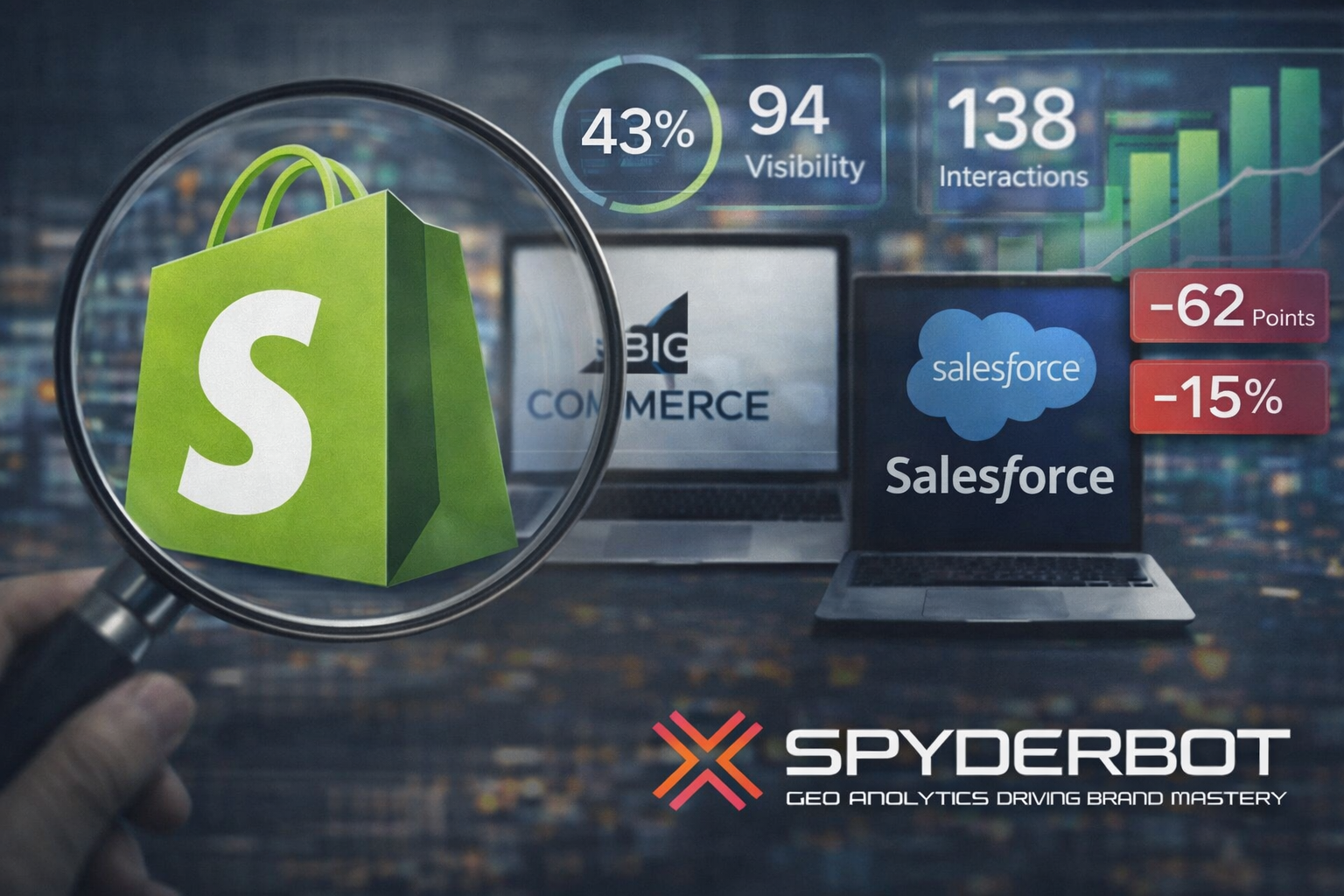
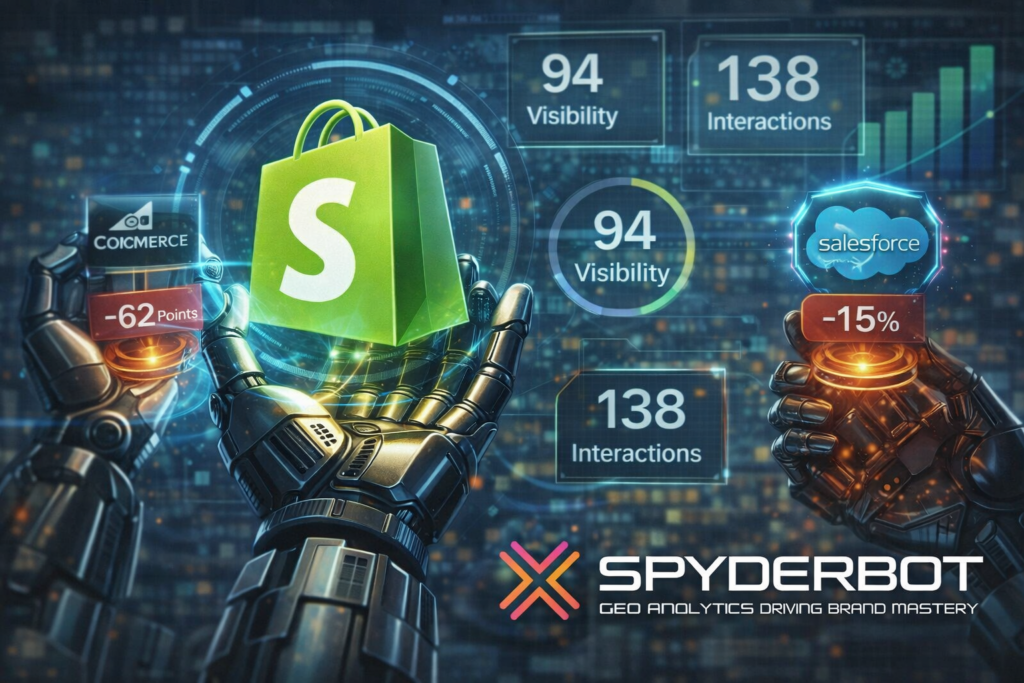
    • 43% Generative Search Share, highest in the sector
    • 94 Visibility Score across 138 LLM interactions
    • 27% Share of voice in LLM brand mentions, leading but pressured by Wix (20%) and BigCommerce (15%)
    • Critical visibility gap of 62 points versus BigCommerce on transaction fee transparency
    • 84 Overall sentiment score in LLM outputs, highest among peers
    • 98% Visibility score on Copilot platform
    • Positive founder sentiment driven by Tobi Lütke’s product-led growth and AI integration narratives
    • Recommendations include technical documentation enhancement, transparency campaigns, and ERP partnership upgrades

    Risk signals

    • 62-point visibility gap on fee-related queries disadvantaging Shopify in price-sensitive segments
    • 15% deficits against Salesforce and Adobe Commerce in enterprise omnichannel and ERP integration queries
    • Legacy founder-related negative sentiment at 14% linked to 2023 workforce reductions
    • Wix’s advancement in ‘Small Business Agility’ rankings threatens Shopify’s lead in that category

    The current GEO analytics position of Shopify reveals a complex competitive landscape within the fast-evolving generative search and e-commerce ecosystem. Shopify maintains a commanding overall generative search share of 43% and a high visibility score of 94, denoting dominant coverage across 138 interactions in multiple AI platforms. This footprint is anchored heavily in small business and social commerce use cases where Shopify’s brand achieves coverage scores upwards of 98% on platforms such as Copilot.

    However, the landscape is not without tensions. Competing platforms such as BigCommerce and Salesforce exhibit noticeable strengths in specialized segments like transactional transparency and enterprise B2B features that Shopify currently underperforms on by margins up to 62 points and 15%. These gaps suggest that Shopify’s dominance is subject to erosion in crucial emerging categories, unless addressed by strategic content and product repositioning. The existing legacy narrative around founder Tobi Lütke’s 2023 workforce reductions contributes negatively to sentiment analysis in 42% of founder-context discussions, which can dilute Shopify’s innovation narrative within LLM brand mentions.

    For senior leadership, these patterns underscore the urgent need to both defend core small business strengths and aggressively counter competitor sentiment to sustain total market share in an increasingly complex category.

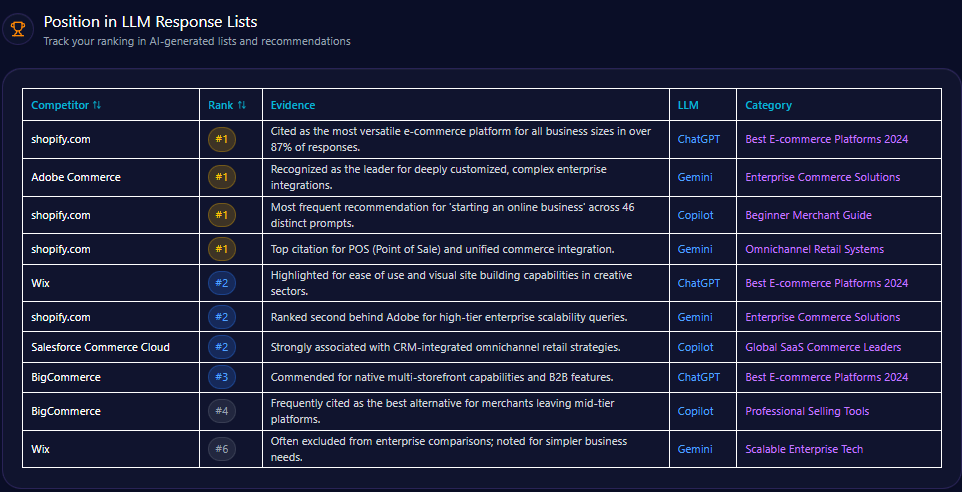
    Position in LLM Response Lists

    Shopify ranks first across multiple key LLM-generated lists. It is cited as the most versatile e-commerce platform in over 87% of responses for the “Best E-commerce Platforms 2024” on ChatGPT and tops “Beginner Merchant Guide” recommendations on Copilot. It holds primacy for POS and unified commerce citations on Gemini.

    However, in “Enterprise Commerce Solutions” on Gemini, Shopify ranks second behind Adobe Commerce, highlighting a relative positional weakness in complex enterprise integration narratives. Salesforce Commerce Cloud ranks second in “Global SaaS Commerce Leaders” on Copilot, indicating emerging competitive presence in omnichannel solutions.

    shopify.com’s Position in LLM Response Lists (Generated on March 20, 2026)

    Competitor Gap Analysis

    QueryShopify ScoreCompetitorCompetitor ScoreGapOpportunityPriority
    Headless commerce for global brands81BigCommerce88-7Improve visibility for Hydrogen/Oxygen headless toolsHigh
    B2B e-commerce features comparison76Salesforce Commerce Cloud91-15Showcase B2B Wholesale capabilitiesCritical
    Transaction fees transparency32BigCommerce94-62Implement transparency campaign on total cost of ownershipCritical
    ERP integration for e-commerce79Adobe Commerce94-15Deploy whitepapers on SAP partnershipsHigh

    Trigger Keywords for Competitor Products

    The report does not quantify trigger keywords for competitor products.

    Founder / Ownership / Leadership Context

    Founder Tobi Lütke’s mention frequency is notably high at 83% with a positive sentiment score of 80.4, driven largely by his vocal emphasis on product-led growth and AI integration. Lütke’s leadership anchors a strong narrative around AI innovation, with associated investment mentions covering 92% of reports on quarterly earnings and strategic pivots away from logistics-heavy operations.

    Nevertheless, a legacy negative sentiment rate of 10.2% couples with residual perceptions of 2023 workforce reductions. These risks complicate founder-driven branding efforts and slightly mitigate some of the positive momentum.

    Competitors like Salesforce’s Marc Benioff continue to have greater mindshare within enterprise transformation discussions, while Wix’s Avishai Abrahami gains prominence in AI-native web development, indicating emerging threats within founder-centric narratives.

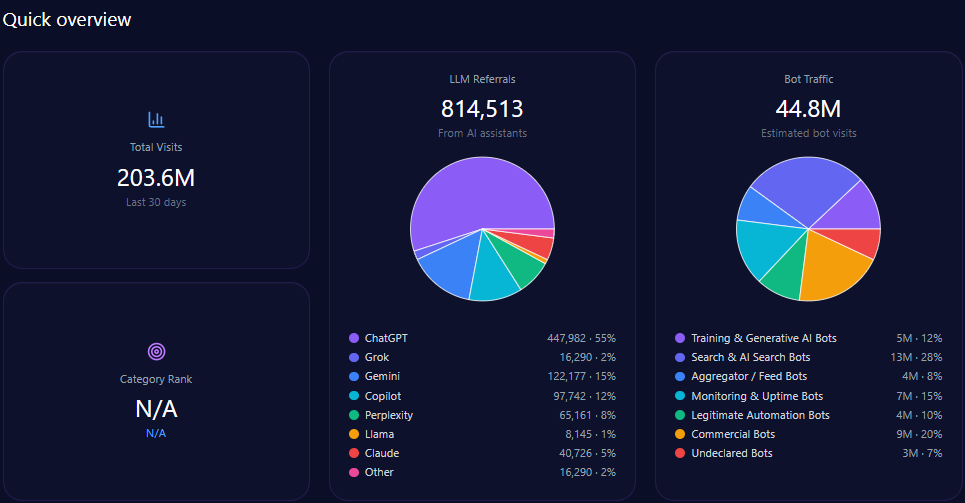
    Quick overview

    shopify.com’s Quick overview (Generated on March 20, 2026)

    Shopify attracted over 203 million total visits, with bot traffic constituting approximately 44.8 million visits. Of these bots, key constituents include 5.4 million training & generative AI bots and 12.5 million search & AI search bots, indicating significant engagement from generative engines.

    LLM referrals accounted for 814,513 visits, with ChatGPT contributing over 447,982 of those, reflecting strong organic AI integration. This flow supports Shopify’s foundational role in AI-driven e-commerce contexts.

    Share of Voice in LLM Responses

    Shopify maintains a leading share of voice at 27% (132 mentions) among competitors, followed by Wix (20%) and BigCommerce (15%). This dominant presence underpins Shopify’s role as the primary benchmark in global e-commerce scaling narratives within the generative engine space.

    AI Platform-Specific Visibility

    PlatformVisibility %Share of Voice %Total Mentions 
    Copilot9828167
    ChatGPT9627162
    Gemini8926158
    Others000

    Shopify’s apex visibility on Copilot and robust presence on ChatGPT and Gemini confirm its cross-platform appeal. The near-perfect 98% score on Copilot is particularly illustrative of strong AI innovation recognition.

    Sentiment Score for Competitors

    BrandPositive %Neutral %Negative %Overall Score
    Shopify7222684
    BigCommerce6231778
    Adobe Commerce52381074
    Wix6824881
    Salesforce5635976

    Shopify’s overall sentiment score of 84 surpasses competitors, consistent with its strong brand coverage in LLM brand mentions reflecting confident user perception and engagement.

    Top Prompts Driving Mentions

    • “Which platform is better for AI-powered storefront customization?” — 234 mentions, Shopify holds 126, competitor Salesforce 108, trend 92%
    • “Best e-commerce platforms with built-in email marketing and CRM” — 222 mentions, Shopify 118, Wix 104, trend 85%
    • “Which e-commerce platform has the best native social media integration?” — 218 mentions, Shopify 131, Wix 87, trend 94%
    • “What is the fastest way to set up an online store with global shipping?” — 212 mentions, Shopify 134, Wix 78, trend 96%
    • “Compare Shopify vs BigCommerce for high volume B2B sales” — 206 mentions, Shopify 112, BigCommerce 94, trend 88%

    These prominent prompt queries illustrate Shopify’s strength in AI commerce capabilities, operational speed, and social media integration while underscoring competitive pressure from Salesforce, Wix, and BigCommerce in enterprise and marketing-related topics.

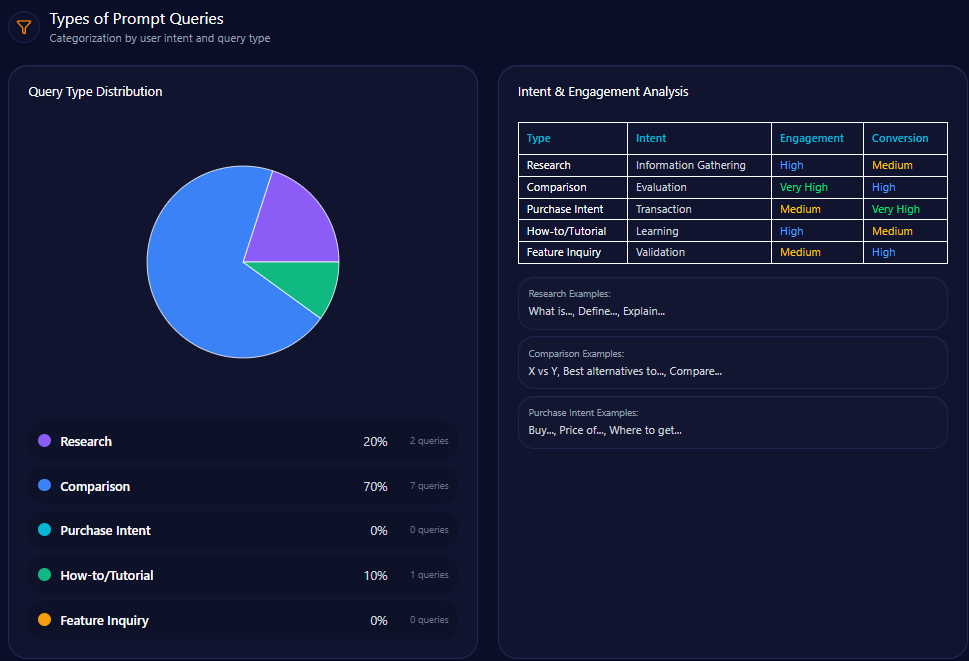
    Types of Prompt Queries

    shopify.com’s Types of Prompt Queries (Generated on March 20, 2026)
    • Research: 20% of queries
    • Comparison: 70%, dominates prompt volume
    • How-to / Tutorial: 10%
    • Purchase Intent: 0%
    • Feature Inquiry: 0%

    LLM brand mentions focus heavily on comparison queries, indicating decision-makers seek detailed product and capability differentiation, reinforcing the need for Shopify to sharpen competitive positioning and content accuracy.

    Service / Product-Level Sentiment

    • AI Commerce Capabilities: 64% frequency; optimistic tone highlighted by AI-driven tools like Shopify Sidekick and Magic
    • App Ecosystem & Extensibility: 81% frequency with strongly positive sentiment, emphasizing App Store variety and checkout extensibility
    • Total Cost of Ownership: 39% frequency; mixed sentiment due to concerns about transaction fees and premium app costs

    The mixed sentiment on cost structure signals a strategic priority to address fee transparency and price sensitivity, evident in competitor sentiment tracking especially against BigCommerce’s dominance in zero transaction fee discussions.

    Conclusion

    Shopify’s performance within generative search and AI-powered e-commerce remains dominant but nuanced. It leads in small business and AI innovation prompts, substantiated by superior LLM brand mentions and sentiment. Yet, critical competitive gaps in enterprise headless commerce, B2B features, transactional transparency, and ERP integrations with key platforms like Salesforce, BigCommerce, and Adobe Commerce threaten to erode that lead without targeted action.

    Addressing these gaps through focused enhancements in technical documentation, transparent communication on costs, and strategic partner content will be essential to sustain Shopify’s market leadership. Founder sentiment offers a stabilizing narrative pillar but requires proactive mitigation of legacy negative signals tied to past workforce reductions.

    Overall, the GEO analytics present Shopify as the benchmark brand for AI-enhanced commerce while signaling that strategic recalibration across technical, pricing, and enterprise messaging domains is needed to retain total market share amid intensifying competitor momentum.

    Explore SpyderBot to operationalize these GEO analytics insights.

  • Why We Built SpyderBot

    Why We Built SpyderBot

    We realized something was broken in AI search   and no one was measuring it.


    The moment it clicked

    A founder asked a simple question:

    “Why is ChatGPT recommending my competitor… when we are the market leader?”

    At first, it sounded like noise.

    Then we tested more prompts.

    • Same industry
    • Same pattern
    • Same result

    AI systems were:

    • Ignoring strong brands
    • Misclassifying products
    • Rewriting categories
    • Recommending competitors inconsistently

    And no tool could explain why.


    This wasn’t a bug. It was a new layer.

    For 20 years, we had SEO:

    • Rankings
    • Keywords
    • Backlinks

    But AI search doesn’t work like that.

    AI systems don’t rank pages.
    They generate answers.

    That means:

    • No “position #1”
    • No guaranteed visibility
    • No clear attribution

    Instead, there’s a new game:

    If you are not mentioned, you don’t exist.


    The invisible problem no one could measure

    We started asking deeper questions:

    • Why ChatGPT not mentioning my brand?
    • Why AI search ignores my website?
    • How do LLMs choose sources?
    • Why my competitor appears in ChatGPT?

    There were no answers.

    Existing tools (SEO analytics, keyword trackers) simply don’t see this layer.

    This is where we defined the problem:

    AI Visibility Gap

    A gap between:

    • What your company has built
    • And what AI systems believe about you

    What we realized about LLMs

    The breakthrough came when we stopped thinking about “search”
    and started thinking about how LLMs actually work.

    LLMs are not ranking engines.
    They are entity reasoning systems.

    They:

    • Extract entities (brand, product, category)
    • Build relationships (competitors, alternatives)
    • Generate answers based on contextual confidence

    Which leads to a critical insight:

    AI visibility is not random — it is structured.

    And if it’s structured, it can be:

    • Measured
    • Analyzed
    • Optimized

    Why existing tools fail completely

    We tested every category:

    • SEO tools
    • Analytics platforms
    • Brand monitoring tools

    None could:

    • Track brand mentions in ChatGPT
    • Monitor AI search results
    • Analyze LLM citation patterns
    • Explain AI ranking behavior

    Because they are built for a different internet.

    Old InternetNew AI Layer
    SEOGEO
    KeywordsEntities
    RankingsMentions
    BacklinksContext
    ClicksGenerated answers

    This is why even strong companies struggle with:

    • AI search optimization
    • ChatGPT brand monitoring
    • LLM visibility tracking
    • AI citation tracking

    So we built SpyderBot

    We didn’t start with a product idea.
    We started with a question:

    “How do you measure visibility inside AI systems?”

    SpyderBot is our answer.


    What SpyderBot actually does

    SpyderBot is a GEO analytics platform — built specifically for AI search.

    It helps companies:

    1. Track AI brand visibility

    • Monitor brand mentions across LLMs
    • Compare against competitors
    • Identify missing visibility

    LLM visibility tracking tool
    AI brand mention tracking


    2. Understand how AI interprets your business

    • Category positioning
    • Entity relationships
    • Misclassification detection

    LLM brand analytics
    AI brand perception analysis


    3. Analyze how your website is read by AI

    • Content structure for LLMs
    • Missing semantic signals
    • Optimization gaps

    how to optimize website for LLM
    AI search optimization


    4. Decode AI decision patterns

    • Why competitors are mentioned
    • How LLMs choose sources
    • Prompt-level analysis

    AI search competitor monitoring
    LLM citation analytics platform


    The category didn’t exist — so we named it

    We call this category:

    Generative Engine Optimization (GEO)

    And SpyderBot is:

    A Generative Engine Optimization tool
    A GEO analytics platform
    An AI search monitoring system

    This is not an extension of SEO.

    It is a new layer.


    Why this matters now

    We are at the same moment as:

    • SEO in 2005
    • Social ads in 2012
    • Mobile in 2010

    Except faster.

    AI systems like:

    • ChatGPT
    • Gemini
    • Claude

    are becoming the interface of the internet.

    Users don’t browse.
    They ask.

    And decisions happen inside answers.


    What happens if you ignore this

    If you don’t understand AI visibility:

    • Your competitors define your category
    • AI misrepresents your product
    • You lose high-intent users silently
    • You cannot debug growth issues

    This is already happening.

    Most companies just don’t see it yet.


    Who we built this for

    SpyderBot is for teams asking:

    • How to appear in AI search results?
    • How to rank in ChatGPT results?
    • How to optimize for Gemini AI?
    • How to track brand mentions in LLM?

    Typically:

    • B2B SaaS companies
    • Growth teams
    • SEO leaders
    • Founders

    Especially in competitive markets.


    The future we believe in

    Search is evolving into:

    Answer engines

    And in this world:

    • Visibility = inclusion in answers
    • Ranking = narrative presence
    • Authority = entity confidence

    This changes everything.


    Our mission

    Make AI visibility measurable, understandable, and controllable

    Because in the AI era:

    You are not competing for clicks
    You are competing for representation inside intelligence


    Final thought

    We didn’t build SpyderBot because we wanted another tool.

    We built it because:

    No one should have to guess how AI sees their company.