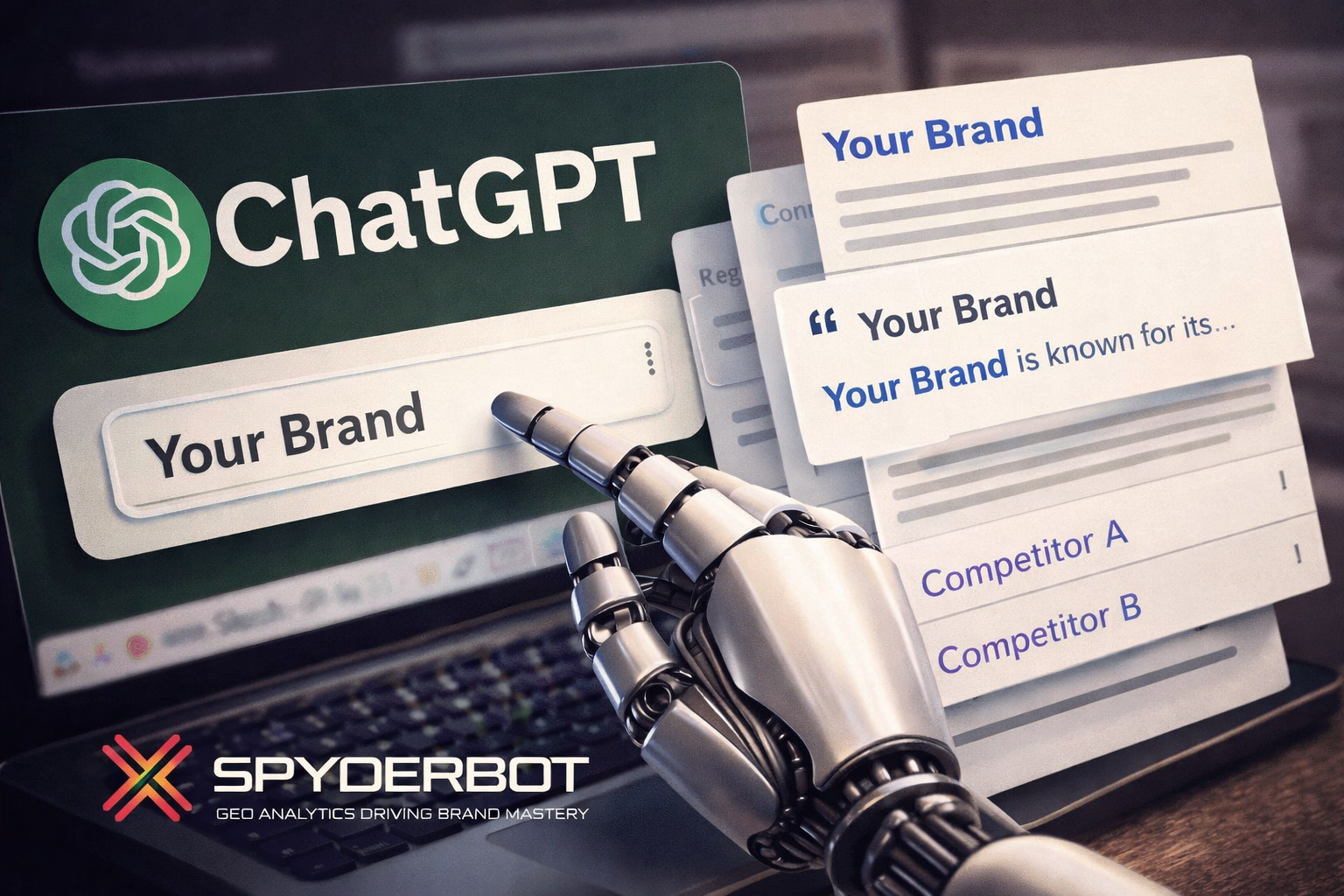
How to get your brand mentioned, selected, and recommended in ChatGPT
The problem
Most companies ask:
- “How do we do SEO for ChatGPT?”
Then they:
- Create more content
- Optimize keywords
- Build backlinks
But nothing changes
- Still not mentioned
- Competitors still dominate
The reason
You are applying SEO strategy to a system that doesn’t use SEO
The shift you must understand
Old model:
SEO → ranking → traffic
New model:
Data → AI → selection → answers
Key insight
You don’t win by ranking
You win by being selected
What is a ChatGPT SEO strategy?
A ChatGPT SEO strategy is:
A system for improving your brand’s visibility, positioning, and selection in AI-generated answers
It focuses on:
- Entity recognition
- Context relevance
- Competitor positioning
- AI visibility
The ChatGPT SEO Strategy Framework
1. Entity foundation
“Does AI understand your brand?”
You must define:
- What you are
- What you do
- Who you serve
Without this:
You cannot be selected
2. Category positioning
“Where do you belong?”
You must:
- Clearly define your category
- Align with correct competitors
3. Association building
“What are you connected to?”
You need to:
- Link your brand to key concepts
- Reinforce use cases
4. Context expansion
“Where should you appear?”
You must:
- Cover multiple query types
- Expand use-case visibility
5. Competitor alignment
“Who are you competing with in AI?”
You need to:
- Identify co-occurring competitors
- Align positioning
6. Positioning optimization
“How are you described?”
You must ensure:
- Strong differentiation
- Clear value proposition
7. Visibility tracking
“Are you measuring performance?”
You need to:
- Track mentions
- Monitor inclusion
- Compare competitors
8. Continuous iteration
“Are you improving over time?”
You must:
- Analyze results
- Adjust strategy
- Repeat
The 3 phases of ChatGPT SEO strategy
Phase 1: Visibility
- Get mentioned
- Appear in queries
Phase 2: Positioning
- Improve how you are described
- Strengthen perception
Phase 3: Dominance
- Increase mention share
- Outperform competitors
Key insight
Visibility is step 1
Positioning wins the game
Tactical execution plan
Week 1–2: Baseline
- Run prompt analysis
- Identify gaps
- Map competitors
Week 3–4: Fix foundation
- Improve entity clarity
- Align category
Month 2–3: Expand coverage
- Add use cases
- Strengthen associations
Ongoing: Optimize
- Track changes
- Improve positioning
- Increase consistency
Common mistakes
1. Treating ChatGPT like Google
→ Wrong strategy
2. Focusing only on content
→ Ignoring positioning
3. Not analyzing competitors
→ No benchmark
4. Not tracking visibility
→ No feedback loop
5. Expecting instant results
→ AI visibility takes time
A realistic scenario
A company:
- Has good SEO
- Strong product
But:
- Not visible in ChatGPT
After strategy:
- Improved entity clarity
- Fixed positioning
- Expanded context
Result:
Increased mentions and visibility
Where SpyderBot fits
SpyderBot enables this strategy by:
- Tracking AI visibility
- Analyzing competitors
- Identifying gaps
- Explaining patterns
It transforms:
Strategy → Data → Insight → Action
The real advantage
Most companies:
- Don’t understand AI systems
Which means:
Early movers win
Final conclusion
ChatGPT SEO strategy is not about:
- Rankings
- Keywords
It is about:
Understanding and influencing how AI selects brands
Final insight
You don’t need better SEO tactics
You need:
A system aligned with AI behavior
The shift
We are moving from:
- Search optimization
To:
- Selection optimization