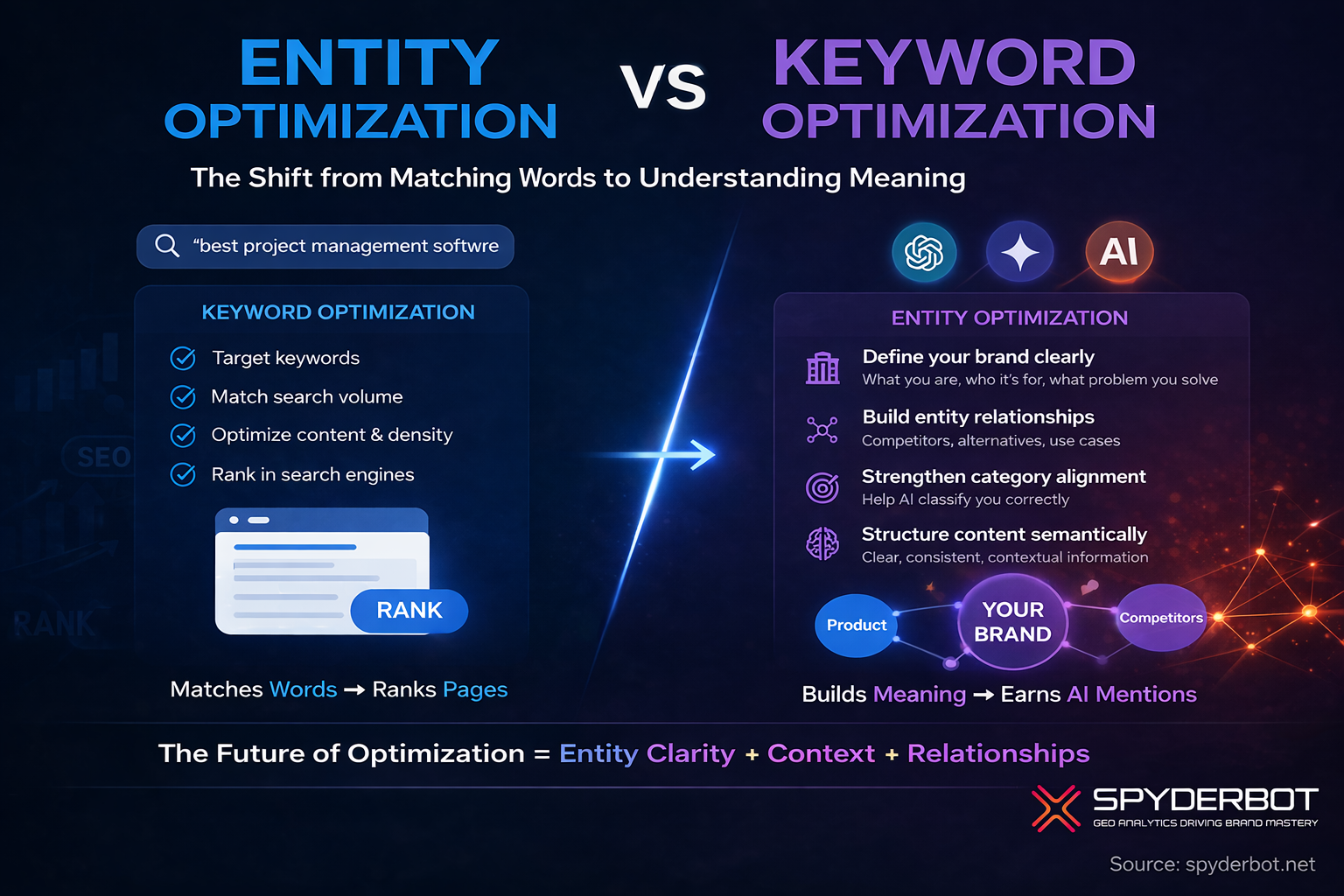
The shift from matching words to understanding meaning
I. For years, SEO was built on keywords
If you wanted to rank on Google, the process was clear:
- Find keywords
- Optimize content
- Match search intent
And the assumption was simple:
If you match the right keywords, you win visibility
II. But AI search doesn’t work that way
AI systems like ChatGPT, Gemini, and Claude don’t think in keywords.
They think in:
Entities and relationships
This creates a fundamental shift:
From keyword optimization → to entity optimization
III. What is keyword optimization?
Keyword optimization is:
The process of optimizing content around specific search terms to rank in search engines.
It focuses on:
- Keyword targeting
- Search volume
- Keyword density
- On-page optimization
The goal:
Match user queries to rank higher
IV. What is entity optimization?
Entity optimization is:
The process of defining, structuring, and strengthening how AI systems understand a brand, product, or concept.
It focuses on:
- Entity clarity
- Relationships between entities
- Contextual meaning
- Semantic structure
The goal:
Ensure AI systems correctly understand and include your brand
V. The core difference
Keyword optimization matches words
Entity optimization builds meaning
VI. Keyword vs Entity (Side-by-side)
| Dimension | Keyword Optimization | Entity Optimization |
| Unit | Keywords | Entities |
| System | Search engines | AI systems |
| Goal | Ranking | Inclusion |
| Focus | Matching queries | Understanding meaning |
| Output | Ranked pages | AI-generated mentions |
| Strategy | Target keywords | Define relationships |
VII. Why keyword optimization is no longer enough
You can:
- Rank for high-volume keywords
- Optimize content perfectly
- Drive organic traffic
And still:
Not be mentioned in AI answers
Because AI does not rely on:
- Exact keyword matches
- Traditional SEO signals
VIII. How AI systems understand entities
AI systems interpret the world through:
1. Entity definition
What is this thing?
- Company
- Product
- Category
2. Entity relationships
How does it connect?
- Competitors
- Alternatives
- Use cases
3. Contextual meaning
When is it relevant?
- User intent
- Problem space
- Industry context
VIX. Example: keyword vs entity thinking
1. Keyword approach:
Target:
“best project management software”
Optimize:
- Title
- H1
- Content density
2. Entity approach:
Define:
- What your product is
- Who it is for
- How it compares
Ensure AI understands:
- Your category
- Your positioning
- Your competitors
X. The shift from matching to understanding
Keyword optimization is about:
Matching queries
Entity optimization is about:
Being understood correctly
XI. The shift from pages to knowledge
SEO builds:
Pages
AI builds:
Knowledge graphs of entities
This means:
- Your brand is not just a page
- It is a node in a network
XII. The shift from ranking to inclusion
Keyword optimization leads to:
Ranking
Entity optimization leads to:
Inclusion in AI-generated answers
XIII. The rise of entity-based visibility
We are entering a world where:
Visibility depends on how well AI understands you
Not just:
- How well you rank
- Or how many keywords you target
XIV. How to move from keywords to entities
1. Define your brand clearly
Answer explicitly:
- What is your product?
- Who is it for?
- What problem does it solve?
2. Strengthen category alignment
Make sure AI can classify you correctly.
3. Build entity relationships
Ensure your brand appears in contexts like:
- Comparisons
- Alternatives
- Use cases
4. Structure content semantically
Use:
- Clear definitions
- Logical structure
- Consistent messaging
5. Monitor AI understanding
Track:
- Brand mentions in AI
- Misclassification
- Competitor positioning
XV. Keyword optimization is not dead
It still matters for:
- Google rankings
- Traffic generation
- Discovery
XVI. But it is no longer sufficient
To win in AI search, you need:
Entity optimization
XVII. The future of optimization
We are moving from:
- Keyword-driven SEO
To:
- Entity-driven GEO
XVIII. Final insight
Keywords help you:
Get found
Entities determine whether:
You are understood — and included
The new model
Visibility = Entity clarity + Context + Relationships