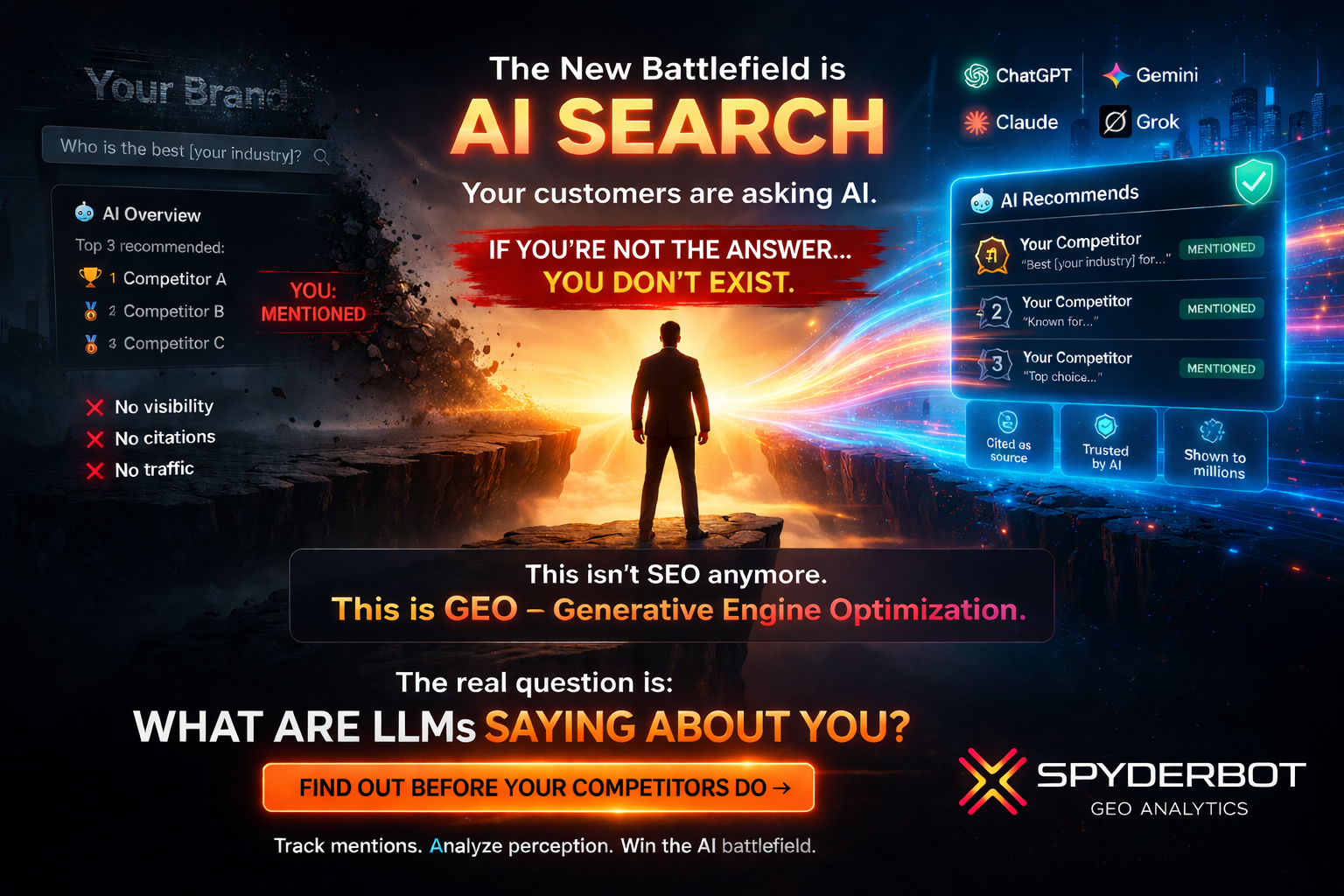
How to appear in AI-generated answers (and why SEO alone is not enough)
I. The question everyone is asking
As AI tools become mainstream, one question keeps coming up:
“How do I do SEO for ChatGPT?”
It sounds familiar.
But it’s also the wrong question.
II. ChatGPT is not a search engine
Traditional SEO works because search engines:
- Crawl webpages
- Index content
- Rank results
ChatGPT does not work that way.
It:
- Interprets queries
- Generates answers
- Selects information probabilistically
Which means:
There is no ranking page to optimize for
III. So what does “SEO for ChatGPT” actually mean?
When people say “SEO for ChatGPT”, they usually mean:
- How to appear in ChatGPT answers
- How to get mentioned by AI
- How to influence AI-generated recommendations
The correct term for this is:
Generative Engine Optimization (GEO)
IV. From SEO to GEO
SEO helps you:
Get discovered on Google
GEO helps you:
Get included in AI-generated answers
V. The new model of visibility
In ChatGPT:
- There is no page 1
- There is no position #3
There is only:
Whether your brand is mentioned or not
This creates a new metric:
AI visibility
VI. Why your brand is not showing up in ChatGPT
Many companies assume:
- “We have strong SEO, so we should appear in AI”
But AI systems don’t work like search engines.
Common reasons you are not mentioned:
1. Weak entity clarity
AI doesn’t clearly understand:
- What your company does
- What category you belong to
2. Poor contextual signals
Your brand is not strongly associated with:
- Use cases
- Problems
- alternatives
3. Inconsistent positioning
AI sees mixed signals about:
- Your product
- Your market
- Your differentiation
4. Lack of semantic structure
Your content is optimized for:
- Humans or Google
But not for:
- AI interpretation
VII. How ChatGPT decides what to mention
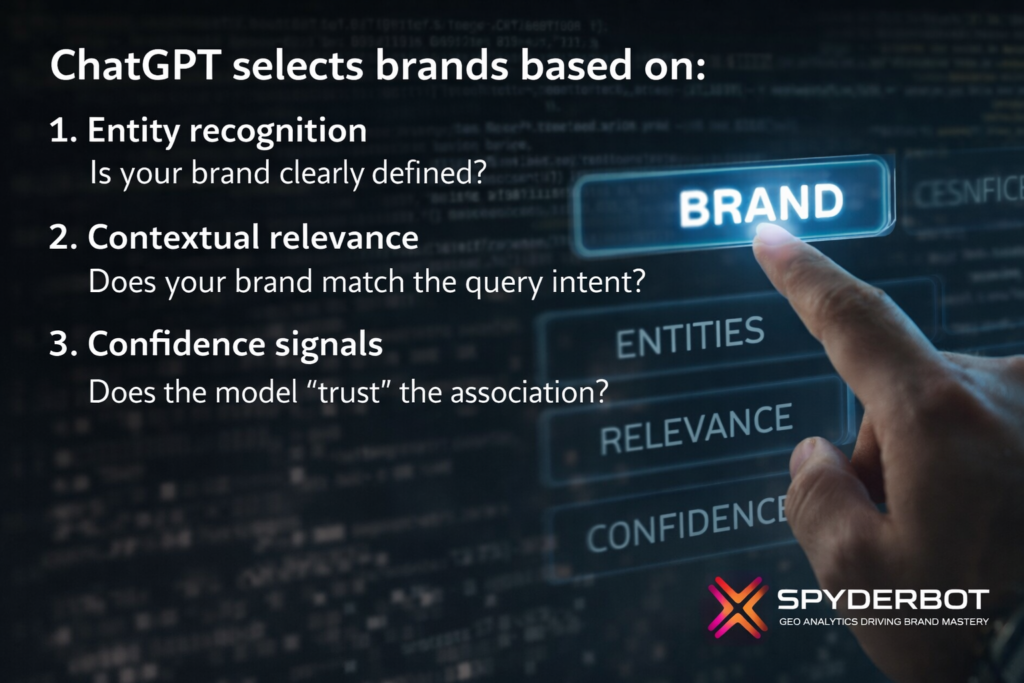
ChatGPT selects brands based on:
1. Entity recognition
- Is your brand clearly defined?
2. Contextual relevance
- Does your brand match the query intent?
3. Confidence signals
- Does the model “trust” the association?
VIII. This leads to a key insight
ChatGPT does not rank pages — it ranks entities
IX. How to do “SEO for ChatGPT” (the right way)
1. Define your brand as an entity
Be explicit about:
- What you are
- Who you are for
- What problem you solve
2. Strengthen category positioning
Make sure AI can answer:
“What category does this company belong to?”
3. Build contextual associations
Your brand should appear in contexts like:
- Use cases
- Comparisons
- Alternatives
4. Structure content for AI
Instead of:
- Keyword stuffing
Focus on:
- Clear definitions
- Structured explanations
- Entity relationships
5. Optimize for inclusion, not ranking
Shift your mindset:
- From “how do I rank #1?”
- To “how do I get mentioned consistently?”
X. SEO vs SEO for ChatGPT (GEO)
| Traditional SEO | SEO for ChatGPT (GEO) |
| Keywords | Entities |
| Rankings | Mentions |
| Pages | Concepts |
| Backlinks | Context |
| Traffic | AI visibility |
XI. The biggest mistake companies make
They try to apply SEO tactics directly:
- More content
- More keywords
- More backlinks
But that doesn’t guarantee:
Inclusion in AI answers
XII. What actually works
Companies that succeed in ChatGPT visibility:
- Have clear positioning
- Strong entity definition
- Consistent messaging
- Structured content
XIII. The future of SEO for ChatGPT
This is not a temporary shift.
We are moving toward:
AI-first discovery
Where:
- AI decides what users see
- AI shapes brand perception
- AI influences decisions
XIV. What you should do now
1. Audit your AI visibility
- Are you mentioned in ChatGPT?
- Are competitors appearing instead?
2. Identify gaps
- Missing contexts
- Weak positioning
- Misclassification
3. Optimize for GEO
- Improve entity clarity
- Strengthen context
- Structure content
XV. Final thought
SEO for ChatGPT is not really SEO.
It is:
A new discipline
And that discipline is:
Generative Engine Optimization