Tag: how to optimize for AI search

  • Entity Optimization vs Keyword Optimization

    Entity Optimization vs Keyword Optimization

    The shift from matching words to understanding meaning


    I. For years, SEO was built on keywords

    If you wanted to rank on Google, the process was clear:

    • Find keywords
    • Optimize content
    • Match search intent

    And the assumption was simple:

    If you match the right keywords, you win visibility


    II. But AI search doesn’t work that way

    AI systems like ChatGPT, Gemini, and Claude don’t think in keywords.

    They think in:

    Entities and relationships

    This creates a fundamental shift:

    From keyword optimization → to entity optimization


    III. What is keyword optimization?

    Keyword optimization is:

    The process of optimizing content around specific search terms to rank in search engines.

    It focuses on:

    • Keyword targeting
    • Search volume
    • Keyword density
    • On-page optimization

    The goal:

    Match user queries to rank higher


    IV. What is entity optimization?

    Entity optimization is:

    The process of defining, structuring, and strengthening how AI systems understand a brand, product, or concept.

    It focuses on:

    • Entity clarity
    • Relationships between entities
    • Contextual meaning
    • Semantic structure

    The goal:

    Ensure AI systems correctly understand and include your brand


    V. The core difference

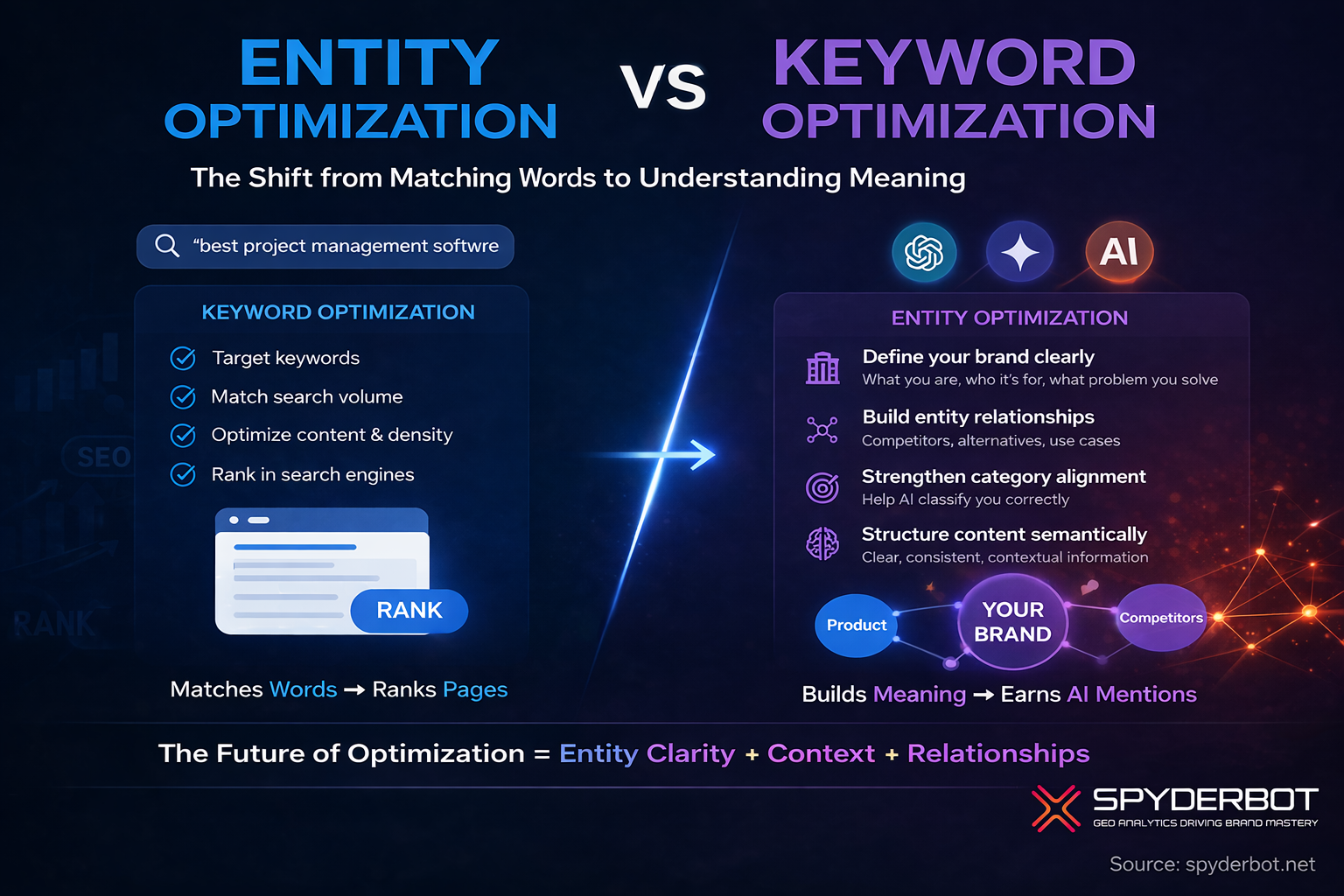
    Keyword optimization matches words
    Entity optimization builds meaning


    VI. Keyword vs Entity (Side-by-side)

    DimensionKeyword OptimizationEntity Optimization
    UnitKeywordsEntities
    SystemSearch enginesAI systems
    GoalRankingInclusion
    FocusMatching queriesUnderstanding meaning
    OutputRanked pagesAI-generated mentions
    StrategyTarget keywordsDefine relationships

    VII. Why keyword optimization is no longer enough

    You can:

    • Rank for high-volume keywords
    • Optimize content perfectly
    • Drive organic traffic

    And still:

    Not be mentioned in AI answers

    Because AI does not rely on:

    • Exact keyword matches
    • Traditional SEO signals

    VIII. How AI systems understand entities

    AI systems interpret the world through:

    1. Entity definition

    What is this thing?

    • Company
    • Product
    • Category

    2. Entity relationships

    How does it connect?

    • Competitors
    • Alternatives
    • Use cases

    3. Contextual meaning

    When is it relevant?

    • User intent
    • Problem space
    • Industry context

    VIX. Example: keyword vs entity thinking

    1. Keyword approach:

    Target:

    “best project management software”

    Optimize:

    • Title
    • H1
    • Content density

    2. Entity approach:

    Define:

    • What your product is
    • Who it is for
    • How it compares

    Ensure AI understands:

    • Your category
    • Your positioning
    • Your competitors

    X. The shift from matching to understanding

    Keyword optimization is about:

    Matching queries

    Entity optimization is about:

    Being understood correctly


    XI. The shift from pages to knowledge

    SEO builds:

    Pages

    AI builds:

    Knowledge graphs of entities

    This means:

    • Your brand is not just a page
    • It is a node in a network

    XII. The shift from ranking to inclusion

    Keyword optimization leads to:

    Ranking

    Entity optimization leads to:

    Inclusion in AI-generated answers


    XIII. The rise of entity-based visibility

    We are entering a world where:

    Visibility depends on how well AI understands you

    Not just:

    • How well you rank
    • Or how many keywords you target

    XIV. How to move from keywords to entities

    1. Define your brand clearly

    Answer explicitly:

    • What is your product?
    • Who is it for?
    • What problem does it solve?

    2. Strengthen category alignment

    Make sure AI can classify you correctly.


    3. Build entity relationships

    Ensure your brand appears in contexts like:

    • Comparisons
    • Alternatives
    • Use cases

    4. Structure content semantically

    Use:

    • Clear definitions
    • Logical structure
    • Consistent messaging

    5. Monitor AI understanding

    Track:

    • Brand mentions in AI
    • Misclassification
    • Competitor positioning

    XV. Keyword optimization is not dead

    It still matters for:

    • Google rankings
    • Traffic generation
    • Discovery

    XVI. But it is no longer sufficient

    To win in AI search, you need:

    Entity optimization


    XVII. The future of optimization

    We are moving from:

    • Keyword-driven SEO

    To:

    • Entity-driven GEO

    XVIII. Final insight

    Keywords help you:

    Get found

    Entities determine whether:

    You are understood — and included


    The new model

    Visibility = Entity clarity + Context + Relationships
  • SEO for AI Search

    SEO for AI Search

    How to optimize for AI systems like ChatGPT, Gemini, and the future of search


    I. The question behind the shift

    As AI becomes the interface of the internet, a new question is emerging:

    “How do we do SEO for AI search?”

    It’s a natural question.

    But like “SEO for ChatGPT,” it hides a deeper reality:

    AI search does not work like traditional search


    II. AI search is fundamentally different

    Traditional search engines:

    • Index pages
    • Rank results
    • Return links

    AI search systems:

    • Interpret intent
    • Generate answers
    • Select and combine information

    This creates a new paradigm:

    You are not optimizing for ranking
    You are optimizing for inclusion


    III. What is “SEO for AI search”?

    “SEO for AI search” refers to:

    • Optimizing content for AI-generated answers
    • Increasing brand visibility in LLMs
    • Influencing how AI systems interpret your business

    The more accurate term is:

    Generative Engine Optimization (GEO)


    IV. From SEO to AI search optimization

    SEO helps you:

    Get discovered through search engines

    AI search optimization helps you:

    Get included in generated answers


    V. The new visibility model

    In AI search:

    • There are no result pages
    • There are no positions
    • There is no click competition

    There is only:

    Whether your brand appears in the answer


    VI. Why traditional SEO is not enough

    You can:

    • Rank #1 on Google
    • Have strong SEO
    • Own your keywords

    And still:

    Not appear in AI search

    This is the AI visibility gap


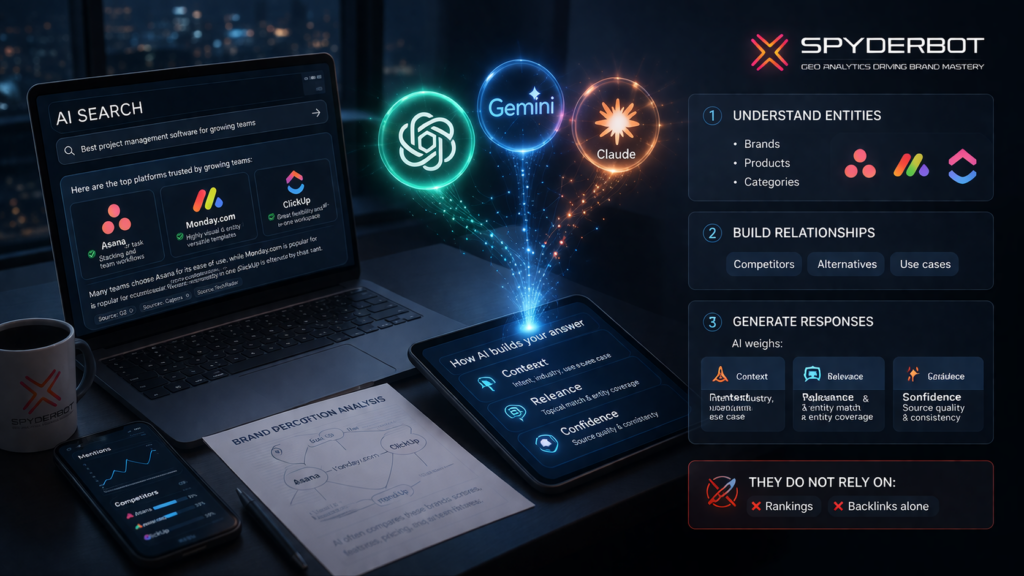
    VII. How AI search systems work

    AI systems like ChatGPT, Gemini, and Claude:

    1. Understand entities

    • Brands
    • Products
    • Categories

    2. Build relationships

    • Competitors
    • Alternatives
    • Use cases

    3. Generate responses based on:

    • Context
    • Relevance
    • Confidence

    They do not rely on:

    • Rankings
    • Backlinks alone

    VIII. What AI search actually optimizes for

    AI systems prioritize:

    1. Entity clarity

    Is your brand clearly defined?


    2. Contextual relevance

    Does your brand match the user’s intent?


    3. Semantic consistency

    Is your positioning consistent across content?


    4. Knowledge structure

    Is your content easy for AI to interpret?


    IX. SEO vs AI Search Optimization

    SEOAI Search Optimization
    KeywordsEntities
    RankingsMentions
    PagesConcepts
    BacklinksContext
    TrafficAI visibility

    X. The new metric: AI visibility

    AI visibility is:

    The presence and positioning of your brand in AI-generated answers

    It includes:

    • Brand mentions
    • Recommendation frequency
    • Position inside responses
    • Comparative context

    XI. How to do SEO for AI search (framework)

    1. Define your entity clearly

    Make it easy for AI to answer:

    “What is this company?”


    2. Own your category

    Ensure AI understands:

    “What category do you belong to?”


    3. Build contextual coverage

    Your brand should appear in:

    • Use cases
    • Alternatives
    • Comparisons

    4. Structure content for AI

    Focus on:

    • Clear definitions
    • Logical structure
    • Entity relationships

    5. Monitor AI visibility

    Track:

    • Mentions in ChatGPT
    • Competitor presence
    • AI interpretation

    XII. The biggest misconception

    Most companies think:

    “More SEO = more AI visibility”

    That’s not true.

    AI visibility depends on:

    • How AI understands you
    • Not how Google ranks you

    XIII. What winning companies are doing

    They:

    • Treat AI as a new channel
    • Optimize for understanding, not just ranking
    • Invest in AI search analytics

    XIV. The future of SEO for AI search

    We are moving toward:

    AI-first discovery

    Where:

    • AI systems are the interface
    • Answers replace results
    • Inclusion replaces ranking

    XV. Final insight

    SEO for AI search is not an extension of SEO.

    It is:

    A new layer of optimization

    And that layer is:

    Generative Engine Optimization (GEO)