Tag: how to rank in ChatGPT results

  • How to Beat Competitors in AI Search

    How to Beat Competitors in AI Search

    AI search has changed the rules of online visibility. OpenAI says ChatGPT Search ranks results using factors tied to reliable, relevant information and does not guarantee top placement. Google says standard SEO best practices still matter for AI Overviews and AI Mode, and Anthropic says Claude’s web search cites sources from search results directly. That means beating competitors in AI search is no longer just about ranking pages. It is about becoming easier for AI systems to crawl, understand, compare, and cite.

    I. What Winning in AI Search Actually Means

    1. You are competing for inclusion, not just ranking

    In traditional search, a strong ranking can still bring visibility even if your messaging is average. In AI search, the answer is synthesized first, and sources are attached second. Google says AI Overviews and AI Mode show AI-generated responses with links to supporting web resources, and AI Mode can split a question into subtopics and search them simultaneously. That creates a very different battlefield: your brand must be selected as part of the answer, not merely listed near it.

    2. Your competitor can win even when your SEO is decent

    A competitor can outrank you inside AI answers if its site is clearer, easier to cite, better structured, or more directly aligned with comparison-style prompts. Google also says AI experiences can surface a wider range of sources, which means visibility can spread beyond the usual top-ranking pages.

    II. Diagnosis

    1. Your brand entity is too vague

    If your company name, product naming, positioning, or category language changes across pages, AI systems get weaker signals about who you are and what you should be mentioned for. When your entity is fuzzy, competitor entities with cleaner definitions tend to win more mentions.

    2. Your site is indexable for Google, but weak for AI retrieval

    OpenAI explicitly says that inclusion in ChatGPT Search depends on allowing OAI-SearchBot to crawl your site and ensuring infrastructure allows access. If your robots rules, CDN, firewall, or hosting setup blocks that path, your pages become harder to surface in AI search experiences.

    3. Your content is built for keywords, not decision prompts

    Many brands publish pages optimized for search terms, but not for the real prompts users ask AI systems, such as:

    • best alternatives to [competitor]
    • [brand] vs [competitor]
    • which tool is better for [use case]
    • why does AI recommend [competitor]

    If you do not publish direct answers for those prompt shapes, the model has fewer reasons to include you.

    4. Your trust signals are weak or hard to parse

    Google says structured data helps it understand page content and organizations, and its Organization guidance recommends adding useful properties such as name, alternateName, url, logo, contact details, and sameAs references. If your site lacks machine-readable brand signals, AI systems have less structured evidence to work with.

    5. Your competitor has more reusable evidence

    AI systems prefer pages that are easier to summarize. If your competitor has clearer use cases, fresher proof, stronger comparative pages, and simpler factual statements, it becomes easier for the model to reuse their material inside an answer.

    6. Your measurement model is outdated

    If you only track Google rankings, you may miss the real reason you are losing. In AI search, you need to measure mentions, citations, prompt coverage, comparison visibility, and competitor share of voice.

    III. Why It Happens (LLM Mechanism)

    1. LLMs do not think like a classic search engine

    LLM-driven search experiences combine retrieval with synthesis. ChatGPT Search emphasizes reliable and relevant information, Google AI responses are supported by web resources, and Claude’s web search cites source material directly. In practice, the model is not just matching keywords. It is assembling a response from entities, claims, and evidence it can trust enough to present.

    2. AI systems favor pages they can understand quickly

    Google says structured data helps it understand content and gather information about the web and the world. That is why explicit labels, clean headings, strong page purpose, visible facts, and schema markup help reduce ambiguity. The easier your page is to parse, the easier it is to reuse.

    3. Retrieval is prompt-sensitive

    Google says AI Mode can break a query into subtopics and search them simultaneously. This matters because broad prompts like “best B2B AI visibility tool” may trigger a different evidence set than “why does ChatGPT recommend my competitor.” If your content only covers one phrasing, you lose coverage across the rest.

    4. Citation behavior rewards clarity

    Claude’s web search automatically cites sources, and ChatGPT Search and Google AI both emphasize linked supporting resources. That means pages with tight answers, explicit claims, scannable formatting, and supporting proof are more likely to survive the compression step from webpage to AI answer.

    5. There is no guaranteed “top position” shortcut

    OpenAI explicitly says there is no way to guarantee top placement in ChatGPT Search, and Google says there are no special extra requirements just for appearing in AI Overviews or AI Mode beyond strong SEO fundamentals. So the winning move is not a trick. It is operational excellence in crawlability, clarity, structure, and evidence.

    IV. How to Beat Competitors in AI Search

    1. Fix crawl access first

    Make sure your important pages are crawlable, indexable, fast, canonicalized, and not blocked for relevant AI crawlers. If ChatGPT cannot reliably access your content, the rest of your optimization is weaker from the start.

    2. Strengthen your brand entity

    Create one crystal-clear brand story across your homepage, about page, product pages, and documentation:

    • who you are
    • what you do
    • who you serve
    • what category you belong to
    • what makes you different

    Use the same naming system everywhere. Do not make the model guess.

    3. Publish pages for high-intent AI prompts

    Create content specifically for prompts that cause competitive switching:

    • best alternatives to [competitor]
    • [your brand] vs [competitor]
    • why is [competitor] recommended in AI search
    • how to choose a tool for [use case]
    • which platform is best for [industry]

    This is where AI search visibility is won.

    4. Add machine-readable trust signals

    Use structured data where it genuinely fits the page: Organization, ProfilePage, Article, FAQ, Product, LocalBusiness, or other relevant schema. Google states that structured data helps it understand content, and its Organization guidance makes clear that properties like name, logo, url, contact information, and sameAs improve clarity.

    5. Turn claims into evidence

    Do not say you are “better.” Prove it with:

    • comparison tables
    • methodology pages
    • screenshots
    • benchmark summaries
    • customer categories
    • limitations and tradeoffs
    • update dates

    AI systems reuse pages that contain compressible evidence, not vague marketing language.

    6. Build comparison-ready page architecture

    Your site should contain pages that can answer:

    • what you are
    • how you work
    • who you are for
    • how you compare
    • why someone should switch
    • what proof supports that claim

    If those pages do not exist, your competitor has an easier path into AI-generated recommendations.

    7. Monitor prompts, not just pages

    Track which prompts trigger your competitors, which pages get cited, which claims repeat across models, and where your brand disappears. That gives you a real GEO roadmap instead of random content production.

    V. Run GEO Audit

    If competitors keep appearing in AI search while your brand is missing, guessing is the slowest possible strategy.

    Run GEO Audit to identify:

    • which competitors AI systems mention most
    • which prompts trigger those mentions
    • which pages are being cited
    • where your entity signals are weak
    • which comparison gaps are costing you visibility
    • what content should be fixed first

    Run GEO Audit and turn AI search from a black box into a measurable growth channel.

    VI. FAQs

    1. Can I guarantee top placement in AI search?

    No. You can improve your odds, but OpenAI explicitly says there is no guaranteed top placement in ChatGPT Search, and Google says AI visibility still depends on strong overall SEO fundamentals rather than a secret AI-only hack.

    2. Does structured data help with AI search visibility?

    It helps machines understand your content and your organization more clearly. Google explicitly says structured data helps it understand page content and world knowledge, which makes it an important clarity layer.

    3. Why does my competitor appear in ChatGPT but not my brand?

    Usually because the competitor is easier to crawl, easier to identify, easier to compare, or easier to cite. In AI search, clarity often beats noise.

    4. Is traditional SEO still useful for AI search?

    Yes. Google explicitly says standard SEO best practices remain relevant for AI Overviews and AI Mode. AI search does not replace SEO; it raises the bar for structure, evidence, and entity clarity.
  • SEO for ChatGPT

    SEO for ChatGPT

    How to appear in AI-generated answers (and why SEO alone is not enough)


    I. The question everyone is asking

    As AI tools become mainstream, one question keeps coming up:

    “How do I do SEO for ChatGPT?”

    It sounds familiar.

    But it’s also the wrong question.


    II. ChatGPT is not a search engine

    Traditional SEO works because search engines:

    • Crawl webpages
    • Index content
    • Rank results

    ChatGPT does not work that way.

    It:

    • Interprets queries
    • Generates answers
    • Selects information probabilistically

    Which means:

    There is no ranking page to optimize for


    III. So what does “SEO for ChatGPT” actually mean?

    When people say “SEO for ChatGPT”, they usually mean:

    • How to appear in ChatGPT answers
    • How to get mentioned by AI
    • How to influence AI-generated recommendations

    The correct term for this is:

    Generative Engine Optimization (GEO)


    IV. From SEO to GEO

    SEO helps you:

    Get discovered on Google

    GEO helps you:

    Get included in AI-generated answers


    V. The new model of visibility

    In ChatGPT:

    • There is no page 1
    • There is no position #3

    There is only:

    Whether your brand is mentioned or not

    This creates a new metric:

    AI visibility


    VI. Why your brand is not showing up in ChatGPT

    Many companies assume:

    • “We have strong SEO, so we should appear in AI”

    But AI systems don’t work like search engines.

    Common reasons you are not mentioned:

    1. Weak entity clarity

    AI doesn’t clearly understand:

    • What your company does
    • What category you belong to

    2. Poor contextual signals

    Your brand is not strongly associated with:

    • Use cases
    • Problems
    • alternatives

    3. Inconsistent positioning

    AI sees mixed signals about:

    • Your product
    • Your market
    • Your differentiation

    4. Lack of semantic structure

    Your content is optimized for:

    • Humans or Google

    But not for:

    • AI interpretation

    VII. How ChatGPT decides what to mention

    How ChatGPT decides what to mention

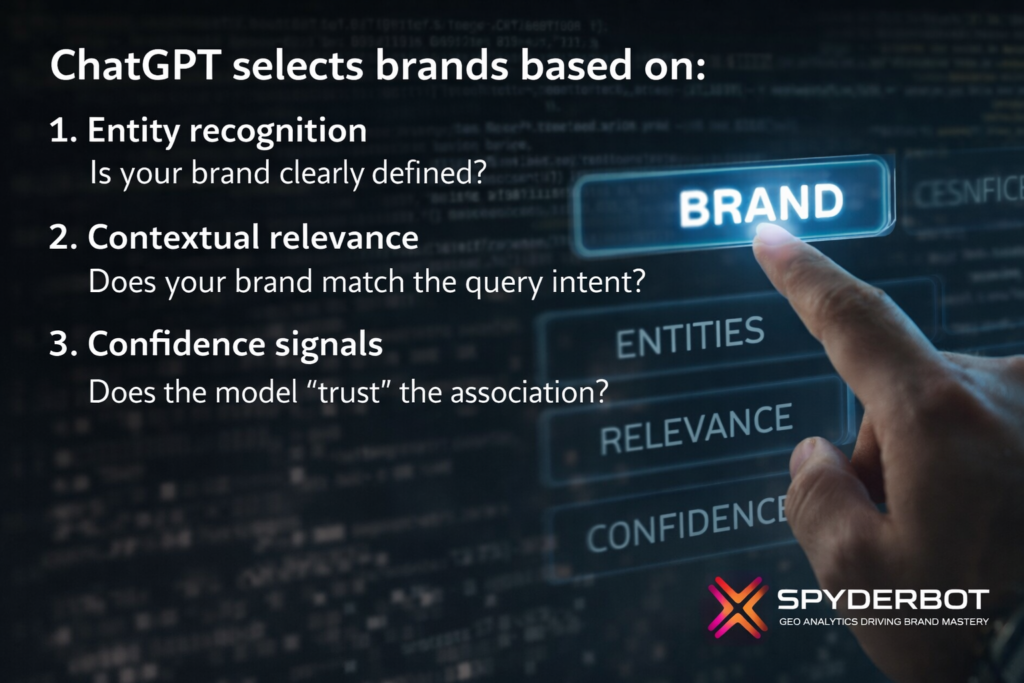
    ChatGPT selects brands based on:

    1. Entity recognition

    • Is your brand clearly defined?

    2. Contextual relevance

    • Does your brand match the query intent?

    3. Confidence signals

    • Does the model “trust” the association?

    VIII. This leads to a key insight

    ChatGPT does not rank pages — it ranks entities


    IX. How to do “SEO for ChatGPT” (the right way)

    1. Define your brand as an entity

    Be explicit about:

    • What you are
    • Who you are for
    • What problem you solve

    2. Strengthen category positioning

    Make sure AI can answer:

    “What category does this company belong to?”


    3. Build contextual associations

    Your brand should appear in contexts like:

    • Use cases
    • Comparisons
    • Alternatives

    4. Structure content for AI

    Instead of:

    • Keyword stuffing

    Focus on:

    • Clear definitions
    • Structured explanations
    • Entity relationships

    5. Optimize for inclusion, not ranking

    Shift your mindset:

    • From “how do I rank #1?”
    • To “how do I get mentioned consistently?”

    X. SEO vs SEO for ChatGPT (GEO)

    Traditional SEOSEO for ChatGPT (GEO)
    KeywordsEntities
    RankingsMentions
    PagesConcepts
    BacklinksContext
    TrafficAI visibility

    XI. The biggest mistake companies make

    They try to apply SEO tactics directly:

    • More content
    • More keywords
    • More backlinks

    But that doesn’t guarantee:

    Inclusion in AI answers


    XII. What actually works

    Companies that succeed in ChatGPT visibility:

    • Have clear positioning
    • Strong entity definition
    • Consistent messaging
    • Structured content

    XIII. The future of SEO for ChatGPT

    This is not a temporary shift.

    We are moving toward:

    AI-first discovery

    Where:

    • AI decides what users see
    • AI shapes brand perception
    • AI influences decisions

    XIV. What you should do now

    1. Audit your AI visibility

    • Are you mentioned in ChatGPT?
    • Are competitors appearing instead?

    2. Identify gaps

    • Missing contexts
    • Weak positioning
    • Misclassification

    3. Optimize for GEO

    • Improve entity clarity
    • Strengthen context
    • Structure content

    XV. Final thought

    SEO for ChatGPT is not really SEO.

    It is:

    A new discipline

    And that discipline is:

    Generative Engine Optimization

  • Why Is My Brand Not Showing in ChatGPT?

    Why Is My Brand Not Showing in ChatGPT?

    If your company is established, your website ranks in Google, and customers already know your brand, it can feel strange when ChatGPT barely mentions you at all.

    But this is now a common problem.

    Traditional SEO and AI visibility are related, but they are not the same thing. A brand can perform well in search engines and still remain weak inside AI-generated answers. That gap is exactly why more companies are starting to pay attention to GEO.

    If your brand is not showing in ChatGPT, the issue is usually not random. It is a signal.

    In most cases, one of three things is happening:

    • the model does not strongly associate your brand with the category
    • your competitors are easier to retrieve and validate
    • your website and off-site signals are too weak for AI systems to trust and surface

    This is where Generative Engine Optimization matters.

    GEO is the practice of improving how AI systems understand, retrieve, and mention your brand when users ask category, comparison, and buying-intent questions.


    1. Diagnosis: How to Tell Why Your Brand Is Missing

    Before you try to fix the problem, you need to diagnose it properly.

    A lot of teams see one ChatGPT answer, do not find their brand, and assume the model is simply wrong. Sometimes that happens. But often the real issue is that the brand is not sending strong enough signals for AI systems to understand, retrieve, and trust it in the right context.

    Start with these checks.

    1.1 Check Whether Your Brand Appears Only in Branded Prompts

    Ask prompts such as:

    • What is [Brand Name]?
    • Tell me about [Brand Name]
    • [Brand Name] pricing
    • [Brand Name] reviews

    Then compare them with discovery prompts such as:

    • best [category] software
    • top tools for [use case]
    • [your brand] vs [competitor]
    • alternatives to [competitor]
    • best solution for [problem]

    If your brand appears only when the user already knows your name, then you do not have strong discovery visibility. You have recognition, not recommendation.

    1.2 Identify Which Competitors Replace You

    This is one of the clearest signals.

    If ChatGPT consistently mentions the same competitors in prompts where your brand should logically appear, that means those competitors are easier for the model to understand, retrieve, and validate.

    That usually happens because they have stronger category-focused content, more comparison coverage, clearer positioning, and better third-party corroboration across the web.

    1.3 Look at Source Behavior, Not Just Mention Behavior

    Do not stop at asking whether your brand is mentioned.

    You should also ask:

    • Is your website being cited?
    • Is a third-party page cited instead of your own site?
    • Is your brand described correctly?
    • Is the model using outdated or weak language when it mentions you?

    A brand can appear in answers occasionally but still have poor AI visibility if it is rarely cited, inconsistently described, or overshadowed by stronger sources.

    1.4 Test Your Category Association

    Ask category-level prompts like:

    • What companies are best known for [category]?
    • Who are the leading [category] brands?
    • What tools are best for [specific use case]?

    If your brand is absent here, the issue is often category association. The model does not strongly connect your brand with the topic you want to own.

    That is usually a positioning problem, a content problem, or both.

    1.5 Review Your Own Website Honestly

    Most websites are written for internal stakeholders, not for AI retrieval.

    Look at your site and ask:

    • Does the homepage clearly explain what your company does?
    • Is your product category obvious?
    • Do you clearly state who the product is for?
    • Are use cases easy to understand?
    • Do comparison pages exist?
    • Do you answer high-intent questions directly?
    • Is your differentiation stated in simple language?

    If those answers are weak, your AI visibility will usually be weak too.


    2. The Most Common Reasons Your Brand Is Not Showing in ChatGPT

    2.1 Your Category Signals Are Vague

    If your messaging sounds polished but unclear, AI systems struggle to place your brand.

    A homepage that speaks in abstract language without clearly naming the product category, target audience, and use case is much harder for an LLM to use in answers.

    2.2 Your Competitors Have Denser Evidence

    AI systems tend to favor brands that are easier to validate from multiple directions.

    If competitors appear across review platforms, analyst roundups, comparison pages, industry blogs, media mentions, partner pages, documentation, and community discussions, they build a stronger evidence network than you do.

    2.3 Your Content Is Navigational, Not Answer-Oriented

    Users do not ask ChatGPT for your slogan.

    They ask things like:

    • what is the best tool for this problem
    • which brands are most trusted
    • what should I use instead of this platform
    • which option fits my budget or workflow

    If your content does not answer these patterns well, your brand becomes harder for the model to recommend.

    2.4 Your Pages May Be Indexable but Still Weak for AI Retrieval

    A page can be technically accessible and still fail to earn mention.

    Thin content, generic copy, weak headings, missing comparisons, shallow topical coverage, poor internal linking, and outdated claims all reduce the chance that your content gets surfaced and cited.

    2.5 Your Site and Off-Site Signals Are Too Weak

    AI visibility is not built from your website alone.

    If the only place making strong claims about your brand is your own site, your authority ceiling stays low. AI systems are more likely to trust brands that are supported by external mentions, reviews, expert commentary, and relevant third-party sources.


    3. Why It Happens: The LLM Mechanism Behind Brand Mentions

    This is the part many marketers miss.

    ChatGPT does not work like a traditional search engine that simply ranks web pages in a visible list. Large language models generate answers based on learned patterns, prompt interpretation, retrieval behavior, and source synthesis.

    That creates a very different brand selection process.

    Your brand is more likely to be mentioned when it wins across several layers at once.

    3.1 Pattern Familiarity

    The model is more likely to mention brands that it has repeatedly seen associated with a category, problem, or use case.

    If your brand rarely appears in strong category contexts, the model has less confidence in selecting it.

    3.2 Retrieval Eligibility

    Your content has to be retrievable.

    That means relevant pages need to be accessible, understandable, and strong enough to be surfaced when a prompt triggers search or retrieval behavior.

    3.3 Entity Clarity

    AI systems need to understand exactly who you are.

    If it is not obvious what your company does, who it serves, what category it belongs to, and how it differs from alternatives, the model is forced to guess. When it guesses, it usually defaults to brands with clearer signals.

    3.4 Evidence Density

    LLMs gain confidence when multiple credible sources support the same story.

    If many sources consistently connect your brand to a certain category or strength, the model is more likely to surface you in related prompts.

    3.5 Answer Usefulness

    Even if your brand is relevant, it still has to help complete the user’s question clearly and confidently.

    Brands that are easier to explain, compare, and justify tend to appear more often in AI-generated answers.

    This is why a company can be well known in its market and still disappear inside ChatGPT. The issue is often not brand size. It is how clearly and consistently the brand exists inside the logic of AI systems.


    4. What to Fix If You Want Your Brand to Appear More Often

    4.1 Strengthen Category Clarity

    Every core page should clearly answer:

    • what your product is
    • who it is for
    • what problem it solves
    • what makes it different
    • when someone should choose you instead of alternatives

    4.2 Build Pages for Prompt Intent

    You need content that matches how people actually ask AI systems questions.

    That includes:

    • comparison pages
    • alternatives pages
    • use-case pages
    • best-for pages
    • pricing explanation pages
    • problem-solution pages
    • well-written FAQs

    4.3 Improve Evidence Outside Your Website

    Your own website is not enough.

    You need external validation from places such as:

    • review sites
    • industry directories
    • media mentions
    • founder interviews
    • expert commentary
    • partner ecosystems
    • community discussions
    • research or benchmark content

    4.4 Make Your Site Easier to Retrieve and Cite

    Review the basics carefully:

    • robots and crawl access
    • page structure
    • heading clarity
    • schema markup
    • internal linking
    • duplicate content
    • outdated pages
    • thin landing pages
    • confusing copy

    4.5 Stop Relying on One Prompt

    AI visibility should never be judged from a single screenshot.

    You need to test across branded, non-branded, category, comparison, use-case, and problem-intent prompts over time. That is how you find the real pattern.


    5. Run GEO Audit

    If your brand is not showing in ChatGPT, guessing is a waste of time.

    You need to know:

    • which prompts exclude your brand
    • which competitors replace you
    • which pages are helping or hurting you
    • which sources are being cited instead
    • which category associations are weak
    • what signals AI systems are using to describe your company

    That is exactly what a GEO Audit is for.

    A proper GEO Audit does not just tell you that your brand is missing. It shows you why it is missing and what to fix first.

    Run a GEO Audit with Spyderbot to uncover why your brand is not showing in ChatGPT, identify the competitors taking your place, and map the exact visibility signals you need to improve.


    FAQ

    1. Why does my competitor appear in ChatGPT but not my brand?

    Because AI systems do not reward brand size alone. They tend to favor brands that are easier to understand, retrieve, validate, and explain across multiple sources.

    2. Can a strong Google presence guarantee visibility in ChatGPT?

    No. Traditional SEO and AI visibility overlap, but they are not the same system. A strong Google presence helps, but it does not guarantee that your brand will be recommended in AI-generated answers.

    3. Why are ChatGPT answers inconsistent across prompts?

    Because prompt wording changes context, retrieval behavior, and answer generation. Small changes in phrasing can lead to different brands, sources, and explanations appearing.

    4. What is the fastest way to improve AI visibility?

    Usually the fastest gains come from clearer category positioning, stronger comparison and use-case content, better retrieval-friendly page structure, and more third-party corroboration.

    5. What is a GEO Audit?

    A GEO Audit is a structured analysis of how AI systems mention, describe, rank, and cite your brand across relevant prompts. It helps identify visibility gaps, competitor displacement, weak content signals, and the actions needed to improve AI search presence.