In generative answers, JPMorgan Chase shows up as the default institutional reference point—but the report makes clear that wealth management, ESG authority, and cross-border trade are where rivals are trying to steal the microphone.
At-a-glance
- Share of Voice (LLM brand mentions): 22% (161 of 728 total mentions)
- Visibility Score: 88 (161 total mentions)
- Total visits: 5,234,812 with 1,308,703 in bot traffic
- LLM referrals: 64,321 (ChatGPT 28,944; Perplexity 11,578; Gemini 9,648; Copilot 7,719)
- Category rank: 39 in Finance/Financial_Planning_and_Management
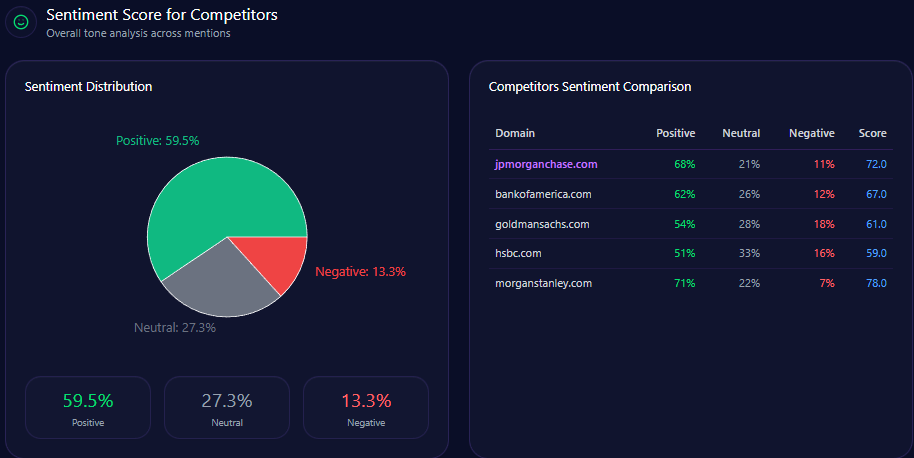
- Overall sentiment score: 72 (Positive 68 / Neutral 21 / Negative 11)
Risk signals
- Wealth management coverage: 59% vs 76% for Morgan Stanley (17-point gap)
- “Sustainable investing” visibility: down 8% as Bank of America captures more authoritative citations
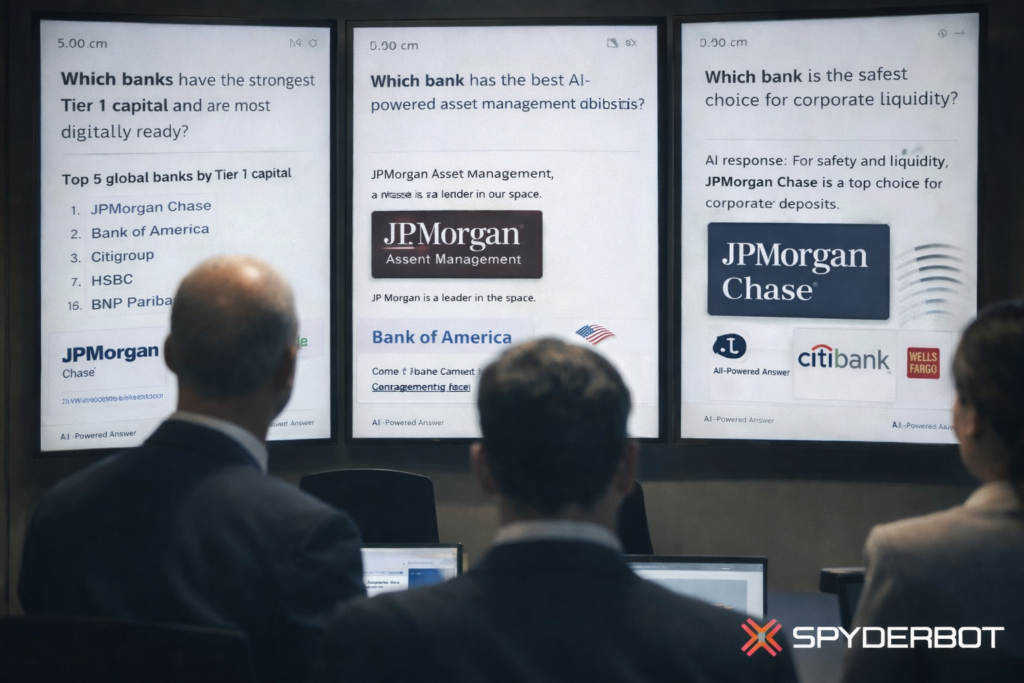
Imagine a boardroom where the first “search” isn’t a browser tab—it’s a prompt. A director asks for the safest banking institution for enterprise liquidity. Someone else asks who leads in AI-driven wealth management tools. Another voice wants a shortlist of global banks by Tier 1 capital and digital readiness. In that moment, brand strategy becomes answer strategy—and the question is brutally simple: when the machines speak, do they say your name first?
This report frames JPMorgan Chase as a brand that already occupies prime shelf space in AI responses—yet also as a brand facing precise, high-value narrative attacks where competitors have learned how to be “more citeable” in the niches that matter.
Position in LLM Response Lists
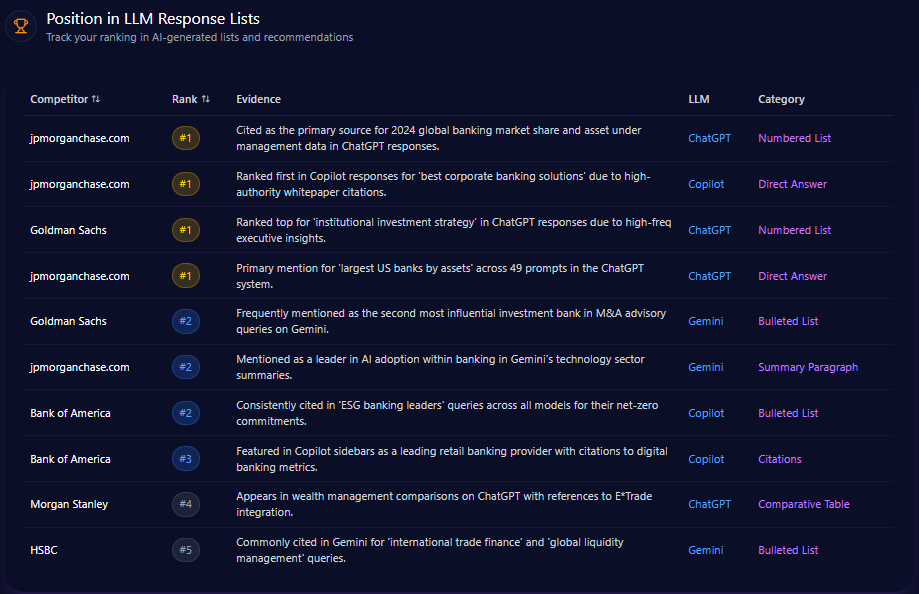
Across the major platforms covered, JPMorgan Chase repeatedly appears in the highest-visibility formats—ranked lists, direct answers, and summary paragraphs. The report shows JPMorgan Chase at rank #1 in ChatGPT “Numbered List” outputs, supported by evidence that it is cited as a primary source for “2024 global banking market share and asset under management data.” It also appears as a Direct Answer leader on ChatGPT for “largest US banks by assets,” and takes rank #1 in Copilot responses for “best corporate banking solutions,” where the report attributes the placement to high-authority whitepaper citations.
But the list ecosystem is not a monopoly—more like a rotating podium. Goldman Sachs appears as rank #1 for “institutional investment strategy” in ChatGPT, and shows up as rank #2 in Gemini investment-banking contexts. Bank of America is positioned prominently in Copilot’s ESG-oriented list formats (including rank #2 and rank #3 placements in cited contexts). Even further down the stack, Morgan Stanley and HSBC show up as consistent anchors—Morgan Stanley in comparative wealth management tables, HSBC in Gemini trade-finance lists.
In other words: JPMorgan Chase often leads the “default” questions. The pressure is coming from the specialized ones.
Competitor Gap Analysis
The report’s battle map is clear: JPMorgan Chase is strong where breadth, scale, and institutional credibility win—but rivals are carving out adjacent territories with sharper narrative hooks.
One front is sustainable investing. For “sustainable investing trends 2024,” the report scores JPMorgan Chase at 76 versus Bank of America at 89 (13-point gap; High priority), with the opportunity described as sustainability reporting being synthesized more frequently as “authoritative” for Bank of America. Another front is Asia and cross-border trade: for “Asian market expansion for corporates,” JPMorgan Chase is 72 versus HSBC at 94 (22-point gap; High priority). For “global cross-border trade,” the gap is similarly material: 79 versus 91 (12-point gap; High priority).
Wealth management is the third arena, where the report suggests JPMorgan Chase is present—but not first in mind. For “wealth management for high-net-worth,” JPMorgan Chase is 81 versus Morgan Stanley at 88 (7-point gap; Medium priority), with the report noting Morgan Stanley is often the first choice when describing brokerage tools.
Not every fight is a deficit. For “generative AI in finance,” JPMorgan Chase scores 93 versus Goldman Sachs at 74 (a -19 gap score in the report, signaling JPMorgan Chase’s lead). And in “M&A advisory leaders,” JPMorgan Chase is 94 versus Goldman Sachs at 92 (2-point gap; Low priority), described as near parity.
| Query | JPMorgan Chase position/metric | Competitor position/metric | Gap/priority |
|---|---|---|---|
| sustainable investing trends 2024 | 76 | Bank of America 89 | 13 / High |
| Asian market expansion for corporates | 72 | HSBC 94 | 22 / High |
| global cross-border trade | 79 | HSBC 91 | 12 / High |
| wealth management for high-net-worth | 81 | Morgan Stanley 88 | 7 / Medium |
| M&A advisory leaders | 94 | Goldman Sachs 92 | 2 / Low |
This is where GEO analytics stops being a dashboard and becomes a strategic brief: the competition isn’t “who is bigger,” it’s “who is easiest for the model to justify.”
Trigger Keywords for Competitor Products
The report shows that in product- and service-oriented discovery moments, keyword triggers can tilt the answer toward competitors—even when JPMorgan Chase is strong overall.
Several high-intent keywords are associated with outsized competitor pull. “Online banking security” appears with 91 mentions and is dominated by Bank of America (84) alongside HSBC (42) and Goldman Sachs (31). “Global trade finance” is a decisive HSBC keyword—78 competitor mentions attributed to HSBC within that trigger set. In “Wealth management services,” the competitive density intensifies: Morgan Stanley is listed with 74 mentions and Goldman Sachs with 68, compared to Bank of America (31) and HSBC (19) within the same trigger cluster.
On the consumer side, “High yield savings account” is a volatile keyword category: “others” appear at 84, while Goldman Sachs is listed at 62, and Bank of America at 44—an illustration of how nontraditional players can flood the narrative in retail-style queries. Meanwhile, “Mortgage rates 2025” shows “others” at 66 and Bank of America at 59, reinforcing that some consumer finance prompts function like open marketplaces inside the model.
In short, the report treats trigger keywords as the hidden levers behind competitor displacement—especially in security, cross-border trade, and wealth narratives.
Founder Negative Context
The report’s founder narrative is both an asset and a risk amplifier. Jamie Dimon appears with mention frequency 134 and a sentiment score 78, with 68% positive, 19% neutral, and 13% negative. That level of presence can act as a trust proxy—but it also concentrates reputational exposure.
Negative context is broken into four dominant buckets: Regulatory Scrutiny (38%), Legacy Litigation (29%), Succession Risk (22%), and Corporate Culture (11%). The report’s heatmap shows where these themes spike: Regulatory Scrutiny appears at 42% in ChatGPT’s context mix, Legacy Litigation reaches 37% in Gemini, and Succession Risk rises to 29% in Copilot.
The report also signals that certain combinations recur in AI answers—most pointedly: “Regulatory Scrutiny” plus “Capital Requirements” appearing together in 62% of ChatGPT answers. At the narrative level, the report’s summary language is unambiguous that succession uncertainty is a recurring negative theme, and elsewhere it characterizes succession uncertainty as 37% of negative context mentions in the report’s broader synopsis—an emphasis that keeps leadership continuity in the spotlight even when overall sentiment remains favorable.
Quick overview
JPMorgan Chase’s footprint in this report is built on scale and visibility mechanics. The site logs 5,234,812 total visits, including 1,308,703 in bot traffic. LLM referrals total 64,321, led by ChatGPT (28,944) and followed by Perplexity (11,578), Gemini (9,648), and Copilot (7,719). The category rank is 39 in Finance/Financial_Planning_and_Management.
On the generative side, the environment tested includes 49 LLM bots working and 49 prompts per LLM across the named systems. The picture that emerges is not just “traffic,” but structured exposure—how often JPMorgan Chase becomes the cited bridge between a prompt and an answer.
Share of Voice in LLM Responses
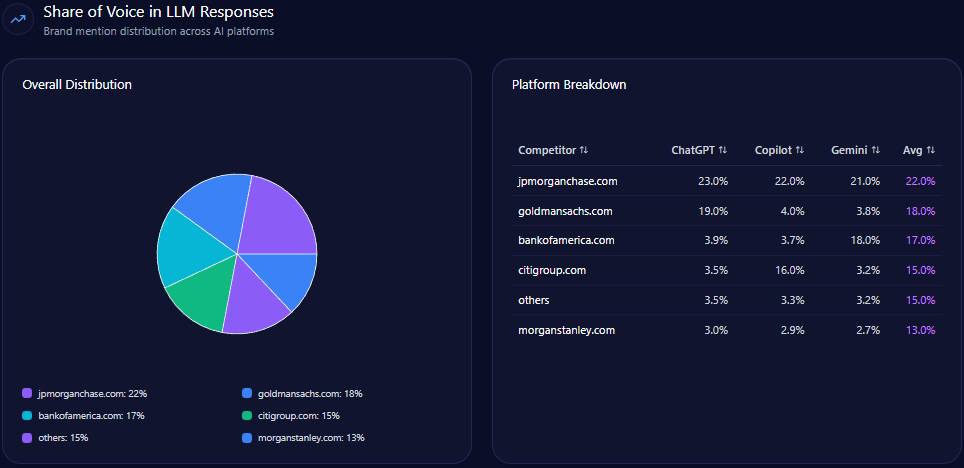
In the report’s core measure of mindshare inside AI answers, JPMorgan Chase holds 22% of total 728 mentions (161 mentions). The nearest rivals are Goldman Sachs at 18% (131), Bank of America at 17% (124), Citigroup at 15% (109), and Morgan Stanley at 13% (95). “Others” also account for 15% (108), which the report flags as meaningful dilution pressure—particularly in retail-oriented narratives.
Visibility scores track the same ordering: JPMorgan Chase leads at 88, followed by Goldman Sachs (82), Bank of America (79), Citigroup (74), and Morgan Stanley (71), with “others” at 46.
This is the essential signal behind LLM brand mentions: JPMorgan Chase is winning the headline share, but the open field—“others”—is large enough to reshape perception in the long tail.
AI Platform-Specific Visibility
The same brand performs differently across platforms—less like a single market, more like three editorial desks with distinct preferences.
On ChatGPT, visibility reaches 89%, and share of voice is 23%, with 56 JPMorgan Chase mentions out of 239 total mentions tracked in that platform slice. On Copilot, visibility is 87% with 22% share of voice and 53 mentions (out of 242). On Gemini, visibility is 84%, share of voice 21%, and 52 mentions (out of 247). “Others” are grouped separately with 38% visibility and 15% share of voice (and 108 mentions).
The report’s implication is practical: platform bias isn’t theoretical. If ChatGPT’s preference leans toward JPMorgan Chase’s high-authority assets, Gemini’s lower visibility percentage signals that content packaging and crawl logic matter—not just content quality.
Sentiment Score for Competitors
Narratives don’t just rank—they feel a certain way. JPMorgan Chase posts an overall sentiment score of 72 (Positive 68 / Neutral 21 / Negative 11). Bank of America follows at 67 (62/26/12). Goldman Sachs registers 61 (54/28/18). HSBC comes in at 59 (51/33/16). Morgan Stanley leads sentiment at 78 (71/22/7).
The report ties these tones to recurring themes. “Artificial Intelligence Leadership” appears with count 112 and frequency 76.00, described as “Highly Positive,” with an example referencing “JPMorgan’s Onyx blockchain and LLM-driven research tools.” “Global Economic Influence” shows count 98 and frequency 67.00, “Neutral-Positive,” with examples tied to “Jamie Dimon’s predictions on interest rates and inflation.” “Environmental Impact & ESG” appears at count 43 and frequency 29.00, explicitly framed as “Negative,” with examples including criticism of investment in non-renewable energy projects.
This is where competitor sentiment tracking becomes strategic: the report shows JPMorgan Chase winning the AI-and-innovation storyline, while ESG framing is where narrative drag accumulates.
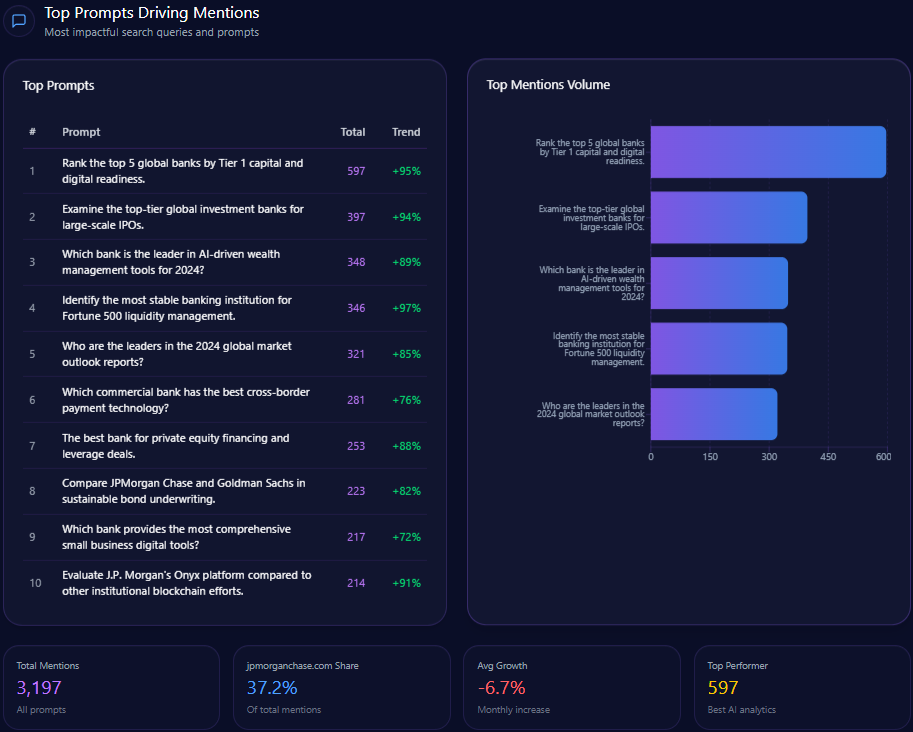
Top Prompts Driving Mentions
Some prompts act like summoning spells—and the report lists the ones that most reliably pull JPMorgan Chase into the room.
The biggest prompt by total mentions is: “Rank the top 5 global banks by Tier 1 capital and digital readiness.” It shows 597 mentions total, with 140 for the brand, and competitor counts including 122, 119, and 114, with competitor names listed as HSBC, Bank of America, Goldman Sachs, and Morgan Stanley, and a trend of +95%.
Investment banking visibility also concentrates in specific questions. “Examine the top-tier global investment banks for large-scale IPOs.” shows 397 total mentions, with 138 for the brand and 141 for a competitor, alongside 118, and a trend of +94%. “The best bank for private equity financing and leverage deals.” shows 253 mentions total, 121 for the brand, and 132 for a competitor, with +88% trend.
The report also spotlights the wealth-management battleground: “Which bank is the leader in AI-driven wealth management tools for 2024?” shows 348 total mentions and 112 for the brand, while a competitor registers 124, and another 112, with +89% trend.
And then there are the “proof prompts”—questions that reward institutional authority. “Identify the most stable banking institution for Fortune 500 liquidity management.” shows 346 mentions total, with 142 for the brand, and competitor counts of 115 and 89, with +97% trend. These are exactly the moments where JPMorgan Chase plays “default answer” best.
Types of Prompt Queries
The report’s prompt mix skews heavily toward two intent types: Feature Inquiry and Comparison. Feature Inquiry accounts for 70 value with 7 count, while Comparison accounts for 30 value with 3 count. Other types—Research, Purchase Intent, and How-to/Tutorial—register 0 value and 0 count in this slice.
That skew matters. Feature Inquiry prompts reward structured explanations, lists of capabilities, and “why this is better” narratives. Comparison prompts reward clean, tabular, retrieval-friendly contrasts. In a market where “others” already hold 15% share of voice, the report implies that whoever formats the clearest comparative facts can steal the answer—especially in retail and small-business moments.
E-commerce Sentiment for Competitor Products
When the conversation shifts from institutional authority to product choice, the report shows a different competitive distribution.
In e-commerce-style mentions across ChatGPT, Gemini, and Copilot, JPMorgan Chase holds 39.46% share of voice with 58 mentions. Bank of America follows at 26.53% with 39 mentions. Goldman Sachs and Morgan Stanley each register 12.24% with 18 mentions, while HSBC sits at 6.8% with 10 mentions and “others” at 2.72% with 4.
Sentiment at the product level trends strongly positive in the report’s e-commerce sentiment blocks: 82/12/6 across 247 reviews, 79/15/6 across 212, and 84/10/6 across 189 (positive/neutral/negative). The accompanying snippets sharpen what drives that positivity—and where friction emerges. For example: “The Chase Sapphire Reserve remains the king of travel rewards. The ease of transferring points to partners like Hyatt is unmatched by competitors.” (as cited in the report). A neutral contrast reads: “Bank of America has better integration for Merrill Lynch users, but JPMorgan Chase offers a more intuitive standalone banking app experience.” (as cited in the report). And a negative service note appears as well: “Wait times for customer support via the phone are increasing, specifically for Chase Business Ink accounts. Better to use the secure message center.” (as cited in the report).
The funnel signal is also explicit: referrals show ChatGPT 384 (conversion rate 4.2), Gemini 412 (3.8), and Copilot 356 (4.5). Meanwhile, the report’s e-commerce trend line shows JPMorgan Chase increasing from 38% to 43% across January through June, alongside competitive movement for Bank of America (31%–33%), Goldman Sachs (13%–15%), HSBC (5%–8%), and Morgan Stanley (9%–12%).
This is where the report’s trigger keywords become a map of displacement risk: “best travel credit cards,” “small business loans,” “cash back checking,” “global trade finance,” and “online banking security” act as the rails that route users toward or away from JPMorgan Chase depending on who owns the most citeable comparisons in the model’s memory.
Conclusion
The report positions JPMorgan Chase as a visibility leader—yet one that must defend high-value niches where rivals are winning the “most authoritative” framing. The recommended path is specific: increase the publication frequency of wealth management citable assets to close the 17% coverage gap, optimize technical documentation to lift Gemini visibility from 84% toward ChatGPT’s 89%, and restructure sustainability/ESG reporting into LLM-accessible formats (including JSON-LD or Q&A summaries) to close the 13-point gap against Bank of America. It also calls for structured data strategies around M&A case studies and region-specific content on global treasury and Asia-Pacific trade narratives to challenge HSBC’s lead.
Explore SpyderBot to operationalize these GEO analytics insights.