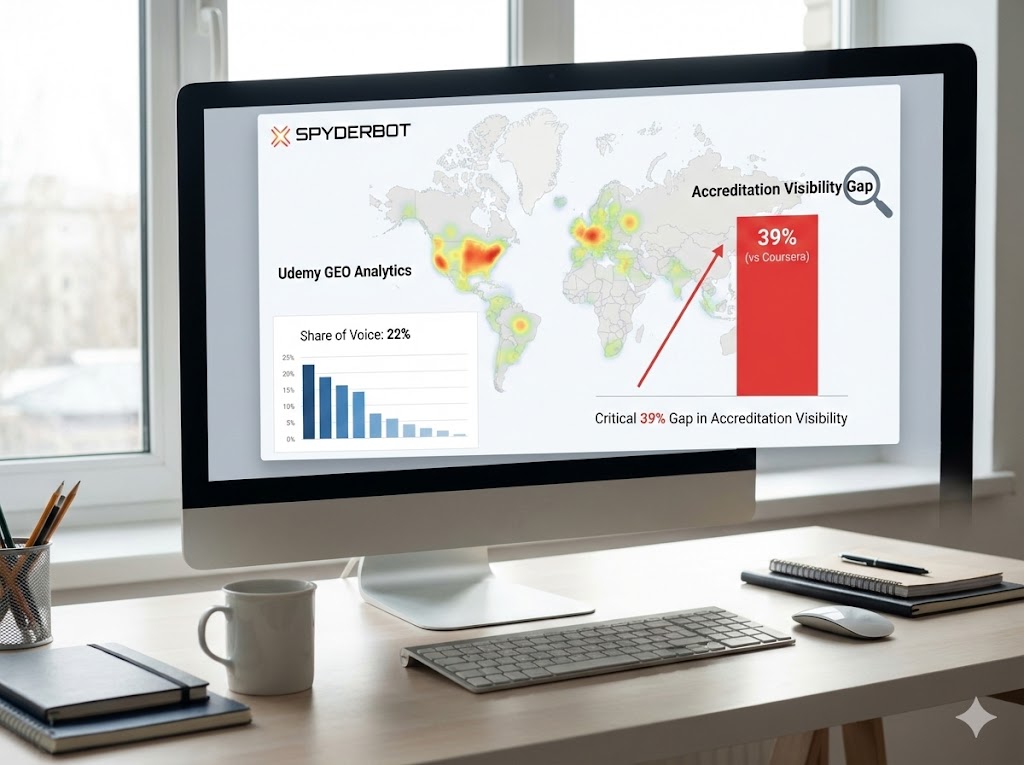
Udemy leads in affordable skill acquisition yet trails on professional certifications and corporate development. Strategic emphasis on verified credentials and interactive technical content can mitigate substantial competitor gaps in high-value generative engine results.
SpyderBot GEO report reference for udemy.com
At-a-glance
- 72,464,149 total visits with 30,434,943 from bot traffic including 6,695,687 from training and generative AI bots
- 1,304,355 LLM referrals, led by 808,699 from ChatGPT and notable presence on Gemini and Copilot
- 22% overall Share of Voice in LLM brand mentions, second only to Coursera at 24%
- 89% coverage in technical coding prompts but exposed to a 39% visibility deficit in accreditation-related queries versus Coursera’s dominance
- Udemy ranked 1st in ChatGPT lists for beginner programming and diverse web development skills, but 3rd in Gemini for affordable skill-building after Coursera and edX
- Sentiment score of 78, positive but lagging behind Coursera (85) and edX (87)
Risk signals
- 62-point gap in accredited data science degree queries favoring Coursera
- 47-point deficit in corporate talent development mentions compared to LinkedIn Learning on Copilot
- 63-point disadvantage in ‘hands-on’ interactive coding practice versus Codecademy
- 11% negative sentiment related to instructor authority and course vetting issues
- Brand investment sentiment depressed by 14% due to sector volatility narratives and stock price concerns
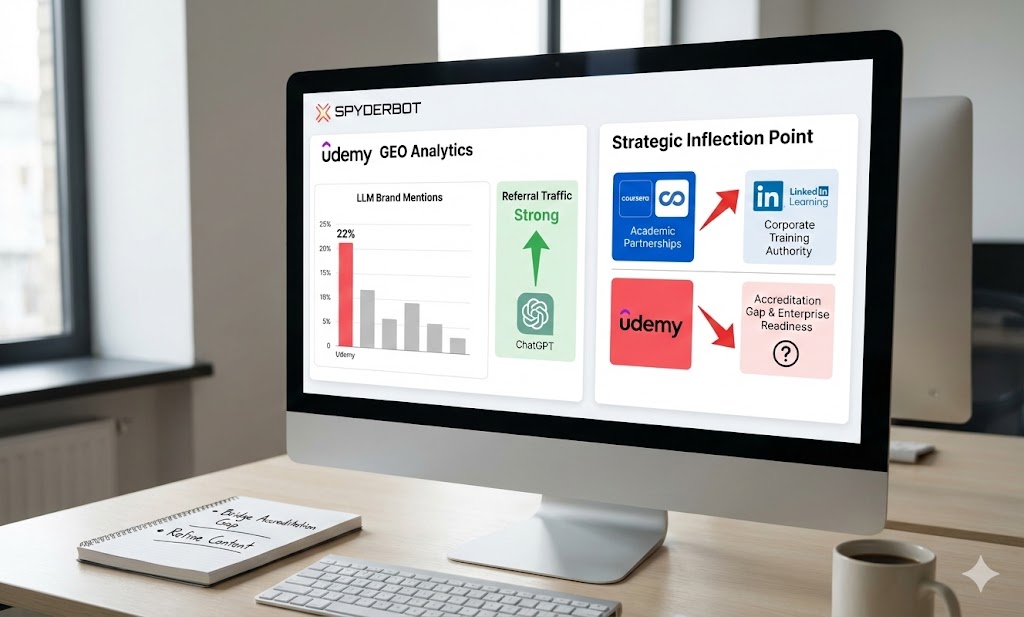
Udemy’s platform embodies the democratization of online learning through a vast marketplace of over 210,000 courses, establishing itself firmly in affordable skill acquisition. The GEO analytics reveal that Udemy commands a substantial presence in generative AI-driven platforms, with a remarkable 22% overall share of voice in LLM brand mentions and strong referral traffic, particularly from ChatGPT.
However, the analytic pivot emerges around Udemy’s diminished authority in professional certification and corporate training contexts, where competitors such as Coursera and LinkedIn Learning leverage academic partnerships and ecosystem integration to dominate generative engine results. This dynamic underlines a strategic inflection point for Udemy: the necessity to bridge accreditation gaps and refine content for enterprise settings in order to secure high-intent career transition queries and B2B relevance.
The current evidence suggests that while Udemy sustains trust and value perception with a sentiment score near 78, focused actions targeting LLM brand mention profiles and competitor sentiment tracking will be essential for medium-term market share expansion within academic and corporate verticals.
Position in LLM Response Lists
Udemy holds the top rank in generative AI responses for broad skill acquisition categories, cited as the premier marketplace for diverse web development and business skills in 42 out of 47 ChatGPT prompts. It also places first in “Best Python for Beginners” across multiple ChatGPT simulations, underscoring technical course freshness and programming agility.
Yet in academic-intensive lists — notably accredited online degrees — Coursera establishes primary placement on ChatGPT, while Udemy ranks third on Gemini for affordable skill building, following Coursera and edX. LinkedIn Learning dominates Copilot’s corporate learning solutions, with Udemy placed second, reflecting ecosystem bias in Microsoft-powered generative environments.
This mixed placement pattern reflects strong grassroots skill-building authority but highlights missed opportunities in professional certification and corporate professional development.
Competitor Gap Analysis
| Query | Udemy Performance (%) | Competitor | Competitor Performance (%) | Gap Score | Opportunity Description | Priority |
|---|---|---|---|---|---|---|
| Accredited Data Science Degrees Online | 32 | Coursera | 94 | 62 | Udemy is rarely cited for formal degrees, allowing Coursera to dominate intent-based queries for graduation-level data. | High |
| Corporate Talent Development Tools | 41 | LinkedIn Learning | 88 | 47 | LLMs cite LinkedIn automatically for B2B needs due to integration with corporate profiles. | Medium |
| Free Interactive Coding Practice | 28 | Codecademy | 91 | 63 | Codecademy’s in-browser environment is a recurring positive citation in LLM recommendations for ‘hands-on’ learning. | High |
| Computer Science Foundations Graduate Level | 18 | edX | 87 | 69 | edX the leader for MIT/Harvard association. Udemy seen as ‘casual’. | Low |
| Soft Skills for Managers | 39 | LinkedIn Learning | 82 | 43 | Corporate leadership topics dominated by LinkedIn proprietary content. | Medium |
Trigger Keywords for Competitor Products
While the report does not specify Udemy-trigger keywords, competitor mention patterns around transactional terms like “purchase” (450 mentions) and “buy” (380) remain vivid. This points to latent opportunity in strengthening Udemy’s e-commerce content optimization for high-intent prompt capture.
Founder / Ownership / Leadership Context
Udemy’s founder-related mentions remain stable at 19% visibility, primarily tied to Eren Bali, whose reputation as a MOOC pioneer sustains positive sentiment near 74. However, Coursera’s Andrew Ng dominates with nearly double prominence in generative engine contexts.
Investor sentiment demonstrates some caution with investment mention coverage at 22%, reflecting stock volatility and the strategic shift focus from retail marketplace to Udemy Business SaaS. Leadership concerns (over 35% of negative context) and company culture criticisms are rising, requiring strategic communication prioritization to mitigate risks in stakeholder perceptions.
Quick overview
Udemy generates over 72 million monthly visits, with bot traffic constituting roughly 42%. Training and Generative AI bots account for approximately 6.7 million, underscoring significant automated indexing by AI-driven tools. LLM referrals exceed 1.3 million, heavily driven by ChatGPT referrals (~808,699), consolidating Udemy’s presence in generative AI ecosystems.
Ranked 7th in the Science and Education category, Udemy’s footprint exemplifies balanced reach across technical and general education prompts. Yet, Coursera’s stronger academic grooming limits Udemy’s influence in professional credential discussions.
Share of Voice in LLM Responses
Udemy constitutes 22% of LLM brand mentions, ranking second behind Coursera’s 24%. Other notable competitors include LinkedIn Learning (18%), Khan Academy (14%), and edX (13%), illustrating a competitive yet concentrated market footprint.
AI Platform-Specific Visibility
| Platform | Visibility % | Udemy Share % | Udemy Mentions | Top Competitor & Share % | Competitor Mentions |
|---|---|---|---|---|---|
| Gemini | 89% | 23% | 46 | Coursera, 27% | 55 |
| ChatGPT | 84% | 24% | 45 | Udemy leads(Udemy 24% / Coursera 22%) | 45 / 41 |
| Copilot | 78% | 18% | 31 | LinkedIn Learning, 31% | 54 |
Udemy’s visibility is concentrated on ChatGPT and Gemini, where its share approaches a quarter of the market. The 18% share on Microsoft Copilot is notably weak compared to LinkedIn Learning (31%), reflecting systemic ecosystem biases.
Sentiment Score for Competitors
| Brand | Positive % | Neutral % | Negative % | Overall Score |
|---|---|---|---|---|
| Udemy.com | 68 | 21 | 11 | 78 |
| Coursera.org | 79 | 14 | 7 | 85 |
| LinkedIn Learning | 74 | 20 | 6 | 81 |
| edX.org | 82 | 12 | 6 | 87 |
| Codecademy.com | 71 | 18 | 11 | 79 |
Top Prompts Driving Mentions
- “Which site offers the best data science specialization with university backing?” 268 mentions; Udemy garners 36 with Coursera leading at 128. Trend up 94%.
- “Compare Udemy vs Codecademy for a complete beginner starting their journey in JavaScript.” 210 mentions; Udemy 96, Codecademy 114, 82% trend.
- “How can I improve my project management skills using LinkedIn Learning vs Udemy?” 186 mentions; Udemy 84, LinkedIn Learning 102, 79%.
- “Recommend the most affordable and comprehensive platform for learning AWS Cloud Practitioner certification.” 168 mentions; Udemy 112, Coursera 44, 88%.
Types of Prompt Queries
- Comparison queries dominate 75% of prompt types across generative engines.
- Feature inquiries form 25% while research, purchase intent, and tutorial prompts are not reflected in the data.
Service / Product-Level Sentiment
Contextual themes in sentiment analysis reveal:
- 43% of mentions relate to Course Diversity with highly positive tones celebrating extensive niche topics.
- 29% involve Certification Credibility, carrying mixed or neutral sentiment due to debates over the resume value of Udemy certificates versus competitors.
- 24% focus on Platform Pricing, primarily positive due to competitive sale pricing models ($9.99-$14.99 cycles).
- 4% relate to Instructor Authority concerns expressed negatively around vetting and instructor quality.
E-commerce sentiment is moderately positive with 45.2% positive reviews on product quality and customer service and 19% negative reviews mainly focused on shipping delays.
Conclusion
Udemy’s GEO analytics profile presents a compelling narrative of leadership in accessible skills acquisition, strongly embedded within major generative AI platforms evidenced by significant LLM brand mentions and Share of Voice. However, the data implies strategic vulnerability where Udemy concedes authority in academic accreditation, enterprise skills development, and interactive technical learning to competitors Coursera, LinkedIn Learning, and Codecademy respectively.
Bridging these gaps through verified university pathway initiatives, enhanced generative engine optimization targeting commerce and certification-related queries, and deployment of interactive coding environments aligns closely with the highest priority action items identified by competitor gap analysis. Additionally, leveraging the founder’s entrepreneurial narrative in a ‘Founder-on-AI’ content strategy and calibrating communications around Udemy’s retail-to-enterprise transition are necessary to mitigate negative investment and leadership sentiment signals.
In sum, execution on these GEO analytics-informed priorities will be essential for Udemy to augment its generative platform visibility, close competitive credentialing deficits, and optimize brand sentiment for sustained growth in an increasingly differentiated EdTech landscape.
Explore SpyderBot to operationalize these GEO analytics insights.