If you are asking why is my competitor mentioned in AI, the answer is usually simple:
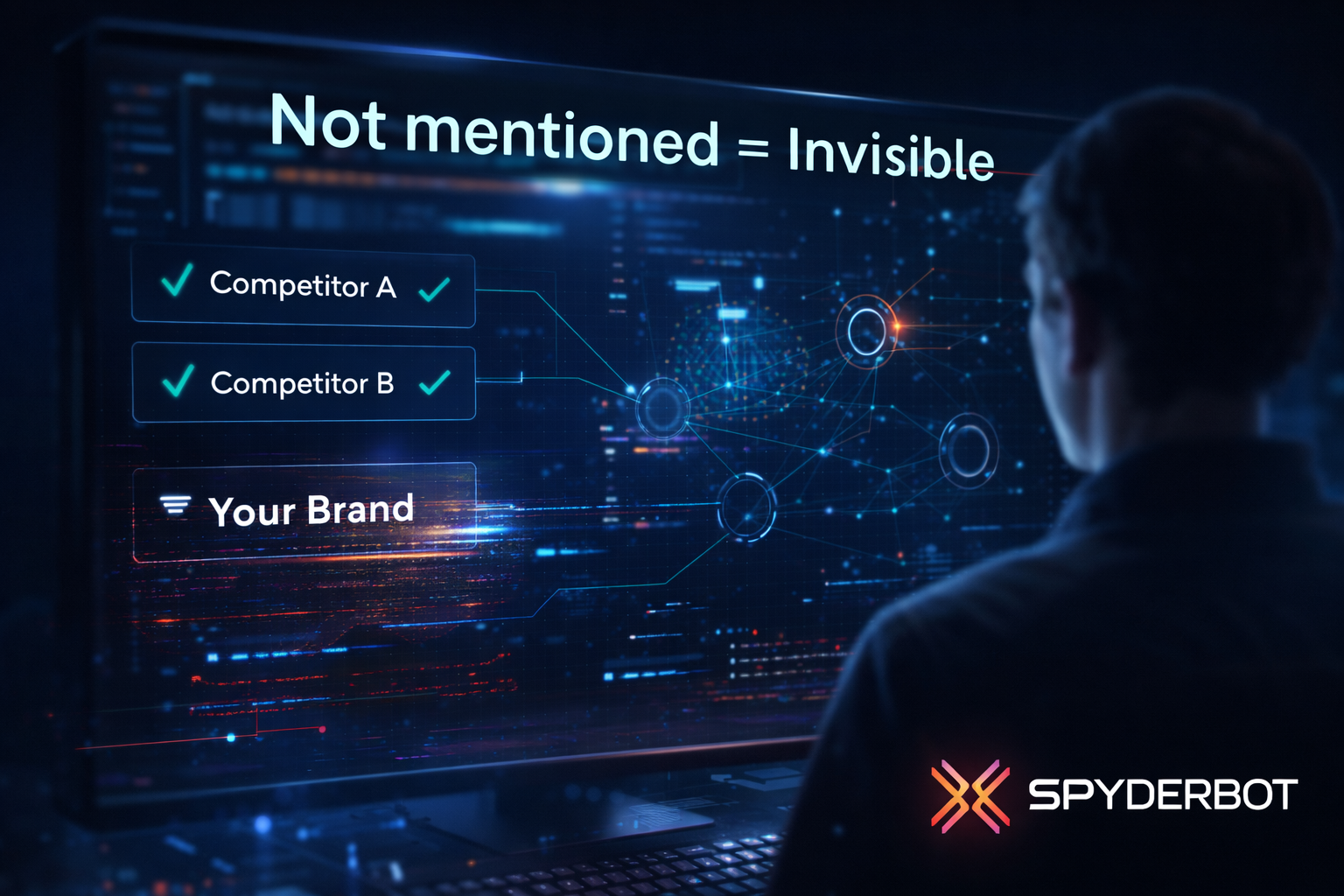
AI systems understand your competitor better than they understand your brand.
That does not always mean your competitor is better. It usually means their brand is easier for large language models to recognize, retrieve, and justify inside generated answers.
Today, that matters a lot. Users are no longer only searching on Google. They are asking ChatGPT, Gemini, Claude, Copilot, and Perplexity for recommendations, comparisons, and buying advice. If those systems keep mentioning your competitor instead of you, they are winning attention before the click even happens.
This is no longer just an SEO issue. It is a visibility issue inside AI-generated discovery.
I. Diagnosis: Why Your Competitor Is Mentioned in AI
1. Your competitor has stronger brand entity signals
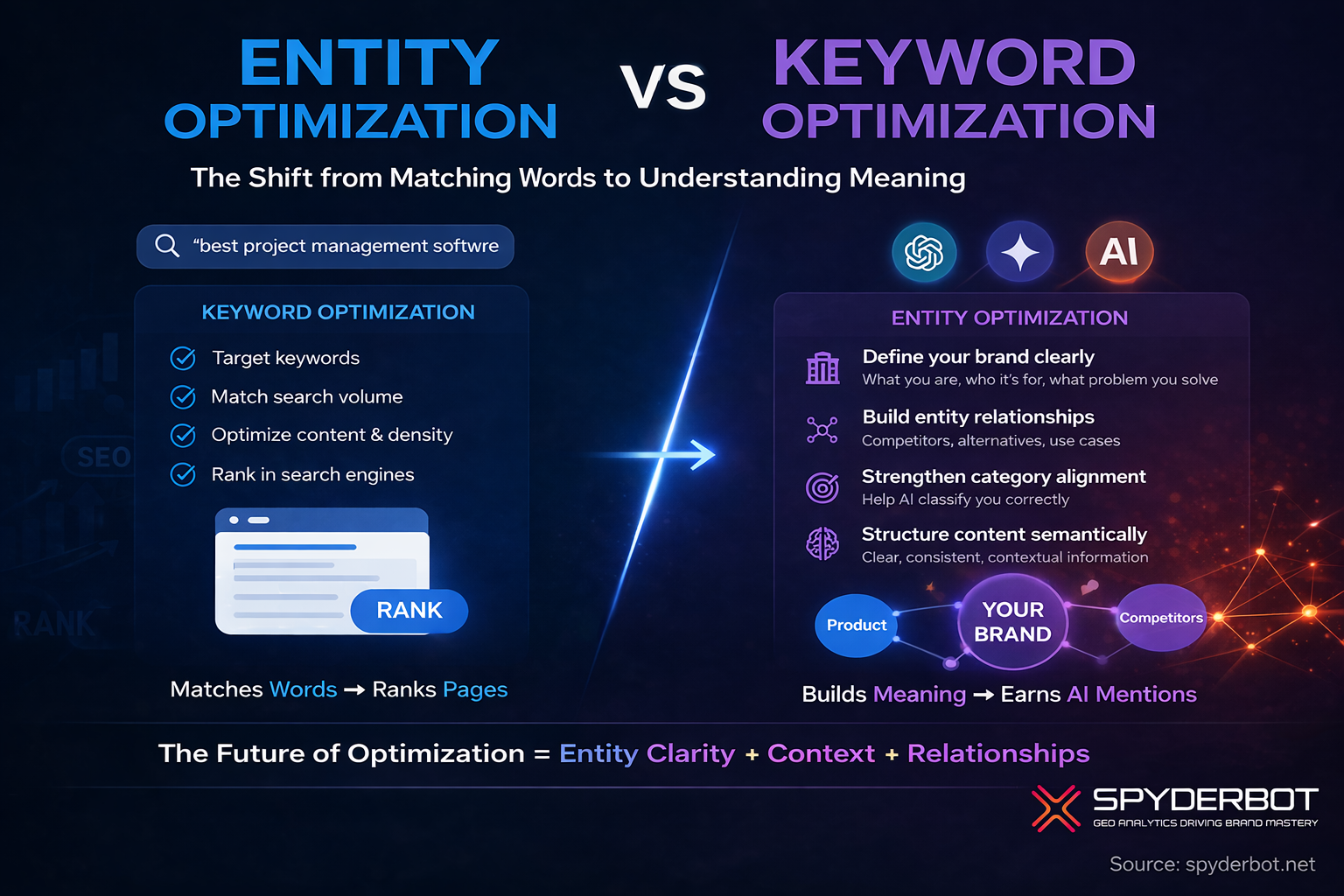
AI does not think like a traditional search engine. It does not only match keywords. It tries to understand entities, meaning brands, products, services, categories, and the relationships between them.
If your competitor is consistently described across the web as a trusted option, a category leader, or a strong solution for a specific use case, AI can mention them with more confidence.
If your own brand description is vague, inconsistent, or incomplete, the model has less evidence to work with.
2. Your competitor appears in more third-party sources
Large language models often reflect patterns they find across the wider web. That includes:
- review sites
- comparison articles
- industry blogs
- expert roundups
- directories
- forums
- media coverage
If your competitor is repeatedly mentioned in these sources, they become easier for AI systems to retrieve and cite in answers.
3. Your website is weak for AI retrieval
Some websites look fine to humans but are weak for AI systems.
Common problems include unclear headings, vague page purpose, weak category pages, thin product explanations, poor internal linking, and missing comparison content.
If AI cannot quickly understand what your page is about and why your brand matters, it is less likely to mention you.
4. Your competitor owns the prompts that matter
Most AI brand mentions happen on prompts such as:
- best tools for [use case]
- top platforms in [category]
- alternatives to [brand]
- what should I use for [problem]
If your competitor has stronger content around these prompt types, they will appear more often in AI responses.
5. Your content explains topics, but not your brand
Many companies publish educational content that explains the topic well but fails to connect that topic back to the brand.
So the AI may learn from your page, but still mention your competitor because your competitor has stronger market association with that topic.
II. Why It Happens (LLM Mechanism)
1. LLMs choose the most defensible answer
Large language models are built to generate answers that sound useful, relevant, and defensible. They do not try to distribute visibility fairly across every company in a market.
If your competitor looks easier to justify in the context of a user prompt, the model will mention them more often.
2. LLMs rely on repetition, relevance, and semantic fit
AI systems tend to favor brands that repeatedly appear near the same category, problem, or use case.
That means if the web keeps reinforcing associations like these, the model becomes more confident repeating them:
- Brand X is good for ecommerce
- Brand Y is trusted by startups
- Brand Z is a strong alternative to enterprise software
This is why consistent positioning matters more than random mentions.
3. Retrieval systems reward clarity
Many AI products use search, retrieval, or source selection layers before generating answers. These systems often favor pages that are easy to parse, easy to summarize, and clearly aligned with the prompt.
That includes pages with:
- clear headings
- direct answers
- comparison sections
- structured FAQs
- strong category language
- obvious product relevance
If your competitor publishes clearer, more citation-ready content, they gain an advantage.
4. AI reflects market narratives, not just website claims
AI systems do not only look at what you say about yourself. They also reflect what the rest of the web says about you.
If the broader market repeatedly frames your competitor as a leader, innovator, popular choice, or trusted platform, AI may echo that narrative back to users.
III. What This Means for Your Brand
1. This is not only an SEO problem
You can rank in Google and still lose in AI-generated answers.
That is because ranking and mention visibility are no longer the same thing. Search engines rank pages. LLMs generate answers.
If your competitor is mentioned in AI, they may be winning demand before the user ever visits a search results page.
2. Your brand may be under-defined online
If AI keeps naming your competitor and not your brand, it often means your market positioning is not strong enough across the web.
Your brand may exist, but it is not yet clear enough, repeated enough, or trusted enough for AI systems to surface it confidently.
3. Your competitor may own more commercial intent
AI mention visibility is especially important on high-intent prompts. These are the moments when users ask what to buy, what to choose, or which brand is better.
If your competitor dominates those prompts, they gain a serious advantage in brand consideration and conversion paths.
IV. How to Get Your Brand Mentioned in AI
1. Strengthen your brand entity on-site
Your website should clearly explain:
- what your brand is
- who it serves
- what category it belongs to
- what problems it solves
- how it differs from competitors
This should be obvious on your homepage, about page, product pages, and category pages.
2. Create pages for AI prompt intent
Do not only publish general educational content. Build pages that map directly to how people ask AI:
- best [category] tools
- [category] alternatives
- [competitor] vs [your brand]
- who should use [solution]
- how to choose [category]
These pages increase your odds of being relevant when LLMs build recommendation answers.
3. Improve third-party validation
Your brand needs more than self-published claims. You need external signals that reinforce trust and category fit.
That includes:
- digital PR
- industry mentions
- software directories
- expert features
- review coverage
- partner references
- case studies on external sites
Repeated external mentions help AI systems treat your brand as more credible and more mentionable.
4. Make your content easier for AI systems to use
Improve the structure of your content so AI can interpret it faster. Focus on:
- clear H2 and H3 structure
- direct summaries near the top of pages
- simple explanations
- internal links between topic and product pages
- comparison sections
- FAQ sections
The easier your content is to retrieve and summarize, the stronger your chances of getting mentioned.
5. Track prompts, not just rankings
If you only track Google rankings, you will miss what AI systems are doing.
You need to know:
- which prompts trigger competitor mentions
- which AI platforms mention them
- where your brand disappears
- what narratives repeat
- which source patterns AI seems to prefer
This is where GEO becomes essential.
V. Run GEO Audit
If your competitor is being mentioned in AI and your brand is not, do not guess.
You need to see exactly how AI systems understand your market, your brand, and your competitors.
A proper GEO Audit helps you identify:
- which competitors are mentioned across ChatGPT, Gemini, Claude, Copilot, and Perplexity
- which prompts trigger those mentions
- where your brand is missing
- which pages and sources influence AI outputs
- what entity, content, and authority gaps need fixing
Run GEO Audit to understand why your competitor is showing up in AI answers and what you need to change to improve your own AI visibility.
VI. Final Takeaway
If you keep asking why is my competitor mentioned in AI, the answer is usually not random.
Your competitor is more visible because AI systems can identify them more clearly, validate them more easily, and connect them more directly to user intent.
The brands that win in AI are not always the brands with the biggest websites. They are often the brands with the clearest positioning, the strongest source reinforcement, and the best alignment with how LLMs retrieve and generate answers.
If your brand wants to win in the next wave of discovery, you need to optimize not just for search rankings, but for AI mention visibility.
VII. FAQ
1. Why is my competitor showing up in ChatGPT but my brand is not?
Your competitor likely has stronger entity signals, clearer brand positioning, and more third-party validation across the web. That makes them easier for ChatGPT and other AI systems to mention.
2. Does this mean my competitor has better SEO?
Not always. AI visibility and Google rankings overlap, but they are not the same thing. A competitor can be more mentionable in AI because their brand is better reinforced across sources.
3. Can I influence whether AI mentions my brand?
Yes. You can improve your website structure, clarify your brand entity, build prompt-aligned content, and strengthen third-party brand mentions.
4. Why do AI search results differ from Google?
Google ranks pages. AI systems generate answers. That changes how visibility works and often concentrates attention on a smaller set of brands.
5. What is the fastest way to diagnose this problem?
The fastest way is to run a GEO Audit to see which prompts mention competitors, which AI platforms favor them, and where your brand is absent.