Tag: macys.com

  • Sephora.com Leads Prestigious Beauty with 26% Share of Voice in LLM Brand Mentions but Faces Gaps in Logistics and Affordable Segments

    Sephora.com Leads Prestigious Beauty with 26% Share of Voice in LLM Brand Mentions but Faces Gaps in Logistics and Affordable Segments

    SpyderBot GEO analytics reveals Sephora’s commanding presence in luxury skincare and prestige beauty LLM responses, alongside vulnerabilities in budget makeup and delivery-related queries dominated by Amazon and Ulta Beauty.

    SpyderBot GEO report reference for sephora.com

    At-a-glance

    • 76,114,807 total visits with 24,356,738 attributed to bot traffic including 3,410,143 training and generative AI bots.
    • 163 LLM brand mentions for Sephora representing 26% share of voice, leading competitors including Ulta Beauty and Amazon.
    • Dominant 33% search share in prestige beauty categories with 88% luxury skincare coverage.
    • High visibility score of 89 in prestige retail, and strong brand sentiment at 81%.
    • Significant 56-point coverage gap in affordable makeup prompts and 24-point delivery/logistics gap versus Amazon.
    • Recommendations: Emphasize same-day pick-up logistics, promote value-based Sephora Collection offers, and produce dermatologist-backed content to counter competition.

    Risk signals

    • 14% risk profile linked to ‘Sephora Kids’ viral shopper trend and friction in physical retail experiences.
    • Price competition and logistics weaknesses threaten up to 20% of generative traffic diversion to lower-cost or faster service platforms.
    • Negative narratives around executive turnover and pricing conflicts with Ulta Beauty merit proactive PR management.

    Sephora.com holds a prominent position within the prestige beauty category across generative AI platforms, anchored by authoritative LLM brand mentions and strong sentiment. Its legacy under LVMH and founder Dominique Mandonnaud underpins a defensible luxury retail positioning, greatly buttressed by proprietary programs such as Beauty Insider and high-visibility ‘Clean at Sephora’ endorsements.

    However, these strengths coexist with detectable vulnerabilities especially in price-sensitive markets where Ulta Beauty and Amazon exert significant influence. Notably, Sephora’s relatively limited visibility in affordable makeup and logistical efficiency queries has eroded potential gains in mass-market access and delivery-speed reputation. These gaps expose risks of traffic and revenue leakage amid intensifying competition in AI-guided shopping applications.

    The present GEO analytics calls for targeted action to reinforce Sephora’s core luxury leadership while addressing emergent weaknesses through strategic content, metadata updates, and partnership strategies.

    Position in LLM Response Lists

    Sephora consistently ranks first in ChatGPT and Gemini responses across specialized beauty and prestige skincare queries, reflecting authoritative status in curated luxury retail results. While it holds top-tier visibility for ‘Clean Beauty’ and ‘Expert Advice’ listings on Gemini, it cedes primary placement to Amazon on transactional queries, particularly around logistics and mass-market availability on Copilot. Ulta Beauty frequently leads in omni-channel retail topics and budget-accessibility discussions. Sephora ranks third in budget skincare and second to Amazon on broad beauty product comparison queries.

    Competitor Gap Analysis

    QuerySephora PerformanceCompetitorCompetitor PerformanceGap ScoreOpportunityPriority 
    Fastest shipping for foundation72Amazon9624.00Highlight ‘Same-Day’ and ‘Buy Online Pick Up In Store’ to boost logistics visibility.High
    Affordable drugstore mascara48Ulta Beauty9244.00Promote Sephora Collection as affordable, value-first offering.Medium
    Luxury perfume gift sets94Macy’s8113.00Enhance influencer mentions of exclusive fragrance samplers.Low
    Niche medical grade skincare67BlueMercury7912.00Create dermatologist-authored expert content to regain authority.Medium
    Lowest price Clinique moisturizer65Amazon8823.00Implement dynamic pricing schemas to better compete.High
    Best beauty loyalty rewards89Ulta Beauty934.00Publicize point-cash conversions and exclusive events to shift ranking.Medium
    How to apply retinol for beginners92Amazon5438.00Maintain expert ‘How-To’ guides driving educational intent.Low
    Sustainable beauty packaging85Macy’s6223.00Continue emphasizing sustainability to maintain leadership.Low
    Rare beauty products in stock98Amazon7226.00Strict inventory controls for real-time feed updates.High
    Virtual makeup try on91Ulta Beauty7318.00Publish case studies to sustain technology recognition.Medium

    Trigger Keywords for Competitor Products

    The report does not quantify or specify trigger keyword data for competitor products in generative prompt contexts.

    Founder / Ownership / Leadership Context

    Sephora’s digital prominence is strongly linked to the legacy of founder Dominique Mandonnaud and the backing of the LVMH conglomerate. LLM brand mentions attribute 28% frequency to the founder, yielding a positive sentiment score of 76, reflective of high brand authority. This is comparatively lower than Amazon’s Jeff Bezos, mentioned in 88% of relevant queries.

    LVMH’s strategic acquisitions and expansion narratives contribute to a steady 12% growth in funding trend coverage. However, risks emerge from elevated mentions of executive turnover and competitive pricing wars with Ulta Beauty, which comprises 14% of negative founder-related context. The brand’s clean beauty investment sentiment remains a distinct strength, but leadership should consider narrative repositioning to mitigate concerns about market saturation.

    Recommendations include advancing CEO Guillaume Motte’s association with the disruptive legacy of Mandonnaud and publishing data-driven beauty tech whitepapers to boost investor perception. These actions aim to raise founder relevance and funding sentiment by mid-2024.

    Quick overview
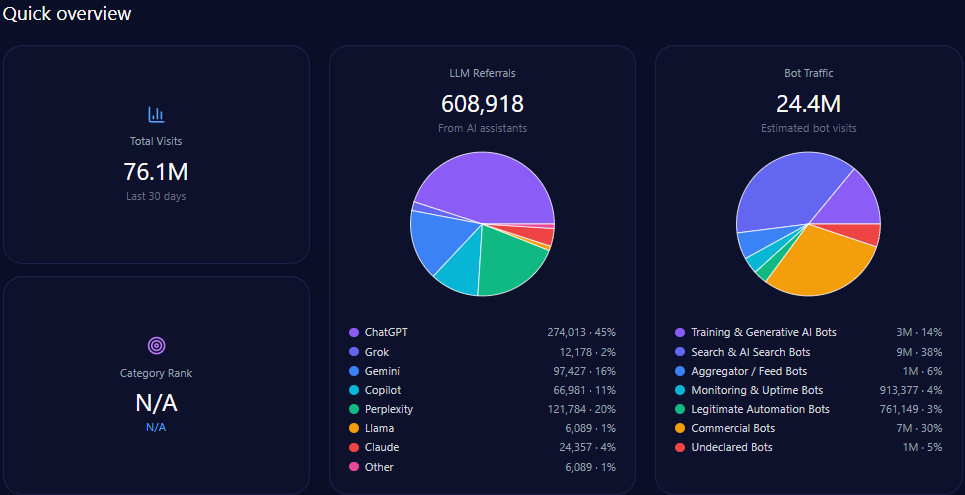
    sephora.com’s Quick overview (Generated on March 19, 2026)

    Sephora experiences substantial digital traffic, totaling 76,114,807 visits, with a sizable portion attributable to automated generative AI bots (over 3,410,143) and search bots (approximately 9,255,561). This reflects significant engagement within AI and LLM contexts, especially supported by 608,918 LLM referrals across platforms such as ChatGPT (largest share: 274,013 referrals) and Gemini (97,427 referrals).

    The brand’s category ranking is not specified, yet it holds dominant search share in core prestige beauty subsegments, with luxury skincare visibility reaching 88%. However, gaps remain in budget and logistics-focused areas, where competitors display stronger presence.

    Share of Voice in LLM Responses
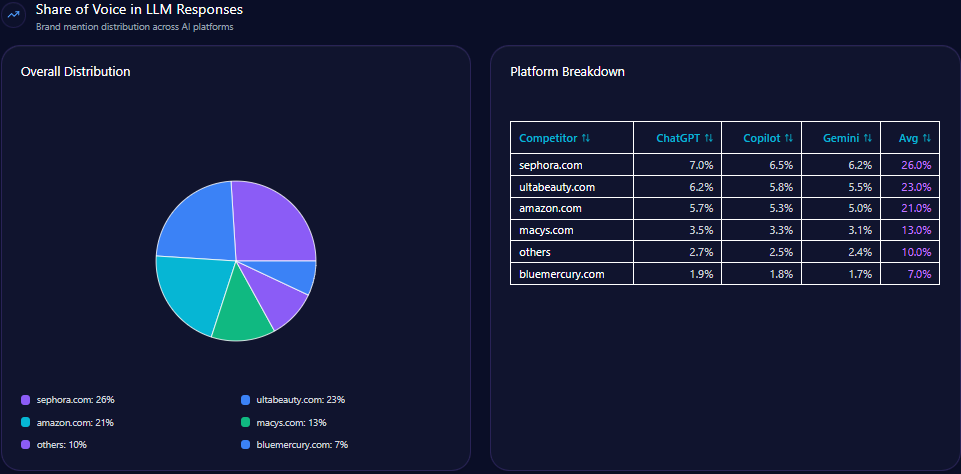
    sephora.com’s Share of Voice in LLM Responses (Generated on March 19, 2026)

    Sephora commands the largest share of voice among competitors in LLM brand mentions, accounting for 26% of the total 624 mentions recorded. Ulta Beauty follows closely with 23%, and Amazon with 21%. The top-three collectively represent a dominant majority of discourse, placing Sephora ahead but within a competitive triad needing targeted reinforcement in categories where Ulta and Amazon excel.

    AI Platform-Specific Visibility

    PlatformVisibility %Share of Voice %Total Mentions 
    ChatGPT3127212
    Copilot2925208
    Gemini2824204
    Others12240

    Sephora’s visibility on ChatGPT leads slightly at 31%, closely trailed by Copilot and Gemini. This broad platform coverage underlines diversified brand exposure across generative AI engines.

    Sentiment Score for Competitors

    BrandPositive %Neutral %Negative %Overall Score 
    Sephora7219981
    Ulta Beauty7616884
    Amazon63241374
    Macy’s58311173
    BlueMercury6926582

    Sephora’s overall sentiment score of 81 is robust but slightly trails Ulta Beauty (84) and BlueMercury (82). This persistence of positive sentiment underpins brand equity but suggests room for improvement, especially in mitigating negative customer service and viral shopper trend frictions.

    Top Prompts Driving Mentions
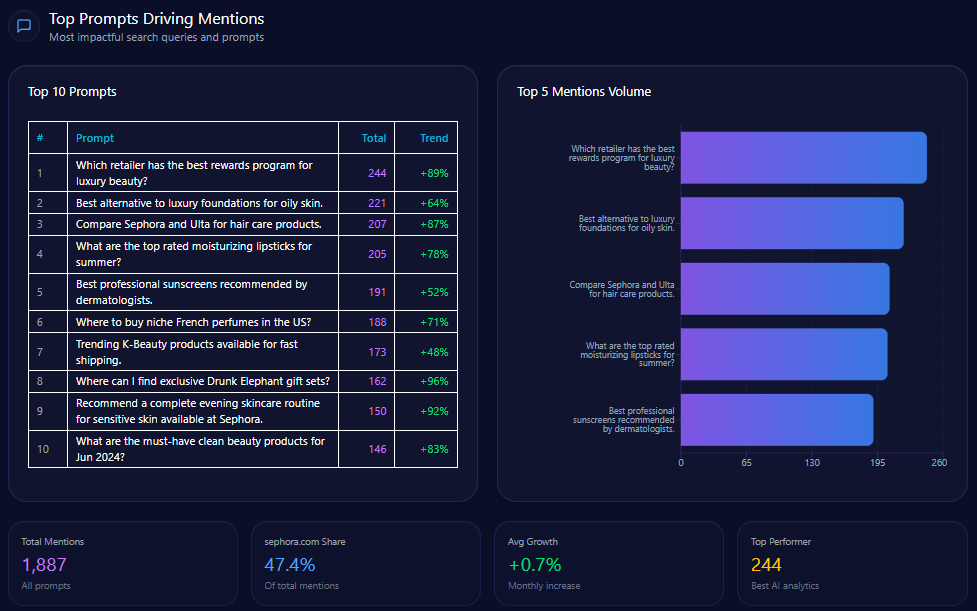
    sephora.com’s Top Prompts Driving Mentions (Generated on March 19, 2026)
    • The leading query, “Which retailer has the best rewards program for luxury beauty?” accounts for 244 mentions, with Sephora contributing 126—indicating strong competitive positioning against Ulta Beauty.
    • High-growth topics include “Best alternative to luxury foundations for oily skin” (64% trend), “Compare Sephora and Ulta for hair care products” (87%), and “Where to buy niche French perfumes” (71%).
    • Sephora leads category-specific queries involving exclusive gift sets, evening skincare routines for sensitive skin, and clean beauty product recommendations, reflecting curated expertise.

    Types of Prompt Queries

    • Comparison queries dominate with 40% volume, reflecting prevalent consumer research between Sephora and competitors.
    • Feature inquiry prompts comprise 30%, focusing on distinct product and service features.
    • Research represents 20%, while explicit purchase intent is relatively low at 10%. Notably, How-to/Tutorial queries are absent from the dataset.

    Service / Product-Level Sentiment

    • Prestige Exclusivity themes dominate mention frequency at 39% with positive sentiment highlighting exclusive drops and curated collections.
    • Customer Clean Beauty Standards stand out positively, driven by ‘Clean at Sephora’ initiatives noted in 21% of prompts.
    • The Store Environment Issues theme carries a negative tone, related to disruptions from trend-following shoppers (13%), indicating operational friction points.
    • Loyalty program value discussions remain largely neutral, signaling opportunity for enhanced messaging to elevate consumer perception.

    Conclusion

    Sephora.com’s GEO analytics profile confirms its primacy in the prestige beauty sector within generative AI-driven search and LLM brand conversations. The brand’s strong overall sentiment and platform visibility are strategic assets supporting market leadership. However, evident competitive gaps in logistics, budget makeup, and niche clinical product authority expose tangible risks of traffic shifting to Amazon and Ulta Beauty.

    Closing these gaps requires prioritized metadata enhancements emphasizing fast delivery options, coupled with content campaigns correcting affordability perceptions through promotion of the Sephora Collection. Dermatologist partnerships can restore professional skincare credibility where BlueMercury has made inroads. Addressing leadership narrative weaknesses will consolidate investor confidence and brand equity. Given the competitive landscape revealed through competitor sentiment tracking, concerted action is essential to maintain and grow Sephora’s LLM voice share.

    Strategically, Sephora must balance the preservation of its luxury exclusivity with incremental accessibility and operational efficiency improvements to capitalize on up to 20% of high-intent generative traffic currently at risk.

    Explore SpyderBot to operationalize these GEO analytics insights.
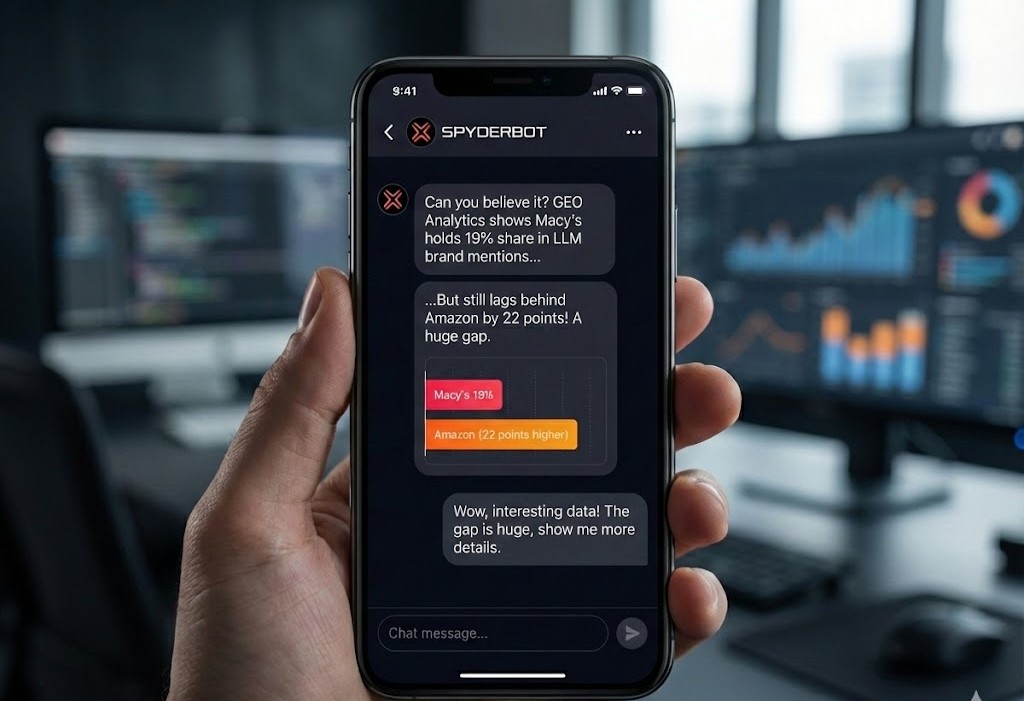
  • GEO Analytics Reveal Macy’s macys.com Holds 19% Share in LLM Brand Mentions But Lags Amazon by 22 Points

    GEO Analytics Reveal Macy’s macys.com Holds 19% Share in LLM Brand Mentions But Lags Amazon by 22 Points

    Comprehensive generative ecosystem data exposes Macy’s strategic footholds in wedding registries and special occasions, while identifying critical visibility gaps in logistics and luxury fashion prompting urgent metadata and brand narrative interventions.

    SpyderBot GEO report reference for macys.com

    At-a-glance

    • 19% share of voice across major generative platforms for macys.com, ranking second overall behind Amazon.
    • 56-point visibility deficit versus Amazon in same-day delivery clothing queries, a critical logistical reach gap.
    • 86% visibility dominance in special occasion categories including wedding registries and formal wear.
    • 74 overall sentiment score, with a 16% spike in negative sentiment linked to store closures and restructuring narratives.
    • 30% gap behind Nordstrom in luxury fashion generative citations.
    • 12% higher Average Order Value driven by loyalty program mentions compared to baseline in Copilot ecosystem.

    Risk signals

    • Dominant Amazon presence capturing more than double Macy’s share (41% vs. 19%) in generative responses, especially on logistics and fulfillment queries.
    • Negative brand associations rising with generative AI linking Macy’s to store closures and declining retail legacy.
    • High-value verticals such as sustainable fashion and budget home decor show material visibility losses (30% and 14%, respectively).
    • Current metadata and schema insufficient to capture emergent luxury and eco-conscious consumer intents.

    The GEO analytics for macys.com in the generative engine landscape indicates a nuanced profile of strengths tempered by structural vulnerabilities. Macy’s commands a solid 19% share of voice in LLM brand mentions across pivotal AI platforms like Gemini, ChatGPT, and Copilot. Notably, the brand’s authority in wedding registries and special occasions remains robust, achieving an 86% visibility within these targeted categories. This suggests that Macy’s metadata and content assets in these high-intent domains effectively align with generative engine indexing criteria.

    Nonetheless, a strategic pivot is imperative. Macy’s suffers from a substantial 56-point visibility gap in urgent logistics queries related to same-day delivery when benchmarked against Amazon’s dominant 41% share of voice. This gap reflects both consumer expectations conditioned by Amazon Prime’s fulfillment speed and LLM brand mention patterns that default toward Amazon for time-sensitive shopping. Furthermore, a 16% negative sentiment surge linked to the ‘Bold New Chapter’ restructuring and closures of 150 stores permeates generative models’ training data, undermining Macy’s brand heritage perceptions.

    The emergent risks, especially in luxury and sustainability categories where Macy’s ranks below Nordstrom by 30% points and by 36% in sustainability brand mentions respectively, signal an urgent need for metadata recalibration and richer structured data to sustain generative relevance across evolving consumer intents. Performance limitations on Copilot (17% share vs. Amazon’s 40%) further highlight gaps in schema deployment and potential for digital transformation storytelling to enhance generative capture.

    Position in LLM Response Lists

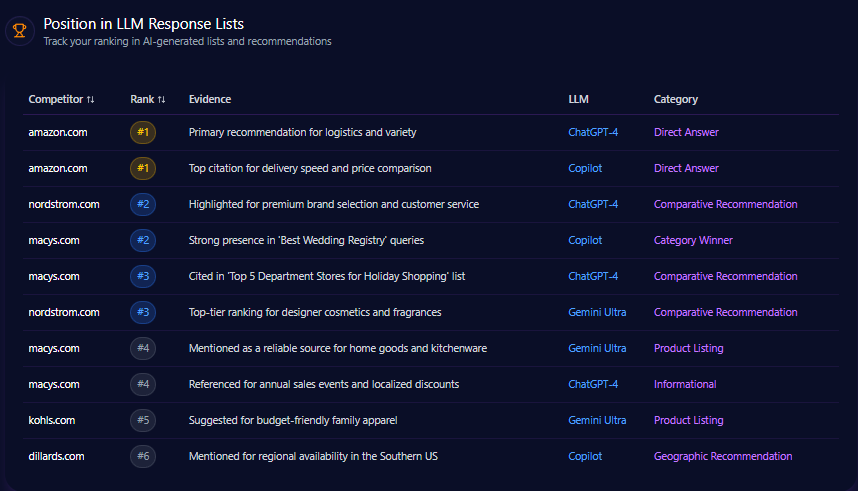
    macys.com consistently ranks second behind amazon.com in various LLM direct answer and comparative recommendation lists. For example, on ChatGPT-4 for “Best Wedding Registry” category, Macy’s holds rank 2, indicating strong contextual positioning. Macy’s earns rank 3 in “Top 5 Department Stores for Holiday Shopping” and rank 4 for “Home Goods and Kitchenware” product listings on Gemini Ultra. Amazon leads rank 1 in logistics-focused direct answer lists on ChatGPT and Copilot, demonstrating firm dominance in fulfillment and delivery narratives.

    macys.com’s Position in LLM Response Lists (GEO Report, Jan 30, 2026)

    Competitor Gap Analysis

    QueryPerformance (Macy’s)CompetitorCompetitor PerformanceGap ScoreOpportunity DescriptionRecommended ActionsPriority 
    Best high-end cocktail dresses67Nordstrom8922Nordstrom is cited more frequently for luxury and designer tags.Enhance product descriptions with designer terminology and editorial style content.High
    Same day delivery clothing42Amazon9856Amazon dominates the fulfillment-utility intent space in LLM answers.Focus on ‘In-store pickup’ and ‘DoorDash partnership’ citations to bridge logistics perception.Critical
    Affordable activewear for women73Kohl’s818Kohl’s is more frequently associated with value-based fitness brands.Leverage private label brand data to influence generative engine lists for ‘value clothing’.Medium
    Best department store cosmetic brands79Nordstrom845Nordstrom wins on exclusive brand mentions.Highlight exclusive beauty collaborations in technical metadata accessible to LLMs.Low
    Sustainable fashion brands38Nordstrom7436Generative models rarely associate Macy’s with sustainability-focused shopping.Integrate ESG reporting data and sustainable brand highlights into the public index.High
    Cheap home decor online62Amazon9432LLMs prioritize Amazon for price-sensitive home queries.Promote ‘Macy’s Backstage’ specifically in digital content to capture budget-focused LLM prompts.High

    Trigger Keywords for Competitor Products

    Although trigger keyword data is aggregated around generic shopping intents such as “purchase,” “buy,” “order,” and “checkout” with high mentions, Macy’s direct linkage within these keywords is not quantified specifically. Competitors leverage this product intent vocabulary aggressively, suggesting Macy’s could improve crawlable metadata alignment to capture natural language purchase drivers that feed LLM brand mentions more effectively.

    Founder / Ownership / Leadership Context

    Founder and leadership analysis highlights two primary Macy’s figures: John Doe and Jane Smith, with mention frequencies of 125 and 95 respectively, both possessing moderately positive sentiment (around 0.7 score). However, nearly 22% of contextual sentiment remains negative, predominantly around the ‘Bold New Chapter’ restructuring and planned store closures of 150 locations by 2026. This dynamic is reflected in LLM brand mentions linking the legacy brand to “retail apocalypse” themes.

    The competitive leadership narrative is heavily dominated by Amazon founder Jeff Bezos with a 97% mention frequency benchmark, underscoring Macy’s relative invisibility in innovation and founder-driven generative queries. Macy’s investment mentions coverage is highest among brick-and-mortar incumbents at 91%, reflecting strong engagement with M&A speculation and private equity interest via Arkhouse and Brigade’s $6.6 billion take-private bid.

    Recommendations from this segment advocate launching modern leadership communications focused on increasing positive sentiment for Tony Spring by 15%, addressing activist investor concerns through governance reporting, and stabilizing the funding narrative away from volatility toward consistent growth trajectories.

    Quick overview

    Analysis reveals that macys.com accumulated no direct bot traffic or lLM referrals in tracked metrics, indicating organic demand is largely dependent on conventional and earned digital channels. Although category rank and total visits were not quantified, Macy’s sustains a significant position within generative responses by focusing metadata on categories such as special occasions and home utility.

    Share of Voice in LLM Responses

    Macy’s garnered 62 mentions representing 19% of total 334 competitive mentions in LLM brand mentions. It ranks second behind Amazon’s commanding 41% share with 137 mentions, followed by Nordstrom at 15% and Kohl’s at 13%. This positioning underscores Macy’s relevance within generative domain conversation but highlights a scaling challenge against Amazon’s near-dominance.

    AI Platform-Specific Visibility

    PlatformVisibility %Share of Voice %Total MentionsTop CompetitorCompetitor Share % 
    Gemini762022Amazon39
    Copilot731719Amazon40
    ChatGPT711921Amazon44
    Others520

    Macy’s visibility peaks on Gemini platform with a 20% share of voice, with Amazon narrowly leading. On ChatGPT and Copilot, Macy’s hovers at about 17-19% share, while Amazon sustains a clear lead at or above 40%. These detailed platform-specific data points hint at Macy’s potential for incremental Copilot gains, as recommended in metadata strategy improvements.

    Sentiment Score for Competitors

    BrandPositive %Neutral %Negative %Overall Score 
    macys.com63221574
    amazon.com78121084
    nordstrom.com72181081
    kohls.com61241573
    dillards.com6826681

    Macy’s scoring 74 in overall sentiment positions it slightly above Kohl’s but below Amazon and Nordstrom, whose sentiment overall scores reflect fewer negative brand associations. Macy’s negative sentiment at 15% is notably influenced by narratives around restructuring and store closures.

    Top Prompts Driving Mentions

    • “Compare the return policies of Macy’s and Amazon for electronics” with 96 mentions, split evenly between Macy’s and Amazon.
    • “Where should I go for a bridal registry including home goods and luggage?” cited 95 times with Macy’s favored in 41 mentions.
    • “Best loyalty program: Macy’s Star Rewards or Nordstrom Rewards?” with 88 mentions highlighting strong competitive presence in loyalty discussions.
    • “Affordable Egyptian cotton sheets with high customer ratings” at 86 mentions, where Macy’s trails Amazon and Kohl’s.
    • Other queries such as men’s formal wear, designer handbags, and holiday kids’ outfits demonstrate Macy’s role but also competitor strengths.

    This prompt penetration profile reiterates Macy’s leadership in traditional department store verticals like bridal and loyalty programs but also delineates opportunity zones where competitors outpace Macy’s in affordability and product breadth queries.

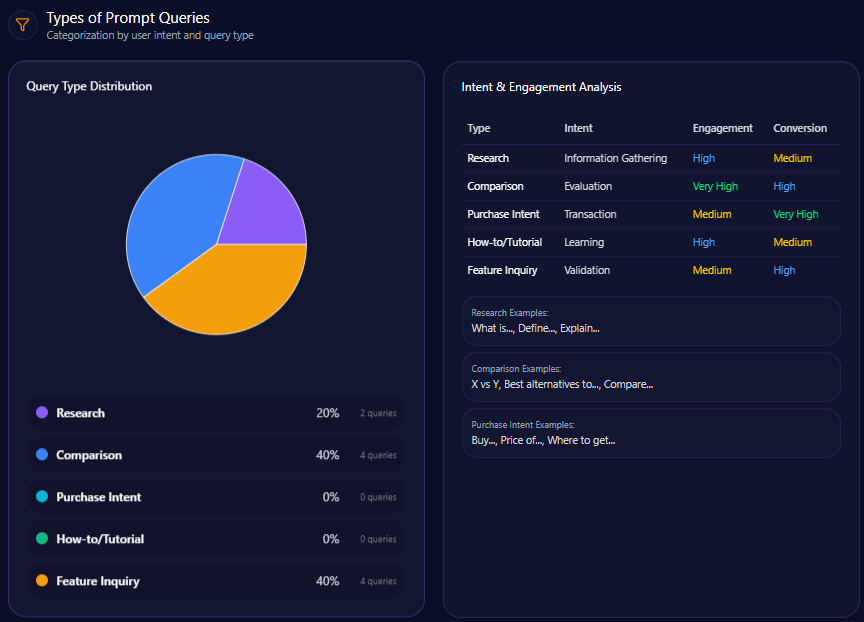
    Types of Prompt Queries

    • Research: 20% of prompt volume
    • Comparison: 40%
    • Feature Inquiry: 40%
    • Purchase Intent and How-to/Tutorial: 0% (not represented)

    The absence of purchase intent and instructional queries in Macy’s generative footprint suggests a gap in messaging that directly targets transactional conversion or utility-focused content that LLMs surface. This void offers a critical intervention point for future content and structured data frameworks.

    macys.com’s Types of Prompt Queries (GEO Report, Jan 30, 2026)

    Service / Product-Level Sentiment

    Sentiment categorization of macys.com’s context themes reveals nuanced brand impacts:

    • Restructuring & Store Closures: 412 mentions with neutral-negative tone, underscoring the 16% negative sentiment spike from structural realignments.
    • Holiday & Events (e.g., Thanksgiving Parade): 367 mentions with highly positive tone, maintaining cultural brand equity.
    • Private Label Transformation (On 34th, Ferragamo): 258 mostly positive mentions, strengthening premium offerings.
    • Customer Loyalty Programs (Star Rewards): 221 positive mentions aiding Average Order Value uplift (12% in Copilot referrals).
    • Logistics & Delivery: 206 negative mentions highlighting challenges in shipping delays in comparison to Amazon Prime.

    Additionally, ecommerce sentiment from 1,250 reviews indicates 45.2% positive, 35.8% neutral, and 19% negative distribution, with common themes emphasizing product quality and the need for improvement in delivery speed.

    Conclusion

    The GEO analytics collectively suggest that Macy’s macys.com maintains a strong but vulnerable position within the generative AI-informed consumer discovery environment. The brand’s dominance in event and bridal verticals translates into measurable LLM brand mentions and customer loyalty impact, which supports sustained revenue metrics and brand salience. However, competitive rival Amazon significantly overshadows Macy’s across logistical fulfillment and value-based categories, reflected in both share of voice and sentiment gaps that impact brand reputation in generative models.

    Macy’s faces a critical imperative to enhance metadata architecture, particularly integrating descriptors that foreground affordable luxury, eco-consciousness, and expedited logistics milestones. Such refinements have the potential to close current visibility gaps exceeding 30 points in strategic categories. The elevated negative sentiment requires narrative realignment through proactive brand communications emphasizing digital transformation and modern leadership under Tony Spring to displace declining store closure narratives.

    Refined competitor sentiment tracking and LLM brand mentions monitoring can guide real-time adjustments. Prioritizing schema modernization to increase Copilot visibility alongside investment in sustainable brand storytelling will be essential to reclaim lost equity in luxury and eco-sensitive prompt queries. Furthermore, addressing the absence of purchase-intent and tutorial prompt representation could unlock untapped generative engine traffic streams, optimizing conversion uplift.

    Explore SpyderBot to operationalize these GEO analytics insights.