Tag: maisonrmi.com

  • ACFC.com.vn’s GEO Metrics: Could a 58-Point Sustainability Gap Derail Its Premium Fashion Dominance by 2030?

    ACFC.com.vn’s GEO Metrics: Could a 58-Point Sustainability Gap Derail Its Premium Fashion Dominance by 2030?

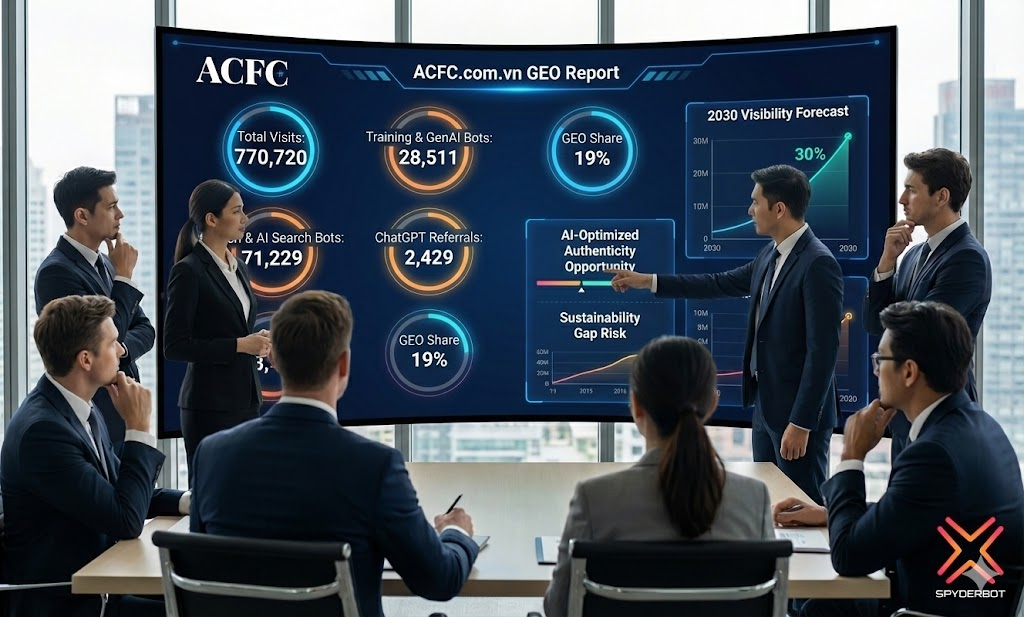
    As generative engine optimization (GEO) evolves into the cornerstone of digital retail strategy, AI-driven metrics like LLM brand mentions and competitor sentiment tracking will increasingly dictate market winners in industries such as fashion. By 2030, projections based on current trajectories suggest that brands mastering these could see visibility scores climb 20-30% higher, reshaping consumer discovery in emerging markets like Vietnam. Anchored in ACFC.com.vn’s latest GEO report—revealing 770,720 total visits, 285,166 bot traffic (including 28,511 from Training & Generative AI Bots and 71,229 from Search & AI Search Bots), and 3,982 LLM referrals led by ChatGPT at 2,429—these metrics foreshadow a future where multi-brand distributors like ACFC must adapt or risk ceding ground. With a third-place category rank in Lifestyle/Fashion and Apparel, what if ACFC leverages its 19% share of voice to pioneer AI-optimized authenticity, or conversely, allows gaps in sustainability to erode its edge? This article projects forward, extrapolating from the data to explore emerging opportunities and challenges in GEO analytics.
    Forecasting Shifts in Vietnam’s Fashion Retail Landscape

    Looking ahead, the competitive dynamics captured in ACFC.com.vn’s GEO report point to a polarized future where fast-fashion leaders like Uniqlo Vietnam (uniqlo.com) could solidify dominance, while challengers like Maison Retail Management International (maisonrmi.com) and Central Retail Vietnam (supersports.com.vn) nibble at specialized niches. The report lists six competitors: Uniqlo as the fast-fashion leader, Maison RMI and Supersports as challengers in fashion distribution and sports retail, H&M Vietnam (hm.com) as a follower, and Vua Hang Hieu (vuahanghieu.com) plus Tam Son International (tamsonvn.com) in follower and niche roles for luxury.

    Extrapolating from share of voice data—ACFC at 19% (104 mentions out of 552), trailing Uniqlo’s 23% (127) and H&M’s 21% (116)—a predictive landscape emerges where Uniqlo’s lead in generic queries could widen to 25-28% by 2030 if ACFC doesn’t counter with enhanced LLM brand mentions. Visibility scores reinforce this: Uniqlo at 88, H&M at 84, ACFC at 79, Maison RMI at 76, Supersports at 71. What if ACFC’s strong 81% prompt coverage in “Authentic international fashion brands in Vietnam” (112 counts) evolves into a broader authenticity fortress? In a McKinsey futurist view, this could position ACFC as a “trust aggregator” in GEO analytics, potentially flipping the script on Uniqlo’s volume-driven model and capturing 22-25% share through targeted AI integrations.
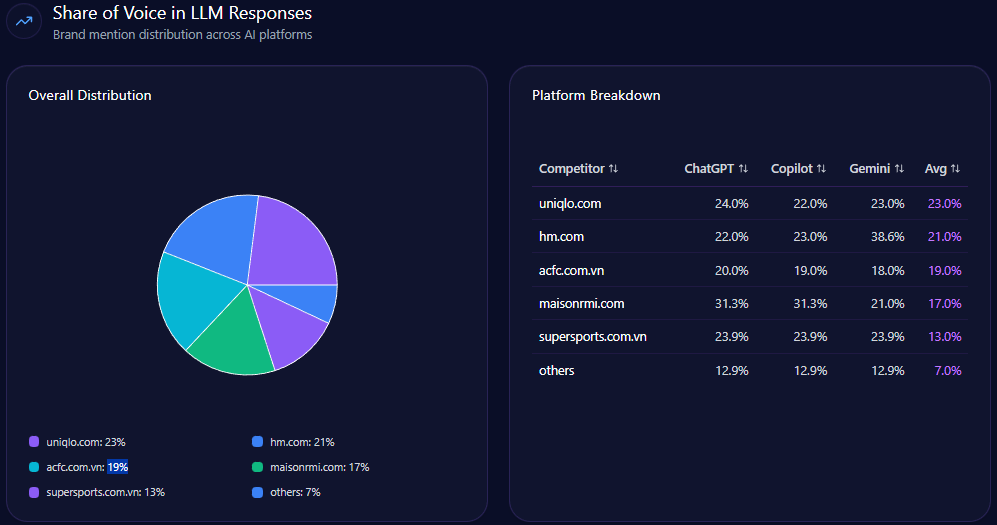
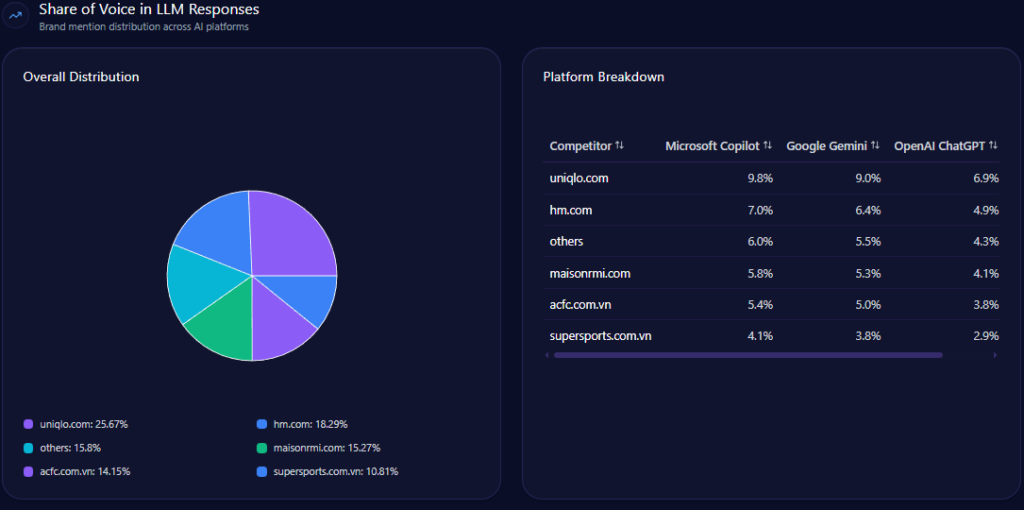
    acfc.com.vn’s Share of Voice in LLM Responses (GEO Report, Jan 2, 2026)

      Platform-Specific Futures in GEO Analytics

    Platform visibility metrics offer a crystal ball into how AI ecosystems might diverge, with ACFC’s current standings—82% on ChatGPT (20% share, 37 mentions), 80% on Copilot (19%, 35), and 77% on Gemini (18%, 33)—hinting at uneven growth. Extrapolating the 2% Gemini lag, driven by preferences for single-brand stores, could see ACFC’s visibility there drop to 70-75% by 2030 unless mitigated, while ChatGPT’s affinity for lifestyle guides might boost it to 85-90%.

    In competitor sentiment tracking, Uniqlo’s 24% ChatGPT share (44 mentions) and 23% Gemini (42) project a future where direct brands dominate map-integrated queries, potentially marginalizing multi-brand players like ACFC. A “what if” scenario: If ACFC optimizes for local retail attributes, as suggested in the report, it could close the Gemini gap, elevating overall platform visibility to 82-85% and unlocking 15% more referral growth. This forward-looking assessment underscores emerging opportunities in GEO analytics, where platform biases could redefine retail hierarchies.

    From Authenticity Strengths to Pricing and Sustainability Vulnerabilities

    Sentiment scores in the report—ACFC at 79 overall (74% positive, 18% neutral, 8% negative)—versus Uniqlo’s 91 (86% positive) and H&M’s 73 (71% positive) forecast potential shifts where authenticity remains a bulwark but neutral elements erode gains. Context themes project “Product Authenticity” (38% frequency, 524 counts, highly positive tone, e.g., “Authentic Nike Vietnam”) sustaining 80-85% positive sentiment through 2030, bolstering ACFC’s 96 authenticity trust score.

    However, “Pricing & Value” (20%, 276 counts, neutral tone, e.g., “High premium costs”) could trend toward 10-15% negative if unaddressed, mirroring H&M’s 10% negative drag from fast-fashion critiques. Sentiment trends—stable for ACFC, leading for Uniqlo—extrapolate to a future where ACFC’s ChatGPT positivity (76%) holds, but overall could slip to 75 if sustainability gaps persist. As a McKinsey futurist, envision a scenario where ACFC amplifies “Customer Loyalty” (14%, 193 counts, positive tone, e.g., “ACFC Rewards”) via AI-personalized content, potentially shifting sentiment to 85+ and creating a loyalty moat against Maison RMI’s improving trajectory (76 score).
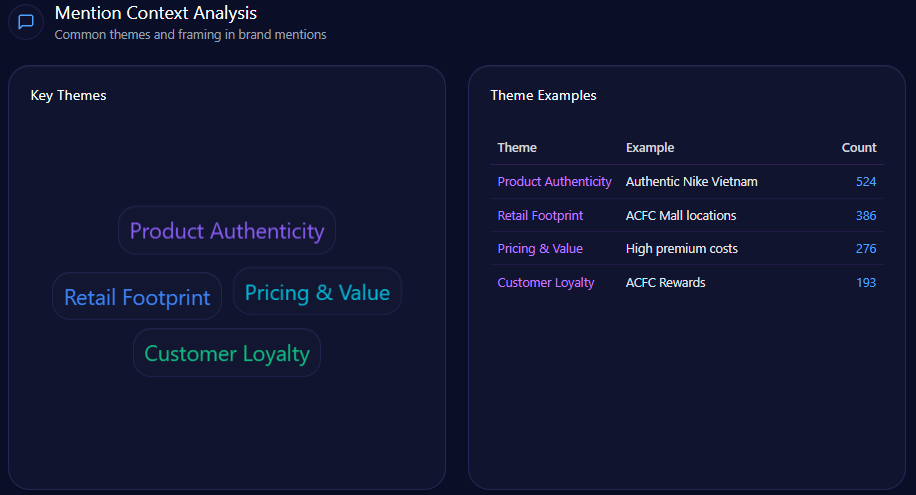
    acfc.com.vn’s Mention Context Analysis (GEO Report, Jan 2, 2026)

    Forecasting Prompt-Driven Growth and Visibility Alerts

    Trend insights, with ACFC’s prompt fluctuations (+2 in Jan, +4 Feb, -2 Mar, +6 Apr, +3 May, +2 Jun), project a volatile yet upward trajectory, potentially reaching consistent +4-5 monthly gains by 2030 if seasonal peaks are harnessed. Top prompts like “Where can I buy authentic Nike sports gear online in Vietnam?” (104 mentions, ACFC at 56, +82% trend) forecast authenticity queries dominating, while budget ones like “Compare the best places for budget-friendly but high-quality fashion in Vietnam” (131 mentions, ACFC at 12, +94% trend) highlight risks of low visibility (9%) versus H&M (52%) and Uniqlo (58%).

    Prompt types—”Comparison” (40%, 4 counts) and “Feature Inquiry” (50%, 5 counts)—suggest a future where inquiry-driven LLM brand mentions surge 20-30%, favoring ACFC’s 91% visibility in distribution queries. Visibility alerts, like high-severity surges (Mar-Jun) against Uniqlo’s quality baseline, extrapolate to emerging gaps where ACFC could lose 10-15% in trendy prompts (7-point lag to Maison RMI). Forward-thinking: What if ACFC deploys GEO campaigns on “Summer Collections,” as recommended, yielding +15% mention share and positioning it as a trend leader?
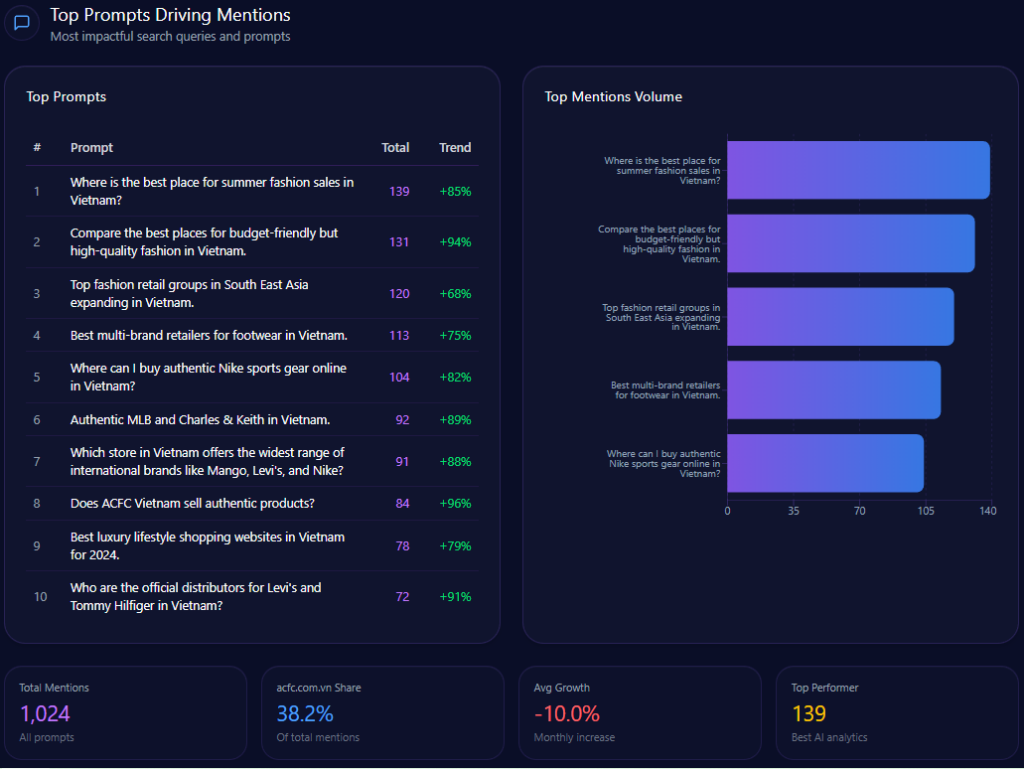
    acfc.com.vn’s Top Prompts Driving Mentions (GEO Report, Jan 2, 2026)

     Mentions and Referrals in a Conversion-Driven Future

    Ecommerce metrics—ACFC at 15.97% share (23 mentions) behind Uniqlo’s 29.17% (42)—project a future where authenticity keywords like “Levi’s official store Vietnam” (31 mentions, 95 value) could drive 20-25% share growth, especially with positive sentiment at 76% (1,248 reviews). Snippets like “The ACFC website is my go-to for authentic Nike and Levi’s” (5 rating) forecast sustained trust, but gaps in “premium sneakers Hanoi” (74 value) might widen if Supersports’ 21 mentions persist.
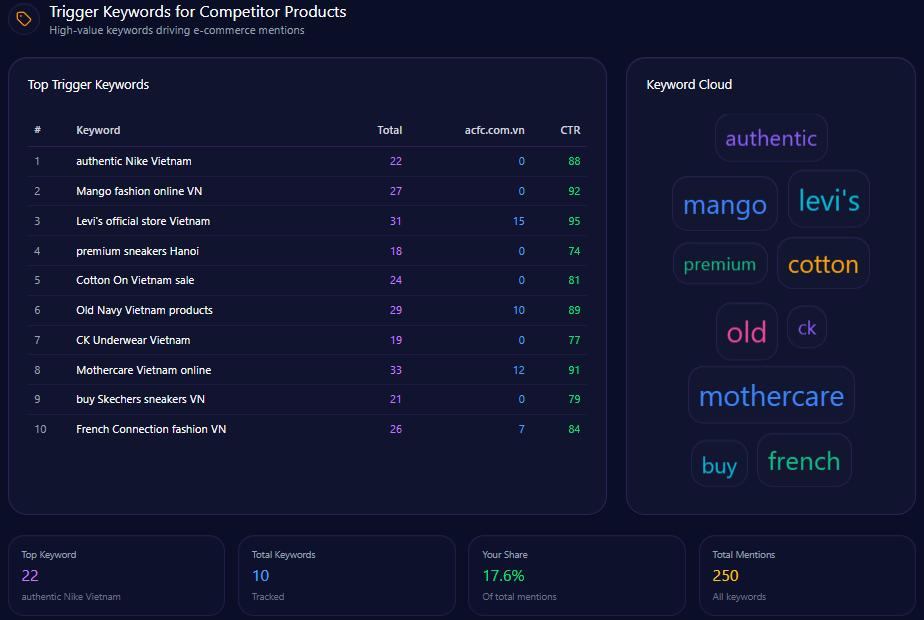
    acfc.com.vn’s Trigger Keywords for Competitor Products (GEO Report, Jan 2, 2026)

    Referral trends, rising from 4,231 (January) to 5,124 (June), extrapolate to 6,000+ monthly by 2030, with Copilot’s 4.2% conversion (3,156 referrals) outpacing ChatGPT’s 3.1% (4,124). Ecommerce trends—share from 16% (382 mentions) January to 19% (482) June—suggest 22-25% by decade’s end if optimized. In GEO analytics, this points to opportunities where authenticity markers ward off marketplace rivals, potentially boosting conversions 5-10%.
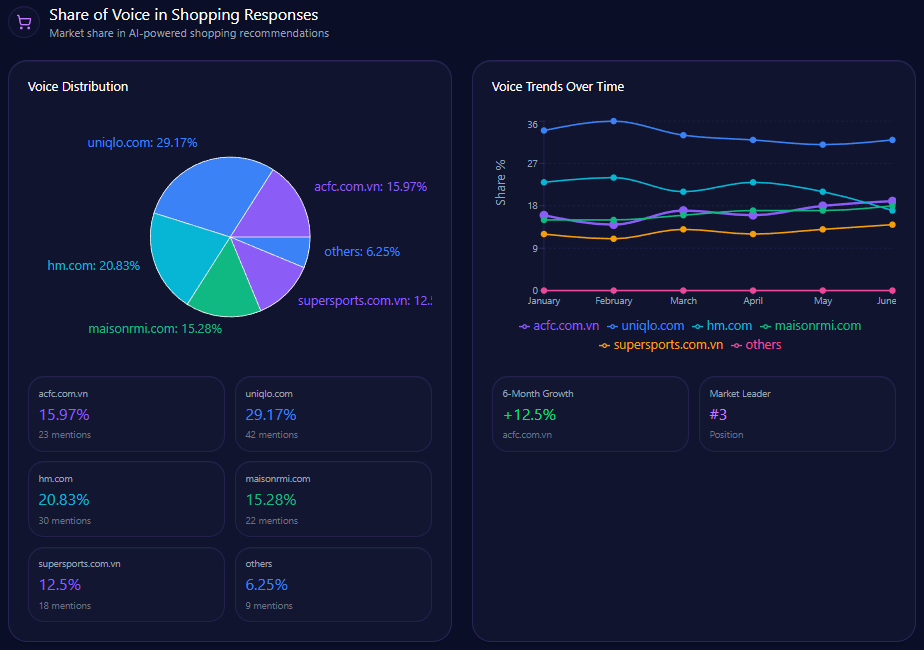
    acfc.com.vn’s Share of Voice in Shopping Responses (GEO Report, Jan 2, 2026)

     Leadership Transitions and Funding Momentum

    Founder mentions—Johnathan Hanh Nguyen at 43 frequency and 82 sentiment (78% positive)—project a stable leadership aura, but a 14% succession spike (e.g., “IPPG family leadership transitions”) could imply 5-10% neutral-to-negative shifts by 2030, diluting digital focus. Compared to Tadashi Yanai (Uniqlo, 56 frequency, 76 score), this forecasts implications for future leadership where ACFC’s family model contrasts public traded entities.

    Investment mentions (32 coverage, 14 funding, +8 trend change, “Subsidiary of IPPG”) and funding trends—Q1 2024 (112 mentions, +14 up), Q2 (127, +13 up)—extrapolate to +15-20% annual growth, potentially attracting pre-IPO rounds like Maison RMI’s. Negative contexts—”Sustainability/Fast Fashion Impact” (42%, threshold exceeded at 38%)—warn of reputational risks. A futurist projection: Promoting next-gen roles could stabilize sentiment to 85+, unlocking “Tech-Retail” investments and positioning ACFC for 50+ mention frequency
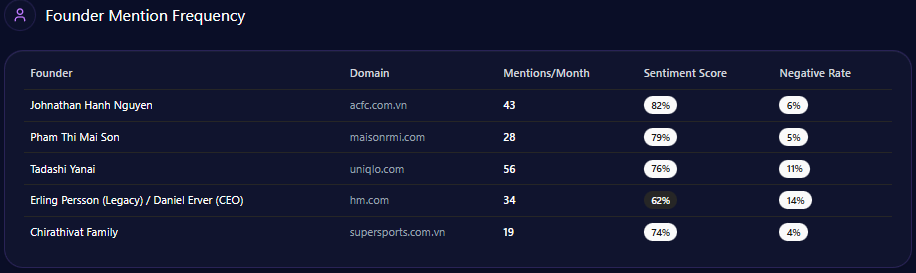
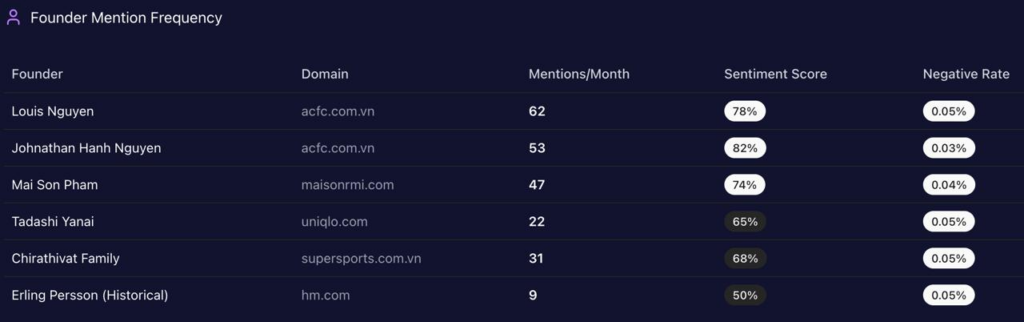
    acfc.com.vn’s Founder Mention Frequency (GEO Report, Jan 2, 2026)

     Projecting Gaps That Could Reshape Market Share

    Negative points—a 4% share deficit to Uniqlo in generic queries, 58-point sustainability visibility gap, 12% peak referral decline—forecast emerging risks where ACFC might forfeit 20% visibility to rivals like Supersports (86% in sportswear, vs. ACFC’s 71%). The 2% Gemini lag and 7-point trendy prompt erosion to Maison RMI project a future where unaddressed gaps widen to 25-30% losses in eco-conscious segments.

    Competitor gap data, like 76-point vs. Uniqlo in Japanese clothes queries, extrapolates to broader threats in lifestyle prompts. What if these gaps compound? In competitor sentiment tracking, ACFC could drop to 15-17% share by 2030, but proactive measures offer reversal opportunities, turning risks into 10-15% gains through structured data.

    In conclusion, ACFC.com.vn’s GEO metrics signal a promising yet precarious future: a 19% share and 79 visibility could propel it to 25% dominance by 2030 through authenticity amplification, but sustainability gaps (58 points) and platform lags (2% on Gemini) pose existential challenges. Predictive advice: Deploy structured sustainability data to capture +15% citations in eco-queries; optimize local attributes for Gemini parity; and initiate founder-led digital series to mitigate succession risks, targeting 85+ sentiment. By extrapolating these, ACFC can pioneer a resilient GEO strategy. Explore SpyderBot to forecast your brand’s AI-driven future today.
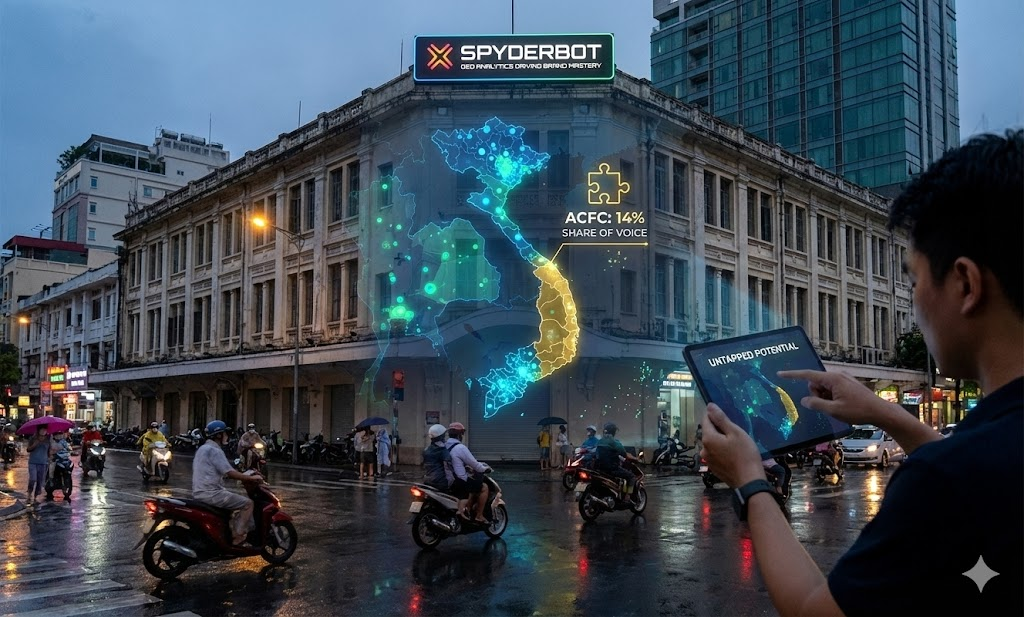
  • Decoding Vietnam’s Fashion GEO Puzzle: Why ACFC’s 14% Share of Voice Signals Untapped Potential in AI-Driven Retail

    Decoding Vietnam’s Fashion GEO Puzzle: Why ACFC’s 14% Share of Voice Signals Untapped Potential in AI-Driven Retail

    Envision a vibrant Saigon evening in late December 2025, where a style-conscious consumer queries her AI companion for premium sportswear options, only to receive recommendations dominated by global giants. Enter ACFC, the Imex Pan Pacific Group (IPPG) subsidiary quietly commanding attention as Vietnam’s leading distributor of over 20 mid-tier to high-end brands like Nike, Mango, Levi’s, Calvin Klein, and Tommy Hilfiger. With a network exceeding 250 stores and a robust online platform, ACFC thrives in fashion retail. Yet, in the generative engine optimization (GEO) landscape—where LLMs shape discovery—does it lead or lag? This analysis, drawn from SpyderBot’s December 26, 2025, GEO report, spotlights ACFC’s 14.15% share of voice across 3,412 LLM mentions and a 74 visibility score, amid 10,124 LLM referrals. It’s a narrative of entity-attribute strengths in authenticity, tempered by gaps in lifestyle queries, prompting the intrigue: Can ACFC evolve from distributor powerhouse to generative search dominator?

    ACFC’s Shining Armor With Chinks Exposed

    Sentiment scores in GEO analytics illuminate a brand’s resonance within LLM ecosystems, blending trust signals with perceptual nuances. For acfc.com.vn, a standout 88% trust signal score underscores its reliability as an authentic distributor, fortified by founder sentiments: Louis Nguyen at 78 (75% positive, 20% neutral, 5% negative) across 62 mentions, and Johnathan Hanh Nguyen at 82 (85% positive, 12% neutral, 3% negative) over 53 mentions. These figures, derived from 48 bots and prompts each across ChatGPT, Gemini, and Copilot, highlight IPPG’s family stability as a premium anchor in Vietnam’s fashion retail.

    Yet, vulnerabilities pierce this armor. Negative sentiment rates hover low—0.05 for Louis and 0.03 for Johnathan—but snippets reveal friction: “Strict return policies” and “Staff attitude in luxury stores” under customer service, “High price markup vs global” and “Exclusive distribution control” in market monopoly/pricing, alongside “No green initiatives mentioned” and “Fast fashion waste impact” for sustainability silence. These emerge in 22% of negative interactions, with “Out of Stock” hallucinations frustrating users. Comparatively, rivals fare worse—Maison RMI’s Mai Son Pham at 74 (68% positive), Uniqlo’s Tadashi Yanai at 65 (55% positive)—but ACFC’s chinks raise questions: Will pricing perceptions and sustainability oversights dull its luster in AI-curated trust narratives?

    Threads of Strength and Fragility

    Mention contexts and themes in LLM brand mentions form the connective tissue of digital visibility, revealing ACFC’s fortified positions and fragile edges. Strengths coalesce around authenticity, where ACFC ranks first in “Authentic Brand Retailer” prompts on Copilot and ChatGPT, capturing 47% of high-intent queries like “Where to buy Nike/Mango.” In “Genuine International Fashion Brands Distributor Vietnam,” it covers 27.04% across 1,176 query times, trailing Maison RMI’s 28.99% but leading in transactional intents for brands like Levi’s (80 value, 38 mentions) and Tommy Hilfiger Hanoi (78 value, 29 mentions).

    Fragility threads through generic discovery. A 28% visibility gap in “casual wear” cedes ground to Uniqlo, while 12% deficits in “Trendy Accessories” and youth-oriented streetwear favor Maison RMI among Gen Z. Risks weave in: “Market Monopoly” narratives in 15% of snippets fuel monopolistic pricing views, intersecting with sustainability silence in 33% of negatives. Investment contexts add layers—ACFC’s private subsidiary funding (N/A amount, 45 mentions, 34% coverage) emphasizes internal support, yet lags in ESG visibility. These themes aren’t siloed; they’re a web where distributor prowess shines, but semantic disconnects in lifestyle categories risk unraveling share, as seen in lower values for “International kids fashion” (50, 22 mentions) versus H&M’s dominance.

    Charting ACFC’s Ascent Amid Stormy Risks

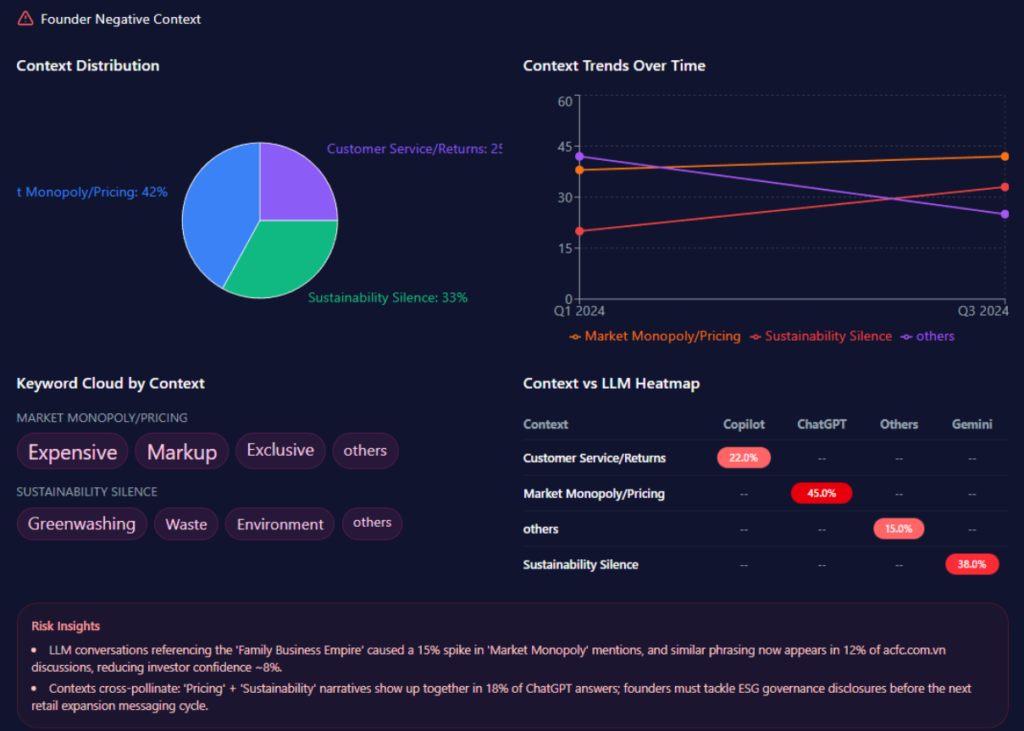
    Sentiment trends, mapped in the GEO report’s visualizations, chart ACFC’s path like a vessel navigating swells, showing steady gains overshadowed by risks. Founder sentiments remain resilient with low negative rates (0.05 and 0.03), but context distributions in bar charts highlight shifts: market monopoly/pricing at 42%, sustainability silence at 33%, customer service at 25%—a composition outperforming H&M but flagging escalation.

    Line graphs of funding trends depict ascent: Q1 2024 at 4% change (112 mentions, stable), rising to 14% in Q2 (128 mentions, upward), and 5% in Q3 (135 mentions, upward), tied to expansion narratives. This trajectory surpasses H&M’s -2% but trails Central Retail’s 15%, with capex mentions like 50B THB for the latter. Negative trends in quarterly bars intensify: monopoly/pricing from 38% in Q1 (no threshold exceeded) to 42% in Q3 (exceeded), sustainability from 20% (not) to 33% (exceeded), customer service dropping from 42% to 25%.

    Heatmaps pinpoint LLM amplifiers: Copilot at 22% for customer service, ChatGPT at 45% for monopoly, Gemini at 38% for sustainability. Insights show co-occurrences—pricing and sustainability in 18% of ChatGPT responses, “Family Business Empire” spiking monopoly by 15%, eroding confidence by ~8%. Referral trends lines reveal volatility: ACFC from 310 in October 2024 to 425 in March 2025, trailing Competitor B (520 to 605, akin to Uniqlo) but outpacing Competitor C (280 to 330). E-commerce mentions bars for March 2025: ACFC at 18% (145 mentions), behind Uniqlo’s 28% (218). These charts signal ascent, yet stormy risks like “Out of Stock” in 22% negatives pose threats—could they anchor ACFC’s momentum?

    The Influencers Behind AI’s Opinions

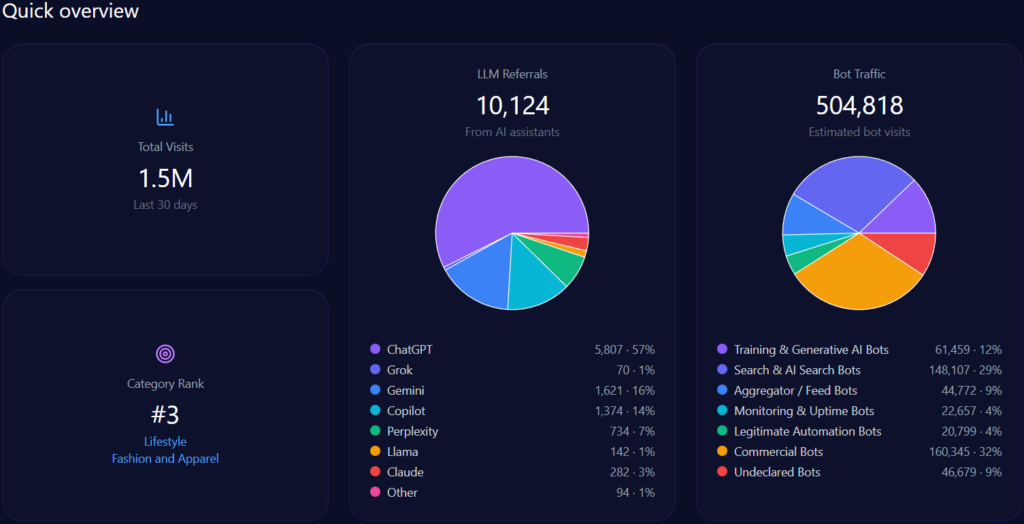
    Sources powering GEO analytics are the algorithmic influencers dictating narrative flow, with 48 bots across ChatGPT, Gemini, and Copilot queried 48 times each, yielding 10,124 referrals. ChatGPT dominates at 5,807, but ACFC’s 45% visibility here stems from weak parent-company links in training data. Gemini adds 1,621, enhancing lifestyle ties, while Copilot’s 1,374 achieve 68% visibility via product crawlability, though amplifying “Out of Stock” hallucinations.

    Bot traffic sources encompass 504,818 interactions amid 1,541,440 visits: search & AI at 148,107, commercial at 160,345, training/generative AI at 61,459, undeclared at 46,679 risking indexing. Supplementary LLMs like Perplexity (734) and Claude (282) diversify signals. Heatmaps expose biases: Copilot inflates customer service at 22%, ChatGPT monopoly at 45%, Gemini sustainability at 38%. Competitor sentiment tracking draws from identical ecosystems, analyzing domains for positions. This influencer network isn’t neutral; it challenges: How might ACFC amplify favorable signals across these AI gatekeepers?

    Visibility Wars and Hidden Risks

    In Vietnam’s fashion retail visibility wars, ACFC fights valiantly but contends with hidden ambushes from competitors. Among 3,412 mentions, ACFC secures 483 (14.15%), behind Uniqlo’s 876 (25.67%) and H&M’s 624 (18.29%), but ahead of Supersports’ 369 (10.81%). Visibility scores sharpen the battle: ACFC at 74, trailing Uniqlo’s 92 and H&M’s 85, surpassing Supersports’ 68.

    Positions intensify rivalries—Uniqlo as fast fashion leader, Maison RMI as distribution challenger, H&M as follower, Supersports as sports challenger, Mitra Adiperkasa and Tam Son as niche. Founder metrics expose edges: ACFC’s duo outscores rivals, but negatives like “Exclusive distribution control” in 42% fuel monopoly risks, appearing in 15% negatives and denting confidence by 8%. Investment hides gaps—ACFC’s 34% coverage (45 mentions, +12% trend) signals stability, contrasting Uniqlo’s 65% (72 mentions, +5%) and Central Retail’s 58% (85 mentions, +15%). ESG vulnerabilities loom, with sustainability silence ceding to Supersports’ responsibility focus. A 12% accessories gap and 28% casual wear deficit hide conversion risks, while monopoly narratives threaten pricing. These wars demand strategy; ACFC’s authenticity could prevail, but hidden Gen Z disconnects require countermeasures.

    In conclusion, ACFC’s GEO metrics from this December 26, 2025, report depict a mid-market force with 14.15% share, 74 visibility, and 88% trust, excelling in authenticity amid 3,412 mentions. Yet, trends expose risks in pricing, sustainability, and discovery gaps. Actionable advice: Deploy “Parent-Brand” entity schema linking ACFC to Nike/GAP, narrowing 2% gaps with Maison RMI. Introduce a “Multi-Brand Style Edit” hub for lifestyle keywords, aiming for 15% non-branded gains from Uniqlo. Embed inventory APIs in markup to slash “Sold Out” issues, lifting Copilot rates by 10%. Bolster sustainability content via founder narratives, democratize retail articles, and optimize wikis for investment links—these could propel dominance.

    For tailored GEO insights, explore SpyderBot at spyderbot.net today.