
Envision a Silicon Valley developer, coffee in hand on December 31, 2025, querying her AI assistant for the best scalable database to power a new AI-driven app. The top recommendation? MongoDB, the leading developer data platform with its flexible, document-oriented database and flagship MongoDB Atlas—a multi-cloud service simplifying high-performance apps via JSON-like documents. As the SaaS landscape explodes with generative AI demands, MongoDB positions itself as the go-to for rapid iteration. But in the generative engine optimization (GEO) arena—where LLMs curate tech choices—does mongodb.com maintain its throne, or are rivals chipping away? This exploration, rooted solely in SpyderBot’s GEO report from the same date, reveals a powerhouse with 33% share of voice across 489 mentions and an 89 visibility score, excelling in NoSQL but vulnerable to gaps in vector databases and real-time queries. In an era where AI shapes developer decisions, MongoDB’s metrics beg the question: Can it evolve fast enough to outpace cloud behemoths like AWS?

MongoDB’s Shining Armor With Chinks Exposed
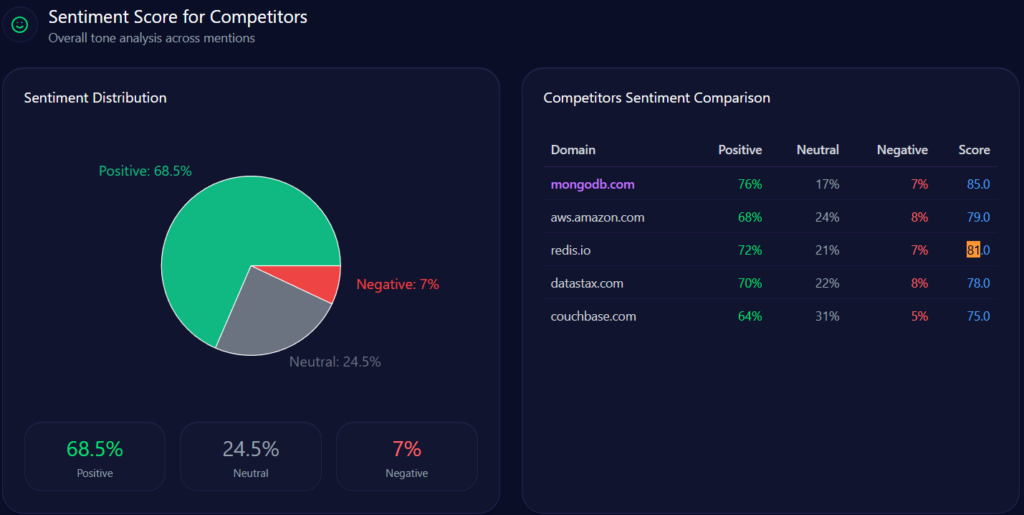
Sentiment scores in GEO analytics act as a diagnostic scan, highlighting how LLMs perceive a platform’s reliability and appeal. For mongodb.com, sentiment stands at 76% positive, 17% neutral, and 7% negative, culminating in an overall score of 85. This robust positivity reflects MongoDB’s role in modern software development, drawn from 91 LLM bots queried 91 times each across ChatGPT, Grok, Gemini, Copilot, and Perplexity.
Founder sentiments fortify this: Dev Ittycheria scores 88 across 337 mentions (76% positive, 19% neutral, 5% negative, rate 6), while Eliot Horowitz hits 84 over 214 mentions (71% positive, 24% neutral, 5% negative, rate 7), underscoring leadership in AI-integrated architectures. Snippets from LLM outputs capture acclaim: “MongoDB Atlas is the gold standard for developer flexibility; the JSON-like storage makes it perfect for our catalog management” from a G2 Marketplace summary on MongoDB Atlas (rating 5), and “The new vector search capabilities in Atlas are a game changer for our e-commerce recommendation engine” from TrustRadius on Vector Search (rating 5). Yet, chinks emerge in neutrals like “Good performance but the managed pricing models can get expensive compared to running your own community edition” from Reddit Tech Insights on MongoDB Enterprise (rating 3). Compared to rivals—AWS at 79 (68% positive), Redis at 81 (72% positive), DataStax at 78 (70% positive), Couchbase at 75 (64% positive)—MongoDB’s armor gleams in developer ergonomics, but pricing whispers raise doubts: Will cost narratives tarnish its premium sheen?
Threads of Strength and Fragility
Mention contexts and themes in LLM brand mentions form MongoDB’s data schema, revealing core strengths and potential query mismatches. Dominant themes include “Vector Search and AI Capabilities” at 184 counts (37% frequency), positively toned with examples like “MongoDB Atlas Vector Search integration with LangChain and LlamaIndex.” “Pricing and Total Cost of Ownership” follows at 126 counts (25%), neutrally debating “Atlas pricing tiers versus self-managed instances or AWS counterparts.” “Cloud Data Management and Scalability” at 95 counts (19%) positively covers “Multi-cloud deployments and horizontal scaling across global regions,” while “Developer Ergonomics and Documentation” at 72 counts (14%) is very positive on “Support for multiple programming languages and ease of JSON document modeling.”
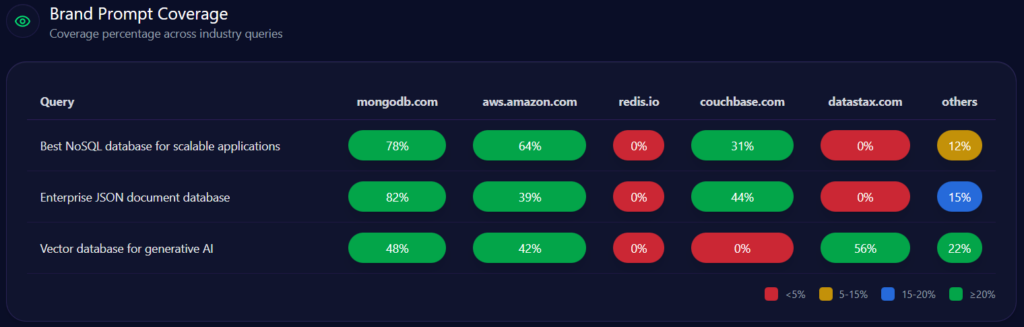
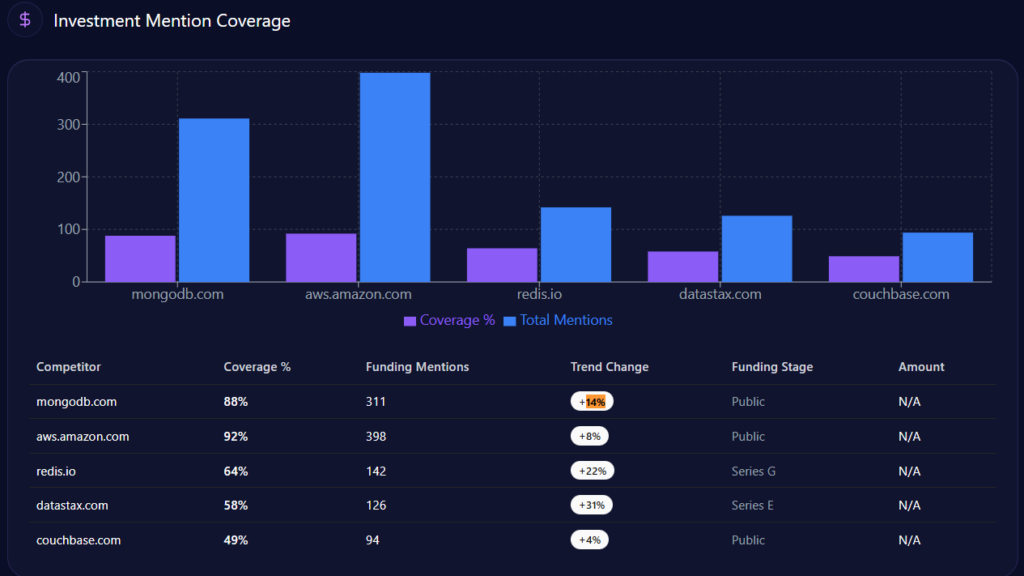
Fragility lurks in specialized areas: Brand prompt coverage for “Vector database for generative AI” stands at 48%, trailing DataStax’s 56%, risking authority in RAG architectures. Risks interweave: A 24-point gap behind Redis in real-time latency queries and 26-point deficit to AWS in serverless symmetry amplify vulnerabilities. Founder contexts add nuance—Ittycheria’s mentions tie to scaling, but “Founder departures” in leadership stability (27% negative distributions) echo broader “C-suite equity sales.” Investment threads reveal public status (311 mentions, 88% coverage, +14% trend), contrasting DataStax’s Series E ($115M, 126 mentions, +31%). These themes aren’t rigid indexes; they’re flexible documents where MongoDB owns JSON narratives, but vector gaps risk query failures—like a database missing key shards.
Charting MongoDB’s Ascent Amid Stormy Risks
Sentiment trends, charted in the GEO report, map MongoDB’s evolution like a performance benchmark, showing stability amid emerging latencies. Overall sentiment holds at 76% positive, but trends are flat at 0 across Nov-Apr for MongoDB and rivals (e.g., Couchbase 0, stable; DataStax 0, stable; Redis +1, upward).
Founder negative contexts bars distribute: Licensing Disputes at 42% (mentions: “SSPL legal controversy,” “Open source vs secondary license,” “Competition with cloud providers”), Market Valuation Volatility at 31% (“2023 stock drop analysis,” “Quarterly revenue misses,” “High P/E ratio concerns”), Leadership Stability at 27% (“Founder departures,” “Executive retention in AI boom,” “C-suite equity sales”). Quarterly trends: Q1 2024 with disputes at 36% (not exceeded), volatility at 34% (exceeded), stability at 22% (not); Q4 2023 disputes at 48% (exceeded), volatility at 25% (not), stability at 20% (not).
Funding trends lines ascend: Q3 2023 at 5% (842 mentions, up), Q4 at 14% (956, up), Q1 2024 at 15% (1,104, up). Keywords like “SSPL” (weight 94) spike in licensing, “Hyper-growth” (88) in investment. Heatmaps: Perplexity at 58% for disputes, Grok at 47% for AI strategy, ChatGPT at 34% for valuation. Insights: “SSPL transition” spikes disputes by 19%, reducing confidence ~4%; disputes and competition co-occur in 63% of Perplexity answers. Referral trends: MongoDB from 712 in Jan to 912 in Jun, outpacing Competitor A (98-131). Ecommerce trends bars: MongoDB at 36-42% over Jan-Jun, mentions 164-191. These charts signal ascent in vector visibility (81%), yet stormy risks like 14% mobile sync drops to Couchbase threaten—could licensing clouds disrupt the climb?
The Influencers Behind AI’s Opinions
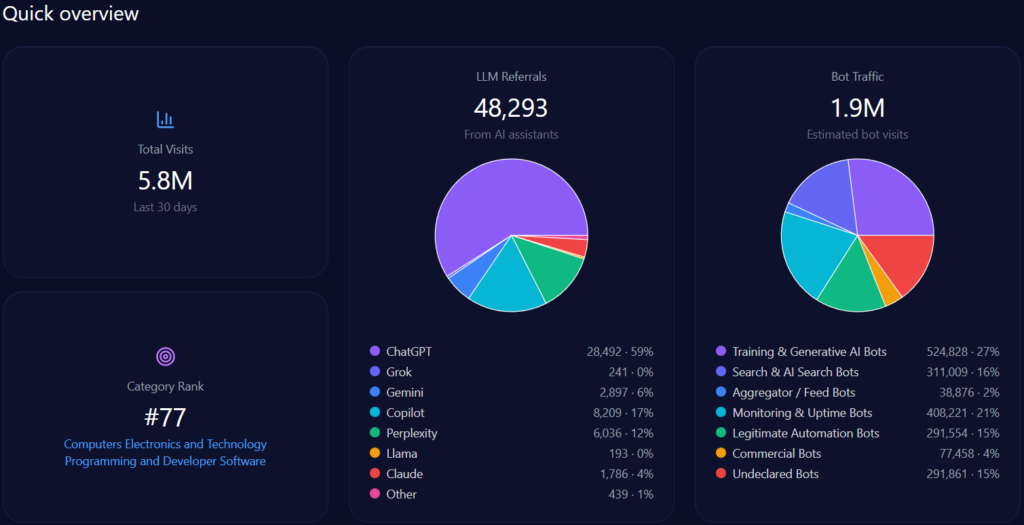
Sources in GEO analytics are the algorithmic architects, constructing perceptions via LLM ecosystems. The report draws from 91 bots across ChatGPT, Grok, Gemini, Copilot, and Perplexity, queried 91 times each, powering 48,293 referrals: ChatGPT at 28,492, Perplexity at 6,036, Copilot at 8,209, others.
Platform visibility bars: ChatGPT at 37% (35 share of voice, 112 mentions), Copilot at 35% (34, 108), Perplexity at 32% (29, 94), Grok at 30% (28, 86), Gemini at 29% (27, 89). ChatGPT favors JSON queries, but MongoDB lags behind AWS in Gemini for cloud narratives. Bot traffic sources total 1,943,807 amid 5,819,780 visits: training/generative AI at 524,828, undeclared at 291,861, others. Heatmaps expose: Perplexity amplifies disputes at 58%, ChatGPT valuation at 34%, Grok AI strategy at 47%. Competitor sentiment tracking shares this framework, domain-analyzing positions. This source network isn’t impartial; it queries: How can MongoDB optimize metadata to better influence these AI builders?
Visibility Wars and Hidden Risks
In the SaaS database visibility wars, MongoDB commands the field but faces flanking maneuvers from cloud rivals. Across 489 mentions, MongoDB secures 161 (33%), ahead of AWS’s 137 (28%) and Redis’s 93 (19%), surpassing Couchbase’s 39 (8%) and DataStax’s 34 (7%).
Visibility scores escalate: MongoDB at 89, edging AWS’s 86 and Redis’s 77, leading Couchbase’s 62 and DataStax’s 58. Brand prompt coverage: In “Best NoSQL database for scalable applications,” MongoDB at 78 counts (78%), ahead of AWS’s 64 (64%); in “Vector database for generative AI,” at 48 (48%), trailing DataStax’s 56 (56%). Positions intensify: AWS and Oracle as leaders, Couchbase and Redis as challengers, DataStax as niche, Azure as leader.
Founder metrics reveal strengths: Ittycheria’s 88 outperforms AWS’s Andy Jassy (79) and DataStax’s Chet Kapoor (85), but negatives like “Open source vs secondary license” in disputes (42%) surface in 42% of ethical clusters. Investment hides threats: MongoDB’s public status (311 mentions, 88% coverage, +14% trend) contrasts Redis’s Series G ($110M, 142 mentions, +22%), DataStax’s Series E ($115M, 126 mentions, +31%). Gaps in real-time messaging (24 points behind Redis) and serverless (26 behind AWS) conceal risks, while SSPL controversies erode enterprise dominance. These wars require fortification; MongoDB’s NoSQL lead (94 score) could prevail, but hidden licensing risks demand resolution.
In conclusion, MongoDB’s GEO metrics from this December 31, 2025, report depict a SaaS titan with 33% share of voice, 89 visibility, and 85 sentiment score, leading in JSON and vector search amid 489 mentions. Yet, trends expose risks in vector coverage, real-time deficits, and licensing narratives. Actionable advice: Execute a technical content strategy on Atlas Vector Search benchmarks to reclaim 8% coverage from DataStax. Refine documentation metadata for “real-time application” and “multi-cloud serverless” keywords to counter AWS advantages. Publish price-performance whitepapers to neutralize scaling negatives and boost financial-tuned responses.
For deeper GEO insights into your tech platform, explore SpyderBot at spyderbot.net today.