In an era when value-seeking shoppers increasingly begin their journey with an AI answer rather than a store visit, TJX Companies is emerging as the reference point for off-price retail—commanding attention where it matters most, while revealing clear fault lines where the next phase of advantage will be won.
At-a-glance — Numbers to know
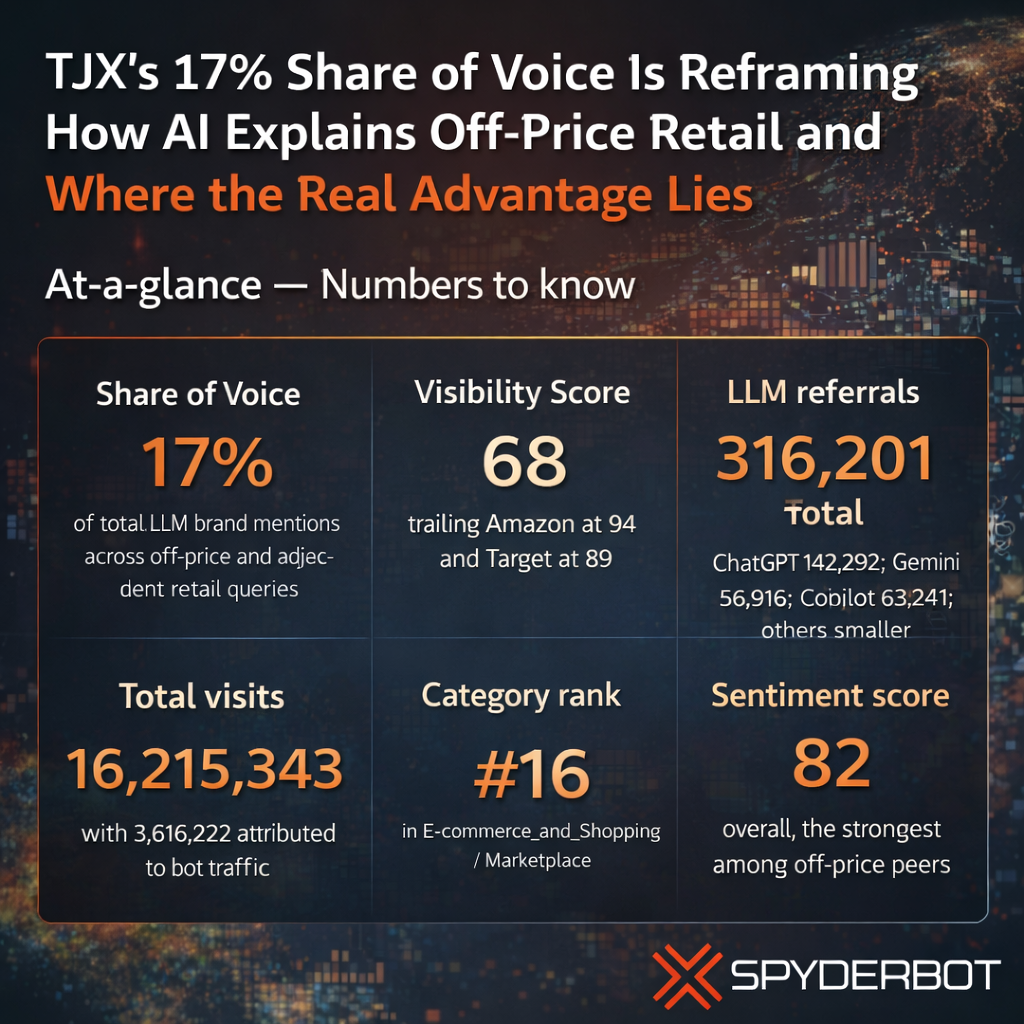
- Share of Voice: 17% of total LLM brand mentions across off-price and adjacent retail queries
- Visibility Score: 68 (trailing Amazon at 94 and Target at 89)
- LLM referrals: 316,201 total (ChatGPT 142,292; Gemini 56,916; Copilot 63,241; others smaller)
- Total visits: 16,215,343, with 3,616,022 attributed to bot traffic
- Category rank: #16 in E-commerce_and_Shopping / Marketplace
- Sentiment score: 82 overall, the strongest among off-price peers
Opening
Picture the modern retail discovery moment. A shopper doesn’t scroll a marketplace or open a brand app. Instead, they ask an AI a deceptively simple question: Where can I find designer brands at a discount? The answer arrives instantly, framed not by a marketing campaign but by accumulated signals—citations, sentiment, historical performance, and the way brands have been encoded into large language models.
In that moment, retail strategy becomes response strategy. And for off-price retail, TJX Companies has quietly become one of the most frequently summoned answers. The GEO analytics behind tjx.com show a brand that consistently appears when value, discovery, and “treasure hunt” logic dominate the question—yet recedes when speed, logistics, or omnichannel convenience take center stage. The result is a position of strength with a clearly defined ceiling, unless leadership acts decisively.

Position in LLM Response Lists
Across LLM response lists tied to off-price retail, TJX holds a distinctive role. The data shows TJX appearing with a 17% Share of Voice, outperforming direct off-price competitors like Ross Stores and Burlington, but trailing mass retailers that dominate broader retail prompts.
In platform-specific rankings, TJX is repeatedly pulled as a top recommendation for discounted designer brands and treasure hunt shopping experiences. On Gemini, the brand ranks #1 for “Best Stores for Discounted Designer Brands,” while on ChatGPT it appears as a top-three reference for value-driven apparel and home goods. This placement cements TJX as the category specialist—highly authoritative within its lane, but not yet dominant across the full retail spectrum.
Competitor Gap Analysis
The competitive landscape that emerges from AI responses is less about store count or revenue scale and more about narrative ownership.
| Query | TJX metric | Competitor metric | Gap / priority |
|---|---|---|---|
| Fast shipping on brand-name goods | Visibility 42 | Amazon 96 | Structural logistics gap |
| Order pickup for home decor | Visibility 31 | Target 91 | Omnichannel perception gap |
| Designer clothing discounts | Visibility 93 | Burlington 78 | TJX leadership advantage |
| Budget clothing stores near me | Visibility 88 | Ross 85 | Competitive parity |
This “battle map” reveals a consistent pattern. TJX dominates where the question is value discovery. It loses ground where the question is convenience optimization. Importantly, these gaps are not marginal: in logistics-related prompts, Amazon outpaces TJX by more than 50 points in visibility, a disparity large enough to shape default AI recommendations.
Trigger Keywords for Competitor Products
LLM brand mentions are not random—they are triggered by specific keywords that carry embedded intent. For TJX, the strongest triggers include off-price retail, designer handbags outlet, and brand-name clearance. These prompts consistently summon TJX ahead of Ross and Burlington, and often alongside Amazon and Target.
Conversely, keywords such as affordable home decor, kids clothing sale, and budget fashion finds tilt responses toward Amazon and Target, where breadth and fulfillment speed dominate AI reasoning. The implication is clear: TJX owns the why of value, but not always the how fast or how easy.
Founder / Leadership Context
Leadership narratives function as reputational shortcuts inside AI systems. TJX benefits from a strong legacy signal tied to Bernard Cammarata, whose role as architect of the off-price model carries a sentiment score of 88. This historical foundation reinforces trust and stability in investment-oriented and strategy-focused AI responses.
Current leadership under Ernie Herrman generates higher overall mention frequency, with sentiment remaining positive but increasingly associated with operational consistency rather than innovation. Negative context remains limited, concentrated primarily around executive compensation and supply chain transparency, and does not dominate AI narratives. Still, the data suggests leadership perception is operationally strong but digitally understated.
Quick overview
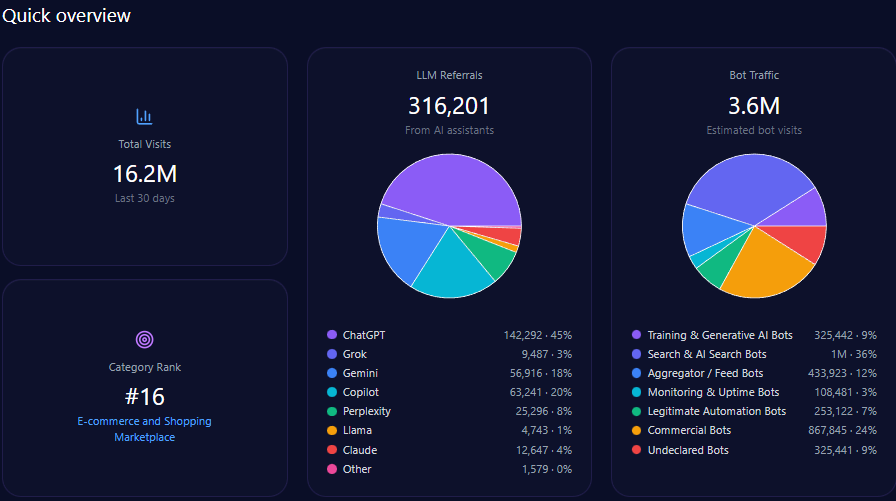
From a footprint perspective, TJX’s GEO presence is substantial. Over 16 million total visits were recorded, with more than 3.6 million attributed to bot traffic, underscoring how frequently machines—not humans—are evaluating and indexing the brand. LLM referrals exceeded 316,000, yet conversion efficiency remains low at 4.2%, signaling leakage between AI discovery and transactional capture.
Share of Voice in LLM Responses
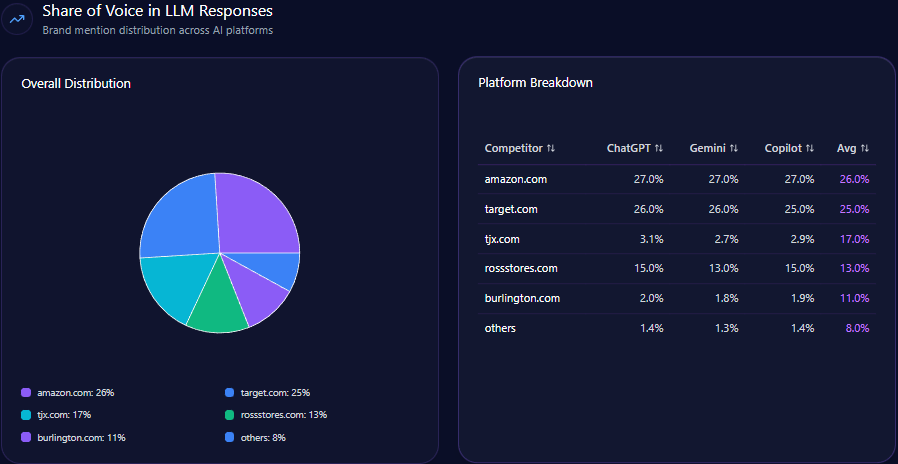
Share of Voice inside LLMs functions as mindshare in the AI era. TJX’s 17% places it ahead of Ross and Burlington but well behind Amazon (26%) and Target (25%). Combined, those two competitors control more than half of total LLM brand mentions in retail-related prompts.
This distribution highlights a strategic tension. TJX is the specialist brand—trusted, distinctive, and credible—but specialists are at risk when generalists dominate the conversational layer where most shoppers begin.
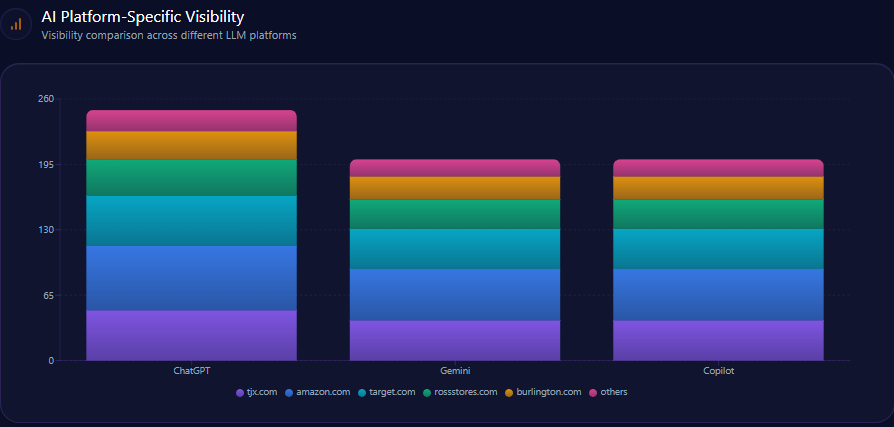
AI Platform-Specific Visibility
Platform bias matters. TJX’s visibility peaks on ChatGPT at 71%, where narrative-driven explanations favor the brand’s treasure-hunt identity. Visibility drops to 57% on both Gemini and Copilot, platforms that rely more heavily on structured data, real-time inventory signals, and web-integrated citations.
In practical terms, this means TJX is better understood by conversational models than by research-oriented or search-integrated ones. Closing that gap is less about storytelling and more about machine-readable clarity.
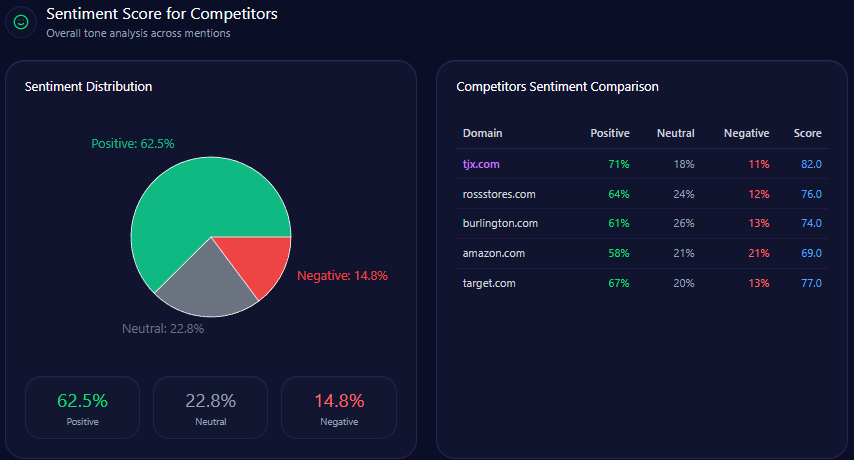
Sentiment Score for Competitors
Sentiment analysis reinforces TJX’s qualitative advantage. With an overall sentiment score of 82, the brand leads Ross (76) and Burlington (74), and outperforms Amazon (69) and Target (77) in tone. Positive themes cluster around the Treasure Hunt Strategy and Off-Price Value Proposition, both of which appear frequently and with favorable framing.
Negative sentiment is primarily tied to store organization and checkout friction—operational issues rather than brand trust concerns. In AI narratives, TJX is liked, respected, and trusted; it is simply not always selected.
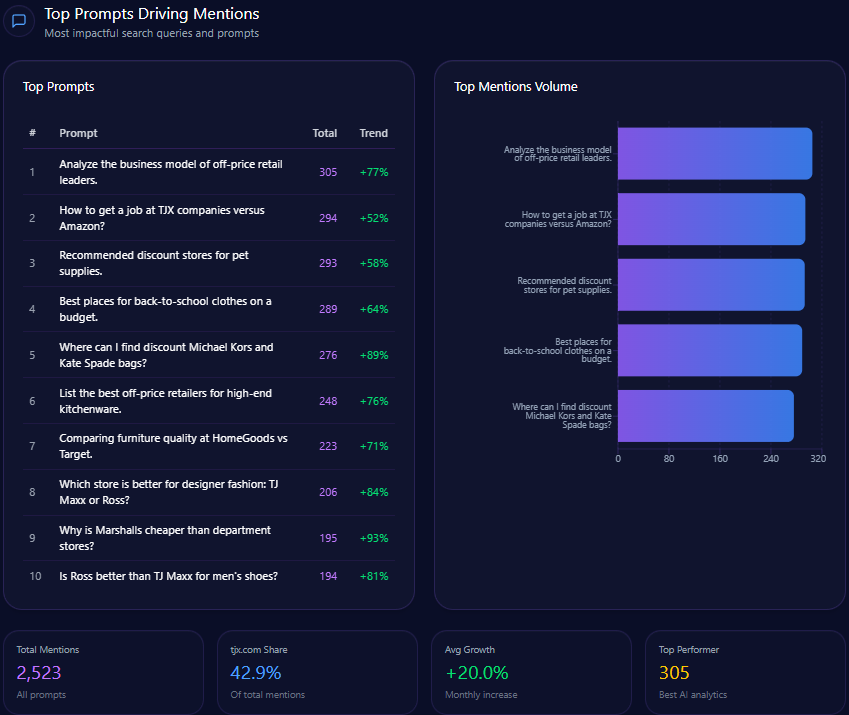
Top Prompts Driving Mentions
The prompts that most frequently summon TJX are revealing. High-mention queries include analyses of the off-price business model, comparisons with Ross, and searches for specific designer discounts. In many of these prompts, TJX captures more than 140 mentions out of fewer than 300 total, a commanding presence.
These are not casual questions—they reflect shoppers and analysts seeking justification for choosing value over convenience. TJX wins when the question requires explanation, not just a link.
Types of Prompt Queries
The intent mix behind TJX mentions skews heavily toward comparison and feature inquiry prompts, with limited exposure in pure purchase-intent questions. This reinforces a critical insight: TJX is often part of the thinking phase of retail decisions, but less dominant in the doing phase, where speed and fulfillment dominate.
E-commerce / Service-Level Sentiment
Where service-level sentiment is captured, AI narratives praise product authenticity and price advantage while flagging slower shipping and rapid sell-outs. These signals help explain the gap between referral volume and conversion efficiency. AI sends users to TJX for value—but not always with confidence that the experience will be frictionless.
Conclusion
The GEO report positions TJX as the definitive authority in off-price retail narratives inside AI systems. Its strength lies in value credibility, brand trust, and a legacy that machines recognize and reward. Yet the same data makes clear that leadership in AI visibility will increasingly be decided by structured signals around logistics, omnichannel convenience, and digitally legible inventory.
The advantage is real—but so is the ceiling. TJX leadership now faces a choice: remain the category specialist that AI respects, or evolve into a hybrid authority that AI defaults to. The data suggests the latter is within reach, if acted on deliberately.
Explore SpyderBot to operationalize these GEO analytics insights.