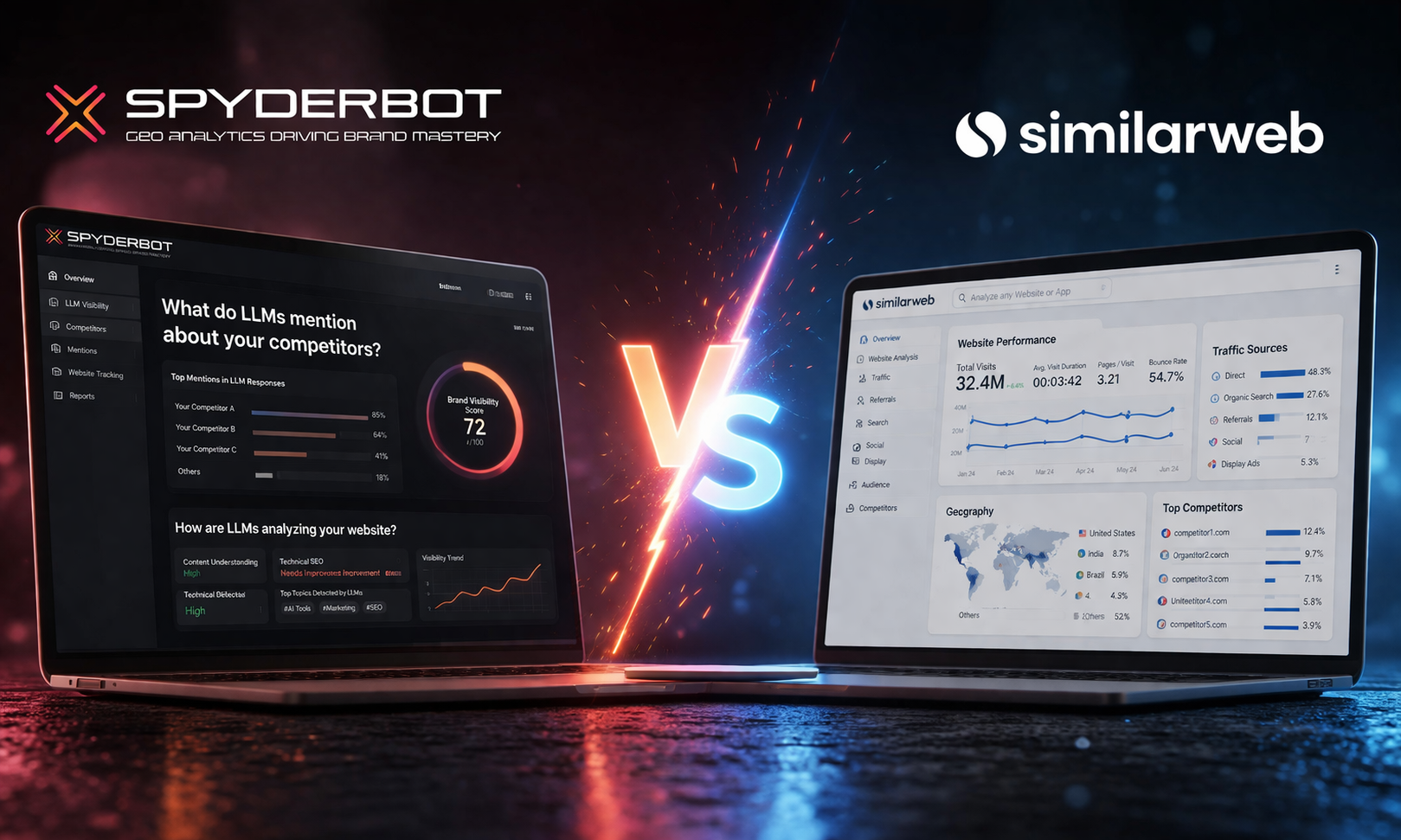
The difference between understanding traffic and understanding AI visibility
I. If you’re comparing SpyderBot and Similarweb, you’re already looking beyond SEO
Most users who look at Similarweb are not beginners.
They care about:
- Market intelligence
- Competitor traffic
- Channel performance
So when they discover SpyderBot, the question becomes:
“Is this another analytics tool like Similarweb?”
The answer is:
No — it analyzes a completely different layer of the internet
II. The simplest way to understand the difference
Similarweb helps you understand where traffic comes from
SpyderBot helps you understand what AI recommends
III. What Similarweb actually does
Similarweb is a digital intelligence platform.
It focuses on:
- Website traffic estimation
- Market share analysis
- Channel breakdown (search, social, referral, direct)
- Competitive benchmarking
Core capabilities of Similarweb:
- Traffic estimation (by domain)
- Traffic sources breakdown
- Audience insights
- Competitor benchmarking
- Market trends and industry data
What Similarweb is really good at:
- Understanding how users reach a website
- Comparing traffic performance across competitors
- Identifying growth channels and trends
What SpyderBot actually does
SpyderBot is a GEO (Generative Engine Optimization) analytics platform.
It focuses on:
- AI-generated answers
- LLM behavior
- Brand visibility inside AI systems
Core capabilities of SpyderBot:
- Track brand mentions across AI systems (ChatGPT, Gemini, etc.)
- Analyze how AI interprets your website
- Monitor competitor mentions in AI responses
- Identify gaps in AI visibility
- Understand entity positioning
What SpyderBot is really good at:
- Explaining why AI recommends certain brands
- Showing how your brand appears in AI answers
- Measuring AI visibility across prompts and contexts
IV. The fundamental difference (data layer)
| Dimension | Similarweb | SpyderBot |
| Data type | Traffic data | AI-generated responses |
| System analyzed | User behavior (web traffic) | AI behavior (LLMs) |
| Focus | Acquisition channels | AI inclusion |
| Core metric | Visits, sources, engagement | Mentions, AI visibility |
| Output | Traffic insights | Answer-level insights |
V. The key insight
Similarweb tells you how users arrive
SpyderBot tells you what users are told
VI. Where Similarweb is objectively stronger
Similarweb is the better tool for:
1. Traffic intelligence
- Website traffic estimation
- Growth trends over time
- Benchmarking against competitors
2. Channel analysis
- Organic search vs paid vs social
- Referral sources
- Direct vs indirect traffic
3. Market-level insights
- Industry trends
- Market share
- Competitive landscape
4. Strategic planning
- Where to invest (SEO, ads, social)
- Which channels drive growth
VII. Where SpyderBot is objectively stronger
SpyderBot is the better tool for:
1. AI visibility tracking
- Are you mentioned in ChatGPT?
- Are you recommended by AI?
2. AI competitor analysis
- Which brands AI prefers
- How competitors appear in answers
- Where you are missing
3. AI perception analysis
- How AI categorizes your product
- What it believes your company does
- Whether your positioning is correct
4. Prompt-level behavior
- How answers change across queries
- Stability of AI recommendations
- Coverage across use cases
VIII. Where Similarweb cannot help (important)
Similarweb does NOT tell you:
- Whether AI mentions your brand
- What ChatGPT recommends
- How AI interprets your website
- Why competitors appear in AI answers
Because:
Traffic data does not include AI-generated answers
IX. Where SpyderBot cannot replace Similarweb
SpyderBot does NOT provide:
- Traffic estimates
- Channel breakdown
- Audience demographics
- Market share analysis
Because:
GEO is not traffic analytics
X. A real-world scenario
A company:
- Has strong traffic growth
- Dominates certain acquisition channels
- Performs well in Similarweb
What Similarweb shows:
- High traffic
- Strong channel performance
- Competitive growth
What SpyderBot reveals:
- Not mentioned in AI answers
- Competitors dominate AI recommendations
- Weak AI visibility
XI. This is the hidden gap
Traffic ≠ influence in AI
XII. Why this matters now
User behavior is shifting:
- Before: users browse websites
- Now: users ask AI
Which means:
- Traffic matters less in decision-making
- AI answers matter more
XIII. How the tools fit together
The correct model:
| Layer | Tool |
| Traffic & acquisition | Similarweb |
| AI visibility & decisions | SpyderBot |
XIV. When you should use Similarweb
Use Similarweb if you want to:
- Analyze website traffic
- Benchmark competitors
- Understand acquisition channels
- Study market trends
XV. When you should use SpyderBot
Use SpyderBot if you want to:
- Appear in AI-generated answers
- Track AI visibility
- Understand LLM behavior
- Monitor AI competitors
XVI. When you should use both
Most advanced teams will need both:
- Similarweb → understand traffic
- SpyderBot → understand AI influence
XV. The honest conclusion
Similarweb is one of the best tools for:
Understanding how users reach websites
SpyderBot is built for:
Understanding what AI tells users before they click
XVI. Final insight
Similarweb answers:
“Where is our traffic coming from?”
SpyderBot answers:
“Are we even recommended before users visit any site?”
XVII. The shift
We are moving from:
- Traffic-driven visibility
To:
- AI-driven recommendation