Tag: target.com

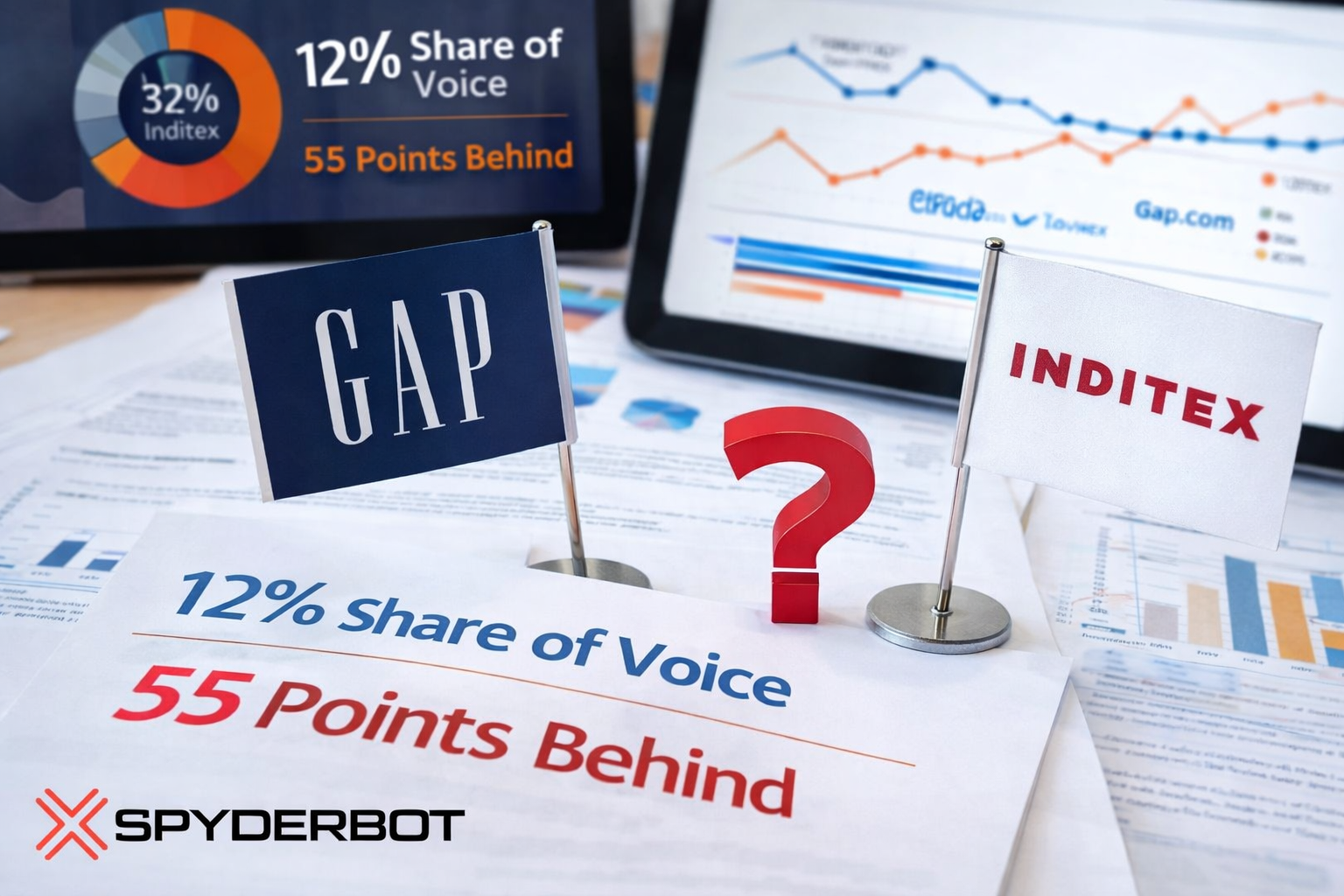
  • Gap.com Generative Engine Optimization: 12% Share of Voice with Critical 55-Point Trend Authority Gap Versus Inditex

    Gap.com Generative Engine Optimization: 12% Share of Voice with Critical 55-Point Trend Authority Gap Versus Inditex

    Gap navigates a complex recovery in GEO visibility marked by elite denim authority and leadership-driven positive sentiment, yet constrained by fulfillment and sustainability visibility deficits against major competitors.

    SpyderBot GEO report reference for gap.com

    At-a-glance

    • 12% overall Share of Voice in LLM brand mentions across top AI platforms.
    • 83% coverage rate in ‘Denim Authority’ category—leading in legacy apparel niches.
    • 32-point operational visibility gap behind Target in fast shipping and last-mile delivery.
    • 55-point authority gap on ‘European fashion trends’ compared to Inditex.
    • 74% positive leadership sentiment associated with CEO Richard Dickson.
    • 64% overall positive sentiment across generative mentions for Gap.
    • 464,187 LLM referrals distributed primarily across ChatGPT, Perplexity, and Gemini.
    • Critical need to realign digital content toward trend-responsive and sustainability-driven narratives.

    Risk signals

    • Substantial 13% Share of Voice deficit versus Target in apparel prompt volume.
    • Lower visibility on Gemini platform at 11%, linked to lack of real-time inventory schema.
    • Negative supply chain sustainability discourse impacts 22% of founder-related LLM outputs.
    • Persistent legacy narratives affecting 19% of investment-related content, indicating erosion concerns.
    • Significant 55-point content authority gap undermines trend-forward brand positioning.
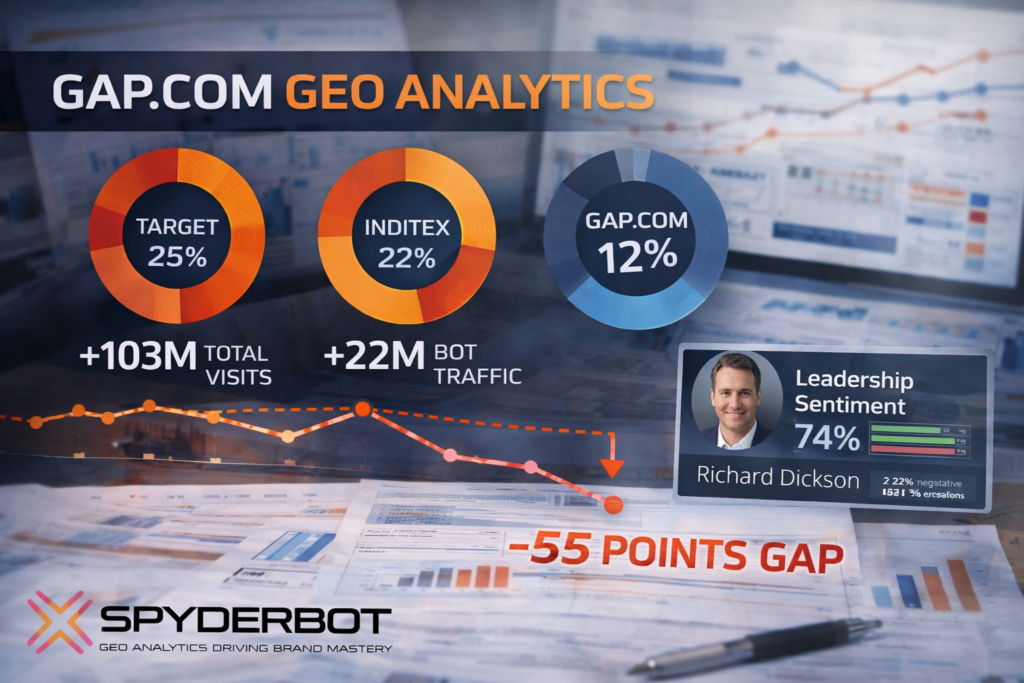
    Gap.com’s current GEO analytics profile reflects a brand at a critical inflection point. With a total site visit count surpassing 103 million and over 22 million bot-driven traffic, the brand commands distinct attention from generative AI models. However, within the crowded apparel vertical dominated by rapid trend cycles, Gap’s Share of Voice at 12% falls considerably behind primary rivals such as Target ( 25% ) and Inditex ( 22% ). Such positioning suggests gap.com currently operates as a strong heritage brand anchored to vintage niches rather than a trending market leader.

    This positioning is consistent with Gap’s dominant rank-1 status in the ‘Denim Authority’ category, registered at an elite 83% coverage rate. Yet this legacy strength contrasts against glaring deficiencies in visibility for contemporary style segments, where the brand lags Inditex by a critical 55 points.

    Leadership sentiment metrics further elucidate this mixed picture. The ‘Richard Dickson turnaround’ narrative commands a 74% positive sentiment score in founder/leadership-focused LLM brand mentions, which supports a shift toward renewed confidence. Despite this, a residual 22% of negative sustainability discourse and a 19% persistence of legacy erosion narratives create headwinds for full generative authority consolidation.

    Position in LLM Response Lists

    Gap consistently ranks within the top 5 in generative response listings across multiple LLM prompts but often trails fast-fashion leaders. For example, Gap is the 3rd ranked brand for ‘Work-From-Home Essentials’ on Copilot and holds the 4th position for ‘Best Casual Clothing Brands’ on ChatGPT. However, in trend-sensitive categories such as ‘Top Trendy Clothing Brands’ on Gemini, Gap sits as low as 8th — demonstrating visibility erosion in fast fashion and trend-led segments.

    Competitor Gap Analysis

    Prompt QueryGap PerformanceCompetitorCompetitor PerformanceGap ScoreOpportunityPriority 
    Where to buy sustainable hoodies68H&M Group8921Enhance product descriptions with specific recycled cotton percentages.High
    Trending European fashion styles41Inditex9655Collaborate with European influencers to trigger LLM geo-associations.Critical
    Fastest shipping for fashion62Target Corporation9432Sync real-time stock and shipping speed data with schema markup.High
    Summer dress trends 202445H&M Group9348Integrate AI-driven trend forecasting into web content generation.High
    Designer label discounts33TJX Companies9562Better differentiate Gap Factory domain visibility from main site.Medium

    Trigger Keywords for Competitor Products

    The report does not quantify specific trigger keywords for competitor products for gap.com.

    Founder / Ownership / Leadership Context

    Gap Inc.’s GEO profile is markedly shaped by the appointment of CEO Richard Dickson, whose tenure is linked to a 74% positive sentiment rating regarding leadership stability and brand revitalization. The Dickson era has elevated investor and consumer perceptions, fueling a 14% quarter-over-quarter rise in investment mention coverage on Gemini and Copilot platforms.

    Nonetheless, legacy Fisher family ownership narratives contribute to a residual 19% negative weight this brand must overcome to fully reset market confidence. Negative sustainability and supply-chain discourse constitutes a significant vulnerability, harming brand reputation in 22% of founder/leader-related outputs.

    Actionable recommendations emphasize diversifying leadership narratives, elevating board governance messaging, and amplifying supply chain AI optimization content to improve both investor and consumer sentiment across LLM brand mentions.

    Quick overview
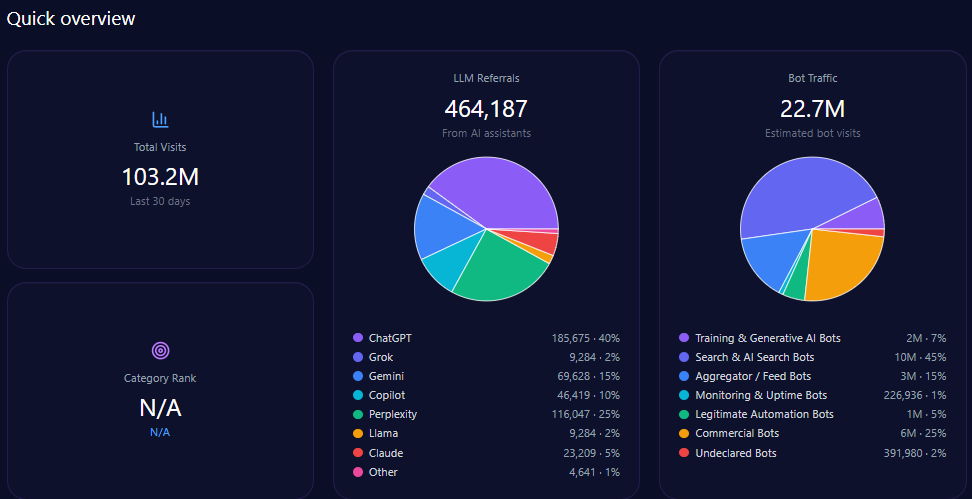
    gap.com’s Quick overview (Generated on March 19, 2026)

    Overall site traffic reflects high engagement, totaling over 103 million visits with bot traffic comprising slightly more than 22 million. This bot activity includes 1.65 million training and generative AI bots, and approximately 10.2 million search and AI search bots, implying active indexing and crawling relevant to generative models.

    LLM referrals to gap.com amount to 464,187, primarily sourced from ChatGPT ( 185,675 ), Perplexity ( 116,047 ), Gemini ( 69,628 ), and Copilot ( 46,419 ), underscoring multi-platform visibility despite underlying share of voice challenges.

    Gap’s niche strengths include standout visibility in 1990s style resurgence (score 94) and maternity apparel performance (91), reinforcing established category leadership beneath broader apparel market pressures.

    Share of Voice in LLM Responses

    In total generative LLM brand mentions, Gap holds a 12% Share of Voice, lagging behind Target ( 25% ), Inditex ( 22% ), and H&M Group ( 18% ). This relative positioning suggests the brand is being overshadowed in trend-driven queries and broader apparel categories, impacting attractiveness to prospective consumers relying on AI-generated recommendations.

    AI Platform-Specific Visibility

    PlatformVisibility %Share of Voice %Total Mentions 
    ChatGPT1313149
    Copilot1313152
    Gemini1111146
    Others9939

    Gap’s lowest visibility on the AI platforms is on Gemini at 11%, a platform where real-time inventory and shipping speed data enhances visibility. Addressing this deficit is critical for reclaiming authority among active shoppers and trend-focused AI queries.

    Sentiment Score for Competitors

    BrandPositive %Neutral %Negative %Overall Score 
    Gap62251375
    TJX Companies7419784
    Inditex71161379
    Target Corporation69201179
    H&M Group58241870

    Gap’s sentiment score of 75 positions it above H&M ( 70 ) but below TJX ( 84 ), Inditex, and Target ( 79 each). This middle-tier sentiment imbues a cautiously positive brand perception, buoyed by leadership narratives and quality-for-value appeal, but constrained by mixed operational and sustainability discourse.

    Top Prompts Driving Mentions
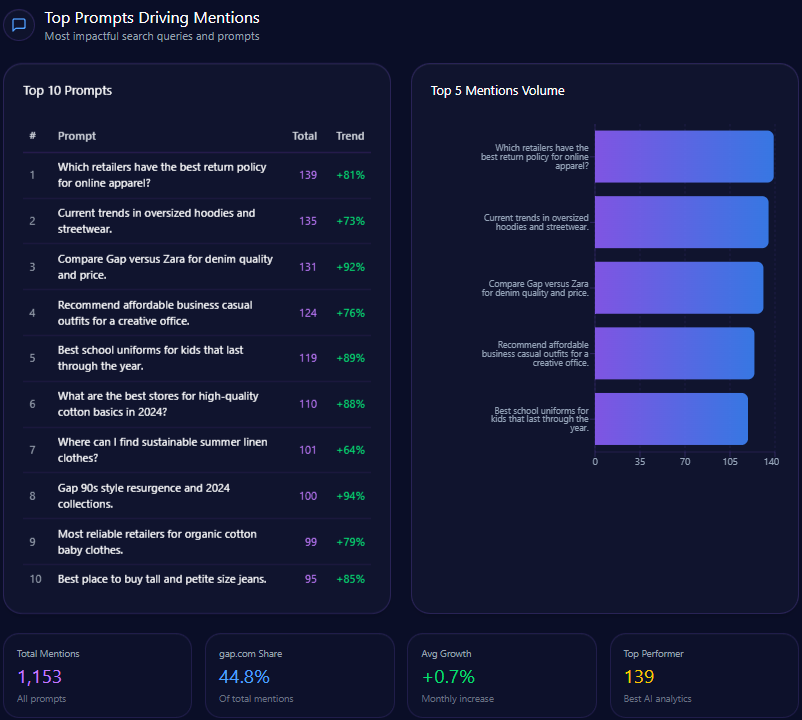
    gap.com’s Top Prompts Driving Mentions (Generated on March 19, 2026)
    • 49 mentions related to “best return policy for online apparel,” outpaced by 72 for Target and 18 for TJX Companies.
    • 34 mentions in “current trends in oversized hoodies and streetwear,” versus 59 for Inditex and 42 for H&M Group.
    • Strong showings in comparison themes such as “Compare Gap versus Zara for denim quality and price,” with Gap leading at 68 mentions over Inditex’s 63.
    • Gap demonstrates niche dominance with 88 mentions for “Gap 90s style resurgence,” significantly ahead of TJX ( 12 ).
    • Consistent visibility in “Best school uniforms for kids” ( 61 mentions) and “Most reliable retailers for organic cotton baby clothes” ( 53 mentions).

    Types of Prompt Queries

    • Feature Inquiry: 50% across 5 key prompts, indicating demand for detailed product understanding.
    • Comparison: 40% coverage, reflecting competitive positioning as a key consumer consideration factor.
    • Research queries at 10%, with absence in Purchase Intent and How-to/Tutorial categories, suggesting opportunity to develop transactional prompts.

    Service / Product-Level Sentiment

    • Brand Turnaround: 29% frequency with optimistic sentiment reflecting positive CEO impact.
    • Sustainable Basics: 20% frequency with positive sentiment, but limited by comparative sustainability visibility gaps.
    • Logistics and Delivery: 15% frequency with mixed sentiment, highlighting persistent user concerns over fulfillment.
    • Affordability & Value: 36% frequency with very positive perception, supporting Gap’s positioning as a value leader in certain apparel segments.

    Conclusion

    Gap.com currently occupies a transitional position within the generative AI landscape, with GEO analytics indicating leadership in legacy denim authority and encouraging positive sentiment tied to executive leadership. However, clear deficiencies exist in agility and trend responsiveness relative to Inditex and Target, which dominate trend-forward and operational fulfillment metrics.

    The quantitative gaps — notably the 55-point deficit in ‘European fashion trends’ authority and the 32-point operational visibility gap on rapid shipping — materially constrain Gap’s capacity to fully leverage generative AI recommendation engines as a growth vector.

    Addressing these gaps requires prioritized investment in advanced schema markup for real-time inventory and delivery data, enhanced sustainability disclosures with specific recycled material percentages, and content innovation targeting modern business casual and fast fashion aesthetics. Establishing these operational and strategic pillars will enable Gap to improve its competitive share in LLM brand mentions and operationalize positive leadership momentum for sustained market relevance.

    Explore SpyderBot to operationalize these GEO analytics insights.
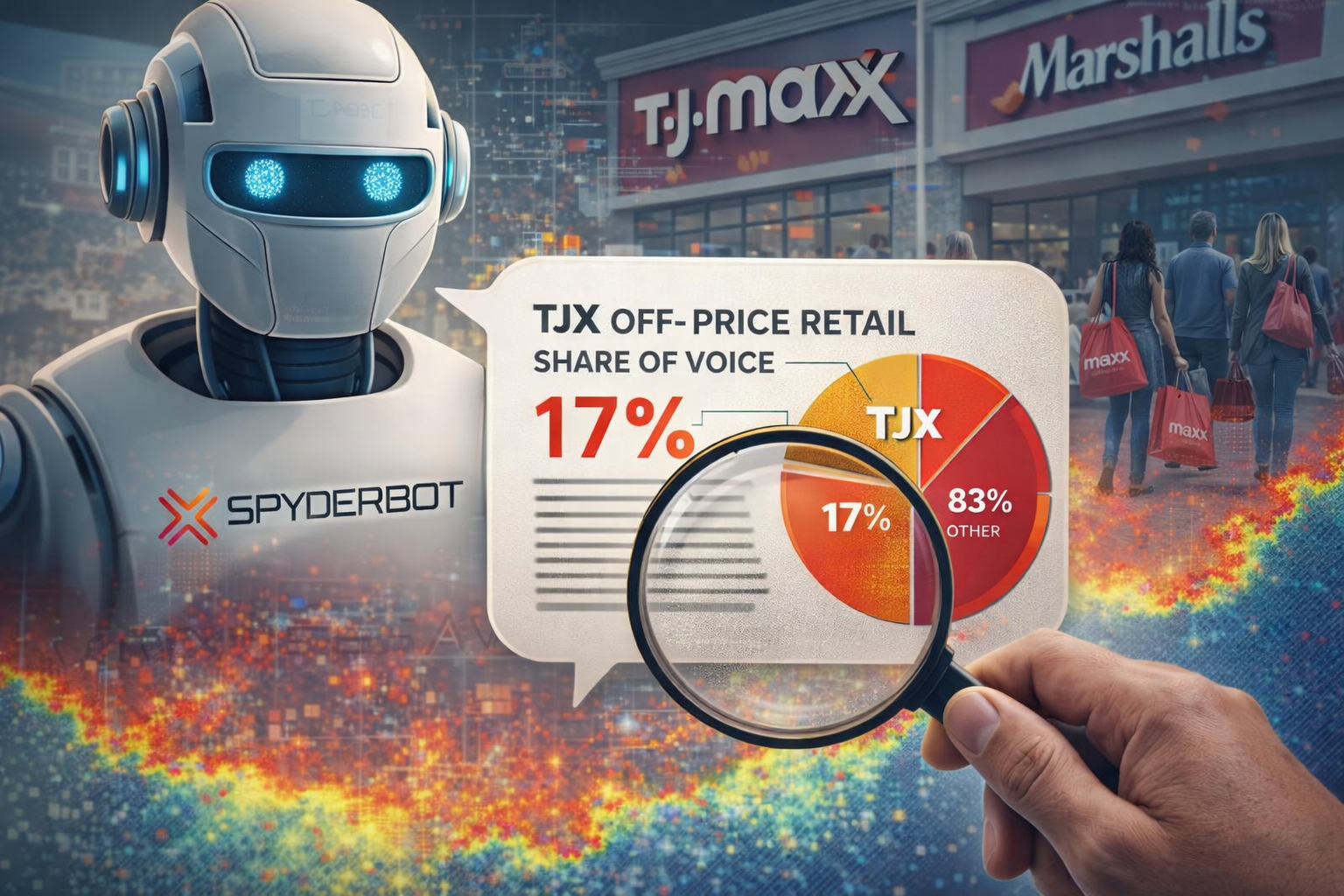
  • TJX’s 17% Share of Voice Is Reframing How AI Explains Off-Price Retail and Where the Real Advantage Lies

    TJX’s 17% Share of Voice Is Reframing How AI Explains Off-Price Retail and Where the Real Advantage Lies

    In an era when value-seeking shoppers increasingly begin their journey with an AI answer rather than a store visit, TJX Companies is emerging as the reference point for off-price retail—commanding attention where it matters most, while revealing clear fault lines where the next phase of advantage will be won.


    At-a-glance — Numbers to know

    • Share of Voice: 17% of total LLM brand mentions across off-price and adjacent retail queries
    • Visibility Score: 68 (trailing Amazon at 94 and Target at 89)
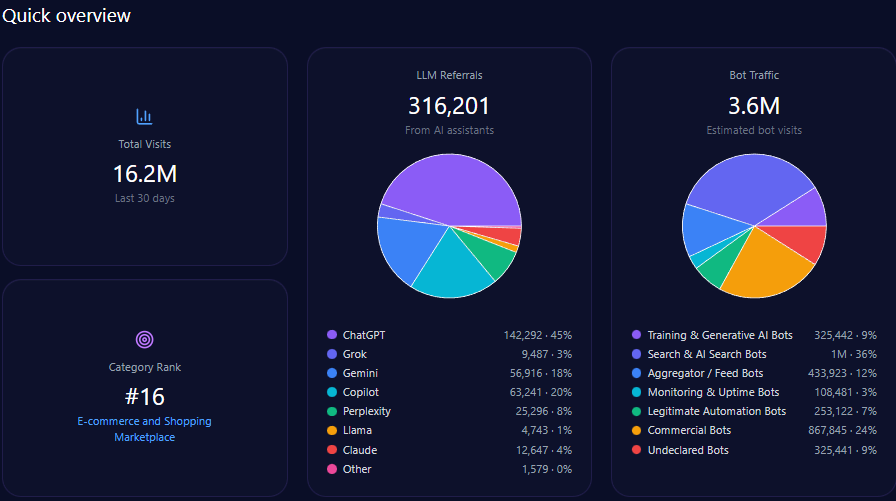
    • LLM referrals: 316,201 total (ChatGPT 142,292; Gemini 56,916; Copilot 63,241; others smaller)
    • Total visits: 16,215,343, with 3,616,022 attributed to bot traffic
    • Category rank: #16 in E-commerce_and_Shopping / Marketplace
    • Sentiment score: 82 overall, the strongest among off-price peers

    Opening

    Picture the modern retail discovery moment. A shopper doesn’t scroll a marketplace or open a brand app. Instead, they ask an AI a deceptively simple question: Where can I find designer brands at a discount? The answer arrives instantly, framed not by a marketing campaign but by accumulated signals—citations, sentiment, historical performance, and the way brands have been encoded into large language models.

    In that moment, retail strategy becomes response strategy. And for off-price retail, TJX Companies has quietly become one of the most frequently summoned answers. The GEO analytics behind tjx.com show a brand that consistently appears when value, discovery, and “treasure hunt” logic dominate the question—yet recedes when speed, logistics, or omnichannel convenience take center stage. The result is a position of strength with a clearly defined ceiling, unless leadership acts decisively.


    Position in LLM Response Lists

    Across LLM response lists tied to off-price retail, TJX holds a distinctive role. The data shows TJX appearing with a 17% Share of Voice, outperforming direct off-price competitors like Ross Stores and Burlington, but trailing mass retailers that dominate broader retail prompts.

    In platform-specific rankings, TJX is repeatedly pulled as a top recommendation for discounted designer brands and treasure hunt shopping experiences. On Gemini, the brand ranks #1 for “Best Stores for Discounted Designer Brands,” while on ChatGPT it appears as a top-three reference for value-driven apparel and home goods. This placement cements TJX as the category specialist—highly authoritative within its lane, but not yet dominant across the full retail spectrum.


    Competitor Gap Analysis

    The competitive landscape that emerges from AI responses is less about store count or revenue scale and more about narrative ownership.

    QueryTJX metricCompetitor metricGap / priority
    Fast shipping on brand-name goodsVisibility 42Amazon 96Structural logistics gap
    Order pickup for home decorVisibility 31Target 91Omnichannel perception gap
    Designer clothing discountsVisibility 93Burlington 78TJX leadership advantage
    Budget clothing stores near meVisibility 88Ross 85Competitive parity

    This “battle map” reveals a consistent pattern. TJX dominates where the question is value discovery. It loses ground where the question is convenience optimization. Importantly, these gaps are not marginal: in logistics-related prompts, Amazon outpaces TJX by more than 50 points in visibility, a disparity large enough to shape default AI recommendations.


    Trigger Keywords for Competitor Products

    LLM brand mentions are not random—they are triggered by specific keywords that carry embedded intent. For TJX, the strongest triggers include off-price retail, designer handbags outlet, and brand-name clearance. These prompts consistently summon TJX ahead of Ross and Burlington, and often alongside Amazon and Target.

    Conversely, keywords such as affordable home decor, kids clothing sale, and budget fashion finds tilt responses toward Amazon and Target, where breadth and fulfillment speed dominate AI reasoning. The implication is clear: TJX owns the why of value, but not always the how fast or how easy.


    Founder / Leadership Context

    Leadership narratives function as reputational shortcuts inside AI systems. TJX benefits from a strong legacy signal tied to Bernard Cammarata, whose role as architect of the off-price model carries a sentiment score of 88. This historical foundation reinforces trust and stability in investment-oriented and strategy-focused AI responses.

    Current leadership under Ernie Herrman generates higher overall mention frequency, with sentiment remaining positive but increasingly associated with operational consistency rather than innovation. Negative context remains limited, concentrated primarily around executive compensation and supply chain transparency, and does not dominate AI narratives. Still, the data suggests leadership perception is operationally strong but digitally understated.


    Quick overview

    From a footprint perspective, TJX’s GEO presence is substantial. Over 16 million total visits were recorded, with more than 3.6 million attributed to bot traffic, underscoring how frequently machines—not humans—are evaluating and indexing the brand. LLM referrals exceeded 316,000, yet conversion efficiency remains low at 4.2%, signaling leakage between AI discovery and transactional capture.

    tjx.com’s Quick overview(GEO Report, Jan 19, 2026)

    Share of Voice in LLM Responses

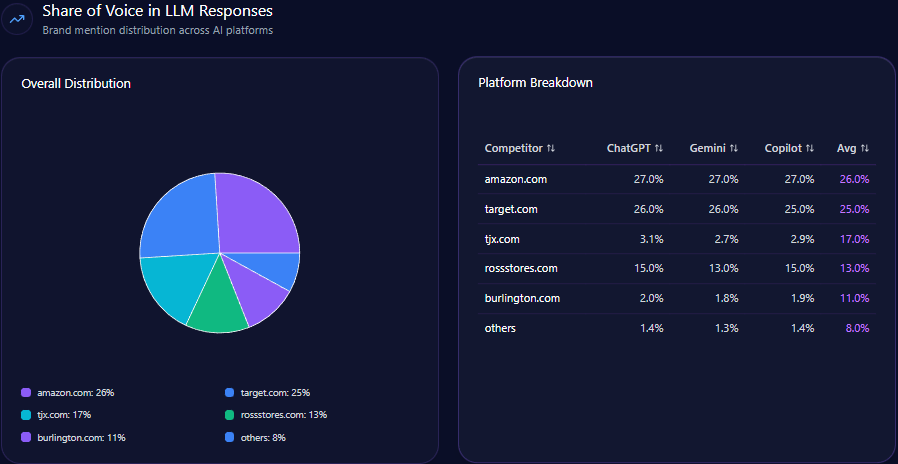
    Share of Voice inside LLMs functions as mindshare in the AI era. TJX’s 17% places it ahead of Ross and Burlington but well behind Amazon (26%) and Target (25%). Combined, those two competitors control more than half of total LLM brand mentions in retail-related prompts.

    This distribution highlights a strategic tension. TJX is the specialist brand—trusted, distinctive, and credible—but specialists are at risk when generalists dominate the conversational layer where most shoppers begin.

    tjx.com’s Share of Voice in LLM Responses(GEO Report, Jan 19, 2026)

    AI Platform-Specific Visibility

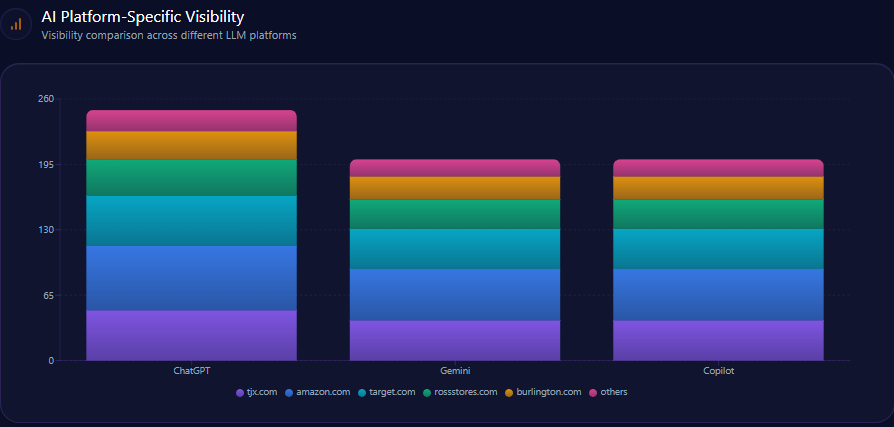
    Platform bias matters. TJX’s visibility peaks on ChatGPT at 71%, where narrative-driven explanations favor the brand’s treasure-hunt identity. Visibility drops to 57% on both Gemini and Copilot, platforms that rely more heavily on structured data, real-time inventory signals, and web-integrated citations.

    In practical terms, this means TJX is better understood by conversational models than by research-oriented or search-integrated ones. Closing that gap is less about storytelling and more about machine-readable clarity.

    tjx.com’s AI Platform-Specific Visibility(GEO Report, Jan 19, 2026)

    Sentiment Score for Competitors

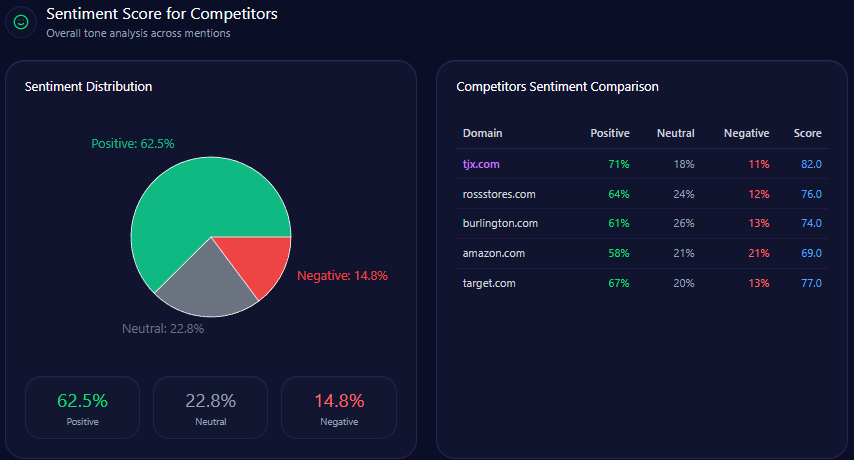
    Sentiment analysis reinforces TJX’s qualitative advantage. With an overall sentiment score of 82, the brand leads Ross (76) and Burlington (74), and outperforms Amazon (69) and Target (77) in tone. Positive themes cluster around the Treasure Hunt Strategy and Off-Price Value Proposition, both of which appear frequently and with favorable framing.

    Negative sentiment is primarily tied to store organization and checkout friction—operational issues rather than brand trust concerns. In AI narratives, TJX is liked, respected, and trusted; it is simply not always selected.

    tjx.com’s Sentiment Score for Competitors (GEO Report, Jan 19, 2026)

    Top Prompts Driving Mentions

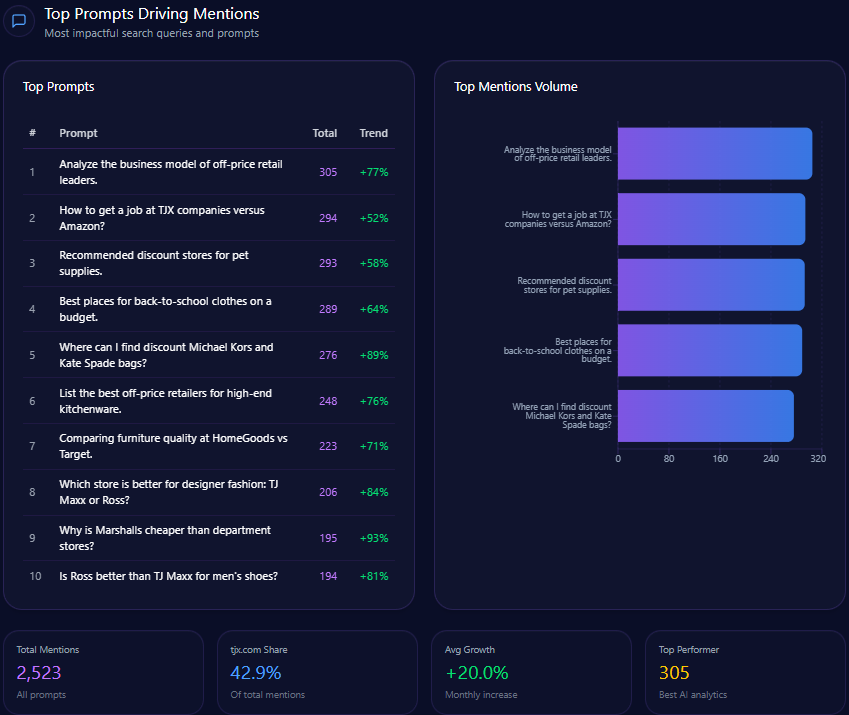
    The prompts that most frequently summon TJX are revealing. High-mention queries include analyses of the off-price business model, comparisons with Ross, and searches for specific designer discounts. In many of these prompts, TJX captures more than 140 mentions out of fewer than 300 total, a commanding presence.

    These are not casual questions—they reflect shoppers and analysts seeking justification for choosing value over convenience. TJX wins when the question requires explanation, not just a link.

    tjx.com’s Top Prompts Driving Mentions (GEO Report, Jan 19, 2026)

    Types of Prompt Queries

    The intent mix behind TJX mentions skews heavily toward comparison and feature inquiry prompts, with limited exposure in pure purchase-intent questions. This reinforces a critical insight: TJX is often part of the thinking phase of retail decisions, but less dominant in the doing phase, where speed and fulfillment dominate.


    E-commerce / Service-Level Sentiment

    Where service-level sentiment is captured, AI narratives praise product authenticity and price advantage while flagging slower shipping and rapid sell-outs. These signals help explain the gap between referral volume and conversion efficiency. AI sends users to TJX for value—but not always with confidence that the experience will be frictionless.


    Conclusion

    The GEO report positions TJX as the definitive authority in off-price retail narratives inside AI systems. Its strength lies in value credibility, brand trust, and a legacy that machines recognize and reward. Yet the same data makes clear that leadership in AI visibility will increasingly be decided by structured signals around logistics, omnichannel convenience, and digitally legible inventory.

    The advantage is real—but so is the ceiling. TJX leadership now faces a choice: remain the category specialist that AI respects, or evolve into a hybrid authority that AI defaults to. The data suggests the latter is within reach, if acted on deliberately.

    Explore SpyderBot to operationalize these GEO analytics insights.
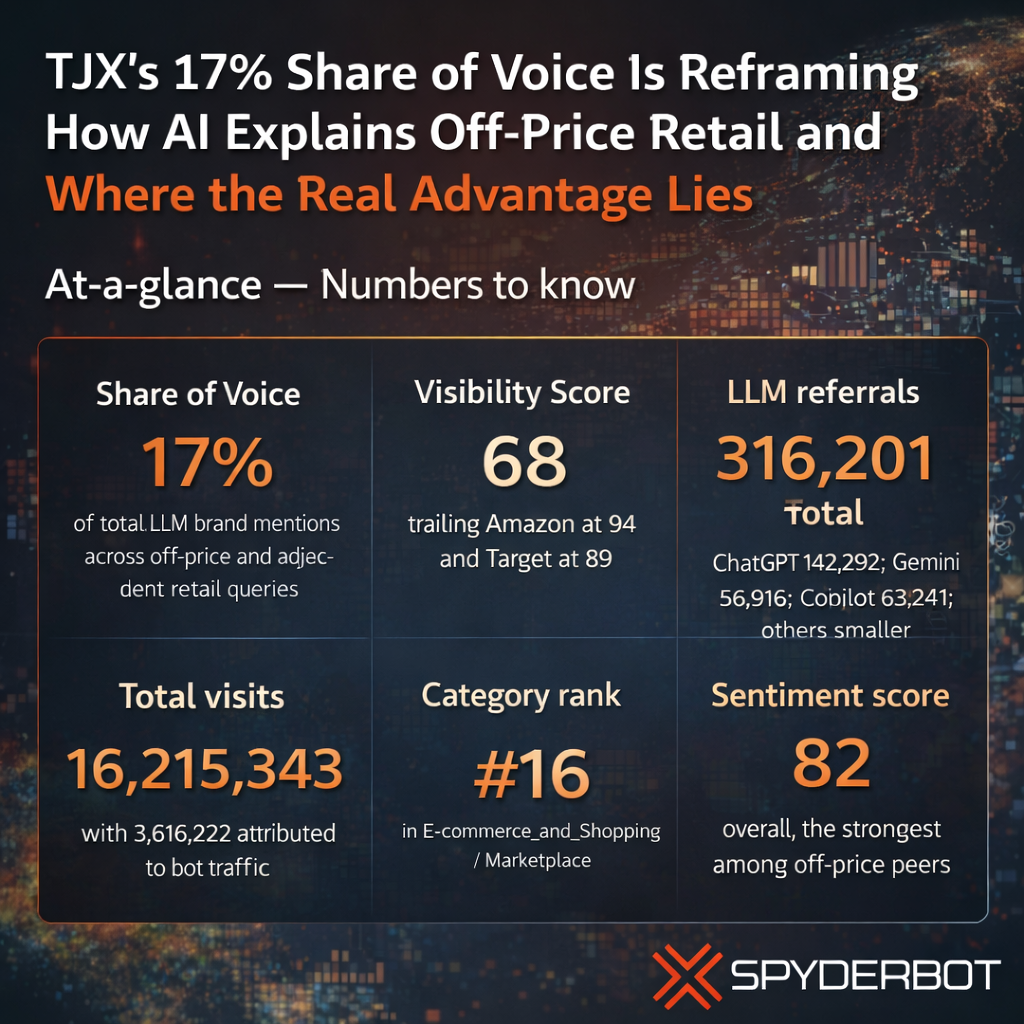
  • Best Buy’s AI Shelf Space Is Strong—But the “Value” Story Is Slipping Away

    Best Buy’s AI Shelf Space Is Strong—But the “Value” Story Is Slipping Away

    Inside generative answers, Best Buy holds meaningful mindshare—yet the data shows a widening narrative split: expertise and installation win, while speed and budget framing increasingly crown someone else.

    At-a-glance

    • Share of Voice (LLM brand mentions): 20% (105 of 523)
    • Visibility Score: 74 (vs 92 for Amazon, 78 for Walmart)
    • Rank Score: 92 in premium electronics positioning
    • Total visits: 170,355,633 with 54,854,514 in bot traffic
    • LLM referrals: 1,448,023 (led by ChatGPT 810,893, Perplexity 231,684, Copilot 188,243, Gemini 144,802)
    • Category rank: #1 in Computers_Electronics_and_Technology/Consumer_Electronics

    Risk signals

    • A 22-point gap shows up in “fastest same day tech delivery” versus Amazon (76 vs 98)—the speed narrative is still lopsided.
    • Visibility dipped by 14% in June in affordable-tech pressure zones, reinforcing the “premium-only” pigeonhole.

    Opening

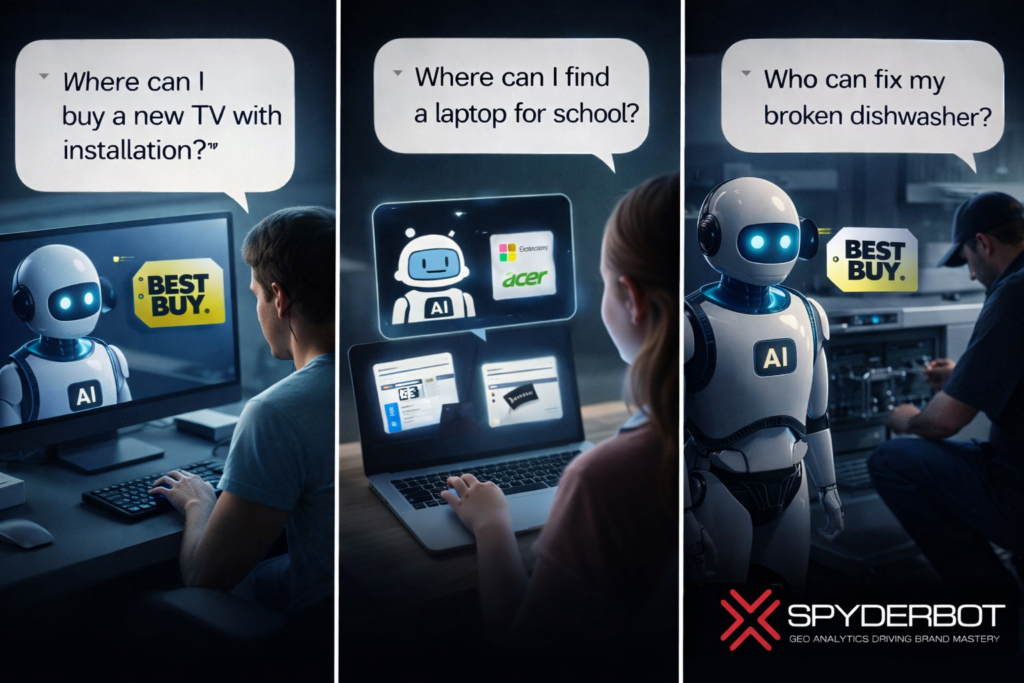
    Picture the modern “storefront” moment: not a mall, not an app—just a blinking cursor. A shopper asks for the best place to buy a new TV with installation. Another asks where to find a laptop for school. A third asks who can fix the mess when something goes wrong. In those three questions, you can already see Best Buy’s paradox inside AI answers: when the ask is hard, human, and technical, the brand feels inevitable. When the ask is cheap, fast, or “good enough,” the story veers.

    What matters isn’t whether Best Buy is present. It is. The question is whether the brand is being chosen—and why.


    The Lists Where Best Buy Still Feels Like the Expert

    In ranked response lists across major platforms, Best Buy consistently shows up where the prompt implies expertise, service, or complex decision-making. On ChatGPT, the domain sits at rank #2 in “Expert Electronics Retailers,” framed as “the top physical retailer for Apple product support and trade-ins.” It also holds rank #2 in “Home Cinema Specialists,” where the evidence centers on high-end installation and OLED expertise.

    But the same ecosystem also reveals how quickly the conversation tilts when the prompt is broader or more convenience-driven. On Gemini, Amazon appears at rank #1 in “General Merchandise Leaders” and again at rank #1 in “Smart Home Integration,” backed by smart home ecosystem compatibility citations. Best Buy’s presence doesn’t vanish—but it becomes conditional. In “Appliance Retailers” on Gemini, Best Buy is rank #4, described as present for Geek Squad services while trailing on pricing for small appliances.

    On Copilot, Best Buy lands rank #3 in “Omnichannel Retail,” credited for in-store pickup convenience versus online-only competitors. That’s not small. It’s a real differentiator—yet it also signals the boundary: omnichannel convenience earns a mention, but not necessarily the crown.


    Where the Battle Map Shows Real Separation

    Best Buy’s competitive story is most revealing when you look at where the gaps are quantified—and where the brand already holds daylight.

    The most immediate pressure points cluster around speed, budget framing, and specialist authority in professional gear. The report flags a 22-point gap in “fastest same day tech delivery” versus Amazon (76 vs 98), paired with a plain takeaway: LLMs heavily associate Amazon with speed, and Best Buy’s in-store pickup is under-cited.

    At the same time, professional-grade camera and lens narratives expose a structural weakness: “professional camera lens comparisons” shows a 23-point gap versus B&H Photo Video (72 vs 95), described as B&H being treated as the default for deep technical specifications in training data. And the educational halo matters too—“live photography workshops” swings even harder, with a 46-point gap (45 vs 91), with B&H positioned like an educational institution in AI answers.

    Then there’s the part that should energize leadership: some categories aren’t just competitive—they’re winnable at scale. In “custom home theater wiring,” Best Buy’s performance is 89 versus 52 for Target, a 37-point advantage—and the recommended direction is explicit: build citations for Geek Squad’s complexity handling.

    A compact view of the clearest quantified gaps:

    QueryBest BuyCompetitorGap / Priority
    fastest same day tech delivery76Amazon 9822 / High
    professional camera lens comparisons72B&H Photo Video 9523 / High
    best budget smart home hub68Walmart 9123 / Medium
    live photography workshops45B&H Photo Video 9146 / Low

    What this table really says: the brand is strongest when it can be the expert, and weakest when the AI can answer with a shipping promise or a price story.


    The Keywords That Quietly Hand Competitors the Microphone

    Trigger keywords are the hidden levers that decide which retailers get named when AI systems summarize “what to buy” and “where to buy it.” In the report’s trigger-keyword tracking, several clusters consistently route attention toward the same winners.

    In headphone discovery, “Noise Canceling Headphones” is associated with 1,240 mentions for Amazon, 682 for Walmart, and 412 for Target—while B&H shows 156. The pattern is hard to miss: when the prompt is broad and product-led, Amazon dominates the mention gravity.

    Budget language is even more punishing. “Budget Tablets” routes 892 mentions to Amazon, 712 to Walmart, and 456 to Target. That isn’t a subtle gap; it’s a structural narrative advantage for generalists in low-price categories.

    Meanwhile, the professional camera cluster flips the power dynamic. “Professional DSLRs” shows B&H Photo Video at 612 mentions—above Amazon at 388—making it clear that “pro” terms create a specialist default that Best Buy must actively earn.

    Some keywords do feel like Best Buy-native territory. “Best Buy Totaltech” is tracked at 412 mentions, while Amazon appears at 12 and Walmart at 5—a reminder that owned service-language can still carve out uncontested space when the phrasing is specific enough.

    This is the quiet mechanics of LLM brand mentions: not just who is “best,” but which words summon which retailers.


    Founder Narratives and the Shadow Topics That Follow Them

    Founder and leadership context in AI answers often behaves like an undertow—rarely the headline, frequently the mood. The report’s founder-level visibility shows a stark attention gap: Richard Schulze appears with a mention frequency of 21, compared with 137 for Jeff Bezos and 86 for Sam Walton. Even Herman Schreiber appears at 38.

    Yet sentiment is not the problem for Best Buy’s founder story. Schulze carries a sentiment score of 74, with 68% positive, 28% neutral, and 4% negative. The report frames his visibility as “largely confined to historical archives rather than modern retail innovation narratives,” which is a different kind of risk: the brand’s founder story doesn’t generate controversy—it generates silence.

    Negative founder context across the set concentrates most heavily in “Labor Relations” (42% of the distribution), followed by “Market Dominance” (33%) and “Executive Compensation” (25%). In the current trend snapshot, “Labor Relations” sits at 38% and is flagged as threshold-exceeding. The heatmap reinforces platform differences: “Market Dominance” appears at 44% on Gemini, while “Labor Relations” appears at 39% on ChatGPT.

    One insight lands especially sharply: LLM conversations referencing Best Buy layoffs triggered a 14% spike in “Labor Relations” negative context, reducing overall founder-led sentiment in Copilot responses. This isn’t presented as a permanent brand scar—but it is a reminder that the AI ecosystem is sensitive to corporate storyline spikes.

    The founder narrative doesn’t need to be louder for its own sake. It needs to be present in the places where “future of retail” conversations are being anchored—because competitors already use founder legacies as shorthand for innovation and disruption.


    A Snapshot of the GEO Footprint That Actually Matters

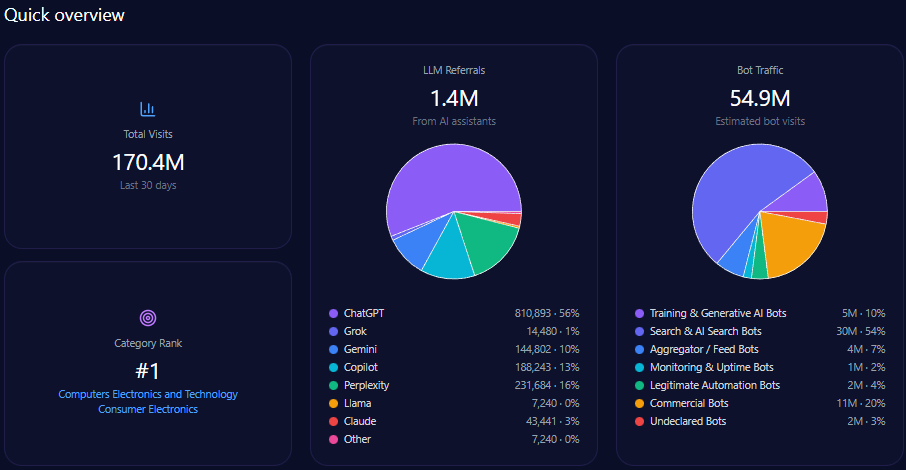
    Best Buy’s scale is not theoretical. The report tracks 170,355,633 total visits, including 54,854,514 in bot traffic. Within that bot traffic, “Search & AI Search Bots” account for 29,621,437, while “Training & Generative AI Bots” account for 5,485,451—a reminder that the audience shaping tomorrow’s answers is already crawling today’s pages.

    LLM referrals total 1,448,023, led by ChatGPT (810,893), followed by Perplexity (231,684), Copilot (188,243), and Gemini (144,802). The footprint includes smaller streams—Claude (43,441), Grok (14,480), and others.

    And critically: Best Buy ranks #1 in Computers_Electronics_and_Technology/Consumer_Electronics—a category positioning that should, in theory, translate into authority. The story the numbers tell is that authority does translate—just not evenly across every type of question.

    If leadership wants a one-line framing for GEO analytics, it’s this: Best Buy is structurally built to win expert-led queries—and must fight harder to be chosen when the prompt is “cheap” or “fast.”

    bestbuy.com’s Quick overview (GEO Report, Jan 18, 2026)

    The Mindshare Math Inside AI Answers

    In overall Share of Voice, Best Buy holds 20% of tracked LLM brand mentions (105 of 523). Amazon leads at 35% (183), while Walmart follows at 22% (115). Target shows 12% (63), B&H Photo Video 8% (42), and “others” 3% (15).

    Visibility Score tells a similar story with a different emphasis. Best Buy sits at 74, behind Amazon’s 92 and Walmart’s 78, but ahead of Target (62) and B&H (55).

    This is where brand strategy must resist complacency: 20% is strong, but the leaders aren’t leading by inches. Amazon’s advantage is both share (35%) and visibility (92). Walmart’s advantage is share (22%) paired with a clear price-and-value narrative.

    Best Buy’s opportunity is not to become Amazon. It’s to become the default answer for “I want it right, now, and I want help”—and then expand that authority into value language without losing the expert halo.


    Same Brand, Different AI Outcomes

    Platform splits make the ecosystem feel like three different markets.

    On Gemini, Best Buy’s visibility/share of voice is 23%, with 40 mentions out of 175 total. Amazon holds 31% (55) and Walmart 26% (45). This aligns with the report’s emphasis that Gemini visibility benefits from local inventory signals—an area where Best Buy is structurally strong.

    On ChatGPT, Best Buy sits at 19%, with 32 mentions out of 170 total. Amazon climbs to 41% (70), while Walmart posts 21% (35). Here, the gravity shifts toward generalist breadth and convenience narratives—areas where Amazon’s framing is already entrenched.

    On Copilot, Best Buy also shows 19%, with 33 mentions out of 178 total. Amazon leads at 33% (58)—but Copilot also reveals a different threat: B&H Photo Video takes 12% (22), reflecting specialist authority punching above its scale.

    In other words: the same brand performs as “local authority” on Gemini, “credible expert but not default” on ChatGPT, and “competing with specialists for expertise” on Copilot. The implication isn’t that one platform is right. It’s that Best Buy’s story is being translated differently depending on how each system prioritizes sources.


    The Tone War: Trust, Value, Logistics, and Expertise

    Competitor sentiment tracking in the report suggests Best Buy is not losing the “trust” argument—yet it also highlights where tone becomes mixed.

    Overall sentiment scores cluster tightly at the top:

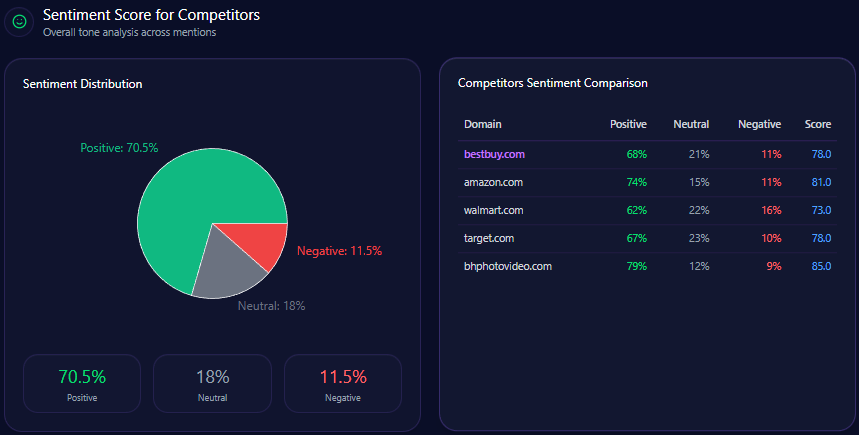
    • B&H Photo Video: 85 (Positive 79, Neutral 12, Negative 9)
    • Amazon: 81 (Positive 74, Neutral 15, Negative 11)
    • Best Buy: 78 (Positive 68, Neutral 21, Negative 11)
    • Target: 78 (Positive 67, Neutral 23, Negative 10)
    • Walmart: 73 (Positive 62, Neutral 22, Negative 16)

    Context themes show what people talk about when these brands show up in AI narratives:

    • “Technical Support & Repair” appears 52 times (35.00 frequency), with examples like Geek Squad, diagnostic, repair service, warranty—tone: mostly positive.
    • “Price & Value” appears 41 times (27.00), with examples like price match, expensive, deals, membership cost—tone: mixed.
    • “Logistics & Fulfillment” appears 33 times (22.00)—tone: neutral.
    • “Product Expertise” appears 24 times (16.00)—tone: positive.

    The takeaway is not that Best Buy is viewed negatively. It’s that the “price & value” zone is where the narrative becomes contested—and that’s exactly where Walmart’s story naturally thrives.

    bestbuy.com’s Sentiment Score for Competitors (GEO Report, Jan 18, 2026)

    The Prompts That Most Reliably Summon Best Buy

    Some prompts are practically a lighthouse for Best Buy’s strengths.

    The report’s top prompts include:

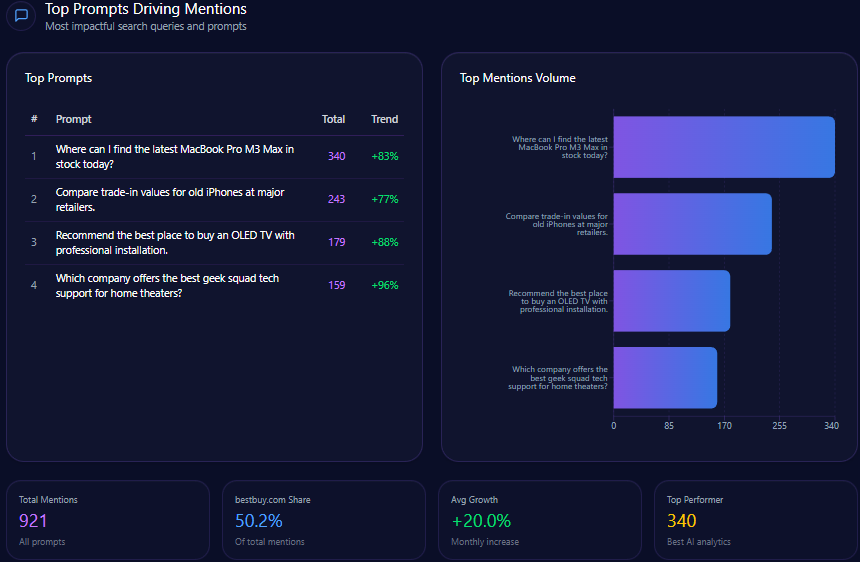
    • “Where can I find the latest MacBook Pro M3 Max in stock today?” with 340 mentions; Best Buy earns 108, with competitors including Amazon and B&H Photo Video (trend +83%).
    • “Compare trade-in values for old iPhones at major retailers.” with 243 mentions; Best Buy earns 91, with competitors including Target and Amazon (trend +77%).
    • “Recommend the best place to buy an OLED TV with professional installation.” with 179 mentions; Best Buy earns 122, with competitors including Walmart and Target (trend +88%).
    • “Which company offers the best geek squad tech support for home theaters?” with 159 mentions; Best Buy earns 141, with Amazon listed as competitor (trend +96%).

    These aren’t just prompts. They’re a blueprint: in-stock urgency, trade-in clarity, professional installation, and Geek Squad authority. When the question implies complexity, Best Buy becomes the answer.

    bestbuy.com’s Top Prompts Driving Mentions (GEO Report, Jan 18, 2026)

    What People Are Actually Asking For

    Prompt-type mix in the report is heavily concentrated:

    • Comparison accounts for 75 with 3 prompts.
    • Feature Inquiry accounts for 25 with 1 prompt.

    Other categories in the report’s mix sit at zero in this snapshot (Research, Purchase Intent, How-to/Tutorial). That doesn’t mean those intents don’t exist in the world. It means the current tracked set is dominated by “Which is better?” and “What should I choose?” moments.

    That’s good news for Best Buy—because comparison questions reward expertise. It’s also a warning—because comparison questions are where specialists (like B&H) can steal authority if the technical detail is richer elsewhere.


    E-commerce Discovery: Where Reviews, Retailers, and Reality Collide

    In e-commerce-oriented AI discovery, Best Buy’s share of voice is 13.15% with 1,135 mentions across ChatGPT, Gemini, and Copilot. Amazon leads at 38.68% (3,340), followed by Walmart at 19.91% (1,719), Target at 10.02% (865), and B&H Photo Video at 5.1% (440). “Others” also appear at 13.15% (1,135).

    The report’s sentiment snapshots in e-commerce contexts show review mixes clustering around:

    • 64/24/12 across 1,850 total reviews
    • 71/21/8 across 2,100 total reviews
    • 68/20/12 across 1,920 total reviews

    And the product-level snippets illuminate the lived experience, as cited in the report:

    • “Best Buy’s Geek Squad protection made the OLED TV setup seamless. Highly recommend for high-end tech.” — TechRadar Community, LG C3 OLED TV, 5
    • “Found the laptop I wanted at Best Buy. Price was same as Amazon, but I could pick it up in an hour.” — Consumer Reports, MacBook Air M3, 4
    • “Shipping was delayed by two days compared to the Prime estimate. Customer service was helpful but slow.” — SiteJabber, PS5 Console, 2

    Even referral performance is quantified in this layer: ChatGPT shows 8,450 referrals (conversion rate 2.8), Gemini 10,200 (conversion rate 3.1), and Copilot 7,820 (conversion rate 4.2).

    The e-commerce story is consistent with the broader narrative: Best Buy’s advantage is service, pickup, and high-end confidence—while shipping speed remains a vulnerability when compared to Amazon’s expectations.


    Conclusion

    Best Buy doesn’t have an awareness problem in generative systems. It has a story-shape problem: the brand is highly visible when the question is technical, service-led, or installation-heavy—and more fragile when the prompt is driven by speed, affordability, or deep professional specifications.

    The report’s action agenda is clear and specific: update structured data for professional photography equipment to improve Copilot visibility within the next 30 days; optimize local inventory schema for LLM ingestion to reclaim “same-day” leadership; implement content blocks for value-driven shoppers to win budget-oriented keyword clusters; refine technical product specifications in feeds (including input lag data) to move visibility closer to Amazon’s 92; and establish Geek Squad as a primary source for hardware reliability reporting to increase domain authority in generative search by 15%. Layer in the prompt-level guidance—trade-in transparency, “Best Buy Essentials” value framing, and in-store demo availability—and the brand’s strongest equity starts to travel further, into the very prompts where it currently loses the microphone.

    Explore SpyderBot to operationalize these GEO analytics insights.
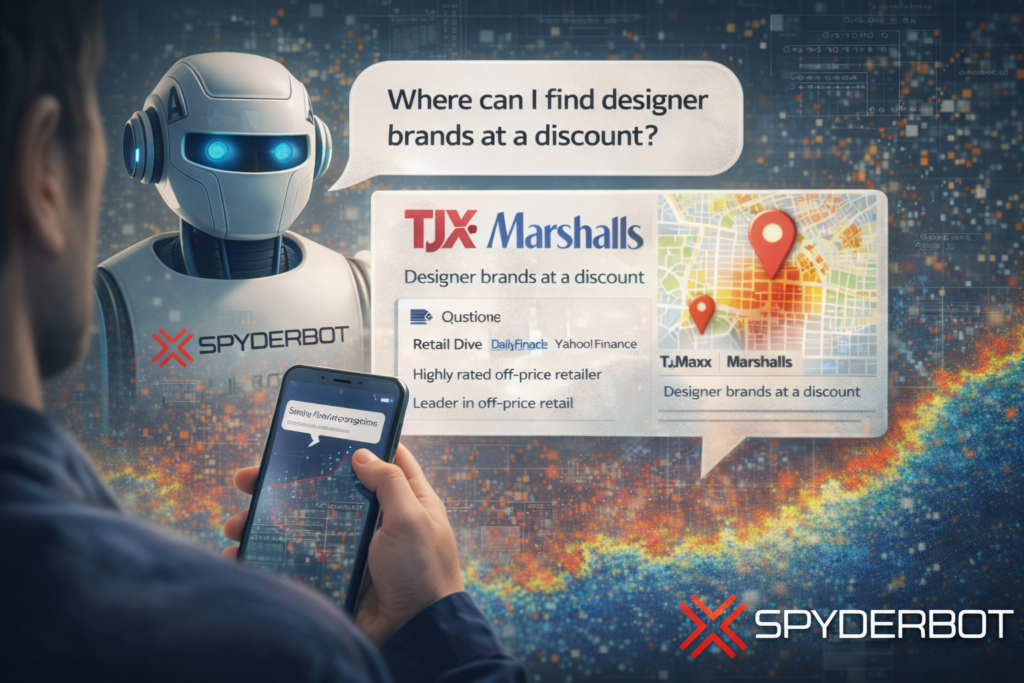
  • Target’s 16% Share of Voice Is Holding the Style Line But the Competitive Gap Is Where the Real Retail Battle Is Being Fought

    Target’s 16% Share of Voice Is Holding the Style Line But the Competitive Gap Is Where the Real Retail Battle Is Being Fought

    Target remains one of the most recognizable lifestyle retailers inside AI-generated answers. Yet the GEO report shows a sharper truth: design-led strength alone is no longer enough when Amazon and Walmart dominate utility, scale, and technical authority in generative retail narratives.


    At-a-glance: what the GEO report makes unavoidable

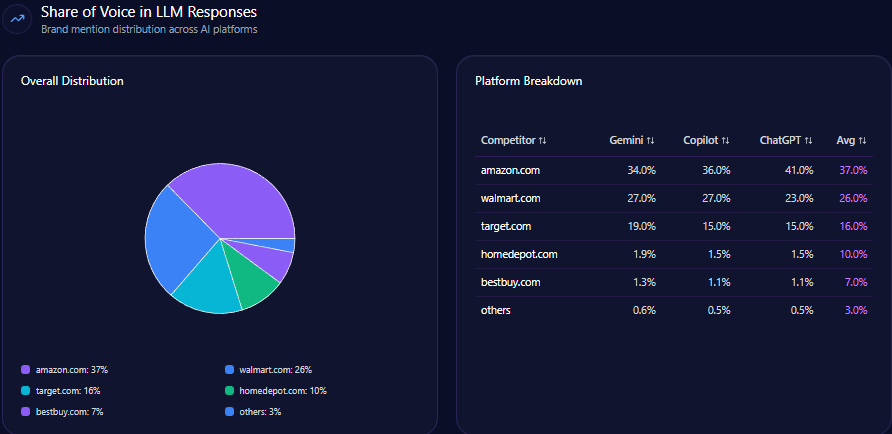
    • Share of Voice: Target holds 16% (63 mentions), trailing Amazon (37%) and Walmart (26%)
    • Visibility Score: 77 for Target, versus Amazon (96) and Walmart (88)
    • Category Rank: #6 in E-commerce_and_Shopping / Marketplace
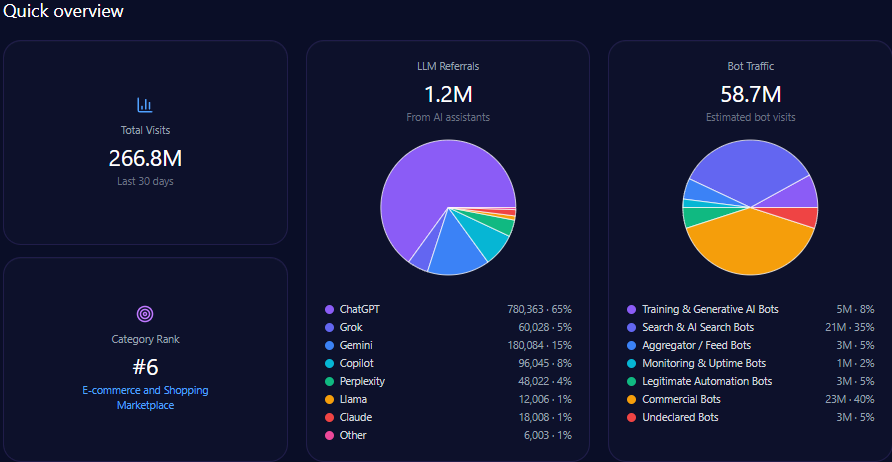
    • LLM Referrals: 1,200,559, led by ChatGPT (780,363) and Gemini (180,084)
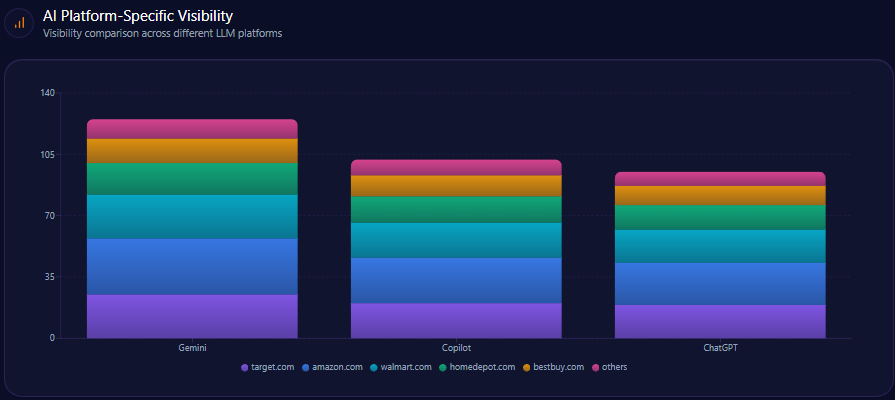
    • Platform Strength: Best visibility on Gemini (35%), lower on ChatGPT (27%)
    • Key Risk Signal: Electronics coverage at 29%, far behind Best Buy (88%) and Amazon (94%)

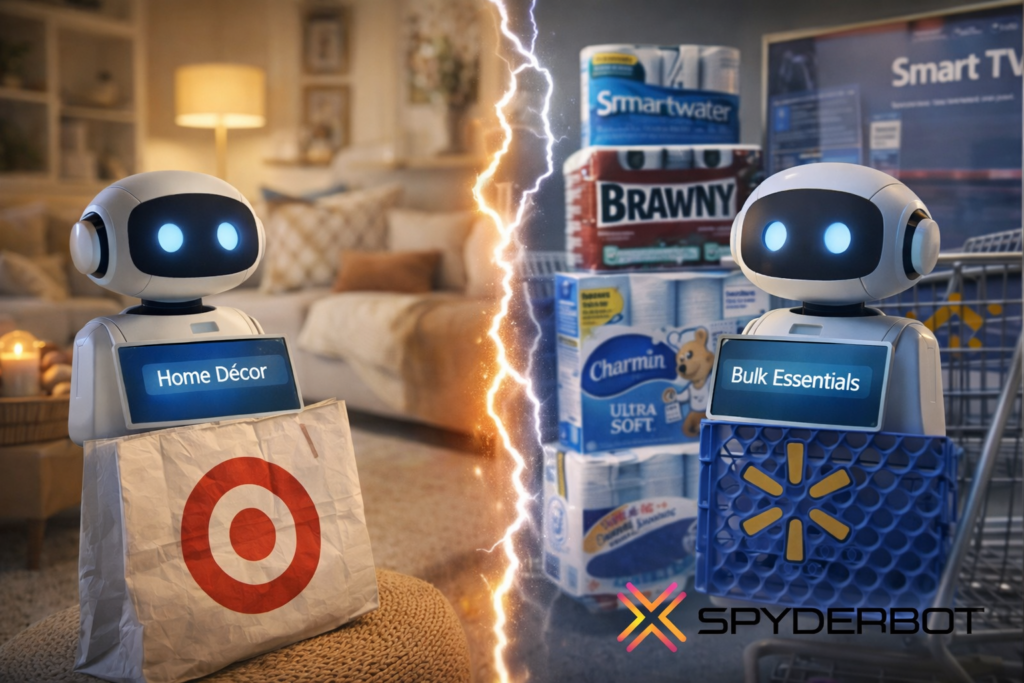
    Imagine a shopper asking an AI assistant a simple question: “Where should I buy stylish home décor on a budget?” Target appears quickly confident, familiar, dependable. Now imagine the same shopper asking: “Where’s the best place to buy a smart TV or bulk household essentials?” The answer changes, and Target starts to fade.

    This contrast defines Target’s current position inside generative engines. The brand is present, respected, and frequently cited but selectively. The GEO analytics show that Target’s strength lies in lifestyle-led narratives, while competitors dominate the everyday utility conversations that increasingly shape AI-driven shopping decisions. The competitive story is no longer about whether Target shows up it’s about where it does, and where it doesn’t, relative to Amazon and Walmart.


    Position in LLM Response Lists

    Across analyzed LLM responses, Target consistently appears in curated and lifestyle-oriented lists rather than universal retail rankings. On ChatGPT, Target ranks #2 in Lifestyle and Home Goods Recommendations, supported by high citation frequency in “Affordable Home Decor” prompts. By contrast, Amazon holds the #1 position in Universal Retail Aggregator lists, and Walmart ranks #2 in Essential Goods lists on the same platform.

    On Gemini, Target’s position softens further. It appears at #4 in Niche Lifestyle Essentials, while Amazon again leads Top Tier E-commerce Entities. Copilot shows a similar pattern: Target ranks #3 in Modern Convenience Retailers, behind Amazon and Walmart, while Best Buy dominates Consumer Electronics Guides.

    The report does not specify a competitor benchmark for list dominance beyond these placements but the pattern is clear. Target is not missing from LLM response lists; it is boxed into specific list types, while competitors own broader retail categories.


    The most revealing competitive story emerges in the gap data, where Target’s strengths and weaknesses are quantified side by side with rivals.

    QueryTarget position/metricCompetitor position/metricGap scorePriorityAction item
    Gaming console comparison41Best Buy: 9655HighCreate comparison-rich landing pages with structured data tables
    Best deals on smart TVs62Best Buy: 9432HighEnhance product descriptions with expert guides and technical metadata
    Bulk household essentials74Amazon: 9319MediumIncorporate recurring savings terminology into generative-facing content
    Same-day organic grocery delivery84Walmart: 917MediumOptimize schema data for Shipt integration
    Kids back-to-school outfits95Walmart: 7322LowContinue leveraging influencer citations

    This table makes the competitive reality unavoidable. Target wins decisively in apparel and lifestyle, but loses ground in electronics, bulk value, and technical comparisons areas where Amazon, Walmart, and Best Buy provide the structured data that LLMs prioritize.


    Trigger Keywords for Competitor Products

    Trigger keywords further reinforce this divide. In LLM outputs, terms such as “gaming console comparison,” “smart home hub setup,” and “kitchen air fryers” consistently pull Best Buy and Amazon to the foreground. Target’s presence in these triggers remains diluted.

    Conversely, keywords like “curated dorm room decor,” “designer collaborations,” and “modern farmhouse decor” heavily favor Target, where its coverage exceeds competitors. Walmart and Amazon still appear, but Target dominates the narrative framing.

    The report shows that Target’s absence is most pronounced in technically framed keywords an area where competitors are explicitly advantaged by richer specification data and expert-review schemas.


    Founder Negative Context

    Leadership narratives add another layer of competitive contrast. Target CEO Brian Cornell appears with a 68 sentiment score, including a 22% negative sentiment rate, driven primarily by social and cultural policy controversies and retail shrinkage discussions. Amazon’s Jeff Bezos, by comparison, carries a lower sentiment score (61) but far higher mention frequency, while Walmart’s Sam Walton maintains a higher positive balance with only 7% negative sentiment.

    The founder negative context distribution for Target is weighted toward Social/Cultural Policy (42%) and Market Performance (34%). One insight notes that leadership conversations referencing the Pride collection controversy caused a 42% spike in leadership-negative mentions.

    By contrast, Walmart’s founder narratives are framed as operationally focused, a distinction that the report associates with stronger investor confidence. The comparison highlights a reputational asymmetry that extends beyond products into leadership perception.


    At a macro level, Target recorded 266,790,786 total visits, including 58,693,973 bot visits, and 1,200,559 LLM referrals. Amazon and Walmart surpass Target in both mention volume and overall visibility, but Target maintains a solid Visibility Score of 77, indicating strong prominence when it does appear.

    Competitor benchmarks reinforce this snapshot. Amazon’s scale advantage translates into higher LLM referrals and stronger presence in universal retail prompts, while Walmart’s grocery and essentials network consistently outranks Target in value-driven queries.

    target.com’s Quick overview (GEO Report, Jan 14, 2026)

    Inside AI-generated answers, share of voice reflects true mindshare. Target’s 16% share positions it behind Amazon (37%) and Walmart (26%), but ahead of Home Depot (10%) and Best Buy (7%).

    What differentiates Target is not volume, but contextual efficiency. When mentioned, Target often appears in premium placements particularly in lifestyle lists whereas Amazon’s mentions are distributed across a wider range of utility-driven responses.

    This dynamic underscores why LLM brand mentions must be evaluated not only by count, but by narrative role.

    target.com’s Share of Voice in LLM Responses (GEO Report, Jan 14, 2026)

    Platform bias plays a decisive role. Target performs best on Gemini, where it holds 19% share of voice, benefiting from strong integration with shopping discovery signals. Amazon leads with 34%, and Walmart follows at 27%.

    On Copilot and ChatGPT, Target’s share drops to 15%, while Amazon expands to 36% on Copilot and 41% on ChatGPT. Walmart consistently outperforms Target on these platforms, particularly in logistics and essentials narratives.

    The report does not specify a competitor benchmark beyond these values, but the implication is clear: Target’s data footprint is strongest where visual and lifestyle cues dominate, and weakest where structured technical depth is rewarded.

    target.com’s AI Platform-Specific Visibility (GEO Report, Jan 14, 2026)

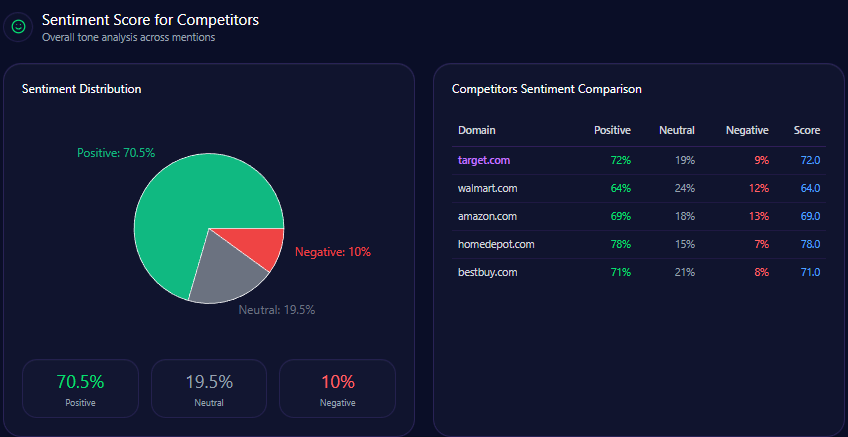
    Sentiment analysis further sharpens the comparison. Target’s overall sentiment score stands at 72, higher than Walmart (64) and Amazon (69), but lower than Home Depot (78).

    Context themes reveal why. Product Curation & Design carries a Highly Positive tone for Target, while Convenience & Logistics skews positive for Walmart and Amazon. Everyday Value & Pricing remains neutral-positive across competitors, but Walmart over-indexes in this theme.

    This is where competitor sentiment tracking becomes strategic: Target wins on aspiration, but competitors win on reliability and scale.

    target.com’s Sentiment Score for Competitors (GEO Report, Jan 14, 2026)

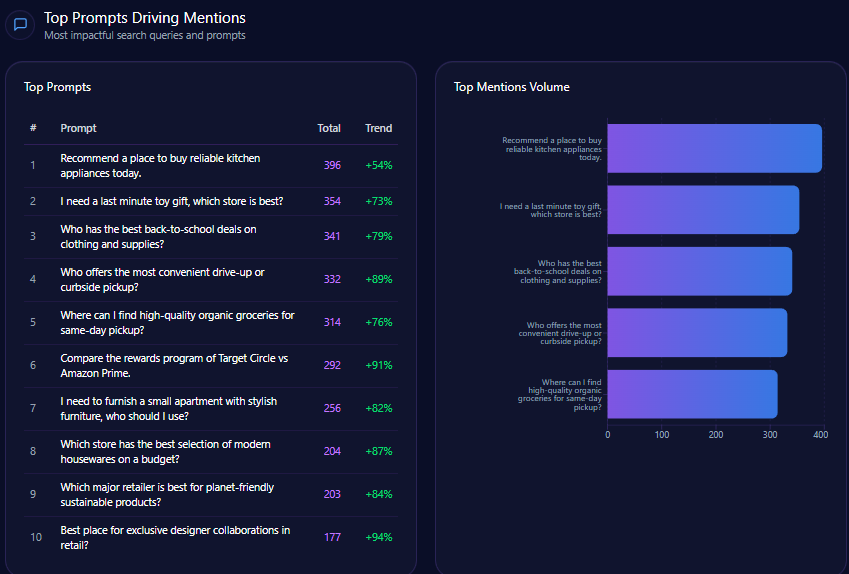
    The prompts that “summon” Target are telling. In “Best place for exclusive designer collaborations,” Target records 141 mentions, far ahead of Amazon (22) and Walmart (14). In “Who offers the most convenient drive-up or curbside pickup?” Target appears 122 times, closely matched by Walmart (126).

    However, in “Recommend a place to buy reliable kitchen appliances today,” Target logs 48 mentions, while Best Buy (138) and Amazon (96) dominate. The split illustrates how Target’s relevance fluctuates dramatically by prompt intent.

    target.com’s Top Prompts Driving Mentions (GEO Report, Jan 14, 2026)

    Types of Prompt Queries

    Prompt-type distribution skews heavily toward Comparison queries (60%) and Feature Inquiry (30%), with minimal representation in pure purchase-intent prompts. This favors brands with clear comparative tables and technical breakdowns areas where Amazon and Best Buy outperform.

    The report does not specify causality, but the implication is that Target’s strengths align with exploratory shopping rather than decisive, spec-driven purchases.


    E-commerce Sentiment for Competitor Products

    At the product level, e-commerce sentiment remains a bright spot. Target’s reviews show 78% positive, 17% neutral, and 5% negative sentiment. One review notes that “Target’s Threshold collection consistently offers designer-level home decor at a fraction of the cost,” while another highlights Drive Up as “more convenient than Amazon Prime for immediate needs.”

    Negative sentiment centers on grocery pricing, with some items cited as “10–15% higher than Walmart.” Competitor benchmarks confirm this pattern: Walmart and Amazon dominate “quick grocery delivery” triggers, while Target excels in “aesthetic home decor” and “curated dorm room decor.”


    Conclusion

    The GEO report positions Target at a strategic crossroads. Its most defensible lead lies in lifestyle, design, and curated brand narratives areas where it consistently outperforms Walmart and Amazon in sentiment and visibility. Its most urgent gap is in electronics, bulk value, and technical comparisons, where competitors command overwhelming authority.

    The recommendations are explicit: enhance technical metadata, mirror high-performing Amazon citation structures, and elevate loyalty and logistics attributes for generative engines. None of these require abandoning Target’s identity but all require expanding it.

    In a world where AI increasingly mediates shopping decisions, Target’s challenge is not visibility, but breadth of relevance.