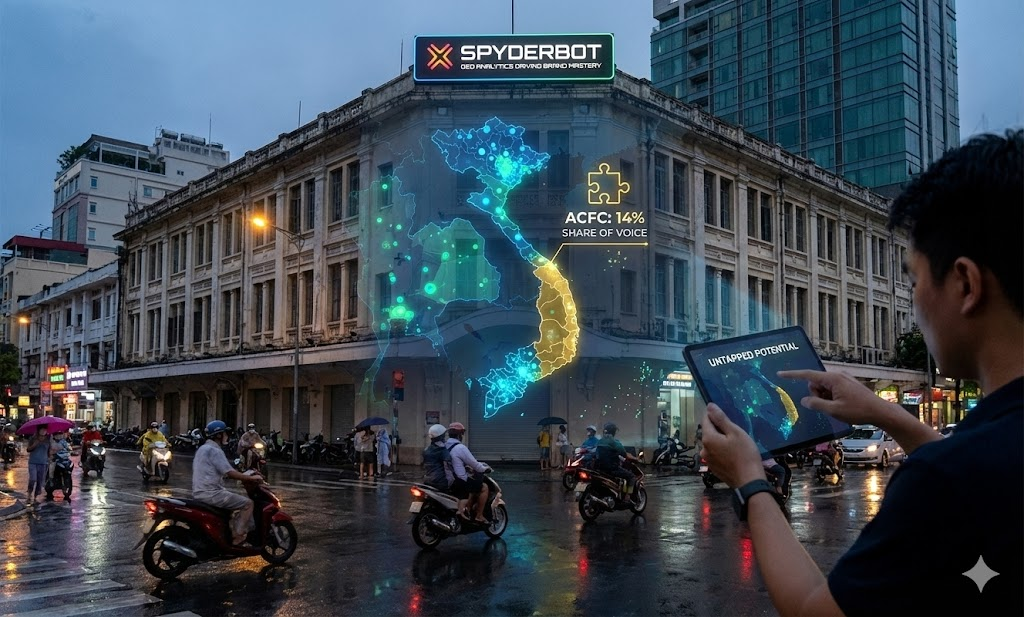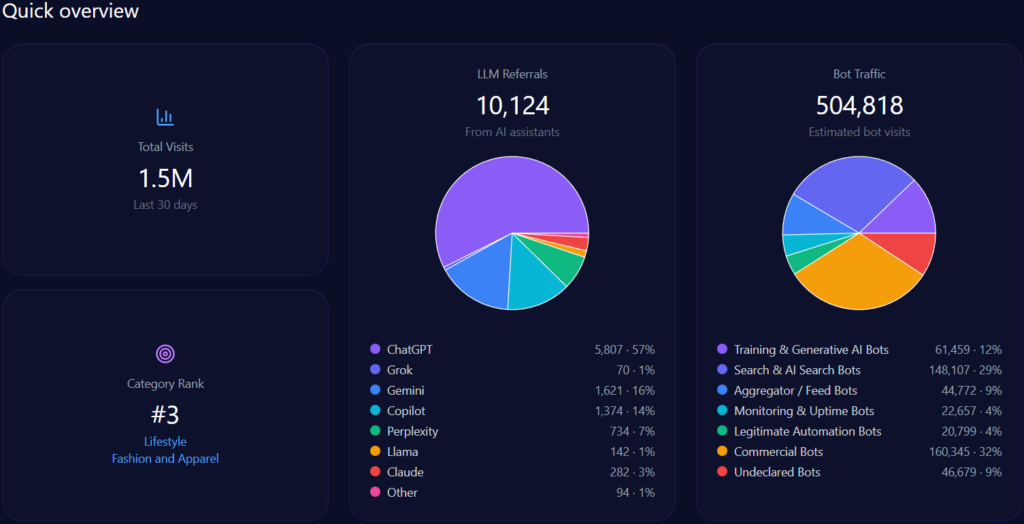
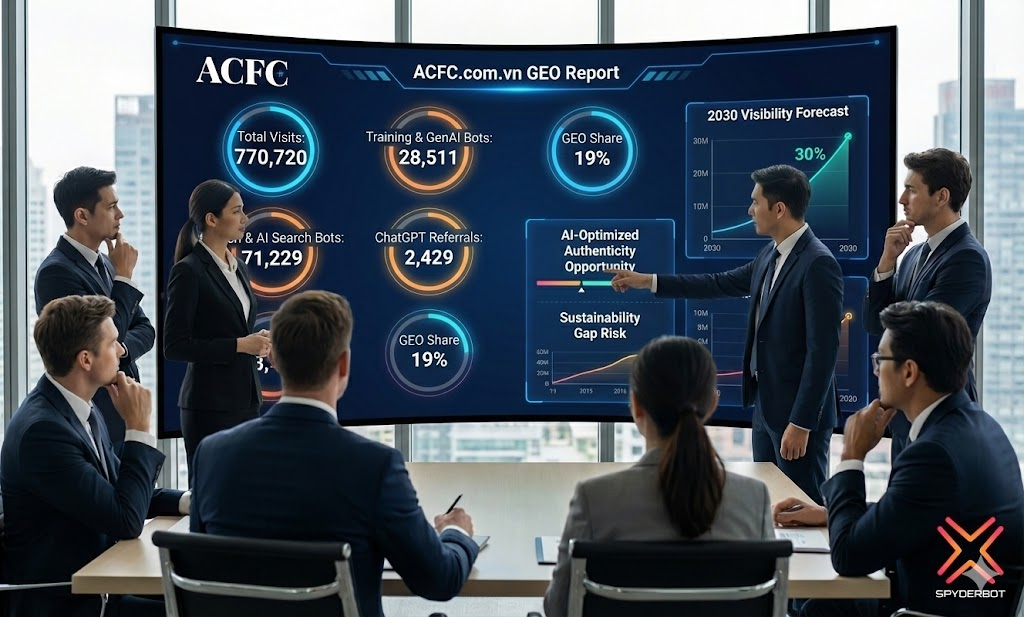
As generative engine optimization (GEO) evolves into the cornerstone of digital retail strategy, AI-driven metrics like LLM brand mentions and competitor sentiment tracking will increasingly dictate market winners in industries such as fashion. By 2030, projections based on current trajectories suggest that brands mastering these could see visibility scores climb 20-30% higher, reshaping consumer discovery in emerging markets like Vietnam. Anchored in ACFC.com.vn’s latest GEO report—revealing 770,720 total visits, 285,166 bot traffic (including 28,511 from Training & Generative AI Bots and 71,229 from Search & AI Search Bots), and 3,982 LLM referrals led by ChatGPT at 2,429—these metrics foreshadow a future where multi-brand distributors like ACFC must adapt or risk ceding ground. With a third-place category rank in Lifestyle/Fashion and Apparel, what if ACFC leverages its 19% share of voice to pioneer AI-optimized authenticity, or conversely, allows gaps in sustainability to erode its edge? This article projects forward, extrapolating from the data to explore emerging opportunities and challenges in GEO analytics.
Forecasting Shifts in Vietnam’s Fashion Retail Landscape
Looking ahead, the competitive dynamics captured in ACFC.com.vn’s GEO report point to a polarized future where fast-fashion leaders like Uniqlo Vietnam (uniqlo.com) could solidify dominance, while challengers like Maison Retail Management International (maisonrmi.com) and Central Retail Vietnam (supersports.com.vn) nibble at specialized niches. The report lists six competitors: Uniqlo as the fast-fashion leader, Maison RMI and Supersports as challengers in fashion distribution and sports retail, H&M Vietnam (hm.com) as a follower, and Vua Hang Hieu (vuahanghieu.com) plus Tam Son International (tamsonvn.com) in follower and niche roles for luxury.
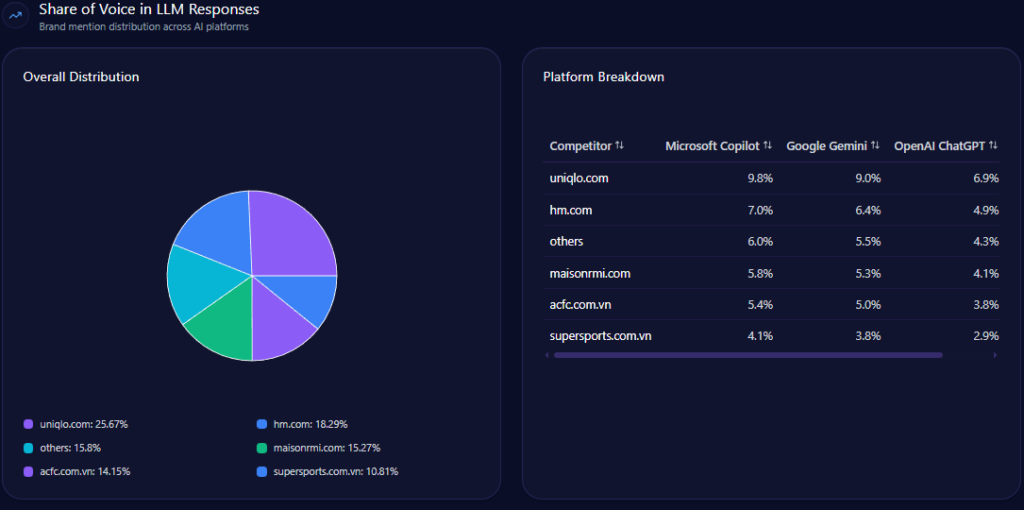
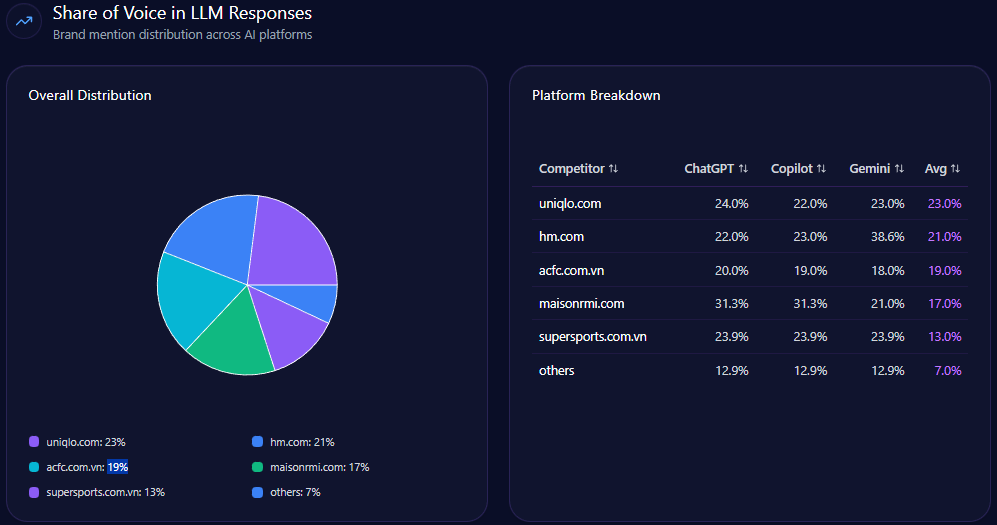
Extrapolating from share of voice data—ACFC at 19% (104 mentions out of 552), trailing Uniqlo’s 23% (127) and H&M’s 21% (116)—a predictive landscape emerges where Uniqlo’s lead in generic queries could widen to 25-28% by 2030 if ACFC doesn’t counter with enhanced LLM brand mentions. Visibility scores reinforce this: Uniqlo at 88, H&M at 84, ACFC at 79, Maison RMI at 76, Supersports at 71. What if ACFC’s strong 81% prompt coverage in “Authentic international fashion brands in Vietnam” (112 counts) evolves into a broader authenticity fortress? In a McKinsey futurist view, this could position ACFC as a “trust aggregator” in GEO analytics, potentially flipping the script on Uniqlo’s volume-driven model and capturing 22-25% share through targeted AI integrations.
Platform-Specific Futures in GEO Analytics
Platform visibility metrics offer a crystal ball into how AI ecosystems might diverge, with ACFC’s current standings—82% on ChatGPT (20% share, 37 mentions), 80% on Copilot (19%, 35), and 77% on Gemini (18%, 33)—hinting at uneven growth. Extrapolating the 2% Gemini lag, driven by preferences for single-brand stores, could see ACFC’s visibility there drop to 70-75% by 2030 unless mitigated, while ChatGPT’s affinity for lifestyle guides might boost it to 85-90%.
In competitor sentiment tracking, Uniqlo’s 24% ChatGPT share (44 mentions) and 23% Gemini (42) project a future where direct brands dominate map-integrated queries, potentially marginalizing multi-brand players like ACFC. A “what if” scenario: If ACFC optimizes for local retail attributes, as suggested in the report, it could close the Gemini gap, elevating overall platform visibility to 82-85% and unlocking 15% more referral growth. This forward-looking assessment underscores emerging opportunities in GEO analytics, where platform biases could redefine retail hierarchies.
From Authenticity Strengths to Pricing and Sustainability Vulnerabilities
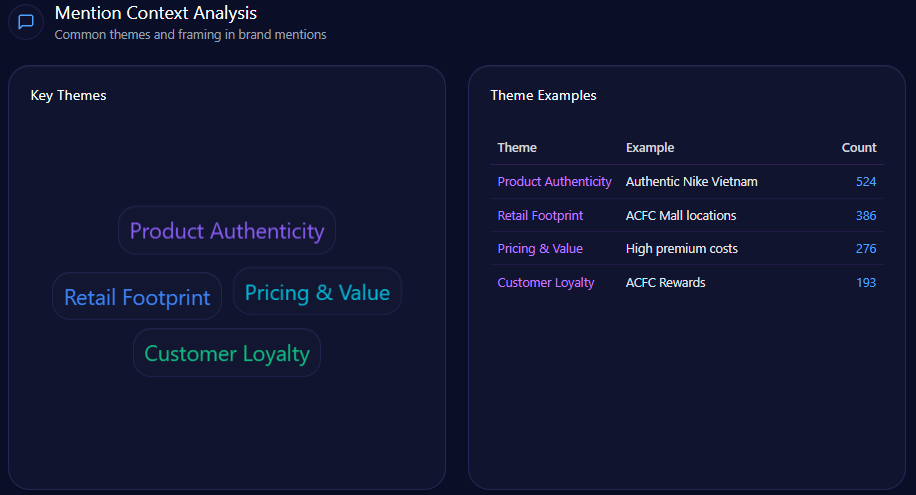
Sentiment scores in the report—ACFC at 79 overall (74% positive, 18% neutral, 8% negative)—versus Uniqlo’s 91 (86% positive) and H&M’s 73 (71% positive) forecast potential shifts where authenticity remains a bulwark but neutral elements erode gains. Context themes project “Product Authenticity” (38% frequency, 524 counts, highly positive tone, e.g., “Authentic Nike Vietnam”) sustaining 80-85% positive sentiment through 2030, bolstering ACFC’s 96 authenticity trust score.
However, “Pricing & Value” (20%, 276 counts, neutral tone, e.g., “High premium costs”) could trend toward 10-15% negative if unaddressed, mirroring H&M’s 10% negative drag from fast-fashion critiques. Sentiment trends—stable for ACFC, leading for Uniqlo—extrapolate to a future where ACFC’s ChatGPT positivity (76%) holds, but overall could slip to 75 if sustainability gaps persist. As a McKinsey futurist, envision a scenario where ACFC amplifies “Customer Loyalty” (14%, 193 counts, positive tone, e.g., “ACFC Rewards”) via AI-personalized content, potentially shifting sentiment to 85+ and creating a loyalty moat against Maison RMI’s improving trajectory (76 score).
Forecasting Prompt-Driven Growth and Visibility Alerts
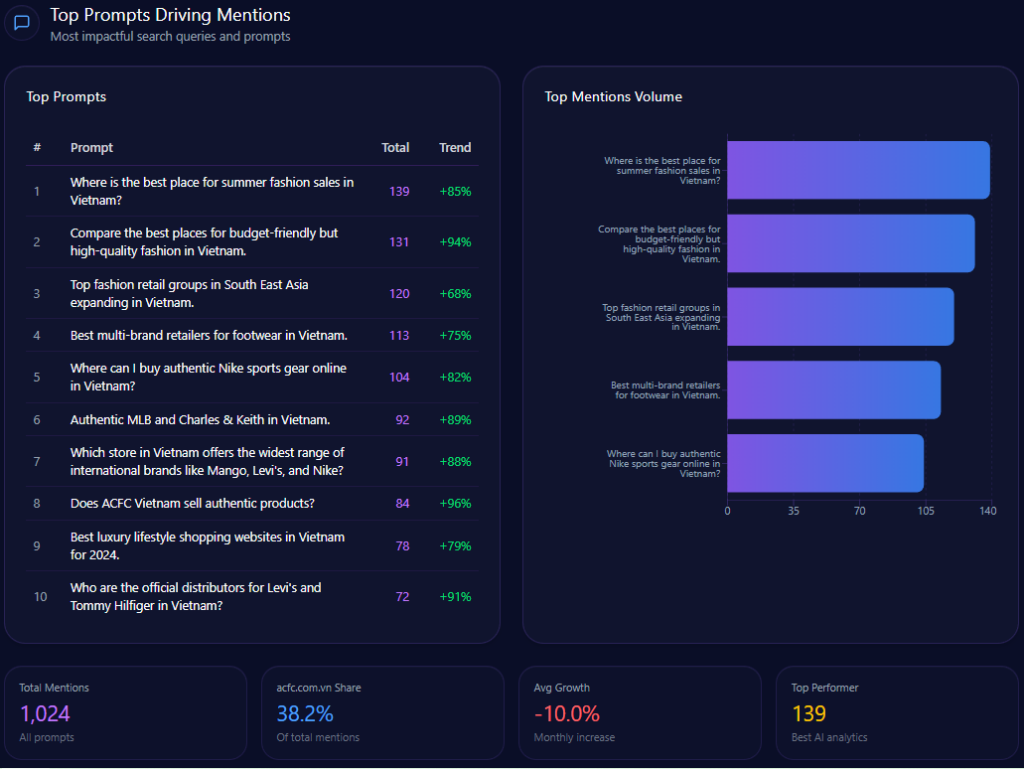
Trend insights, with ACFC’s prompt fluctuations (+2 in Jan, +4 Feb, -2 Mar, +6 Apr, +3 May, +2 Jun), project a volatile yet upward trajectory, potentially reaching consistent +4-5 monthly gains by 2030 if seasonal peaks are harnessed. Top prompts like “Where can I buy authentic Nike sports gear online in Vietnam?” (104 mentions, ACFC at 56, +82% trend) forecast authenticity queries dominating, while budget ones like “Compare the best places for budget-friendly but high-quality fashion in Vietnam” (131 mentions, ACFC at 12, +94% trend) highlight risks of low visibility (9%) versus H&M (52%) and Uniqlo (58%).
Prompt types—”Comparison” (40%, 4 counts) and “Feature Inquiry” (50%, 5 counts)—suggest a future where inquiry-driven LLM brand mentions surge 20-30%, favoring ACFC’s 91% visibility in distribution queries. Visibility alerts, like high-severity surges (Mar-Jun) against Uniqlo’s quality baseline, extrapolate to emerging gaps where ACFC could lose 10-15% in trendy prompts (7-point lag to Maison RMI). Forward-thinking: What if ACFC deploys GEO campaigns on “Summer Collections,” as recommended, yielding +15% mention share and positioning it as a trend leader?
Mentions and Referrals in a Conversion-Driven Future
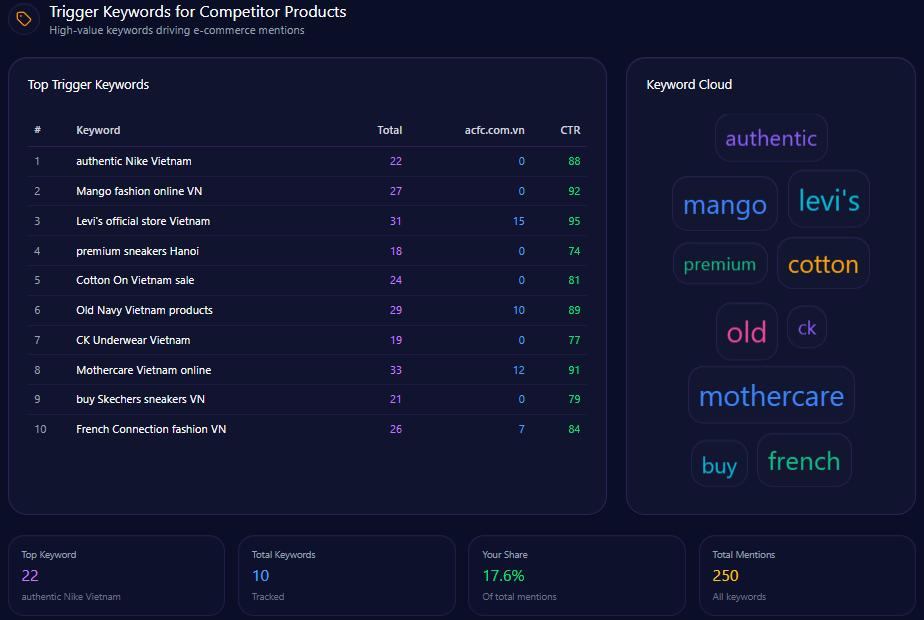
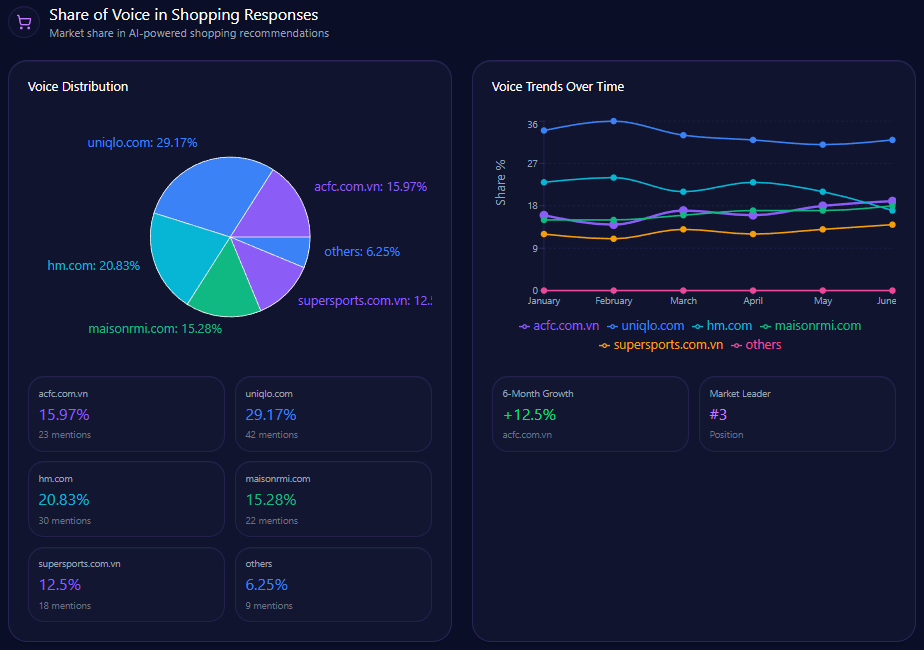
Ecommerce metrics—ACFC at 15.97% share (23 mentions) behind Uniqlo’s 29.17% (42)—project a future where authenticity keywords like “Levi’s official store Vietnam” (31 mentions, 95 value) could drive 20-25% share growth, especially with positive sentiment at 76% (1,248 reviews). Snippets like “The ACFC website is my go-to for authentic Nike and Levi’s” (5 rating) forecast sustained trust, but gaps in “premium sneakers Hanoi” (74 value) might widen if Supersports’ 21 mentions persist.
Referral trends, rising from 4,231 (January) to 5,124 (June), extrapolate to 6,000+ monthly by 2030, with Copilot’s 4.2% conversion (3,156 referrals) outpacing ChatGPT’s 3.1% (4,124). Ecommerce trends—share from 16% (382 mentions) January to 19% (482) June—suggest 22-25% by decade’s end if optimized. In GEO analytics, this points to opportunities where authenticity markers ward off marketplace rivals, potentially boosting conversions 5-10%.
Leadership Transitions and Funding Momentum
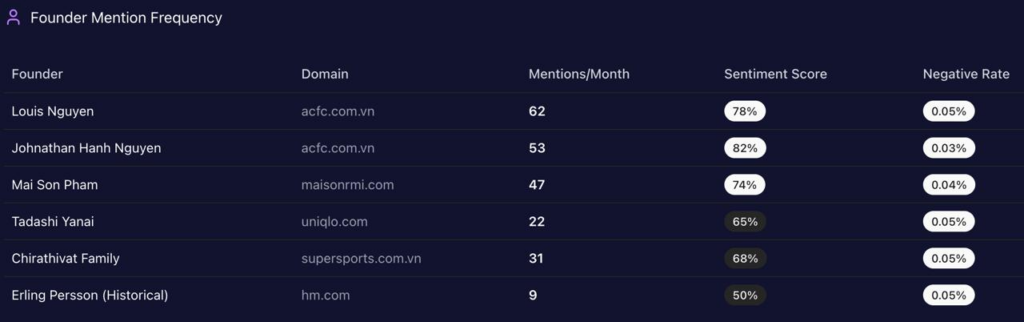
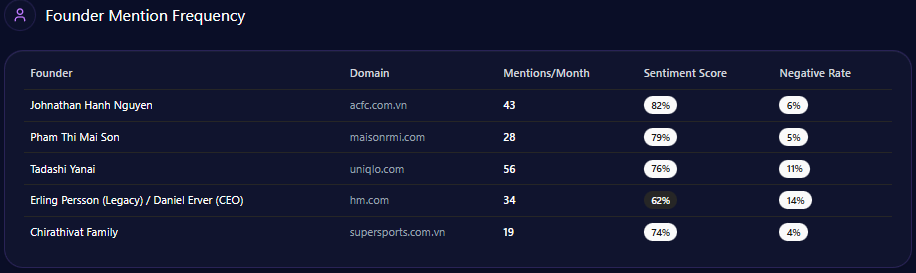
Founder mentions—Johnathan Hanh Nguyen at 43 frequency and 82 sentiment (78% positive)—project a stable leadership aura, but a 14% succession spike (e.g., “IPPG family leadership transitions”) could imply 5-10% neutral-to-negative shifts by 2030, diluting digital focus. Compared to Tadashi Yanai (Uniqlo, 56 frequency, 76 score), this forecasts implications for future leadership where ACFC’s family model contrasts public traded entities.
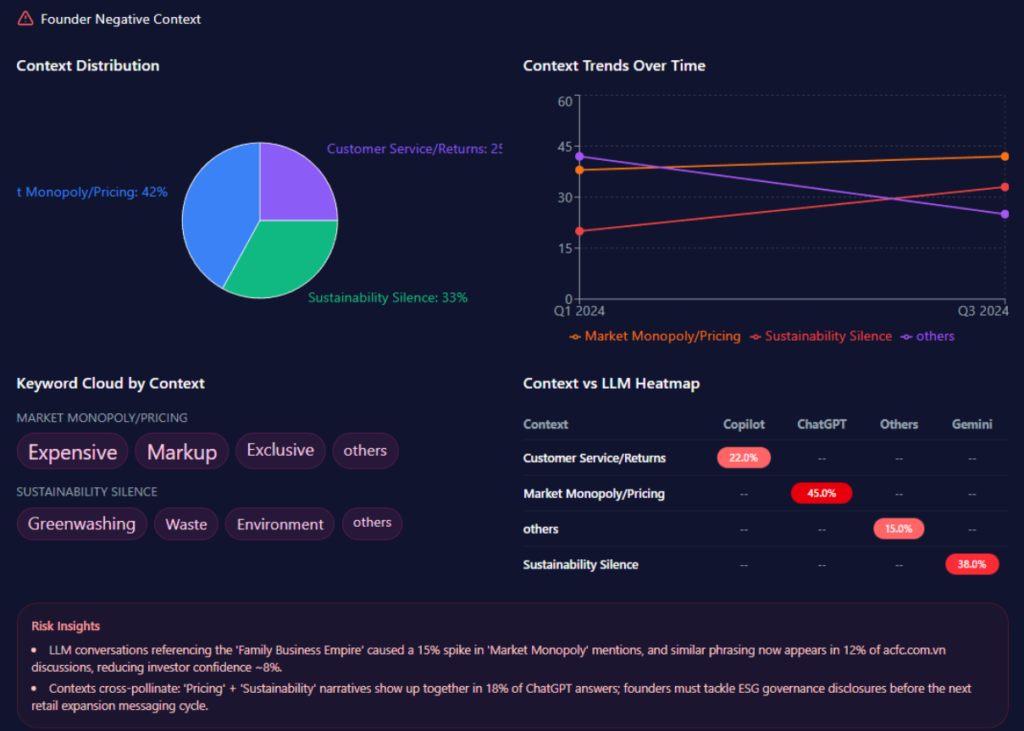
Investment mentions (32 coverage, 14 funding, +8 trend change, “Subsidiary of IPPG”) and funding trends—Q1 2024 (112 mentions, +14 up), Q2 (127, +13 up)—extrapolate to +15-20% annual growth, potentially attracting pre-IPO rounds like Maison RMI’s. Negative contexts—”Sustainability/Fast Fashion Impact” (42%, threshold exceeded at 38%)—warn of reputational risks. A futurist projection: Promoting next-gen roles could stabilize sentiment to 85+, unlocking “Tech-Retail” investments and positioning ACFC for 50+ mention frequency
Projecting Gaps That Could Reshape Market Share
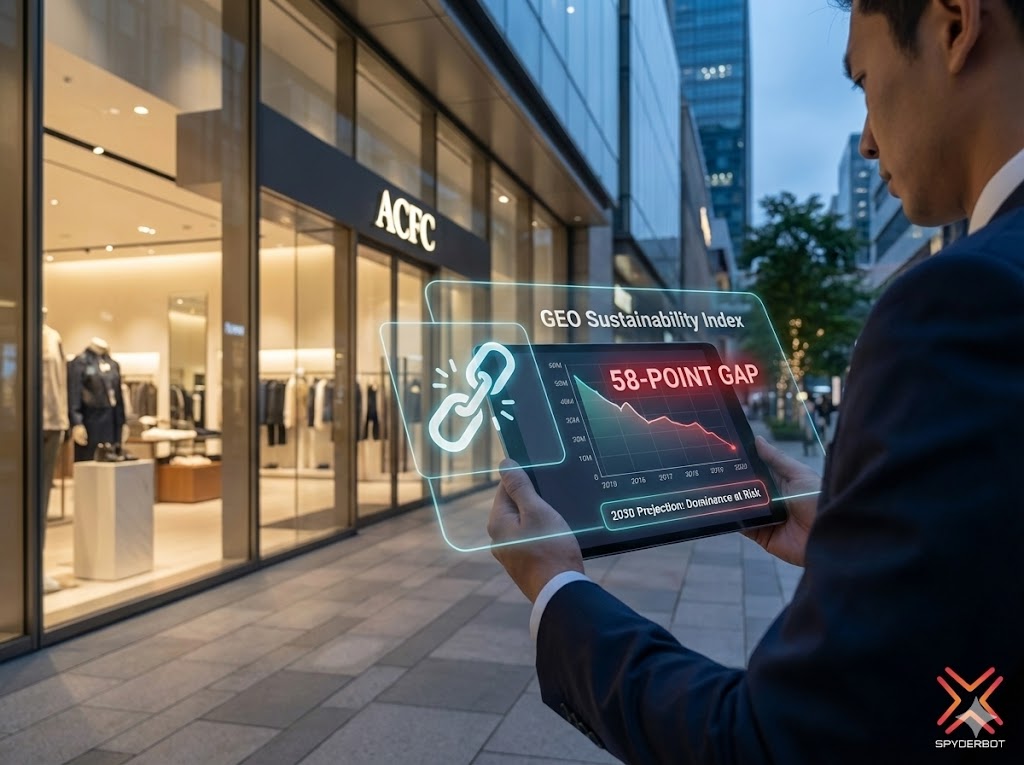
Negative points—a 4% share deficit to Uniqlo in generic queries, 58-point sustainability visibility gap, 12% peak referral decline—forecast emerging risks where ACFC might forfeit 20% visibility to rivals like Supersports (86% in sportswear, vs. ACFC’s 71%). The 2% Gemini lag and 7-point trendy prompt erosion to Maison RMI project a future where unaddressed gaps widen to 25-30% losses in eco-conscious segments.
Competitor gap data, like 76-point vs. Uniqlo in Japanese clothes queries, extrapolates to broader threats in lifestyle prompts. What if these gaps compound? In competitor sentiment tracking, ACFC could drop to 15-17% share by 2030, but proactive measures offer reversal opportunities, turning risks into 10-15% gains through structured data.
In conclusion, ACFC.com.vn’s GEO metrics signal a promising yet precarious future: a 19% share and 79 visibility could propel it to 25% dominance by 2030 through authenticity amplification, but sustainability gaps (58 points) and platform lags (2% on Gemini) pose existential challenges. Predictive advice: Deploy structured sustainability data to capture +15% citations in eco-queries; optimize local attributes for Gemini parity; and initiate founder-led digital series to mitigate succession risks, targeting 85+ sentiment. By extrapolating these, ACFC can pioneer a resilient GEO strategy. Explore SpyderBot to forecast your brand’s AI-driven future today.