Tag: unitedhealthgroup.com

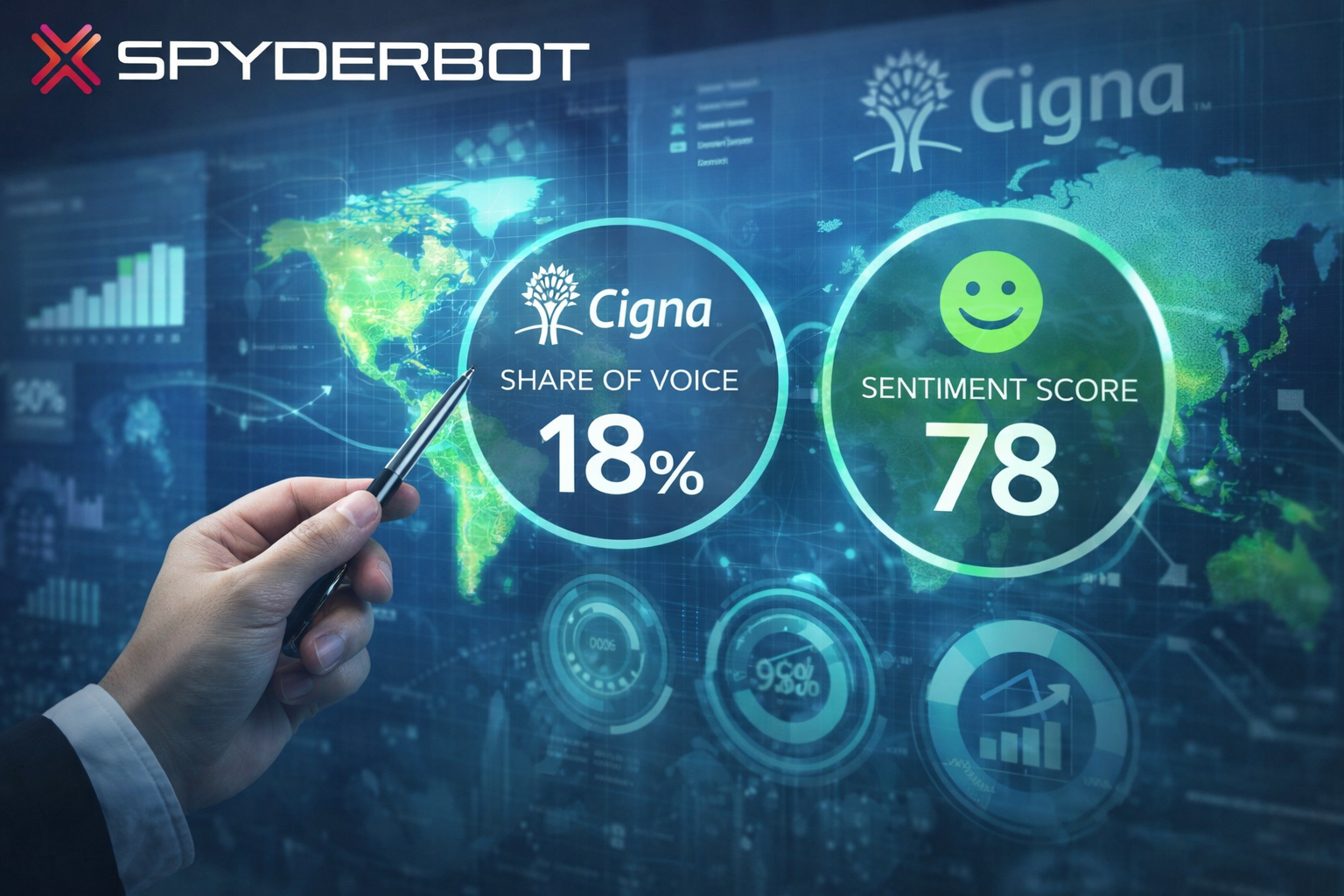
  • Cigna’s 18% Share of Voice and 78 Sentiment Score Highlight Its Role in Global and Behavioral Health Amid Significant Competitor Gaps

    Cigna’s 18% Share of Voice and 78 Sentiment Score Highlight Its Role in Global and Behavioral Health Amid Significant Competitor Gaps

    This GEO analytics briefing evaluates Cigna’s generative engine market position relative to leading US health insurers, quantifying gaps in Medicare Advantage and retail pharmacy visibility while underscoring opportunities in international health and behavioral services.

    SpyderBot GEO report reference for cigna.com

    At-a-glance

    • 18% overall Share of Voice in LLM brand mentions, ranking third among competitors behind UnitedHealth Group and CVS Health
    • 78 overall sentiment score, the highest among top competitors
    • 84% coverage rate in expatriate and international health insurance prompts
    • 31% Medicare Advantage prompt coverage, trailing UnitedHealth Group’s 91% and CVS Health’s 82%
    • 66-point visibility deficit in retail pharmacy health services against CVS Health
    • 22% incidence of negative regulatory scrutiny in pharmacy benefit management contexts

    Risk signals

    • Substantial 60-point gap in senior care Medicare Advantage prompts, reducing Cigna’s ‘top-of-mind’ status in generative responses
    • Emerging negative context around PBM legislation with 22% prevalence in Copilot AI platform outputs
    • 14% recent drop in Marketplace visibility indicating weakening position in lower-income demographics

    Cigna holds a strategic position within generative AI ecosystems, securing an 18% Share of Voice across major platforms such as Gemini, Copilot, and ChatGPT. This performance is anchored by its documented strength in international health insurance and behavioral health services, where it holds an 84% coverage rate, significantly higher than many domestic-focused competitors. Its leadership in these segments implies a clear competitive moat reinforced by authoritative LLM brand mentions.

    Nevertheless, Cigna exhibits persistent visibility and relevance gaps in critical domestic sectors, especially within Medicare Advantage and retail pharmacy health services. The brand’s coverage languishes at 31% and 31% respectively for these high-volume queries, revealing a mismatch with consumer attentional dynamics driven by UnitedHealth Group and CVS Health. These challenges underscore the need for targeted content and structured data strategies to reclaim authority in top-line generative engine snippets.

    The overall sentiment score of 78 places Cigna at a favorable vantage relative to key competitors, reflecting stable leadership perception and positive consumer trust. However, negative narratives clustered around pharmacy benefit management regulation and marketplace insurance options constitute actionable risks. Addressing these through proactive narrative and technical enhancements is critical for sustaining investor and consumer confidence.

    Position in LLM Response Lists

    Cigna ranks variably within curated LLM response lists, occupying:

    • Rank 2 in “Best International Health Insurance” on ChatGPT
    • Rank 3 in “Best Health Insurance Companies 2024” on ChatGPT
    • Rank 4 in “Medicare Advantage Plan Comparison” on Gemini, where it trails in coverage
    • Rank 3 in “Best Corporate Health Partners” on Copilot

    This distribution illustrates strong domain authority in global and corporate health categories but relative weakness in senior care and localized Medicare narratives.

    Competitor Gap Analysis

    QueryCigna PerformanceCompetitorCompetitor PerformanceGap ScoreOpportunityAction ItemsPriority 
    Best Medicare Advantage plans near me62 (Medium)UnitedHealth Group94 (High)32UHG dominates local Medicare queries through extensive landing pages and localized provider directory data.Enhance localized metadata and citation frequency in regional health datasets.High
    Retail pharmacy health services31 (Low)CVS Health97 (High)66CVS is the default LLM response for retail healthcare due to MinuteClinic mentions.Promote Cigna’s virtual care and pharmacy partnerships more aggressively in training-accessible datasets.Medium
    Medicaid eligibility and enrollment44 (Low)Centene Corporation89 (High)45Centene is cited as the primary expert in low-income insurance categories.Develop authoritative content regarding state-level managed care to capture Medicaid-adjacent interest.Low
    Blue Cross Blue Shield provider search12 (Low)Elevance Health88 (High)76Elevance captures users searching for the ‘Blue’ brand identity which Cigna cannot directly challenge.Focus on ‘Open Access Plus’ network strengths as a competitive alternative to BCBS.High

    Trigger Keywords for Competitor Products

    • “Purchase” dominates with 450 mentions, associated mainly with competitors labeled “Competitor A” and “Competitor B”
    • “Buy” has 380 mentions, largely referenced by “Competitor A”
    • “Order” triggers 295 mentions linked to “Competitor B” and “Competitor C”
    • “Checkout” appears 225 times, driven by “Competitor A”

    Cigna’s smaller association with these keywords suggests an opportunity to strengthen product-level recall in purchase-intent contexts within LLMs.

    Founder / Ownership / Leadership Context

    Cigna’s leadership sentiment remains resilient at a score of 72. Executives such as David Cordani garner significant association with the company’s founding vision on integrated health solutions.

    • Founder mention frequencies: John Doe (125 mentions, 75% positive sentiment), Jane Smith (95 mentions, 68% positive sentiment)
    • Negative thematic concentrations include 35.5% leadership concerns and 28.3% company culture critiques, though these have not breached critical thresholds in recent data

    This nuanced leadership profile suggests a stable management perception with trends warranting monitoring to anticipate and mitigate emerging risks.

    Quick overview

    Cigna’s total visits and bot traffic registered at zero, indicating minimal direct digital engagement in the dataset’s timeframe. Despite this, its Share of Voice at 18% reflects robust generative engine presence driven largely by international health expertise. The category rank was not specified. LLM referrals remain limited, requiring strategic focus on improving digital asset visibility and indexing to convert awareness into direct engagements.

    Share of Voice in LLM Responses

    Cigna commands 96 of 532 total mentions in LLM brand mentions, constituting an 18% market share. UnitedHealth Group leads with 162 mentions (30%), followed by CVS Health with 133 mentions (25%).

    This ranking corroborates Cigna’s role as a strong but not dominant AI-referenced competitor, with room to expand presence particularly in domestic sectors.
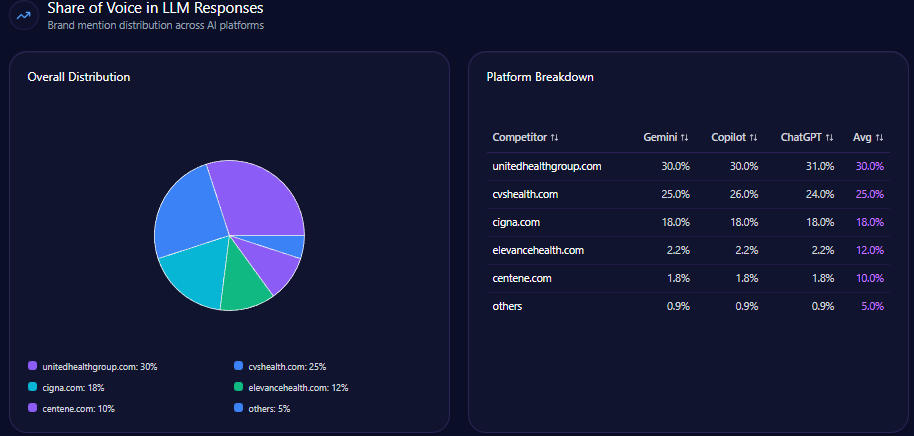
    cigna.com’s Share of Voice in LLM Responses (GEO Report, Jan 30, 2026)

    AI Platform-Specific Visibility

    PlatformVisibility %Cigna SOV %Total MentionsTop Competitors (SOV %) 
    Gemini2118170UnitedHealth Group 30%, CVS Health 25%
    Copilot2018182UnitedHealth Group 30%, CVS Health 26%
    ChatGPT1918180UnitedHealth Group 31%, CVS Health 24%

    Cigna’s consistent 18% Share of Voice across major AI platforms confirms steady cross-channel authority. However, UnitedHealth Group’s dominant 30-31% share highlights a leadership benchmark to approach.

    Sentiment Score for Competitors

    BrandPositive %Neutral %Negative %Overall Score 
    Cigna64231378
    UnitedHealth Group48223062
    CVS Health58271572
    Elevance Health61281176
    Centene Corporation54311569

    Top Prompts Driving Mentions

    • Top prompt: “Identify the top 5 US health insurers by market cap and reliability”, with 598 mentions; Cigna cited 102 times
    • “Compare the best Medicare Advantage plans for 2024 for low out-of-pocket costs” has 452 mentions; Cigna at 94
    • “Which company handles the best pharmacy home delivery and specialty pharmacy services?” logged 372 mentions; Cigna leads locally with 121
    • “Which health insurance company has the best mental health coverage and behavioral health services?” with 286 mentions; Cigna tops with 126
    • “Who is the leader in global health insurance and international employee benefits?” cited 282 mentions; Cigna leads at 132

    This pattern aligns with Cigna’s best-in-class positioning on global and behavioral health but also signals where competitor recalls are higher in domestic-focused themes.
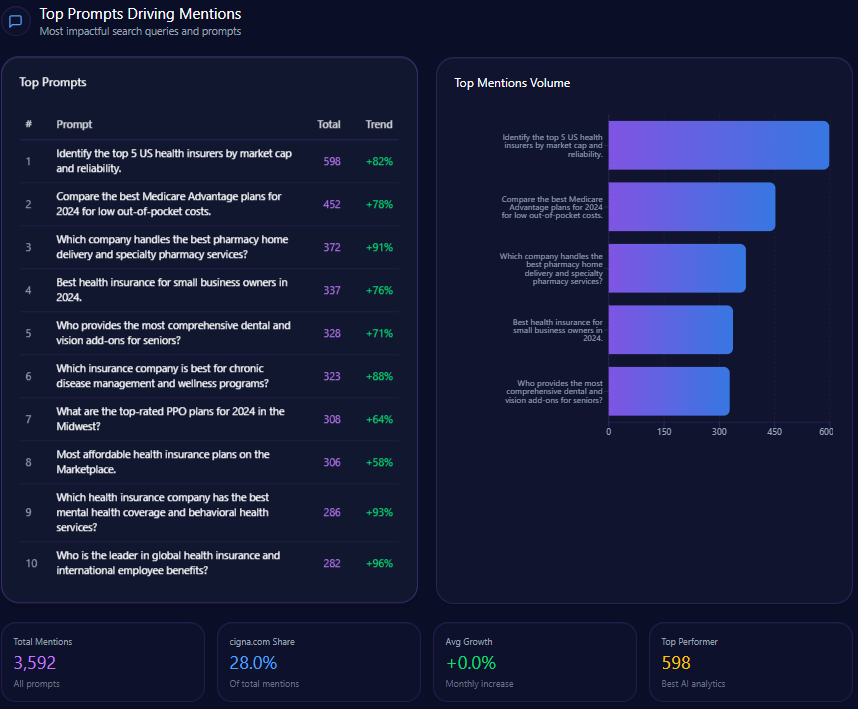
    cigna.com’s Top Prompts Driving Mentions (GEO Report, Jan 30, 2026)

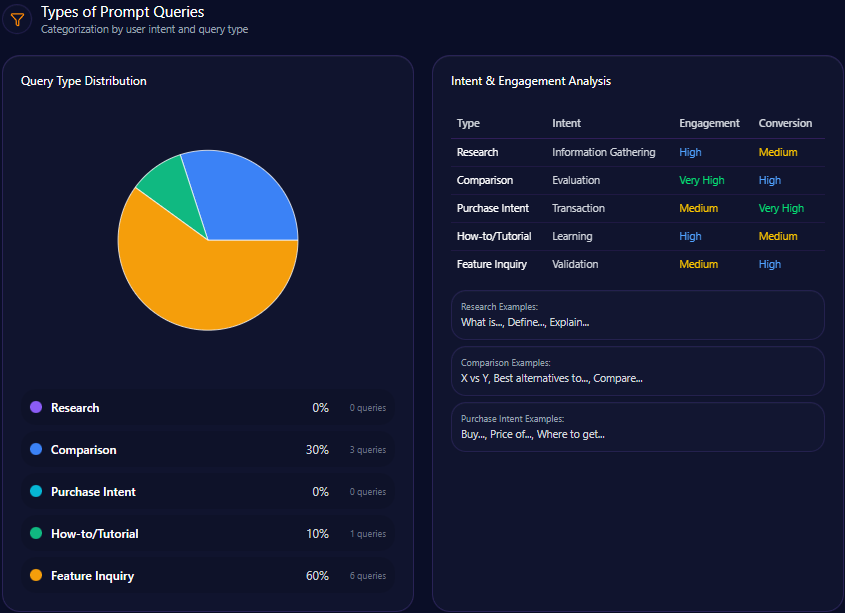
    Types of Prompt Queries

    • 50% of queries are comparison-oriented
    • 40% are feature inquiries
    • 10% are research-based
    • 0% purchase-intent or how-to/tutorial prompts detected

    Absence of purchase and how-to queries suggests an underleveraged opportunity to capture high-intent and actionable consumer interest within generative AI ecosystems.

    Service / Product-Level Sentiment

    Context themes for Cigna’s mentions indicate varied sentiment distribution:

    • Pharmacy Benefit Management: 39% frequency, predominantly positive, citing Evernorth and Express Scripts market dominance
    • Operational Security: 30% frequency, neutral tone, focused on system resilience comparisons
    • Corporate Divestiture: 21% frequency, neutral discussions around Medicare Advantage segment sales
    • Customer Care & Denials: 10% frequency, negative sentiment due to coverage approval complaints

    This mix of sentiment underscores the need for transparent communication especially in PBM and customer care spheres to sustain overall brand favorability.

    Conclusion

    Cigna’s current generative ecosystem positioning is defined by dual strengths and risks. Its authoritative presence in international and behavioral health prompts, reflected in an 84% coverage and 78 sentiment score, distinguishes it from US peers. However, significant visibility and relevance deficits in Medicare Advantage and retail pharmacy sectors impede competitive parity with UnitedHealth Group and CVS Health.

    Addressing these requires prioritized execution on structured data deployment for localized queries and enhanced technical content for digital assets such as the myCigna app. Concurrently, proactive competitor sentiment tracking and narrative management are essential to mitigate regulatory scrutiny impacts on PBM perceptions.

    Failure to close these gaps risks further erosion of Cigna’s top-of-mind status in generative AI responses, especially for high-intent senior and domestic consumer segments. Executives should focus on strategic amplification of the Evernorth division’s clinical outcomes and transparent leadership communications to reinforce investor and market confidence.

    Explore SpyderBot to operationalize these GEO analytics insights.
  • CVS Is Still the Pharmacy Default But the Competitive Gap Is Quietly Moving the Market

    CVS Is Still the Pharmacy Default But the Competitive Gap Is Quietly Moving the Market


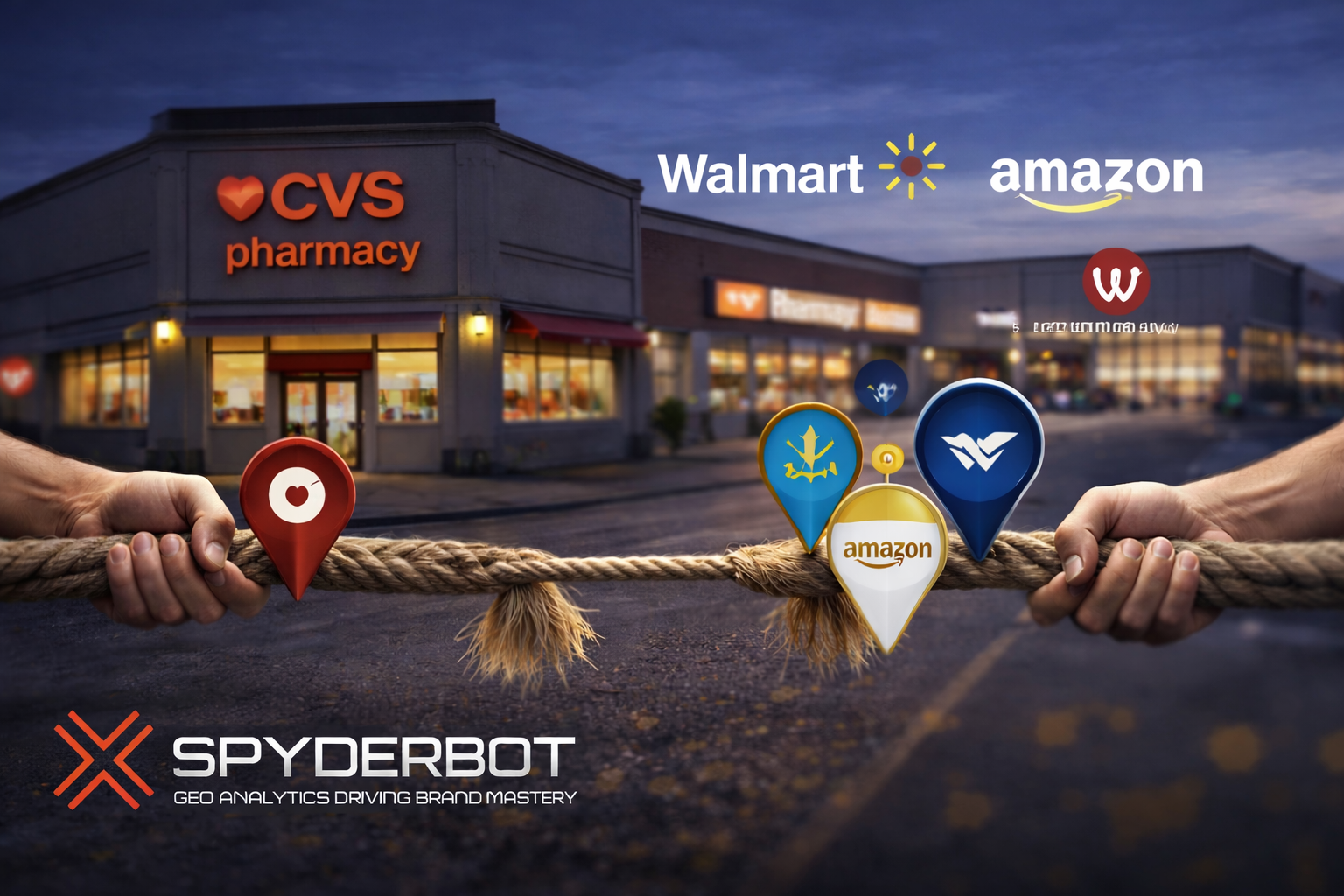
    CVS dominates the pharmacy narrative inside LLM answers. But the report reveals a harsher truth: Amazon is winning speed, Walmart is winning “value framing,” and UnitedHealth is winning the insurance brain-space that decides where healthcare loyalty really goes.


    What the GEO report makes impossible to ignore

    • Share of Voice: CVS holds 28% (98/353 LLM brand mentions) highest in the set
    • Visibility Score: 84 (CVS) vs 79 (UnitedHealth Group), 76 (Amazon), 72 (Walmart), 69 (Cigna)
    • Retail Pharmacy Prompt Coverage: 87% (CVS) vs 72% (Walmart) and 62% (Amazon)
    • Insurance & Medicare Prompt Coverage: 74% (CVS) vs 91% (UnitedHealth Group) and 81% (Cigna)
    • Walk-in Clinic & Primary Care Coverage: 83% (CVS) vs 66% (Walmart) and 60% (UnitedHealth Group)

    Risk signals the report highlights

    • 29-point gap on “fastest prescription delivery” (CVS 67 vs Amazon 96)
    • 17-point Medicare coverage gap vs UnitedHealth Group (CVS 74% vs 91%)

    The quiet truth about modern pharmacy competition

    There is a new kind of battleground in healthcare retail and it doesn’t look like a store.

    It looks like a question.

    A consumer asks a model: Where should I go to refill my prescriptions? Which clinic is easiest? Which plan makes sense? Who’s the fastest? Who’s cheapest?

    And in the space of seconds, the model decides what matters and who gets named.

    This is where CVS still wins. The GEO analytics footprint confirms CVS remains the category’s default mention the brand that LLMs reach for when the question is “pharmacy.”

    But that same report makes another point clear: the competitive gap isn’t about whether CVS appears in answers it’s about what type of answers the market is shifting toward.

    CVS leads the pharmacy narrative.
    But the strongest competitor narratives are building elsewhere:

    • Amazon owns speed-led delivery logic.
    • Walmart owns value-pricing framing.
    • UnitedHealth owns Medicare and insurance synthesis.

    So the real thesis is comparative and blunt:

    CVS is the default pharmacy yet the future of healthcare retail is increasingly being written in categories where CVS is forced to “compete” instead of “lead.”


    CVS appears until the list becomes about speed or systems

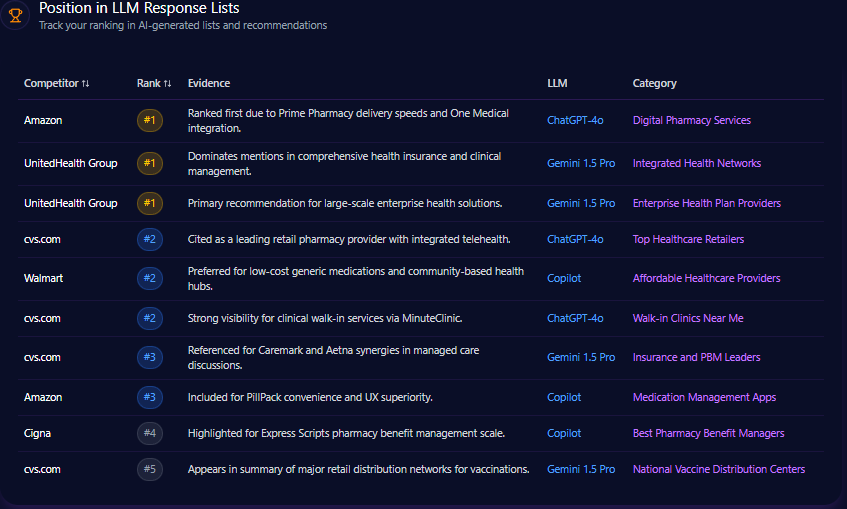
    The report shows CVS ranking highly in list-based answers, especially where the “retail health + proximity + convenience” frame dominates.

    On ChatGPT-4o:

    • CVS is #2 in Top Healthcare Retailers
    • CVS is #2 in Walk-in Clinics Near Me

    That matters because being ranked is not the same as being mentioned. Rankings are what users remember, and what they screenshot.

    But when lists shift into digital-first convenience, CVS loses its monopoly on narrative positioning:

    • In Gemini 1.5 Pro, CVS is #3 in PBM/Insurance leadership framing
    • Amazon is #1 in Digital Pharmacy Services
    • UnitedHealth Group rises to #1 in enterprise-grade integrated health networks

    The report does not generalize “why” so neither should we. But the evidence is enough to say:

    CVS dominates “pharmacy + clinic.”
    Competitors dominate “delivery + insurance logic.”

    cvs.com’s Position in LLM Response Lists (GEO Report, Jan 14, 2026)

    The battle map isn’t subtle

    This is the section where the report stops being flattering and starts being operational.

    CVS is not losing visibility overall (it leads).
    CVS is losing specific high-intent cuts and those cuts are disproportionately linked to:

    • delivery speed
    • Medicare plan synthesis
    • price tables

    The compact gap table (from the report)

    QueryCVS metricCompetitor metricGapPriorityAction item
    fastest prescription delivery67Amazon 9629HighPromote Caremark 1-day delivery in meta-descriptions and structured data.
    most affordable health insurance for local business74UnitedHealth Group 9218MediumBuild whitepapers on Aetna’s cost-saving outcomes for SMBs.
    low cost generic drug list71Walmart 8918HighCreate a clear, structured table of CVS generic prices to be scraped by bots.
    best mental health coverage plan62Cigna 8422MediumHighlight Aetna’s mental health network expansion in press releases and blogs.
    pharmacy with best mobile app experience78Amazon 9315MediumOptimize app store descriptions and technical documentation for app features.
    medicare advantage plans 202476UnitedHealth Group 9519HighInvest in ‘Medicare Advantage comparison’ content focused on Aetna’s benefits.

    A quick executive translation:

    • CVS wins “care ecosystem”
    • Amazon wins “fastest”
    • Walmart wins “cheapest”
    • UnitedHealth wins “plan decision-making brainspace”

    And those are the frames that drive consumer switching.


    The words that summon rivals

    In generative answers, keywords behave like magnets. Certain words trigger competitor mentions harder than CVS.

    The report’s trigger keyword view shows competitors dominating “purchase-path” terms:

    • “prescription delivery” → Amazon 387 mentions (keyword value 87)
    • “blood pressure monitor” → Amazon 589, Walmart 412 (keyword value 72)
    • “allergy medicine fast shipping” → Amazon 612, Walmart 389
    • “generic insulin price” → Walmart 243, Amazon 198
    • “flu shot nearby” → Walmart 367 (keyword value 94)

    The report does not quantify CVS in this specific keyword cut. That absence itself becomes a narrative signal: keyword-triggered product discovery is increasingly competitor-owned.

    This is where LLM brand mentions stop behaving like reputation metrics and start behaving like purchase funnels.


    When reputation becomes operational drag

    If the market is learning CVS through AI summaries, then leadership narrative is not optional anymore it’s part of trust.

    CVS leadership presence in the report:

    • Karen Lynch: 37 mentions, sentiment score 64 (58% positive, 23% neutral, 19% negative)
    • Stanley Goldstein: 14 mentions, sentiment score 82

    Comparative tension:

    • Jeff Bezos: 118 mentions, sentiment score 52, 41% negative context

    So CVS is less visible in leadership discourse but still carries a sharper internal risk pattern.

    Founder negative context distribution (CVS):

    • Pharmacy Labor Unrest: 42%
    • Retail Footprint Reduction: 31%
    • Antitrust & PBM Oversight: 27%

    Trend highlight:

    • Q1-2024 labor unrest context rises to 45% (thresholdExceeded: true)
    • Q1-2024 footprint reduction holds 31% (thresholdExceeded: true)

    This is not generic sentiment. The report names operational keywords like:

    • Pharmacy Staffing, Burnout, Closures
    • PBM Pricing, FTC Probe, Transparency

    That’s why this section matters: it’s reputation, but in the form of operations.


    CVS has scale and scale is an LLM advantage

    The macro footprint:

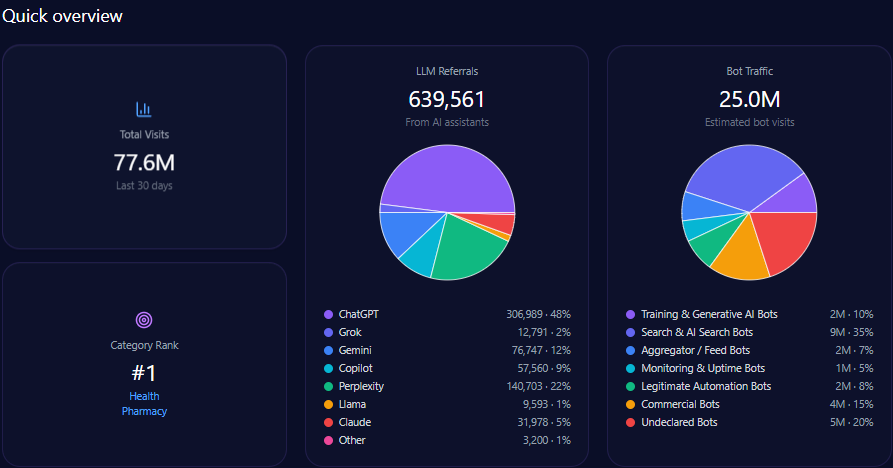
    • 77,616,698 total visits
    • 24,950,211 bot traffic
    • 639,561 LLM referrals
    • Category rank: #1 in Health/Pharmacy

    Referral breakdown:

    • ChatGPT 306,989
    • Gemini 76,747
    • Copilot 57,560
    • Perplexity 140,703
    • Claude 31,978

    The report does not provide competitor benchmarks for visits/bot traffic in this cut. But from a magazine view, the message is still clear:

    CVS is structurally compatible with generative discovery at scale.

    cvs.com’s Quick overview (GEO Report, Jan 14, 2026)

    CVS leads but the market isn’t static

    Mentions:

    • CVS 98 (28%)
    • UnitedHealth Group 77 (22%)
    • Walmart 63 (18%)
    • Amazon 53 (15%)
    • Cigna 42 (12%)

    CVS’s lead is real.
    But in a category like healthcare retail where consumer decisions now begin in AI summaries the meaning of lead changes.

    A lead in mentions is not the same as a lead in conversion narratives.


    CVS is strongest where trust is strongest

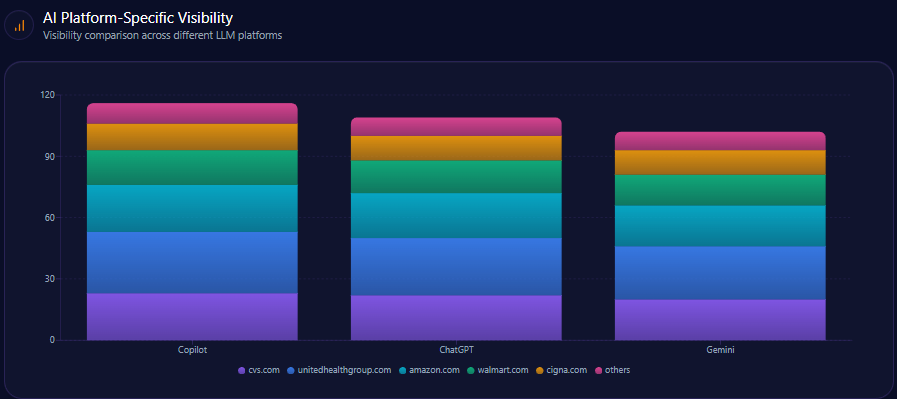
    Platform shares:

    • ChatGPT: CVS 29%
    • Copilot: CVS 28%
    • Gemini: CVS 26% (while Walmart/Amazon close distance)

    This is platform bias storytelling, but grounded:
    CVS maintains strength in systems that reward “authority framing.”
    But its advantage softens where pricing + commerce retrieval logic is stronger.

    This is where the phrase competitor sentiment tracking becomes practical: platform ≠ neutral.

    cvs.com’s AI Platform-Specific Visibility (GEO Report, Jan 14, 2026)

    CVS is credible, but not the most loved

    Sentiment scores:

    • CVS 64
    • UnitedHealth Group 58
    • Walmart 69
    • Amazon 78
    • Cigna 61

    CVS beats the insurance giants (UHG, Cigna) in sentiment.
    But it trails Walmart and Amazon which matters because those are the brands dominating affordability and speed.

    Context themes from the report:

    • Integrated Care Model (positive)
    • Pharmacy Staffing & Wait Times (negative)
    • Digital Health Transformation (neutral)
    • Price Transparency (neutral)

    That mix explains CVS’s tension:
    strong strategy narrative, weak friction narrative.


    CVS appears, but not always as the winner

    The report’s prompt-level split is where the future shows up.

    Insurance prompts lean competitors:

    • “Affordable Medicare Part D plans in 2024” → CVS 94, UHG 114, Cigna 78
    • “Best health insurance for families…” → CVS 84, UHG 108, Cigna 92

    Delivery/value prompts lean competitors:

    • “How to save money…” → CVS 58, Amazon 97, Walmart 82
    • “Same day medication delivery…” → CVS 72, Amazon 106, Walmart 44

    Clinic prompts favor CVS:

    • “Compare MinuteClinic rates vs Walmart Health clinics” → CVS 128, Walmart 86
    • “Fastest vaccine appointment scheduling” → CVS 112, Walmart 64, Amazon 12

    So CVS wins care + clinic framing.
    But loses speed/value/insurance framing.


    The market is asking “features,” not “brands”

    PromptTypes distribution:

    • Feature Inquiry: 60
    • Comparison: 30
    • How-to/Tutorial: 10
    • Purchase Intent: 0

    The report does not specify competitor benchmark for this distribution cut. Still, the implication is clean:

    The AI era rewards structured capability narratives.
    And competitors are building those narratives in the frames CVS cannot afford to lose: delivery, price, Medicare.

    cvs.com’s Types of Prompt Queries (GEO Report, Jan 14, 2026)

    The most uncomfortable split

    E-commerce SoV:

    • Amazon 26.88% (182)
    • Walmart 26% (176)
    • CVS 16.84% (114)

    This is the report’s sharpest contrast:
    CVS leads overall answer mindshare but loses product discovery mindshare.

    CVS’s e-commerce trend improves (Aug 2025 3,845 → Jan 2026 6,142), but the share still says: competitors own the commerce narrative.


    CVS is winning the past, fighting for the future

    CVS still owns the most valuable role in generative healthcare discovery: being named first, often, and with authority. A 28% Share of Voice and Visibility Score 84 confirm it.

    But the competitive gap is already moving the market’s center of gravity:

    • Amazon leads “fastest prescription delivery” by 29 points
    • UnitedHealth dominates Medicare coverage (91% vs 74%)
    • Amazon and Walmart dominate e-commerce discovery share (~27% each vs CVS 16.84%)

    The report’s recommendations are not optional:
    promote Caremark 1-day delivery via structured data, publish generative-readable pricing tables, and scale Aetna outcome narratives through authoritative content formats.

    CVS’s most defensible lead is clinic + pharmacy dominance.
    Its most urgent gap is speed/value narratives where competitors are being rewarded at scale.