CVS Health leads AI-driven healthcare discovery with standout visibility and Share of Voice—yet the same engines amplify pressure points in Medicare Advantage, PBM scrutiny, and retail pharmacy experience. The question for leadership is no longer “Are we present?” but “Are we believed?”
At-a-glance — Numbers to know
- Generative Search Share: 41% (with 34% → 41% across the report’s monthly search-share series through 2024-08-31)
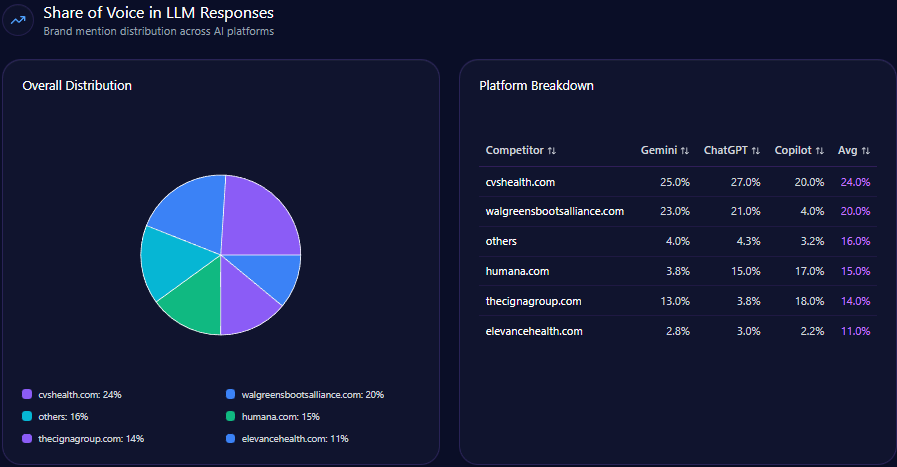
- Share of Voice (LLM brand mentions): 24% (204 of 843 total mentions)
- Visibility Score: 88 (highest among listed peers in the report’s visibility table)
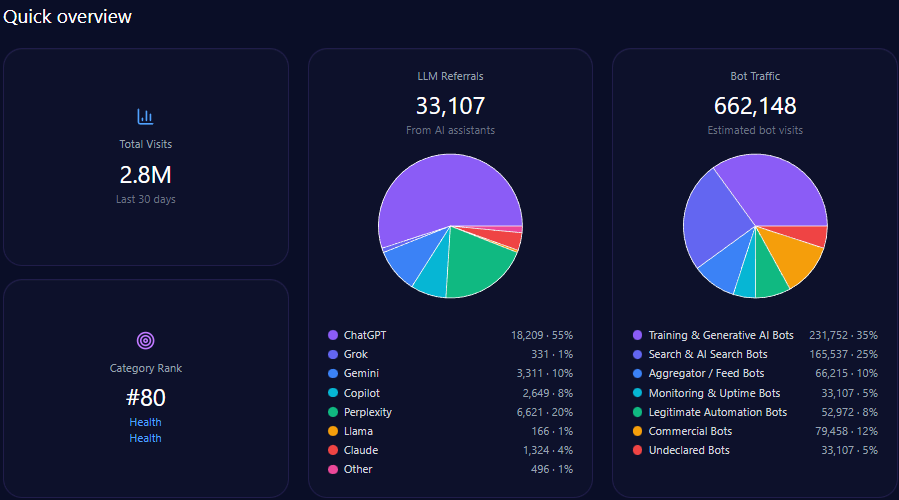
- Traffic + bots: 2,758,948 total visits with 662,148 bot traffic
- LLM referrals: 33,107 total (ChatGPT 18,209; Perplexity 6,621; Gemini 3,311; Copilot 2,649; Claude 1,324)
- Category rank: #80 in Health/Health
Risk signals
- 32% negative sentiment for cvshealth.com in the sentiment split (overall sentiment score 68)
- 18-point gap in “Best Medicare Advantage plans for 2024” (CVS 76 vs Humana 94) and 20% Share of Voice on Copilot
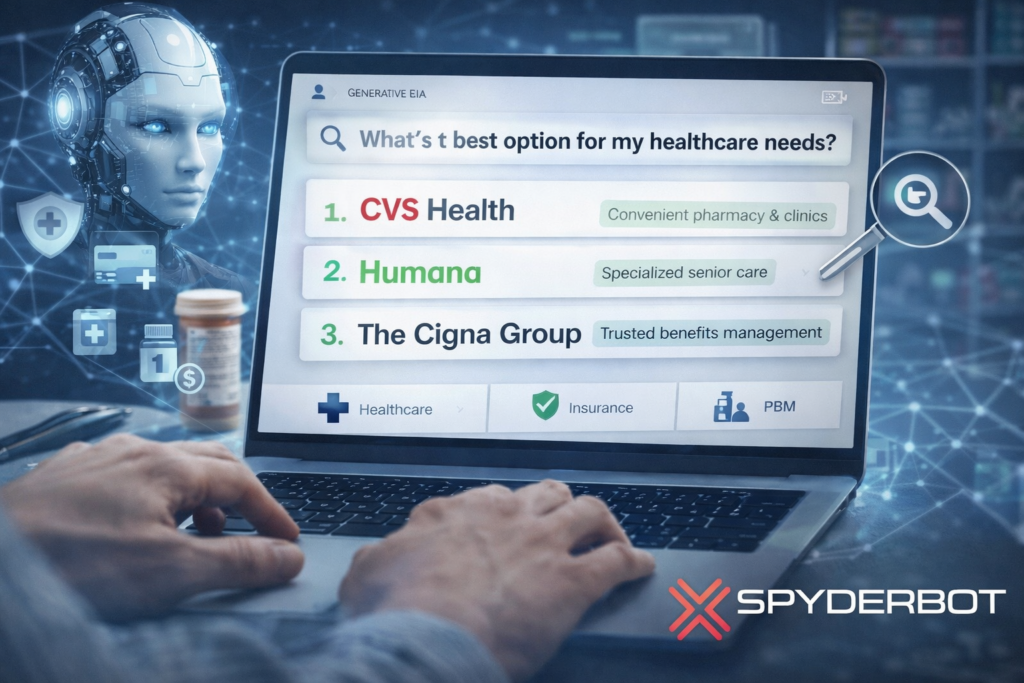
A consumer doesn’t “search for a pharmacy” anymore. They ask a system to decide which option feels safest for prescriptions, which clinics are convenient, which health insurance plan is easiest to navigate, which PBM is most credible, and which digital health experience won’t break at the moment it matters.
That’s the new care doorway: a prompt, a ranked answer, and a recommendation that feels final.
In this report’s GEO analytics view, CVS Health sits in the center of that doorway. It shows up often, across pharmacy, retail healthcare, health insurance, PBM, clinics, prescriptions, and care delivery narratives. But the same answer engines that elevate CVS also sharpen the contrast: specialized senior care authority leans toward Humana; enterprise PBM language leans toward The Cigna Group; and the “wait times and transparency” conversation keeps surfacing as a reputational tax.
The modern trust gap isn’t about awareness. It’s about the shape of the story that AI chooses to tell.
Position in LLM Response Lists
When people ask large language models for leaders in healthcare, CVS Health is not merely present—it is often placed at the top.
The report shows cvshealth.com ranked #1 on ChatGPT in “Top 5 Healthcare Companies,” backed by an evidence statement that it is “cited as the primary integrated healthcare provider in 84% of healthcare infrastructure queries.” CVS Health is also ranked #1 on Copilot in “Healthcare Innovation Leaders,” with evidence tied to “digital health innovation and MinuteClinic convenience.”
At the same time, the list behavior reveals where the brand becomes “near-leader” rather than default choice. CVS Health appears at #2 in Gemini’s “Most Accessible Health Plans,” described as “ranked high for pharmacy accessibility and Aetna insurance integration.” And it appears at #2 in ChatGPT’s “Best Medicare Part D Options,” where the evidence notes it “loses ground to Humana in specific Medicare Part D recommendation frequency.”
Competitors are also clearly pinned to specific roles: Humana is ranked #1 in “Best Senior Health Insurance” on ChatGPT, while Walgreens is ranked #1 in Gemini’s “Leading Pharmacy Chains.” The result: CVS Health leads the integrated narrative, but AI still assigns “specialist authority” elsewhere—especially in senior care.
Competitor Gap Analysis
Inside generative answers, competition is not a single leaderboard—it is a set of battles by query intent. The report’s gap analysis reads like a care-map: senior care authority, PBM credibility, pharmacy convenience, network brand power, and specialty pharmacy expertise.
| Query | CVS Health metric | Competitor metric | Gap/priority |
|---|---|---|---|
| Best Medicare Advantage plans for 2024 | 76 | 94 (Humana) | 18 — High |
| Home healthcare services for seniors | 72 | 86 (Humana) | 14 — High |
| Global health benefit solutions for enterprises | 68 | 89 (The Cigna Group) | 21 — Medium |
| Behavioral health support programs | 79 | 91 (The Cigna Group) | 12 — Medium |
| Cheap prescription refills today | 81 | 92 (Walgreens) | 11 — Medium |
| Specialty pharmacy for rare diseases | 82 | 88 (The Cigna Group) | 6 — Medium |
The action items in the report are unusually direct: improve Aetna Medicare features content targeting 65+ demographics; publicize home health benefits and clinical partnerships more aggressively; enhance technical white papers for global workforces; and develop authoritative content around community mental health services.
In other words, the “gap” isn’t framed as a product deficit. It’s framed as a documentation-and-citation deficit—where the wrong brand becomes the “expert” because it is easier for AI to cite.
Trigger Keywords for Competitor Products
The report’s trigger keyword data shows a crucial reality: in many high-intent healthcare phrases, competitors are “summoned” faster than CVS Health—often by default, and often at scale.
A few examples from the report’s keyword triggers:
- “Medicare Advantage plans” (mentions: 657) drives competitor mentions led by Humana (894) and Elevance (712).
- “PBM services” (mentions: 432) tilts toward The Cigna Group (489).
- “OTC health products” (mentions: 921) skews toward Walgreens (874).
- “Vaccine scheduling” (mentions: 1102) heavily favors Walgreens (1054).
- “Telehealth consultation” (mentions: 381) favors Humana (312).
- “Pharmacy delivery” shows competitor mentions led by Walgreens (912).
Even in phrases that should naturally favor a broad integrated platform—like pharmacy delivery, clinics near me, and vaccine scheduling—AI’s tendency is to follow the most repeatedly cited retail convenience narrative.
This is where LLM brand mentions become strategy: the keyword isn’t the market; the keyword is the doorway into an answer.
Founder / Leadership Context
The report’s leadership layer is not about a founder myth. It is about reputation signals that get bundled into AI narratives—governance, regulatory context, labor conditions, and retail financial performance.
Founder mentions appear explicitly for Stanley Goldstein (mention frequency 64, sentiment score 71, with 58% positive, 36% neutral, 6% negative) and Sidney Goldstein (mention frequency 42, sentiment score 68, with 52% positive, 43% neutral, 5% negative). That legacy visibility provides a stable baseline—but modern narrative volatility is driven elsewhere.
The report’s “founderNegativeContext” distribution concentrates on:
- PBM Regulatory Scrutiny: 38%
- Retail Financial Performance: 31%
- Labor and Staffing Issues: 22%
- Others: 9%
In the “Current Month” slice, PBM Regulatory Scrutiny rises to 44%, with Retail Financial Performance at 32%. The heatmap further shows where these contexts peak: Retail Financial Performance is highest on Gemini (42%), PBM Regulatory Scrutiny on ChatGPT (36%), and Labor and Staffing Issues on Copilot (29%).
One report insight captures the mechanism plainly: “LLM conversations referencing the FTC PBM investigation caused a 28% spike in ‘Regulatory Scrutiny’ context mentions… similar phrasing now appears in 44% of cvshealth.com discussions.” Another notes “Margin Compression” and “Medicare Advantage” narratives co-appearing in 37% of Gemini answers.
The point isn’t the debate itself—it’s that AI packages the debate as part of the brand identity unless leadership intervenes with authoritative counterweight.
Operationally, CVS Health’s footprint in the report is large and measurable:
- 2,758,948 total visits
- 662,148 bot traffic, with bot categories including Training & Generative AI Bots (231,752) and Search & AI Search Bots (165,537)
- 33,107 LLM referrals, led by ChatGPT (18,209), Perplexity (6,621), Gemini (3,311), and Copilot (2,649)
- #80 category rank in Health/Health
- The LLM configuration notes 46 LLM bots working and 46 prompts per LLM across ChatGPT, Gemini, Copilot
The report also attributes an $87 average order value from high-intent healthcare service referrals—an outcome signal that makes visibility more than vanity.
CVS Health holds 24% Share of Voice across 843 total mentions (204 for cvshealth.com). The next closest peer in the report’s Share of Voice table is Walgreens at 20% (171 mentions), followed by Humana at 15% (128), The Cigna Group at 14% (116), and Elevance Health at 11% (89).
This is the paradox of leadership in answer engines: the brand that appears most often becomes the comparison anchor. CVS Health is frequently used as the integrated reference point—and that invites frequent “versus” framing: insurance complexity versus specialized plans; PBM transparency versus enterprise documentation; retail pharmacy convenience versus staffing strain.
That’s why GEO analytics isn’t just measurement. It’s narrative governance.
The same brand is interpreted differently depending on the platform.
- ChatGPT: visibility 89%, Share of Voice 27%, total mentions 298 (CVS: 81 mentions; Walgreens: 63; Humana: 45)
- Gemini: visibility 92%, Share of Voice 25%, total mentions 284 (CVS: 71; Walgreens: 65; The Cigna Group: 37)
- Copilot: visibility 84%, Share of Voice 20%, total mentions 261 (CVS: 52; The Cigna Group: 47; Humana: 44)
Copilot is where CVS Health’s relative advantage compresses—exactly where the report’s recommendations repeatedly point to technical citation optimization, structured content, and stronger documentation patterns for enterprise-grade answers.
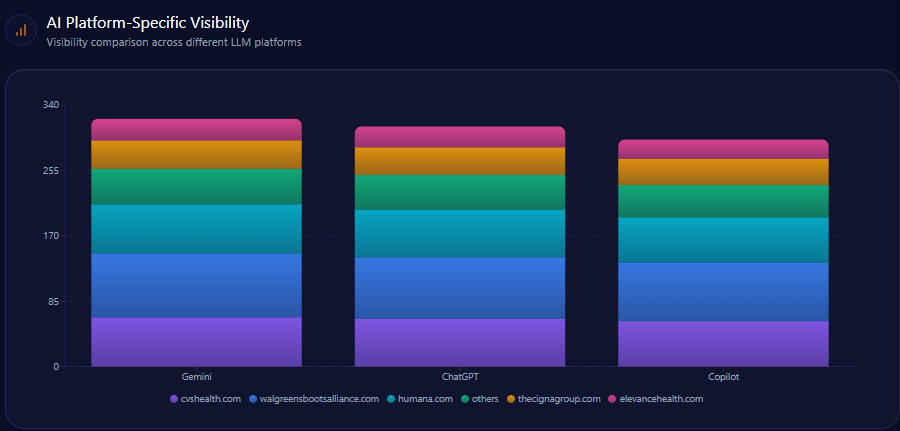
Platform bias isn’t theoretical here. It’s quantified.
Sentiment Score for Competitors
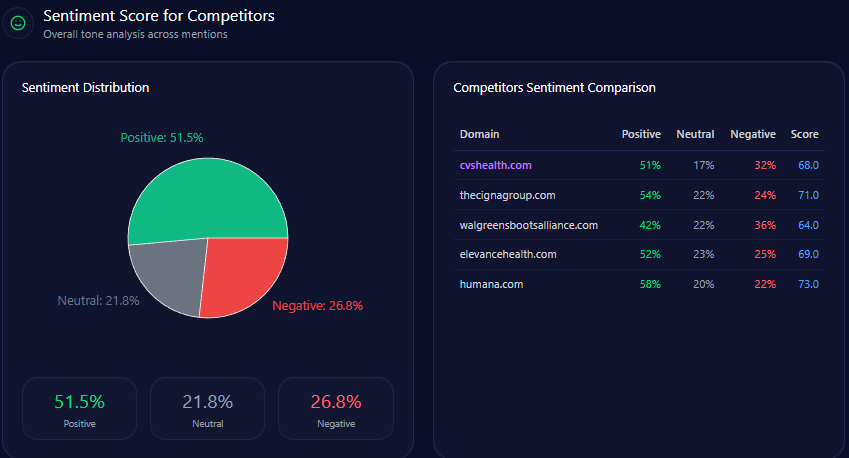
The sentiment split in the report shows CVS Health at 68 overall sentiment score, with 51% positive, 17% neutral, and 32% negative. Competitors cluster close—but meaningfully different:
- Humana: score 73 (58% positive, 20% neutral, 22% negative)
- The Cigna Group: score 71 (54% positive, 22% neutral, 24% negative)
- Elevance Health: score 69 (52% positive, 23% neutral, 25% negative)
- Walgreens: score 64 (42% positive, 22% neutral, 36% negative)
Context themes help explain why. “Integrated Health Services” is the largest theme (count 58, frequency 42.00, tone Positive), while “Retail Pharmacy Challenges” sits close behind (count 44, frequency 32.00, tone Negative). “Value-Based Care” appears as Neutral (count 31, frequency 22.00), and “Medicare Advantage Competition” is Positive (count 28, frequency 20.00)—suggesting that the topic draws attention but not always reassurance.
The report’s sentiment trend panel flags most competitors as “stable,” with Walgreens marked “recovering” (change from previous +1) and The Cigna Group marked “downward” (change -1). For leadership, competitor sentiment tracking is less about winning applause and more about preventing the wrong narrative from becoming default truth.
Top Prompts Driving Mentions
The report highlights specific prompts that drive the largest mention volumes—and reveal where CVS Health wins, and where it yields the “expert slot”:
- “Which company is leading in value-based care model implementation?” (136 mentions; CVS 47; Humana 56; Elevance 33; trend +81%)
- “Healthcare companies with the best specialized chronic condition management.” (125; CVS 36; Humana 48; Elevance 41; trend +77%)
- “Which retail pharmacy offers the most comprehensive integrated clinical services?” (123; CVS 74; Walgreens 49; trend +92%)
- “Compare the top pharmacy benefit managers for large enterprise employers.” (121; CVS 58; The Cigna Group 63; trend +87%)
- “How does CVS Health leverage its MinuteClinic for preventive care?” (100; CVS 88; Walgreens 12; trend +94%)
- “Analyze the digital health strategy of Elevance Health vs CVS Health.” (91; CVS 39; Elevance 52; trend +68%)
The pattern is consistent: CVS Health dominates when the question is retail healthcare plus clinics plus convenience; it competes tightly in PBM and value-based care; and it loses ground when the question demands specialized authority in senior care or enterprise positioning.
Types of Prompt Queries
The report classifies prompt intent into a simple mix:
- Comparison: value 50, count 5
- Feature Inquiry: value 40, count 4
- Research: value 10, count 1
- Purchase Intent: value 0, count 0
- How-to/Tutorial: value 0, count 0
This matters for strategy because it means the majority of discovery moments are evaluative rather than transactional. The user isn’t buying a prescription in the prompt; they’re deciding who to trust for prescriptions, primary care, health insurance, PBM credibility, digital health convenience, and care delivery clarity.
E-commerce / Service-Level Sentiment
The report includes service-level perception signals that connect AI discovery to downstream experience.
In the e-commerce/service mention share table, cvshealth.com holds 31.95% share with 3,533 mentions, closely followed by Walgreens at 28.6% with 3,163. The Cigna Group sits at 14.6% (1,615), Humana at 11.85% (1,310), and Elevance at 10.02% (1,108).
Referral performance for this layer is shown by platform:
- ChatGPT: 1,842 referrals, conversion rate 3.4
- Gemini: 1,654 referrals, conversion rate 4.2
- Copilot: 1,521 referrals, conversion rate 3.1
The report’s service sentiment snapshots are reported as three review distributions:
- 68% positive / 21% neutral / 11% negative (total reviews 4,218)
- 64% / 23% / 13% (total reviews 3,892)
- 62% / 26% / 12% (total reviews 3,564)
And the report’s snippets, as cited in the report, explain the emotional logic behind those splits:
- “The MinuteClinic was able to see me within 15 minutes of scheduling online; a true lifesaver for respiratory concerns.” (5)
- “Prescription was ready on time but the in-store pharmacy staff seemed overwhelmed by the holiday rush.” (3)
- “Difficulty coordinating with Aetna/CVS Caremark for specialty medications remains a recurring hurdle.” (2)
This is the real trust gap: the integrated promise is compelling in AI answers, but service friction—especially around PBM and specialty coordination—keeps re-entering the narrative as evidence.
Conclusion
CVS Health is the integrated healthcare platform that answer engines cite most often: 41% Generative Search Share, 24% Share of Voice, and a visibility score of 88 across a discovery landscape dominated by comparison prompts. But leadership is also confronted by a quantified vulnerability: 32% negative sentiment, a 20% Copilot Share of Voice, and an 18-point Medicare Advantage authority gap versus Humana. The report’s path forward is explicit—produce high-authority clinical whitepapers and outcome reports to narrow the Medicare Advantage gap, refine structured data feeds for high-margin OTC categories to strengthen Copilot visibility (including the report’s 15% mentions growth target by Q3 2025), and deploy a targeted narrative campaign on pharmacy labor improvements and digital tool integration to mitigate the negative sentiment rate.
Explore SpyderBot to operationalize these GEO analytics insights.