Tag: walmart.com

  • Publix’s Generative Ecosystem Position: 9% Share of Voice Amidst Premium Service Strengths and Visibility Gaps

    Publix’s Generative Ecosystem Position: 9% Share of Voice Amidst Premium Service Strengths and Visibility Gaps

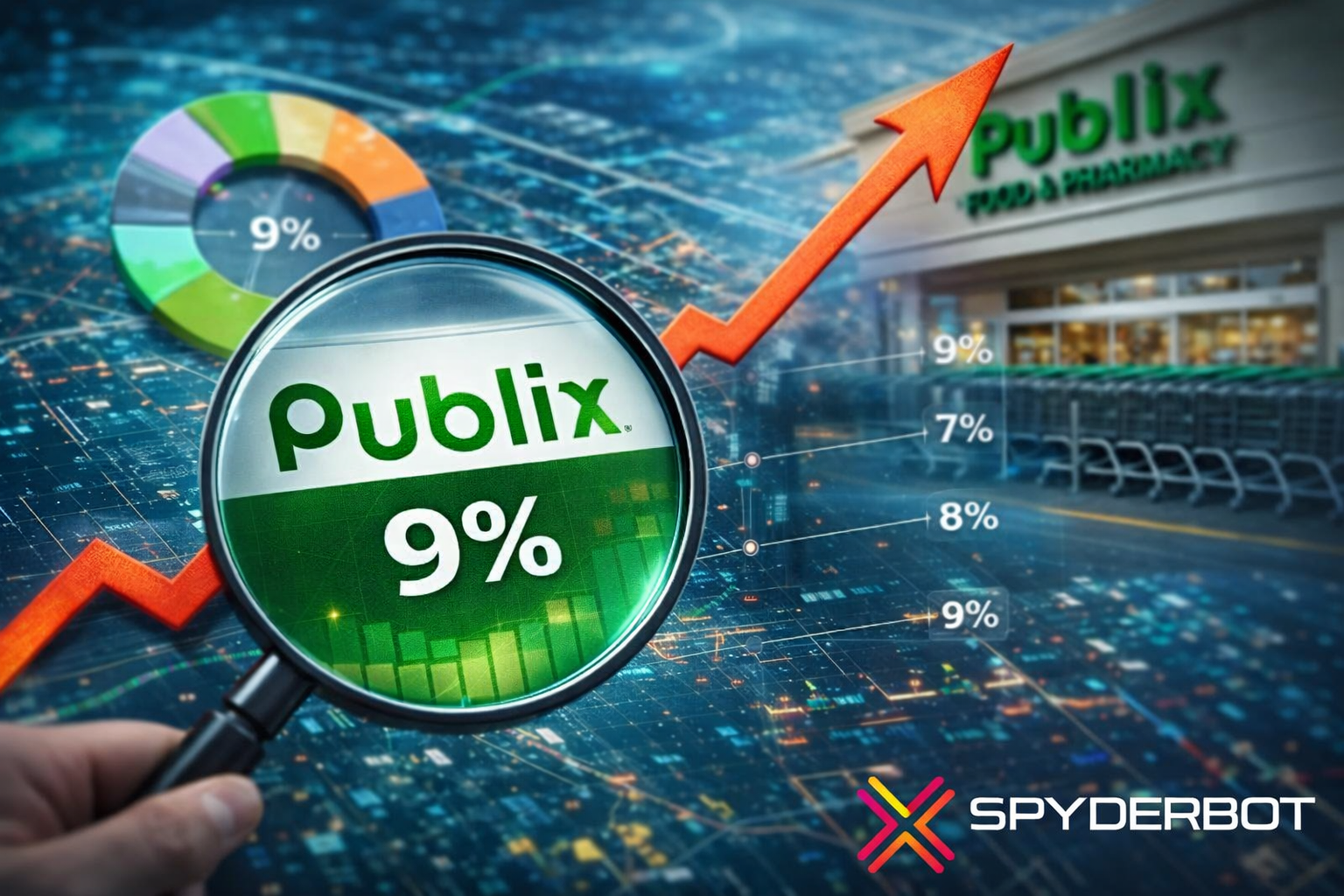
    Publix demonstrates leadership in customer experience and prepared food categories within generative AI-driven content, yet remains challenged by affordability and national availability visibility shortfalls, underscoring a clear strategic imperative to optimize value narratives for broader scale.

    SpyderBot GEO report reference for publix.com

    At-a-glance

    • 9% overall Share of Voice in generative LLM responses within the Food_and_Drink/Groceries category
    • Dominates ‘Best Prepared Food Grocers’ category as Rank 1 on Copilot platform
    • 86% positive sentiment score, highest among key competitors including Walmart and Kroger
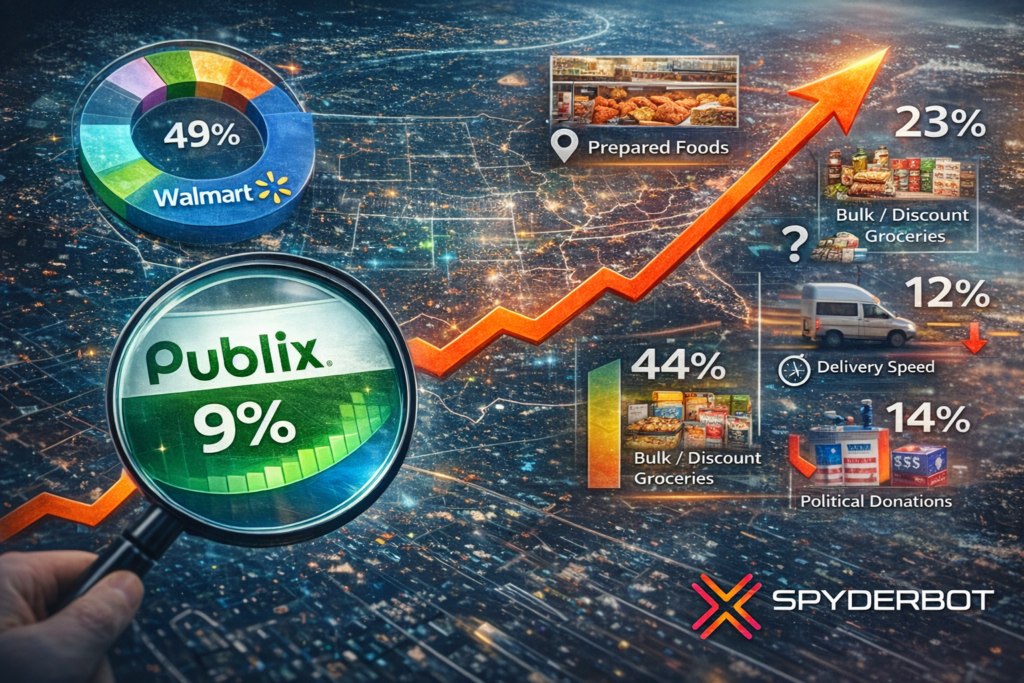
    • 49% coverage in ‘prepared foods’ vertical, contrasted with only 6% in price/value-sensitive queries
    • 15% negative sentiment in political context reducing employee-ownership narrative efficacy
    • 12% decline in delivery efficiency visibility compared to Amazon and Walmart

    Risk signals

    • Publix holds a 14-point Share of Voice gap behind Walmart, a dominant player in affordability queries
    • Geographic concentration creates a 54-point deficit in national availability indexing compared to Kroger
    • An 18% rise in visibility for discount brands like Aldi in ‘healthy snacks’ positions direct competitive threats
    • Persistent 42% negative founder-related sentiment linked to political controversies impairs leadership perception in LLM contexts

    Opening

    In the increasingly AI-mediated food and drink sector, Publix acquires a specialized, service-oriented digital presence defined by high-quality product associations and strong customer sentiment. Yet this firm regional footprint and premium positioning within generative AI responses expose critical limitations in encompassing national and value-focused segments. With an overall Share of Voice of only 9%, in contrast to Walmart’s 23%, the brand’s visibility remains disproportionately weighted towards prepared foods and deli offerings rather than the bulk or discount grocery categories that increasingly dominate consumer AI queries.

    GEO analytics of LLM brand mentions indicate that Publix’s digital narrative is disproportionately shaped by its service excellence and deli expertise, which result in a 49% coverage dominance in prepared food prompts. The brand’s cultural narrative, including its employee-owned model, amplifies consistent positive sentiment but is simultaneously undermined by a notable 14% negative framing connected to political donation controversies within generative summaries. Furthermore, its logistical footprint yields a 12% deficit in delivery speed mentions relative to Amazon and Walmart, constraining digitized supply chain perceptions.

    Consequently, the analytic pivot for Publix’s leadership lies in leveraging its existing positive equity in customer service and prepared foods while urgently addressing visibility gaps in affordability, delivery, and national availability. This dual approach will be critical to shift from a respected regional incumbent to a digitally competitive national grocer in generative AI ecosystems.
    Position in LLM Response Lists

    Publix secures dominant Rank 1 status in the ‘Best Prepared Food Grocers’ category on Copilot, reflecting strong content alignment with deli and bakery queries. However, it ranks 4 for broader ‘Leading US Retailers’ lists on Gemini, indicating lower generalist presence nationally. Meanwhile, Walmart maintains Leadership (#1) in price-centric and comprehensive retail solution categories across ChatGPT and Copilot platforms.

    Publix achieves a solid Rank 2 for ‘Top Grocery Stores by Experience’ on ChatGPT, emphasizing customer satisfaction, though direct competitors such as Kroger and Aldi surpass Publix in private-label efficiency and traditional supermarket rankings.

    Competitor Gap Analysis

    QueryPublix PerformanceCompetitorCompetitor PerformanceGap ScoreOpportunity DescriptionAction ItemsPriority 
    cheapest weekly groceries62 (medium)Walmart Inc.94 (high)32.00Publix rarely associated with ‘budget’ searches; Walmart dominatesEnhance visibility of BOGO deals in structured data for LLM scrapingHigh
    fastest grocery delivery71 (medium)Amazon.com, Inc. (Whole Foods Market)96 (high)25.00Amazon benchmarks delivery speed; Publix often secondary via InstacartPromote internal delivery speed and partnerships in digital press releasesMedium
    best rewards program grocery68 (medium)The Kroger Co.89 (high)21.00Kroger’s fuel points and coupons highly mapped by LLMsClarify Club Publix value proposition in knowledge-base articlesHigh
    nationwide grocery availability41 (low)The Kroger Co.95 (high)54.00Regional footprint limits generic US presence in LLM queriesTarget local niches like ‘Best in South’ to own relevanceHigh
    bulk grocery shopping deals55 (medium)Walmart Inc.97 (high)42.00Walmart/Sam’s Club dominate bulk-buy mentionsAnalyze ‘family size’ bundle visibility in product feedsMedium

    Trigger Keywords for Competitor Products

    The most frequent LLM-driven trigger keywords driving competitor product mentions include “purchase” (450 mentions), “buy” (380 mentions), “order” (295 mentions), and “checkout” (225 mentions). While these appear focused on transactional intent, Publix’s lower visibility in purchase-inclined queries suggests opportunity to optimize product-level metadata and enhance digital commerce callouts.

    Founder / Ownership / Leadership Context

    Publix’s founder legacy, centered on George Jenkins, retains high reverence in LLM output, though negative sentiment associated with the Jenkins family political contributions generates a 42% negative context rate — the highest among competitors tracked. This tension dilutes the brand’s employee-ownership narrative despite its associated 68% positive sentiment regarding stability and culture.

    Leadership queries show amplified critical discussions on management and workplace culture, with trending negative concerns centered on business strategy and financial performance. Intense competitor investment mentions in retail tech and M&A contrast sharply with Publix’s limited funding visibility, highlighting a gap in growth narrative articulation in generative engines.

    Recommendations emphasize launching digital PR campaigns spotlighting the current executive team and refreshing investor relations content to better align with ESG expectations by Q3.

    Publix recorded a total of 18,513,094 visits in the analyzed period, with bots accounting for 4,072,881. Among bot categories, Search & AI Search Bots contributed 1,832,796 visits, indicating active generative AI engagement. Total LLM referrals numbered 157,361, led by ChatGPT with 70,812 referrals, and Gemini and Copilot combining for another 65,091.

    The brand ranks 4 in its category (Food_and_Drink/Groceries). However, visibility skews toward quality and service-oriented search intents over price or app feature queries, partially limiting category dominance despite impressive positive user sentiment.
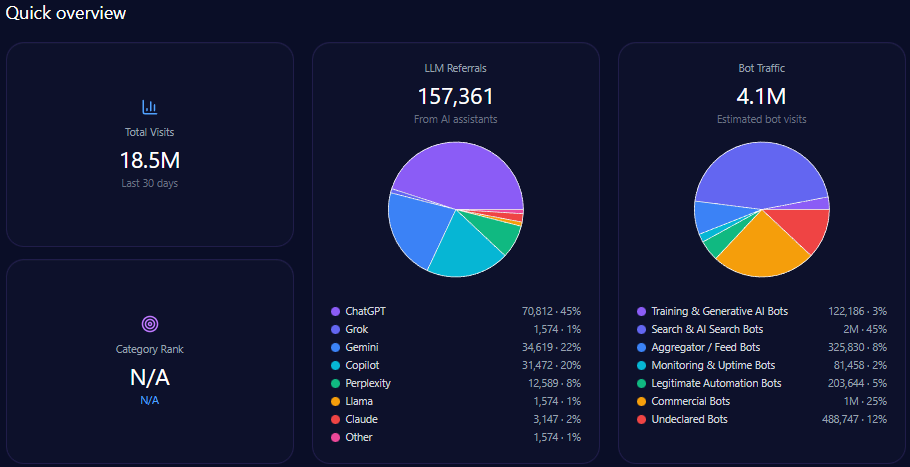
    publix.com’s Quick overview (GEO Report, Jan 21, 2026)

    Share of Voice in LLM Responses

    Publix holds 9% of total LLM brand mentions (164 of 1,824), placing it behind Walmart Inc. (23%) and Amazon/Whole Foods (21%). Kroger and Aldi follow with 14% and 12% respectively. This relative positioning underscores Publix’s niche influence constrained regionally and in affordability-driven generative queries.

    AI Platform-Specific Visibility

    AI PlatformVisibility %Share of Voice %Total MentionsWalmart MentionsPublix MentionsAldi Mentions 
    Gemini38115981266678
    ChatGPT34961214755
    Copilot28761414743

    Visibility across platforms remains fragmented with Walmart consistently leading. Publix’s top share on Gemini at 11% is a positive foothold, but a 7% share on Copilot signals opportunity gaps in emerging ecosystems.

    Sentiment Score for Competitors

    BrandPositive %Neutral %Negative %Overall Score 
    Publix869586
    Walmart Inc.64221464
    The Kroger Co.7318973
    Amazon.com8111881
    Aldi Inc.8410684

    Publix’s 86% positive sentiment significantly outpaces Walmart’s 64%, reinforcing its premium service and product quality reputation. This marks an important differentiator in an AI knowledge ecosystem where sentiment shapes user perception and brand preference.

    Top Prompts Driving Mentions

    • “Which grocery store has the best customer service and deli selections?” — Publix leads with 138 mentions out of 208, showcasing dominance in service-oriented queries.
    • “Best grocery stores for prepared meals and rotisserie chicken.” — Publix captures majority presence with 124 mentions of 275.
    • “Where should I buy premium quality seafood for a dinner party?” — Strong showing with 84 mentions among 230.
    • “Recommend the best place for fresh bakery items and custom cakes.” — Publix commands 112 mentions out of 205.
    • “Compare grocery store prices for a weekly budget under $100.” — Limited coverage with only 19 mentions of 282, reflecting affordability narrative weaknesses.
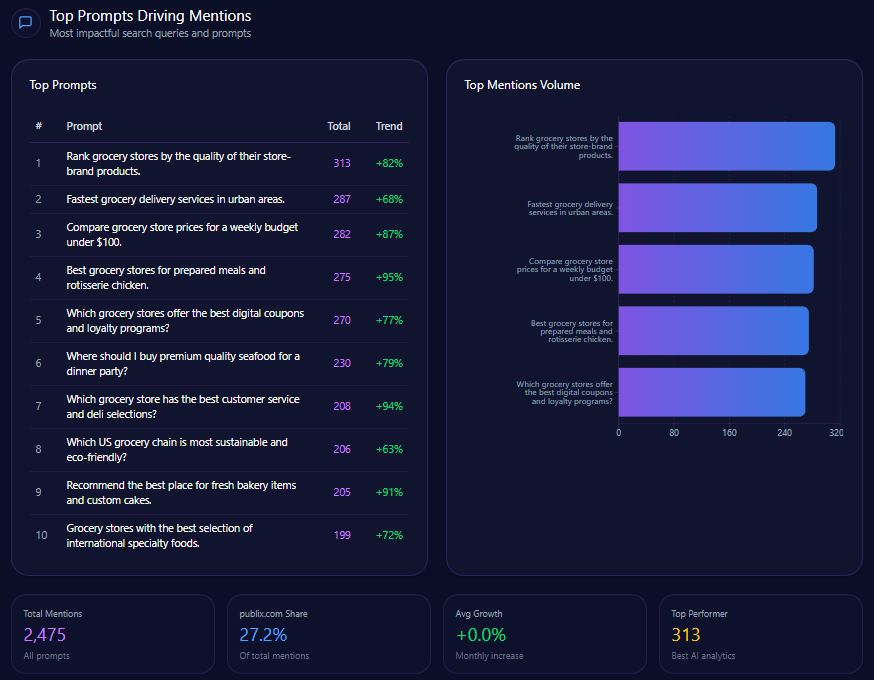
    publix.com’s Top Prompts Driving Mentions (GEO Report, Jan 21, 2026)

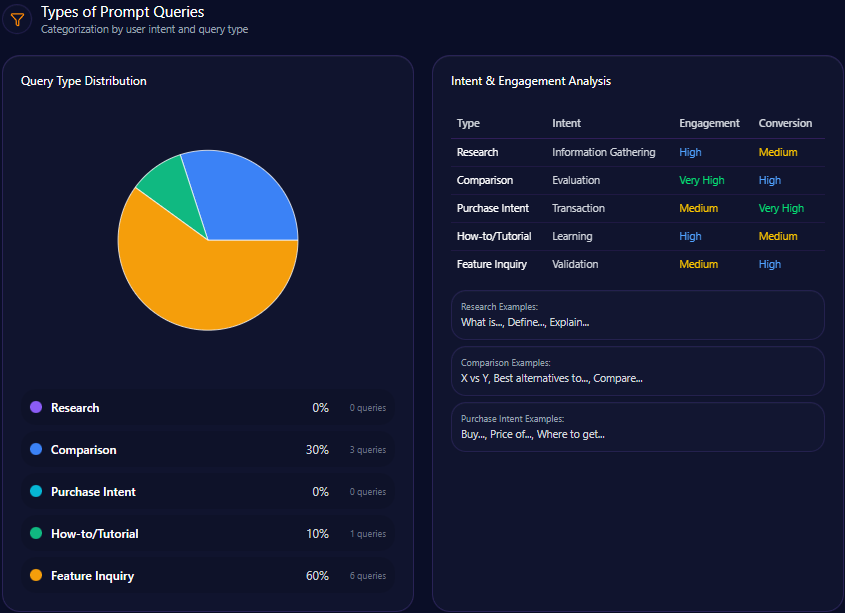
    • Comparison inquiries constitute 60% of prompt types, highlighting the competitive research nature of generative AI grocery queries.
    • Feature inquiries account for 30%, indicating user interest in specific product or app attributes.
    • Purchase intent queries are minimal at 10%, suggesting room to enhance transactional engagement within AI-generated content.
    • No measurable Research or How-to/Tutorial queries were noted.
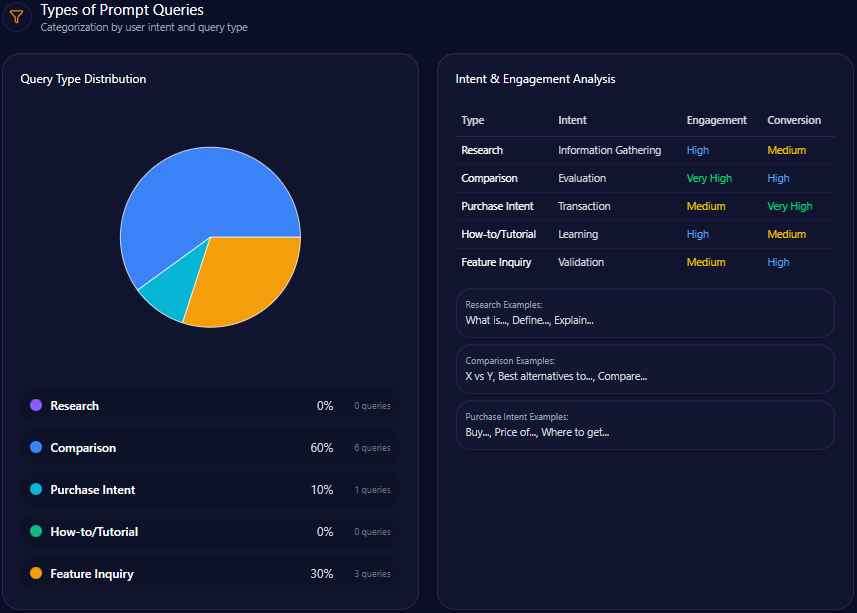
    publix.com’s Types of Prompt Queries (GEO Report, Jan 21, 2026)

    Service / Product-Level Sentiment

    • Customer Service & Experience: Highly positive sentiment (85% frequency) with facets such as “Friendly staff” and “store cleanliness.”
    • Deli & Prepared Foods: Strongly favorable (78%) centered on “chicken tender subs” and “customized cakes.”
    • Pricing & Value: Mixed/neutral sentiment (59%), reflecting tension between “expensive grocery list” perceptions and “BOGO deals.”
    • Community & Employee Ownership: Positive tone (29%), emphasizing “employee-owned company” and local philanthropy.

    E-commerce sentiment reviews illustrate 45.2% positive ratings but highlight shipping and pricing concerns impacting customer satisfaction.

    Conclusion

    Publix’s generative ecosystem presence delineates a clear strategic opportunity to capitalize on its customer service and product quality advantages while aggressively addressing key visibility and narrative gaps. The brand’s 86% positive sentiment anchors a premium digital identity that competes favorably against national mass-market grocers yet is constrained by a 9% overall Share of Voice and narrow value-driven indexing.

    Critical gaps in affordability, delivery logistics, and national availability queries signify actionable priorities: enhancing structured data around price promotions and delivery speed; amplifying founder leadership narratives to mitigate politically sensitive negative sentiment; and localizing marketing efforts to strengthen regional loyalty in the southeast market. Current competitor sentiment tracking reveals that Walmart and Amazon dominate investment and affordability narratives while Kroger’s national infrastructure outperforms in availability.

    Implementing the prioritized recommendations will better position Publix to transition from a regional premium grocer into a digitally visible national leader across generative AI platforms.

    Explore SpyderBot to operationalize these GEO analytics insights.
  • Best Buy’s AI Shelf Space Is Strong—But the “Value” Story Is Slipping Away

    Best Buy’s AI Shelf Space Is Strong—But the “Value” Story Is Slipping Away

    Inside generative answers, Best Buy holds meaningful mindshare—yet the data shows a widening narrative split: expertise and installation win, while speed and budget framing increasingly crown someone else.

    At-a-glance

    • Share of Voice (LLM brand mentions): 20% (105 of 523)
    • Visibility Score: 74 (vs 92 for Amazon, 78 for Walmart)
    • Rank Score: 92 in premium electronics positioning
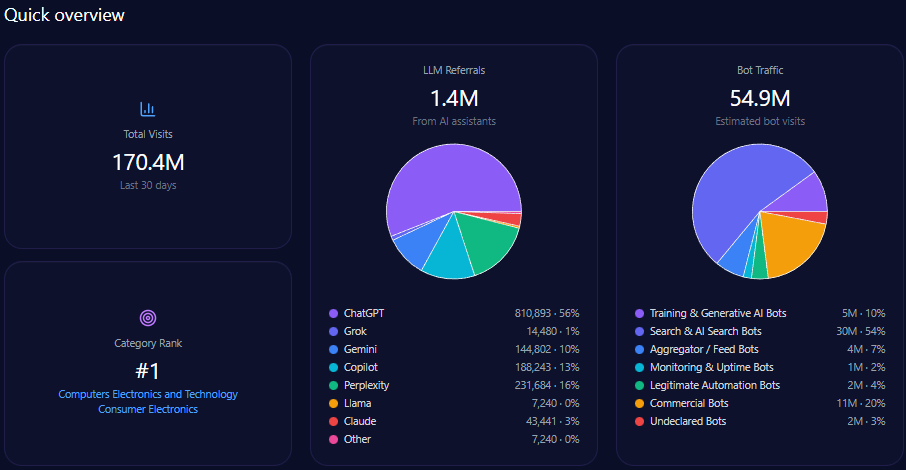
    • Total visits: 170,355,633 with 54,854,514 in bot traffic
    • LLM referrals: 1,448,023 (led by ChatGPT 810,893, Perplexity 231,684, Copilot 188,243, Gemini 144,802)
    • Category rank: #1 in Computers_Electronics_and_Technology/Consumer_Electronics

    Risk signals

    • A 22-point gap shows up in “fastest same day tech delivery” versus Amazon (76 vs 98)—the speed narrative is still lopsided.
    • Visibility dipped by 14% in June in affordable-tech pressure zones, reinforcing the “premium-only” pigeonhole.

    Opening

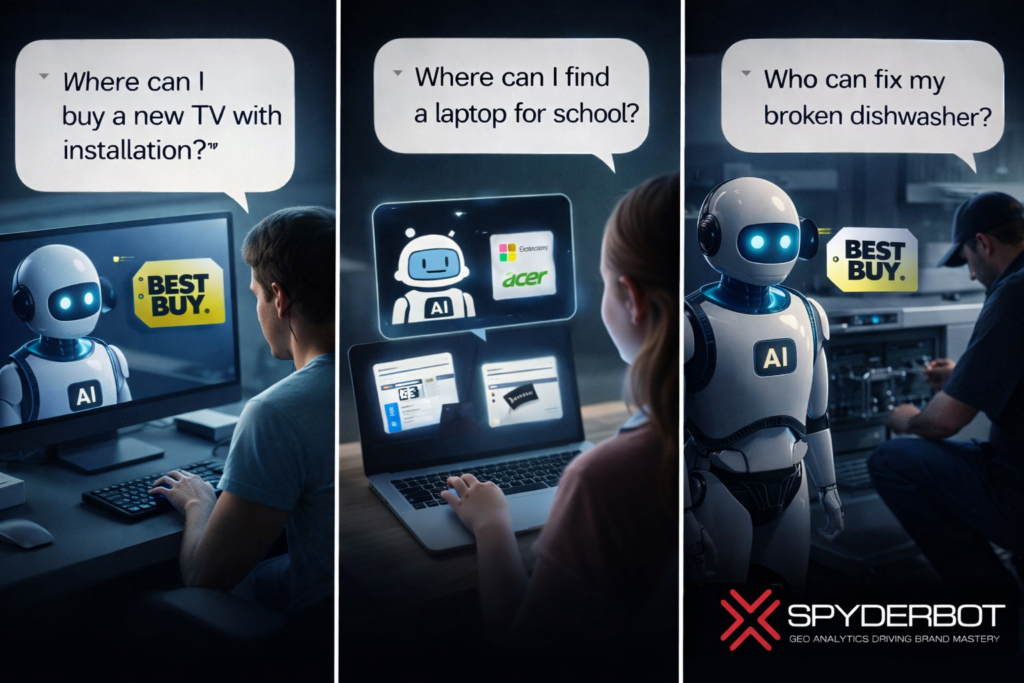
    Picture the modern “storefront” moment: not a mall, not an app—just a blinking cursor. A shopper asks for the best place to buy a new TV with installation. Another asks where to find a laptop for school. A third asks who can fix the mess when something goes wrong. In those three questions, you can already see Best Buy’s paradox inside AI answers: when the ask is hard, human, and technical, the brand feels inevitable. When the ask is cheap, fast, or “good enough,” the story veers.

    What matters isn’t whether Best Buy is present. It is. The question is whether the brand is being chosen—and why.


    The Lists Where Best Buy Still Feels Like the Expert

    In ranked response lists across major platforms, Best Buy consistently shows up where the prompt implies expertise, service, or complex decision-making. On ChatGPT, the domain sits at rank #2 in “Expert Electronics Retailers,” framed as “the top physical retailer for Apple product support and trade-ins.” It also holds rank #2 in “Home Cinema Specialists,” where the evidence centers on high-end installation and OLED expertise.

    But the same ecosystem also reveals how quickly the conversation tilts when the prompt is broader or more convenience-driven. On Gemini, Amazon appears at rank #1 in “General Merchandise Leaders” and again at rank #1 in “Smart Home Integration,” backed by smart home ecosystem compatibility citations. Best Buy’s presence doesn’t vanish—but it becomes conditional. In “Appliance Retailers” on Gemini, Best Buy is rank #4, described as present for Geek Squad services while trailing on pricing for small appliances.

    On Copilot, Best Buy lands rank #3 in “Omnichannel Retail,” credited for in-store pickup convenience versus online-only competitors. That’s not small. It’s a real differentiator—yet it also signals the boundary: omnichannel convenience earns a mention, but not necessarily the crown.


    Where the Battle Map Shows Real Separation

    Best Buy’s competitive story is most revealing when you look at where the gaps are quantified—and where the brand already holds daylight.

    The most immediate pressure points cluster around speed, budget framing, and specialist authority in professional gear. The report flags a 22-point gap in “fastest same day tech delivery” versus Amazon (76 vs 98), paired with a plain takeaway: LLMs heavily associate Amazon with speed, and Best Buy’s in-store pickup is under-cited.

    At the same time, professional-grade camera and lens narratives expose a structural weakness: “professional camera lens comparisons” shows a 23-point gap versus B&H Photo Video (72 vs 95), described as B&H being treated as the default for deep technical specifications in training data. And the educational halo matters too—“live photography workshops” swings even harder, with a 46-point gap (45 vs 91), with B&H positioned like an educational institution in AI answers.

    Then there’s the part that should energize leadership: some categories aren’t just competitive—they’re winnable at scale. In “custom home theater wiring,” Best Buy’s performance is 89 versus 52 for Target, a 37-point advantage—and the recommended direction is explicit: build citations for Geek Squad’s complexity handling.

    A compact view of the clearest quantified gaps:

    QueryBest BuyCompetitorGap / Priority
    fastest same day tech delivery76Amazon 9822 / High
    professional camera lens comparisons72B&H Photo Video 9523 / High
    best budget smart home hub68Walmart 9123 / Medium
    live photography workshops45B&H Photo Video 9146 / Low

    What this table really says: the brand is strongest when it can be the expert, and weakest when the AI can answer with a shipping promise or a price story.


    The Keywords That Quietly Hand Competitors the Microphone

    Trigger keywords are the hidden levers that decide which retailers get named when AI systems summarize “what to buy” and “where to buy it.” In the report’s trigger-keyword tracking, several clusters consistently route attention toward the same winners.

    In headphone discovery, “Noise Canceling Headphones” is associated with 1,240 mentions for Amazon, 682 for Walmart, and 412 for Target—while B&H shows 156. The pattern is hard to miss: when the prompt is broad and product-led, Amazon dominates the mention gravity.

    Budget language is even more punishing. “Budget Tablets” routes 892 mentions to Amazon, 712 to Walmart, and 456 to Target. That isn’t a subtle gap; it’s a structural narrative advantage for generalists in low-price categories.

    Meanwhile, the professional camera cluster flips the power dynamic. “Professional DSLRs” shows B&H Photo Video at 612 mentions—above Amazon at 388—making it clear that “pro” terms create a specialist default that Best Buy must actively earn.

    Some keywords do feel like Best Buy-native territory. “Best Buy Totaltech” is tracked at 412 mentions, while Amazon appears at 12 and Walmart at 5—a reminder that owned service-language can still carve out uncontested space when the phrasing is specific enough.

    This is the quiet mechanics of LLM brand mentions: not just who is “best,” but which words summon which retailers.


    Founder Narratives and the Shadow Topics That Follow Them

    Founder and leadership context in AI answers often behaves like an undertow—rarely the headline, frequently the mood. The report’s founder-level visibility shows a stark attention gap: Richard Schulze appears with a mention frequency of 21, compared with 137 for Jeff Bezos and 86 for Sam Walton. Even Herman Schreiber appears at 38.

    Yet sentiment is not the problem for Best Buy’s founder story. Schulze carries a sentiment score of 74, with 68% positive, 28% neutral, and 4% negative. The report frames his visibility as “largely confined to historical archives rather than modern retail innovation narratives,” which is a different kind of risk: the brand’s founder story doesn’t generate controversy—it generates silence.

    Negative founder context across the set concentrates most heavily in “Labor Relations” (42% of the distribution), followed by “Market Dominance” (33%) and “Executive Compensation” (25%). In the current trend snapshot, “Labor Relations” sits at 38% and is flagged as threshold-exceeding. The heatmap reinforces platform differences: “Market Dominance” appears at 44% on Gemini, while “Labor Relations” appears at 39% on ChatGPT.

    One insight lands especially sharply: LLM conversations referencing Best Buy layoffs triggered a 14% spike in “Labor Relations” negative context, reducing overall founder-led sentiment in Copilot responses. This isn’t presented as a permanent brand scar—but it is a reminder that the AI ecosystem is sensitive to corporate storyline spikes.

    The founder narrative doesn’t need to be louder for its own sake. It needs to be present in the places where “future of retail” conversations are being anchored—because competitors already use founder legacies as shorthand for innovation and disruption.


    A Snapshot of the GEO Footprint That Actually Matters

    Best Buy’s scale is not theoretical. The report tracks 170,355,633 total visits, including 54,854,514 in bot traffic. Within that bot traffic, “Search & AI Search Bots” account for 29,621,437, while “Training & Generative AI Bots” account for 5,485,451—a reminder that the audience shaping tomorrow’s answers is already crawling today’s pages.

    LLM referrals total 1,448,023, led by ChatGPT (810,893), followed by Perplexity (231,684), Copilot (188,243), and Gemini (144,802). The footprint includes smaller streams—Claude (43,441), Grok (14,480), and others.

    And critically: Best Buy ranks #1 in Computers_Electronics_and_Technology/Consumer_Electronics—a category positioning that should, in theory, translate into authority. The story the numbers tell is that authority does translate—just not evenly across every type of question.

    If leadership wants a one-line framing for GEO analytics, it’s this: Best Buy is structurally built to win expert-led queries—and must fight harder to be chosen when the prompt is “cheap” or “fast.”

    bestbuy.com’s Quick overview (GEO Report, Jan 18, 2026)

    The Mindshare Math Inside AI Answers

    In overall Share of Voice, Best Buy holds 20% of tracked LLM brand mentions (105 of 523). Amazon leads at 35% (183), while Walmart follows at 22% (115). Target shows 12% (63), B&H Photo Video 8% (42), and “others” 3% (15).

    Visibility Score tells a similar story with a different emphasis. Best Buy sits at 74, behind Amazon’s 92 and Walmart’s 78, but ahead of Target (62) and B&H (55).

    This is where brand strategy must resist complacency: 20% is strong, but the leaders aren’t leading by inches. Amazon’s advantage is both share (35%) and visibility (92). Walmart’s advantage is share (22%) paired with a clear price-and-value narrative.

    Best Buy’s opportunity is not to become Amazon. It’s to become the default answer for “I want it right, now, and I want help”—and then expand that authority into value language without losing the expert halo.


    Same Brand, Different AI Outcomes

    Platform splits make the ecosystem feel like three different markets.

    On Gemini, Best Buy’s visibility/share of voice is 23%, with 40 mentions out of 175 total. Amazon holds 31% (55) and Walmart 26% (45). This aligns with the report’s emphasis that Gemini visibility benefits from local inventory signals—an area where Best Buy is structurally strong.

    On ChatGPT, Best Buy sits at 19%, with 32 mentions out of 170 total. Amazon climbs to 41% (70), while Walmart posts 21% (35). Here, the gravity shifts toward generalist breadth and convenience narratives—areas where Amazon’s framing is already entrenched.

    On Copilot, Best Buy also shows 19%, with 33 mentions out of 178 total. Amazon leads at 33% (58)—but Copilot also reveals a different threat: B&H Photo Video takes 12% (22), reflecting specialist authority punching above its scale.

    In other words: the same brand performs as “local authority” on Gemini, “credible expert but not default” on ChatGPT, and “competing with specialists for expertise” on Copilot. The implication isn’t that one platform is right. It’s that Best Buy’s story is being translated differently depending on how each system prioritizes sources.


    The Tone War: Trust, Value, Logistics, and Expertise

    Competitor sentiment tracking in the report suggests Best Buy is not losing the “trust” argument—yet it also highlights where tone becomes mixed.

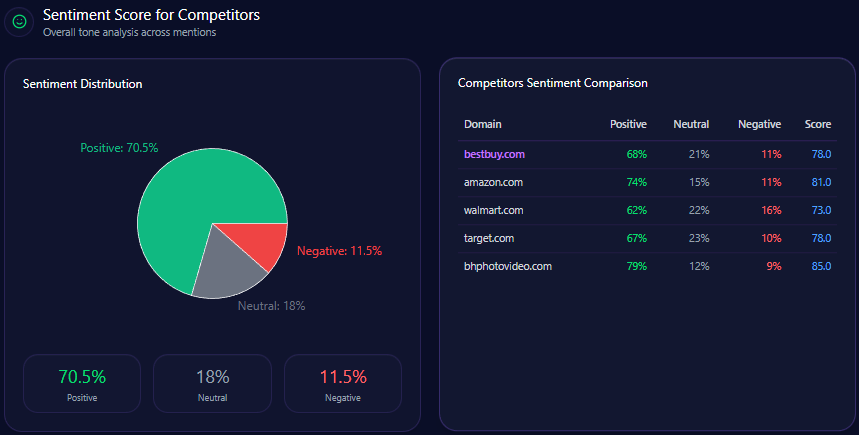
    Overall sentiment scores cluster tightly at the top:

    • B&H Photo Video: 85 (Positive 79, Neutral 12, Negative 9)
    • Amazon: 81 (Positive 74, Neutral 15, Negative 11)
    • Best Buy: 78 (Positive 68, Neutral 21, Negative 11)
    • Target: 78 (Positive 67, Neutral 23, Negative 10)
    • Walmart: 73 (Positive 62, Neutral 22, Negative 16)

    Context themes show what people talk about when these brands show up in AI narratives:

    • “Technical Support & Repair” appears 52 times (35.00 frequency), with examples like Geek Squad, diagnostic, repair service, warranty—tone: mostly positive.
    • “Price & Value” appears 41 times (27.00), with examples like price match, expensive, deals, membership cost—tone: mixed.
    • “Logistics & Fulfillment” appears 33 times (22.00)—tone: neutral.
    • “Product Expertise” appears 24 times (16.00)—tone: positive.

    The takeaway is not that Best Buy is viewed negatively. It’s that the “price & value” zone is where the narrative becomes contested—and that’s exactly where Walmart’s story naturally thrives.

    bestbuy.com’s Sentiment Score for Competitors (GEO Report, Jan 18, 2026)

    The Prompts That Most Reliably Summon Best Buy

    Some prompts are practically a lighthouse for Best Buy’s strengths.

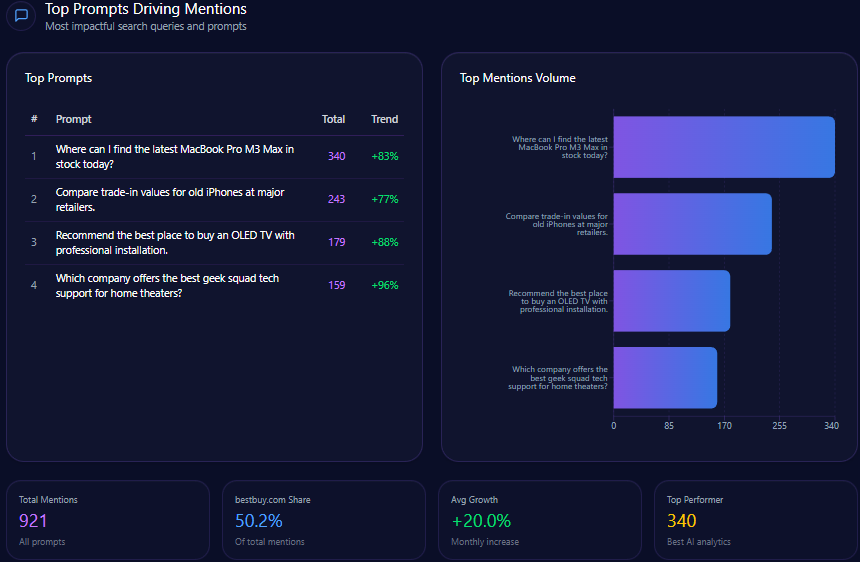
    The report’s top prompts include:

    • “Where can I find the latest MacBook Pro M3 Max in stock today?” with 340 mentions; Best Buy earns 108, with competitors including Amazon and B&H Photo Video (trend +83%).
    • “Compare trade-in values for old iPhones at major retailers.” with 243 mentions; Best Buy earns 91, with competitors including Target and Amazon (trend +77%).
    • “Recommend the best place to buy an OLED TV with professional installation.” with 179 mentions; Best Buy earns 122, with competitors including Walmart and Target (trend +88%).
    • “Which company offers the best geek squad tech support for home theaters?” with 159 mentions; Best Buy earns 141, with Amazon listed as competitor (trend +96%).

    These aren’t just prompts. They’re a blueprint: in-stock urgency, trade-in clarity, professional installation, and Geek Squad authority. When the question implies complexity, Best Buy becomes the answer.

    bestbuy.com’s Top Prompts Driving Mentions (GEO Report, Jan 18, 2026)

    What People Are Actually Asking For

    Prompt-type mix in the report is heavily concentrated:

    • Comparison accounts for 75 with 3 prompts.
    • Feature Inquiry accounts for 25 with 1 prompt.

    Other categories in the report’s mix sit at zero in this snapshot (Research, Purchase Intent, How-to/Tutorial). That doesn’t mean those intents don’t exist in the world. It means the current tracked set is dominated by “Which is better?” and “What should I choose?” moments.

    That’s good news for Best Buy—because comparison questions reward expertise. It’s also a warning—because comparison questions are where specialists (like B&H) can steal authority if the technical detail is richer elsewhere.


    E-commerce Discovery: Where Reviews, Retailers, and Reality Collide

    In e-commerce-oriented AI discovery, Best Buy’s share of voice is 13.15% with 1,135 mentions across ChatGPT, Gemini, and Copilot. Amazon leads at 38.68% (3,340), followed by Walmart at 19.91% (1,719), Target at 10.02% (865), and B&H Photo Video at 5.1% (440). “Others” also appear at 13.15% (1,135).

    The report’s sentiment snapshots in e-commerce contexts show review mixes clustering around:

    • 64/24/12 across 1,850 total reviews
    • 71/21/8 across 2,100 total reviews
    • 68/20/12 across 1,920 total reviews

    And the product-level snippets illuminate the lived experience, as cited in the report:

    • “Best Buy’s Geek Squad protection made the OLED TV setup seamless. Highly recommend for high-end tech.” — TechRadar Community, LG C3 OLED TV, 5
    • “Found the laptop I wanted at Best Buy. Price was same as Amazon, but I could pick it up in an hour.” — Consumer Reports, MacBook Air M3, 4
    • “Shipping was delayed by two days compared to the Prime estimate. Customer service was helpful but slow.” — SiteJabber, PS5 Console, 2

    Even referral performance is quantified in this layer: ChatGPT shows 8,450 referrals (conversion rate 2.8), Gemini 10,200 (conversion rate 3.1), and Copilot 7,820 (conversion rate 4.2).

    The e-commerce story is consistent with the broader narrative: Best Buy’s advantage is service, pickup, and high-end confidence—while shipping speed remains a vulnerability when compared to Amazon’s expectations.


    Conclusion

    Best Buy doesn’t have an awareness problem in generative systems. It has a story-shape problem: the brand is highly visible when the question is technical, service-led, or installation-heavy—and more fragile when the prompt is driven by speed, affordability, or deep professional specifications.

    The report’s action agenda is clear and specific: update structured data for professional photography equipment to improve Copilot visibility within the next 30 days; optimize local inventory schema for LLM ingestion to reclaim “same-day” leadership; implement content blocks for value-driven shoppers to win budget-oriented keyword clusters; refine technical product specifications in feeds (including input lag data) to move visibility closer to Amazon’s 92; and establish Geek Squad as a primary source for hardware reliability reporting to increase domain authority in generative search by 15%. Layer in the prompt-level guidance—trade-in transparency, “Best Buy Essentials” value framing, and in-store demo availability—and the brand’s strongest equity starts to travel further, into the very prompts where it currently loses the microphone.

    Explore SpyderBot to operationalize these GEO analytics insights.
  • Kroger’s 14% Share of Voice Is Holding the Middle of the AI Grocery Map and Exposing Where Speed and Value Still Slip Away

    Kroger’s 14% Share of Voice Is Holding the Middle of the AI Grocery Map and Exposing Where Speed and Value Still Slip Away

    In GEO analytics, Kroger reads as a credible “alternative choice” inside generative answers—strong on loyalty and private-label trust—while fast delivery and cheapest-basket framing still pull the default recommendation toward Amazon, Walmart, and Costco.

    At-a-glance: Numbers to know

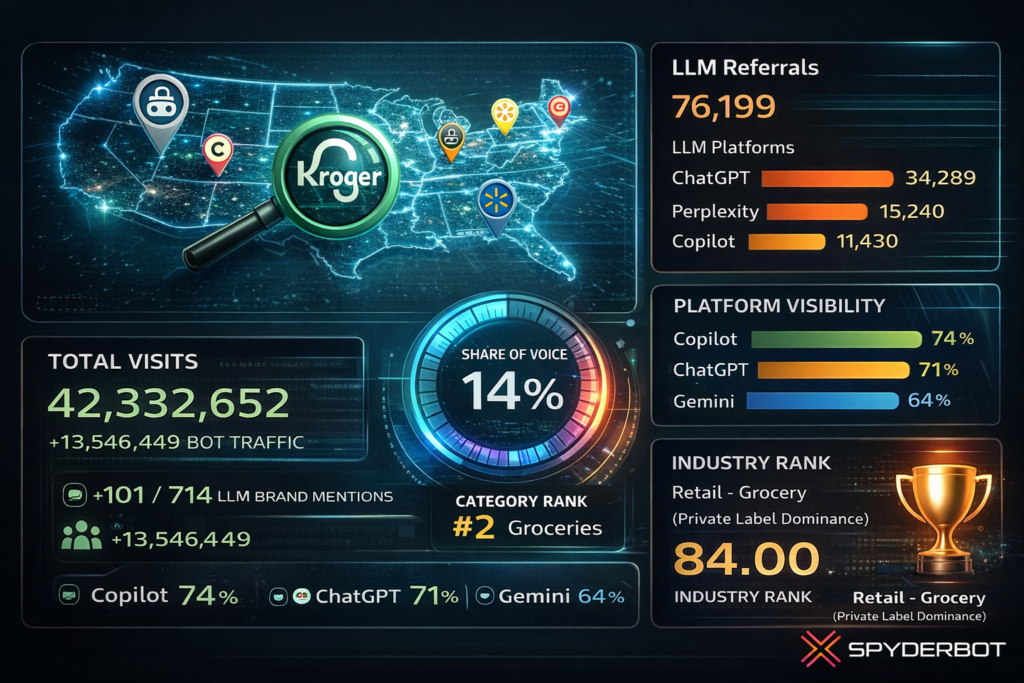
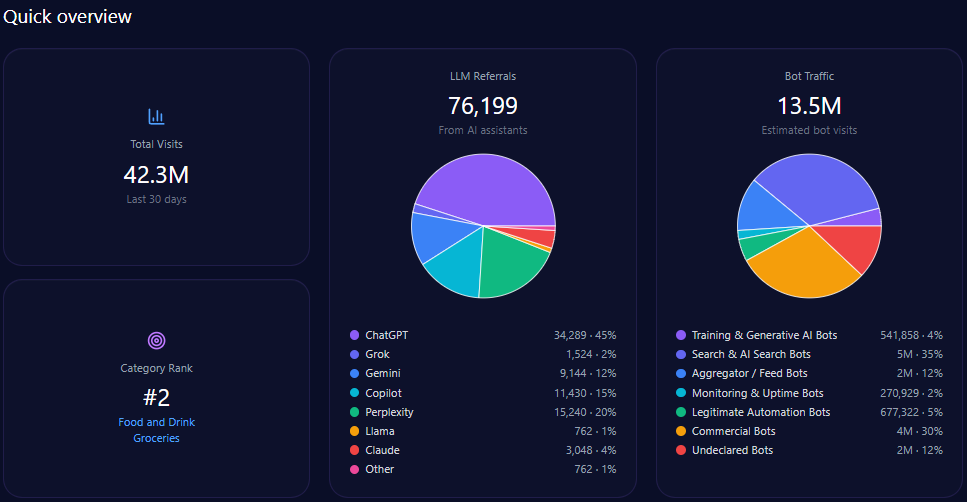
    • 42,332,652 total visits, including 13,546,449 in bot traffic
    • 76,199 LLM referrals, led by ChatGPT (34,289), Perplexity (15,240), and Copilot (11,430)
    • 14% Share of Voice (101 of 714 LLM brand mentions) and a Visibility Score of 73
    • Category rank: #2 in Food_and_Drink/Groceries
    • Platform visibility: Copilot 74%, ChatGPT 71%, Gemini 64%
    • Industry rank score: 84.00 in Retail – Grocery (Private Label Dominance)

    Risk signals

    • Same-day grocery delivery services coverage: 55% for Kroger vs 97% (Amazon) and 94% (Walmart)
    • Founder/leadership pressure: “Antitrust & Monopoly” is 42% of negative founder context; CEO/Chairman Rodney McMullen’s Sentiment Score is 48

    Ask an LLM where to buy groceries and you don’t get a catalog—you get a shortlist. Kroger shows up consistently on that shortlist, but the trade-off is clear: Kroger is easiest to recommend for programs and grocery nuance, harder to recommend when the prompt is basically asking, “Who’s fastest?” or “Who’s cheapest?”

    Position in LLM Response Lists

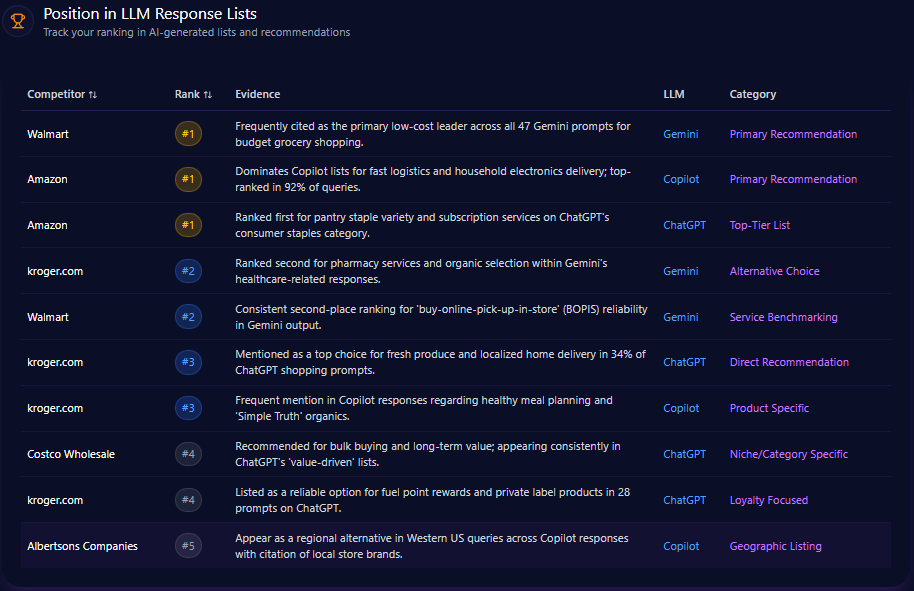
    Kroger’s placements cluster in the middle of ranked outputs. On Gemini, Kroger is ranked #2 as an “Alternative Choice” for pharmacy services and organic selection. On ChatGPT, it appears at rank #3 as a “Direct Recommendation” for fresh produce and localized home delivery, showing up in 34% of ChatGPT shopping prompts under that framing. Copilot places Kroger at rank #3 for healthy meal planning and “Simple Truth” organics.

    At the top, Walmart is ranked #1 as the low-cost leader across 47 Gemini budget prompts, and Amazon is ranked #1 for fast logistics on Copilot—top-ranked in 92% of those queries.

    kroger.com’s Position in LLM Response Lists (GEO Report, Jan 15, 2026)

    Competitor Gap Analysis

    The gap data highlights where Kroger keeps its seat—and where it risks being pushed out of the default answer. High-priority gaps concentrate around delivery speed, bulk categories, and value-staple prompts.

    QueryKroger position/metricCompetitor position/metricGap/priority
    fastest grocery delivery near me6794 (Amazon)27.00 / High
    bulk household cleaning supplies5497 (Costco Wholesale)43.00 / High
    same day grocery pickup8496 (Walmart)12.00 / High
    low cost household staples7893 (Walmart)15.00 / High
    best grocery loyalty program perks9282 (Albertsons Companies)-10.00 / Low

    Trigger Keywords for Competitor Products

    Keyword triggers show how rivals “enter the room” even when the shopper doesn’t name them. “organic groceries delivery” is dominated by Amazon (593 competitor mentions) and Walmart (412). “local supermarket delivery” pulls Walmart (612) and Amazon (534). “bulk grocery savings” routes attention to Costco (892). “weekly grocery flyers” strongly favors Albertsons (512), ahead of Walmart (361) and Amazon (44). Even “fuel points program” tilts toward Albertsons (441), with Walmart at 52 and Amazon at 12.

    Founder Negative Context

    Leadership narratives carry measurable drag. Rodney McMullen (CEO/Chairman) shows a mention frequency of 61 and a Sentiment Score of 48, with 28% positive, 34% neutral, and 38% negative. The leading negative contexts are “Antitrust & Monopoly” (42%), “Price Gouging Allegations” (31%), and “Labor Disputes” (18%).

    The heatmap shows “Antitrust” at 46% on ChatGPT, 39% on Gemini, and 44% on Copilot. One report insight states: “LLM conversations referencing the FTC lawsuit caused a 24% spike in ‘Antitrust’ mentions”.

    Quick overview

    Kroger records 42,332,652 total visits and 13,546,449 in bot traffic. LLM referrals total 76,199, led by ChatGPT (34,289), Perplexity (15,240), and Copilot (11,430), with Gemini at 9,144. Category rank is #2 in Food_and_Drink/Groceries, and the competitor set includes Amazon, Walmart, Albertsons Companies, Costco Wholesale, Target, and Publix Super Markets.

    kroger.com’s Share of Voice in LLM Responses (GEO Report, Jan 15, 2026)

    Share of Voice in LLM Responses

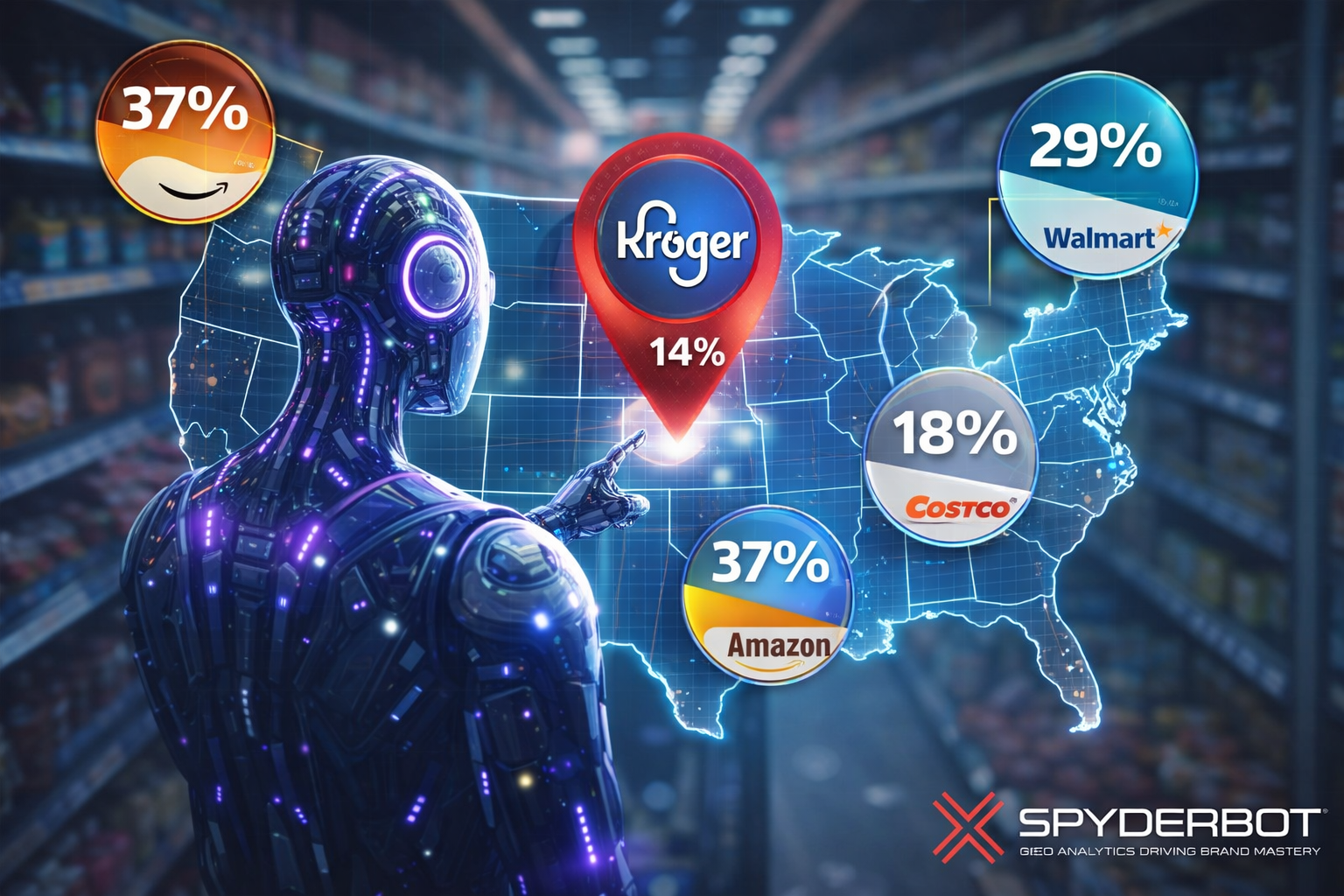
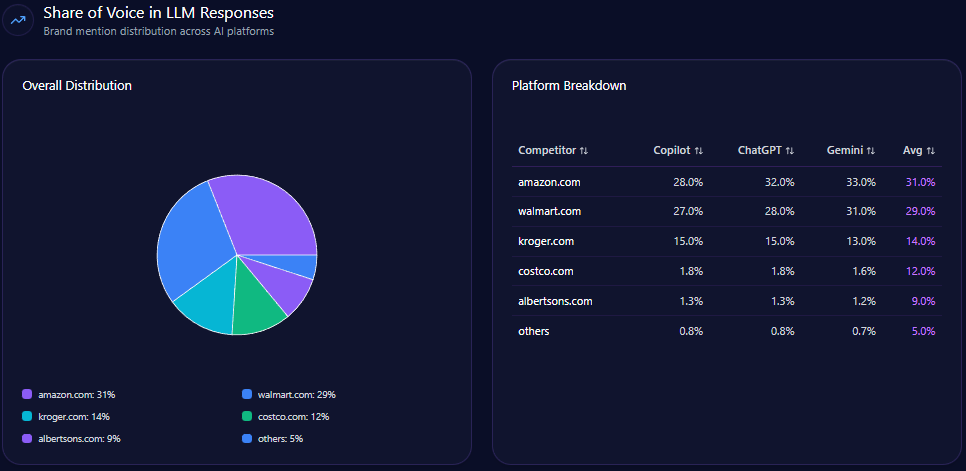
    Across 141 total prompts on ChatGPT, Gemini, and Copilot, the report tracks 714 total mentions. Kroger holds 101 (14%), behind Amazon (218; 31%) and Walmart (204; 29%). Costco Wholesale follows with 83 (12%), and Albertsons Companies has 61 (9%). Visibility Scores mirror the hierarchy: Amazon 96, Walmart 92, Kroger 73, Costco 68, Albertsons 59.

    Kroger’s challenge isn’t being missing—it’s being third. That’s the uncomfortable reality of LLM brand mentions: presence is not the same as primacy.

    kroger.com’s Share of Voice in LLM Responses (GEO Report, Jan 15, 2026)

    AI Platform-Specific Visibility

    Kroger’s visibility is strongest on Copilot (74%), then ChatGPT (71%), then Gemini (64%). Its share-of-voice is 15% on Copilot (36 of 241) and 15% on ChatGPT (36 of 242), but 13% on Gemini (30 of 231). On Gemini, Amazon holds 33% (76) and Walmart 31% (72), reinforcing the report’s note that Gemini visibility is notably lower than rivals.

    Sentiment Score for Competitors

    Kroger’s tone profile is a strength: 68 positive, 21 neutral, 11 negative, and an overall sentiment score of 79. Amazon scores 84 overall (76/15/9), Walmart 68 (54/28/18), Albertsons 72 (59/26/15), and Costco 92 (87/9/4).

    Three themes explain the upside and the friction. “Private Label Quality” leads (count 52, frequency 37.00) with a Positive tone. “Digital Savings & Rewards” is also Positive (count 34, frequency 24.00), with fuel points and digital coupons shaping the narrative. “Delivery & Logistics” is Mixed (count 28, frequency 20.00). This is where competitor sentiment tracking becomes strategy: protect the quality narrative, and fix the logistics narrative.

    Top Prompts Driving Mentions

    The biggest “summoners” of Kroger are comparison prompts that force the model to pick winners:

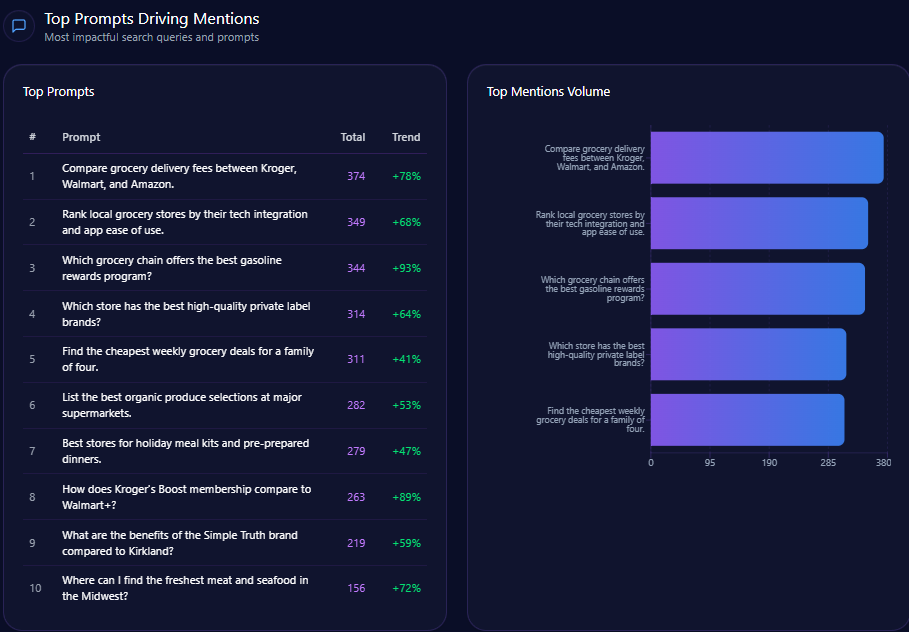
    • “Compare grocery delivery fees between Kroger, Walmart, and Amazon.” (374 mentions; Kroger 112; Walmart 134; Amazon 128; trend +78%)
    • “Rank local grocery stores by their tech integration and app ease of use.” (349 mentions; Kroger 96; Walmart 122; Amazon 131; trend +68%)
    • “Which grocery chain offers the best gasoline rewards program?” (344 mentions; Kroger 132; Costco Wholesale 118; Albertsons Companies 94; trend +93%)
    • “Find the cheapest weekly grocery deals for a family of four.” (311 mentions; Kroger 58; Walmart 141; Costco Wholesale 112; trend +41%)
    kroger.com’s Top Prompts Driving Mentions (GEO Report, Jan 15, 2026)

    Types of Prompt Queries

    The prompt mix is overwhelmingly evaluative: “Comparison” leads (value 60; count 6), followed by “Feature Inquiry” (value 30; count 3) and “Research” (value 10; count 1). “Purchase Intent” and “How-to/Tutorial” are both 0 with count 0. Kroger is being judged, not simply discovered.

    E-commerce Sentiment for Competitor Products

    In e-commerce share of voice, Kroger holds 12.95% with 858 mentions, behind Amazon at 32.16% (2,131) and Walmart at 30.03% (1,990), and close to Costco at 11.02% (730). Referral signals show Gemini at 1,056 with a 3.2 conversion rate, Copilot at 923 with 3.4, and ChatGPT at 842 with 2.8.

    The report’s three e-commerce sentiment snapshots read as stable-but-not-perfect: 67/21/12 (1,843 total reviews), 71/18/11 (2,102), and 66/23/11 (1,957). Snippets, as cited in the report, reinforce both strengths and friction:

    • “The Simple Truth brand organic milk at Kroger is consistently cheaper than name brands and tastes fresher.” (Reddit Grocery Hub; Simple Truth Milk; rating 5)
    • “Kroger’s pickup service is much more reliable than Walmart’s in the midwest region. Very few substitutions.” (Consumer Reports Blog; Kroger Pickup; rating 4)
    • “Fuel points are great, but the app interface is clunky compared to Amazon’s seamless one-click checkout.” (TechRetail Review; Digital App; rating 3)

    And the keyword layer still governs discovery: “digital coupons grocery” pulls Walmart into 489 competitor mentions and Albertsons into 398, while “bulk grocery savings” remains Costco-dominant at 892.

    Conclusion

    Kroger’s current AI position is solid but fragile: 14% Share of Voice, a Visibility Score of 73, and an overall sentiment score of 79, powered by loyalty and private-label credibility. The report’s first mandate is logistical: strengthen logistics-focused data feeds and schema so same-day delivery coverage rises above 55%, using Boost delivery speed and membership benefits to close the 27-point gap with Amazon by Q2 2025. Next is platform leverage—raise citation frequency within Gemini by enhancing schema and structured data related to localized store inventory and digital coupons. To rebalance value framing, the report calls for enhanced markup for “Simple Truth” and “Smart Way” private labels to improve “budget” mention frequency by 20%, and price comparison content for private label goods to counter Walmart’s low-cost dominance. Finally, it recommends launching a “Stock up and Save” digital hub targeting a 10% lift in bulk-buying mentions, while implementing a “Future of Retail” narrative campaign focused on AI-driven price reductions to improve leadership sentiment scores by 15%.

    Explore SpyderBot to operationalize these GEO analytics insights.
  • Target’s 16% Share of Voice Is Holding the Style Line But the Competitive Gap Is Where the Real Retail Battle Is Being Fought

    Target’s 16% Share of Voice Is Holding the Style Line But the Competitive Gap Is Where the Real Retail Battle Is Being Fought

    Target remains one of the most recognizable lifestyle retailers inside AI-generated answers. Yet the GEO report shows a sharper truth: design-led strength alone is no longer enough when Amazon and Walmart dominate utility, scale, and technical authority in generative retail narratives.


    At-a-glance: what the GEO report makes unavoidable

    • Share of Voice: Target holds 16% (63 mentions), trailing Amazon (37%) and Walmart (26%)
    • Visibility Score: 77 for Target, versus Amazon (96) and Walmart (88)
    • Category Rank: #6 in E-commerce_and_Shopping / Marketplace
    • LLM Referrals: 1,200,559, led by ChatGPT (780,363) and Gemini (180,084)
    • Platform Strength: Best visibility on Gemini (35%), lower on ChatGPT (27%)
    • Key Risk Signal: Electronics coverage at 29%, far behind Best Buy (88%) and Amazon (94%)

    Imagine a shopper asking an AI assistant a simple question: “Where should I buy stylish home décor on a budget?” Target appears quickly confident, familiar, dependable. Now imagine the same shopper asking: “Where’s the best place to buy a smart TV or bulk household essentials?” The answer changes, and Target starts to fade.

    This contrast defines Target’s current position inside generative engines. The brand is present, respected, and frequently cited but selectively. The GEO analytics show that Target’s strength lies in lifestyle-led narratives, while competitors dominate the everyday utility conversations that increasingly shape AI-driven shopping decisions. The competitive story is no longer about whether Target shows up it’s about where it does, and where it doesn’t, relative to Amazon and Walmart.


    Position in LLM Response Lists

    Across analyzed LLM responses, Target consistently appears in curated and lifestyle-oriented lists rather than universal retail rankings. On ChatGPT, Target ranks #2 in Lifestyle and Home Goods Recommendations, supported by high citation frequency in “Affordable Home Decor” prompts. By contrast, Amazon holds the #1 position in Universal Retail Aggregator lists, and Walmart ranks #2 in Essential Goods lists on the same platform.

    On Gemini, Target’s position softens further. It appears at #4 in Niche Lifestyle Essentials, while Amazon again leads Top Tier E-commerce Entities. Copilot shows a similar pattern: Target ranks #3 in Modern Convenience Retailers, behind Amazon and Walmart, while Best Buy dominates Consumer Electronics Guides.

    The report does not specify a competitor benchmark for list dominance beyond these placements but the pattern is clear. Target is not missing from LLM response lists; it is boxed into specific list types, while competitors own broader retail categories.


    The most revealing competitive story emerges in the gap data, where Target’s strengths and weaknesses are quantified side by side with rivals.

    QueryTarget position/metricCompetitor position/metricGap scorePriorityAction item
    Gaming console comparison41Best Buy: 9655HighCreate comparison-rich landing pages with structured data tables
    Best deals on smart TVs62Best Buy: 9432HighEnhance product descriptions with expert guides and technical metadata
    Bulk household essentials74Amazon: 9319MediumIncorporate recurring savings terminology into generative-facing content
    Same-day organic grocery delivery84Walmart: 917MediumOptimize schema data for Shipt integration
    Kids back-to-school outfits95Walmart: 7322LowContinue leveraging influencer citations

    This table makes the competitive reality unavoidable. Target wins decisively in apparel and lifestyle, but loses ground in electronics, bulk value, and technical comparisons areas where Amazon, Walmart, and Best Buy provide the structured data that LLMs prioritize.


    Trigger Keywords for Competitor Products

    Trigger keywords further reinforce this divide. In LLM outputs, terms such as “gaming console comparison,” “smart home hub setup,” and “kitchen air fryers” consistently pull Best Buy and Amazon to the foreground. Target’s presence in these triggers remains diluted.

    Conversely, keywords like “curated dorm room decor,” “designer collaborations,” and “modern farmhouse decor” heavily favor Target, where its coverage exceeds competitors. Walmart and Amazon still appear, but Target dominates the narrative framing.

    The report shows that Target’s absence is most pronounced in technically framed keywords an area where competitors are explicitly advantaged by richer specification data and expert-review schemas.


    Founder Negative Context

    Leadership narratives add another layer of competitive contrast. Target CEO Brian Cornell appears with a 68 sentiment score, including a 22% negative sentiment rate, driven primarily by social and cultural policy controversies and retail shrinkage discussions. Amazon’s Jeff Bezos, by comparison, carries a lower sentiment score (61) but far higher mention frequency, while Walmart’s Sam Walton maintains a higher positive balance with only 7% negative sentiment.

    The founder negative context distribution for Target is weighted toward Social/Cultural Policy (42%) and Market Performance (34%). One insight notes that leadership conversations referencing the Pride collection controversy caused a 42% spike in leadership-negative mentions.

    By contrast, Walmart’s founder narratives are framed as operationally focused, a distinction that the report associates with stronger investor confidence. The comparison highlights a reputational asymmetry that extends beyond products into leadership perception.


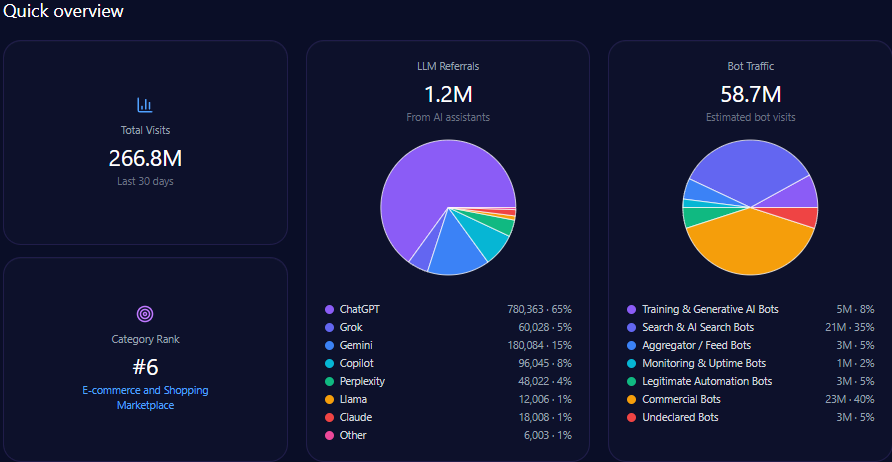
    At a macro level, Target recorded 266,790,786 total visits, including 58,693,973 bot visits, and 1,200,559 LLM referrals. Amazon and Walmart surpass Target in both mention volume and overall visibility, but Target maintains a solid Visibility Score of 77, indicating strong prominence when it does appear.

    Competitor benchmarks reinforce this snapshot. Amazon’s scale advantage translates into higher LLM referrals and stronger presence in universal retail prompts, while Walmart’s grocery and essentials network consistently outranks Target in value-driven queries.

    target.com’s Quick overview (GEO Report, Jan 14, 2026)

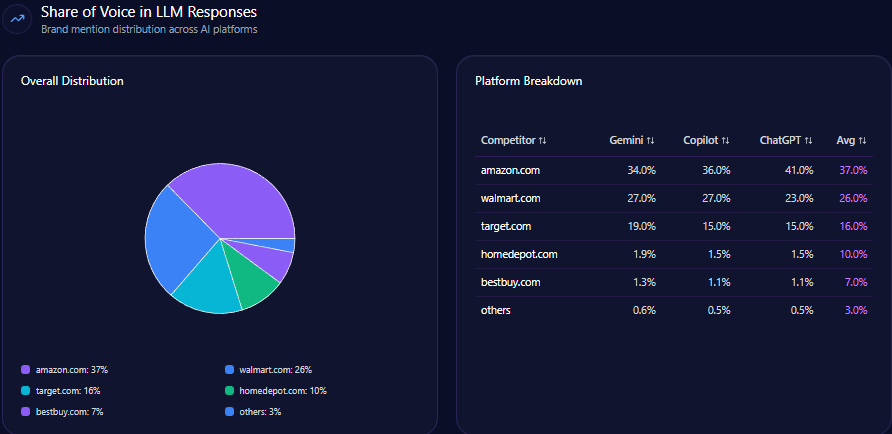
    Inside AI-generated answers, share of voice reflects true mindshare. Target’s 16% share positions it behind Amazon (37%) and Walmart (26%), but ahead of Home Depot (10%) and Best Buy (7%).

    What differentiates Target is not volume, but contextual efficiency. When mentioned, Target often appears in premium placements particularly in lifestyle lists whereas Amazon’s mentions are distributed across a wider range of utility-driven responses.

    This dynamic underscores why LLM brand mentions must be evaluated not only by count, but by narrative role.

    target.com’s Share of Voice in LLM Responses (GEO Report, Jan 14, 2026)

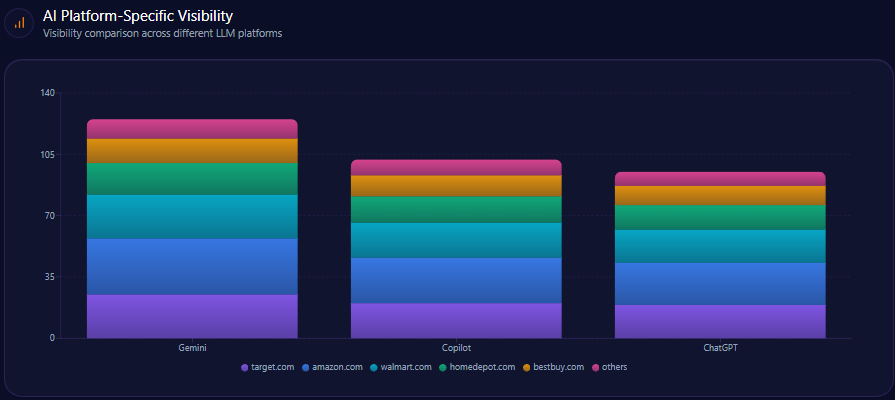
    Platform bias plays a decisive role. Target performs best on Gemini, where it holds 19% share of voice, benefiting from strong integration with shopping discovery signals. Amazon leads with 34%, and Walmart follows at 27%.

    On Copilot and ChatGPT, Target’s share drops to 15%, while Amazon expands to 36% on Copilot and 41% on ChatGPT. Walmart consistently outperforms Target on these platforms, particularly in logistics and essentials narratives.

    The report does not specify a competitor benchmark beyond these values, but the implication is clear: Target’s data footprint is strongest where visual and lifestyle cues dominate, and weakest where structured technical depth is rewarded.

    target.com’s AI Platform-Specific Visibility (GEO Report, Jan 14, 2026)

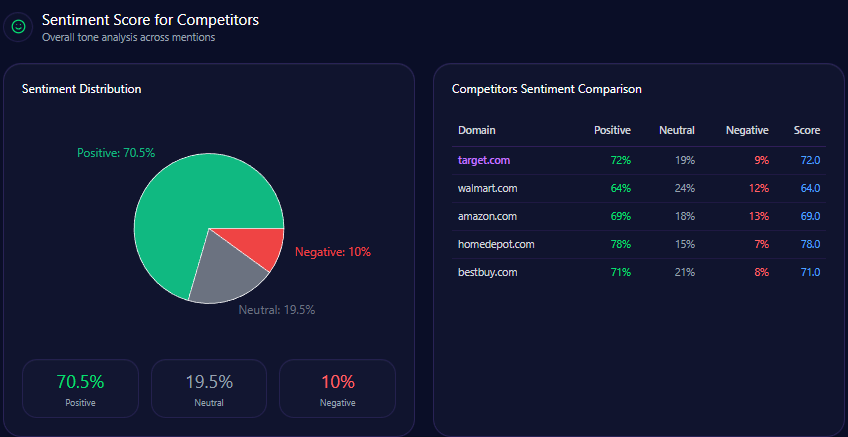
    Sentiment analysis further sharpens the comparison. Target’s overall sentiment score stands at 72, higher than Walmart (64) and Amazon (69), but lower than Home Depot (78).

    Context themes reveal why. Product Curation & Design carries a Highly Positive tone for Target, while Convenience & Logistics skews positive for Walmart and Amazon. Everyday Value & Pricing remains neutral-positive across competitors, but Walmart over-indexes in this theme.

    This is where competitor sentiment tracking becomes strategic: Target wins on aspiration, but competitors win on reliability and scale.

    target.com’s Sentiment Score for Competitors (GEO Report, Jan 14, 2026)

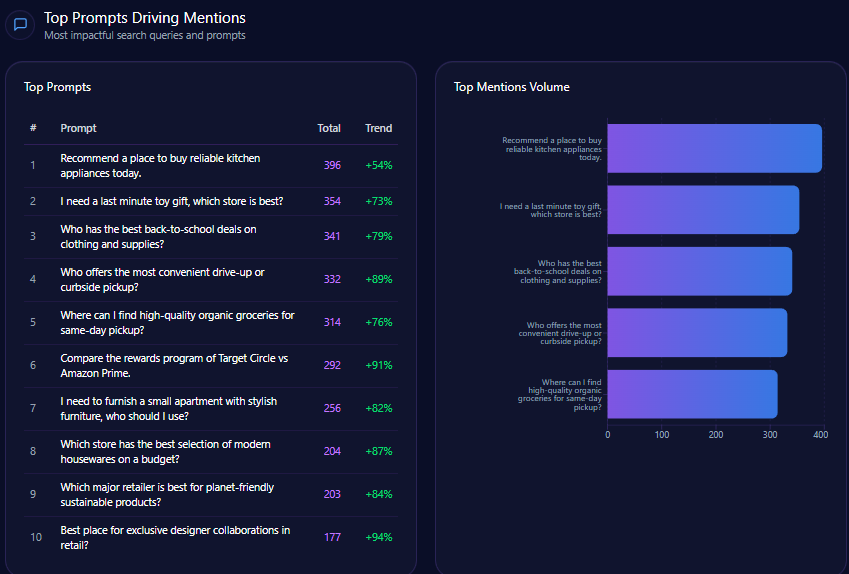
    The prompts that “summon” Target are telling. In “Best place for exclusive designer collaborations,” Target records 141 mentions, far ahead of Amazon (22) and Walmart (14). In “Who offers the most convenient drive-up or curbside pickup?” Target appears 122 times, closely matched by Walmart (126).

    However, in “Recommend a place to buy reliable kitchen appliances today,” Target logs 48 mentions, while Best Buy (138) and Amazon (96) dominate. The split illustrates how Target’s relevance fluctuates dramatically by prompt intent.

    target.com’s Top Prompts Driving Mentions (GEO Report, Jan 14, 2026)

    Types of Prompt Queries

    Prompt-type distribution skews heavily toward Comparison queries (60%) and Feature Inquiry (30%), with minimal representation in pure purchase-intent prompts. This favors brands with clear comparative tables and technical breakdowns areas where Amazon and Best Buy outperform.

    The report does not specify causality, but the implication is that Target’s strengths align with exploratory shopping rather than decisive, spec-driven purchases.


    E-commerce Sentiment for Competitor Products

    At the product level, e-commerce sentiment remains a bright spot. Target’s reviews show 78% positive, 17% neutral, and 5% negative sentiment. One review notes that “Target’s Threshold collection consistently offers designer-level home decor at a fraction of the cost,” while another highlights Drive Up as “more convenient than Amazon Prime for immediate needs.”

    Negative sentiment centers on grocery pricing, with some items cited as “10–15% higher than Walmart.” Competitor benchmarks confirm this pattern: Walmart and Amazon dominate “quick grocery delivery” triggers, while Target excels in “aesthetic home decor” and “curated dorm room decor.”


    Conclusion

    The GEO report positions Target at a strategic crossroads. Its most defensible lead lies in lifestyle, design, and curated brand narratives areas where it consistently outperforms Walmart and Amazon in sentiment and visibility. Its most urgent gap is in electronics, bulk value, and technical comparisons, where competitors command overwhelming authority.

    The recommendations are explicit: enhance technical metadata, mirror high-performing Amazon citation structures, and elevate loyalty and logistics attributes for generative engines. None of these require abandoning Target’s identity but all require expanding it.

    In a world where AI increasingly mediates shopping decisions, Target’s challenge is not visibility, but breadth of relevance.


  • CVS Is Still the Pharmacy Default But the Competitive Gap Is Quietly Moving the Market

    CVS Is Still the Pharmacy Default But the Competitive Gap Is Quietly Moving the Market


    CVS dominates the pharmacy narrative inside LLM answers. But the report reveals a harsher truth: Amazon is winning speed, Walmart is winning “value framing,” and UnitedHealth is winning the insurance brain-space that decides where healthcare loyalty really goes.


    What the GEO report makes impossible to ignore

    • Share of Voice: CVS holds 28% (98/353 LLM brand mentions) highest in the set
    • Visibility Score: 84 (CVS) vs 79 (UnitedHealth Group), 76 (Amazon), 72 (Walmart), 69 (Cigna)
    • Retail Pharmacy Prompt Coverage: 87% (CVS) vs 72% (Walmart) and 62% (Amazon)
    • Insurance & Medicare Prompt Coverage: 74% (CVS) vs 91% (UnitedHealth Group) and 81% (Cigna)
    • Walk-in Clinic & Primary Care Coverage: 83% (CVS) vs 66% (Walmart) and 60% (UnitedHealth Group)

    Risk signals the report highlights

    • 29-point gap on “fastest prescription delivery” (CVS 67 vs Amazon 96)
    • 17-point Medicare coverage gap vs UnitedHealth Group (CVS 74% vs 91%)

    The quiet truth about modern pharmacy competition

    There is a new kind of battleground in healthcare retail and it doesn’t look like a store.

    It looks like a question.

    A consumer asks a model: Where should I go to refill my prescriptions? Which clinic is easiest? Which plan makes sense? Who’s the fastest? Who’s cheapest?

    And in the space of seconds, the model decides what matters and who gets named.

    This is where CVS still wins. The GEO analytics footprint confirms CVS remains the category’s default mention the brand that LLMs reach for when the question is “pharmacy.”

    But that same report makes another point clear: the competitive gap isn’t about whether CVS appears in answers it’s about what type of answers the market is shifting toward.

    CVS leads the pharmacy narrative.
    But the strongest competitor narratives are building elsewhere:

    • Amazon owns speed-led delivery logic.
    • Walmart owns value-pricing framing.
    • UnitedHealth owns Medicare and insurance synthesis.

    So the real thesis is comparative and blunt:

    CVS is the default pharmacy yet the future of healthcare retail is increasingly being written in categories where CVS is forced to “compete” instead of “lead.”


    CVS appears until the list becomes about speed or systems

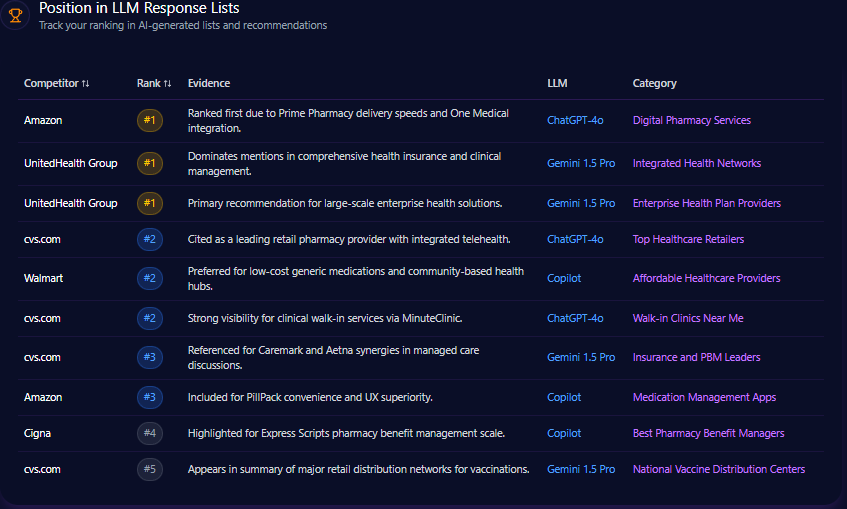
    The report shows CVS ranking highly in list-based answers, especially where the “retail health + proximity + convenience” frame dominates.

    On ChatGPT-4o:

    • CVS is #2 in Top Healthcare Retailers
    • CVS is #2 in Walk-in Clinics Near Me

    That matters because being ranked is not the same as being mentioned. Rankings are what users remember, and what they screenshot.

    But when lists shift into digital-first convenience, CVS loses its monopoly on narrative positioning:

    • In Gemini 1.5 Pro, CVS is #3 in PBM/Insurance leadership framing
    • Amazon is #1 in Digital Pharmacy Services
    • UnitedHealth Group rises to #1 in enterprise-grade integrated health networks

    The report does not generalize “why” so neither should we. But the evidence is enough to say:

    CVS dominates “pharmacy + clinic.”
    Competitors dominate “delivery + insurance logic.”

    cvs.com’s Position in LLM Response Lists (GEO Report, Jan 14, 2026)

    The battle map isn’t subtle

    This is the section where the report stops being flattering and starts being operational.

    CVS is not losing visibility overall (it leads).
    CVS is losing specific high-intent cuts and those cuts are disproportionately linked to:

    • delivery speed
    • Medicare plan synthesis
    • price tables

    The compact gap table (from the report)

    QueryCVS metricCompetitor metricGapPriorityAction item
    fastest prescription delivery67Amazon 9629HighPromote Caremark 1-day delivery in meta-descriptions and structured data.
    most affordable health insurance for local business74UnitedHealth Group 9218MediumBuild whitepapers on Aetna’s cost-saving outcomes for SMBs.
    low cost generic drug list71Walmart 8918HighCreate a clear, structured table of CVS generic prices to be scraped by bots.
    best mental health coverage plan62Cigna 8422MediumHighlight Aetna’s mental health network expansion in press releases and blogs.
    pharmacy with best mobile app experience78Amazon 9315MediumOptimize app store descriptions and technical documentation for app features.
    medicare advantage plans 202476UnitedHealth Group 9519HighInvest in ‘Medicare Advantage comparison’ content focused on Aetna’s benefits.

    A quick executive translation:

    • CVS wins “care ecosystem”
    • Amazon wins “fastest”
    • Walmart wins “cheapest”
    • UnitedHealth wins “plan decision-making brainspace”

    And those are the frames that drive consumer switching.


    The words that summon rivals

    In generative answers, keywords behave like magnets. Certain words trigger competitor mentions harder than CVS.

    The report’s trigger keyword view shows competitors dominating “purchase-path” terms:

    • “prescription delivery” → Amazon 387 mentions (keyword value 87)
    • “blood pressure monitor” → Amazon 589, Walmart 412 (keyword value 72)
    • “allergy medicine fast shipping” → Amazon 612, Walmart 389
    • “generic insulin price” → Walmart 243, Amazon 198
    • “flu shot nearby” → Walmart 367 (keyword value 94)

    The report does not quantify CVS in this specific keyword cut. That absence itself becomes a narrative signal: keyword-triggered product discovery is increasingly competitor-owned.

    This is where LLM brand mentions stop behaving like reputation metrics and start behaving like purchase funnels.


    When reputation becomes operational drag

    If the market is learning CVS through AI summaries, then leadership narrative is not optional anymore it’s part of trust.

    CVS leadership presence in the report:

    • Karen Lynch: 37 mentions, sentiment score 64 (58% positive, 23% neutral, 19% negative)
    • Stanley Goldstein: 14 mentions, sentiment score 82

    Comparative tension:

    • Jeff Bezos: 118 mentions, sentiment score 52, 41% negative context

    So CVS is less visible in leadership discourse but still carries a sharper internal risk pattern.

    Founder negative context distribution (CVS):

    • Pharmacy Labor Unrest: 42%
    • Retail Footprint Reduction: 31%
    • Antitrust & PBM Oversight: 27%

    Trend highlight:

    • Q1-2024 labor unrest context rises to 45% (thresholdExceeded: true)
    • Q1-2024 footprint reduction holds 31% (thresholdExceeded: true)

    This is not generic sentiment. The report names operational keywords like:

    • Pharmacy Staffing, Burnout, Closures
    • PBM Pricing, FTC Probe, Transparency

    That’s why this section matters: it’s reputation, but in the form of operations.


    CVS has scale and scale is an LLM advantage

    The macro footprint:

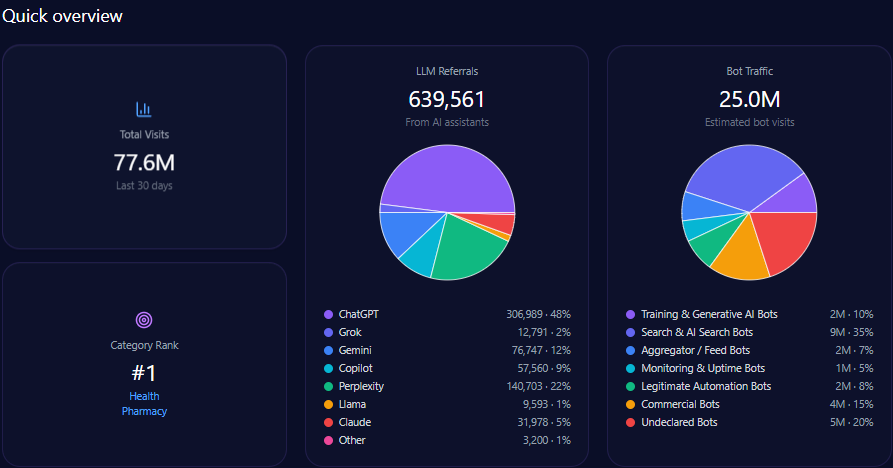
    • 77,616,698 total visits
    • 24,950,211 bot traffic
    • 639,561 LLM referrals
    • Category rank: #1 in Health/Pharmacy

    Referral breakdown:

    • ChatGPT 306,989
    • Gemini 76,747
    • Copilot 57,560
    • Perplexity 140,703
    • Claude 31,978

    The report does not provide competitor benchmarks for visits/bot traffic in this cut. But from a magazine view, the message is still clear:

    CVS is structurally compatible with generative discovery at scale.

    cvs.com’s Quick overview (GEO Report, Jan 14, 2026)

    CVS leads but the market isn’t static

    Mentions:

    • CVS 98 (28%)
    • UnitedHealth Group 77 (22%)
    • Walmart 63 (18%)
    • Amazon 53 (15%)
    • Cigna 42 (12%)

    CVS’s lead is real.
    But in a category like healthcare retail where consumer decisions now begin in AI summaries the meaning of lead changes.

    A lead in mentions is not the same as a lead in conversion narratives.


    CVS is strongest where trust is strongest

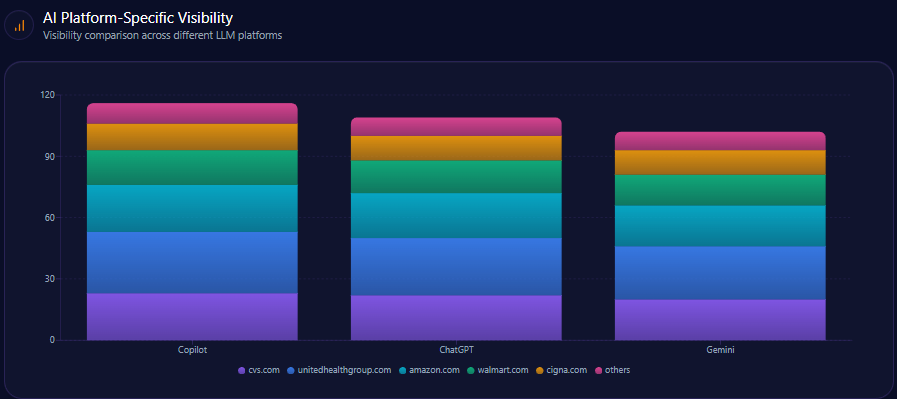
    Platform shares:

    • ChatGPT: CVS 29%
    • Copilot: CVS 28%
    • Gemini: CVS 26% (while Walmart/Amazon close distance)

    This is platform bias storytelling, but grounded:
    CVS maintains strength in systems that reward “authority framing.”
    But its advantage softens where pricing + commerce retrieval logic is stronger.

    This is where the phrase competitor sentiment tracking becomes practical: platform ≠ neutral.

    cvs.com’s AI Platform-Specific Visibility (GEO Report, Jan 14, 2026)

    CVS is credible, but not the most loved

    Sentiment scores:

    • CVS 64
    • UnitedHealth Group 58
    • Walmart 69
    • Amazon 78
    • Cigna 61

    CVS beats the insurance giants (UHG, Cigna) in sentiment.
    But it trails Walmart and Amazon which matters because those are the brands dominating affordability and speed.

    Context themes from the report:

    • Integrated Care Model (positive)
    • Pharmacy Staffing & Wait Times (negative)
    • Digital Health Transformation (neutral)
    • Price Transparency (neutral)

    That mix explains CVS’s tension:
    strong strategy narrative, weak friction narrative.


    CVS appears, but not always as the winner

    The report’s prompt-level split is where the future shows up.

    Insurance prompts lean competitors:

    • “Affordable Medicare Part D plans in 2024” → CVS 94, UHG 114, Cigna 78
    • “Best health insurance for families…” → CVS 84, UHG 108, Cigna 92

    Delivery/value prompts lean competitors:

    • “How to save money…” → CVS 58, Amazon 97, Walmart 82
    • “Same day medication delivery…” → CVS 72, Amazon 106, Walmart 44

    Clinic prompts favor CVS:

    • “Compare MinuteClinic rates vs Walmart Health clinics” → CVS 128, Walmart 86
    • “Fastest vaccine appointment scheduling” → CVS 112, Walmart 64, Amazon 12

    So CVS wins care + clinic framing.
    But loses speed/value/insurance framing.


    The market is asking “features,” not “brands”

    PromptTypes distribution:

    • Feature Inquiry: 60
    • Comparison: 30
    • How-to/Tutorial: 10
    • Purchase Intent: 0

    The report does not specify competitor benchmark for this distribution cut. Still, the implication is clean:

    The AI era rewards structured capability narratives.
    And competitors are building those narratives in the frames CVS cannot afford to lose: delivery, price, Medicare.

    cvs.com’s Types of Prompt Queries (GEO Report, Jan 14, 2026)

    The most uncomfortable split

    E-commerce SoV:

    • Amazon 26.88% (182)
    • Walmart 26% (176)
    • CVS 16.84% (114)

    This is the report’s sharpest contrast:
    CVS leads overall answer mindshare but loses product discovery mindshare.

    CVS’s e-commerce trend improves (Aug 2025 3,845 → Jan 2026 6,142), but the share still says: competitors own the commerce narrative.


    CVS is winning the past, fighting for the future

    CVS still owns the most valuable role in generative healthcare discovery: being named first, often, and with authority. A 28% Share of Voice and Visibility Score 84 confirm it.

    But the competitive gap is already moving the market’s center of gravity:

    • Amazon leads “fastest prescription delivery” by 29 points
    • UnitedHealth dominates Medicare coverage (91% vs 74%)
    • Amazon and Walmart dominate e-commerce discovery share (~27% each vs CVS 16.84%)

    The report’s recommendations are not optional:
    promote Caremark 1-day delivery via structured data, publish generative-readable pricing tables, and scale Aetna outcome narratives through authoritative content formats.

    CVS’s most defensible lead is clinic + pharmacy dominance.
    Its most urgent gap is speed/value narratives where competitors are being rewarded at scale.

  • Ahold Delhaize’s 12% Share of Voice Is Building a Sustainability-Led Advantage—and Revealing Where Value Narratives Slip Away

    Ahold Delhaize’s 12% Share of Voice Is Building a Sustainability-Led Advantage—and Revealing Where Value Narratives Slip Away

    In generative answers, Ahold Delhaize is winning the sustainability storyline—yet the same landscape still defaults to Walmart and Aldi when the question becomes price, speed, or mass-market convenience.


    Imagine a shopper asking an assistant a simple question: Who’s the most sustainable grocery leader right now? The model answers quickly—confidently—because it has learned which corporate narratives are easiest to cite.

    Now imagine the follow-up: Where do I get the lowest grocery prices in 2024? The tone changes. The cast of “obvious” brands changes. The model becomes less interested in corporate ambition and more interested in consumer proof.

    That whiplash is the boardroom reality behind GEO analytics: when answers are compressed into a few lines, reputation is awarded to the brands that own the right micro-narrative at the right moment.

    Position in LLM Response Lists

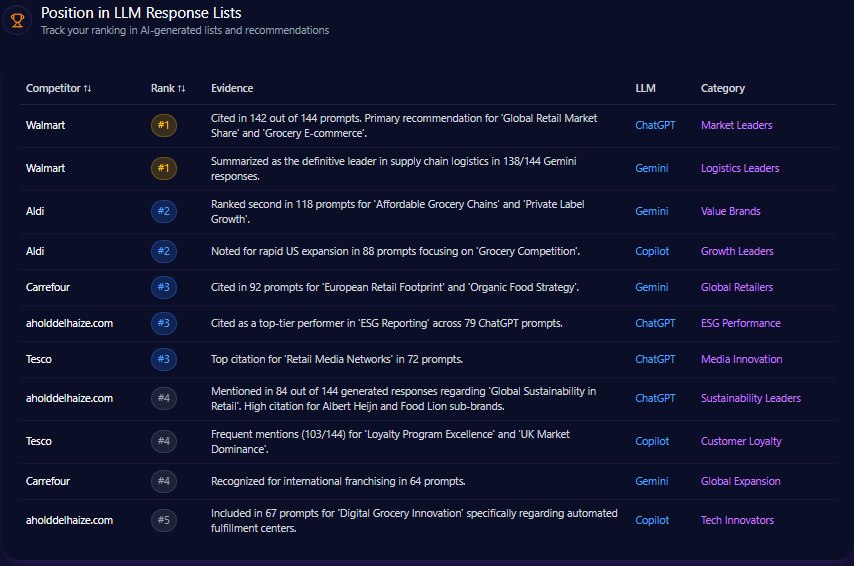
    Ahold Delhaize’s presence in response lists is defined by a split personality: it is treated as a top-tier authority in sustainability and ESG contexts, while being less “default” in value and convenience lists.

    On ChatGPT, Ahold Delhaize shows up as rank 3 in an “ESG Performance” list type, cited across 79 prompts. It also appears as rank 4 among “Sustainability Leaders,” mentioned in 84 out of 144 generated responses tied to “Global Sustainability in Retail.” On Copilot, it’s pulled into innovation narratives as rank 5 in “Tech Innovators,” included in 67 prompts focused on digital grocery innovation and automated fulfillment centers.

    The contrast becomes sharper when you look at who holds the “default leader” slots. Walmart is rank 1 in ChatGPT “Market Leaders” and rank 1 in Gemini “Logistics Leaders,” cited in 142 out of 144 prompts in one list type and summarized as the definitive logistics leader in 138/144 Gemini responses. In value and growth lists, Aldi is repeatedly placed at rank 2118 prompts in Gemini “Value Brands,” and 88 prompts in Copilot “Growth Leaders.”

    aholddelhaize.com’s Position in LLM Response Lists (GEO Report, Jan 12, 2026)

    Ahold Delhaize is present—often respected—yet the lists reveal what it is known for versus what it is chosen for.

    Competitor Gap Analysis

    The competitor battle map isn’t a single front. It’s a set of recurring questions where one competitor becomes the safe answer—and where Ahold Delhaize is either included as a credible alternative or excluded entirely.

    Here’s the tightest snapshot of the gaps the report surfaces:

    QueryAhold Delhaize metricCompetitor metricGap / priority
    lowest grocery prices 202464Aldi 9632.00 / High
    fastest grocery delivery services72Walmart 9422.00 / High
    best supermarket loyalty app58Tesco 8830.00 / Medium
    retail job benefits 202462Walmart 9129.00 / High
    best private label grocery74Aldi 9521.00 / Medium

    The story these queries tell is uncomfortable in its simplicity. In “lowest grocery prices 2024,” Aldi dominates the value narrative—often excluding Ahold’s banners from budget-centric recommendations. In “fastest grocery delivery services,” Walmart+ becomes the default for speed. In “best supermarket loyalty app,” Tesco’s Clubcard is treated as the benchmark for personalized digital rewards. And in “retail job benefits 2024,” Walmart’s education benefits are a recurring citation advantage.

    Yet the same data also shows where Ahold Delhaize can lead. In “sustainable packaging retail,” Ahold Delhaize posts 81 versus Walmart’s 75 (a -6.00 gap score, flagged as low priority because the brand already leads). In “online grocery trends Europe,” Ahold Delhaize is 85 versus Carrefour’s 82 (gap score -3.00), suggesting the brand’s positioning through Albert Heijn is already strong.

    This is not a brand that lacks authority. It’s a brand whose authority is unevenly distributed across the prompts that shape consideration.

    Trigger Keywords for Competitor Products

    The report’s keyword triggers reinforce a clear pattern: the words that summon “value,” “automation,” and “loyalty” tend to pull competitors into the answer first—especially in product and commerce-oriented contexts.

    Several triggers stand out as repeat summons for competitors:

    • “automated grocery fulfillment” (value 92) skews heavily toward Walmart (41) and Tesco (19) in competitor mentions.
    • “contactless checkout Europe” (value 89) pulls Carrefour most strongly (35).
    • “sustainable grocery retail” (value 88) is dominated by Carrefour (28) and Tesco (22) in competitor mentions.
    • “AI grocery assistant” (value 84) leans toward Walmart (32) and Carrefour (24).
    • “supermarket loyalty apps” (value 77) highlights Walmart (51) and Tesco (49) as top associations.

    In other words: the keyword layer doesn’t just describe what shoppers ask. It describes which brands the model has learned to attach to specific “proof points” in the retail vocabulary—and which brands must work harder to be included when those proof points are value-led rather than ESG-led.

    Founder Negative Context

    Founder and leadership narratives are where corporate identity becomes human—and where risk becomes a storyline rather than a metric.

    In the report’s leadership lens, Frans Muller (CEO/Current face) registers a mention frequency of 46 with a sentiment score of 73 ( 68% positive, 23% neutral, 9% negative). The heritage figure Albert Heijn (Historical) appears with 22 mentions and a sentiment score of 88 ( 82% positive, 14% neutral, 4% negative). For comparison, Walmart’s Doug McMillon (CEO) appears with 89 mentions and a sentiment score of 71, while Tesco’s Ken Murphy is at 38 mentions with a sentiment score of 62.

    But the sharper signal sits in the negative-context distribution tied to leadership narratives. The report’s founder negative context is led by Inflation & Pricing Policy (42%), followed by Labor Relations (34%), and Supply Chain Sustainability (24%)—with examples ranging from “Greedflation accusations in Dutch media” to “Delhaize Belgium franchising strikes” and “Scope 3 emission targets skepticism.”

    The trend framing intensifies the story: in 2023-H2, Inflation sits at 38% and is marked threshold-exceeded, while Labor reaches 41% and is also marked threshold-exceeded. In 2024-H1, Inflation rises to 42% and remains threshold-exceeded. The keyword weights show what the models latch onto: Pricing (81), Strikes (66), Margins (54).

    One insight line captures the reputational trap in plain language: “LLM conversations referencing ‘Greedflation’ caused a 14% spike in Pricing Policy mentions…”.

    Quick overview

    Ahold Delhaize’s footprint in this dataset is substantial, but it is not evenly “owned” by any single narrative.

    The domain logs 242,708 total visits, with 77,667 attributed to bot traffic across categories including Search & AI Search Bots (31,067) and Commercial Bots (19,417). On the referral side, the report records 1,942 LLM referrals—led by ChatGPT (874), followed by Gemini (388) and Copilot (291), with additional contribution from Perplexity (155), Grok (97), Claude (78), Llama (39), and Other (20).

    Category-wise, the domain sits at rank 58 in Food_and_Drink/Food_and_Drink. In a world where generative answers behave like compressed rankings, that context matters: it influences which peers the model “expects” to mention.

    Share of Voice in LLM Responses

    Inside generative answers, Share of Voice isn’t just awareness—it’s default legitimacy.

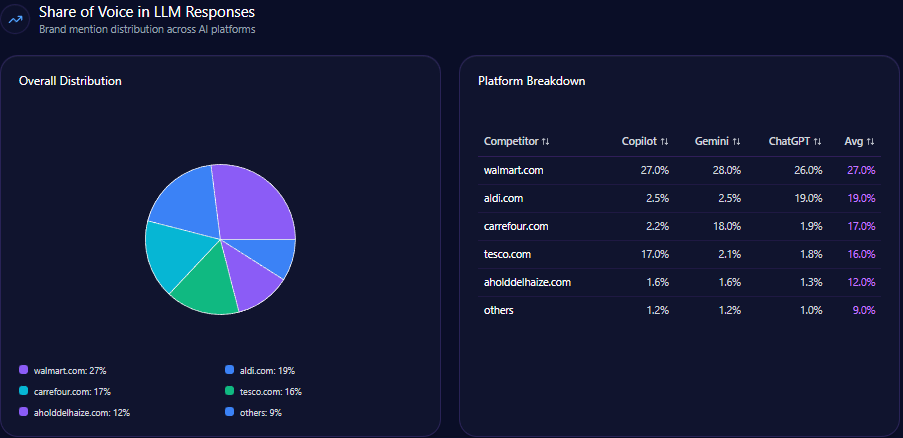
    Across 490 total mentions, Ahold Delhaize captures 61—a 12% Share of Voice. Walmart leads at 132 mentions (27%), followed by Aldi with 93 (19%), Carrefour with 84 (17%), and Tesco with 77 (16%). The remainder sits in “others” at 43 mentions (9%).

    Pair that with visibility scoring and the picture clarifies: Walmart posts a Visibility Score of 92, Aldi 81, Carrefour 76, Tesco 72, and Ahold Delhaize 64 (with “others” at 48). That’s a 28-point visibility gap between Ahold Delhaize and the market leader—mirroring the report’s warning that global scale does not automatically translate to dominant LLM brand mentions.

    aholddelhaize.com’s Share of Voice in LLM Responses (GEO Report, Jan 12, 2026)

    The crucial nuance: this is not a collapse of presence. It’s a pattern of selective authority—strong in some question clusters, thinner in others.

    AI Platform-Specific Visibility

    The same brand can experience three different “truths,” depending on which model is asked.

    Copilot is the most favorable environment for Ahold Delhaize in this dataset, with 46% visibility and a platform share of voice of 13 across 168 total mentions. Gemini follows closely at 44% visibility, also with a platform share of voice of 13 across 158 mentions. ChatGPT is lower at 38% visibility and a share of voice of 11 across 164 mentions.

    The competitive cast changes by platform. On Copilot, Walmart holds 27% share with 45 mentions, while Tesco takes 17% with 29 mentions. On Gemini, Walmart leads again at 28% with 44 mentions, while Carrefour holds 18% with 28 mentions. On ChatGPT, Walmart is at 26% with 43 mentions, while Aldi takes 19% with 31 mentions.

    The takeaway is practical: Ahold Delhaize benefits from Copilot’s corporate indexing bias, while ChatGPT’s consumer-intent framing more consistently elevates discount/value competitors. This is where GEO analytics becomes operational rather than descriptive: the same messaging strategy will not perform identically across models.

    Sentiment Score for Competitors

    Share of voice is volume. Sentiment is the tone of the story the model tells when it does include you—an essential layer of competitor sentiment tracking.

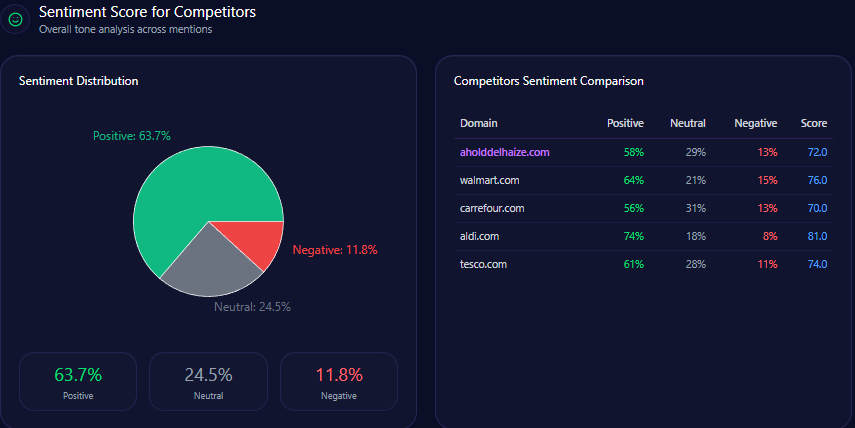
    Ahold Delhaize posts 58 positive, 29 neutral, and 13 negative, with an overall sentiment score of 72. Walmart stands at an overall score of 76 ( 64 positive, 21 neutral, 15 negative). Carrefour is 70 ( 56 positive, 31 neutral, 13 negative). Tesco is 74 ( 61 positive, 28 neutral, 11 negative). Aldi leads the sentiment set at 81 ( 74 positive, 18 neutral, 8 negative).

    The context themes explain why tone shifts by query cluster. “Pricing & Inflation Resilience” carries a frequency of 31.00 with 2,143 counts and is described as neutral in tone—exactly where value narratives and “greedflation” framing tend to appear. “Sustainability & ESG leadership” runs at 27.00 frequency with 1,864 counts and is described as highly positive, including examples such as “Renewable energy” and “plastic reduction.” “Omnichannel & Digital Growth” sits at 22.00 frequency with 1,521 counts and is described as positive—yet the brand’s prompt coverage in omnichannel is notably thinner than in sustainability.

    aholddelhaize.com’s Sentiment Score for Competitors (GEO Report, Jan 12, 2026)

    Ahold Delhaize is not losing the tone war. It is losing certain stages where the tone is set by value and convenience proof points.

    Top Prompts Driving Mentions

    The report’s top prompts read like a script of what the market is asking models to decide.

    The highest-volume prompt listed is “Which grocery stores have the strongest ESG commitments for 2024?” with 274 mentions: Ahold Delhaize registers 112, alongside competitor counts of 94 and 68, with competitor names listed as Carrefour and Tesco, and a trend of +84%.

    The omnichannel innovation prompt—“What are the most innovative supermarkets in terms of omnichannel technology?”—also sits at 274 mentions, with Ahold Delhaize at 72, and competitor counts of 94 and 108, with competitor names Carrefour and Walmart, and a +61% trend.

    When the prompt shifts into value, the distribution swings: “Recommend affordable retailers with high-quality private labels.” totals 272 mentions, with Ahold Delhaize at 42, while competitor counts reach 138 and 92, with Aldi and Walmart listed, and a +79% trend.

    Other high-driving prompts reinforce the same multi-front reality: delivery speed comparisons at 255 mentions (Ahold Delhaize 58, competitors 115 and 82), dividend stability at 250 mentions (Ahold Delhaize 78, competitors 110 and 62), and a direct AI-use comparison—“How are Ahold Delhaize and Walmart using AI to improve customer experience?”—at 212 mentions (Ahold Delhaize 88, Walmart 124), trending +68%.

    The model isn’t asking one question about Ahold Delhaize. It’s asking several—each with different winners.

    Types of Prompt Queries

    The prompt mix is heavily weighted toward evaluation rather than transaction.

    Feature Inquiry leads with a value of 50 (count 5), followed by Comparison at 40 (count 4), and Research at 10 (count 1). Purchase Intent and How-to/Tutorial both sit at 0 with counts of 0.

    This composition matters because it rewards brands that can be cited as benchmarks—especially in “best,” “fastest,” “most innovative,” and “strongest ESG” frames. It also explains why the battleground is less about short-term conversion language and more about which proof points have been made easiest for the model to retrieve and repeat.

    E-commerce Sentiment for Competitor Products

    In the e-commerce lens, the competitive hierarchy tightens.

    Ahold Delhaize holds 10.42% share of voice with 15 mentions, while Walmart leads at 37.5% with 54 mentions. Aldi sits at 18.06% with 26 mentions, Carrefour at 15.28% with 22, and Tesco at 14.58% with 21 (with “others” at 4.17% and 6 mentions).

    Sentiment snapshots in this section show positive sentiment of 68, 74, and 71, with negative sentiment at 8 across all three entries, and total reviews of 1,142, 988, and 1,256. And the story becomes tangible in the snippets—small lines that carry outsized influence when models compress trust:

    • “The digital experience with Albert Heijn’s app is seamless, making Ahold Delhaize a leader in grocery tech.” (as cited in the report; source: G2 / TechReviews, rating 5)
    • “Decent prices at Food Lion, but I often find Walmart has a larger variety for bulk items.” (as cited in the report; source: Trustpilot, rating 3)
    • “Impression of the sustainability reports from Ahold Delhaize suggests they are ahead of Tesco in green initiatives.” (as cited in the report; source: Retail Insight Blog, rating 4)

    Even referrals reinforce the platform pattern: Copilot (3,112) at 4.2 conversion rate, Gemini (1,850) at 3.8, and ChatGPT (2,410) at 3.4. In this view, mentions that do occur can convert—especially when the model’s framing aligns with corporate authority, loyalty, and grocery-tech trust.

    Conclusion

    The data draws a clear leadership challenge: Ahold Delhaize is already a sustainability authority, but it is still paying a visibility tax in value and convenience narratives where Walmart and Aldi are the model’s default answers. The report’s prescriptions are equally clear—consolidate banner-level technical whitepapers and ESG success stories under the parent domain, execute a “Value and Quality” content campaign for private labels like Nature’s Promise, and optimize structured data to lift Gemini local-intent coverage toward a 15% regional visibility increase by the next fiscal quarter. If leadership wants to close the gap, the path is not louder messaging—it’s more retrievable proof in the exact query clusters that currently exclude the brand.

    Explore SpyderBot to operationalize these GEO analytics insights.