Blog

  • SpyderBot vs AthenaHQ

    SpyderBot vs AthenaHQ

    I. Why this comparison matters now

    This article was updated because more companies are starting to realize that AI visibility has two different layers:

    • The content optimization layer
    • The AI interpretation layer

    AthenaHQ and SpyderBot both operate around Generative Engine Optimization (GEO), but they focus on different parts of the workflow.

    That distinction is important because many teams assume that optimizing content automatically guarantees visibility inside AI-generated answers.

    In reality, that is not always true.

    A company can publish highly optimized content and still fail to appear in ChatGPT, Gemini, Claude, or other AI systems.

    That is why understanding the difference between AthenaHQ and SpyderBot matters.

    AthenaHQ focuses on optimizing content for AI systems.

    SpyderBot focuses on analyzing how AI systems actually interpret and recommend brands.

    II. The simplest difference

    AthenaHQ answers:

    How should we structure and optimize content for AI systems?

    SpyderBot answers:

    Did AI systems actually understand, mention, and recommend us after the content was published?

    These are connected questions, but they solve different stages of GEO.

    AthenaHQ focuses on optimization inputs.

    SpyderBot focuses on AI-generated outputs.

    III. What AthenaHQ is built for

    AthenaHQ is focused on AI-driven content optimization workflows.

    The platform is designed to help teams create content that is easier for LLMs and AI systems to process, understand, and potentially use in generated answers.

    AthenaHQ is useful for:

    • AI-friendly content optimization
    • LLM-oriented content structuring
    • Content recommendations
    • SEO and GEO hybrid workflows
    • Page structure improvements
    • Readability optimization
    • Publishing workflows
    • AI-oriented content guidance

    AthenaHQ is especially useful for teams that are actively producing content and want guidance on how to structure that content for AI systems.

    If your workflow is content-heavy, AthenaHQ can help improve execution efficiency.

    IV. What SpyderBot is built for

    SpyderBot is a GEO analytics platform focused on measuring and analyzing AI visibility outcomes.

    Instead of focusing on content creation itself, SpyderBot focuses on understanding how AI systems interpret brands after content is already live.

    SpyderBot is useful for:

    • AI mention tracking
    • LLM interpretation analysis
    • Competitor recommendation analysis
    • Prompt-level visibility tracking
    • Entity positioning analysis
    • AI perception analysis
    • Website interpretation analysis
    • GEO diagnostics
    • AI visibility monitoring

    SpyderBot is designed for teams that want to understand whether their AI visibility strategy is actually working.

    It focuses on analysis, diagnosis, and interpretation.

    V. Input optimization vs output analysis

    The biggest difference is this:

    AthenaHQ focuses on optimizing the input.

    SpyderBot focuses on analyzing the output.

    AthenaHQ helps teams improve what they publish.

    SpyderBot helps teams understand what AI systems generate after interpreting that content.

    That distinction is important because optimization alone does not guarantee inclusion in AI-generated answers.

    A page may look optimized structurally, but AI systems may still:

    • Misclassify the product
    • Ignore the brand
    • Recommend competitors instead
    • Associate the company with the wrong category
    • Fail to connect the brand to important use cases

    This is the layer SpyderBot is built to analyze.

    VI. Comparison table

    CategoryAthenaHQSpyderBot
    Main categoryAI content optimizationGEO analytics
    Main focusContent structure and optimizationAI behavior and visibility analysis
    Workflow stageContent creationAI interpretation and visibility
    Core layerInput optimizationOutput analysis
    Main questionWhat should we publish?What is AI actually doing?
    Best forContent executionGEO diagnostics
    OutputRecommendations and optimization guidanceInsights and explanations
    StrengthActionable optimization workflowsDeep AI visibility analysis

    VII. Where AthenaHQ is stronger

    AthenaHQ is stronger for execution-oriented workflows.

    It is useful for:

    • Structuring AI-friendly content
    • Improving readability for LLMs
    • Optimizing formatting
    • Guiding publishing workflows
    • Creating scalable content operations
    • Helping teams move faster
    • Supporting hybrid SEO and GEO content strategies

    AthenaHQ is especially valuable for marketing and content teams that need practical optimization guidance.

    It provides a more direct workflow for content production.

    VIII. Where SpyderBot is stronger

    SpyderBot is stronger for visibility analysis and diagnostics.

    It is useful for:

    • Understanding why AI ignores a brand
    • Diagnosing AI visibility gaps
    • Analyzing how AI interprets a website
    • Understanding competitor positioning
    • Tracking prompt-level variation
    • Measuring visibility across AI systems
    • Identifying missing entity relationships
    • Understanding contextual AI behavior

    SpyderBot is designed for teams that need deeper GEO intelligence.

    It focuses less on publishing and more on understanding AI outcomes.

    IX. Why optimization alone is not enough

    One of the biggest mistakes in GEO is assuming that optimized content automatically creates AI visibility.

    It does not.

    A company may:

    • Improve page structure
    • Add headings
    • Optimize semantic clarity
    • Create AI-friendly formatting
    • Publish optimized content

    But AI systems may still:

    • Prefer competitors
    • Misunderstand the category
    • Exclude the brand from answers
    • Fail to connect the brand to buying intent
    • Associate the company with weak signals

    This happens because AI systems evaluate more than formatting.

    They also evaluate context, entity relationships, reputation signals, associations, comparative framing, and broader semantic understanding.

    That is why GEO requires both optimization and measurement.

    X. Real-world example

    Imagine a SaaS company investing heavily in GEO content optimization.

    The team uses AthenaHQ to:

    • Improve content structure
    • Optimize headings
    • Increase readability
    • Follow AI-oriented recommendations
    • Publish AI-friendly pages

    AthenaHQ may show:

    • Better optimization scores
    • Improved structure
    • Cleaner formatting
    • Stronger AI-oriented content signals

    But when the company checks AI-generated answers, competitors still dominate recommendations.

    SpyderBot may reveal:

    • AI misunderstands the category
    • The product positioning is unclear
    • Competitors have stronger entity associations
    • The brand lacks contextual relevance in certain prompts
    • AI systems frame competitors as more authoritative

    This is the hidden gap between optimization and visibility.

    XI. The real difference

    AthenaHQ improves the content workflow.

    SpyderBot analyzes AI behavior after the workflow is complete.

    That is the practical distinction.

    AthenaHQ helps teams prepare content for AI systems.

    SpyderBot helps teams understand whether AI systems actually respond the way they expected.

    XII. When to use AthenaHQ

    Use AthenaHQ if your priority is to:

    • Create AI-friendly content
    • Improve structure and readability
    • Build scalable publishing workflows
    • Optimize content execution
    • Support SEO and GEO hybrid strategies
    • Get actionable optimization recommendations
    • Improve publishing speed

    AthenaHQ is best for teams focused on content operations.

    XIII. When to use SpyderBot

    Use SpyderBot if your priority is to:

    • Measure AI visibility
    • Diagnose visibility problems
    • Understand LLM behavior
    • Analyze AI-generated answers
    • Understand competitor positioning
    • Track prompt-level AI visibility
    • Improve GEO strategy
    • Analyze AI interpretation of your brand

    SpyderBot is best for teams focused on understanding AI behavior and improving AI inclusion.

    XIV. Should companies use both?

    Yes.

    Many advanced teams will benefit from both optimization and analytics.

    The workflow often looks like this:

    GEO workflow stageSuitable tool
    Content optimizationAthenaHQ
    AI-friendly structuringAthenaHQ
    AI visibility measurementSpyderBot
    Prompt-level diagnosticsSpyderBot
    Competitor AI analysisSpyderBot
    AI interpretation analysisSpyderBot

    AthenaHQ improves the content input layer.

    SpyderBot analyzes the AI output layer.

    Together, they provide a more complete GEO workflow.

    XV. Which tool is better for GEO strategy?

    That depends on what the team needs most.

    If the goal is content optimization and execution support, AthenaHQ is stronger.

    If the goal is understanding AI visibility behavior and diagnosing why brands are missing from AI answers, SpyderBot is stronger.

    GEO is not only about publishing optimized content.

    It is also about understanding how AI systems interpret entities, categories, competitors, and user intent.

    That deeper analysis layer is where SpyderBot is positioned.

    XVI. Final conclusion

    AthenaHQ and SpyderBot both support GEO workflows, but they solve different problems.

    AthenaHQ helps teams optimize content for AI systems.

    SpyderBot helps teams understand how AI systems actually behave after that content is published.

    AthenaHQ focuses on improving inputs.

    SpyderBot focuses on analyzing outputs.

    As AI search continues to grow, successful GEO strategies will require both optimization and visibility analysis.

    Publishing AI-friendly content is important.

    But understanding whether AI systems truly recognize, interpret, and recommend your brand is becoming equally important.

    That is the deeper visibility layer SpyderBot is built to analyze
  • SpyderBot vs Profound

    SpyderBot vs Profound

    I. Why this comparison matters now

    This article was updated because AI visibility is no longer a vague marketing concept.

    More companies are now asking a serious question:

    When users ask AI systems for recommendations, does our brand appear?

    That question has created a new category of tools: AI visibility platforms and GEO analytics tools.

    Profound and SpyderBot both operate in this category.

    Unlike comparisons between SpyderBot and traditional SEO tools, this is not a comparison between SEO and GEO.

    This is a comparison between two AI visibility platforms with different product philosophies.

    Profound is mainly focused on monitoring AI visibility.

    SpyderBot is focused on understanding, diagnosing, and improving AI visibility.

    That difference matters.

    II. The simplest difference

    Profound helps answer:

    Are we being mentioned by AI?

    SpyderBot helps answer:

    Why are we being mentioned, ignored, misunderstood, or replaced by competitors?

    Both questions are important.

    But they solve different stages of the same problem.

    The first stage is monitoring.

    The second stage is diagnosis.

    III. What Profound is built for

    Profound is an AI visibility platform focused on tracking brand presence across AI systems.

    Its core value is helping teams monitor whether their brand appears in AI-generated answers.

    Profound is useful for:

    • AI mention tracking
    • Visibility monitoring
    • Competitive mention comparison
    • High-level reporting
    • Dashboard-based tracking
    • Trend monitoring over time

    Profound is especially useful for teams that want a simple way to understand whether their brand is visible in AI answers.

    If your team needs a clean dashboard and quick visibility reporting, Profound is a strong option.

    IV. What SpyderBot is built for

    SpyderBot is a GEO analytics platform focused on deeper AI visibility analysis.

    It does not only ask whether a brand appears.

    It asks why the brand appears, why it does not appear, how AI understands it, and which competitors are being preferred.

    SpyderBot is useful for:

    • AI mention tracking
    • LLM brand interpretation analysis
    • Competitor recommendation analysis
    • Prompt-level visibility tracking
    • Entity relationship mapping
    • AI positioning diagnosis
    • Website interpretation analysis
    • GEO strategy development

    SpyderBot is built for teams that do not only want to report visibility.

    They want to understand the cause behind visibility gaps.

    V. Monitoring vs diagnostics

    The most important difference is this:

    Profound is stronger as a monitoring layer.

    SpyderBot is stronger as a diagnostic layer.

    Monitoring tells you what happened.

    Diagnostics helps you understand why it happened and what to improve.

    For example, a dashboard may show that your competitor appears more often than your brand.

    That is useful.

    But the deeper question is:

    Why does AI prefer that competitor?

    Possible reasons may include:

    • The competitor has clearer entity signals
    • Your category positioning is weak
    • Your website does not explain the product clearly
    • AI associates your competitor with more relevant use cases
    • Your brand is missing from important comparison contexts
    • Your content does not create strong semantic relationships

    This is the layer SpyderBot is designed to analyze.

    VI. Comparison table

    CategoryProfoundSpyderBot
    Main categoryAI visibility platformGEO analytics platform
    Primary focusMonitoring AI mentionsDiagnosing AI visibility
    Best forHigh-level visibility trackingDeep AI behavior analysis
    Main questionAre we visible?Why are we visible or invisible?
    OutputDashboards and visibility metricsInsights, explanations, and diagnostics
    Analysis depthMention-level trackingEntity, prompt, competitor, and context analysis
    Use caseReportingStrategy and improvement
    Team fitTeams needing simple monitoringTeams needing deeper GEO analysis

    VII. Where Profound is stronger

    Profound is stronger when a team wants simplicity.

    It is useful for:

    • Quick AI visibility checks
    • Executive dashboards
    • High-level reporting
    • Tracking changes over time
    • Monitoring basic brand mentions
    • Getting started with AI visibility

    This makes Profound a good fit for teams that want to quickly understand whether their brand is appearing in AI-generated answers.

    For many companies, this is a good starting point.

    VIII. Where SpyderBot is stronger

    SpyderBot is stronger when the team needs deeper analysis.

    It is useful for:

    • Understanding why AI excludes a brand
    • Finding weak entity signals
    • Analyzing how AI categorizes a company
    • Seeing which competitors dominate AI answers
    • Understanding prompt-level behavior
    • Identifying visibility gaps by context
    • Improving GEO strategy
    • Diagnosing website interpretation issues

    This makes SpyderBot more suitable for teams that are serious about improving AI visibility, not just observing it.

    IX. Why AI visibility cannot stop at tracking mentions

    Mention tracking is important, but it is not enough.

    Knowing that your brand appears 20 percent of the time is useful.

    But it does not explain:

    • Why the brand appears in some prompts but not others
    • Why a competitor appears more often
    • Whether the AI understands your product correctly
    • Whether your brand is associated with the right category
    • Whether the answer frames your brand positively or weakly
    • What needs to change to improve visibility

    This is why AI visibility strategy needs more than reporting.

    It needs interpretation.

    X. Real-world example

    Imagine a B2B SaaS company checking its AI visibility.

    The company finds that competitors are mentioned more often in AI-generated answers.

    Profound may show:

    • The brand has low visibility
    • Competitors are mentioned more often
    • Visibility changes over time
    • The brand is underrepresented in AI answers

    That is valuable.

    But SpyderBot goes deeper by asking:

    • Is the product category clear to AI?
    • Is the brand associated with the right use cases?
    • Does AI misunderstand what the company does?
    • Which competitor is being framed as the better option?
    • Which prompts cause the brand to disappear?
    • What entity relationships are missing?

    This turns visibility tracking into a diagnostic workflow.

    XI. The real difference

    Profound identifies visibility status.

    SpyderBot explains visibility behavior.

    That is the practical difference.

    If your goal is to know whether you appear, Profound can help.

    If your goal is to understand why you do or do not appear, SpyderBot is built for that deeper layer.

    XII. When to use Profound

    Use Profound if your priority is to:

    • Track AI mentions
    • Monitor brand visibility
    • Create simple visibility reports
    • Compare high-level competitor mentions
    • Build executive dashboards
    • Start measuring AI visibility quickly

    Profound is a good fit for teams that want a clear reporting layer.

    XIII. When to use SpyderBot

    Use SpyderBot if your priority is to:

    • Diagnose AI visibility problems
    • Understand LLM behavior
    • Improve brand interpretation in AI systems
    • Analyze competitor positioning
    • Track prompt-level performance
    • Identify why your brand is missing
    • Build a deeper GEO strategy
    • Understand how AI systems interpret your website

    SpyderBot is a good fit for teams that want to improve AI visibility, not only monitor it.

    XIV. Can teams use both?

    Yes.

    Some teams may use both platforms for different purposes.

    For example:

    Use caseSuitable tool
    High-level visibility reportingProfound
    AI mention trackingProfound or SpyderBot
    Deep diagnosisSpyderBot
    Prompt-level analysisSpyderBot
    Competitor positioning analysisSpyderBot
    GEO strategy developmentSpyderBot

    The choice depends on the maturity of the team.

    Early-stage teams may only need monitoring.

    More advanced teams need diagnostics.

    XV. Which tool is better for GEO strategy?

    For simple AI visibility tracking, Profound is a strong option.

    For deeper GEO strategy, SpyderBot is stronger because it focuses on interpretation, entity relationships, prompt behavior, and competitor positioning.

    GEO is not only about counting mentions.

    GEO is about understanding why AI systems choose certain brands, how they describe them, and what signals influence inclusion in generated answers.

    That is where SpyderBot is positioned.

    XVI. Final conclusion

    Profound and SpyderBot both belong to the AI visibility category.

    But they are not identical.

    Profound is built for monitoring.

    SpyderBot is built for analysis and diagnostics.

    Profound helps teams see whether they are visible.

    SpyderBot helps teams understand why they are visible, why they are missing, and how to improve their position inside AI-generated answers.

    The future of AI visibility will not be won by dashboards alone.

    It will be won by teams that understand how AI systems interpret brands, categories, competitors, and user intent.

    That is the deeper layer SpyderBot is built for.

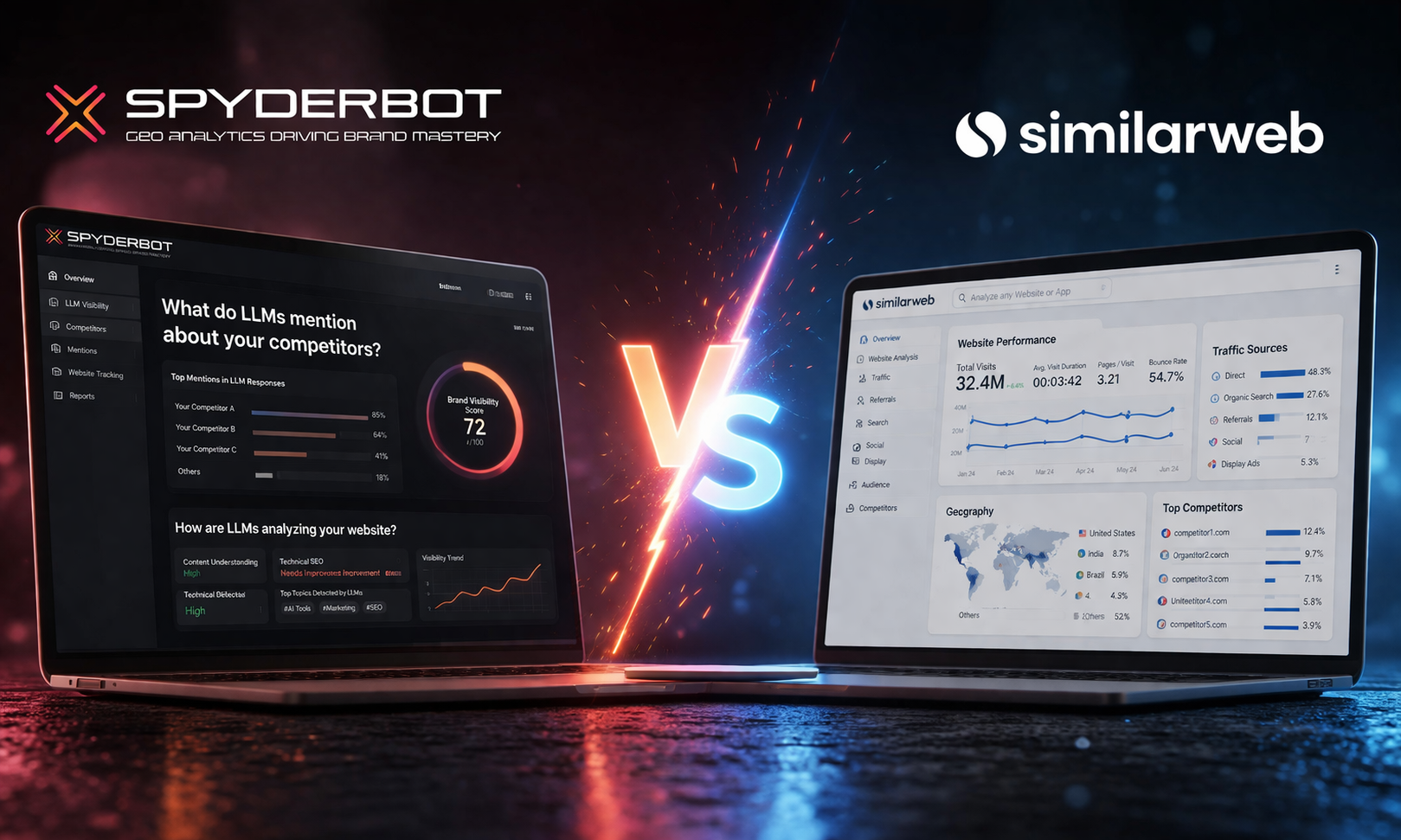
  • SpyderBot vs Similarweb

    SpyderBot vs Similarweb

    I. Why this page was updated

    This article was updated because the way users discover brands is changing.

    For years, tools like Similarweb helped companies understand traffic, market share, acquisition channels, and competitor performance.

    That is still useful.

    But traffic is no longer the full picture.

    Today, users also ask ChatGPT, Gemini, Claude, Perplexity, Copilot, Grok, and other AI systems before they ever visit a website.

    That creates a new visibility problem:

    A company can have strong traffic, strong market presence, and good channel performance, but still be missing from AI-generated recommendations.

    This is where the difference between Similarweb and SpyderBot becomes important.

    Similarweb helps you understand where traffic comes from.

    SpyderBot helps you understand what AI systems say before users click.

    II. The simplest difference

    Similarweb answers:

    How are users reaching websites?

    SpyderBot answers:

    Is AI recommending, mentioning, or correctly understanding your brand?

    These are not the same question.

    Similarweb analyzes web traffic behavior.

    SpyderBot analyzes AI-generated answers and LLM interpretation.

    One looks at user movement across the web.

    The other looks at what AI tells users before they make a decision.

    III. What Similarweb is built for

    Similarweb is a digital intelligence and traffic analytics platform.

    It is mainly used to understand website performance, competitor traffic, market share, and acquisition channels.

    Similarweb is useful for:

    • Website traffic estimation
    • Competitor traffic benchmarking
    • Channel breakdown
    • Organic search traffic analysis
    • Paid search insights
    • Referral traffic analysis
    • Audience behavior
    • Industry and market trends
    • Digital market intelligence

    For growth teams, SEO teams, investors, marketers, and strategy teams, Similarweb is valuable because it shows how users move across websites and digital channels.

    If your goal is to understand traffic and market position, Similarweb is the right type of tool.

    IV. What SpyderBot is built for

    SpyderBot is a GEO analytics platform.

    GEO means Generative Engine Optimization.

    Instead of analyzing traffic, SpyderBot analyzes how AI systems interpret, mention, compare, and recommend brands.

    SpyderBot helps answer questions such as:

    • Does ChatGPT mention your brand?
    • Does Gemini understand what your company does?
    • Does Claude recommend your competitors instead of you?
    • Is your website being interpreted correctly by LLMs?
    • Which brands appear most often in AI-generated answers?
    • What does AI say about your category?
    • Is your brand missing from important AI prompts?
    • How stable is your AI visibility across different questions?

    This matters because AI visibility is becoming a separate layer of digital visibility.

    A user may never visit a comparison page if an AI system already recommends a competitor first.

    V. Traffic visibility vs AI visibility

    The biggest mistake is assuming traffic equals influence.

    It does not.

    A website can receive traffic and still lose the decision layer.

    For example, a company may have:

    • Strong monthly visits
    • Good referral traffic
    • Strong organic search performance
    • Healthy market share
    • Good brand awareness

    But when users ask AI tools for recommendations, the company may not appear.

    That means the company has traffic visibility, but weak AI visibility.

    Similarweb helps identify the first problem.

    SpyderBot helps identify the second.

    VI. Comparison table

    CategorySimilarwebSpyderBot
    Main focusWebsite traffic analyticsAI visibility analytics
    System analyzedUser behavior across websitesAI systems and LLMs
    Core data layerVisits, channels, engagementMentions, prompts, AI answers
    Main questionWhere does traffic come from?What does AI recommend?
    Best forMarket and traffic intelligenceGEO and AI brand visibility
    Competitor analysisTraffic-based competitorsAI-recommended competitors
    OutputTraffic insightsAnswer-level insights
    Visibility layerWebsite acquisitionAI-generated decision layer

    VII. Where Similarweb is stronger

    Similarweb is stronger when your goal is digital market intelligence.

    Use Similarweb when you need to:

    • Estimate competitor traffic
    • Compare website performance
    • Understand acquisition channels
    • Analyze market share
    • Study referral sources
    • Track category trends
    • Evaluate digital growth
    • Understand audience behavior

    Similarweb is especially useful when you want to know how users arrive at websites and which digital channels are driving growth.

    SpyderBot does not replace this.

    VIII. Where SpyderBot is stronger

    SpyderBot is stronger when your goal is AI visibility intelligence.

    Use SpyderBot when you need to:

    • Track whether AI systems mention your brand
    • Monitor competitor mentions in AI-generated answers
    • Understand why AI recommends another company
    • Analyze how LLMs interpret your website
    • Identify missing brand associations
    • Measure prompt-level visibility
    • Detect weak AI positioning
    • Improve visibility in AI search and answer engines

    This is a different kind of analytics.

    It is not about traffic after the click.

    It is about influence before the click.

    IX. What Similarweb cannot show

    Similarweb does not fully answer questions like:

    • Does ChatGPT recommend my brand?
    • Does Gemini mention my competitors more often?
    • How does Claude describe my product?
    • What does AI think my company does?
    • Is my brand included in AI-generated buying recommendations?
    • Why is AI ignoring my website?
    • Which prompts make my competitors appear?

    This is because traffic data does not show AI-generated answer behavior.

    Similarweb can show where users go.

    It cannot fully show what AI tells users before they go anywhere.

    X. What SpyderBot cannot replace

    SpyderBot does not replace Similarweb.

    SpyderBot is not designed for:

    • Traffic estimation
    • Channel breakdown
    • Audience demographics
    • Market share analysis
    • Referral traffic analysis
    • Website visit benchmarking

    Those are Similarweb’s strengths.

    SpyderBot focuses on AI visibility, not traffic analytics.

    The correct approach is not to replace one with the other.

    The correct approach is to understand which visibility layer you are trying to measure.

    XI. Real-world example

    Imagine a SaaS company with strong traffic.

    Similarweb may show:

    • High monthly visits
    • Strong organic search growth
    • Good referral traffic
    • Better performance than smaller competitors
    • Strong category presence

    From a traffic perspective, the company looks healthy.

    But when users ask AI:

    “What are the best tools for this problem?”

    The AI answer may recommend competitors instead.

    SpyderBot may reveal:

    • The brand is rarely mentioned
    • Competitors appear more often
    • AI does not clearly understand the product category
    • The website lacks strong entity signals
    • The brand is not associated with key use cases

    This is the hidden gap.

    Traffic is not the same as AI influence.

    XII. Why this matters now

    The buying journey is changing.

    Before, users searched, clicked, compared, and then decided.

    Now, users often ask AI first.

    That means AI systems can shape the shortlist before a user visits any website.

    This changes the role of analytics.

    Traffic analytics tells you what happened after users moved across the web.

    AI visibility analytics tells you whether your brand was included before the user made a decision.

    That is why GEO is becoming important.

    XIII. How Similarweb and SpyderBot work together

    The best teams should not treat Similarweb and SpyderBot as direct replacements.

    They should treat them as tools for different stages of visibility.

    LayerQuestionTool type
    Market intelligenceHow large is the opportunity?Similarweb
    Traffic acquisitionWhere do users come from?Similarweb
    AI recommendationWhich brands does AI suggest?SpyderBot
    Brand interpretationHow does AI understand us?SpyderBot
    Competitive visibilityWho appears before the user clicks?SpyderBot

    Similarweb helps you understand the traffic layer.

    SpyderBot helps you understand the AI answer layer.

    Both matter.

    XIV. When to use Similarweb

    Use Similarweb if your priority is to:

    • Understand website traffic
    • Benchmark competitors
    • Analyze digital channels
    • Study market trends
    • Compare audience behavior
    • Evaluate traffic growth
    • Plan digital acquisition strategy

    Similarweb is best for understanding web activity and market-level performance.

    XV. When to use SpyderBot

    Use SpyderBot if your priority is to:

    • Improve AI visibility
    • Track LLM brand mentions
    • Monitor AI competitor recommendations
    • Understand how AI interprets your website
    • Identify missing brand signals
    • Improve GEO strategy
    • Measure prompt-level visibility
    • Know whether AI includes your brand in answers

    SpyderBot is best for understanding how AI systems represent your brand.

    XVI. Should companies use both?

    Yes.

    Most serious marketing teams will need both traffic analytics and AI visibility analytics.

    Similarweb helps answer:

    Where is our traffic coming from?

    SpyderBot helps answer:

    Are we being recommended before users even visit a website?

    Those two questions support different decisions.

    Traffic matters.

    But AI recommendation is becoming a new source of influence.

    XVII. Final conclusion

    Similarweb is a strong platform for traffic analytics, market intelligence, and competitor benchmarking.

    SpyderBot is built for a different problem: understanding AI visibility, LLM mentions, competitor recommendations, and how AI systems interpret your brand.

    The difference is simple.

    Similarweb shows how users move across the web.

    SpyderBot shows what AI tells users before they move.

    In the old digital model, visibility meant traffic.

    In the AI-driven model, visibility also means being included in the answer.

    That is why brands should measure both traffic visibility and AI visibility.

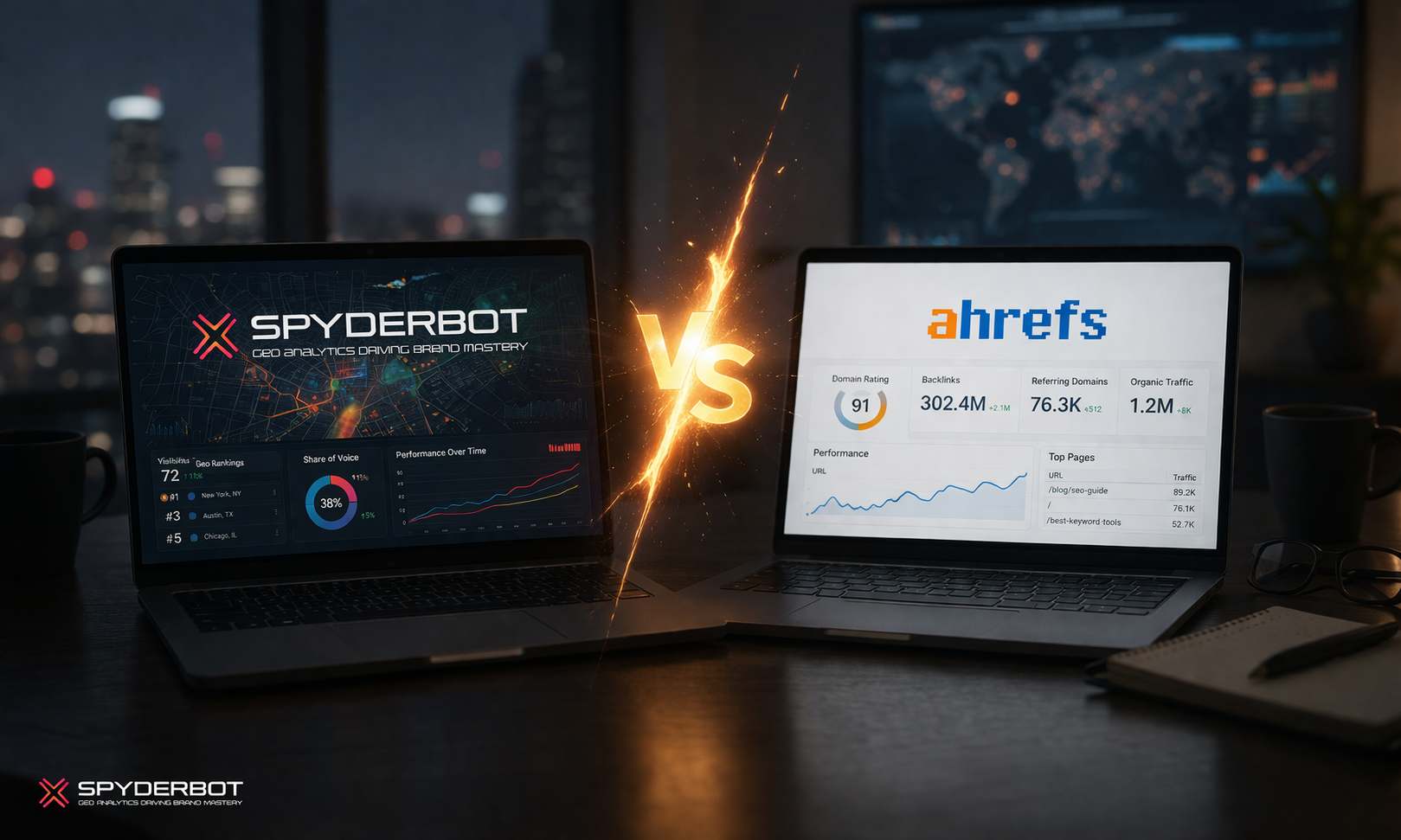
  • SpyderBot vs Ahrefs

    SpyderBot vs Ahrefs

    I. Why this comparison matters now

    This article was updated because the search landscape has changed.

    For years, SEO teams used tools like Ahrefs to understand rankings, backlinks, keyword gaps, and organic traffic opportunities. That workflow is still important.

    But today, users do not only search on Google.

    They also ask ChatGPT, Gemini, Claude, Perplexity, Copilot, Grok, and other AI systems for product recommendations, vendor comparisons, and buying decisions.

    That creates a new problem:

    A brand can rank well on Google and still be invisible inside AI-generated answers.

    This is the core difference between Ahrefs and SpyderBot.

    Ahrefs helps you understand traditional search visibility.

    SpyderBot helps you understand AI visibility.

    They are not built for the same layer of discovery.

    II. The simplest difference

    Ahrefs answers:

    How does my website perform in Google search?

    SpyderBot answers:

    How does AI understand, mention, compare, and recommend my brand?

    That distinction matters because search engines and AI systems do not work the same way.

    Google search usually retrieves and ranks web pages.

    AI systems generate answers by interpreting entities, relationships, context, trust signals, and patterns across information sources.

    So the question is no longer only:

    “How do we rank higher?”

    The new question is:

    “Are we included when AI gives the answer?”

    III. What Ahrefs is built for

    Ahrefs is one of the strongest SEO analytics platforms in the market.

    It is designed for classic SEO workflows such as:

    • Keyword research
    • Backlink analysis
    • Rank tracking
    • Competitor SEO research
    • Content gap analysis
    • SERP analysis
    • Technical SEO auditing
    • Organic traffic opportunity discovery

    Ahrefs is especially strong when the goal is to understand why a page ranks, which keywords bring traffic, and how competitors earn backlinks.

    For SEO teams, content teams, and link-building teams, Ahrefs remains a powerful tool.

    If your goal is to improve Google rankings, Ahrefs is the right kind of platform.

    IV. What SpyderBot is built for

    SpyderBot is built for GEO, which means Generative Engine Optimization.

    Instead of focusing on keyword rankings and backlinks, SpyderBot focuses on how AI systems interpret and mention brands.

    SpyderBot helps answer questions such as:

    • Does ChatGPT mention your brand?
    • Does Gemini understand what your company does?
    • Which competitors are recommended instead of you?
    • What does AI say about your product category?
    • Is your brand positioned correctly in AI-generated answers?
    • Are you visible across different prompts and use cases?
    • Is your website being interpreted clearly by LLMs?

    This matters because AI visibility is not the same as search visibility.

    You can have traffic, backlinks, and keyword rankings, but still lose the recommendation layer when users ask AI what to buy, compare, or trust.

    V. SEO visibility vs AI visibility

    The biggest mistake is assuming that SEO success automatically creates AI visibility.

    It does not.

    A page can rank on Google because it has strong backlinks, optimized content, and good technical SEO.

    But an AI system may still fail to mention that brand because the entity is unclear, the product positioning is weak, the brand is not consistently associated with the right category, or competitors have stronger contextual signals.

    That is why GEO is becoming a separate discipline.

    SEO helps users find pages.

    GEO helps brands appear inside AI-generated answers.

    VI. Comparison table

    CategoryAhrefsSpyderBot
    Main focusSEO analyticsAI visibility analytics
    System analyzedSearch enginesAI systems and LLMs
    Core unitKeywords, links, pagesEntities, mentions, prompts, context
    Main outputRankings, backlinks, SEO metricsAI mentions, competitor visibility, brand interpretation
    Best forGoogle SEO strategyGEO and AI search strategy
    Key questionHow do we rank?Are we included in AI answers?
    Competitor analysisSEO competitorsAI-recommended competitors
    Visibility layerSearch result pagesAI-generated responses

    VII. Where Ahrefs is stronger

    Ahrefs is stronger for traditional SEO.

    Use Ahrefs when you need to:

    • Find keyword opportunities
    • Analyze backlink profiles
    • Track Google keyword rankings
    • Discover content gaps
    • Audit technical SEO issues
    • Study SERP competition
    • Improve organic traffic

    If your growth strategy depends heavily on Google search traffic, Ahrefs is still extremely valuable.

    SpyderBot does not replace that.

    VIII. Where SpyderBot is stronger

    SpyderBot is stronger when the question shifts from ranking to AI inclusion.

    Use SpyderBot when you need to:

    • Track brand mentions in AI-generated answers
    • Compare how AI systems mention your competitors
    • Understand how LLMs interpret your website
    • Identify missing brand associations
    • Monitor prompt-level visibility
    • Detect whether your brand is being ignored, misunderstood, or replaced
    • Improve your position in AI search and answer engines

    This is where traditional SEO tools have limited visibility.

    They can show ranking data, but they cannot fully explain how AI systems construct answers.

    IX. A practical example

    Imagine a SaaS company with strong SEO performance.

    It has:

    • Good backlinks
    • Top 3 Google rankings
    • Strong blog traffic
    • Optimized landing pages
    • Healthy domain authority

    Ahrefs may show that the SEO strategy is working.

    But when users ask AI tools:

    “What are the best tools for this problem?”

    The company may not appear.

    Instead, AI may recommend competitors.

    That is the gap SpyderBot is designed to identify.

    The issue is not ranking.

    The issue is AI visibility.

    X. Why brands need both SEO and GEO

    SEO and GEO should not fight each other.

    They solve different problems.

    Ahrefs helps you win traffic.

    SpyderBot helps you understand whether AI systems include you in the answer.

    The modern visibility stack looks like this:

    LayerGoalTool type
    Search discoveryRank on GoogleSEO tools like Ahrefs
    AI recommendationAppear in generated answersGEO tools like SpyderBot
    Brand interpretationControl how systems understand youAI visibility platforms
    Competitive intelligenceKnow who AI recommendsAI mention tracking tools

    The strongest teams will not abandon SEO.

    They will add GEO on top of it.

    XI. When to choose Ahrefs

    Choose Ahrefs if your main goal is to:

    • Grow organic traffic
    • Improve Google rankings
    • Build backlinks
    • Research keywords
    • Audit your website
    • Plan SEO content
    • Monitor SERP performance

    Ahrefs is a mature SEO platform for search engine visibility.

    XII. When to choose SpyderBot

    Choose SpyderBot if your main goal is to:

    • Understand how AI sees your brand
    • Track mentions across AI systems
    • Find out why competitors are recommended
    • Improve AI search visibility
    • Measure GEO performance
    • Monitor brand presence in generated answers
    • Analyze LLM interpretation of your website

    SpyderBot is designed for the AI answer layer.

    XIII. Does SpyderBot replace Ahrefs?

    No.

    SpyderBot does not replace Ahrefs.

    Ahrefs is for SEO.

    SpyderBot is for GEO.

    The better question is not:

    “Which one should replace the other?”

    The better question is:

    “Which visibility layer are we trying to measure?”

    If you want Google ranking data, use Ahrefs.

    If you want AI visibility data, use SpyderBot.

    If you care about both search traffic and AI-driven decisions, use both.

    XIV. Final conclusion

    Ahrefs is one of the best tools for understanding how websites perform in traditional search.

    SpyderBot is built for a newer problem: understanding how AI systems mention, interpret, compare, and recommend brands.

    The difference is simple.

    Ahrefs helps you rank.

    SpyderBot helps you get included.

    In the old search model, visibility meant appearing on page one.

    In the AI search model, visibility means being part of the answer.

    That is why GEO is becoming important.

    And that is why brands that already invest in SEO should now start measuring AI visibility too.

  • SpyderBot vs SEMrush

    SpyderBot vs SEMrush

    A detailed, honest comparison between SEO analytics and AI visibility platforms


    I. If you’re comparing these two, you’re asking the right question — but at the wrong layer

    Many people discover SpyderBot and immediately ask:

    “Is this like SEMrush?”

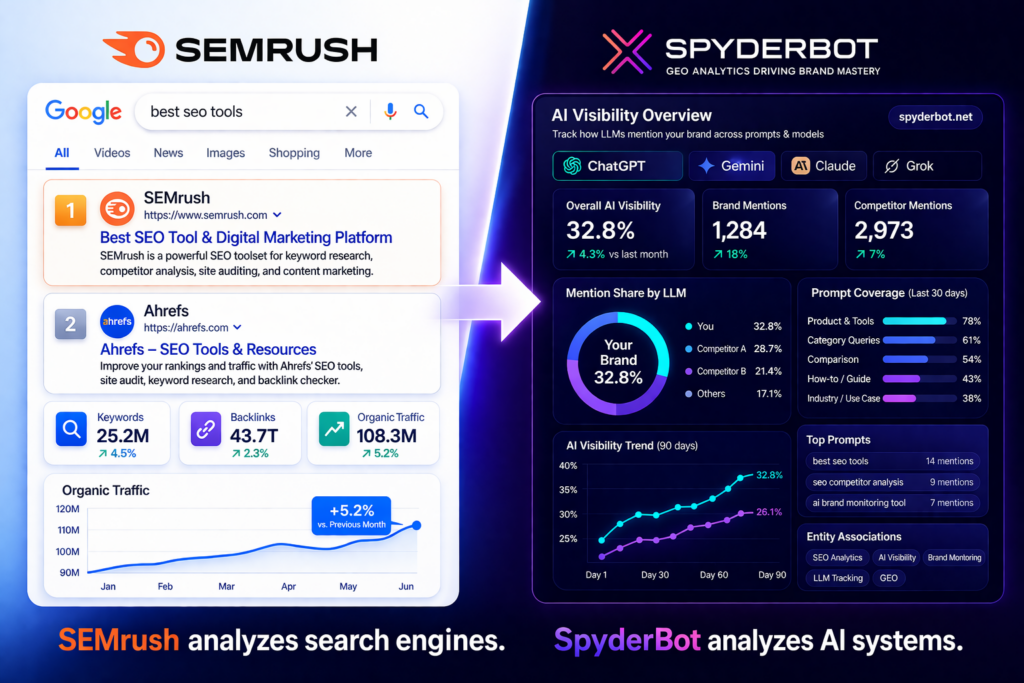
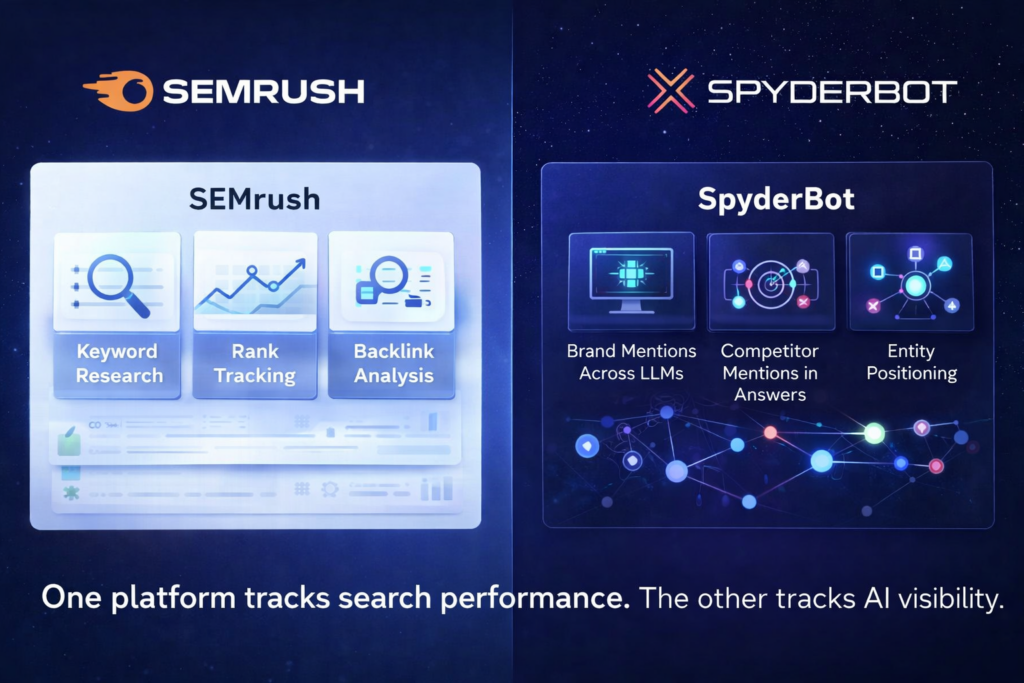
    SEMrush analyzes search engines. SpyderBot analyzes AI systems

    That question is understandable.

    But it assumes both tools solve the same problem.

    They don’t.


    II. The simplest way to understand the difference

    SEMrush helps you understand search engines
    SpyderBot helps you understand AI systems


    III. What SEMrush actually does

    One platform tracks search performance. The other tracks AI visibility

    SEMrush is one of the most mature SEO platforms in the market.

    It is built for:

    • Search engine visibility
    • Keyword intelligence
    • Traffic growth

    Core capabilities:

    • Keyword research (volume, difficulty, intent)
    • Rank tracking (SERP positions over time)
    • Backlink analysis
    • Site audit (technical SEO)
    • Competitor SEO analysis
    • Content optimization (SEO-driven)

    What SEMrush is really good at:

    • Explaining why you rank (or don’t rank) on Google
    • Identifying keyword opportunities
    • Tracking search performance over time

    IV. What SpyderBot actually does

    SpyderBot is a GEO (Generative Engine Optimization) analytics platform.

    It is built for:

    • AI search visibility
    • LLM behavior analysis
    • Brand perception inside AI systems

    Core capabilities:

    • Track brand mentions across LLMs (ChatGPT, Gemini, etc.)
    • Analyze how AI systems interpret your website
    • Compare how competitors are mentioned in AI answers
    • Identify gaps in AI visibility
    • Understand entity positioning and relationships

    What SpyderBot is really good at:

    • Explaining why AI mentions competitors instead of you
    • Revealing how AI understands your brand
    • Tracking AI visibility across prompts and contexts

    V. The fundamental difference (not marketing — architectural)

    LayerSEMrushSpyderBot
    System analyzedSearch enginesAI systems (LLMs)
    Data modelIndexed web pagesGenerated answers
    Core unitKeywordsEntities
    OutputRankings, trafficMentions, AI visibility
    Decision layerUser clicksAI-generated answers

    VI. The key insight

    SEMrush analyzes retrieval systems
    SpyderBot analyzes generation systems

    This is not a feature difference.

    It is a system difference.


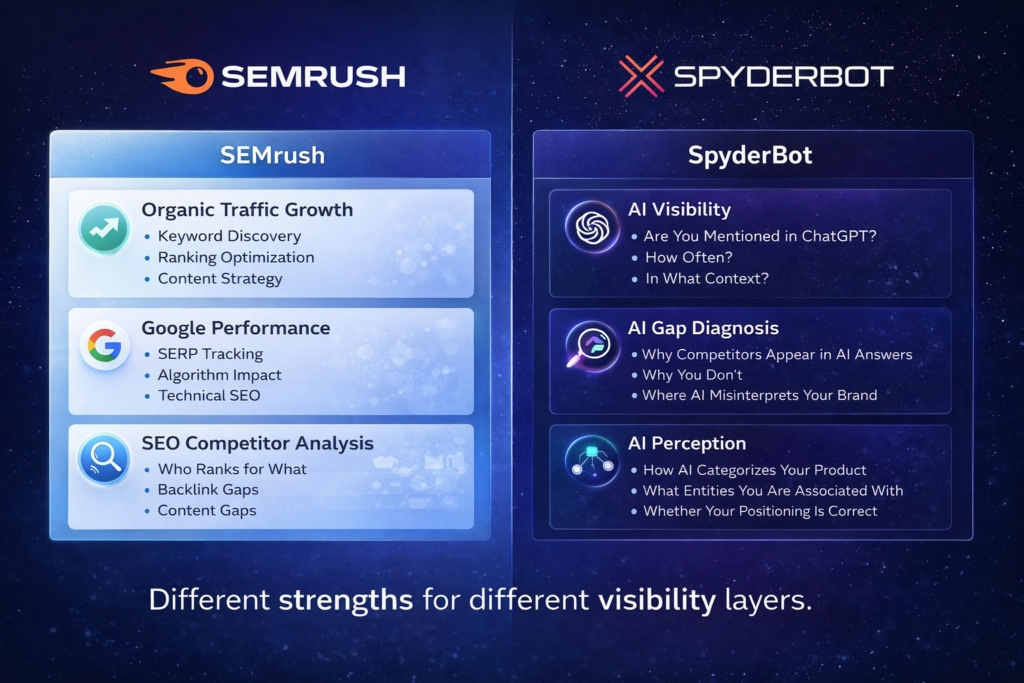
    VII. Where SEMrush is objectively stronger

    SEMrush is the better tool when your goal is:

    1. Growing organic traffic

    • Keyword discovery
    • Ranking optimization
    • Content strategy

    2. Understanding Google performance

    • SERP position tracking
    • Algorithm impact
    • Technical SEO issues

    3. Competitive SEO analysis

    • Who ranks for what
    • Backlink gaps
    • Content gaps

    4. Execution of SEO strategy

    • On-page optimization
    • Content briefs
    • Site audits
    Different strengths for different visibility layers

    VIII. Where SpyderBot is objectively stronger

    SpyderBot is the better tool when your goal is:

    1. Understanding AI visibility

    • Are you mentioned in ChatGPT?
    • How often?
    • In what context?

    2. Diagnosing AI-driven gaps

    • Why competitors appear in AI answers
    • Why you don’t
    • Where AI misinterprets your brand

    3. Analyzing AI perception

    • How AI categorizes your product
    • What entities you are associated with
    • Whether your positioning is correct

    4. Monitoring AI search behavior

    • Prompt-level analysis
    • Variation across contexts
    • Consistency of mentions

    IX. Where SEMrush cannot help (important)

    SEMrush does NOT provide visibility into:

    • AI-generated answers
    • ChatGPT or Gemini recommendations
    • Brand mentions inside LLM outputs
    • AI interpretation of your content

    Because:

    Search engine data ≠ AI system behavior


    X.Where SpyderBot cannot replace SEMrush (also important)

    SpyderBot does NOT provide:

    • Keyword volume or difficulty
    • SERP ranking data
    • Backlink analysis
    • Technical SEO audits

    Because:

    GEO is not a replacement for SEO


    XI.A realistic scenario

    A company:

    • Ranks #1 for multiple high-value keywords
    • Has strong SEO performance

    But when users ask AI:

    “What are the best tools in this category?”

    The company is not mentioned.


    What SEMrush shows:

    • Strong rankings
    • High traffic
    • Good SEO health

    What SpyderBot reveals:

    • Zero AI visibility
    • Competitors dominating AI answers
    • Weak entity positioning

    XII.This is the real gap

    SEO tells you how you perform in search
    GEO tells you whether you exist in AI


    XIII.Why this matters now

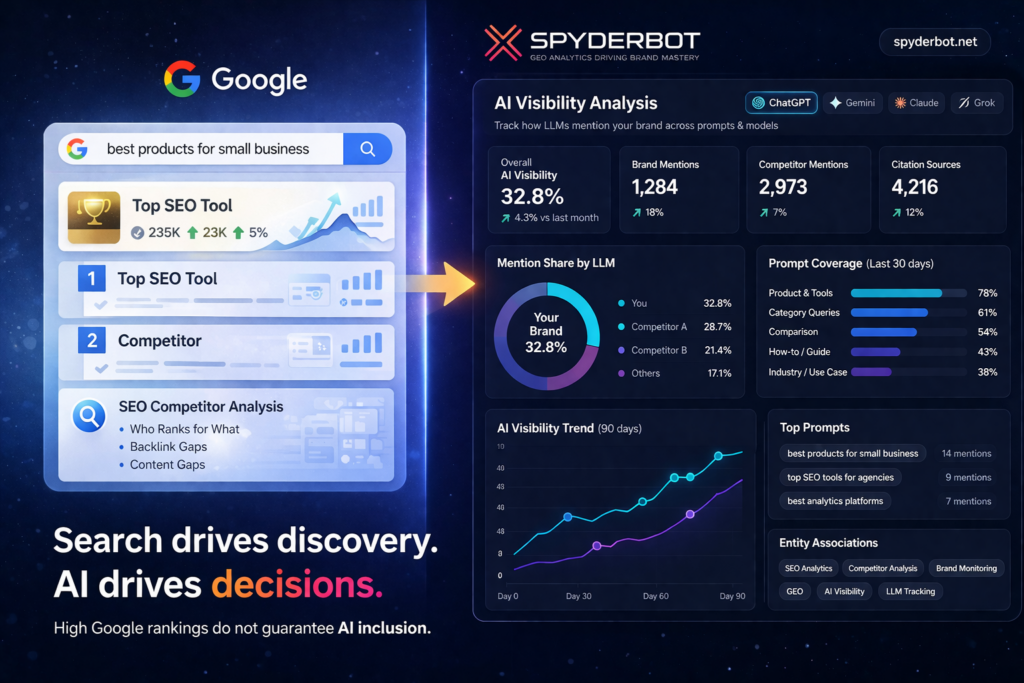
    Search drives discovery. AI drives decisions

    Search behavior is changing:

    • Google → discovery
    • AI → decision

    If you only optimize for SEO:

    • You capture traffic
    • But lose AI-driven conversions

    XIV.How the tools fit together

    The correct model is:

    LayerTool
    DiscoverySEMrush (SEO)
    DecisionSpyderBot (GEO)

    XV.When you should choose SEMrush

    Use SEMrush if:

    • Your main channel is Google
    • You want to increase organic traffic
    • You need keyword and ranking insights
    • You are executing SEO campaigns
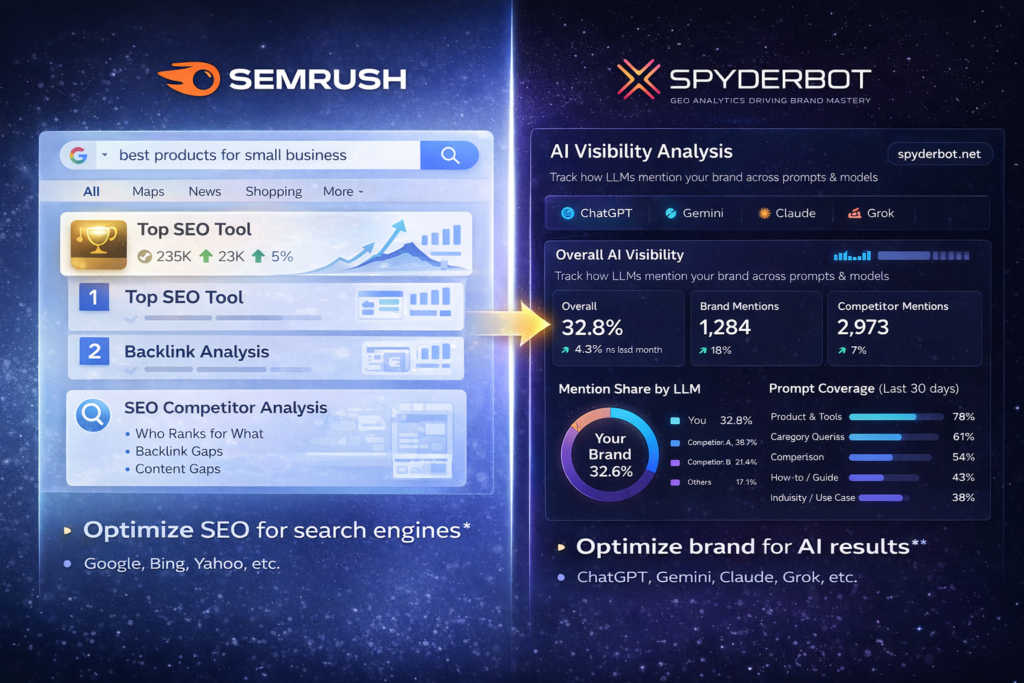
    SEO gets you discovered. GEO gets you included

    XVI.When you should choose SpyderBot

    Use SpyderBot if:

    • You want to appear in AI answers
    • You want to track AI visibility
    • You need to understand LLM behavior
    • You want to monitor AI competitors

    XVII.When you need both

    Most serious companies will need both:

    • SEO → to be discovered
    • GEO → to be included

    XVIII. The honest conclusion

    SEMrush is not outdated.
    SpyderBot is not a replacement.

    They solve:

    Two different problems in two different systems


    XIX.Final insight

    SEMrush answers:

    “How do we get traffic from search engines?”

    SpyderBot answers:

    “Are we even part of the answers users trust?”


    XX. The shift

    We are moving from:

    • Ranking-based visibility

    To:

    • AI-driven inclusion
  • How to Beat Competitors in AI Search

    How to Beat Competitors in AI Search

    AI search has changed the rules of online visibility. OpenAI says ChatGPT Search ranks results using factors tied to reliable, relevant information and does not guarantee top placement. Google says standard SEO best practices still matter for AI Overviews and AI Mode, and Anthropic says Claude’s web search cites sources from search results directly. That means beating competitors in AI search is no longer just about ranking pages. It is about becoming easier for AI systems to crawl, understand, compare, and cite.

    I. What Winning in AI Search Actually Means

    1. You are competing for inclusion, not just ranking

    In traditional search, a strong ranking can still bring visibility even if your messaging is average. In AI search, the answer is synthesized first, and sources are attached second. Google says AI Overviews and AI Mode show AI-generated responses with links to supporting web resources, and AI Mode can split a question into subtopics and search them simultaneously. That creates a very different battlefield: your brand must be selected as part of the answer, not merely listed near it.

    2. Your competitor can win even when your SEO is decent

    A competitor can outrank you inside AI answers if its site is clearer, easier to cite, better structured, or more directly aligned with comparison-style prompts. Google also says AI experiences can surface a wider range of sources, which means visibility can spread beyond the usual top-ranking pages.

    II. Diagnosis

    1. Your brand entity is too vague

    If your company name, product naming, positioning, or category language changes across pages, AI systems get weaker signals about who you are and what you should be mentioned for. When your entity is fuzzy, competitor entities with cleaner definitions tend to win more mentions.

    2. Your site is indexable for Google, but weak for AI retrieval

    OpenAI explicitly says that inclusion in ChatGPT Search depends on allowing OAI-SearchBot to crawl your site and ensuring infrastructure allows access. If your robots rules, CDN, firewall, or hosting setup blocks that path, your pages become harder to surface in AI search experiences.

    3. Your content is built for keywords, not decision prompts

    Many brands publish pages optimized for search terms, but not for the real prompts users ask AI systems, such as:

    • best alternatives to [competitor]
    • [brand] vs [competitor]
    • which tool is better for [use case]
    • why does AI recommend [competitor]

    If you do not publish direct answers for those prompt shapes, the model has fewer reasons to include you.

    4. Your trust signals are weak or hard to parse

    Google says structured data helps it understand page content and organizations, and its Organization guidance recommends adding useful properties such as name, alternateName, url, logo, contact details, and sameAs references. If your site lacks machine-readable brand signals, AI systems have less structured evidence to work with.

    5. Your competitor has more reusable evidence

    AI systems prefer pages that are easier to summarize. If your competitor has clearer use cases, fresher proof, stronger comparative pages, and simpler factual statements, it becomes easier for the model to reuse their material inside an answer.

    6. Your measurement model is outdated

    If you only track Google rankings, you may miss the real reason you are losing. In AI search, you need to measure mentions, citations, prompt coverage, comparison visibility, and competitor share of voice.

    III. Why It Happens (LLM Mechanism)

    1. LLMs do not think like a classic search engine

    LLM-driven search experiences combine retrieval with synthesis. ChatGPT Search emphasizes reliable and relevant information, Google AI responses are supported by web resources, and Claude’s web search cites source material directly. In practice, the model is not just matching keywords. It is assembling a response from entities, claims, and evidence it can trust enough to present.

    2. AI systems favor pages they can understand quickly

    Google says structured data helps it understand content and gather information about the web and the world. That is why explicit labels, clean headings, strong page purpose, visible facts, and schema markup help reduce ambiguity. The easier your page is to parse, the easier it is to reuse.

    3. Retrieval is prompt-sensitive

    Google says AI Mode can break a query into subtopics and search them simultaneously. This matters because broad prompts like “best B2B AI visibility tool” may trigger a different evidence set than “why does ChatGPT recommend my competitor.” If your content only covers one phrasing, you lose coverage across the rest.

    4. Citation behavior rewards clarity

    Claude’s web search automatically cites sources, and ChatGPT Search and Google AI both emphasize linked supporting resources. That means pages with tight answers, explicit claims, scannable formatting, and supporting proof are more likely to survive the compression step from webpage to AI answer.

    5. There is no guaranteed “top position” shortcut

    OpenAI explicitly says there is no way to guarantee top placement in ChatGPT Search, and Google says there are no special extra requirements just for appearing in AI Overviews or AI Mode beyond strong SEO fundamentals. So the winning move is not a trick. It is operational excellence in crawlability, clarity, structure, and evidence.

    IV. How to Beat Competitors in AI Search

    1. Fix crawl access first

    Make sure your important pages are crawlable, indexable, fast, canonicalized, and not blocked for relevant AI crawlers. If ChatGPT cannot reliably access your content, the rest of your optimization is weaker from the start.

    2. Strengthen your brand entity

    Create one crystal-clear brand story across your homepage, about page, product pages, and documentation:

    • who you are
    • what you do
    • who you serve
    • what category you belong to
    • what makes you different

    Use the same naming system everywhere. Do not make the model guess.

    3. Publish pages for high-intent AI prompts

    Create content specifically for prompts that cause competitive switching:

    • best alternatives to [competitor]
    • [your brand] vs [competitor]
    • why is [competitor] recommended in AI search
    • how to choose a tool for [use case]
    • which platform is best for [industry]

    This is where AI search visibility is won.

    4. Add machine-readable trust signals

    Use structured data where it genuinely fits the page: Organization, ProfilePage, Article, FAQ, Product, LocalBusiness, or other relevant schema. Google states that structured data helps it understand content, and its Organization guidance makes clear that properties like name, logo, url, contact information, and sameAs improve clarity.

    5. Turn claims into evidence

    Do not say you are “better.” Prove it with:

    • comparison tables
    • methodology pages
    • screenshots
    • benchmark summaries
    • customer categories
    • limitations and tradeoffs
    • update dates

    AI systems reuse pages that contain compressible evidence, not vague marketing language.

    6. Build comparison-ready page architecture

    Your site should contain pages that can answer:

    • what you are
    • how you work
    • who you are for
    • how you compare
    • why someone should switch
    • what proof supports that claim

    If those pages do not exist, your competitor has an easier path into AI-generated recommendations.

    7. Monitor prompts, not just pages

    Track which prompts trigger your competitors, which pages get cited, which claims repeat across models, and where your brand disappears. That gives you a real GEO roadmap instead of random content production.

    V. Run GEO Audit

    If competitors keep appearing in AI search while your brand is missing, guessing is the slowest possible strategy.

    Run GEO Audit to identify:

    • which competitors AI systems mention most
    • which prompts trigger those mentions
    • which pages are being cited
    • where your entity signals are weak
    • which comparison gaps are costing you visibility
    • what content should be fixed first

    Run GEO Audit and turn AI search from a black box into a measurable growth channel.

    VI. FAQs

    1. Can I guarantee top placement in AI search?

    No. You can improve your odds, but OpenAI explicitly says there is no guaranteed top placement in ChatGPT Search, and Google says AI visibility still depends on strong overall SEO fundamentals rather than a secret AI-only hack.

    2. Does structured data help with AI search visibility?

    It helps machines understand your content and your organization more clearly. Google explicitly says structured data helps it understand page content and world knowledge, which makes it an important clarity layer.

    3. Why does my competitor appear in ChatGPT but not my brand?

    Usually because the competitor is easier to crawl, easier to identify, easier to compare, or easier to cite. In AI search, clarity often beats noise.

    4. Is traditional SEO still useful for AI search?

    Yes. Google explicitly says standard SEO best practices remain relevant for AI Overviews and AI Mode. AI search does not replace SEO; it raises the bar for structure, evidence, and entity clarity.

  • AI Visibility Decline Causes

    AI Visibility Decline Causes

    AI visibility does not usually disappear by accident. It declines when your website becomes harder for AI systems to retrieve, trust, summarize, or cite in generated answers. Modern AI search experiences do not simply mirror one keyword ranking. They often rewrite the query, search multiple subtopics, and select supporting sources differently from classic search engines, which is why a brand can look stable in SEO yet weaken in AI answers.

    I. What AI Visibility Decline Actually Means

    AI visibility decline means your brand, product, or website is being mentioned less often in generative responses across systems such as ChatGPT, Gemini, Claude, and Copilot.

    This decline can show up in several ways:

    1. Your brand is no longer named in AI answers

    The model discusses the category, but not your company.

    2. Competitors are cited more often than you

    Even when you have strong SEO, AI answers may surface a different set of brands.

    3. Your pages are no longer used as supporting sources

    Traffic from AI referrals falls because your content is not being selected as a cited or linked source.

    4. Your brand appears only on branded prompts

    You show up when users ask for you directly, but disappear on category or problem-based prompts.

    5. Your messaging becomes inconsistent across models

    One model may mention you while another ignores you entirely.

    II. Diagnosis

    If your AI visibility is declining, diagnose the issue through these five checkpoints.

    1. Check whether your pages are still crawlable and indexable

    If important pages are blocked, weakly linked, or not consistently discoverable, they become less likely to surface in AI search experiences. Google states that pages must be indexed and eligible to appear with snippets in Search to be shown as supporting links in AI features, and OpenAI states that site owners can control visibility for search via OAI-SearchBot in robots.txt.

    2. Check whether your content is truly citation-worthy

    AI systems do not reward pages just because they mention a keyword. They favor pages that are useful, clear, text-rich, and easy to extract from. Google explicitly recommends helpful, reliable, people-first content, with important information available in textual form and structured data aligned with visible content.

    3. Check whether your brand entity is clearly defined

    If your website talks about features, services, or categories without making the brand entity obvious, AI systems may understand the topic but fail to associate it strongly with your company.

    4. Check whether your authority signals are fragmented

    If your website, social profiles, third-party mentions, and product pages describe your brand differently, AI systems get weaker confidence signals. In AI, inconsistency reduces mention probability.

    5. Check whether competitors have become easier to retrieve

    Sometimes your decline is not caused by a penalty. It happens because competitors publish fresher comparisons, more structured explanations, stronger brand narratives, or more quotable pages.

    III. Main Causes of AI Visibility Decline

    1. Weak technical discoverability

    Pages that are difficult to crawl, thinly connected internally, or poorly surfaced across the site are easier for AI systems to miss.

    2. Thin or generic content

    If your content says the same thing as everyone else, AI systems have no reason to choose it as a supporting source.

    3. Poor entity clarity

    If the page does not clearly answer who you are, what you do, what category you belong to, and why you are relevant, your entity becomes weak inside AI-generated answers.

    4. Outdated information

    AI systems often prefer fresher, clearer, and more specific source material when answering time-sensitive or comparison-heavy prompts.

    5. Weak source diversity

    If your brand is only described on your own website and rarely reinforced by external sources, AI confidence can stay low.

    6. Over-optimization for keywords instead of meaning

    Traditional SEO can still win rankings with keyword targeting. AI visibility depends more on topical clarity, relationships, retrieval fit, and citation value.

    7. Competitor content is better aligned to AI prompts

    Your competitor may be winning because their content answers the exact question users ask AI, not because they have more backlinks or higher domain metrics.

    IV. Why It Happens (LLM Mechanism)

    1. AI systems often rewrite the user query

    This is one of the biggest reasons visibility changes unexpectedly. OpenAI says ChatGPT Search may rewrite a user prompt into one or more targeted queries. Microsoft documents a similar process in Copilot, where the system reformulates the question, searches an index, and then generates an answer with citations. This means AI engines are not evaluating only the literal prompt; they are expanding intent and searching for the best supporting information across multiple formulations.

    2. AI search can fan out into multiple related searches

    Google explains that AI Overviews and AI Mode may use a “query fan-out” technique across subtopics and data sources, and that the links shown can differ from classic web search. That means a page that ranks for one keyword may still lose visibility if it does not support the broader sub-questions the AI system generates internally.

    3. AI systems select supporting pages, not just ranked pages

    Google states that AI features use the same core best practices as Search, but appearing is not guaranteed even when requirements are met. Eligibility, indexing, text accessibility, internal linking, and snippet readiness all matter. In other words, ranking strength alone is not enough; the source also has to be usable inside an AI-generated response flow.

    4. Different models use different retrieval and citation behavior

    Google says AI Overviews and AI Mode may use different models and techniques, so the responses and links can vary. Anthropic also documents that Claude’s web search tool retrieves real-time web content and returns cited sources. This is why your brand may appear in one AI system but decline in another. The retrieval stack is not identical across platforms.

    5. AI prefers sources that are easy to extract, trust, and cite

    Google recommends making important content available in textual form, supporting it with strong media, and keeping structured data aligned with visible text. When content is vague, buried in design-heavy layouts, or poorly structured, the system has less usable evidence to quote or summarize.

    V. How to Recover from AI Visibility Decline

    1. Rebuild core entity pages

    Strengthen your homepage, product pages, solution pages, comparison pages, and category pages so each one clearly states:

    • who the brand is
    • what it does
    • which category it belongs to
    • which problems it solves
    • what makes it different

    2. Publish pages that match AI prompt intent

    Create content for the questions people actually ask AI:

    • why choose this brand
    • best alternatives
    • category comparisons
    • use cases
    • pricing logic
    • implementation guides
    • brand vs competitor pages

    3. Make your content easier to cite

    Use concise definitions, direct answers, strong headings, structured comparisons, FAQs, statistics, and short evidence-backed explanations.

    4. Fix technical barriers

    Review crawlability, indexing, internal links, snippet eligibility, text rendering, and page clarity. If AI systems cannot reliably access the page, they cannot use it.

    5. Reinforce your brand across external sources

    AI confidence improves when your brand description is repeated consistently across trusted places such as media mentions, author profiles, partner pages, review pages, and knowledge hubs.

    6. Track prompts, mentions, and source patterns continuously

    AI visibility is dynamic. You need to monitor:

    • which prompts mention you
    • which competitors replace you
    • which pages are cited
    • which platforms show decline first
    • which message themes AI associates with your brand

    VI. Run GEO Audit

    If your brand is losing visibility in AI, do not guess.

    Run a GEO Audit to identify:

    • where your visibility dropped
    • which prompts stopped mentioning you
    • which competitors replaced you
    • which pages AI systems prefer instead
    • what technical, entity, and content gaps caused the decline

    CTA: Run GEO Audit

    VII. Final Takeaway

    AI visibility decline is usually a retrieval problem before it becomes a branding problem.

    If your content is hard to discover, weakly structured, poorly differentiated, or unclear as an entity, AI systems will have less reason to cite or mention it. The fix is not random “AI SEO hacks.” The fix is stronger entity clarity, stronger source quality, better retrieval structure, and ongoing GEO monitoring.

    VIII. FAQ

    1. Can AI visibility decline even if my Google rankings stay stable?

    Yes. AI systems may rewrite queries, search multiple subtopics, and choose supporting sources differently from classic search results.

    2. Does ranking on Google guarantee inclusion in AI answers?

    No. Google states that even if a page meets requirements and best practices, crawling, indexing, and serving are not guaranteed.

    3. Why does one AI model mention my brand while another ignores it?

    Because different systems use different models, techniques, indexes, and citation logic.

    4. What is the fastest way to diagnose AI visibility decline?

    Audit prompt coverage, cited pages, competitor mentions, entity clarity, crawlability, and source consistency across your website and external mentions.

    5. What should I improve first?

    Start with core entity pages, technical discoverability, prompt-aligned content, and citation-friendly page structure.

  • How to Recover AI Brand Visibility

    How to Recover AI Brand Visibility

    If your brand is disappearing from ChatGPT, Gemini, Claude, or other AI search environments, the problem is usually not random. In most cases, AI visibility drops because your brand is weakly structured, poorly cited, inconsistently described, or overshadowed by stronger entities. The good news is that this can be fixed. Recovery starts with diagnosis, then moves into entity clarity, content repair, citation improvement, and ongoing GEO monitoring.

    I. What AI Brand Visibility Actually Means

    AI brand visibility is the likelihood that large language models mention, describe, recommend, or cite your brand when users ask relevant questions.

    Unlike traditional SEO, where rankings are tied to blue links and keyword positions, AI visibility depends on whether your brand becomes part of the model’s answer layer. That means the real question is no longer only “Do I rank on Google?” but also “Does AI recognize my brand as a reliable entity worth mentioning?”

    1. AI visibility is not the same as organic ranking

    A page can rank in search and still fail to appear in AI-generated answers. That happens because LLMs do not simply reproduce search rankings. They synthesize answers from patterns, entities, sources, and repeated associations.

    2. Brand visibility in AI is driven by mention eligibility

    To be included, your brand must be understandable, relevant, and supported by enough signals that the model can confidently use it in a response.


    II. Diagnosis Section: How to Identify Why Your Brand Lost Visibility

    Before fixing anything, you need to diagnose what type of visibility problem you actually have.

    1. Check whether your brand is absent or just weakly represented

    There are two common states:

    • Your brand is completely missing from AI responses.
    • Your brand appears sometimes, but competitors are mentioned more often and more confidently.

    These are different problems. One is an inclusion problem. The other is a positioning problem.

    2. Review how your brand is described across the web

    Ask:

    • Is your brand explained clearly on your website?
    • Do third-party sites describe you consistently?
    • Do your pages repeat the same value proposition, category, and differentiators?
    • Is your company connected to recognizable entities such as industry terms, products, founders, locations, or use cases?

    If the answer is inconsistent, LLMs may not know how to categorize you.

    3. Compare your visibility against competitors

    If competitors are repeatedly mentioned and your brand is not, study:

    • Their category positioning
    • Their media mentions
    • Their product pages
    • Their comparison pages
    • Their educational content
    • Their citations across trusted sources

    Often, the visibility gap is not about brand quality. It is about signal clarity.

    4. Audit your content for AI retrieval readiness

    Your site may have traffic content but still lack AI-ready content. Common issues include:

    • Thin service pages
    • Generic blog content
    • Missing authoritativeness
    • Weak topical depth
    • No entity reinforcement
    • No comparison or problem-solving pages
    • No pages answering high-intent AI-style queries

    5. Test prompt scenarios that should mention your brand

    Use prompts that reflect actual buyer behavior, such as:

    • Best tools for [your category]
    • Alternatives to [competitor]
    • Best solution for [pain point]
    • How to choose [product category]
    • Who are the top brands in [space]

    If your brand is absent across these prompts, you likely have a broader AI brand visibility issue.


    III. Why It Happens: LLM Mechanism Behind Visibility Loss

    This is the part most brands miss. AI visibility problems are usually caused by how LLMs form answers.

    1. LLMs prefer entities, not just keywords

    Large language models do not think like keyword match engines. They map language to entities, concepts, relationships, and patterns.

    If your brand is not strongly connected to a clear entity profile, the model has less reason to mention you.

    2. LLMs rely on repeated external validation

    A brand becomes more mentionable when it appears repeatedly across trusted contexts. That includes:

    • Your own website
    • Reputable publications
    • Product directories
    • Comparison articles
    • Reviews
    • Expert discussions
    • Structured brand references across multiple pages

    If your brand exists mostly in isolated pages or vague self-descriptions, the model may treat it as low-confidence information.

    3. LLMs compress and simplify answers

    AI systems do not list every brand. They compress choices into a smaller answer set. When that happens, only brands with strong relevance and strong evidence survive the compression step.

    That is why weakly defined brands disappear first.

    4. Inconsistent brand language confuses retrieval and synthesis

    If one page says you are a platform, another says software, another says agency, and another says tool, the model may fail to build a stable understanding of what you are.

    LLMs reward consistency because consistency helps them synthesize with confidence.

    5. Competitors may have stronger narrative control

    Sometimes competitors win visibility simply because they have clearer positioning, more comparison content, more use-case content, better brand associations, or broader citation coverage.

    AI often reflects the market narrative it sees most clearly.


    IV. The Recovery Framework for AI Brand Visibility

    Recovery should be systematic, not random.

    1. Rebuild your core brand entity

    Start by making your brand definition extremely clear.

    Your website should consistently answer:

    • Who are you?
    • What category are you in?
    • Who is your product for?
    • What problem do you solve?
    • What makes you different?
    • Which competitors or alternatives are you compared against?
    • Which industries or use cases do you serve?

    This information should appear consistently across your homepage, about page, solution pages, product pages, and key articles.

    2. Fix entity inconsistency across pages

    Use the same language for:

    • Brand category
    • Product description
    • Target audience
    • Core benefits
    • Use cases
    • Competitor context

    Do not reinvent your positioning on every page.

    3. Publish pages built for AI-style questions

    Create content around real prompt patterns, such as:

    • Why is my brand not showing in ChatGPT?
    • How do LLMs choose sources?
    • Best tools for [category]
    • [Your brand] vs [competitor]
    • How to optimize for AI search
    • How to monitor AI mentions
    • How to track brand mentions in LLMs

    These pages help train stronger associations between your brand and the questions people actually ask AI tools.

    4. Strengthen citation-worthy content

    AI systems are more likely to mention pages that are useful, specific, and structurally clear.

    Improve content by adding:

    • Definitions
    • Frameworks
    • Comparisons
    • Step-by-step guidance
    • Real examples
    • Category explanations
    • Problem-solution structure
    • Internal links to supporting pages

    5. Expand topical authority around your niche

    Do not rely on one page. Build a cluster.

    For example, if your product is in GEO analytics, publish related content around:

    • AI brand mention tracking
    • LLM visibility tracking
    • AI search competitor monitoring
    • How ChatGPT recommends brands
    • Why AI search ignores websites
    • Generative engine optimization strategy
    • AI citation tracking
    • Brand presence in Gemini and Claude

    A cluster creates repetition, and repetition strengthens entity recall.

    6. Create comparison and alternative pages

    LLMs frequently mention brands when users ask for comparisons, recommendations, or alternatives.

    Pages like these are powerful:

    • [Your brand] vs [competitor]
    • Best [category] tools
    • Top alternatives to [competitor]
    • Which AI visibility platform is best for [industry]

    These pages help insert your brand into high-intent decision contexts.


    V. Content Changes That Improve AI Mention Probability

    Once diagnosis is complete, execution matters.

    1. Use explicit category language

    Say exactly what your company is. Avoid vague, clever, or overly abstract messaging.

    Bad example:
    “We transform digital intelligence into opportunity.”

    Better example:
    “We are a GEO analytics platform that helps brands track visibility in ChatGPT, Gemini, and other LLMs.”

    2. Add brand-to-problem alignment

    Your pages should clearly connect your brand to a problem users actually ask AI about.

    For example:

    • How to recover AI brand visibility
    • Why ChatGPT not mentioning my brand
    • How to optimize website for LLM
    • How to monitor AI mentions

    3. Build scannable content structures

    LLMs handle structured information well. Use:

    • Clear headings
    • Lists
    • Definitions
    • Comparison blocks
    • FAQ sections
    • Concise paragraphs
    • Consistent terminology

    4. Reinforce brand relevance with internal linking

    If your site has scattered content without semantic linking, your authority stays fragmented.

    Link supporting pages into a central hub so AI-visible themes reinforce one another.


    VI. Off-Site Signals That Support Recovery

    AI visibility is not built only on your own website.

    1. Improve third-party mention quality

    You want your brand to appear in places that help models validate it, such as:

    • Industry blogs
    • Media coverage
    • Interviews
    • Listicles
    • Product directories
    • Review platforms
    • Partner pages
    • Guest articles

    2. Keep brand descriptions consistent off-site

    Your brand name, category, positioning, and product description should match across external references as much as possible.

    3. Earn inclusion in comparison contexts

    If people and publications compare tools in your category and your brand is never included, AI may learn that omission as a signal.


    VII. How to Measure Recovery

    Recovery is not only about publishing content. It is about observing whether mention probability improves over time.

    1. Track prompt-level visibility

    Measure whether your brand appears for:

    • Commercial prompts
    • Comparison prompts
    • Informational prompts
    • Category prompts
    • Competitor prompts

    2. Track competitor share of mention

    You need to know:

    • Who gets mentioned most
    • In what context
    • With what sentiment
    • In which AI systems
    • Against which prompts

    3. Monitor citation behavior

    Some brands are mentioned without citations. Others are cited directly. Both matter, but cited presence is usually a stronger trust signal.

    4. Watch which pages AI systems favor

    Not every page helps equally. Over time, identify which pages are most likely to be surfaced, paraphrased, or associated with your brand.


    VIII. Common Reasons Recovery Fails

    Many brands try to fix AI visibility but make the same mistakes.

    1. They only add keywords

    Keywords alone are not enough. AI visibility is about entity understanding, not just phrase repetition.

    2. They publish content without repositioning the brand

    More content does not help if the core brand narrative is still unclear.

    3. They ignore competitor framing

    If competitors define the category and own the comparison space, your recovery will stay slow.

    4. They do not measure prompt outcomes

    Without prompt testing and monitoring, you cannot tell what is improving and what is not.


    IX. What Recovery Usually Looks Like in Practice

    Most successful recovery patterns follow this sequence:

    1. Diagnose the visibility gap

    Find where, when, and why your brand is missing.

    2. Clarify the entity

    Make your brand easier for LLMs to recognize and categorize.

    3. Repair high-value pages

    Upgrade homepage, solution pages, product pages, and high-intent blog content.

    4. Build supporting content clusters

    Create topical depth around AI search, LLM mentions, citations, competitors, and use cases.

    5. Monitor AI responses continuously

    Track whether your visibility improves across ChatGPT, Gemini, Claude, and other generative systems.


    X. CTA: Run GEO Audit

    If your brand has dropped out of AI-generated answers, guessing is a waste of time.

    A proper GEO audit helps you identify:

    • Where your brand is missing
    • Which competitors are being mentioned instead
    • Which prompts expose your visibility gap
    • Which pages support or weaken brand inclusion
    • Which entity and citation signals need to be fixed first

    Run GEO Audit to understand how AI systems see your brand, what they mention about competitors, and what needs to change to recover visibility.


    XI. Final Takeaway

    To recover AI brand visibility, you need more than SEO maintenance. You need entity clarity, citation support, AI-oriented content, and prompt-level monitoring.

    Brands disappear from AI answers when models do not have enough confidence to include them. Brands recover when they become easier to understand, easier to validate, and easier to associate with the right questions.

    That is the real work of GEO.


    XII. FAQ

    1. Why is ChatGPT not mentioning my brand?

    Usually because your brand lacks strong entity clarity, citation support, or repeated relevance across trusted sources and high-intent content.

    2. How do LLMs choose which brands to mention?

    They tend to prefer brands with clearer category associations, stronger contextual signals, repeated references, and higher-confidence source patterns.

    3. Can I recover AI visibility without ranking first on Google?

    Yes. Traditional ranking helps, but AI visibility can improve when your brand becomes more structurally understandable and more frequently associated with relevant questions.

    4. What is the fastest way to improve AI brand visibility?

    Start with diagnosis, then fix brand positioning, upgrade core pages, build comparison content, and monitor AI mentions continuously.

    5. What should I track during recovery?

    Track brand mentions, competitor mentions, prompt coverage, citation behavior, visibility by AI platform, and which pages are most associated with your brand.

  • Why Did My Brand Disappear From ChatGPT?

    Why Did My Brand Disappear From ChatGPT?

    If your brand used to appear in ChatGPT and now it does not, that usually means your AI visibility has weakened.

    This does not always mean your brand became worse. It usually means ChatGPT now sees other brands as more relevant, more trusted, easier to retrieve, or better explained for the prompt being asked.

    I. What does it mean when your brand disappears from ChatGPT?

    When your brand disappears from ChatGPT, it means the model is no longer selecting your brand as one of the most useful answers for certain prompts.

    In practice, this usually happens when:

    • your competitors have stronger supporting signals
    • your brand positioning is unclear
    • your site content is not aligned with AI-style questions
    • third-party validation is weak
    • your content is outdated or inconsistent

    This is an AI visibility problem, not just an SEO problem.

    II. Diagnosis

    1. Check whether your brand only appears in branded prompts

    If ChatGPT only mentions your brand when users type your exact company name, your visibility is shallow. That means the model recognizes your brand, but does not strongly associate it with broader category or buyer-intent prompts.

    2. Check whether competitors appear for the same use case

    If your competitors are consistently mentioned for the exact problems your product solves, ChatGPT likely has stronger confidence in their category fit, relevance, or authority.

    3. Check whether your website clearly explains what you are

    A surprising number of brands disappear because their website uses vague messaging. If your homepage is full of slogans but does not clearly explain what the company does, who it serves, and why it matters, LLMs struggle to classify it properly.

    4. Check whether your content matches real user questions

    LLMs respond to natural-language intent. If your site lacks pages that answer comparison questions, problem-aware questions, use-case questions, and decision-stage questions, your brand becomes less likely to surface.

    5. Check whether external sources validate your brand

    If the only place describing your brand is your own website, the model has less confidence. Strong brands usually appear across multiple trusted sources with consistent descriptions.

    6. Check whether your content is fresh and consistent

    Outdated pages, conflicting positioning, or weak internal content structure can reduce trust. If competitors publish newer and clearer content, they become easier for AI systems to mention.

    III. Why it happens (LLM mechanism)

    1. LLMs do not rank like Google

    ChatGPT does not work like a traditional list of search results. It generates a compressed answer based on patterns, relevance, confidence, and available supporting evidence.

    That means a brand can be visible in Google and still be absent in ChatGPT.

    2. The model selects only a limited set of brands

    Most prompts do not produce long lists. The model usually chooses a few brands that appear most relevant and defensible. If your signals are weaker than competitors, you get pushed out of the answer.

    3. Entity clarity affects selection

    LLMs rely heavily on entity understanding. If your brand is not clearly defined by category, use case, audience, and relationships, the model may not map your brand strongly enough to include it.

    4. Corroboration increases confidence

    ChatGPT is more likely to mention brands that are consistently reinforced across multiple sources. When your messaging is fragmented or only self-published, confidence drops.

    5. Prompt phrasing changes the answer set

    A small change in prompt wording can change which brands appear. That is because the model reweights relevance depending on user intent, framing, and context.

    6. Competitors may have better AI-ready content

    Your competitors may have stronger category pages, better comparison pages, more trusted citations, and clearer explanations of their value. In LLM systems, that often wins.

    IV. The most common reasons brands disappear from ChatGPT

    1. Your brand positioning is too vague

    If your site sounds clever but not clear, AI systems cannot confidently place you in the right category.

    2. Your competitors are easier to understand

    A competitor with simpler, more explicit, and more structured content often gets mentioned more often.

    3. Your site is not built around prompt-level intent

    If your content is written only for traditional SEO or brand storytelling, it may miss the conversational structure LLMs respond to.

    4. You lack trust signals outside your own domain

    Brands with stronger third-party mentions, reviews, citations, and reference pages are easier for AI systems to validate.

    5. Your content is stale

    Old claims, outdated use cases, or weak content maintenance can cause the model to shift toward fresher alternatives.

    6. Your entity is fragmented across the web

    If your brand is described differently across pages, profiles, and sources, the model receives mixed signals and becomes less likely to mention you.

    V. How to recover your visibility in ChatGPT

    1. Clarify your brand entity

    Your website should clearly state:

    • what your company is
    • who it serves
    • what problem it solves
    • what category it belongs to
    • how it differs from competitors

    2. Create pages that match real AI prompts

    Build content around:

    • comparison queries
    • problem-based queries
    • buyer-intent queries
    • category definition queries
    • use-case queries

    This gives the model more answer-ready material.

    3. Strengthen third-party validation

    You need consistent mentions beyond your own site. Press, partner sites, directories, reviews, community references, and expert commentary all help strengthen AI confidence.

    4. Improve consistency across all pages

    Your homepage, about page, product pages, blog content, and external profiles should all reinforce the same positioning.

    5. Refresh old content

    Update outdated pages and strengthen weak sections. Freshness and consistency help improve retrieval and mention probability.

    6. Monitor AI mentions continuously

    Do not judge visibility from one screenshot or one prompt. Brand visibility in ChatGPT changes across prompts, models, and time. Continuous monitoring is what reveals the real pattern.

    VI. Why this matters for growth

    If your brand disappears from ChatGPT, you are not just losing visibility.

    You may also be losing:

    • top-of-funnel discovery
    • brand preference
    • comparison-stage influence
    • category authority
    • recommendation share against competitors

    As more users move from search to AI answers, disappearing from ChatGPT can directly reduce future traffic, trust, and conversion opportunities.

    VII. CTA: Run GEO Audit

    If your brand disappeared from ChatGPT, do not guess.

    Run GEO Audit to find out:

    • which prompts stopped mentioning your brand
    • which competitors are replacing you
    • what ChatGPT currently understands about your website
    • where your entity, content, and trust gaps are
    • what to fix first to recover AI visibility

  • Why Is My Competitor Mentioned in AI?

    Why Is My Competitor Mentioned in AI?

    If you are asking why is my competitor mentioned in AI, the answer is usually simple:

    AI systems understand your competitor better than they understand your brand.

    That does not always mean your competitor is better. It usually means their brand is easier for large language models to recognize, retrieve, and justify inside generated answers.

    Today, that matters a lot. Users are no longer only searching on Google. They are asking ChatGPT, Gemini, Claude, Copilot, and Perplexity for recommendations, comparisons, and buying advice. If those systems keep mentioning your competitor instead of you, they are winning attention before the click even happens.

    This is no longer just an SEO issue. It is a visibility issue inside AI-generated discovery.

    I. Diagnosis: Why Your Competitor Is Mentioned in AI

    1. Your competitor has stronger brand entity signals

    AI does not think like a traditional search engine. It does not only match keywords. It tries to understand entities, meaning brands, products, services, categories, and the relationships between them.

    If your competitor is consistently described across the web as a trusted option, a category leader, or a strong solution for a specific use case, AI can mention them with more confidence.

    If your own brand description is vague, inconsistent, or incomplete, the model has less evidence to work with.

    2. Your competitor appears in more third-party sources

    Large language models often reflect patterns they find across the wider web. That includes:

    • review sites
    • comparison articles
    • industry blogs
    • expert roundups
    • directories
    • forums
    • media coverage

    If your competitor is repeatedly mentioned in these sources, they become easier for AI systems to retrieve and cite in answers.

    3. Your website is weak for AI retrieval

    Some websites look fine to humans but are weak for AI systems.

    Common problems include unclear headings, vague page purpose, weak category pages, thin product explanations, poor internal linking, and missing comparison content.

    If AI cannot quickly understand what your page is about and why your brand matters, it is less likely to mention you.

    4. Your competitor owns the prompts that matter

    Most AI brand mentions happen on prompts such as:

    • best tools for [use case]
    • top platforms in [category]
    • alternatives to [brand]
    • what should I use for [problem]

    If your competitor has stronger content around these prompt types, they will appear more often in AI responses.

    5. Your content explains topics, but not your brand

    Many companies publish educational content that explains the topic well but fails to connect that topic back to the brand.

    So the AI may learn from your page, but still mention your competitor because your competitor has stronger market association with that topic.

    II. Why It Happens (LLM Mechanism)

    1. LLMs choose the most defensible answer

    Large language models are built to generate answers that sound useful, relevant, and defensible. They do not try to distribute visibility fairly across every company in a market.

    If your competitor looks easier to justify in the context of a user prompt, the model will mention them more often.

    2. LLMs rely on repetition, relevance, and semantic fit

    AI systems tend to favor brands that repeatedly appear near the same category, problem, or use case.

    That means if the web keeps reinforcing associations like these, the model becomes more confident repeating them:

    • Brand X is good for ecommerce
    • Brand Y is trusted by startups
    • Brand Z is a strong alternative to enterprise software

    This is why consistent positioning matters more than random mentions.

    3. Retrieval systems reward clarity

    Many AI products use search, retrieval, or source selection layers before generating answers. These systems often favor pages that are easy to parse, easy to summarize, and clearly aligned with the prompt.

    That includes pages with:

    • clear headings
    • direct answers
    • comparison sections
    • structured FAQs
    • strong category language
    • obvious product relevance

    If your competitor publishes clearer, more citation-ready content, they gain an advantage.

    4. AI reflects market narratives, not just website claims

    AI systems do not only look at what you say about yourself. They also reflect what the rest of the web says about you.

    If the broader market repeatedly frames your competitor as a leader, innovator, popular choice, or trusted platform, AI may echo that narrative back to users.

    III. What This Means for Your Brand

    1. This is not only an SEO problem

    You can rank in Google and still lose in AI-generated answers.

    That is because ranking and mention visibility are no longer the same thing. Search engines rank pages. LLMs generate answers.

    If your competitor is mentioned in AI, they may be winning demand before the user ever visits a search results page.

    2. Your brand may be under-defined online

    If AI keeps naming your competitor and not your brand, it often means your market positioning is not strong enough across the web.

    Your brand may exist, but it is not yet clear enough, repeated enough, or trusted enough for AI systems to surface it confidently.

    3. Your competitor may own more commercial intent

    AI mention visibility is especially important on high-intent prompts. These are the moments when users ask what to buy, what to choose, or which brand is better.

    If your competitor dominates those prompts, they gain a serious advantage in brand consideration and conversion paths.

    IV. How to Get Your Brand Mentioned in AI

    1. Strengthen your brand entity on-site

    Your website should clearly explain:

    • what your brand is
    • who it serves
    • what category it belongs to
    • what problems it solves
    • how it differs from competitors

    This should be obvious on your homepage, about page, product pages, and category pages.

    2. Create pages for AI prompt intent

    Do not only publish general educational content. Build pages that map directly to how people ask AI:

    • best [category] tools
    • [category] alternatives
    • [competitor] vs [your brand]
    • who should use [solution]
    • how to choose [category]

    These pages increase your odds of being relevant when LLMs build recommendation answers.

    3. Improve third-party validation

    Your brand needs more than self-published claims. You need external signals that reinforce trust and category fit.

    That includes:

    • digital PR
    • industry mentions
    • software directories
    • expert features
    • review coverage
    • partner references
    • case studies on external sites

    Repeated external mentions help AI systems treat your brand as more credible and more mentionable.

    4. Make your content easier for AI systems to use

    Improve the structure of your content so AI can interpret it faster. Focus on:

    • clear H2 and H3 structure
    • direct summaries near the top of pages
    • simple explanations
    • internal links between topic and product pages
    • comparison sections
    • FAQ sections

    The easier your content is to retrieve and summarize, the stronger your chances of getting mentioned.

    5. Track prompts, not just rankings

    If you only track Google rankings, you will miss what AI systems are doing.

    You need to know:

    • which prompts trigger competitor mentions
    • which AI platforms mention them
    • where your brand disappears
    • what narratives repeat
    • which source patterns AI seems to prefer

    This is where GEO becomes essential.

    V. Run GEO Audit

    If your competitor is being mentioned in AI and your brand is not, do not guess.

    You need to see exactly how AI systems understand your market, your brand, and your competitors.

    A proper GEO Audit helps you identify:

    • which competitors are mentioned across ChatGPT, Gemini, Claude, Copilot, and Perplexity
    • which prompts trigger those mentions
    • where your brand is missing
    • which pages and sources influence AI outputs
    • what entity, content, and authority gaps need fixing

    Run GEO Audit to understand why your competitor is showing up in AI answers and what you need to change to improve your own AI visibility.

    VI. Final Takeaway

    If you keep asking why is my competitor mentioned in AI, the answer is usually not random.

    Your competitor is more visible because AI systems can identify them more clearly, validate them more easily, and connect them more directly to user intent.

    The brands that win in AI are not always the brands with the biggest websites. They are often the brands with the clearest positioning, the strongest source reinforcement, and the best alignment with how LLMs retrieve and generate answers.

    If your brand wants to win in the next wave of discovery, you need to optimize not just for search rankings, but for AI mention visibility.

    VII. FAQ

    1. Why is my competitor showing up in ChatGPT but my brand is not?

    Your competitor likely has stronger entity signals, clearer brand positioning, and more third-party validation across the web. That makes them easier for ChatGPT and other AI systems to mention.

    2. Does this mean my competitor has better SEO?

    Not always. AI visibility and Google rankings overlap, but they are not the same thing. A competitor can be more mentionable in AI because their brand is better reinforced across sources.

    3. Can I influence whether AI mentions my brand?

    Yes. You can improve your website structure, clarify your brand entity, build prompt-aligned content, and strengthen third-party brand mentions.

    4. Why do AI search results differ from Google?

    Google ranks pages. AI systems generate answers. That changes how visibility works and often concentrates attention on a smaller set of brands.

    5. What is the fastest way to diagnose this problem?

    The fastest way is to run a GEO Audit to see which prompts mention competitors, which AI platforms favor them, and where your brand is absent.