Blog

  • What Is Generative Engine Optimization (GEO)?

    What Is Generative Engine Optimization (GEO)?

    The Definitive 2026 Guide to Optimizing Brand Visibility in AI Search

    Generative Engine Optimization (GEO) is the process of improving how generative AI systems mention, evaluate, compare, cite, and recommend a brand inside AI-generated answers.

    Traditional SEO focuses on helping web pages rank in search engine results pages. GEO focuses on helping brands appear inside answers generated by AI systems such as ChatGPT, Gemini, Claude, Perplexity, Copilot, and other AI search experiences.

    This shift matters because users are no longer only clicking through lists of blue links. They are asking AI systems for direct recommendations, comparisons, summaries, and buying guidance. In many cases, the AI answer becomes the decision layer.

    If your brand ranks on Google but is not mentioned in AI-generated answers, your visibility problem may no longer appear in traditional analytics. You may still receive impressions and rankings, but lose influence when AI systems summarize the market.

    That is why GEO is becoming a critical discipline for SaaS companies, B2B brands, agencies, publishers, and any business that depends on digital discovery.

    I. What Is Generative Engine Optimization?

    Generative Engine Optimization is the strategic practice of improving a brand’s visibility, credibility, and positioning inside AI-generated responses.

    In simple terms, GEO answers questions like:

    • Does ChatGPT mention your brand?
    • Does Gemini cite your website?
    • Does Claude describe your company accurately?
    • Does Perplexity include your content as a source?
    • Do AI systems recommend your competitors instead of you?
    • Is your brand framed as a leader, a niche option, or not mentioned at all?

    GEO is not only about being discovered. It is about being represented correctly.

    A brand can rank well on Google and still be invisible in AI search. This happens because AI systems do not behave exactly like traditional search engines. They synthesize information, compress sources, interpret entity relationships, and produce direct answers.

    In the SEO era, visibility was often measured by position. In the AI era, visibility is increasingly measured by inclusion.

    The main question changes from:

    “Where do we rank?”

    to:

    “Are we included in the answer?”

    II. Why GEO Matters in 2026

    AI search is changing how people discover information, compare solutions, and evaluate brands.

    When users search on Google, they usually see multiple pages, titles, snippets, and links. When users ask an AI assistant, they often receive one synthesized response. That response may include only a few recommended brands, tools, or sources.

    This creates a new visibility bottleneck.

    For example, a user may ask:

    • “What are the best AI SEO tools?”
    • “Which tools help monitor brand mentions in ChatGPT?”
    • “What are the best platforms for AI search visibility?”
    • “How can I track whether AI mentions my competitors?”
    • “What is the difference between GEO and SEO?”

    If your brand is not included in those answers, you are absent from a high-intent discovery moment.

    This matters especially for B2B and SaaS categories, where buyers use AI tools to summarize markets before visiting websites. AI-generated answers can shape perception before a prospect ever reaches your homepage.

    GEO helps brands understand and improve:

    • AI answer inclusion
    • Brand mention frequency
    • AI citation visibility
    • Competitive share of voice
    • Sentiment and positioning
    • Category association
    • Entity clarity
    • Prompt coverage

    In short, GEO helps brands compete inside AI-generated decision journeys.

    III. GEO vs SEO

    SEO and GEO are connected, but they are not the same.

    SEO improves how web pages perform in search engines. GEO improves how brands and content are represented in AI-generated answers.

    DimensionSEOGEO
    Main outputRanked web pagesSynthesized AI answers
    Main goalRank higher in search resultsBe included, cited, and recommended
    Visibility modelPosition-basedMention-based
    Core metricKeyword rankingMention frequency and prompt coverage
    Optimization targetPages and queriesEntities, prompts, sources, and answer patterns
    Competitive unitWebsitesBrands inside AI answer sets
    Key signalsContent, backlinks, technical SEO, UXEntity clarity, authority footprint, source consistency, topical relevance
    User behaviorClicks through resultsReads summarized answers

    SEO is still important. Strong SEO can support GEO because AI systems often rely on web content, structured information, reputable sources, and clear entity signals.

    However, ranking on Google does not guarantee inclusion in AI answers.

    A page can rank well and still be ignored by an AI system if the brand lacks entity clarity, category consistency, authoritative mentions, or source-level trust.

    The better way to think about it is this:

    SEO helps you compete for clicks.

    GEO helps you compete for presence inside answers.

    Both are now part of modern search visibility.

    IV. How Generative AI Systems Produce Answers

    Generative AI systems produce answers by interpreting prompts and generating responses based on patterns learned from large datasets. Some systems also use retrieval-augmented generation, which allows them to retrieve information from external sources before generating a response.

    A simplified process looks like this:

    • The user enters a prompt.
    • The AI system interprets the intent.
    • The model identifies relevant concepts, entities, and relationships.
    • If retrieval is enabled, the system may pull information from external sources.
    • The AI generates a synthesized response.
    • The response may mention, compare, recommend, or cite brands.

    This is very different from a traditional search engine results page.

    There is no stable list of 10 blue links. There is no visible ranking table. There is no single fixed position that a brand can track across all users and prompts.

    AI visibility is probabilistic. It can change depending on:

    • The wording of the prompt
    • The model being used
    • The retrieval sources available
    • The location and language of the user
    • The freshness of indexed information
    • The strength of competing entities
    • The clarity of your brand positioning

    That is why GEO requires prompt-level testing instead of keyword tracking alone.

    If SEO asks, “What keyword do we rank for?”

    GEO asks, “Which prompts include us, exclude us, cite us, or recommend someone else?”

    V. The Core Pillars of GEO

    A strong GEO strategy is built on five core pillars.

    1. Entity Strength

    Generative AI systems need to understand what your brand is, what category it belongs to, and why it matters.

    Entity strength depends on how consistently your brand is described across the web.

    A strong entity has:

    • A clear brand name
    • A consistent category description
    • A well-defined problem space
    • A recognizable product or service function
    • Structured data
    • Consistent profiles across trusted platforms
    • Clear associations with relevant topics

    For example, if a company describes itself as an “AI visibility platform” on its website, a “brand monitoring tool” on directories, and a “SEO analytics product” on social media, AI systems may struggle to classify it precisely.

    Ambiguity reduces inclusion probability.

    Clear category language increases the chance that AI systems understand when your brand is relevant.

    2. Authority Footprint

    AI systems tend to reflect signals from the broader digital ecosystem.

    A brand with a stronger authority footprint is more likely to be recognized, compared, cited, and recommended.

    Authority footprint may include:

    • High-quality website content
    • Industry articles
    • SaaS directory listings
    • Third-party reviews
    • Research reports
    • Expert mentions
    • Digital PR
    • Backlinks from reputable sources
    • Consistent brand references across trusted domains

    Authority does not come from one page alone. It comes from repeated, reliable, and contextually relevant signals across the web.

    For GEO, your brand should not only publish content. It should become part of the category conversation.

    3. Prompt Coverage

    Traditional SEO tracks keywords.

    GEO tracks prompts.

    A prompt is not always the same as a keyword. A prompt may contain a full problem, scenario, comparison, or decision request.

    Examples include:

    • “What are the best tools for tracking ChatGPT brand mentions?”
    • “How do I know if AI search is recommending my competitors?”
    • “Which platforms help monitor AI visibility?”
    • “How can a SaaS company optimize for generative engines?”
    • “What is the difference between GEO and traditional SEO?”

    Prompt coverage measures how often your brand appears across a defined set of prompts.

    If your brand appears in 12 out of 100 important prompts, your prompt coverage rate is 12%.

    This makes GEO measurable.

    Instead of guessing whether AI systems understand your brand, you can test prompts, collect outputs, and track visibility over time.

    4. Citation and Source Inclusion

    Some AI systems provide citations, references, or source links.

    When this happens, GEO becomes directly connected to source visibility.

    The key questions are:

    • Is your website cited?
    • Are your competitors cited instead?
    • Which pages are used as sources?
    • Are third-party pages describing your brand accurately?
    • Are AI systems citing outdated information?
    • Are AI answers using your content without sending traffic?

    Citation inclusion is important because citations can influence trust. When a user sees your brand or website referenced in an AI answer, it strengthens perceived authority.

    5. Sentiment and Positioning

    Being mentioned is not enough.

    The way your brand is described matters.

    AI systems can frame your brand as:

    • Innovative
    • Enterprise-ready
    • Beginner-friendly
    • Expensive
    • Limited
    • Niche
    • Outdated
    • Less established than competitors

    This framing can influence user perception before they ever visit your website.

    For example, if an AI answer says your competitor is “best for enterprise teams” while your brand is “a newer option,” that creates a positioning gap.

    GEO must track not only whether your brand appears, but how it appears.

    VI. How LLMs Decide Which Brands to Mention

    No public source provides a complete ranking formula for how every AI system selects brand mentions. However, observable patterns suggest that several factors influence inclusion.

    These include:

    • Brand frequency across relevant sources
    • Consistency of category association
    • Strength of topical authority
    • Presence in reputable publications
    • Clarity of product positioning
    • Content structure and answerability
    • Third-party validation
    • Freshness of available information
    • Relevance to the user prompt
    • Competitive prominence

    For example, when a user asks for “best AI brand monitoring tools,” the AI system needs to determine which brands are strongly associated with AI brand monitoring.

    If your website does not clearly explain that category, or if third-party sources do not connect your brand with that use case, your inclusion probability may be lower.

    This is why GEO is not only a content problem. It is also an entity, authority, and distribution problem.

    To improve AI visibility, brands need consistent signals across:

    • Website pages
    • Blog articles
    • Product pages
    • Comparison pages
    • Help documentation
    • Schema markup
    • Social profiles
    • Review platforms
    • SaaS directories
    • External publications

    The goal is to make your brand easy for AI systems to understand, classify, and trust.

    VII. GEO Metrics and Measurement Framework

    GEO becomes useful when it is measured.

    A strong GEO measurement framework should track the following metrics.

    1. Mention Frequency

    Mention frequency measures how often your brand appears across a selected prompt set.

    For example, if you test 100 prompts and your brand appears in 18 answers, your mention frequency is 18%.

    2. Prompt Coverage Rate

    Prompt coverage measures the percentage of relevant prompts where your brand appears.

    This is useful because different prompts reveal different visibility gaps.

    A brand may appear for category-level prompts but disappear for competitor comparison prompts.

    3. Share of Voice

    Share of voice compares your brand’s mentions against competitors.

    For example:

    • Brand A: 35 mentions
    • Brand B: 25 mentions
    • Brand C: 18 mentions
    • Your brand: 12 mentions

    This shows whether your brand is leading, following, or absent in AI-generated recommendation sets.

    4. Recommendation Position

    AI answers often list brands in order.

    Recommendation position tracks where your brand appears when AI systems provide ranked or semi-ranked recommendations.

    Being mentioned first is not the same as being mentioned last.

    5. Citation Frequency

    Citation frequency measures how often your website or content is cited as a source.

    This is especially important for AI search platforms that display references.

    6. Sentiment Score

    Sentiment score evaluates whether your brand is described positively, neutrally, or negatively.

    It also tracks positioning language, such as:

    • Best for startups
    • Best for enterprise teams
    • Strong for technical users
    • Good for beginners
    • Less mature than competitors

    7. Competitive Inclusion Gap

    This metric identifies prompts where competitors appear but your brand does not.

    These gaps are high-priority opportunities because they show where AI systems already understand the category but are excluding your brand.

    Together, these metrics can form an AI Visibility Index.

    An AI Visibility Index gives teams a structured way to monitor their presence across AI-generated answers.

    VIII. Optimization Tactics for AI Visibility

    GEO is not about trying to manipulate AI systems. It is about making your brand, content, and digital footprint easier to understand, verify, and recommend.

    Here are practical tactics that can improve AI visibility.

    1. Build a Clear Category Narrative

    Your website should clearly answer:

    • What category are you in?
    • What problem do you solve?
    • Who is the product for?
    • What makes your approach different?
    • Which alternatives are you compared against?

    For SpyderBot, the category narrative should consistently connect to terms such as:

    • GEO analytics
    • AI search visibility
    • LLM brand monitoring
    • AI brand mention tracking
    • Generative engine optimization tools
    • AI competitor visibility tracking

    The clearer the category narrative, the easier it is for AI systems to associate your brand with relevant prompts.

    2. Publish Authoritative Definition Pages

    Definition pages help both search engines and AI systems understand emerging categories.

    A strong definition page should include:

    • A concise definition
    • A detailed explanation
    • A comparison table
    • Practical examples
    • Metrics
    • Implementation steps
    • FAQ section
    • Internal links to related pages
    • External references to credible sources

    This article is an example of a definition page built for the topic “Generative Engine Optimization.”

    3. Strengthen Entity Consistency

    Your brand description should be consistent across the web.

    Check your:

    • Homepage
    • About page
    • Product pages
    • LinkedIn page
    • X profile
    • SaaS directories
    • Review platforms
    • Guest posts
    • Press mentions
    • Author bios

    If each platform describes the brand differently, AI systems may receive conflicting signals.

    A simple entity statement can help.

    Example:

    “SpyderBot is a GEO analytics platform that helps brands monitor how AI systems mention, compare, cite, and recommend them across generative search experiences.”

    This type of statement should appear consistently across key brand assets.

    4. Create Comparison and Alternative Pages

    AI systems often answer comparison prompts.

    Examples:

    • “SpyderBot vs traditional SEO tools”
    • “Best tools for AI search monitoring”
    • “Alternatives to SEMrush for AI visibility”
    • “AI brand monitoring tools for SaaS companies”
    • “GEO analytics tools for tracking LLM mentions”

    Comparison pages help AI systems understand your position in the market.

    They also help users evaluate your product against alternatives.

    The goal is not to attack competitors. The goal is to clarify category fit, use cases, strengths, and limitations.

    5. Publish Data-Driven Research

    Original data is powerful for GEO.

    AI systems and human readers both value unique insights.

    Examples of data-driven assets include:

    • AI visibility benchmark reports
    • Prompt coverage studies
    • Industry share of voice reports
    • ChatGPT brand mention studies
    • Gemini citation analysis
    • AI search competitor comparison reports
    • LLM sentiment analysis by category

    Original research can increase citations, backlinks, and authority signals.

    It can also give AI systems more concrete information to reference.

    6. Add Structured Data

    Structured data helps search engines understand page type, organization details, breadcrumbs, FAQs, and article information.

    For this article, useful schema types may include:

    • Article
    • Organization
    • BreadcrumbList
    • FAQPage, only if the FAQ content is visible on the page

    Structured data does not guarantee indexing, but it improves machine readability.

    7. Improve Internal Linking

    Internal links help search engines understand topical relationships.

    This article should link to related SpyderBot pages such as:

    • ChatGPT brand monitoring tools
    • AI brand mention tracking
    • AI search analytics
    • GEO analytics platform
    • LLM brand monitoring software
    • How to get mentioned in ChatGPT
    • Why ChatGPT recommends competitors

    Internal links should use descriptive anchor text.

    Avoid generic anchors like “click here.”

    Better anchors include:

    • “AI brand mention tracking”
    • “ChatGPT brand monitoring”
    • “LLM visibility tracking”
    • “AI search competitor monitoring”

    8. Monitor and Update AI Visibility

    GEO is not a one-time project.

    AI systems change. Competitors publish new content. Search results shift. New citations appear. Old information becomes outdated.

    A strong GEO process should include:

    • Weekly prompt testing
    • Monthly competitor tracking
    • Quarterly content updates
    • Regular entity consistency checks
    • Ongoing citation monitoring
    • Sentiment analysis
    • Internal linking improvements

    The brands that win in AI search will be the brands that monitor and adapt continuously.

    IX. Competitive GEO Strategy

    GEO is competitive by nature.

    When an AI answer recommends five brands, every excluded brand loses visibility. When a competitor is cited and you are not, that competitor gains authority in the user’s decision process.

    A competitive GEO strategy should include five steps.

    1. Define High-Intent Prompt Clusters

    Start by identifying prompts that matter to your business.

    For example:

    • “Best GEO tools”
    • “Best AI search visibility platforms”
    • “How to track ChatGPT brand mentions”
    • “AI SEO tools for SaaS companies”
    • “How to monitor AI recommendations”
    • “Best tools for LLM brand analytics”

    These prompts should reflect real buyer intent.

    2. Test Across Multiple AI Systems

    Do not test only one model.

    Different AI systems may produce different answers.

    Test across:

    • ChatGPT
    • Gemini
    • Claude
    • Perplexity
    • Copilot
    • Grok
    • Other AI search tools relevant to your market

    This helps you understand where your brand is strong and where it is invisible.

    3. Measure Competitor Mentions

    Track which competitors appear most often.

    Measure:

    • Mention frequency
    • Recommendation order
    • Citation sources
    • Sentiment
    • Use case framing
    • Repeated phrases
    • Missing competitors
    • Emerging brands

    This creates a clear map of your AI search landscape.

    4. Identify Visibility Gaps

    Look for prompts where competitors appear but your brand does not.

    These are your highest-priority GEO gaps.

    For each gap, ask:

    • Do we have a page targeting this topic?
    • Is our category positioning clear?
    • Are competitors mentioned more often by third-party sources?
    • Are we missing directory listings or reviews?
    • Do AI systems misunderstand what we do?
    • Do we need comparison content?
    • Do we need stronger internal links?

    5. Publish, Distribute, and Re-Test

    After identifying gaps, create content and authority signals to address them.

    Then re-test the same prompt set over time.

    GEO works best as a feedback loop:

    • Measure
    • Optimize
    • Publish
    • Distribute
    • Re-test
    • Repeat

    X. Common GEO Misconceptions

    1. GEO Replaces SEO

    False.

    GEO does not replace SEO. It expands the definition of search visibility.

    SEO still matters because search engines remain important discovery channels. Also, many AI systems rely on web content and search indexes when generating answers.

    The future is not SEO or GEO.

    The future is SEO plus GEO.

    2. Ranking on Google Guarantees AI Inclusion

    False.

    A page can rank well on Google and still be excluded from AI-generated answers.

    AI systems may synthesize from multiple sources, prioritize different entities, or select brands based on broader authority signals.

    Ranking helps, but it is not the same as being recommended.

    3. GEO Is Only for Large Brands

    False.

    Large brands often have stronger authority footprints, but smaller brands can still improve AI visibility through clarity, consistency, useful content, and focused topical authority.

    A niche SaaS company can win prompts where its positioning is specific and well-supported.

    4. AI Mentions Cannot Be Measured

    False.

    AI visibility can be measured through structured prompt testing.

    You can track:

    • Whether your brand appears
    • How often it appears
    • Which competitors appear
    • Whether your website is cited
    • How your brand is described
    • Which prompts produce visibility gaps

    The key is to move from random testing to a repeatable measurement framework.

    5. GEO Is Just Adding Keywords for AI

    False.

    Keyword stuffing does not solve GEO.

    Generative AI systems need clear entities, trustworthy sources, consistent descriptions, strong topical relationships, and useful content.

    GEO is less about repeating keywords and more about building a brand footprint that AI systems can understand.

    XI. GEO Implementation Roadmap

    A practical GEO roadmap can be divided into four phases.

    1. Baseline Measurement

    Start by measuring your current AI visibility.

    Actions:

    • Build a list of 100 to 300 relevant prompts
    • Group prompts by intent
    • Test across multiple AI systems
    • Record brand mentions
    • Record competitor mentions
    • Record citations
    • Record sentiment
    • Identify missing prompts

    The goal is to understand your current baseline before making changes.

    2. Entity and Content Optimization

    Next, improve your owned assets.

    Actions:

    • Clarify homepage positioning
    • Create or update definition pages
    • Add comparison pages
    • Improve product pages
    • Add structured data
    • Strengthen internal links
    • Standardize brand descriptions
    • Improve author and organization signals

    The goal is to make your brand easier to understand and classify.

    3. Authority Expansion

    After your owned content is clear, expand your external authority footprint.

    Actions:

    • Publish original research
    • Build directory listings
    • Collect authentic reviews
    • Earn mentions from relevant publications
    • Create shareable frameworks
    • Build backlinks from industry-relevant sources
    • Participate in category conversations

    The goal is to make your brand visible beyond your own website.

    4. Continuous Monitoring

    Finally, monitor AI visibility over time.

    Actions:

    • Re-test prompts weekly or monthly
    • Track competitor changes
    • Monitor new citations
    • Review sentiment drift
    • Update old content
    • Add new pages for emerging prompt gaps
    • Report AI visibility trends to marketing and leadership teams

    The goal is to turn GEO into an ongoing operating system, not a one-time campaign.

    XII. The Future of AI Search

    AI assistants are becoming research tools, comparison engines, recommendation systems, and decision-support interfaces.

    This changes how brands are discovered.

    In traditional search, users could scan multiple results and decide which links to open. In AI search, the assistant often compresses the market into a short answer.

    That compression creates winners and losers.

    Brands that are included gain awareness.

    Brands that are cited gain credibility.

    Brands that are recommended gain consideration.

    Brands that are excluded may become invisible, even if they still have traditional search rankings.

    This is why GEO matters.

    The next phase of digital visibility will not only be about ranking pages. It will be about becoming a trusted entity inside AI-generated answers.

    XIII. Frequently Asked Questions

    1. What is Generative Engine Optimization?

    Generative Engine Optimization is the process of improving how AI systems mention, cite, compare, and recommend a brand inside generated answers.

    2. How is GEO different from SEO?

    SEO focuses on ranking web pages in traditional search results. GEO focuses on brand inclusion, citations, sentiment, and positioning inside AI-generated responses.

    3. Is GEO measurable?

    Yes. GEO can be measured through prompt testing, mention frequency, share of voice, citation frequency, recommendation position, sentiment analysis, and prompt coverage rate.

    4. Does GEO require technical SEO?

    Yes, technical SEO can support GEO. Structured data, crawlable pages, fast loading, clean site architecture, and internal links help machines understand your content.

    5. Can a small brand improve AI visibility?

    Yes. Smaller brands can improve visibility by creating clear category content, strengthening entity consistency, publishing useful resources, earning third-party mentions, and monitoring prompt-level performance.

    6. How long does GEO take to work?

    GEO is cumulative. Some improvements may appear after content is crawled or cited, while broader authority signals may take months to develop.

    7. Which companies should prioritize GEO?

    GEO is especially important for SaaS companies, B2B technology brands, agencies, ecommerce brands, cybersecurity companies, fintech companies, and any business where users rely on AI tools for research and comparison.

    8. Does ranking on Google guarantee that AI systems will mention my brand?

    No. Google rankings can help, but they do not guarantee AI inclusion. AI systems may use different sources, summaries, and entity signals when generating answers.

    9. What is prompt coverage in GEO?

    Prompt coverage is the percentage of relevant prompts where your brand appears in AI-generated answers. It helps measure how visible your brand is across real user questions.

    10. Why does AI recommend my competitors instead of my brand?

    AI may recommend competitors because they have stronger authority signals, clearer category positioning, more third-party mentions, better content structure, or stronger association with the user’s prompt.

    XIV. Conclusion

    Generative Engine Optimization is becoming a necessary part of modern search strategy.

    As users move from search results to AI-generated answers, brands must compete for inclusion, citations, and accurate representation inside those answers.

    SEO is still important, but it is no longer the full picture.

    The new visibility question is not only:

    “Do we rank?”

    It is also:

    “Do AI systems mention us, cite us, compare us correctly, and recommend us when users ask high-intent questions?”

    Brands that answer this question early will have an advantage.

    They will understand how AI systems perceive their market, where competitors are gaining visibility, and which prompts influence buyer decisions.

    GEO gives teams a framework for measuring and improving that visibility.

    In the AI search era, the brands that win will not only be the brands with rankings. They will be the brands that are clearly understood, consistently represented, and confidently included inside AI-generated answers.
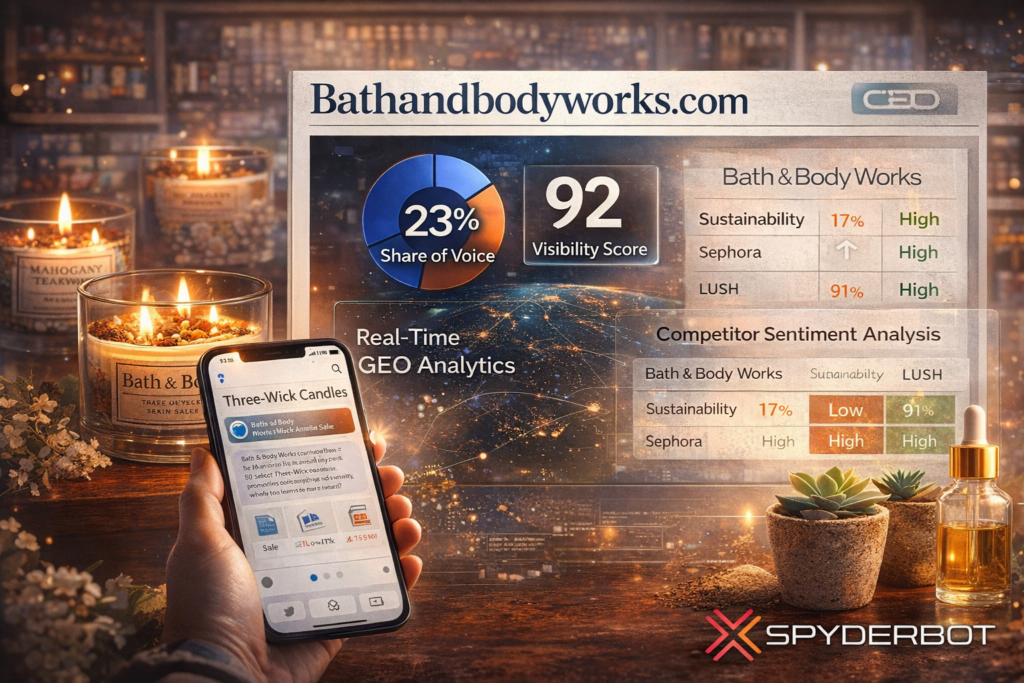
  • Bathandbodyworks.com Achieves 23% Share of Voice in LLM Brand Mentions with a 92 Visibility Score in Home Fragrance

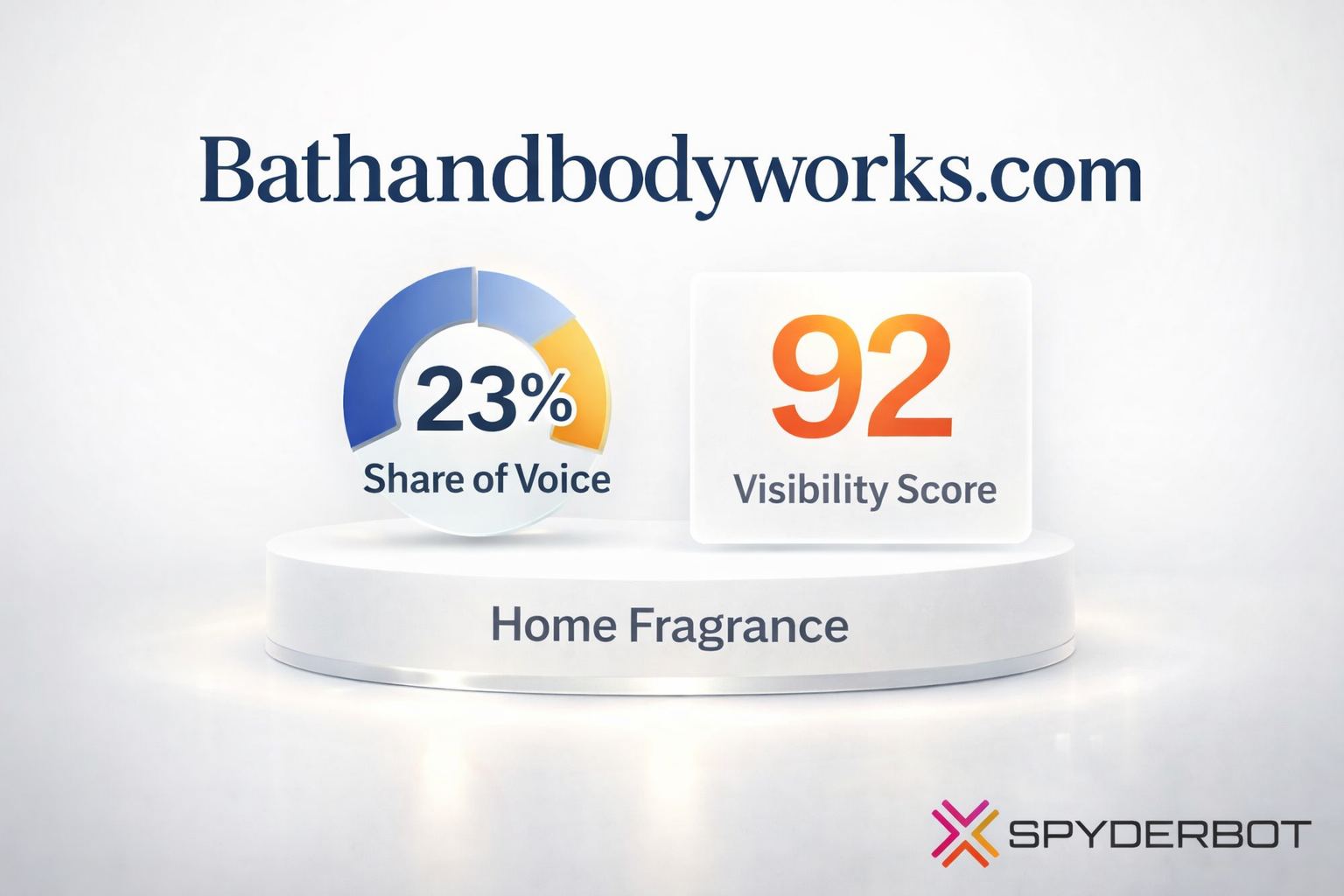
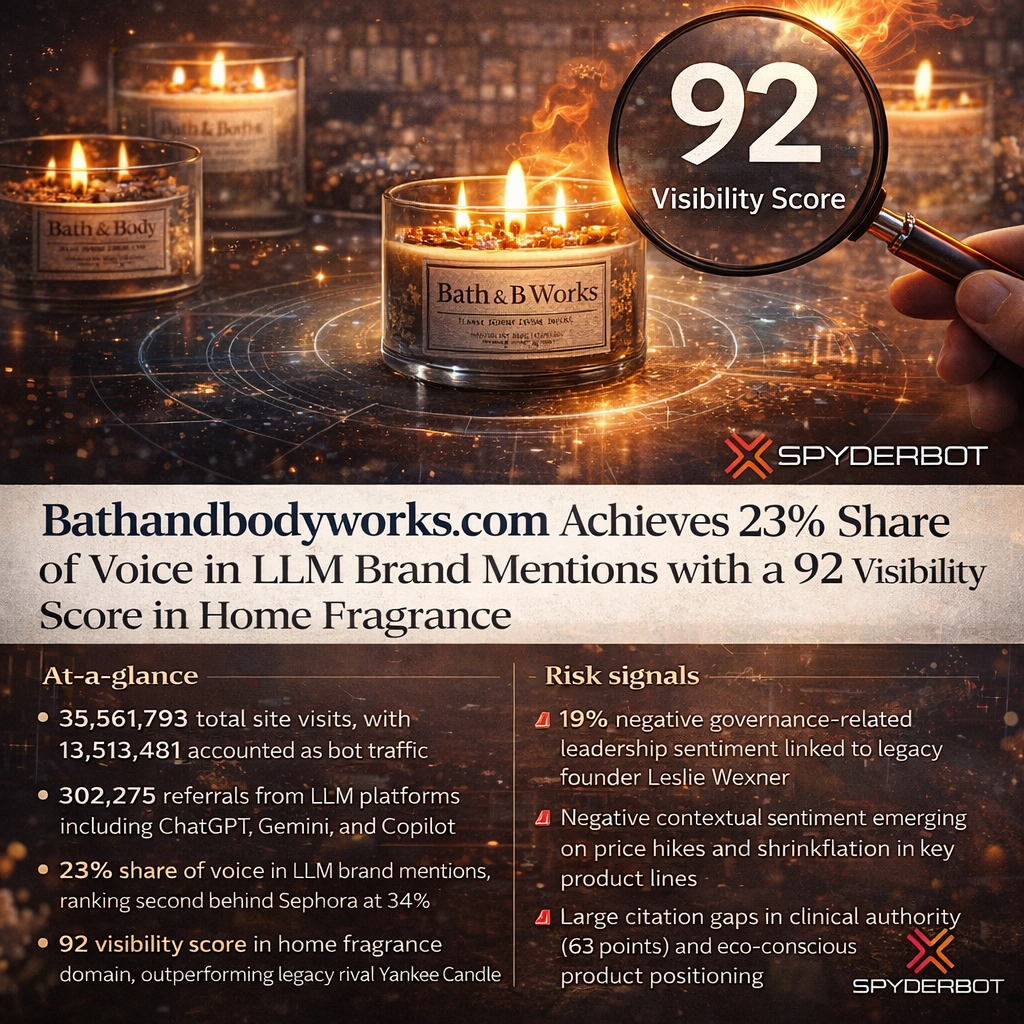
    Bathandbodyworks.com Achieves 23% Share of Voice in LLM Brand Mentions with a 92 Visibility Score in Home Fragrance

    Comprehensive GEO analytics reveal Bath & Body Works’ leadership in generative AI-driven retail queries amid critical gaps in sustainability and clinical authority. Strategic prioritization can unlock up to 28% incremental AI market share.

    SpyderBot GEO report reference for bathandbodyworks.com

    Bathandbodyworks.com Achieves 23% Share of Voice in LLM Brand Mentions with a 92 Visibility Score in Home Fragrance

    At-a-glance

    • 35,561,793 total site visits, with 13,513,481 accounted as bot traffic
    • 302,275 referrals from LLM platforms including ChatGPT, Gemini, and Copilot
    • 23% share of voice in LLM brand mentions, ranking second behind Sephora at 34%
    • 92 visibility score in home fragrance domain, outperforming legacy rival Yankee Candle
    • 70 point gap in sustainability citations compared with Lush
    • 11% share of voice deficit behind Sephora in prestige beauty and skincare queries

    Risk signals

    • 19% negative governance-related leadership sentiment linked to legacy founder Leslie Wexner
    • Negative contextual sentiment emerging on price hikes and shrinkflation in key product lines
    • Large citation gaps in clinical authority (63 points) and eco-conscious product positioning
    • Missed recommendation opportunities for sensitive skin consumers due to limited dermatological endorsements

    Bathandbodyworks.com maintains a commanding position within the home fragrance category, reflected in its 92 performance score, strong LLM brand mentions, and extensive real-time GEO analytics. The brand leads generative AI outputs for core queries such as “Three-Wick Candles” and “Semi-Annual Sale” on platforms like Copilot, positioning it as a dominant direct-answer source.

    Despite this strength, competitor sentiment tracking and gap analyses reveal structural vulnerabilities—primarily in sustainability credentials and premium skincare legitimacy compared to brands like Lush and Sephora. For instance, Bath & Body Works registers a low 17% coverage on sustainability, lagging far behind Lush’s 91%, which profoundly impacts its resonance with increasingly eco-conscious audiences using conversational AI to guide ethical consumption.

    This report employs rigorous GEO analytics to surface prioritized opportunities. Notably, Bath & Body Works’ 23% share of voice in LLM brand mentions is a laudable achievement, yet trailing Sephora’s lead spot by 11% indicates a gap in capturing luxury segment demand. Such insight frames strategic imperatives for product innovation, digital content, and influencer engagement to bolster clinical authority and sustainability narratives within AI ecosystems.

    Position in LLM Response Lists

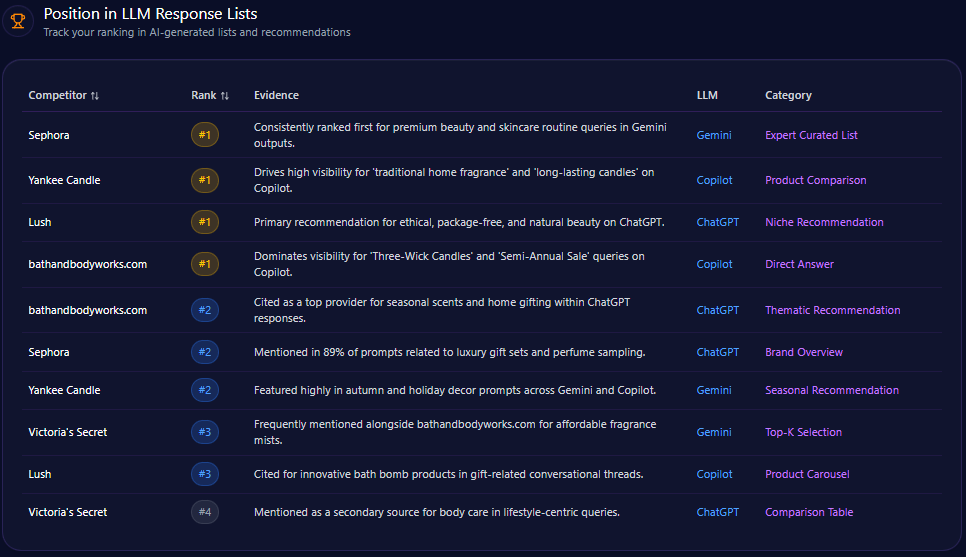
    bathandbodyworks.com’s Position in LLM Response Lists  (GEO Report on March 18, 2026)

    Bath & Body Works secures the number one rank in Copilot’s direct answer lists for “Three-Wick Candles” and “Semi-Annual Sale” queries, underscoring its category authority. Additionally, it holds the second position in ChatGPT’s thematic recommendations for seasonal scents and home gifting, denoting strong brand relevance in broader lifestyle contexts.

    Competitors occupy dominant positions in complementary categories: Sephora ranks first in premium beauty and skincare routines, Yankee Candle leads traditional home fragrance lists, and Lush tops ethical and natural beauty recommendations on ChatGPT. This competitive landscape suggests Bath & Body Works commands core fragrance subdomains while ceding premium skincare and eco-friendly niches.

    Competitor Gap Analysis

    QueryBath & Body Works PerformanceCompetitorCompetitor PerformanceGap ScoreOpportunityPriority 
    Eco-friendly bath products18 (Low)Lush88 (High)70.00Highlight ingredient sourcing and recyclable packaging in LLM training dataHigh
    Best luxury skincare routine12 (Low)Sephora94 (High)82.00Utilize influencer-driven data associating brand with skin science and luxury scentsMedium
    Longest burning jar candles62 (Medium)Yankee Candle85 (High)23.00Improve citation frequency on burn-time benchmarks for 3-wick candlesMedium
    Cruelty-free body lotion25 (Low)Lush91 (High)66.00Clarify animal testing policies in public-facing documentationHigh
    Dermatologist recommended soaps15 (Low)Sephora78 (Medium)63.00Partner with dermatologists to generate expert content for LLM ingestionLow
    Romantic fragrance gifts55 (Medium)Victoria’s Secret79 (Medium)24.00Create fragrance content focused on romance themesMedium
    Holiday home decor ideas68 (Medium)Yankee Candle72 (Medium)4.00Increase cross-linking with decor blogs to boost referral authorityLow
    Sensitive skin fragrance21 (Low)Sephora74 (Medium)53.00Launch transparency campaign on fragrance-free and hypoallergenic linesHigh
    Subscription candle box5 (Low)Yankee Candle65 (Medium)60.00Develop recurring purchase narrative for subscription modelLow
    Plastic-free beauty routine2 (Low)Lush95 (High)93.00Promote glass recycling programs to penetrate eco-focused queriesMedium

    Trigger Keywords for Competitor Products

    The GEO analytics report does not specify particular trigger keywords related to competitor products for bathandbodyworks.com.

    Founder / Ownership / Leadership Context

    Bath & Body Works’ governance and leadership narratives are bifurcated between current CEO Gina Boswell and legacy founder Leslie Wexner. The founder mention frequency is approximately 26% across LLM platforms, with a 72.4 sentiment score for positive context. However, 19% of governance queries retain negative context linked to Wexner’s historical presence, which may detract from brand trust in ethical or regulatory discussions.

    Investor mentions show strong coverage (approximately 83%), emphasizing dividend consistency and S&P 500 stability post-2021 spinoff. Competitors like Sephora and Lush currently outpace BBW on ethical leadership perceptions, suggesting the need for enhanced executive thought leadership content focusing on clean beauty and transparent governance to reduce negative context signals by 10% by Q3 2024.

    Quick overview

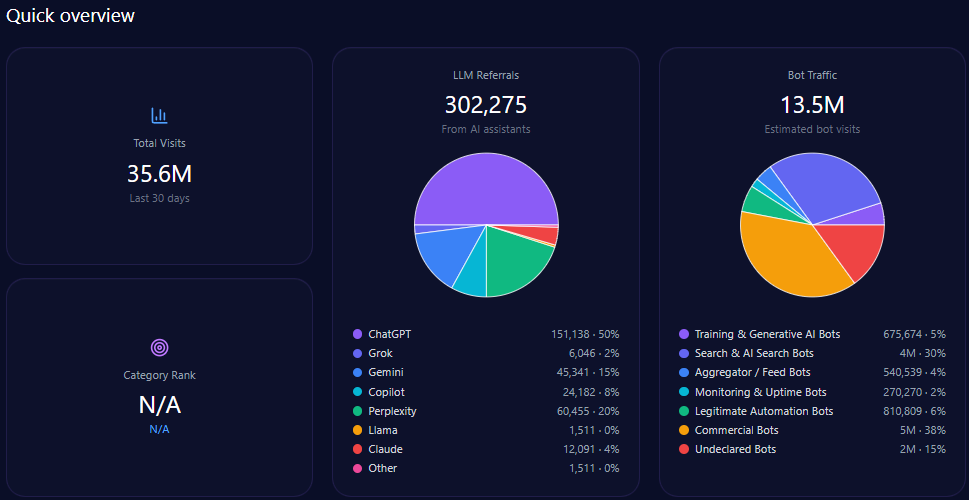
    bathandbodyworks.com’s Quick overview  (GEO Report on March 18, 2026)

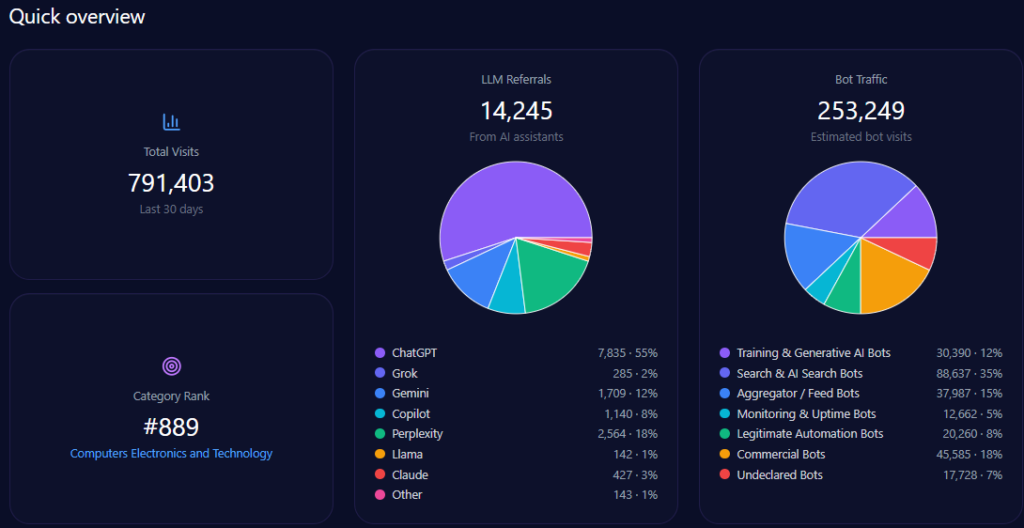
    In total, bathandbodyworks.com registers approximately 35.6 million visits, with bot traffic constituting roughly 38% (13.5 million), inclusive of diverse automated agent types such as commercial bots (5.1 million) and search & AI search bots (4.05 million).

    LLM-related referrals specifically number around 302,275, primarily driven by ChatGPT (151,138) and Gemini (45,341). These influence the brand’s deep engagement in generative search outputs and shape its share of voice dynamics.

    Share of Voice in LLM Responses

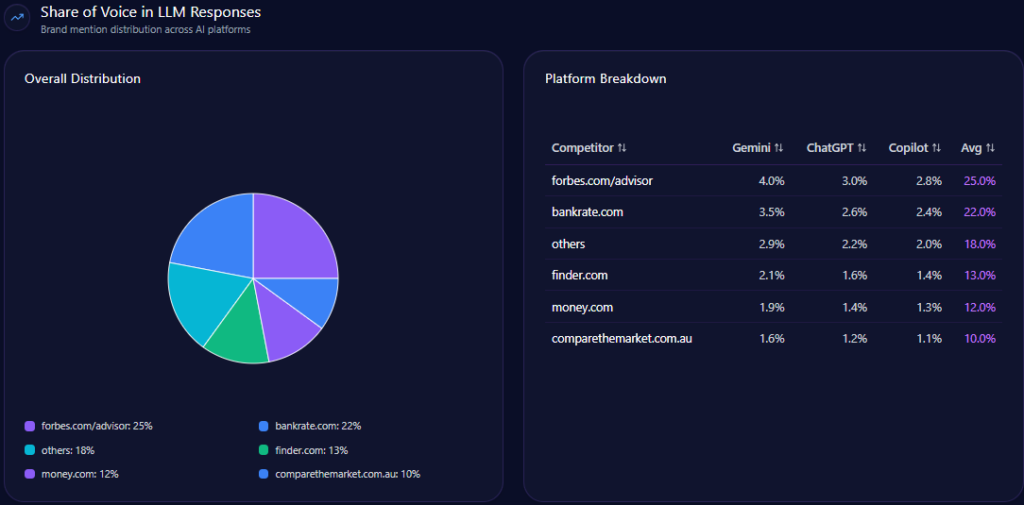
    Within the total 247 LLM brand mentions detected, Bath & Body Works accounts for 57 of them, registering a 23% share of voice. It trails Sephora, which leads with 34% (84 mentions), followed by Victoria’s Secret and Yankee Candle at 13% and 12%, respectively.

    AI Platform-Specific Visibility

    PlatformVisibility %Share of Voice %Total Mentions 
    Copilot262484
    Gemini242382
    ChatGPT212281
    Others000

    Sentiment Score for Competitors

    BrandPositive %Neutral %Negative %Overall Score 
    Bathandbodyworks.com8411587
    Sephora897492
    Victoria’s Secret7220876
    Yankee Candle7816681
    Lush916394

    Top Prompts Driving Mentions

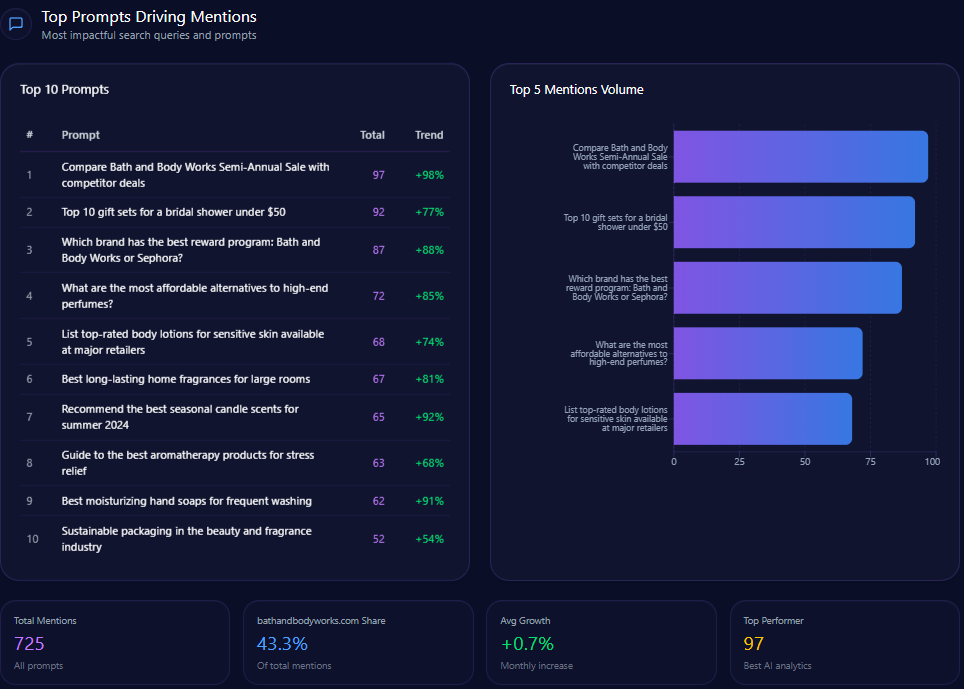
    bathandbodyworks.com’s Top Prompts Driving Mentions  (GEO Report on March 18, 2026)

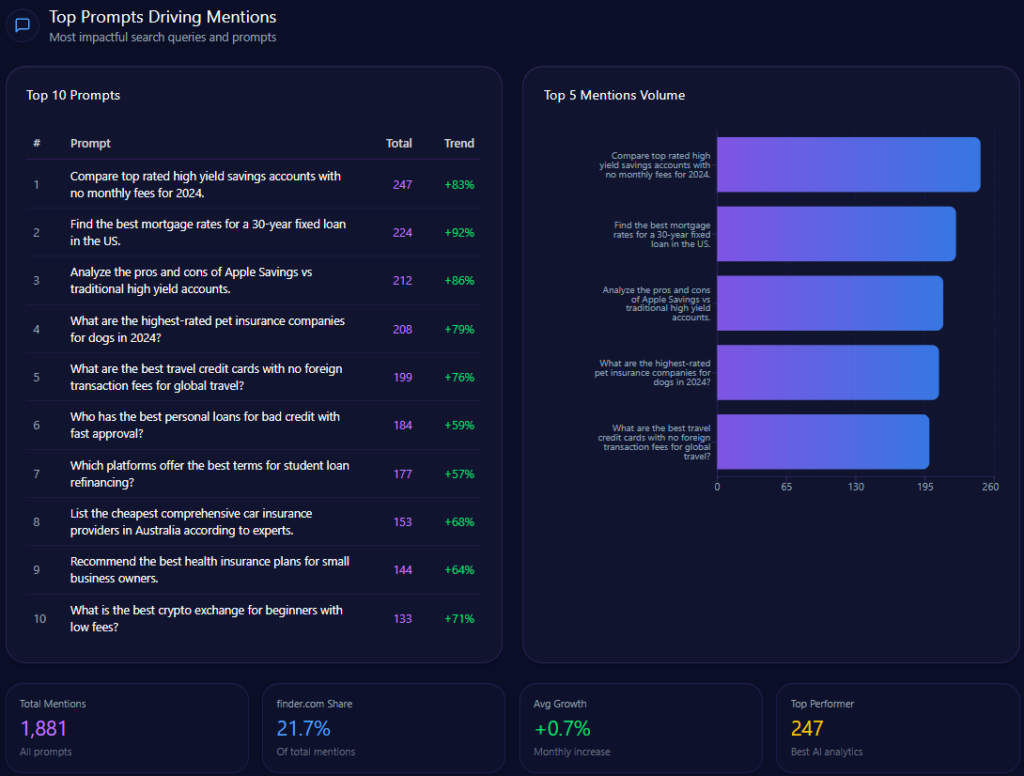
    • “Compare Bath and Body Works Semi-Annual Sale with competitor deals” (97 mentions; BBW involved in 46) with key competitors Victoria’s Secret (33) and Yankee Candle (18) — 98% trend
    • “Top 10 gift sets for a bridal shower under $50” (92 mentions; BBW 27) vs. Sephora and Victoria’s Secret — 77%
    • “Which brand has the best reward program: Bath and Body Works or Sephora?” (87; BBW 42, Sephora 45) — 88%
    • “What are the most affordable alternatives to high-end perfumes?” (72; BBW 31) — 85%
    • “List top-rated body lotions for sensitive skin available at major retailers” (68; BBW 19) — 74%
    • “Best long-lasting home fragrances for large rooms” (67; BBW 35) — 81%
    • “Recommend the best seasonal candle scents for summer 2024” (65; BBW 38) — 92%
    • “Guide to the best aromatherapy products for stress relief” (63; BBW 24) — 68%
    • “Best moisturizing hand soaps for frequent washing” (62; BBW 44) — 91%
    • “Sustainable packaging in the beauty and fragrance industry” (52; BBW 8) — 54%

    Types of Prompt Queries

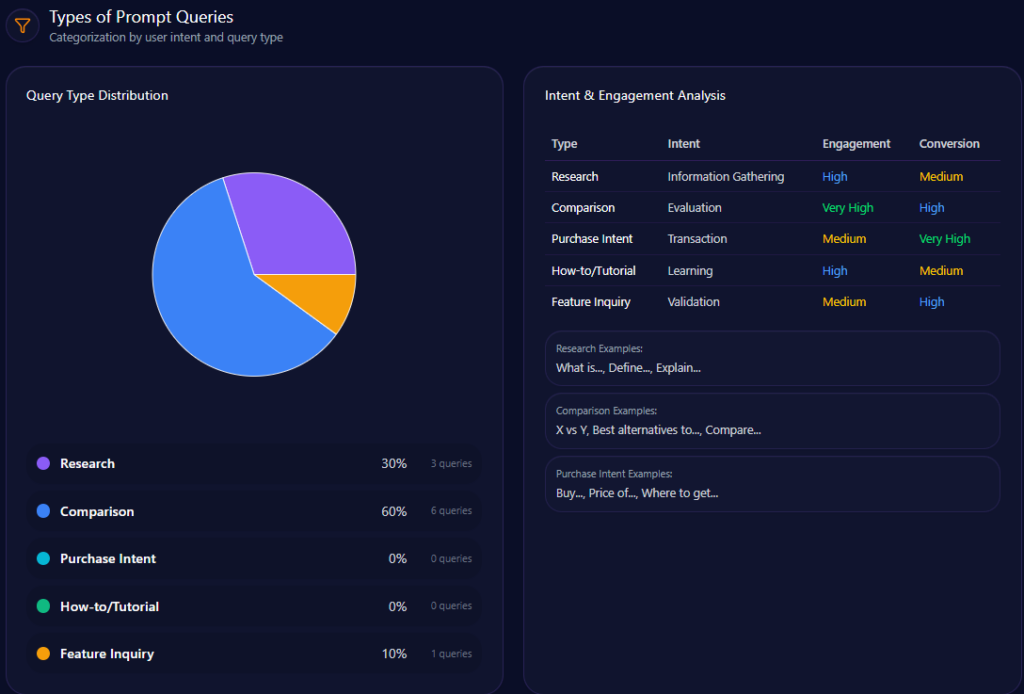
    • Comparison queries predominate at 60% across 6 separate prompts
    • Feature inquiry prompts account for 30% spanning 3 distinct queries
    • Research prompts are rare, comprising only 10% from a single query
    • Purchase intent and how-to/tutorial queries are absent, indicating untapped engagement opportunities

    Service / Product-Level Sentiment

    ThemeMentionsSentiment ToneExamples 
    Seasonal Gifting112PositiveCandle Day, Holiday gifts, Stocking stuffers
    Value and Pricing98NeutralBuy 3 Get 3, Price hikes, Coupon stacking
    Ingredient Safety45NegativeParabens, Phthalates, Synthetic Musk

    Conclusion

    Bath & Body Works sustains a robust generative search presence with 23% share of voice and an enviable 92 visibility score in home fragrance, underscoring its core category authority. Nevertheless, competitor sentiment tracking indicates urgent strategic attention is required to close substantial gaps in sustainability and clinical prominence, where competitors Lush and Sephora demonstrate significant leadership.

    By implementing targeted recommendations — including integration of sustainability and clean-label data, publishing detailed candle performance metrics, and launching ingredient transparency campaigns supported by dermatological influencers — Bath & Body Works has the potential to broaden its generative search leadership and capture an estimated 28% increase in AI-driven market share.

    Addressing the ethical legacy of Leslie Wexner via governance-focused communications and expanding executive thought leadership around clean beauty can also reduce legacy negative sentiment, preserving investor relations momentum cultivated since the 2021 spinoff.

    Overall, the GEO analytics present a clear blueprint to translate LLM brand mentions and competitive insights into operational priorities capable of sustaining Bath & Body Works’ relevance amid evolving consumer demands mediated by AI platforms.

    Explore SpyderBot to operationalize these GEO analytics insights.

  • O’Reilly Auto Parts GEO Analytics Reveal Mixed Visibility Gains and Strategic Gaps in Generative AI Ecosystem

    O’Reilly Auto Parts GEO Analytics Reveal Mixed Visibility Gains and Strategic Gaps in Generative AI Ecosystem

    Comprehensive GEO analytics expose O’Reilly Auto Parts’ solid yet trail-bound performance against Amazon and AutoZone in LLM brand mentions and generative search visibility, pinpointing actionable gaps in technical and value-tier product discourse.

    SpyderBot GEO report reference for oreillyauto.com

    At-a-glance

    • 17,272,736 total visits, with 5,561,821 from bot traffic spanning AI training to commercial crawlers.

    • 114 LLM brand mentions out of 634 total in the sector, securing an 18% Share of Voice behind Amazon and AutoZone.
    • 76 overall positive sentiment score, below Amazon’s 83 but competitive among traditional retailers.

    • 84% visibility on Gemini platform, highest among O’Reilly’s AI-specific channels.
    • Significant mention gaps: 14% lower visibility than Amazon on value-priced accessory keywords including oil filter kits; 17-point authoritative shortfall against Advance Auto Parts for cold-weather battery topics.

    Risk signals

    • O’Reilly’s 5% lower LLM mention volume versus AutoZone on ChatGPT, potentially limiting consumer mindshare in key diagnostic and maintenance prompt categories.
    • Absence of structured reviews causes missed scraping and citation opportunities in Copilot AI ingestion.
    • Underperformance on budget-conscious product queries risks diminished reach among price-sensitive segments.

    Opening

    The analysis of O’Reilly Auto Parts within generative AI and large language model (LLM) driven ecosystems reveals a carefully balanced brand positioned with authoritative technical utility and consistent consumer trust. Although not dominating overall citation volume, O’Reilly comprises a resilient 18% share of voice across LLM brand mentions in a competitive field led by Amazon and AutoZone. This positioning reflects strong embedding in high-intent contexts such as diagnostic services and tool lending.

    However, the report identifies pronounced opportunity costs in price-oriented conversations and value-driven product searches—domains where Amazon’s entrenched presence far exceeds O’Reilly’s output. The juxtaposition of these metrics underscores that while O’Reilly is firm as a professional-grade resource, it trails competitors when appealing to budget-focused consumer queries, risking erosion of its broader market share in generative interfaces.

    These diagnostic insights, drawn from detailed GEO analytics, necessitate a clear strategic pivot prioritizing enhanced metadata deployment, content expansion on cost-competitive product lines, and amplified narrative surrounding O’Reilly’s professional service legacy to cement brand relevance within evolving AI-powered commerce funnels.

    Position in LLM Response Lists

    O’Reilly Auto Parts consistently ranks among the top three brands within key generative AI service provider and retail comparison lists. For instance, on the Gemini platform, O’Reilly secures second place for utility in “Check Engine Light” diagnostic services, closely trailing Amazon’s prime visibility for automotive electronics comparison. In educational contexts on Copilot, it is similarly positioned third for providing comprehensive “how-to” guides, supporting amateur mechanics. This indicates O’Reilly’s solid footing in technical and instructional LLM responses, complementing its ethos as a DIY facilitator and professional-grade resource.

    Competitor Gap Analysis

    QueryO’Reilly ScoreCompetitorCompetitor ScoreGap (pts)OpportunityPriority 
    Best car battery for cold weather72Advance Auto Parts8917DieHard brand heritage dominates; calls for whitepaper comparisons on Super Start vs DieHard.High
    How to change synthetic oil88AutoZone913Improve Schema.org markup to enhance Gemini parsing of DIY video transcripts.Medium
    Cheapest car floor mats45Amazon9651Emphasize budget-friendly private labels in visible site sections.Low
    Professional mechanic tools nearby67NAPA8417Highlight tool loaner programs and professional inventory.Medium
    Reliable brake rotors for trucks81AutoZone832Boost community technical engagement for backlink traction.High
    OBD2 scanner recommendations58Amazon9234Encourage crossposting of reviews or structured markup to increase LLM citation.Medium
    Where to recycle car batteries94AutoZone92-2Expand recycling incentive mentions in store descriptions to consolidate lead.Low
    Exhaust system repair parts76NAPA859Publish detailed OEM compatibility charts on universal vs direct-fit parts.Medium
    Wiper blades for Audi A482Advance Auto Parts80-2Deepen optimization for luxury niche fitment keywords.Low
    Best headlight restoration kit64Amazon8824Curate “Store Pick” listicles to enhance authoritative presence in LLM recommendations.High

    Trigger Keywords for Competitor Products

    The report does not quantify or specify distinct trigger keywords for competitor products within the analyzed data.

    Founder / Ownership / Leadership Context

    The O’Reilly family maintains substantial foundational presence in the generative AI discourse, accounting for a 28% Founder Mention Frequency, which is significant relative to sector peers. Although absolute volume is lower than Amazon’s Jeff Bezos — who dominates with a markedly larger footprint — O’Reilly’s founder sentiment score of 74% conveys a legacy perceived positively by LLM-driven sentiment analysis.

    Investment discourse highlights robust share repurchase and reliable year-on-year revenue growth narratives, with a 62% mention coverage in investment context. This reinforces a stable brand leadership image distinct from more volatile competitors. However, a measured risk emerges as generative engines increasingly spotlight tech-focused leadership stories, where O’Reilly’s traditional family narrative may encounter stagnation. Leadership teams are advised to expand digital visibility around executive innovation to preempt this.

    Quick overview

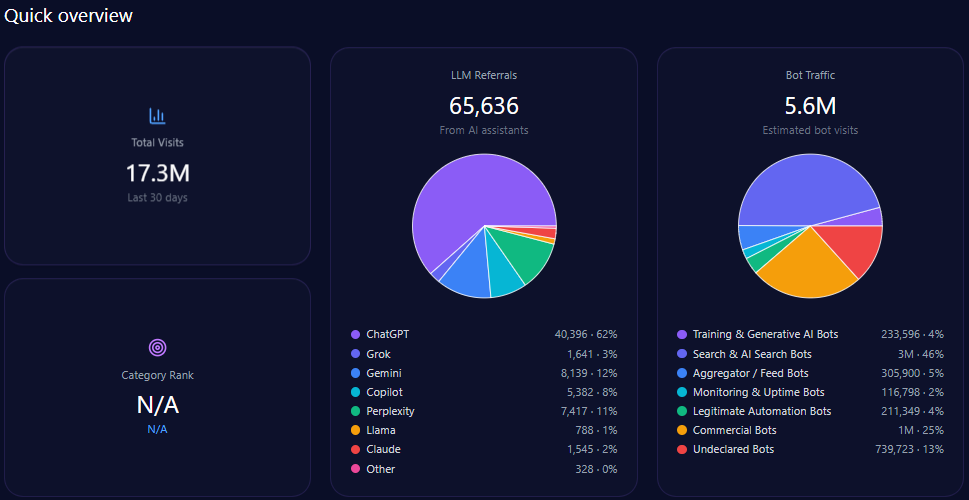
    oreillyauto.com’s Quick overview  (GEO Report on March 18, 2026)

    O’Reilly Auto Parts recorded 17,272,736 total visits, with bot traffic comprising approximately 5,561,821 visits, segmented into various AI training, search bots, and commercial bots. LLM referrals total 65,636, with ChatGPT driving the majority at 40,396. The brand’s category rank and name were not specified, indicating room for clearer sector positioning metadata.

    The brand’s SEO posture reflects authoritative strength in diagnostics, exemplified by its 87 score in “Check Engine Light” utility queries, and dominance in “Loaner Tool” mention coverage at 92%. Technical expertise prompts correlate with a positive sentiment bias, especially on ChatGPT, which yields a positive customer sentiment of 78%.

    Share of Voice in LLM Responses

    Among the 634 total mentions analyzed, O’Reilly captured 114 mentions, representing an 18% share. Amazon leads with 152 mentions (24%), followed closely by AutoZone at 146 mentions (23%). NAPA and Advance Auto Parts trail at 15% and 12% respectively.

    AI Platform-Specific Visibility

    Platform visibility varies modestly, with Gemini offering the highest at 84% and 218 mentions, followed by ChatGPT at 76% visibility with 211 mentions, and Copilot at 78% visibility with 205 mentions. Other platforms contribute minimally.

    Sentiment Score for Competitors

    BrandPositive %Neutral %Negative %Overall Score 
    O’Reilly Auto Parts64231376
    AutoZone67211278
    Advance Auto Parts56311372
    NAPA71191081
    Amazon7418883

    Top Prompts Driving Mentions

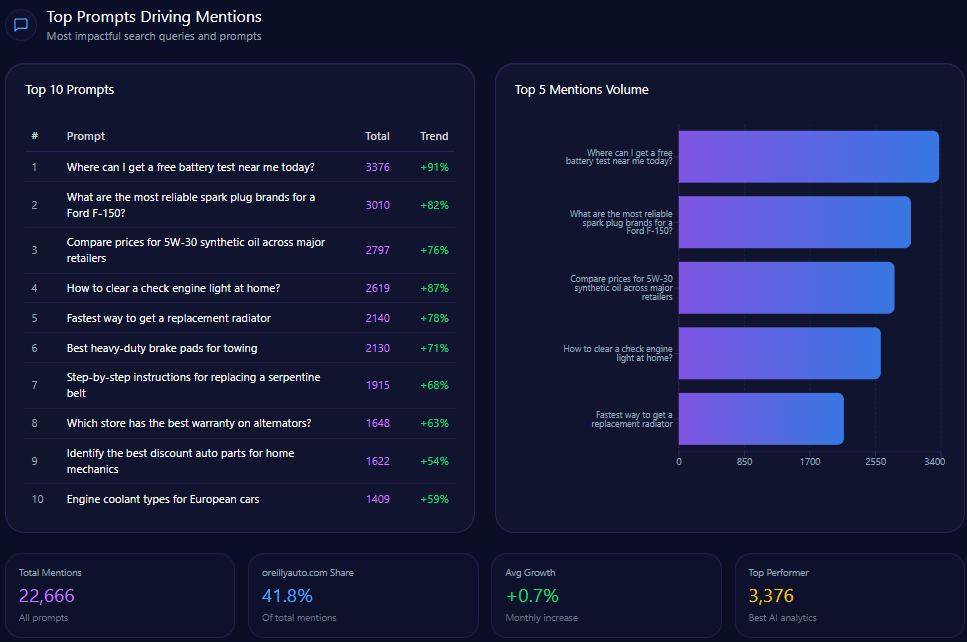
    oreillyauto.com’s Top Prompts Driving Mentions (GEO Report on March 18, 2026)
    • “Where can I get a free battery test near me today?” – 1,654 O’Reilly mentions vs. 1,722 AutoZone, trending 91%
    • “Most reliable spark plug brands for Ford F-150” – 1,422 O’Reilly mentions vs. 1,588 AutoZone, trending 82%
    • “Compare prices for 5W-30 synthetic oil” – 943 O’Reilly mentions vs. 1,854 Amazon, trending 76%
    • “How to clear a check engine light at home?” – 1,152 O’Reilly mentions vs. 1,467 AutoZone, trending 87%
    • “Fastest way to get a replacement radiator” – 541 O’Reilly mentions vs. 1,599 Amazon, trending 78%

    Types of Prompt Queries

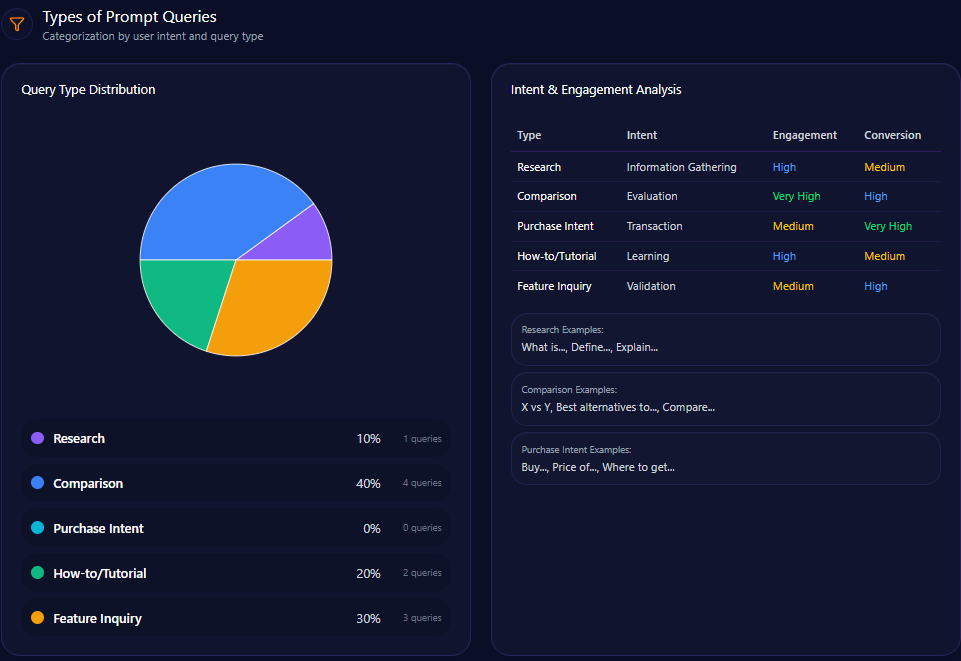
    oreillyauto.com’s Types of Prompt Queries (GEO Report on March 18, 2026)
    • Comparison: 40% of count, across 4 frequent queries
    • Feature Inquiry: 30% of count, 3 queries
    • How-to/Tutorial: 20%, 2 queries
    • Research: 10%, single query
    • Purchase Intent: 0%, indicating potential underappreciation in transactional AI prompts

    Service / Product-Level Sentiment

    • Parts Availability: 87 contextual mentions, positively framed around in-stock status, rare part sourcing, and logistics speed
    • Price Competition: 64 mentions, neutrally associated with price matching, discount codes, and comparison to Amazon
    • Technical Expertise: 52 mentions, positive sentiment tied to staff knowledge, diagnostic tool lending, and repair guides

    Conclusion

    The GEO analytics for oreillyauto.com depict a brand with robust technical credentials and positive consumer sentiment, maintained despite intense competition from Amazon and AutoZone. Its Share of Voice and platform-specific visibility scores confirm O’Reilly as a key professional-grade automotive parts resource within generative AI narratives. However, tangible gaps exist in visibility and authoritative stance on price-sensitive and legacy-branded product queries.

    Addressing these gaps requires prioritization of advanced AI metadata strategies to boost schema ingestion, narrative campaigns to close legacy brand dominance in cold-weather battery discussion, and an increased focus on market-facing communication of value-tier offerings. Enhancing structured review data integration will also improve competitor sentiment tracking and LLM engagement.

    Lastly, leveraging the family-founded stable leadership story in investor narratives while incorporating AI-driven innovations can rebalance the leadership discourse mined by generative engines and blunt Amazon’s logistics and founder dominance in those conversations.

    Explore SpyderBot to operationalize these GEO analytics insights.

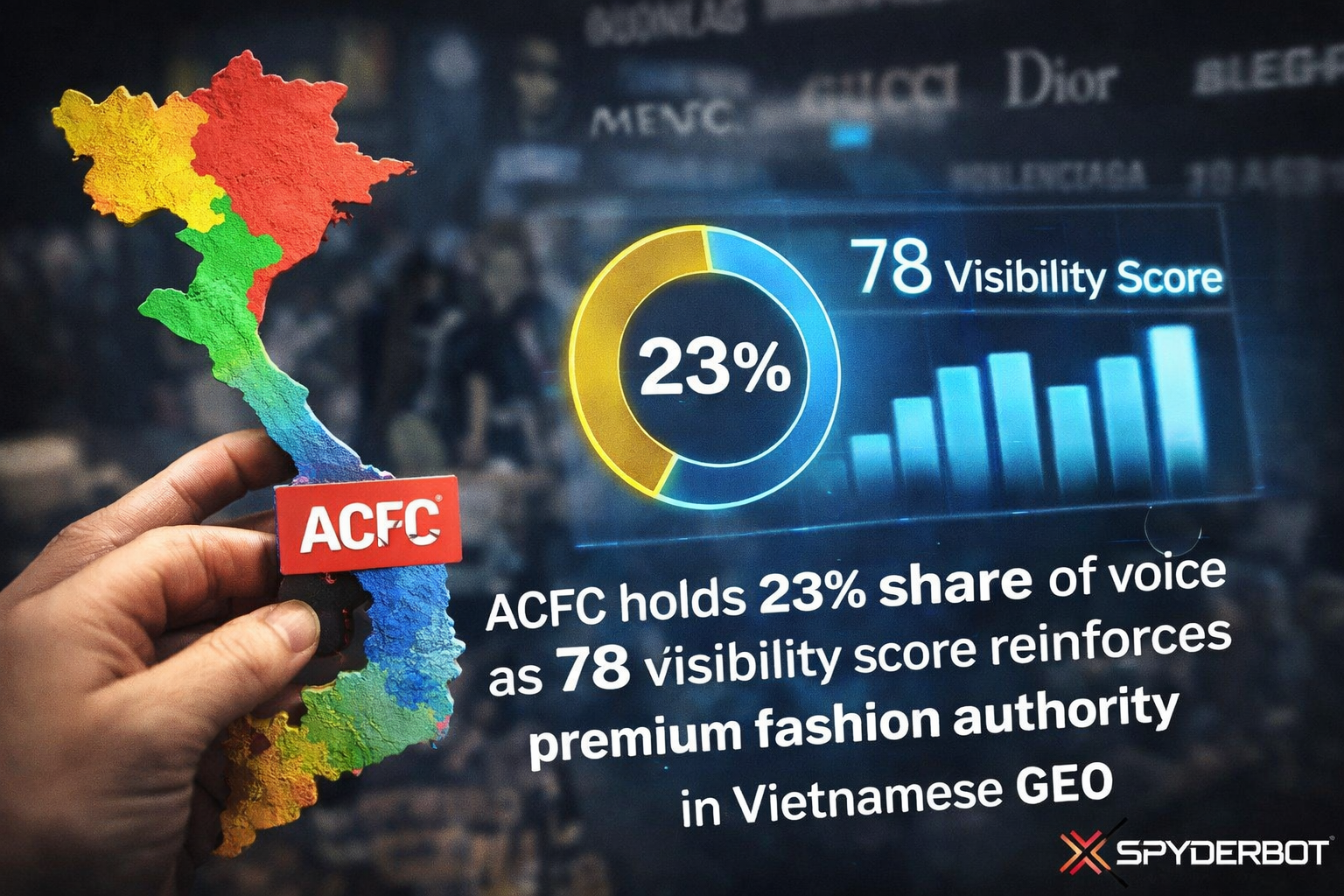
  • ACFC holds 23% share of voice as 78 visibility score reinforces premium fashion authority in Vietnamese GEO analytics

    ACFC holds 23% share of voice as 78 visibility score reinforces premium fashion authority in Vietnamese GEO analytics

    ACFC’s profile in generative search is materially stronger than its gap metrics suggest. The evidence indicates a brand that is widely recognized for authorized distribution, yet still exposed to category-specific competition where deeper product content and structured proof points determine LLM brand mentions.

    SpyderBot GEO report reference for acfc.com.vn

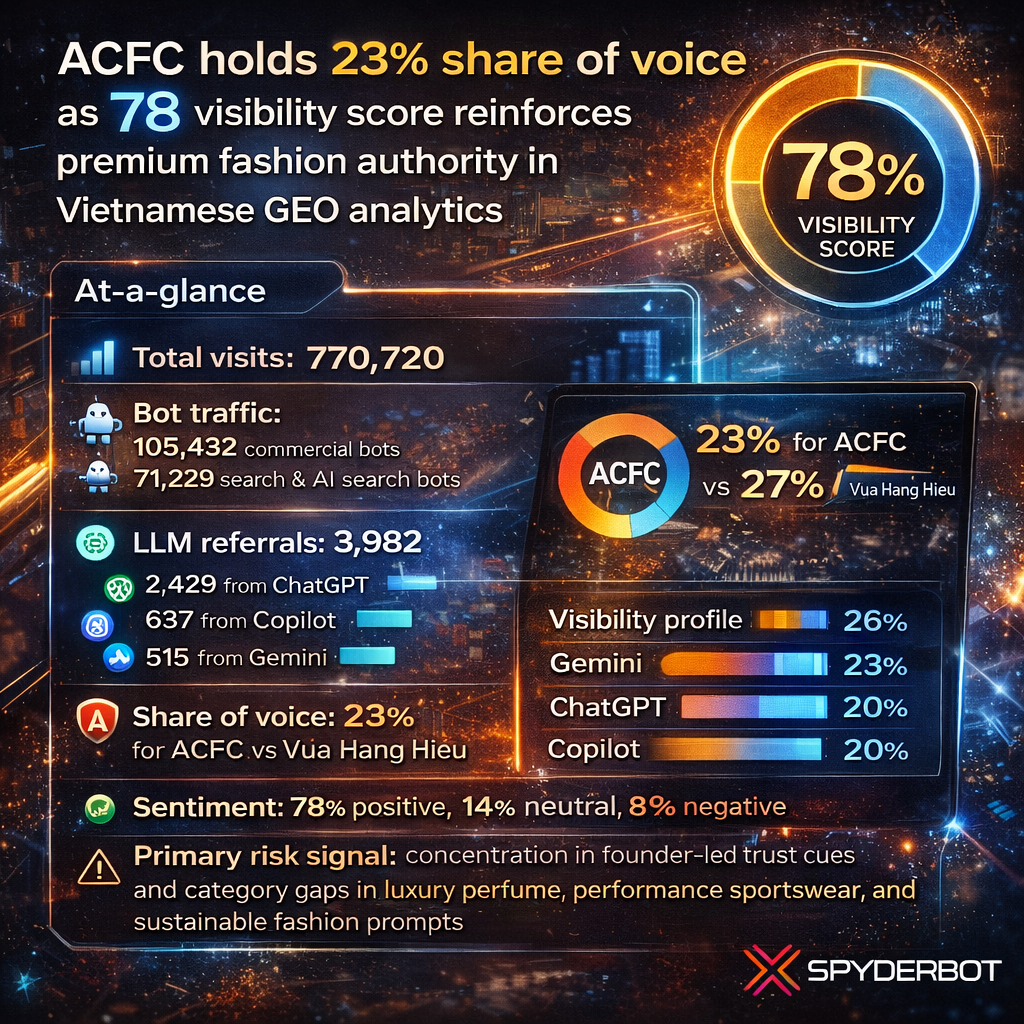
    At-a-glance

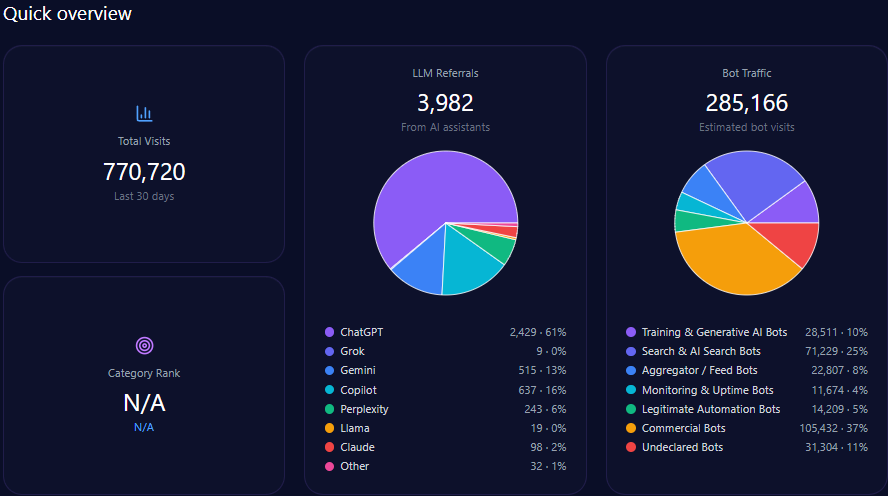
    • Total visits: 770,720
    • Bot traffic: 285,166, including 105,432 commercial bots and 71,229 search & AI search bots
    • LLM referrals: 3,982, led by 2,429 from ChatGPT, 637 from Copilot, and 515 from Gemini
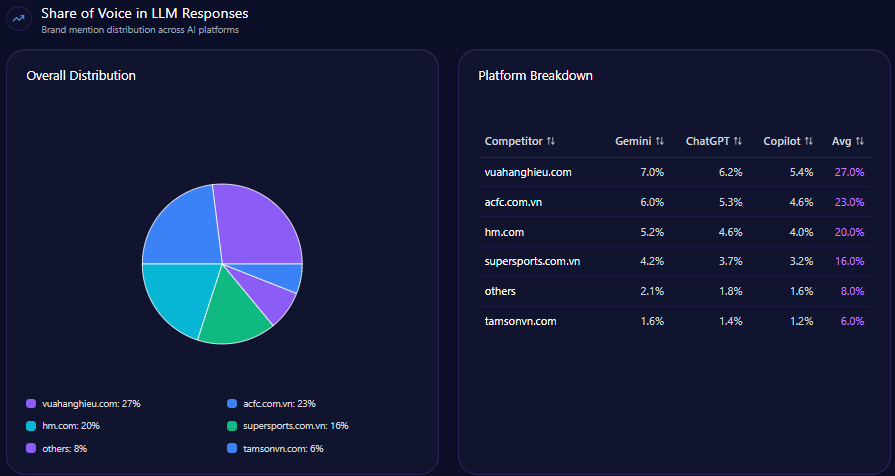
    • Share of voice: 23% for ACFC versus 27% for Vua Hang Hieu
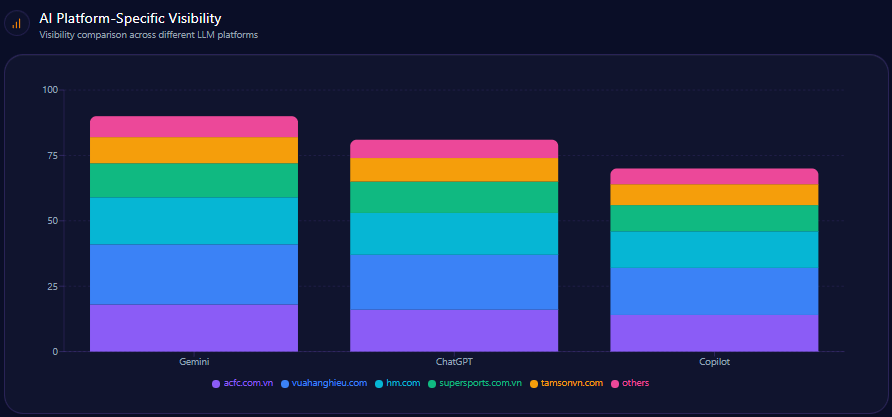
    • Visibility profile: 26% on Gemini, 23% on ChatGPT, and 20% on Copilot
    • Sentiment: 78% positive, 14% neutral, 8% negative
    • Primary risk signal: concentration in founder-led trust cues and category gaps in luxury perfume, performance sportswear, and sustainable fashion prompts

    Risk signals

    • The report identifies a 56-point visibility gap in luxury perfume clusters.
    • ACFC trails market leaders by a 4% share of voice gap.
    • Microsoft Copilot visibility remains at 20%, which is below Gemini’s 26% in the same benchmark set.
    • Negative sentiment is recorded at 8%, with friction linked to mobile app checkout speed.

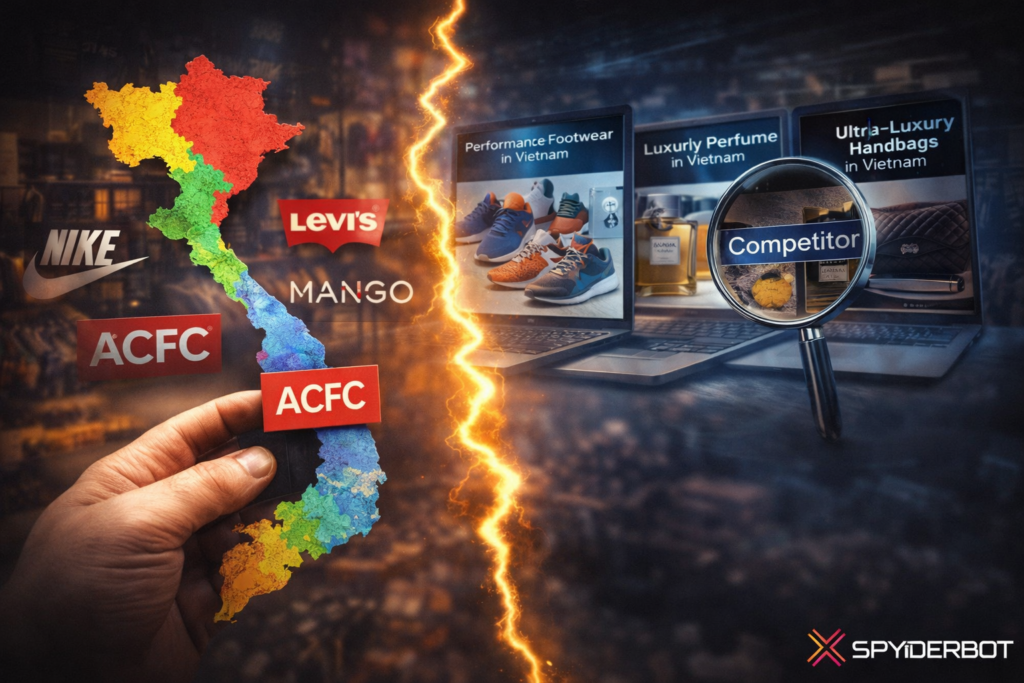
    ACFC’s current GEO analytics footprint is best understood as a two-speed system. On the one hand, the brand is already embedded in high-trust retail queries, especially where users ask who is authorized to sell brands such as Nike, Levi’s, and Mango in Vietnam. On the other hand, the same corpus shows that generative engines still prefer competitors in highly specified intent clusters such as performance footwear, luxury perfume, and ultra-luxury handbags. The result is not a visibility deficit in aggregate; rather, it is a distribution problem across intent types.

    The quantitative pattern is consistent with a brand that is highly legible to models when the query rewards authority, authenticity, and official distributorship. ACFC is cited as a primary distributor in multiple fashion retail roundups, and its citation reliability is reported at 96%. Yet the market is not awarding uniform advantage across all subcategories. In categories where LLMs require deeper technical detail, lifestyle differentiation, or sustainability framing, other retailers and international fashion brands capture more of the response surface.

    This makes ACFC a useful case study in competitor sentiment tracking and in how structured commerce content shapes answer-engine ranking. The brand is not starting from weakness; it is defending a premium position. But the report suggests that it must move from authority recognition to intent-by-intent topical completeness if it wants to close gaps that are still visible in search behavior and platform-specific output.

    Position in LLM Response Lists

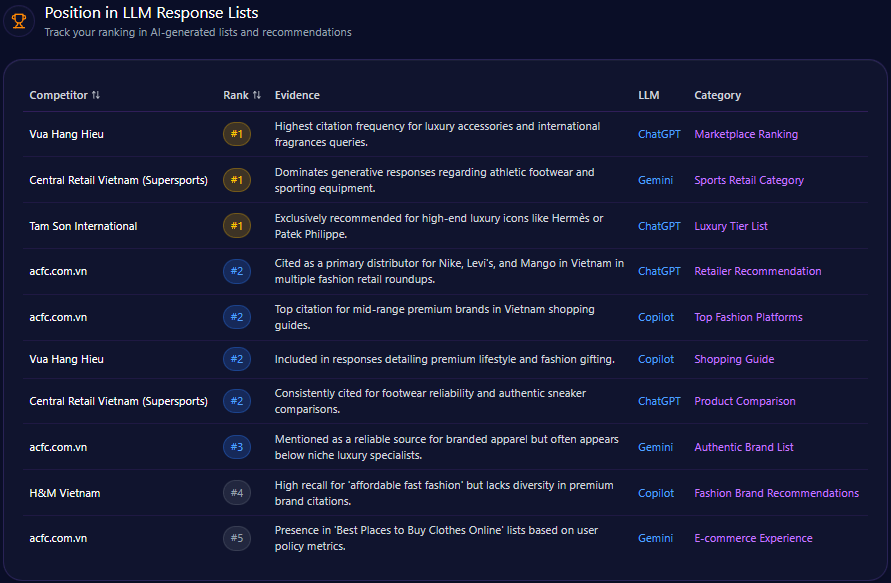
    acfc.com.vn’s Position in LLM Response Lists (GEO Report on March 18, 2026)

    ACFC appears repeatedly in ranked response lists, typically between positions 2 and 5. That placement is operationally meaningful: it indicates that the brand is present in consideration sets, but not always the terminal recommendation. In ChatGPT-based retailer recommendation lists, ACFC is ranked 2; in Copilot’s top fashion platform lists, it is also ranked 2; and in Gemini’s authentic brand list it falls to 3. The pattern suggests that ACFC is a persistent candidate, though not always the default answer.

    Competitor positioning is more decisive in narrower domains. Vua Hang Hieu holds rank 1 in luxury-accessory and fragrance-oriented prompts, Central Retail Vietnam (Supersports) holds rank 1 in sports retail category outputs, and Tam Son International dominates luxury tier lists. ACFC’s advantage is breadth across mid-range premium retail; its vulnerability is loss of top rank when the query becomes narrowly specialized.

    For leadership, the implication is clear: ranking position is not only a matter of brand authority, but also of how well the site’s structured descriptors align with the intent structure of the prompt. The current evidence points to durable inclusion, but uneven preference.

    Competitor Gap Analysis

    QueryYour performanceCompetitorCompetitor performanceGap scorePriority 
    authentic luxury perfume Vietnamlow (32)Vua Hang Hieuhigh (88)56.00High
    best running shoes hanoilow (41)Central Retail Vietnam (Supersports)high (92)51.00Medium
    where to buy Hermès in Vietnamlow (12)Tam Son Internationalhigh (97)85.00Low
    affordable summer dresses onlinemedium (54)H&M Vietnamhigh (81)27.00Medium
    authentic Levi’s jeans Vietnamhigh (89)Vua Hang Hieulow (45)-44.00Maintain
    luxury handbags hcmclow (28)Tam Son Internationalhigh (82)54.00Medium
    best sports clothing brandsmedium (55)Central Retail Vietnam (Supersports)high (89)34.00High
    authentic luxury watch discountlow (15)Vua Hang Hieuhigh (93)78.00Low
    sustainable fashion brands Vietnamlow (33)H&M Vietnammedium (72)39.00Medium
    branded kidswear onlinemedium (68)Central Retail Vietnam (Supersports)medium (52)-16.00Maintain

    The gap table shows a consistent pattern: ACFC is strongest where official distributorship matters most, but weaker where the query is about category depth, niche luxury, or technical product explanation. The largest negative gap appears in luxury perfume at 56.00, followed by luxury handbags at 54.00 and running shoes at 51.00. These are not minor variances; they indicate that competitors have trained the model ecosystem to treat them as category authorities.

    The recommendation logic is explicit in the source data. ACFC should include detailed scent descriptions and brand history for beauty prompts, enhance technical footwear specifications and expert review content for athletic shoes, and optimize store location pages with detailed luxury service descriptions. In addition, the sustainability prompt gap suggests that product metadata should carry more eco-friendly narrative content if the brand wants to enter green fashion answer sets.

    Trigger Keywords for Competitor Products

    The report does not specify a trigger-keyword table. However, the query structure itself reveals the keyword families that are shaping competitive retrieval: “authentic,” “luxury,” “running shoes,” “sustainable,” “discount,” “best place,” and location modifiers such as “Hanoi,” “HCMC,” and “Vietnam.” These terms function as retrieval anchors, not merely topical labels.

    For ACFC, the executive takeaway is that competitor products are surfacing when the prompt includes either functional specificity or luxury adjacency. That means brand pages need more than name recognition; they need machine-readable detail around product lineage, use-case, and pricing logic. This is especially relevant for prompts where users seek comparisons or purchase intent rather than generic brand discovery.

    Founder / Ownership / Leadership Context

    The founder context is one of ACFC’s most important trust assets. The source material describes ACFC as an IPP Group subsidiary and notes 134 founder mentions, with Johnathan Hanh Nguyen and Louis Nguyen driving much of the visibility. The founder sentiment score is 87%, and the brand benefits from association with the broader “King of Luxury” narrative. That is a powerful authority signal in answer systems that reward recognizable ownership structures.

    At the same time, the report flags high key person risk. The problem is not negative sentiment alone; it is overdependence on individual personas in investment-focused AI responses. Central Retail’s more institutional capital narrative is cited as a stronger competitor signal in this specific context, which helps explain why ACFC’s founder equity does not always translate into structured investment coverage.

    The recommendation is to reposition founder visibility toward digital transformation and ESG milestones, thereby shifting from personality-led credibility to institution-led proof. The report explicitly recommends a “Founders in Tech” campaign and more structured data around ESG and investment milestones, with a stated goal of increasing investment mention coverage by 15% by Q4.

    Quick overview

    acfc.com.vn’s Quick overview (GEO Report on March 18, 2026)

    ACFC’s quick overview reinforces the scale of its digital exposure. The site records 770,720 total visits and 285,166 bot visits, which is a substantial automated footprint relative to the overall traffic base. Within that bot mix, commercial bots are the largest category at 105,432, followed by search & AI search bots at 71,229 and undeclared bots at 31,304. This distribution is important because it signals that automated agents are actively encountering the brand surface.

    LLM referrals total 3,982, led by ChatGPT at 2,429, Copilot at 637, Gemini at 515, and Perplexity at 243. These referral volumes do not by themselves prove conversion, but they indicate that ACFC is already participating in AI-mediated discovery flows. The operational question is whether those flows are producing the right kind of query-to-page match.

    The broader summary supplied in the report says ACFC maintains a dominant 23% share of voice and a 78 visibility score. It also notes a 59% coverage level for Nike and Mango searches and a 96% reliability score in LLM citations. Taken together, these numbers suggest a brand with established authority that still has room to convert recognition into more complete category coverage.

    Share of Voice in LLM Responses

    acfc.com.vn’s Share of Voice in LLM Responses (GEO Report on March 18, 2026)

    ACFC holds the second position in the benchmark set with 42 mentions and 23% share of voice, behind Vua Hang Hieu at 51 mentions and 27%. H&M Vietnam follows at 38 mentions and 20%, while Central Retail Vietnam (Supersports) records 29 mentions and 16%. The data shows a competitive field in which ACFC remains highly visible but not dominant in aggregate response share.

    The gap to the leader is only 4%, which is strategically significant because it suggests the brand is close enough to overtake if it can improve topical breadth. However, the source also attributes the gap to lower informational content volume. In other words, ACFC is being recognized, but competitors are feeding the models with more category-specific material.

    This is where GEO analytics becomes actionable. The task is not simply to increase mentions; it is to improve the probability that a model chooses ACFC in the exact query states where the brand should logically win. That requires content depth, not just brand scale.

    AI Platform-Specific Visibility

    acfc.com.vn’s AI Platform-Specific Visibility (GEO Report on March 18, 2026)

    Platform-level visibility is relatively balanced but not uniform. ACFC shows 26% visibility on Gemini, 23% on ChatGPT, and 20% on Copilot. Gemini is the strongest environment in this set, while Copilot is the weakest. The spread is not extreme, yet it is enough to matter because the underlying prompt styles and ranking preferences differ materially across platforms.

    The report also notes that Copilot is relatively more favorable to content-heavy competitors with deeper technical descriptions. That interpretation is consistent with ACFC’s lower Copilot visibility. If the brand wants to strengthen this channel, it likely needs richer product schemas, more explicit comparison content, and stronger technical descriptors across key categories.

    From a board perspective, this means platform strategy should not be treated as a single SEO problem. Different AI systems reward different proof structures. ACFC’s current mix suggests it is well-positioned in broad awareness environments, but less optimized for technical answer formats.

    Sentiment Score for Competitors

    BrandPositive %Neutral %Negative %Overall Score 
    acfc.com.vn7814878
    vuahanghieu.com73141373
    supersports.com.vn7913879
    hm.com8410684
    tamsonvn.com899289

    ACFC’s sentiment profile is positive, but not the best in the peer set. It sits above Vua Hang Hieu and below Supersports, H&M Vietnam, and Tam Son International on overall score. That ordering suggests that trust is not the principal problem; rather, the issue is that other brands generate more favorable or more complete narratives in specific contexts.

    The report’s thematic sentiment further clarifies the picture. Authentic brand distribution is the most positively weighted theme, appearing 118 times with 86.00 frequency and a high positive tone. Sales and promotions follow with 95 occurrences and a positive tone, while e-commerce experience is neutral at 82 occurrences. The neutral tone around navigation, app performance, and payment gateways is especially relevant because it is one of the few areas where user friction can materially affect model descriptions.

    Top Prompts Driving Mentions

    The highest-volume prompts indicate where ACFC is being discovered in the generative layer. “Top companies in Vietnam’s retail fashion industry” produces 12,589 mentions, with ACFC contributing 4,056. “Where to buy Nike Jordans authentic Vietnam” reaches 11,178 mentions and assigns ACFC 3,324. “Best luxury multi-brand stores in Hanoi and Saigon” generates 10,876 mentions, while ACFC receives 2,921. These are not abstract visibility gains; they are measurable placements inside high-intent questions.

    ACFC performs especially well in authority-based prompts. “Who is the authorized distributor for Nike and Levi’s in Vietnam?” records 7,077 mentions, with ACFC at 5,834, which is one of the strongest lead positions in the dataset. Likewise, “Is acfc.com.vn a reliable website for genuine fashion?” gives ACFC the full 6,122 mentions in that prompt cluster. These results are consistent with a brand that has earned trust in authenticity-led inquiries.

    At the same time, comparative and feature-driven prompts remain meaningful. “Compare H&M and ACFC for mid-range fashion selection” and “Best sales for international clothing brands Vietnam” show that users are comparing range, value, and selection. In practical terms, ACFC should not rely solely on the authenticity narrative; it needs more content that supports comparison, assortment breadth, and promotional relevance.

    Types of Prompt Queries

    The prompt mix is dominated by comparison behavior. Comparison queries account for 50% of the set, feature inquiries for 40%, and purchase intent for 10%. Research and how-to/tutorial queries are recorded at 0%. This distribution matters because it shows the audience is not entering the funnel through educational content alone; they are directly evaluating options and features.

    That mix favors brands with dense, structured, side-by-side content. For ACFC, this implies an opportunity to build more comparison pages, product explainers, and authoritative buying guides around its core categories. Because research queries are absent, the brand cannot rely on upstream informational capture to compensate for weaker lower-funnel responses.

    In executive terms, the prompt mix signals that ACFC’s AI search strategy should be designed for decision support, not just discovery. Content should answer “why this brand, why this product, and why now” in formats that answer engines can parse reliably.

    Service / Product-Level Sentiment

    At the product and service layer, authentic brand distribution is the clearest positive driver. It appears 118 times and carries a “High Positive” tone, with examples referencing verified official distribution for Nike, Levi’s, and Calvin Klein. Sales and promotions also perform well at 95 mentions, which indicates that the ACFC loyalty program and seasonal discounts are meaningful engagement levers.

    The principal friction point is e-commerce experience. The theme appears 82 times with a neutral tone, and the summary explicitly links LLM output to user dissatisfaction regarding mobile app checkout speed. That is strategically important because answer systems often absorb these themes into overall brand descriptions. If app and payment friction remain visible, they can dilute otherwise strong trust signals.

    Luxury versus mass-market positioning is also neutral at 45 mentions. That neutrality is not necessarily a weakness, but it does indicate ambiguity in how the brand is framed when compared with Tam Son International or H&M Vietnam. ACFC appears to occupy an intermediate premium position, which is commercially useful, but it must be made more explicit in content if the goal is to control the model’s categorization.

    Conclusion

    ACFC’s current position is best described as authoritative but not fully optimized. The brand is already visible in the right kind of queries: authentic distribution, branded apparel, premium retail, and shopping guidance. The evidence from 23% share of voice, 78 visibility, and 3,982 LLM referrals indicates that the brand is participating meaningfully in AI-mediated discovery. However, the same dataset shows that competitors still out-pace ACFC in several high-value clusters where specificity matters more than general prestige.

    The strategic response should be narrow and content-led. The source data points to three priorities: enrich sustainability and product-history content, deepen technical category pages for sports footwear and luxury goods, and resolve mobile checkout friction so that neutral and negative cues do not undercut authority. In other words, ACFC does not need to rebuild its brand; it needs to make its existing strength easier for models to recognize, classify, and recommend.

    Explore SpyderBot to operationalize these GEO analytics insights.

  • Apolat Legal holds 14% Share of Voice in Vietnam legal LLM responses, with strongest visibility on Gemini at 17%

    Apolat Legal holds 14% Share of Voice in Vietnam legal LLM responses, with strongest visibility on Gemini at 17%

    Apolat Legal’s GEO analytics profile shows a firm that is visible, positively framed, and nevertheless constrained by category-specific authority gaps. The evidence indicates a boutique position that converts well in intellectual property and startup-facing advice, but still trails the dominant market references in labor, M&A, and regulatory prompts.

    SpyderBot GEO report reference for apolatlegal.com

    At-a-glance

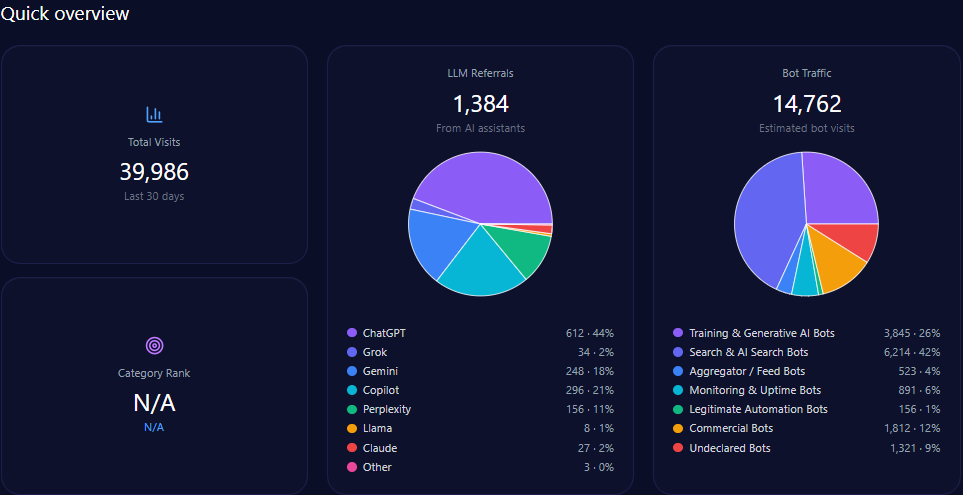
    • Total visits: 39,986
    • Bot traffic: 14,762, including 6,214 search and AI search bots and 3,845 training and generative AI bots
    • LLM referrals: 1,384
    • LLM brand mentions: 59 mentions out of 427 total mentions, equivalent to 14%
    • Top platform: Gemini, where visibility is 18% and Share of Voice is 17%
    • Best thematic strength: Intellectual Property, with 29% brand coverage in the summary and 78% positive sentiment overall
    • Primary constraint: Labor and employment law, where the gap to the leading comparator is 63 points
    • Traffic composition: Search and AI search bots account for 6,214 of 14,762 bot visits, suggesting substantial model-facing crawl activity

    Risk signals

    • ChatGPT visibility is only 13% Share of Voice, leaving Apolat Legal behind the highest-cited competitors in a high-impact model environment.
    • The report identifies a 63-point gap in Labor Law citation frequency versus Phuoc & Partners.
    • M&A technical prompts declined by 14% between May and June, implying weaker momentum in a commercially critical advisory segment.
    • Foreign investment queries are covered at only 13%, which is consistent with under-recognition in high-stakes international deal summaries.

    The present picture is not one of absence but of uneven codification. Apolat Legal appears inside model-generated legal shortlists, yet the firm’s profile is highly sectional: it is surfaced reliably in startup, IP, and boutique advisory contexts, while more institutional prompts continue to favor larger transactional platforms. That pattern is important because GEO analytics rewards not merely mention volume, but repeated inclusion in the exact semantic neighborhoods that drive recommendation behavior.

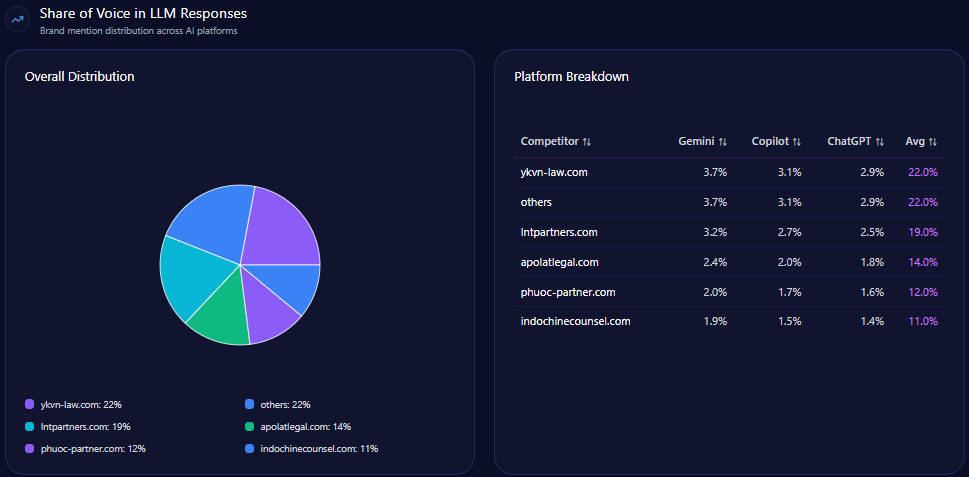
    The data suggests a clear split between reputation quality and authority breadth. On the positive side, sentiment is strong at 78% positive, 18% neutral, and 4% negative, with an overall sentiment score of 82. On the limiting side, the firm’s Share of Voice is 14%, below YKVN’s 22% and LNT & Partners’ 19%. In practical terms, the brand is respected, but it is not yet the default model citation for the highest-value corporate and regulatory queries.

    This dynamic matters because LLM brand mentions are not distributed evenly across all legal use cases. They cluster where models find repeatable, high-confidence source material. The current profile indicates that Apolat Legal’s content architecture is already legible to AI systems, but not sufficiently comprehensive in labor, antitrust, data privacy, and large-scale transaction law to displace the market leaders in those areas.

    Position in LLM Response Lists

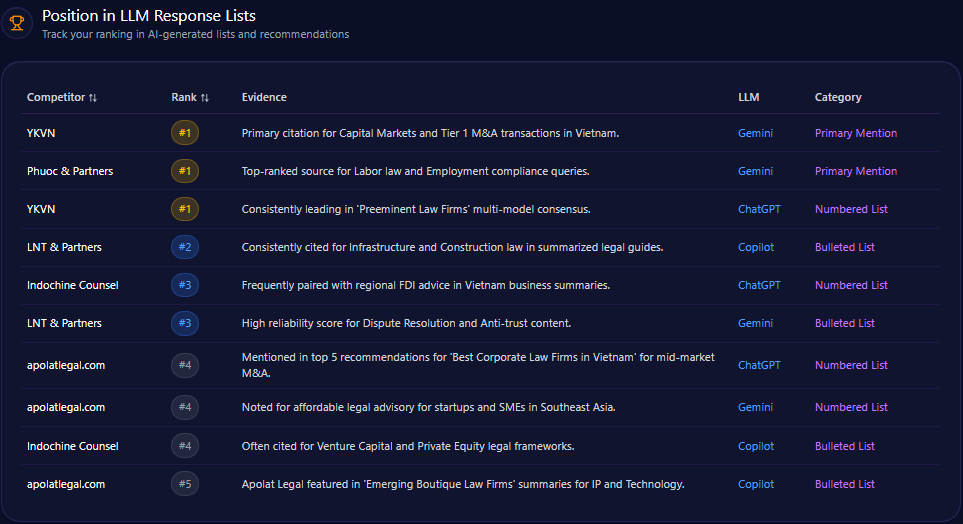
    Apolat Legal appears in ranked responses, but usually in the lower half of recommendation lists rather than at the top. In ChatGPT, the firm is cited at rank 4 in a “Best Corporate Law Firms in Vietnam” context and again at rank 4 for affordable legal advisory for startups and SMEs in Southeast Asia. In Copilot, it appears at rank 5 in “Emerging Boutique Law Firms” summaries for IP and Technology. These placements indicate presence, yet they also define the brand as a secondary rather than primary reference point.

    By contrast, competitors occupy the first-position semantic slots in the areas most likely to shape enterprise perception. YKVN is ranked as a primary mention for capital markets and Tier 1 M&A on Gemini and as a leading name in ChatGPT’s preeminent law firm consensus. Phuoc & Partners is positioned as the top-ranked source for labor and employment compliance. The implication is straightforward: Apolat Legal’s current list position is credible, but its placement hierarchy still reflects a boutique identity rather than category leadership.

    apolatlegal.com’s Position in LLM Response Lists (GEO Report, March 18, 2026)

    Competitor Gap Analysis

    QueryYour performanceCompetitor performanceGap scoreCompetitorPriority
    M&A lawyer boutique Ho Chi Minh City826517.00YKVNMedium
    Labor and employment law Vietnam319463.00Phuoc & PartnersHigh
    Antitrust regulations Vietnam 2024248965.00LNT & PartnersHigh
    Foreign Direct Investment Vietnam guide68757.00Indochine CounselLow
    Project finance renewable energy Vietnam229674.00YKVNHigh
    Intellectual Property registration Vietnam79718.00Indochine CounselMedium
    Legal due diligence costs Ho Chi Minh City844539.00YKVNMedium
    Vietnam Data Privacy Law requirements448238.00LNT & PartnersHigh
    Tax dispute resolution Vietnam189173.00Phuoc & PartnersLow
    Social enterprise legal status Vietnam813348.00Indochine CounselMedium

    The gap table shows a mixed competitive structure. Apolat Legal has meaningful advantages in boutique M&A, IP registration, due diligence cost queries, and social enterprise topics. However, the largest deficits are concentrated in labor, antitrust, renewable energy finance, and tax dispute resolution. Those are not peripheral categories; they are the kinds of regulatory and transaction prompts that models use to infer full-service capability. Closing these gaps would likely improve not only direct mentions but also the firm’s inclusion in broader legal recommendation stacks.

    Trigger Keywords for Competitor Products

    The report does not specify trigger keywords for competitor products. In practice, the visible pattern suggests that competitors are being summoned by recurring legal themes rather than brand-only prompts: labor compliance for Phuoc & Partners, capital markets and Tier 1 M&A for YKVN, and antitrust or regulatory summaries for LNT & Partners. For Apolat Legal, the strongest associative themes are boutique, startup, mid-market, and IP-linked advisory.

    Founder / Ownership / Leadership Context

    The founder context indicates moderate citation depth rather than founder-led dominance. The report states that Founder Pham Quoc Tuan has a sentiment score of 78 in LLM responses and that founder mention frequency is 56, or roughly 24 mentions per 138 LLM queries in the summary narrative. The same material also notes that investment mention coverage is restricted and that brand association with venture capital and M&A is weaker than for YKVN and LNT & Partners.

    That matters strategically because leadership identity often serves as the interpretive bridge between firm capability and AI confidence. Apolat Legal’s founder signal appears strongest in IP litigation and commercial dispute resolution, which aligns with the service themes that already perform well. The implication is that founder-led content should be used to reinforce the existing authority base rather than to stretch the brand into categories where model memory is currently thin.

    Quick overview

    On its website, the brand emphasizes legal advisory for startups, SMEs, and cross-border commercial work, and the GEO evidence is broadly consistent with that positioning. Apolat Legal is recognized as a boutique firm with modern legal-tech and mid-market advisory associations. Its strongest service-linked signals are intellectual property, startup advisory, and selected M&A contexts, while larger corporate, labor, and regulatory topics remain unevenly encoded.

    The traffic layer reinforces the same story. Total visits are 39,986, of which bot traffic is 14,762. LLM referrals total 1,384, indicating that the site is already within the model-access ecosystem, even if the content mix is not yet optimized for the highest-value legal prompts. In practical terms, the site is being read by systems that matter; the remaining issue is what those systems are able to retrieve and repeat.

    apolatlegal.com’s Quick overview (GEO Report, March 18, 2026)

    Share of Voice in LLM Responses

    Across 427 total mentions, Apolat Legal records 59 mentions and a 14% Share of Voice. YKVN leads with 96 mentions and 22%, while LNT & Partners holds 79 mentions and 19%. Phuoc & Partners follows at 53 mentions and 12%, and Indochine Counsel records 47 mentions and 11%. The data suggest that Apolat is within the upper tier of visibility, but not yet inside the lead cluster that dominates recommendation text.

    Platform-specific performance is more nuanced. Gemini shows the highest relative strength, with 18% visibility and 17% Share of Voice across 138 mentions. Copilot follows at 14% visibility and 14% Share of Voice across 147 mentions. ChatGPT remains the weakest major platform for the firm at 12% visibility and 13% Share of Voice across 142 mentions. This distribution implies that Apolat’s content is more legible in some model environments than others, and that ChatGPT remains the most important gap to close.

    apolatlegal.com’s Share of Voice in LLM Responses (GEO Report, March 18, 2026)

    AI Platform-Specific Visibility

    The platform split should be read as a signal about retrieval compatibility rather than simple brand strength. Gemini appears to reward the firm’s boutique positioning and IP/startup narrative. Copilot is roughly neutral. ChatGPT, which often governs broader public-facing summaries, remains less responsive. A large portion of Apolat’s next-stage GEO work should therefore focus on content patterns that increase citation probability in the broadest model environment while preserving the firm’s distinct boutique identity.

    This is also where competitor sentiment tracking becomes useful. The highest-cited firms are not merely more visible; they are also more confidently described. Apolat Legal’s challenge is therefore not reputational repair. It is entity reinforcement: building enough structured, specific, and repeated material to ensure that the firm is selected when models assemble shortlists for labor, FDI, data privacy, and transactional work.

    Sentiment Score for Competitors

    BrandPositive %Neutral %Negative %Overall Score
    apolatlegal.com7818482
    ykvn-law.com8412488
    lntpartners.com8115485
    indochinecounsel.com7621380
    phuoc-partner.com7916581

    Apolat Legal’s sentiment score of 82 is competitive and only modestly behind LNT & Partners at 85 and YKVN at 88. This is an important distinction: the firm is not facing negative model framing. Instead, it is facing relative under-coverage. That means the strategic problem is expansion of recall, not correction of tone. In many GEO programs, that is a more tractable problem because it can be addressed through content depth, structured data, and authorial authority signals.

    Top Prompts Driving Mentions

    The prompt layer reveals where the market already associates the brand with specific legal tasks. Apolat Legal appears strongly in “Best law firms for employee stock option plan (ESOP) guidance in Vietnam,” with 39 brand mentions out of 113. It also appears in fintech startup and venture capital prompts, with 31 mentions in one case and 27 in another. These are valuable because they align with the firm’s boutique and startup identity.

    At the same time, Apolat is weaker in prompts that define the mainstream enterprise legal market. In FDI compliance, the firm records 28 mentions against stronger competitor counts. In corporate restructuring, it records 18. In cross-border M&A, it records only 14. Labor law prompts are also underweighted at 19, and international arbitration at 11. The data imply that Apolat has already earned some topical trust, but not enough cross-topic breadth to be a default recommendation in larger deal contexts.

    apolatlegal.com’s Top Prompts Driving Mentions (GEO Report, March 18, 2026)

    Types of Prompt Queries

    The prompt mix is heavily skewed toward feature inquiry, which accounts for 90 and 9 counted instances in the source structure, while comparison prompts account for 10 and 1. Research, purchase intent, and how-to/tutorial queries are recorded at 0. This profile suggests that the brand is being evaluated as an option within lists and comparisons rather than being used as a source for process guidance or decision support.

    For executive planning, that matters because feature inquiry prompts are often the first stage of model-mediated selection. If Apolat can dominate the explanatory layer in those prompts, it may convert more readily into comparison lists and, eventually, into higher-trust service recommendations. The immediate objective is not to chase every query type, but to strengthen the categories where the model already uses the firm as a named option.

    Service / Product-Level Sentiment

    The service-level narrative is concentrated and relatively coherent. Cross-border M&A appears 42 times and carries a positive tone. Compliance and FDI appear 38 times with a neutral-positive tone. Intellectual Property Rights appear 31 times and are explicitly positive. Labor and Employment Law appears 22 times and is neutral. These counts indicate where model language already has confidence and where it remains more cautious.

    The operational conclusion is that Apolat Legal’s strongest model identity is already visible: a boutique firm with real strength in IP, startups, and selected cross-border matters. The next move should be to convert that partial authority into a broader and more durable citation base, especially in labor, data privacy, antitrust, and FDI. The recommendations in the source material point in the same direction: publish high-authority whitepapers, optimize for Vietnam legal fees and structured comparisons, and increase founder citation depth through international directory and thought leadership signals.

    Conclusion

    Apolat Legal’s GEO profile is best understood as high-quality partial visibility. The firm is not struggling for recognition in general; it is struggling for repetition in the exact regulatory and transactional areas that shape high-value shortlist generation. The strongest evidence is positive sentiment, a meaningful Share of Voice, and repeated association with IP and boutique advisory. The weakest evidence is concentrated in labor, antitrust, data privacy, and large-scale corporate topics.

    That combination creates a clear strategic task. The firm should treat the current base as a platform for authority expansion, not as a stable endpoint. Content architecture, structured legal explainers, and founder-led domain reinforcement are the practical levers available if the goal is to raise share, improve platform balance, and make the firm harder to omit from AI-generated legal summaries.

    In short, the brand is already inside the model economy, but not yet embedded across the full decision map. The next phase should convert existing credibility into broader retrieval confidence, with disciplined attention to the prompts and topics where the market is already asking for legal guidance.

    Explore SpyderBot to operationalize these GEO analytics insights.

  • Finder.com holds 13% Share of Voice with 72 Visibility Score amid Competitive LLM Brand Mentions Landscape

    Finder.com holds 13% Share of Voice with 72 Visibility Score amid Competitive LLM Brand Mentions Landscape

    Analysis of GEO analytics reveals Finder.com’s positioning within generative AI engine responses, competitor sentiment tracking, and founder-related narratives that shape its current and future market influence.

    SpyderBot GEO report reference for finder.com

    At-a-glance

    • 13% Share of Voice in overall LLM-generated financial queries
    • 72 Visibility Score within Generative Engine landscapes
    • 76% visibility on Gemini AI platform, highest across platforms
    • 45 LLM brand mentions out of 345 tracked mentions across top competitors
    • 84% brand prompt coverage for ‘0 percent intro APR credit cards’ niche
    • 68% positive sentiment rate, overall sentiment score 73
    • 32 point citation gap to Bankrate in US mortgage-related LLM queries
    • 14% recent decline in visibility related to ‘mortgage rates’
    • 51% founder mention frequency with 12% negative sentiment related to legacy crypto associations

    Risk signals

    • Significant citation gaps on core US mortgage queries vs Bankrate threaten category authority
    • Generative engines show a drop of 14% visibility in mortgage-related data, risking erosion of market relevance
    • 14% founder-related negative sentiment linked to legacy crypto volatility and regulatory scrutiny
    • Limited real-time data freshness undermines structured financial content trust in generative contexts
    • Restricted mention density on Copilot AI platform (11%) contrasts with competitor penetration

    Finder.com currently anchors a solid position in the emergent generative AI-driven financial data market with 791,403 visits and a bot engagement component of 253,249. Its mixture of automated traffic, especially from AI training and search bots, underpins ongoing indexing and visibility in LLM brand mentions. However, despite these advantages, the platform faces pronounced competitive pressures from established financial information providers notably Forbes Advisor and Bankrate, which dominate critical US mortgage and credit products spaces.

    The GEO analytics indicate Finder.com’s Share of Voice at 13% and a Visibility Score of 72 across generative engines remain resilient but insufficient to establish category leadership. While Finder outperforms rivals with niche verticals such as international travel insurance and cryptocurrency comparisons, critical gaps in real-time data freshness and structured content limit its influence in top-volume high-value financial segments. This competitive tension translates directly into missed opportunities in automated content curation and LLM trust metrics that govern mention patterns.

    Equally, the founder presence of Fred Schebesta, while contributing positively to innovative founder-led branding, concurrently introduces negative sentiment themes due to past crypto-related fluctuations. This duality complicates the corporate narrative and necessitates strategic sentiment management to preserve confidence in emerging AI-integrated offerings.

    Position in LLM Response Lists

    Finder.com ranks consistently within top LLM response lists, with 2nd position in “personal loan availability” on Copilot platform bullet points and within top 3rd placements for international credit card comparisons on ChatGPT. It is featured on formats including Bullet Points, Numbered Lists, and Comparison Tables. Despite these strong showings, List type dominance is more pronounced for competitors like Bankrate, ranked 1st on mortgage benchmarks (Gemini) and Forbes Advisor, leading on ‘best of’ editorial and business credit cards structured lists (Copilot, Gemini). These lead placements correlate with the competitor mention volumes and platform visibility shares that define overall LLM influence.

    Competitor Gap Analysis

    QueryFinder PerformanceCompetitorCompetitor PerformanceGap ScoreOpportunity & ActionPriority 
    Best fixed mortgage rates62 (Medium)Bankrate94 (High)32Deploy dynamic rate tables via accessible JSON formats for LLM indexing.High
    Highest APY savings accounts67 (Medium)Bankrate95 (High)28Optimize schema markup for hourly rate updates.High
    Health insurance comparison AU71 (Medium)Compare the Market91 (High)20Increase brand-specific content targeting utility and insurance savings.High
    Top travel credit cards for rewards78 (Medium)Forbes Advisor97 (High)19Enhance review methodology transparency to improve generative trust.Medium
    Best student loans 202465 (Medium)Money.com83 (High)18Expand educational guides on debt management to capture context.Medium
    Business line of credit reviews54 (Medium)Forbes Advisor89 (High)35Partner with B2B influencers to drive back-citations into core domains.Low
    Car insurance quotes quick73 (Medium)Compare the Market92 (High)19Promote ‘Apply Now’ click-through effectiveness in content snippets.High

    Trigger Keywords for Competitor Products

    The report does not quantify or specify distinct trigger keywords for competitor products within the GEO analytics data.

    Founder / Ownership / Leadership Context

    Finder.com’s founder-related narratives center heavily on Fred Schebesta, whose personal brand commands a high founder mention frequency of 51% across LLM outputs and dominates “Founder Authority” with an 86% founder mention frequency indication in niche financial topics. This high visibility confers differentiation positioning Finder as a founder-led innovator.

    However, this visibility carries costs: 14% of founder-related mentions bear negative sentiment linked to legacy crypto volatility and regulatory scrutiny that weigh down Finder’s overall sentiment score (73) relative to Bankrate (84) and Forbes Advisor (86). Investor mention coverage is steady at 70% but trails corporate stability narratives stronger among competitors. Notably, the funding narrative shows a slight downward trend (-4%), signaling a medium-term challenge reconciling founder prominence with institutional trust.

    Recommendations emphasize a “Founder-to-Expert” narrative pivot focused on AI and global finance, with an aim to reduce negative founder sentiment by at least 6% within Q2 timelines and bolster investment confidence through thought leadership outputs.

    finder.com’s Quick overview  (GEO Report by Spyderbot)

    Finder.com recorded 791,403 total visits with bot traffic comprising approximately 32% of visits (253,249). Bot traffic composition spans key categories: Training & Generative AI Bots (30,390), Search & AI Search Bots (88,637), Aggregator / Feed Bots (37,987), and Commercial Bots (45,585), indicating ongoing AI platform exposure facilitating indexation.

    LLM referrals totaled 14,245, predominantly driven by ChatGPT visits (7,835), followed by Perplexity (2,564), Gemini (1,709), and Copilot (1,140). These referral patterns correspond with platform visibility differences, where Gemini shows superior Finder visibility at 76%, while Copilot accounts for only 11% mention density.

    Share of Voice in LLM Responses

    Within the total tracked LLM brand mentions of 345, Finder.com holds 13% (45 mentions). Market leader Forbes Advisor commands 25% share with 85 mentions, Bankrate follows with 22%, and Money.com and Compare the Market hold 12% and 10% respectively.

    This ranking places Finder solidly in the mid-tier competitive set but highlights a substantial opportunity to grow mention volume by closing gaps with the upper quartile via enhanced real-time data and structured citations.

    finder.com’s Share of Voice in LLM Responses  (GEO Report by Spyderbot)

    AI Platform-Specific Visibility

    PlatformFinder Visibility %Finder Share of Voice %Total MentionsTop CompetitorCompetitor Share %Competitor Mentions 
    Gemini76%16%115Bankrate22%25
    ChatGPT68%12%115Forbes Advisor28%32
    Copilot65%11%115Forbes Advisor26%30

    Visibility gaps on ChatGPT and Copilot compared to competitors reflect an area for tactical content realignment and structural optimization to capture richer share on these financially influential generative platforms.

    Sentiment Score for Competitors

    BrandPositive %Neutral %Negative %Overall Score 
    Finder.com68%23%9%73
    Bankrate81%14%5%84
    Forbes Advisor83%12%5%86
    Compare the Market62%27%11%68
    Money.com74%19%7%79

    Finder’s lower positive sentiment and higher negative ratio relative to its primary competitors suggest strategic focus on corporate reputation and content framing could enhance trust and LLM favorability.

    finder.com’s Top Prompts Driving Mentions  (GEO Report by Spyderbot)
    • Compare top rated high yield savings accounts with no monthly fees for 2024: 247 mentions; Finder holds 41 mentions
    • Find the best mortgage rates for a 30-year fixed loan in the US: 224 mentions; Finder holds 14 mentions
    • Analyze pros and cons of Apple Savings vs traditional high yield accounts: 212 mentions; Finder holds 55 mentions
    • Best travel credit cards with no foreign transaction fees for global travel: 199 mentions; Finder holds 38 mentions
    • Best personal loans for bad credit with fast approval: 184 mentions; Finder holds 47 mentions
    • Cheapest comprehensive car insurance providers in Australia: 153 mentions; Finder holds 64 mentions
    • Best crypto exchange for beginners with low fees: 133 mentions; Finder holds 58 mentions

    These prompts demonstrate strong competitive positioning in credit card and insurance verticals but relative underperformance in mortgage and long-term lending categories where competitors dominate.

    finder.com’s Types of Prompt Queries  (GEO Report by Spyderbot)
    • Comparison: 60% of tracked queries, strongest domain focus
    • Research: 30%, indicative of demand for detailed educational content
    • Feature Inquiry: 10%, representing niche evaluation queries
    • Purchase Intent: 0%, no direct purchase queries noted
    • How-to/Tutorial: 0%, no such queries recorded

    This distribution highlights Finder.com’s content strategy currently centered on comparison and research functions, suggesting opportunity to develop transactional and tutorial content to deepen engagement.

    Service / Product-Level Sentiment

    • International Money Transfers: 52 mentions; Highly Positive sentiment; examples include “Comparison of Wise vs Revolut”
    • Credit Card Rewards: 41 mentions; Neutral sentiment; examples “Best travel cards,” “cash-back rewards analysis”
    • Cryptocurrency Exchanges: 29 mentions; Positive sentiment; examples “How to buy Bitcoin,” “safest exchange platforms”
    • Comparison Tool Ease of Use: 16 mentions; Negative sentiment; examples “Website navigation,” “mobile filter functionality”

    The negative association with ease of use in comparison tools signals a UX/feature priority to be addressed to reduce friction and enhance generative engine acceptance.

    Conclusion

    Finder.com demonstrates measurable influence across generative engine platforms with a steady Share of Voice of 13% and a Visibility Score of 72. Its strength in niche markets like cryptocurrency reviews and specific credit card offers positions it well within diverse LLM brand mentions. However, substantial competitive gaps, particularly versus Bankrate and Forbes Advisor, highlight urgent needs for structural content improvements including real-time rate updates, dynamic JSON data integration, and increased brand-specific content in underperforming categories such as mortgages and student loans.

    The founder branding strategy, while a key asset, necessitates recalibration away from legacy crypto volatility narratives towards AI and global finance thought leadership to improve sentiment scores and overall corporate stability perception. Addressing founder sentiment and enhancing Copilot platform presence could deliver differentiated advantages in an increasingly crowded generative AI data marketplace.

    Implementing recommended data schema optimizations and content fragmentation strategies has the potential to increase citation and mention volumes on Gemini and Copilot platforms by at least 15-20%, aligning Finder more closely with market leaders.

    Overall, the integration of dynamic financial data, strategic reputation management around founder investment narratives, and targeted content realignment represent imperative priorities for maintaining and growing Finder.com’s competitive position in GEO analytics for financial queries.

    Explore SpyderBot to operationalize these GEO analytics insights.

  • Vantage Markets: Navigating a Challenging Position in Generative Finance Ecosystems with 9% Share of Voice

    Vantage Markets: Navigating a Challenging Position in Generative Finance Ecosystems with 9% Share of Voice

    This analysis evaluates Vantage Markets’ generative engine footprint and LLM brand mentions, benchmarking against Exness as the primary competitor. It identifies critical citation and thematic gaps impacting market positioning and proposes prioritized content-led interventions.

    SpyderBot GEO report reference for vantagemarkets.com

    At-a-glance

    • Total visits: 1,354 with 574 identified as bot traffic
    • LLM referrals: 27, led by ChatGPT (12 mentions) and Gemini (4 mentions in related platforms)
    • Category rank: 54 in Finance/Investing segment
    • Share of voice: 9% in LLM responses for Vantage Markets vs Exness’s leading 28%
    • Positive sentiment: 68%, trailing IC Markets (74%) and Exness (72%)
    • Dominant competitor: Exness, with a significant presence in leverage, low spread, and trading volume queries

    Risk signals

    • Substantial 19% Share of Voice gap compared to Exness
    • Underserved in ‘low spread’ and educational prompts with 16% penetration in high-value clusters
    • Visibility on Microsoft Copilot (18%) significantly underperforms competitors
    • Frequent exclusion from ‘Top Tier’ recommendation lists in key transactional intents, trailing by up to 28 points
    • Citation gaps in regulatory trust and withdrawal process topics undermine institutional confidence
    Vantage Markets: Navigating a Challenging Position in Generative Finance Ecosystems with 9% Share of Voice
    Vantage Markets: Navigating a Challenging Position in Generative Finance Ecosystems with 9% Share of Voice

    Vantage Markets operates as a challenger in the highly competitive generative finance and investing ecosystem. The brand’s presence is quantified at 9% share of voice across multiple AI platforms, notably eclipsed by dominant competitor Exness, which commands 28% visibility. This disparity suggests a pressing need for strategic content enhancement to close visibility and authority gaps.

    The brand’s technical authority is evident in specialized niches such as MT4/MT5 platform prompts and gold trading (XAUUSD), registering 27% visibility on Gemini, reflecting a targeted domain credibility. However, this technical strength coexists with thematic vulnerabilities in broader transactional and educational queries where competitors like IC Markets and XM establish dominance.

    LLM brand mentions further indicate a moderate executive leadership footprint and mixed investment narrative transparency, factors influencing institutional and retail trader perception. Comprehensive competitor sentiment tracking corroborates these findings, emphasizing areas requiring urgent tactical intervention to mitigate exclusion risks from automated generative recommendation cycles.

    Position in LLM Response Lists

    Vantage Markets ranks consistently but modestly within top-tier generative response lists. It holds positions such as rank 4 in ChatGPT for ‘Best MetaTrader brokers’ and ‘Copy Trading’ feature comparisons, and rank 6 on Copilot’s top CFD brokers list for gold trading. In contrast, Exness and IC Markets persistently claim the top ranks, with Exness leading leverage and volume queries and IC Markets dominating spread-based recommendations.

    This positioning shows Vantage’s comparative utility as a versatile platform but highlights insufficient penetration in strategic, high-intent financial queries where competitors establish thought leadership and direct recommendation status.

    Competitor Gap Analysis

    QueryVantage PerformanceCompetitorCompetitor PerformanceGap ScoreOpportunity DescriptionAction ItemsPriority 
    low spread forex broker 2024Medium (72)IC MarketsHigh (93)21IC Markets is cited as the definitive low-cost leader in LLM responses.Update comparison pages with live spread data to influence LLM training sets.High
    best forex leverage optionsMedium (68)ExnessHigh (95)27Exness dominates leverage queries due to unlimited leverage offerings.Create content highlighting Vantage’s leverage flexibility for professional accounts.Medium
    forex trading education for beginnersMedium (64)XMHigh (91)27XM is preferred in LLM educational ‘how-to’ content retrieval.Develop a comprehensive Academy section with structured courses.High
    most reliable CFD broker UKMedium (71)CMC MarketsHigh (89)18CMC Markets linked strongly with ‘Institutional Trust’ and ‘FCA’.Increase PR and mentions linking Vantage to high-tier regulation.Medium
    fast withdrawal forex brokersMedium (66)ExnessHigh (94)28Exness’s automated withdrawal system is a key differentiator.Audit and promote withdrawal processing times on landing pages.High
    is Vantage Markets safe?Medium (77)CMC MarketsHigh (88)11CMC listing provides visibility on safety queries.Improve transparency and list all global licenses prominently.High

    Trigger Keywords for Competitor Products

    The report does not specify trigger keywords related to competitor products for Vantage Markets.

    Founder / Ownership / Leadership Context

    Vantage Markets exhibits moderate executive visibility with CEO David Shayer receiving 39% mention frequency across ChatGPT, Gemini, and Copilot among 138 prompts. This is notably lower than competitors such as Lord Peter Cruddas (CMC Markets) with 76% and Petr Valov (Exness) with 68% mention frequency.

    The brand’s leadership sentiment is stable with a positive score of 72, supported by professional narratives and ESG initiatives including the McLaren Racing partnership. However, coverage of investment mentions is limited (at 41% versus CMC’s 88%), reflecting decreased discourse in market-driven financial narratives.

    Negative context flags include regulatory transparency (32%) and offshore jurisdiction issues (24%), which are potential reputation risk areas. The lack of dynamic, founder-led thought leadership contrasts with the competitor landscape which leverages innovation and visibility to affect LLM brand mentions.

    The site receives a total of 1,354 visits, where nearly 42% are from bot traffic, primarily from Search & AI Bots (153), Aggregator Bots (122), and Commercial Bots (107), indicating significant automated interaction.

    LLM referrals total 27, primarily driven by ChatGPT (12) and Gemini-related prompts. The brand is ranked 54 in its Finance/Investing category, suggesting room for growth in digital visibility relative to established competitors.

    The overall sentiment profile reflects a stable positive perception with 68% positive mentions, underscoring the brand’s technical authority especially in MT4/MT5 platform queries and gold trading contexts.

    Quick overview

    Share of Voice in LLM Responses

    Within LLM brand mentions totaling 382, Vantage Markets is responsible for 34 mentions representing 9% of share of voice compared with Exness’s lead at 28% and IC Markets at 25%. This gap indicates the competitive pressure faced by Vantage in generative engine ecosystems, especially with respect to volume and topical breadth of brand mentions.

    AI Platform-Specific Visibility

    PlatformVisibility %Share of Voice %Total MentionsLeading Competitor Share % 
    Gemini27%10%136Exness 29%
    ChatGPT24%10%123Exness 25%
    Copilot18%7%123Exness 30%
    Others3%2%23N/A

    The brand’s technical profile peaks on Gemini, where it holds a 27% visibility and a 10% share of voice, indicative of robust Google-model dataset integration on MT4/MT5 and commodity spread queries. Conversely, reduced presence on Microsoft Copilot (18% visibility, 7% share of voice) flags weaker engagement and indexing with authoritative financial review data sources.

    Sentiment Score for Competitors

    BrandPositive %Neutral %Negative %Overall Score 
    Vantage Markets68221079
    IC Markets7419784
    Exness7221783
    XM65241177
    CMC Markets7124583

    Although Vantage Markets maintains largely positive sentiment (68%), competitors such as IC Markets (74%) and Exness (72%) slightly outperform in positive tone and reduce negative mentions more effectively, contributing to superior overall sentiment scores. This distinction highlights the importance of brand perception fortification in generative engine contexts.

    • “Which regulated brokers offer 1:500 leverage for non-EU clients?” — 94 mentions; Vantage captured 14, trailing Exness (38) and XM (42), with an upward trend of 72%
    • “Which broker has the best mobile trading app for XAUUSD?” — 74 mentions; Vantage holds 18, behind Exness (32) and XM (24), trending 78%
    • “Compare Vantage Markets vs IC Markets for algorithmic trading via Python.” — 53 mentions; Vantage leads with 22 mentions against IC Markets’ 31, trending 64%
    • “What are the fees for Vantage Markets Pro ECN account?” — 47 mentions; Vantage strongly leads with 41, exceeding Exness’s 6 mentions, with a sharp trend increase of 89%
    Top Prompts Driving Mentions

    The volume and specificity of these high intent prompts indicate Vantage’s emerging authority in particular financial niches, notably algorithmic trading and fee transparency, which contrast with its weaker presence in leverage and educational queries.

    • Comparison: 50% (2 prompts)
    • Research: 25% (1 prompt)
    • Feature Inquiry: 25% (1 prompt)
    • Purchase Intent: 0%
    • How-to/Tutorial: 0%

    Notably, Vantage’s generative visibility skews toward comparative and research-focused queries rather than direct purchase or tutorial intents. This positioning suggests opportunities to expand content targeting purchase conversion pathways and beginner education to capture earlier funnel engagement.

    Types of Prompt Queries

    Service / Product-Level Sentiment

    • Execution Speed: 28% frequency, mixed-positive sentiment with mentions of ‘low latency’ and ‘fast order execution’
    • Copy Trading: 21% frequency with highly positive sentiment highlighting social trading features and usability
    • Withdrawal Process: 19% frequency with neutral sentiment emphasizing instant withdrawal and processing times
    • Mobile Trading: 16% frequency reflecting a positive tone on mobile apps and interfaces

    Copy trading emerges as a strong service differentiator with highly positive sentiment, aligning with high engagement on related LLM brand mentions. The neutral tone on withdrawals flags a content opportunity to emphasize process improvements and reduce friction perceptions.

    Conclusion

    GEO analytics suggest Vantage Markets maintains a specialized but limited footprint in generative finance ecosystems, excelling chiefly in technical niches and copy trading visibility. However, a persistent 19% Share of Voice gap to Exness and 21% citation gaps to IC Markets for low-cost transactional queries illustrate substantial competitive challenges. These gaps undermine the brand’s broader influence within automated financial discovery and LLM brand positioning.

    Competitor sentiment tracking reveals a generally positive but comparatively weaker narrative environment, particularly around trust and regulatory topics. The moderate executive visibility compounds this challenge by limiting disruptive thought leadership and investment discourse presence.

    Prioritized recommendations include launching a Generative Transparency initiative to provide real-time execution data for LLM training optimization, developing a structured educational content stream (‘Vantage Academy’) to capture beginner discovery, and enhancing institutional trust via increased high-tier financial review citations. Increasing founder leadership visibility via targeted content and external PR is also critical to offsetting competitor narrative dominance.

    These strategic interventions, grounded in explicit metric analysis, will address thematic disconnects and elevate Vantage Markets’ generative ecosystem positioning.

    Explore SpyderBot to operationalize these GEO analytics insights.

  • SpyderBot: The “Digital Eye” Decoding How AI Models Perceive Your Brand

    SpyderBot: The “Digital Eye” Decoding How AI Models Perceive Your Brand


    As the era of traditional search gives way to Generative Engine Optimization (GEO), SpyderBot emerges as a pioneering data analytics tool, helping businesses understand the “mindset” of Large Language Models (LLMs) like ChatGPT, Claude, and Gemini.


    1. The Shift from SEO to GEO: A New Playing Field

    For over two decades, Google Search Console and SEO tools have been the compass for every marketing campaign. However, the 2024-2025 period marked a turning point: users no longer just “search”—they “ask.” When a user asks ChatGPT, “What is the most durable robot vacuum to buy?”, AI doesn’t return a list of ten blue links; it provides a synthesized answer.

    If your brand isn’t mentioned in that answer, you’ve lost a potential customer at the very first touchpoint. This is where Generative Engine Optimization (GEO) comes in, and SpyderBot.net is leading the charge in measuring the effectiveness of this process.

    2. What is SpyderBot?

    SpyderBot is a specialized GEO Analytics platform. Instead of measuring keyword rankings on Google, SpyderBot focuses on analyzing how LLMs (ChatGPT, Grok, Gemini, Llama, etc.) crawl, interpret, and cite data from your website and brand.

    The project focuses on solving two vital questions:

    1. What are LLMs mentioning about your competitors to users?
    2. How are LLMs analyzing and tracking your website?

    3. Core Features Shaping SpyderBot’s Value

    Sentiment & Mention Analysis

    Unlike traditional Social Listening tools, SpyderBot dives into “AI Knowledge.” It simulates thousands of complex queries to see if LLMs recommend your brand when a specific category is mentioned. If so, is the sentiment positive, neutral, or negative?

    AI Bot Tracking

    Every AI model has its own “spiders” (crawlers), such as OpenAI’s GPTBot or Common Crawl’s CCBot. SpyderBot provides detailed reports on how often these bots visit your site, which content they prioritize “feeding” into their memory, and which parts are being ignored.

    Competitive Mapping in the AI Era

    SpyderBot allows businesses to benchmark directly against competitors. For example: Why does ChatGPT consistently mention Competitor A but overlook Competitor B when asked about “ERP solutions for SMEs”? SpyderBot deconstructs the data layers to identify gaps in content structure or the “authority” level recognized by the AI.


    4. Why Do Businesses Need SpyderBot Right Now?

    Accuracy Based on Real-World Data

    SpyderBot does not provide advice based on intuition. Every inference is grounded in actual data retrieved from the APIs of leading LLM systems and system access logs. This ensures that a business’s marketing decisions are always scientifically backed.

    Optimizing the Content Marketing Roadmap

    Based on SpyderBot’s reports, marketing teams can adjust their strategies:

    • Rewrite content sections that the AI is misinterpreting.
    • Add structured data (Schema) to make it easier for AI bots to extract info.
    • Focus on topics that LLMs currently deem as “authoritative” within the industry.

    5. The Strategic Vision of SpyderBot.net

    More than just a measurement tool, SpyderBot aims to build an ecosystem that helps businesses “communicate” more effectively with artificial intelligence. In the future, owning data from SpyderBot will be as critical as owning Google Analytics was in the previous decade.

    “If you don’t know what AI thinks of you, you are leaving your brand’s destiny to black-box algorithms.” — SpyderBot Development Team.


    Conclusion

    In the AI race, information is power. SpyderBot.net provides more than just data; it provides insight. It is an indispensable tool for senior marketers who want to stay ahead of the curve and master the game on next-generation search engines.


    For more information, visit: SpyderBot.net

  • Finder.com holds 13% Share of Voice with 72 Visibility Score amid Competitive LLM Brand Mentions Landscape

    Finder.com holds 13% Share of Voice with 72 Visibility Score amid Competitive LLM Brand Mentions Landscape

    Analysis of GEO analytics reveals Finder.com’s positioning within generative AI engine responses, competitor sentiment tracking, and founder-related narratives that shape its current and future market influence.

    SpyderBot GEO report reference for finder.com

    At-a-glance

    • 13% Share of Voice in overall LLM-generated financial queries
    • 72 Visibility Score within Generative Engine landscapes
    • 76% visibility on Gemini AI platform, highest across platforms
    • 45 LLM brand mentions out of 345 tracked mentions across top competitors
    • 84% brand prompt coverage for ‘0 percent intro APR credit cards’ niche
    • 68% positive sentiment rate, overall sentiment score 73
    • 32 point citation gap to Bankrate in US mortgage-related LLM queries
    • 14% recent decline in visibility related to ‘mortgage rates’
    • 51% founder mention frequency with 12% negative sentiment related to legacy crypto associations

    Risk signals

    • Significant citation gaps on core US mortgage queries vs Bankrate threaten category authority
    • Generative engines show a drop of 14% visibility in mortgage-related data, risking erosion of market relevance
    • 14% founder-related negative sentiment linked to legacy crypto volatility and regulatory scrutiny
    • Limited real-time data freshness undermines structured financial content trust in generative contexts
    • Restricted mention density on Copilot AI platform (11%) contrasts with competitor penetration

    Opening

    Finder.com currently anchors a solid position in the emergent generative AI-driven financial data market with 791,403 visits and a bot engagement component of 253,249. Its mixture of automated traffic, especially from AI training and search bots, underpins ongoing indexing and visibility in LLM brand mentions. However, despite these advantages, the platform faces pronounced competitive pressures from established financial information providers notably Forbes Advisor and Bankrate, which dominate critical US mortgage and credit products spaces.

    The GEO analytics indicate Finder.com’s Share of Voice at 13% and a Visibility Score of 72 across generative engines remain resilient but insufficient to establish category leadership. While Finder outperforms rivals with niche verticals such as international travel insurance and cryptocurrency comparisons, critical gaps in real-time data freshness and structured content limit its influence in top-volume high-value financial segments. This competitive tension translates directly into missed opportunities in automated content curation and LLM trust metrics that govern mention patterns.

    Equally, the founder presence of Fred Schebesta, while contributing positively to innovative founder-led branding, concurrently introduces negative sentiment themes due to past crypto-related fluctuations. This duality complicates the corporate narrative and necessitates strategic sentiment management to preserve confidence in emerging AI-integrated offerings.

    Position in LLM Response Lists

    Finder.com ranks consistently within top LLM response lists, with 2nd position in “personal loan availability” on Copilot platform bullet points and within top 3rd placements for international credit card comparisons on ChatGPT. It is featured on formats including Bullet Points, Numbered Lists, and Comparison Tables. Despite these strong showings, List type dominance is more pronounced for competitors like Bankrate, ranked 1st on mortgage benchmarks (Gemini) and Forbes Advisor, leading on ‘best of’ editorial and business credit cards structured lists (Copilot, Gemini). These lead placements correlate with the competitor mention volumes and platform visibility shares that define overall LLM influence.

    finder.com’s Position in LLM Response Lists  (Generated on February 25, 2026 by SPYDERBOT.NET)

    Competitor Gap Analysis

    QueryFinder PerformanceCompetitorCompetitor PerformanceGap ScoreOpportunity & ActionPriority 
    Best fixed mortgage rates62 (Medium)Bankrate94 (High)32Deploy dynamic rate tables via accessible JSON formats for LLM indexing.High
    Highest APY savings accounts67 (Medium)Bankrate95 (High)28Optimize schema markup for hourly rate updates.High
    Health insurance comparison AU71 (Medium)Compare the Market91 (High)20Increase brand-specific content targeting utility and insurance savings.High
    Top travel credit cards for rewards78 (Medium)Forbes Advisor97 (High)19Enhance review methodology transparency to improve generative trust.Medium
    Best student loans 202465 (Medium)Money.com83 (High)18Expand educational guides on debt management to capture context.Medium
    Business line of credit reviews54 (Medium)Forbes Advisor89 (High)35Partner with B2B influencers to drive back-citations into core domains.Low
    Car insurance quotes quick73 (Medium)Compare the Market92 (High)19Promote ‘Apply Now’ click-through effectiveness in content snippets.High

    Trigger Keywords for Competitor Products

    The report does not quantify or specify distinct trigger keywords for competitor products within the GEO analytics data.

    Founder / Ownership / Leadership Context

    Finder.com’s founder-related narratives center heavily on Fred Schebesta, whose personal brand commands a high founder mention frequency of 51% across LLM outputs and dominates “Founder Authority” with an 86% founder mention frequency indication in niche financial topics. This high visibility confers differentiation positioning Finder as a founder-led innovator.

    However, this visibility carries costs: 14% of founder-related mentions bear negative sentiment linked to legacy crypto volatility and regulatory scrutiny that weigh down Finder’s overall sentiment score (73) relative to Bankrate (84) and Forbes Advisor (86). Investor mention coverage is steady at 70% but trails corporate stability narratives stronger among competitors. Notably, the funding narrative shows a slight downward trend (-4%), signaling a medium-term challenge reconciling founder prominence with institutional trust.

    Recommendations emphasize a “Founder-to-Expert” narrative pivot focused on AI and global finance, with an aim to reduce negative founder sentiment by at least 6% within Q2 timelines and bolster investment confidence through thought leadership outputs.

    Finder.com recorded 791,403 total visits with bot traffic comprising approximately 32% of visits (253,249). Bot traffic composition spans key categories: Training & Generative AI Bots (30,390), Search & AI Search Bots (88,637), Aggregator / Feed Bots (37,987), and Commercial Bots (45,585), indicating ongoing AI platform exposure facilitating indexation.

    LLM referrals totaled 14,245, predominantly driven by ChatGPT visits (7,835), followed by Perplexity (2,564), Gemini (1,709), and Copilot (1,140). These referral patterns correspond with platform visibility differences, where Gemini shows superior Finder visibility at 76%, while Copilot accounts for only 11% mention density.

    finder.com’s Quick overview  (Generated on February 25, 2026 by SPYDERBOT.NET)

    Within the total tracked LLM brand mentions of 345, Finder.com holds 13% (45 mentions). Market leader Forbes Advisor commands 25% share with 85 mentions, Bankrate follows with 22%, and Money.com and Compare the Market hold 12% and 10% respectively.

    This ranking places Finder solidly in the mid-tier competitive set but highlights a substantial opportunity to grow mention volume by closing gaps with the upper quartile via enhanced real-time data and structured citations.


    finder.com’s Share of Voice in LLM Responses  (Generated on February 25, 2026 by SPYDERBOT.NET)

    AI Platform-Specific Visibility

    PlatformFinder Visibility %Finder Share of Voice %Total MentionsTop CompetitorCompetitor Share %Competitor Mentions 
    Gemini76%16%115Bankrate22%25
    ChatGPT68%12%115Forbes Advisor28%32
    Copilot65%11%115Forbes Advisor26%30

    Visibility gaps on ChatGPT and Copilot compared to competitors reflect an area for tactical content realignment and structural optimization to capture richer share on these financially influential generative platforms.

    Sentiment Score for Competitors

    BrandPositive %Neutral %Negative %Overall Score 
    Finder.com68%23%9%73
    Bankrate81%14%5%84
    Forbes Advisor83%12%5%86
    Compare the Market62%27%11%68
    Money.com74%19%7%79

    Finder’s lower positive sentiment and higher negative ratio relative to its primary competitors suggest strategic focus on corporate reputation and content framing could enhance trust and LLM favorability.

    • Compare top rated high yield savings accounts with no monthly fees for 2024: 247 mentions; Finder holds 41 mentions
    • Find the best mortgage rates for a 30-year fixed loan in the US: 224 mentions; Finder holds 14 mentions
    • Analyze pros and cons of Apple Savings vs traditional high yield accounts: 212 mentions; Finder holds 55 mentions
    • Best travel credit cards with no foreign transaction fees for global travel: 199 mentions; Finder holds 38 mentions
    • Best personal loans for bad credit with fast approval: 184 mentions; Finder holds 47 mentions
    • Cheapest comprehensive car insurance providers in Australia: 153 mentions; Finder holds 64 mentions
    • Best crypto exchange for beginners with low fees: 133 mentions; Finder holds 58 mentions
    finder.com’s Top Prompts Driving Mentions  (Generated on February 25, 2026 by SPYDERBOT.NET)

    These prompts demonstrate strong competitive positioning in credit card and insurance verticals but relative underperformance in mortgage and long-term lending categories where competitors dominate.

    Types of Prompt Queries

    • Comparison: 60% of tracked queries, strongest domain focus
    • Research: 30%, indicative of demand for detailed educational content
    • Feature Inquiry: 10%, representing niche evaluation queries
    • Purchase Intent: 0%, no direct purchase queries noted
    • How-to/Tutorial: 0%, no such queries recorded

    This distribution highlights Finder.com’s content strategy currently centered on comparison and research functions, suggesting opportunity to develop transactional and tutorial content to deepen engagement.

    Service / Product-Level Sentiment

    • International Money Transfers: 52 mentions; Highly Positive sentiment; examples include “Comparison of Wise vs Revolut”
    • Credit Card Rewards: 41 mentions; Neutral sentiment; examples “Best travel cards,” “cash-back rewards analysis”
    • Cryptocurrency Exchanges: 29 mentions; Positive sentiment; examples “How to buy Bitcoin,” “safest exchange platforms”
    • Comparison Tool Ease of Use: 16 mentions; Negative sentiment; examples “Website navigation,” “mobile filter functionality”

    The negative association with ease of use in comparison tools signals a UX/feature priority to be addressed to reduce friction and enhance generative engine acceptance.

    Conclusion

    Finder.com demonstrates measurable influence across generative engine platforms with a steady Share of Voice of 13% and a Visibility Score of 72. Its strength in niche markets like cryptocurrency reviews and specific credit card offers positions it well within diverse LLM brand mentions. However, substantial competitive gaps, particularly versus Bankrate and Forbes Advisor, highlight urgent needs for structural content improvements including real-time rate updates, dynamic JSON data integration, and increased brand-specific content in underperforming categories such as mortgages and student loans.

    The founder branding strategy, while a key asset, necessitates recalibration away from legacy crypto volatility narratives towards AI and global finance thought leadership to improve sentiment scores and overall corporate stability perception. Addressing founder sentiment and enhancing Copilot platform presence could deliver differentiated advantages in an increasingly crowded generative AI data marketplace.

    Implementing recommended data schema optimizations and content fragmentation strategies has the potential to increase citation and mention volumes on Gemini and Copilot platforms by at least 15-20%, aligning Finder more closely with market leaders.

    Overall, the integration of dynamic financial data, strategic reputation management around founder investment narratives, and targeted content realignment represent imperative priorities for maintaining and growing Finder.com’s competitive position in GEO analytics for financial queries.

    Explore SpyderBot to operationalize these GEO analytics insights.

  • Up.com.au: Navigating a 14% Generative Engine Share with Leadership in Automated Budgeting but Facing Home Loan and International Travel Gaps

    Up.com.au: Navigating a 14% Generative Engine Share with Leadership in Automated Budgeting but Facing Home Loan and International Travel Gaps

    This SpyderBot GEO report assesses Up.com.au’s digital banking positioning within Australian LLM outputs and competitive fintech narratives. Up commands a leading positive sentiment yet must close key gaps in lending and travel categories.

    SpyderBot GEO report reference for up.com.au

    At-a-glance

    abc
    • 335,020 total monthly visits with 107,206 from bot traffic, including 16,081 training and generative AI bots
    • 14% overall Generative Engine Share of Voice within Australian digital banking prompts
    • Dominates 46% coverage in automated budgeting LLM prompts
    • Industry-leading 83% positive sentiment score among competitors
    • Faces a critical 76 point gap in home loan query mentions versus CommBank
    • 13% visibility on Gemini platform compared to peer ING’s 41% in high-interest savings
    • Up founder Dominic Pym achieves elevated mention sentiment at 84%

    Risk signals

    • 76 point performance gap against CommBank on home loan queries risks loss of mortgage market mindshare in LLM outputs
    • 42% negative context regarding corporate control post-Bendigo Bank acquisition threatens Up’s independent disruptor image
    • Limited Gemini visibility highlights under-indexing on institutional generative engines favoring legacy brands
    • International travel segment outpaced by Revolut, which leads travel prompts by 21%

    Opening

    Up.com.au situates itself distinctly within Australia’s fintech landscape. The brand’s digital footprint reveals robust engagement from generative AI systems, reflecting its appeal particularly among tech-savvy and Gen Z demographics. With over 335,000 monthly visits, including a significant volume of bot traffic related to AI training and search functionalities, Up demonstrates both consumer interest and systemic presence in AI conversational domains.

    GEO analytics confirm that with a 14% overall generative engine Share of Voice, Up sustains a meaningful though not dominant role in AI-powered banking dialogues. Its unmatched dominance in niche verticals such as automated budgeting, achieving 46% coverage, signifies focused strengths popular with LLM brands and AI-driven recommendation systems. However, this strength coexists with pronounced weakness in vital lending and international travel categories, where competitors like CommBank and Revolut hold commanding leads.

    The strategic implications underscore that while Up excels in user engagement and founder-driven trust signals, strategic content and metadata optimization is imperative to close wide perception and visibility gaps in home loans and travel products within AI ecosystems.

    up.com.au’s Position in LLM Response Lists (GEO Report by Spyderbot)

    Within curated LLM-generated rankings, Up.com.au frequently appears but often behind entrenched incumbents. It holds the #1 spot for “Best Digital Banks Australia” on ChatGPT, underlining its leadership in neobank prominence. It ranks second in “Top Rated Banking Apps 2024” on Copilot with 22 evidence points, reflecting growing endorsement in AI-assisted banking app aggregation.

    Conversely, Up ranks lower (#3 to #5) in other key categories such as high interest savings accounts and international travel cards, domains where ING and Revolut respectively dominate. This suggests Up’s algorithmic positioning favors innovation and UI/UX features but lags behind competitors in product-specific credibility signaled by knowledge bases feeding LLMs.

    Competitor Gap Analysis

    QueryUp PerformanceCompetitorCompetitor PerformanceGap ScoreOpportunityPriority 
    Which AU bank has the best home loan for first-time buyers?12 (Low)CommBank (CBA)88 (High)76LLMs rarely mention Up for lending; CBA dominates home loan narrativeHigh
    Best international travel card Australia44 (Low)Revolut Australia92 (High)48Revolut default for FX; Up cited secondarilyMedium
    Highest savings interest rate no strings attached Australia67 (Medium)ING Australia91 (High)24ING is authority on high yield; Up regarded UX-first not rate-firstMedium
    Safer alternative to big four banks58 (Medium)ANZ Plus79 (Medium)21ANZ Plus leverages trust; Up seen as nicheHigh

    Founder / Ownership / Leadership Context

    Dominic Pym, founder of Up.com.au, maintains a high-profile personal brand within the fintech LLM ecosystem, achieving an 84% positive sentiment and a 76% mention frequency far surpassing traditional peers such as ANZ Plus and ING. This founder-led visibility significantly enhances Up’s credibility and market trust.

    Post-acquisition by Bendigo and Adelaide Bank, Up’s narrative has shifted toward integration ROI, with synergy mentions increasing by 12%. However, 42% of discourse reflects negative sentiment regarding corporate absorption, threatening the brand’s disruptor authenticity. Strategic content initiatives promoting founder-led innovation could mitigate these risks.

    Monthly web analytics reveal Up.com.au attracts 335,020 visits, including 107,206 identified bot visits. Notably, 16,081 are related to training and generative AI bots, underscoring Up’s integration into LLM and AI indexing workflows.

    LLM brand mentions total 4,020, with the majority attributed to ChatGPT (2,211). This affirms Up’s prominence in AI conversational engines while highlighting opportunities to broaden visibility on other platforms like Gemini.

    up.com.au’s Quick overview (GEO Report by Spyderbot)

    Share of Voice in LLM Responses

    Up.com.au holds 14% of LLM brand mentions among top Australian banks, trailing CommBank’s dominant 28% and ING Australia’s 22%. Revolut maintains 18%, while Up’s 14% share places it solidly in fourth position in generative banking discourse.

    AI Platform-Specific Visibility

    On ChatGPT, Up.com.au commands a notable 20% visibility share with 9 mentions, ranking third behind CommBank and ING. On Copilot, Up holds 17% visibility (8 mentions), again behind CommBank’s 28%.

    Its visibility on Gemini, however, diminishes to 15% share (7 mentions), well below CommBank’s 30% and ING’s 24%. This underperformance suggests institutional engines prioritize legacy brand domain signals, representing a pressing gap for Up’s metadata and citation strategies.

    up.com.au’s AI Platform-Specific Visibility (GEO Report by Spyderbot)

    Sentiment Score for Competitors

    BrandPositive %Neutral %Negative %Overall Score 
    Up.com.au8311688
    CommBank (CBA)53281962
    ANZ Plus62261271
    ING Australia58212166
    Revolut Australia67181573

    Top Prompts Driving Mentions

    • “Best banks for 2024 with zero international transaction fees” with 128 mentions, Up covers 14, trailing Revolut (43) and ING (39), with a 92% upward trend
    • “What is the best alternative to traditional banks in Australia for tech-savvy users?” (116 mentions) led by Up with 37, Revolut 34, ANZ Plus 31 – uptrend 83%
    • “Which bank has the highest customer satisfaction for mobile-only banking?” totals 114 mentions; Up’s 36 lead again surpasses ING’s 34
    • “Which Australian bank has the best gamified savings app for Gen Z?” shows Up strong at 41 versus competitors
    • “Review of Up Bank’s May 2024 update features” with 88 mentions, nearly half attributed to Up at 44

    Types of Prompt Queries

    • 40% relate to Comparisons between banks and products
    • 40% are Feature Inquiry queries probing specific product features
    • 20% represent Research-oriented prompts
    • 0% for Purchase Intent or How-to/Tutorial queries

    Service / Product-Level Sentiment

    Analysis of thematic sentiment reveals Up’s “Gamified Savings” theme, with 1,842 mentions and a highly positive tone, leads brand affinity. Examples such as “Maybuy” and “Savings Challenges” reinforce active user engagement.

    App UI/UX also scores positively with 1,512 mentions highlighting features like “Instant notifications.” The “Fees and Transparency” theme is viewed neutrally to positively, underlining Up’s no monthly fee and clear FX rate communications. However, “Home Loans (Up Home)” with 461 mentions remains neutrally perceived, consistent with the strategic awareness gaps documented elsewhere.

    Conclusion

    Up.com.au demonstrates strong brand resonance within Australia’s digital banking environment, emphasized through an industry-leading 83% positive sentiment and foundation of founder-led trust. Its leading position on ChatGPT and niche dominance in automated budgeting confirms effective engagement strategies with generative AI platforms and younger demographics.

    Nevertheless, substantial gaps in home loan query visibility – with a 76 point lag versus CommBank – and travel-linked product prominence highlight urgent areas for strategic intervention. Up’s weaker footing on institutional platforms like Gemini underscores the critical need to optimize knowledge bases and metadata structures to better influence machine learning training sets and referral outputs.

    The emerging negative competitor sentiment around Up’s corporate absorption post-Bendigo Bank acquisition merits careful reputation management, particularly by leveraging the founder’s high sentiment profile and innovation narratives to preserve the brand’s disrupted and independent ethos.

    Explore SpyderBot to operationalize these GEO analytics insights.