For years, SEO defined how brands competed for visibility online.
If users searched for a product, service, or solution, companies tried to rank higher on Google. The logic was simple: better rankings meant more visibility, more clicks, and more opportunities to convert users.
That model still matters.
SEO is not dead. Google still crawls, indexes, and ranks webpages. Strong technical SEO, helpful content, clear internal links, and accessible pages are still essential. Google’s own SEO Starter Guide explains that SEO helps search engines understand your content and helps users find your site through search.
But the search experience is changing.
Users are no longer only typing keywords into Google and scanning a list of links. They are also asking AI systems like ChatGPT, Gemini, Claude, Grok, and Copilot for direct answers, comparisons, and recommendations.
That creates a new layer of visibility.
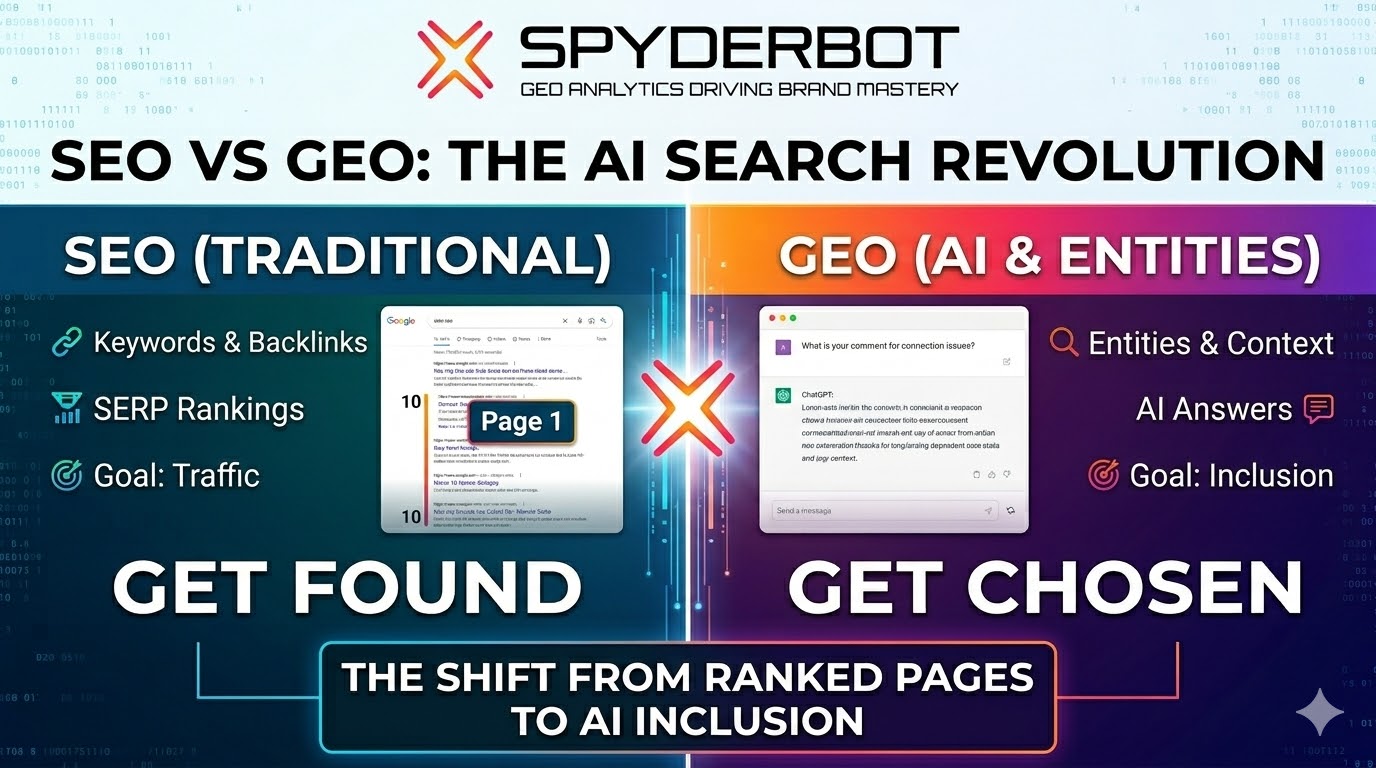
In SEO, your webpage competes for ranking.
In GEO, your brand competes for inclusion inside AI-generated answers.
That is the core difference between Search Engine Optimization and Generative Engine Optimization.
What is SEO?
SEO stands for Search Engine Optimization.
It is the process of improving a website so search engines can crawl, understand, index, and rank its pages.
SEO focuses on webpage visibility in search results.
Common SEO work includes:
- Keyword research
- Technical SEO
- Content optimization
- Internal linking
- Backlink building
- Page speed improvement
- Search intent matching
- Structured data
- Title tags and meta descriptions
- Content updates
The goal of SEO is to help users find your pages when they search for relevant topics.
For example, if someone searches “best AI brand monitoring tools,” SEO helps your article, comparison page, or product page appear in Google Search.
SEO is mostly page-centric.
It asks:
Can this webpage rank for the query?
What is GEO?
GEO stands for Generative Engine Optimization.
It is the process of improving how AI systems understand, mention, compare, and represent a brand in generated answers.
GEO focuses on AI visibility.
Instead of asking only whether a webpage ranks, GEO asks whether a brand is included when AI systems generate answers.
For example, a user may ask ChatGPT:
“What are the best tools to track brand mentions in AI answers?”
The answer may mention only a few tools. If your brand is not included, the user may never consider you.
GEO is more entity-centric.
It asks:
Can AI systems understand our brand clearly enough to include it in relevant answers?
The simple difference between GEO and SEO
The easiest way to understand it is this:
SEO helps your pages get found.
GEO helps your brand get included.
SEO is about search result visibility.
GEO is about AI answer visibility.
SEO measures how webpages perform in search engines.
GEO measures how brands appear inside AI-generated answers.
Both are important, but they solve different problems.
GEO vs SEO comparison table
| Dimension | SEO | GEO |
|---|---|---|
| Main goal | Rank webpages in search results | Get brands included in AI-generated answers |
| Core unit | Page | Entity, brand, product, category |
| Visibility model | Search result list | AI-generated answer |
| Main output | Links, snippets, rankings | Mentions, recommendations, summaries |
| Primary metric | Rankings, impressions, clicks, traffic | Mentions, inclusion, prominence, accuracy |
| Optimization focus | Keywords, technical SEO, content quality, links | Entity clarity, context, semantic consistency, AI interpretation |
| Competition type | Position-based | Mention-based |
| User behavior | Search, compare, click | Ask, receive, decide |
| Main risk | Ranking below competitors | Being excluded or misrepresented |
Why SEO alone is no longer enough
SEO still matters because it helps your content become discoverable, crawlable, indexable, and useful in search.
But SEO alone does not show the full visibility picture anymore.
A website can have:
- Strong rankings
- Good backlinks
- High-quality content
- Organic traffic
- A technically healthy site
And still be missing from AI-generated answers.
This is the AI visibility gap.
The gap happens because AI-generated answers do not always behave like search engine results pages. Instead of showing a list of webpages, AI systems synthesize information and may mention only selected brands, sources, or products.
That means ranking on Google does not automatically guarantee that ChatGPT, Gemini, Claude, Grok, or Copilot will recommend your brand.
SEO is visible. GEO is harder to see.
SEO is easier to measure because search engines provide visible signals.
You can track:
- Ranking position
- Search impressions
- Click-through rate
- Organic traffic
- Indexed pages
- Backlinks
- Search Console performance
- Conversion paths
GEO is harder to measure because AI answers are not always fixed or transparent.
You need to track:
- Whether your brand appears in AI answers
- Which competitors appear instead
- How often your brand is mentioned
- Where your brand appears in the answer
- Whether your brand is described accurately
- Whether AI systems cite your website
- Whether your brand appears across different prompt clusters
- Whether different AI systems describe your brand differently
This is why AI visibility tracking is becoming important.
In SEO, you can see your position.
In GEO, you need to know whether you are included, ignored, misrepresented, or positioned behind a competitor.
GEO still has ranking, but it is hidden
Some people assume AI search has no ranking.
That is not accurate.
AI systems still make selection decisions.
They decide:
- Which brands to mention
- Which brands to omit
- Which sources to cite
- Which options to recommend first
- Which competitors to compare
- Which category to place your brand in
- Which description to use
The ranking is simply less visible.
In Google Search, ranking appears as a list.
In AI-generated answers, ranking is embedded inside the response.
That creates three important GEO layers.
1. Inclusion
Is your brand mentioned at all?
This is the first layer of AI visibility.
If your brand is not included, the user may never consider you.
2. Prominence
If your brand is mentioned, where does it appear?
Are you the first recommendation, one of several options, or a minor alternative?
Prominence matters because users often trust the first few brands AI systems mention.
3. Positioning
How does the AI system describe your brand?
Are you described as:
- A category leader
- A niche tool
- A new alternative
- A lower-cost option
- An enterprise solution
- A limited product
- A trusted provider
Positioning affects perception.
A brand can be mentioned and still lose if the AI description is weak, inaccurate, or less confident than the competitor’s description.
Example: SEO vs GEO in action
Imagine a user is looking for project management software.
In traditional SEO, the user searches:
“best project management software”
Google shows a list of results. The user can compare articles, ads, review pages, and vendor websites.
In this model, ranking on page one gives your brand a chance to earn attention.
Now imagine the user asks an AI system:
“What is the best project management software for a small remote team?”
The AI system may answer with three or four tools and explain why each one is useful.
If your brand is not included, you are not part of the decision.
That is the difference.
SEO gives you visibility in a list.
GEO gives you visibility inside the answer.
The shift from pages to entities
SEO is mostly page-centric.
Search engines rank individual URLs based on relevance, quality, technical accessibility, links, and other signals.
GEO is more entity-centric.
AI systems need to understand what your brand is, what it does, who it serves, what category it belongs to, and how it compares with alternatives.
For GEO, your brand needs clear entity signals, including:
- Brand name
- Website
- Product category
- Company description
- Target audience
- Use cases
- Competitors
- Differentiators
- Industry context
- Consistent descriptions across the web
For example, this is a weak entity description:
“SpyderBot is an AI analytics platform.”
This is stronger:
SpyderBot is a GEO analytics platform that helps brands understand how AI systems like ChatGPT, Gemini, Claude, and Grok mention, compare, and interpret their websites and competitors.
The second sentence is stronger because it clearly explains the category, function, platforms, and value.
The shift from traffic to influence
SEO has traditionally focused on traffic.
That makes sense. More organic traffic usually means more chances to generate leads, signups, sales, or awareness.
But AI search introduces influence before the click.
A user may ask AI for recommendations and form an opinion before visiting any website.
This means GEO is not only about traffic.
It is also about:
- Brand perception
- Recommendation visibility
- Competitive framing
- Trust signals
- Category association
- Answer accuracy
- Inclusion in buyer-intent prompts
A brand may lose influence even if traffic has not dropped yet.
That is why companies should monitor AI visibility before it becomes an obvious revenue problem.
The shift from links to meaning
Backlinks have long been important in SEO because they help search engines discover pages and evaluate authority.
In GEO, links can still matter as part of the broader information ecosystem, but meaning becomes more important.
AI systems need to understand relationships:
- What problem does your brand solve?
- Which category does it belong to?
- Which competitors are relevant?
- What use cases does it support?
- What type of customer is it built for?
- What makes it different?
- Which sources describe it consistently?
GEO requires semantic clarity.
Repeating keywords is not enough.
The goal is to make your brand easier to understand, not just easier to crawl.
How GEO changes content strategy
GEO changes how brands should create content.
In traditional SEO, many companies built separate pages for many keyword variations. That approach can create thin or repetitive content.
Google says its ranking systems are designed to prioritize helpful, reliable information created to benefit people, not content created mainly to manipulate rankings.
For GEO, this matters even more.
AI systems need clarity, not repetition.
Instead of creating many weak articles around similar terms, build strong topic clusters.
For example, a GEO content cluster could include:
- What is Generative Engine Optimization?
- GEO vs SEO
- Why ChatGPT is not mentioning your brand
- How to track brand mentions in LLMs
- How AI systems choose which brands to mention
- Best GEO analytics tools
- AI visibility tracking for SaaS brands
Each article should have a distinct purpose.
This article explains the difference between GEO and SEO.
A “What is GEO?” article should define the concept in detail.
A “Why ChatGPT is not mentioning your brand” article should address a specific problem.
A “Best GEO analytics tools” article should support commercial search intent.
This prevents content cannibalization and helps both users and search engines understand the role of each page.
How to optimize for SEO
Companies should continue investing in SEO fundamentals.
That includes:
- Publishing helpful content
- Matching search intent
- Making pages crawlable
- Keeping pages indexable
- Improving site speed
- Using clear internal links
- Writing descriptive title tags
- Creating useful meta descriptions
- Adding structured data where appropriate
- Improving topical authority
- Updating outdated content
Google’s documentation explains that Search works through crawling, indexing, and serving results, and not every page makes it through every stage.
That means technical accessibility and content quality still matter.
How to optimize for GEO
GEO requires an additional layer of work.
1. Clarify your brand entity
Your website should clearly explain:
- Who you are
- What you do
- Who you serve
- What problem you solve
- What category you belong to
- What makes you different
Avoid vague positioning.
If your brand can be described in five different ways, AI systems may struggle to classify it.
2. Build content around AI-style questions
AI users ask longer, more specific questions.
Examples:
- Why is ChatGPT not mentioning my brand?
- How do LLMs choose which brands to recommend?
- How can I track AI brand mentions?
- How does AI search differ from Google search?
- What tools monitor AI visibility?
- Why does my competitor appear in AI-generated answers?
These questions should become part of your content strategy.
3. Monitor brand mentions across AI systems
Manual testing is useful, but it is not enough.
You should track how your brand appears across:
- ChatGPT
- Gemini
- Claude
- Grok
- Copilot
- AI search experiences
Measure not only whether your brand appears, but also how it is described.
4. Compare competitor visibility
GEO is competitive.
If your competitors appear more often than you, you need to know why.
Track:
- Which competitors appear
- Which prompts trigger competitor mentions
- How competitors are described
- Whether competitors are cited
- Which use cases competitors dominate
- Whether your brand is missing from key categories
5. Improve consistency across the web
AI systems rely on patterns.
If your website, social profiles, third-party listings, product pages, and articles describe your company inconsistently, AI systems may form a weak understanding of your brand.
Consistency helps reinforce entity clarity.
SEO and GEO should work together
The future is not SEO vs GEO.
The future is SEO plus GEO.
SEO helps your website get discovered, crawled, indexed, and ranked.
GEO helps AI systems understand, include, and describe your brand.
A strong digital visibility strategy should include both.
Think of it this way:
- SEO builds discoverability.
- GEO builds AI inclusion.
- SEO helps users find your pages.
- GEO helps AI systems recommend your brand.
- SEO measures rankings and traffic.
- GEO measures mentions, prominence, and perception.
The strongest brands will not choose one over the other.
They will build a system where SEO and GEO support each other.
Founder insight from SpyderBot
While building SpyderBot, one pattern became clear:
The next stage of search visibility is not only about where your website ranks. It is about how AI systems understand your brand.
Traditional SEO tools are excellent for tracking rankings, traffic, backlinks, and technical performance.
But they do not fully answer the new questions companies now face:
- What do LLMs mention about our competitors to users?
- How are AI systems interpreting our website?
- Are we included in AI-generated recommendations?
- Are we being compared with the right competitors?
- Are AI systems describing our product accurately?
That is why GEO matters.
It fills the gap between traditional search visibility and AI-generated brand perception.
GEO vs SEO checklist
Use this checklist to understand where your company stands.
SEO checklist
- Is your website indexable?
- Are your important pages included in the sitemap?
- Are your title tags clear?
- Are your meta descriptions useful?
- Are your pages internally linked?
- Is your content helpful and original?
- Does each page target a distinct search intent?
- Are your pages fast and mobile-friendly?
- Do you have clear company and trust signals?
GEO checklist
- Does AI correctly understand what your brand does?
- Does your brand appear in ChatGPT for category prompts?
- Does your brand appear in Gemini, Claude, Grok, and Copilot?
- Are your competitors mentioned more often?
- Is your brand description accurate?
- Are you included in buyer-intent prompts?
- Are you associated with the right category?
- Are you compared with the right competitors?
- Do AI systems mention your strongest use cases?
- Is your brand consistently described across the web?
Common mistakes when comparing GEO and SEO
Mistake 1: Thinking GEO replaces SEO
GEO does not replace SEO.
SEO remains the foundation of website visibility. Without strong SEO, your content may struggle to be discovered and understood.
GEO adds another layer focused on AI-generated answers.
Mistake 2: Treating GEO as keyword stuffing
GEO is not about repeating “AI visibility,” “LLM monitoring,” or “ChatGPT SEO” many times.
It is about making your brand understandable and contextually relevant.
Mistake 3: Publishing duplicate content
Many brands will publish multiple articles that say almost the same thing:
- What is GEO?
- GEO vs SEO
- Why GEO matters
- AI search vs SEO
- Future of GEO
These articles must have different angles.
Otherwise, they may compete with each other and weaken the site.
Mistake 4: Measuring only traffic
Traffic is important, but it does not show the full picture.
A brand can lose AI visibility before losing organic traffic.
That is why GEO measurement should include mentions, sentiment, prominence, competitor inclusion, and answer accuracy.
Mistake 5: Ignoring misrepresentation
Being mentioned is not enough.
If AI systems describe your brand incorrectly, your GEO strategy still has a problem.
Accuracy matters as much as visibility.
Final thought
SEO is about being found.
GEO is about being included.
SEO helps your pages appear in search results.
GEO helps your brand appear in AI-generated answers.
In the past, digital visibility was mostly about ranking on a results page. In the AI search era, visibility also depends on whether AI systems understand, select, and accurately describe your brand.
The best strategy is not to choose between SEO and GEO.
The best strategy is to build both.
SpyderBot helps brands understand how AI systems mention, compare, and interpret them across major LLMs.
If your company wants to know whether ChatGPT, Gemini, Claude, or Grok is including your brand, ignoring your website, or recommending competitors instead, SpyderBot gives you a clearer view of your AI visibility and the signals shaping your position in AI-generated answers.