Tag: AI search trends

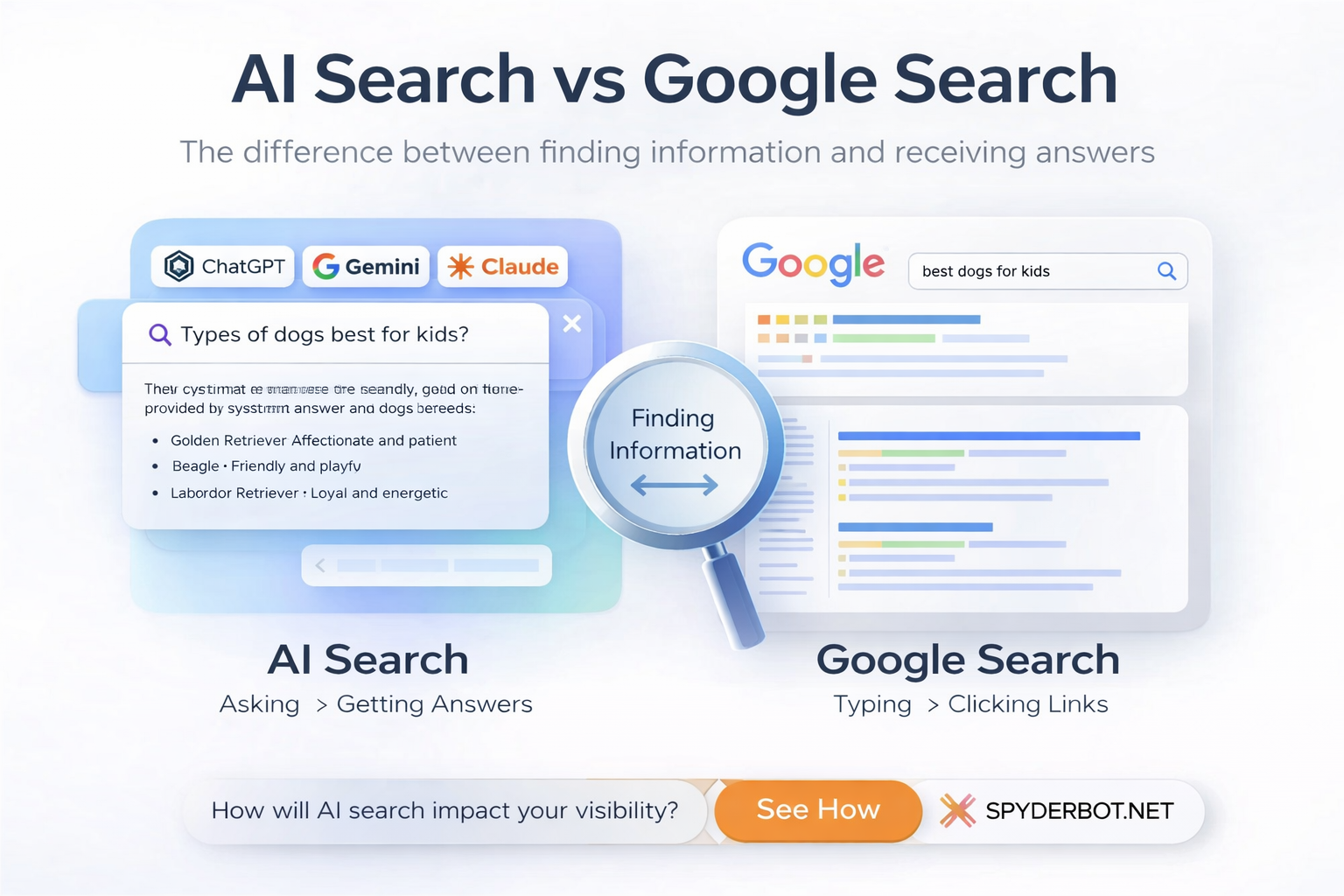
  • AI Search vs Google Search

    AI Search vs Google Search

    The Difference Between Finding Information and Receiving Answers

    For decades, Google Search shaped how people accessed the internet.

    A user typed a query, scanned a list of links, clicked a result, compared sources, and decided what to trust. That behavior became the foundation of SEO, content marketing, ecommerce discovery, and digital brand visibility.

    AI search is changing that pattern.

    Instead of returning only a list of webpages, AI search systems generate direct answers. Users ask questions in natural language and receive summaries, recommendations, comparisons, explanations, and next-step guidance.

    This creates a major shift in how information is discovered.

    Google Search helps users find information.

    AI Search helps users receive answers.

    That difference may sound simple, but it changes how brands are seen, cited, recommended, and trusted online.

    For companies, this shift creates a new visibility challenge. Ranking on Google is still important, but it is no longer the full picture. If AI systems do not mention your brand, cite your website, or include your company in generated recommendations, you may become invisible in the fastest-growing layer of digital discovery.

    This is why the conversation is moving from SEO alone to a broader discipline: AI search visibility and Generative Engine Optimization (GEO).

    I. What Is Google Search?

    Google Search is a retrieval-based search engine.

    Its main function is to crawl the web, index webpages, evaluate relevance, and return a ranked list of results for a user query.

    When someone searches on Google, the system attempts to identify the most useful pages based on many signals, including relevance, authority, page quality, backlinks, technical structure, content usefulness, user experience, and search intent.

    The typical Google Search experience looks like this:

    • A user enters a query.
    • Google returns a search engine results page.
    • The user scans titles, snippets, URLs, images, videos, ads, or featured results.
    • The user clicks one or more links.
    • The user evaluates the information manually.

    This model gives users options.

    A person searching for “best AI search analytics tools” may see multiple webpages, review articles, product pages, comparison posts, ads, videos, and directory listings. The user can open several results and decide which source is most useful.

    Google Search is powerful because it connects users to the open web.

    For companies, this created the traditional SEO model.

    The goal was clear:

    • Rank higher.
    • Get more impressions.
    • Earn more clicks.
    • Convert traffic into leads or customers.

    In this model, visibility is strongly tied to ranking position.

    A page ranking in position one usually receives more attention than a page ranking in position seven. A page on page two may still exist, but it often receives very little traffic.

    That is how search visibility worked for many years.

    II. What Is AI Search?

    AI search is a generative search experience.

    Instead of simply returning a ranked list of webpages, AI search systems interpret a user’s question and generate a synthesized answer.

    AI search may use large language models, retrieval systems, web sources, knowledge graphs, product data, user context, and other signals to produce a response.

    The typical AI search experience looks like this:

    • A user asks a question.
    • The AI system interprets the intent.
    • The system identifies relevant concepts, entities, and sources.
    • The AI generates an answer.
    • The answer may include summaries, recommendations, citations, or follow-up suggestions.

    The output is not just a list of links.

    The output is an answer.

    This changes user behavior.

    Instead of opening five articles to compare options, a user may ask:

    “What are the best tools for tracking brand visibility in ChatGPT?”

    The AI system may respond with a short list of recommended platforms, a comparison, and a direct explanation of which tool is best for each use case.

    That means the AI system is no longer only helping the user search.

    It is helping the user decide.

    This is the core difference between traditional search and AI search.

    Google Search organizes access to information.

    AI Search interprets information and turns it into a response.

    III. AI Search vs Google Search: The Core Difference

    The simplest way to understand the difference is this:

    Google Search returns links.

    AI Search generates answers.

    Google Search gives users options to explore.

    AI Search gives users a synthesized conclusion.

    Google Search is built around ranking pages.

    AI Search is built around selecting, interpreting, and presenting information.

    Google Search usually asks the user to decide which result is best.

    AI Search often makes the first decision for the user by choosing what to include in the answer.

    That has a major impact on brand visibility.

    In Google Search, your page can rank fifth and still get traffic.

    In AI Search, if your brand is not mentioned in the generated answer, the user may never know you exist.

    This is why AI search creates a new visibility model.

    The old question was:

    “Where do we rank?”

    The new question is:

    “Are we included in the answer?”

    IV. Side-by-Side Comparison

    DimensionGoogle SearchAI Search
    Main outputRanked webpagesGenerated answers
    InterfaceSearch engine results pageConversational answer interface
    User behaviorSearch, scan, click, compareAsk, read, trust, refine
    Visibility modelRanking positionInclusion in the answer
    Main unitWebpagesEntities, sources, brands, concepts
    Primary goalDrive trafficShape decisions
    CompetitionPages competing for rankingsBrands competing for mentions
    MeasurementRankings, impressions, clicksMentions, citations, sentiment, prompt coverage
    User controlUser chooses which link to openAI filters and summarizes options
    Brand riskLow ranking means less trafficNo mention means invisibility

    This comparison does not mean Google Search is outdated.

    It means the search environment is expanding.

    Traditional search still matters for discovery, research, navigation, and traffic acquisition.

    AI search matters because it increasingly influences perception, trust, and decision-making.

    The strongest digital strategies will not choose one over the other.

    They will optimize for both.

    V. Ranking vs Inclusion

    Google Search is based on ranking.

    AI Search is based on inclusion.

    This is one of the most important differences for marketers, founders, SEO teams, and brand owners.

    In Google Search, visibility is positional.

    For example:

    • Position 1 usually gets high attention.
    • Position 3 can still drive meaningful traffic.
    • Position 8 may still receive clicks.
    • Page 2 may have low visibility, but it can still be found.

    In AI Search, visibility is more compressed.

    An AI answer may mention only three to five brands. Sometimes it may mention only one. Sometimes it may summarize the category without mentioning your company at all.

    That creates a binary visibility problem:

    • Mentioned means visible.
    • Not mentioned means invisible.

    This is why AI search can be more difficult for brands.

    In traditional SEO, a company can still compete from lower positions and improve over time.

    In AI search, if the system does not include your brand in the answer set, you may be absent from the user’s decision journey entirely.

    This is especially important for high-intent prompts such as:

    • “Best AI search analytics tools”
    • “Top tools for tracking ChatGPT mentions”
    • “Best software for AI brand monitoring”
    • “How do I know if AI recommends my competitors?”
    • “Which GEO tools should SaaS companies use?”

    These are not casual searches.

    They are decision-driven prompts.

    If AI systems recommend your competitors and exclude your brand, you lose visibility before the user even reaches Google.

    VI. Pages vs Entities

    Google Search traditionally focuses on webpages.

    AI Search focuses more heavily on entities.

    An entity can be a brand, person, product, company, concept, place, category, or organization that a system can recognize and understand.

    This matters because AI systems do not only evaluate one page. They try to understand what something is and how it relates to other concepts.

    For example, an AI system may evaluate a brand based on:

    • What the company does
    • Which category it belongs to
    • What problems it solves
    • Which competitors it is compared against
    • Whether other sources mention it
    • Whether its descriptions are consistent
    • Whether it is associated with trusted topics
    • Whether users discuss it in relevant contexts

    This is different from optimizing a single article for one keyword.

    A company may publish many blog posts and still have weak AI visibility if the brand itself is unclear.

    For example, if a company is described as an “SEO tool” in one place, an “AI analytics platform” in another place, and a “brand monitoring product” somewhere else, AI systems may struggle to classify it accurately.

    That weakens entity clarity.

    In AI search, your brand needs a clear and consistent identity.

    The system should understand:

    • Who you are
    • What you do
    • Who you serve
    • What category you belong to
    • What makes you different
    • Why you are relevant to a specific prompt

    This is why entity optimization is becoming more important.

    SEO still needs strong pages.

    GEO needs strong entities.

    VII. Links vs Answers

    Google Search gives users links.

    AI Search gives users answers.

    That shift changes the user journey.

    In Google Search, the user must do more work:

    • Open results
    • Compare pages
    • Read content
    • Judge source quality
    • Decide what to trust

    In AI Search, the system does much of that work for the user.

    It summarizes the topic, compares options, and often provides a direct recommendation.

    This can be convenient for users, but it creates a new challenge for brands.

    If the AI answer becomes the user’s primary source of understanding, the brands included in that answer gain influence.

    The brands excluded from that answer may lose visibility.

    For example, when a user asks:

    “What is the best platform for monitoring AI brand visibility?”

    The answer may list several tools and explain which one is best for each use case.

    If your company is not included, the user may never search for you separately.

    This is very different from Google Search, where a user can scroll, compare, and open multiple results.

    AI search compresses the journey.

    That compression increases the value of being mentioned.

    VIII. Traffic vs Influence

    Google Search is strongly connected to traffic.

    AI Search is strongly connected to influence.

    In the traditional model, brands optimized content to win clicks. A successful article could bring users to a website, where the brand controlled the experience.

    In the AI search model, users may receive enough information directly inside the AI answer. They may not click through to the original website at all.

    That does not mean AI visibility is less valuable.

    It means value shifts from traffic to influence.

    A brand mentioned positively in an AI answer may influence a buyer even without receiving an immediate click.

    For example, AI search can influence:

    • Which brands users consider
    • Which tools users compare
    • Which products users trust
    • Which companies appear credible
    • Which competitors are perceived as leaders
    • Which websites receive follow-up visits later

    This is why traffic alone is no longer enough to measure search performance.

    A company may see stable Google rankings but still lose influence if AI systems consistently recommend competitors.

    The new visibility problem is not always obvious in analytics.

    A user may never visit your site because the AI answer already gave them a shortlist.

    If you were not on that shortlist, there may be no click, no impression, and no measurable lost visit.

    That is invisible demand loss.

    IX. How Visibility Works in Each System

    Visibility works differently in Google Search and AI Search.

    1. Visibility in Google Search

    In Google Search, visibility usually depends on ranking performance.

    Common SEO visibility signals include:

    • Keyword rankings
    • Search impressions
    • Click-through rate
    • Organic traffic
    • Backlinks
    • Page authority
    • Indexation
    • Content quality
    • Technical performance
    • Search intent alignment

    The goal is to help a page appear when users search relevant queries.

    The stronger the ranking, the more likely the page is to receive traffic.

    2. Visibility in AI Search

    In AI Search, visibility depends on whether your brand, content, or website is included in generated answers.

    Common AI visibility signals include:

    • Brand mention frequency
    • Citation frequency
    • Prompt coverage
    • Share of voice
    • Recommendation position
    • Sentiment
    • Competitive inclusion gaps
    • Entity clarity
    • Contextual relevance
    • Source consistency

    The goal is not only to rank a page.

    The goal is to be understood, trusted, mentioned, and recommended.

    This is why AI visibility tracking is becoming important.

    Companies need to know:

    • Does ChatGPT mention us?
    • Does Gemini cite us?
    • Does Claude describe us accurately?
    • Does Perplexity include our website as a source?
    • Which competitors appear more often?
    • Which prompts trigger competitor recommendations?
    • Which topics exclude our brand?
    • Is our brand sentiment positive, neutral, or negative?

    Without these answers, companies are operating blind in AI search.

    X. Why This Matters for Companies

    The rise of AI search matters because it changes how buyers discover and evaluate companies.

    This is especially important for SaaS, B2B technology, ecommerce, fintech, cybersecurity, agencies, consultants, publishers, and high-consideration products.

    In many categories, users now ask AI systems for help before they visit websites.

    They ask questions like:

    • “Which product should I use?”
    • “What are the best tools in this category?”
    • “Which company is better for my use case?”
    • “What are the pros and cons of each option?”
    • “Which solution is best for a small team?”
    • “Which platform is better for enterprise users?”

    These prompts are close to purchase decisions.

    If your brand appears in the answer, you gain consideration.

    If your competitor appears and you do not, your competitor gains the advantage.

    This creates three major risks.

    1. Invisible Competitor Advantage

    Your competitors may be gaining AI visibility even if you do not see it in standard SEO tools.

    They may be mentioned more often in AI-generated answers, recommended for high-intent use cases, or cited as trusted sources.

    2. Perception Drift

    AI systems may describe your brand inaccurately.

    They may position you as too small, too limited, too expensive, outdated, or less relevant than competitors.

    Even if the description is subtle, it can influence user perception.

    3. Analytics Blind Spots

    Traditional analytics may not show what you are losing.

    If a user gets an AI recommendation and never visits your site, there may be no traffic data to analyze.

    This is why companies need to monitor AI visibility separately from traditional SEO.

    XI. The Role of GEO in AI Search

    Generative Engine Optimization, or GEO, is the practice of improving how a brand appears inside AI-generated answers.

    GEO focuses on visibility inside generative systems such as ChatGPT, Gemini, Claude, Perplexity, Copilot, and other AI search experiences.

    The goal of GEO is to improve:

    • Brand mentions
    • Source citations
    • Prompt coverage
    • Entity clarity
    • Competitive positioning
    • Sentiment
    • Recommendation frequency
    • AI answer inclusion

    GEO does not replace SEO.

    It extends search strategy into AI-generated environments.

    Traditional SEO asks:

    “How do we rank higher on Google?”

    GEO asks:

    “How do AI systems understand, mention, cite, and recommend us?”

    A strong GEO strategy usually includes:

    • Clear category positioning
    • Strong entity consistency
    • Authoritative content
    • Structured data
    • Third-party mentions
    • Review signals
    • Comparison content
    • Prompt testing
    • Competitor monitoring
    • Continuous visibility tracking

    For companies like SpyderBot, this is the core opportunity.

    As more users rely on AI systems for research and recommendations, brands need a way to measure how AI systems see them.

    That includes knowing what LLMs mention about competitors and how AI systems analyze and track a brand’s website.

    XII. What Companies Should Do Now

    Companies should not abandon Google Search.

    They should expand their search strategy.

    The future is not Google Search versus AI Search.

    The future is Google Search plus AI Search.

    1. Maintain Traditional SEO

    Google still matters.

    Companies should continue investing in:

    • Technical SEO
    • Helpful content
    • Search intent alignment
    • Internal linking
    • Backlink quality
    • Page speed
    • Crawlability
    • Indexation
    • Content updates
    • Conversion-focused landing pages

    SEO remains the foundation of web visibility.

    Strong SEO can also support AI visibility because many AI systems rely on web content and external sources.

    2. Strengthen Entity Clarity

    Brands need to make themselves easier for AI systems to understand.

    This means creating consistent descriptions across:

    • Website pages
    • Social profiles
    • Product pages
    • Blog articles
    • SaaS directories
    • Review sites
    • Press mentions
    • Author bios
    • Knowledge panels
    • External references

    A clear brand statement should answer:

    • What does the company do?
    • Who is it for?
    • What category does it belong to?
    • What problem does it solve?
    • What makes it different?

    For example:

    “SpyderBot is a GEO analytics platform that helps brands monitor how AI systems mention, compare, cite, and recommend them across generative search experiences.”

    A clear statement like this should be repeated consistently across important brand assets.

    3. Create AI-Readable Content

    AI systems need clear, structured, answerable content.

    Useful content formats include:

    • Definition pages
    • Comparison pages
    • Alternative pages
    • Use case pages
    • FAQ sections
    • Research reports
    • Data studies
    • Glossaries
    • Step-by-step guides
    • Industry-specific resources

    The content should be easy to parse.

    That means:

    • Clear headings
    • Short definitions
    • Direct answers
    • Comparison tables
    • Practical examples
    • Consistent terminology
    • Internal links
    • Structured data where appropriate

    4. Track AI Visibility

    Companies should measure how often they appear in AI-generated answers.

    Key metrics include:

    • Mention frequency
    • Prompt coverage
    • Share of voice
    • Citation frequency
    • Sentiment
    • Recommendation position
    • Competitor inclusion
    • Missing prompt opportunities

    This is where AI visibility tracking becomes essential.

    A company should know whether it is being included, ignored, misrepresented, or outperformed by competitors.

    5. Monitor Competitor Presence

    AI search is competitive.

    If a competitor appears more often in generated answers, that competitor may be gaining early influence in the buyer journey.

    Companies should track:

    • Which competitors are mentioned
    • Which prompts trigger competitor recommendations
    • Which sources AI systems cite
    • How competitors are described
    • What categories competitors are associated with
    • Where your brand is missing

    This turns AI search from a mystery into a measurable strategy.

    XIII. The Future of Search

    Search is becoming hybrid.

    Traditional search engines will continue to help users discover webpages, navigate the internet, compare sources, and access detailed information.

    AI systems will increasingly help users interpret information, summarize choices, make comparisons, and decide what to do next.

    This means the search journey is splitting into two layers.

    Google Search supports discovery.

    AI Search supports decision-making.

    A user may still use Google to find websites, reviews, documents, and official sources.

    But the same user may use AI search to ask:

    • “Which one should I choose?”
    • “What is the best option for my use case?”
    • “Which company is more trusted?”
    • “What are the main differences?”
    • “What should I do next?”

    That is where AI search becomes powerful.

    The brands that win in this environment will not only be the brands that rank.

    They will be the brands that are included in answers.

    XIV. Conclusion

    AI Search and Google Search are not the same.

    Google Search helps users find information by returning ranked links.

    AI Search helps users receive answers by generating summaries, recommendations, and explanations.

    This changes the meaning of search visibility.

    In Google Search, companies compete for ranking positions.

    In AI Search, companies compete for inclusion inside generated answers.

    That shift matters because users are relying more on AI systems to understand categories, compare options, evaluate brands, and make decisions.

    SEO is still essential.

    But SEO alone is no longer enough.

    Brands now need to understand how AI systems interpret them, whether they are being mentioned, how they compare against competitors, and whether they are included in high-intent answers.

    The future of search is not Google versus AI.

    It is discovery plus decision.

    Google helps users find.

    AI helps users decide.

    And in that world, the companies that win are the companies that are clearly understood, accurately represented, and consistently included in the answer.
  • The Future of Generative Engine Optimization (GEO)

    The Future of Generative Engine Optimization (GEO)

    Most companies are still optimizing for search engines.

    That still matters. Google is not disappearing. SEO is not dead. Rankings, technical SEO, useful content, internal links, and authority signals will continue to shape how people discover information online.

    But the interface of the internet is changing.

    Users are no longer only typing short keywords into a search box, scanning ten links, and choosing which website to visit. More often, they are asking AI systems like ChatGPT, Gemini, Claude, Grok, Copilot, and AI-powered search experiences for direct answers.

    That change creates a new layer of competition.

    In traditional SEO, brands compete to rank.

    In Generative Engine Optimization, brands compete to be understood, selected, and included inside AI-generated answers.

    That is the future of GEO.

    What is Generative Engine Optimization?

    Generative Engine Optimization, or GEO, is the practice of improving how AI systems understand, interpret, mention, and compare brands inside generated answers.

    Traditional SEO focuses on search visibility. It helps webpages appear in search engine results.

    GEO focuses on AI visibility. It helps brands appear accurately and confidently when AI systems generate answers, recommendations, comparisons, and summaries.

    The difference is simple:

    SEO helps your website rank. GEO helps your brand get included in AI-generated answers.

    This distinction matters because users are increasingly asking questions like:

    • What are the best tools for AI brand monitoring?
    • Which GEO analytics platforms should I compare?
    • How can I track brand mentions in ChatGPT?
    • What are the best alternatives to a specific SEO platform?
    • Why does ChatGPT recommend my competitor instead of my brand?

    These questions are not always answered with a traditional list of links. They may be answered with a synthesized response that includes only a few brands.

    That is where GEO becomes important.

    The future of search is not only ranking

    For years, the digital marketing playbook was built around rankings.

    If you ranked higher, you had more visibility. If you had more visibility, you had more clicks. If you had more clicks, you had more chances to convert users.

    That model still works, but it is no longer complete.

    AI search changes the user journey.

    A user may ask a complex question, receive a summarized answer, compare options, and make a decision without opening ten different pages.

    This means brands need to think beyond ranking position.

    The future of visibility will depend on three things:

    1. Inclusion: Is your brand mentioned?
    2. Prominence: Is your brand presented clearly and near the top of the answer?
    3. Perception: Is your brand described accurately and positively?

    This is the core shift from SEO to GEO.

    Why AI visibility will become a core business metric

    AI visibility measures how often, how accurately, and how prominently a brand appears in AI-generated answers.

    Today, most companies track metrics like:

    • Organic traffic
    • Keyword rankings
    • Click-through rate
    • Backlinks
    • Impressions
    • Conversions

    These metrics are still useful.

    But they do not answer a critical new question:

    What do AI systems say about your brand when users ask for recommendations?

    That question matters because AI-generated answers can influence buying decisions before a user ever reaches your website.

    A company may have strong Google rankings but weak AI visibility. Another company may have weaker traditional SEO but stronger entity clarity, making it easier for AI systems to understand and mention it.

    That is why AI visibility will become a core metric for modern digital strategy.

    From SEO metrics to GEO metrics

    As AI search grows, companies will need a new measurement layer.

    SEO metrics answer questions like:

    • What keywords do we rank for?
    • How much organic traffic do we get?
    • Which pages receive impressions?
    • Which pages convert users?

    GEO metrics answer different questions:

    • Is our brand mentioned in AI-generated answers?
    • Which competitors are mentioned more often?
    • How does AI describe our product?
    • What category does AI associate with our brand?
    • Are we included for high-intent prompts?
    • Are we cited as a source?
    • Is the answer accurate?
    • Is our brand positioned as a leader, alternative, niche tool, or missing option?

    This shift is important because AI visibility is not only about traffic. It is also about perception.

    If an AI system describes your brand incorrectly, the user may form the wrong opinion before visiting your site.

    If a competitor appears repeatedly in AI answers and your brand does not, your market visibility is already being affected.

    The evolution of optimization

    Digital optimization is moving through three major phases.

    Phase 1: SEO

    SEO was built for search engines.

    The goal was to help search engines crawl, index, understand, and rank webpages. Brands optimized around keywords, technical structure, backlinks, page quality, and search intent.

    This phase is still important.

    Without good SEO fundamentals, your website may struggle to be discovered, indexed, and understood.

    Phase 2: GEO

    GEO is built for AI-generated answers.

    The goal is to help AI systems understand your brand as an entity, connect it to the right category, compare it correctly with competitors, and include it in relevant answers.

    GEO focuses on:

    • Entity clarity
    • Brand positioning
    • Contextual relevance
    • Structured explanations
    • Consistent external signals
    • AI answer monitoring
    • Competitor mention tracking

    Phase 3: AI-native optimization

    The next phase will be AI-native optimization.

    In this phase, companies will not only create content for human readers and search engines. They will also structure their digital presence so AI systems can interpret it more accurately.

    This means brands will need to think about:

    • How their company is described across the web
    • How their products are categorized
    • Which use cases they are associated with
    • Which competitors they are compared against
    • Whether AI systems understand their unique value
    • Whether their content answers real prompts users ask AI systems

    The future will reward brands that are easy for both humans and machines to understand.

    How AI search will reshape competition

    AI search will change how brands compete online.

    1. Smaller brands can become more visible

    In traditional SEO, larger brands often have an advantage because they have stronger domain authority, more backlinks, and more historical content.

    In AI-generated answers, authority still matters, but it is not the only factor.

    AI systems may include smaller brands when they have:

    • Clear positioning
    • Strong category relevance
    • Specific use cases
    • Consistent information
    • Distinct differentiation
    • Helpful explanatory content

    This creates an opportunity for emerging companies.

    A smaller brand may not outrank a large competitor on every Google keyword, but it may still appear in AI-generated answers for specific prompts if the brand is clearly understood.

    2. Categories will be shaped by AI systems

    Companies used to define their own categories through branding, messaging, and SEO content.

    In the AI search era, categories will also be shaped by how AI systems understand the market.

    For example, a company may describe itself as an “AI analytics platform,” but AI systems may classify it as:

    • SEO software
    • Brand monitoring software
    • AI visibility tracking
    • LLM analytics
    • Competitor intelligence
    • Marketing analytics

    If the category is unclear, the brand may appear in the wrong comparison set or be excluded from the right one.

    GEO helps companies reduce that ambiguity.

    3. Brand perception will become algorithmic

    AI systems do not only retrieve information. They summarize, frame, and explain it.

    That means users may see your brand described as:

    • A market leader
    • A niche alternative
    • A newer product
    • A competitor to another tool
    • A solution for a specific use case
    • An incomplete or unclear option

    This framing matters.

    If AI systems consistently position your competitor as the safer or more established choice, that can affect user perception.

    If they fail to explain your strongest advantage, you may lose high-intent users before they compare your website.

    This is why GEO is not only a content strategy. It is a brand strategy.

    The future of content in the GEO era

    Content will not disappear.

    But the role of content will change.

    In traditional SEO, many companies created content around individual keywords. That led to large libraries of similar articles targeting small variations of the same topic.

    In the GEO era, that approach becomes risky.

    AI systems need clarity, not repetition.

    Winning content will be:

    • Clear
    • Structured
    • Specific
    • Contextual
    • Useful
    • Consistent
    • Easy to interpret

    Instead of creating ten thin articles around similar terms, brands should create strong topic clusters.

    For example, a GEO content cluster could include:

    • What is Generative Engine Optimization?
    • GEO vs SEO
    • Why AI search ignores your website
    • How to track brand mentions in ChatGPT
    • How AI systems compare competitors
    • Best GEO analytics tools
    • AI visibility tracking for SaaS companies

    Each article should have a distinct purpose.

    One article should define the category. Another should solve a problem. Another should compare approaches. Another should help users evaluate tools.

    That structure is better for readers, search engines, and AI systems.

    The future of analytics: from traffic to interpretation

    Analytics has traditionally focused on what users do after they find you.

    GEO analytics focuses on what AI systems say before users find you.

    That is a major shift.

    Companies will need tools that can answer questions like:

    • How often is my brand mentioned in ChatGPT?
    • How often is my competitor mentioned?
    • Which prompts include my brand?
    • Which prompts exclude my brand?
    • How does Gemini describe my product?
    • Does Claude understand my category?
    • Does Grok compare me with the right competitors?
    • Are AI systems using outdated information?
    • Which sources are influencing AI-generated answers?
    • Has our visibility improved after publishing new content?

    This is why AI search analytics is becoming a new category.

    It is not the same as traditional SEO analytics. It measures how AI systems interpret, include, and frame brands across generated answers.

    The rise of GEO tools

    As GEO becomes more important, a new ecosystem of tools will emerge.

    These tools will help companies track:

    • AI brand mentions
    • LLM visibility
    • Competitor mentions
    • AI answer accuracy
    • Prompt-level performance
    • AI citation patterns
    • Brand perception
    • Category association
    • Changes across AI systems over time

    This new category will become increasingly important because manual testing is not enough.

    A marketing team can manually ask ChatGPT a few questions, but that does not create a reliable monitoring system.

    To understand AI visibility properly, companies need repeatable tracking across prompts, models, competitors, and time.

    That is where GEO analytics platforms become valuable.

    What companies should do now

    The future of GEO is already forming, but companies do not need to wait.

    They can start preparing now.

    Step 1: Audit your AI visibility

    Start by testing how AI systems describe your brand.

    Use prompts such as:

    • What does [your brand] do?
    • What are the best tools in [your category]?
    • What are the best alternatives to [competitor]?
    • Which companies help with [your use case]?
    • How does [your brand] compare with [competitor]?

    Then check:

    • Is your brand mentioned?
    • Is the description accurate?
    • Are your competitors mentioned more often?
    • Is your website cited?
    • Is your product category correct?
    • Is your unique value included?

    Step 2: Clarify your entity signals

    Your website should make your brand easy to understand.

    This includes:

    • A clear homepage description
    • A focused product category
    • Consistent messaging across pages
    • Strong about page information
    • Clear use case pages
    • Comparison pages
    • FAQ sections
    • Structured data where appropriate
    • Internal links between related articles

    For SpyderBot, the core entity signal should be clear:

    SpyderBot is a GEO analytics platform that helps brands understand how AI systems like ChatGPT, Gemini, Claude, and Grok mention, compare, and interpret their websites and competitors.

    That sentence works because it explains the brand, the category, the platforms, the function, and the business value.

    Step 3: Build content around real AI search questions

    Do not only target keywords.

    Target the questions users ask AI systems.

    Examples:

    • Why is ChatGPT not mentioning my brand?
    • How do LLMs choose which brands to mention?
    • How can I monitor AI brand visibility?
    • What is the difference between SEO and GEO?
    • How can SaaS companies appear in AI search results?
    • Why does my competitor appear in AI-generated answers?

    These questions are stronger than generic keyword variations because they match real user intent.

    Step 4: Monitor competitors inside AI answers

    GEO is not only about your brand.

    It is also about who appears instead of you.

    Track competitors across:

    • Recommendation prompts
    • Comparison prompts
    • Category prompts
    • Problem-based prompts
    • Alternative prompts
    • Buyer-intent prompts

    The goal is to understand not only whether your brand appears, but also how the market is being framed by AI systems.

    Step 5: Improve accuracy and consistency

    AI systems may misunderstand your brand if your public information is unclear.

    To reduce that risk, make sure your messaging is consistent across:

    • Website pages
    • Blog content
    • Schema markup
    • Social profiles
    • Product descriptions
    • Third-party profiles
    • Review platforms
    • Press mentions
    • Documentation pages

    Consistency helps AI systems connect your brand to the right category and context.

    Founder insight from SpyderBot

    While building SpyderBot, one insight became obvious:

    The next search battle is not only about who ranks. It is about who AI understands well enough to recommend.

    Traditional SEO tools are excellent at showing rankings, traffic, backlinks, and keyword performance.

    But they do not fully answer the new visibility questions:

    1. What do LLMs mention about your competitors to users?
    2. How are AI systems analyzing and tracking your website?
    3. Is your brand included in AI-generated recommendations?
    4. Is your brand being described accurately?
    5. Are competitors shaping the category before users even visit your site?

    These questions are becoming essential because AI systems are increasingly acting as interpreters between users and the web.

    That is why GEO is not just another marketing trend.

    It is a new layer of digital visibility.

    Common mistakes companies will make with GEO

    Mistake 1: Thinking SEO alone is enough

    SEO remains important, but SEO alone does not guarantee AI visibility.

    A page can rank well and still be absent from AI-generated answers.

    That means brands need both SEO and GEO.

    Mistake 2: Treating GEO as keyword stuffing

    Repeating terms like “AI visibility tracking” or “LLM brand monitoring” does not automatically improve AI visibility.

    AI systems need clear meaning, not repeated phrases.

    The focus should be on entity clarity, useful explanations, and consistent context.

    Mistake 3: Publishing too many similar articles

    Publishing many similar articles can weaken your site.

    For example, these topics may overlap if handled poorly:

    • What is GEO?
    • Why GEO matters
    • The future of GEO
    • GEO vs SEO
    • AI search optimization

    Each article needs a distinct purpose.

    This article focuses on the future of GEO. A separate “What is GEO?” article should define the concept. A “GEO vs SEO” article should compare the two disciplines. A “Why GEO matters” article should explain the business case.

    Clear separation helps avoid content cannibalization.

    Mistake 4: Ignoring how AI describes competitors

    If competitors are consistently mentioned and your brand is not, that is a serious signal.

    You need to know which competitors appear, how they are described, and what prompts trigger their inclusion.

    Mistake 5: Ignoring inaccurate AI answers

    AI visibility is not only about being mentioned.

    Accuracy matters.

    If AI systems describe your brand incorrectly, place you in the wrong category, or miss your strongest use case, your GEO strategy needs to fix that.

    The long-term future of GEO

    The long-term future of GEO will be shaped by three forces.

    1. AI-mediated discovery

    Users will increasingly rely on AI systems to filter information.

    Instead of visiting many websites, they will ask AI to summarize, compare, recommend, and explain.

    This will make AI visibility a key part of brand discovery.

    2. Entity-first marketing

    Brands will need to become clear entities in the digital ecosystem.

    That means consistent information, strong category association, and clear relationships between brand, product, audience, problem, and competitors.

    3. Continuous AI visibility monitoring

    Because AI answers change, GEO cannot be a one-time project.

    Companies will need to monitor how their brand appears across AI systems over time.

    This includes changes in:

    • Mention frequency
    • Competitor visibility
    • Answer accuracy
    • Citation patterns
    • Sentiment
    • Category association
    • Prompt-level performance

    The companies that build this monitoring layer early will understand the market faster than competitors who rely only on traditional search metrics.

    Final thought

    SEO was about being found.

    GEO is about being understood, selected, and included.

    That difference matters because the future of search is moving from pages to answers, from rankings to recommendations, and from traffic alone to AI-shaped perception.

    The companies that win the next decade of digital visibility will not only be the ones that rank on Google.

    They will be the ones that AI systems can clearly understand, accurately describe, and confidently include.

    That is the future of Generative Engine Optimization.


    SpyderBot helps brands understand how AI systems mention, compare, and interpret them across major LLMs.

    If your company wants to know whether AI systems are including your brand, ignoring your website, or recommending competitors instead, SpyderBot gives you a clearer view of your AI visibility and the signals shaping your position in AI-generated answers.