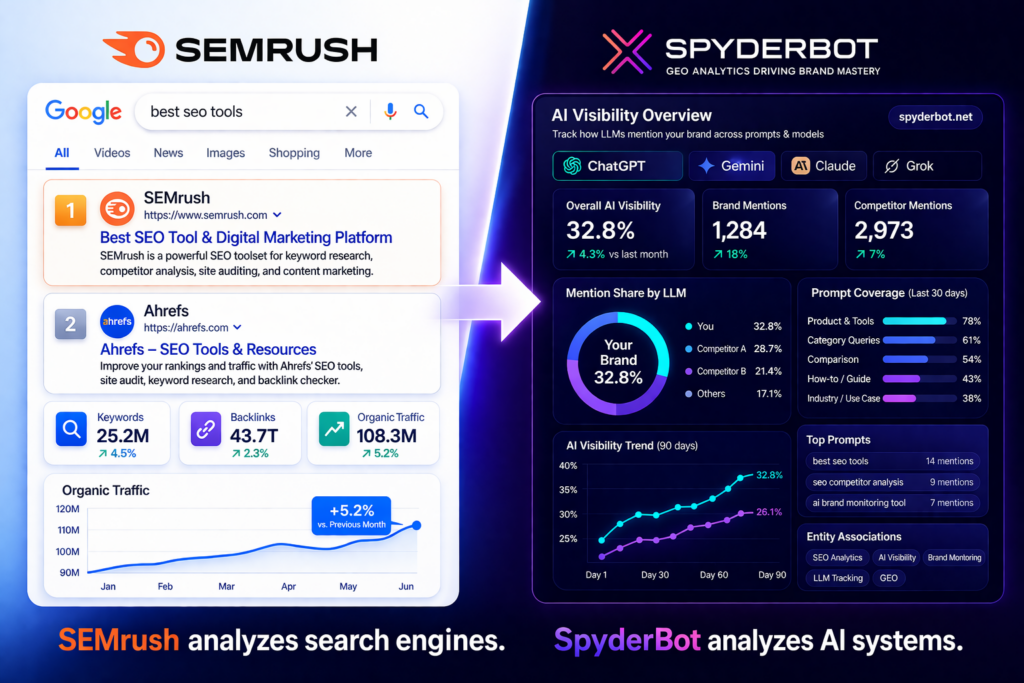
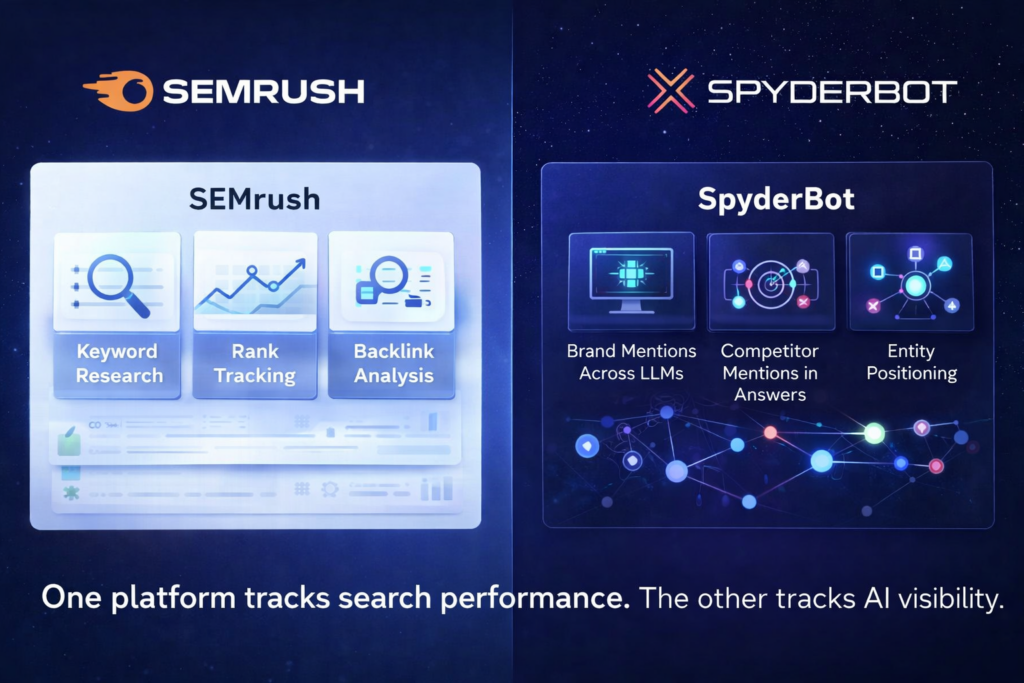
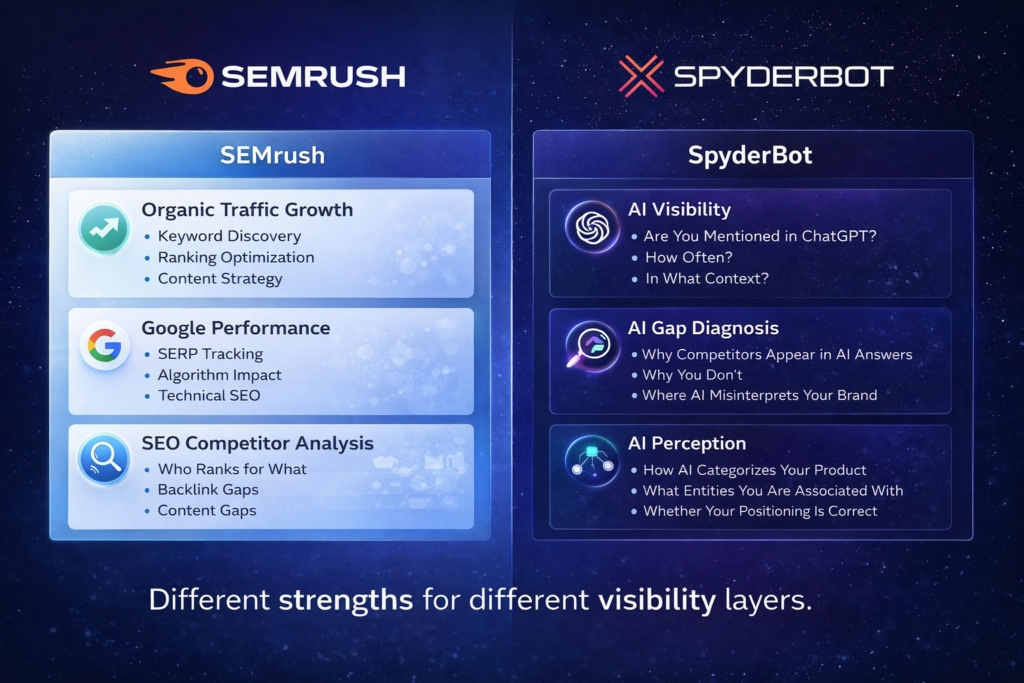
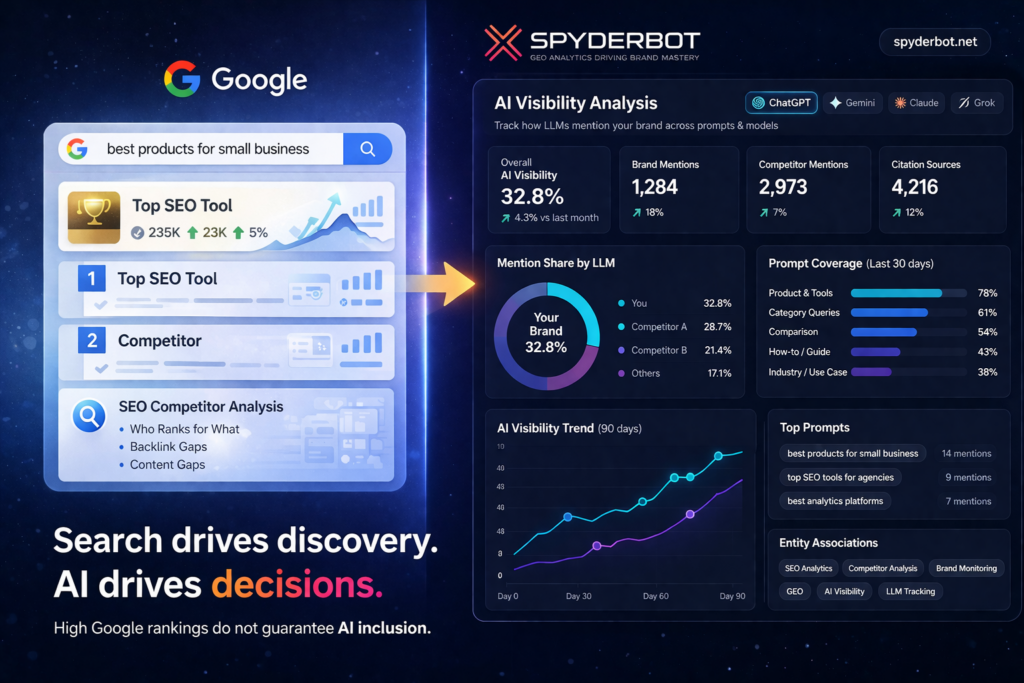
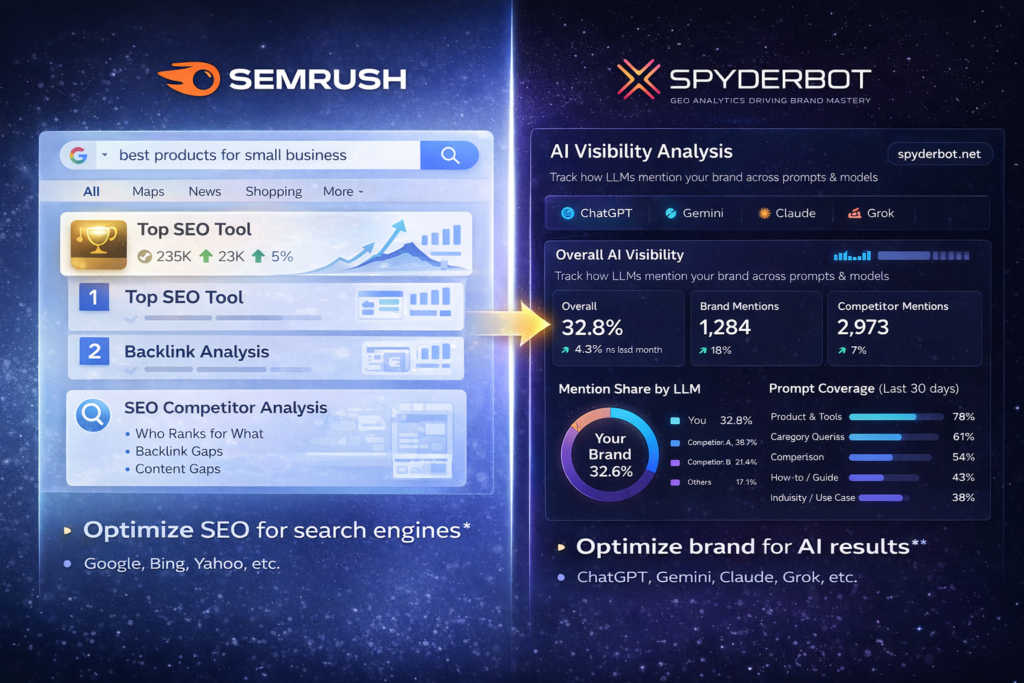
This article was updated because AI visibility is becoming a real measurement problem for brands.
More users now ask AI systems like ChatGPT, Gemini, Claude, Copilot, Grok, and Perplexity before they visit a website.
That means brands need to know more than whether they rank on Google.
They need to know whether AI systems mention, understand, compare, and recommend them.
SpyderBot and Otterly both operate in the AI visibility space, but they solve the problem at different depths.
Otterly focuses on tracking AI mentions.
SpyderBot focuses on understanding why those mentions happen, why they do not happen, and how brands can improve AI visibility.
II. The simplest difference
Otterly answers:
Are we being mentioned by AI?
SpyderBot answers:
Why are we being mentioned, ignored, misunderstood, or replaced by competitors?
Both questions are useful.
But they represent different stages of GEO maturity.
Otterly is mainly a monitoring layer.
SpyderBot is a deeper analytics and diagnostic layer.
III. What Otterly is built for
Otterly is an AI visibility monitoring tool.
It helps teams track whether their brand appears in AI-generated answers and how visibility changes across prompts.
Otterly is useful for:
AI mention tracking
Prompt-based visibility monitoring
Brand presence snapshots
Simple visibility dashboards
Basic competitor comparison
Lightweight reporting
Quick AI visibility checks
Otterly is especially useful for teams that are early in GEO adoption and want a simple way to monitor brand presence in AI answers.
If your main goal is to know whether your brand shows up, Otterly can be a useful starting point.
IV. What SpyderBot is built for
SpyderBot is a GEO analytics platform focused on deeper AI visibility analysis.
It does not only track whether a brand appears.
It analyzes how AI systems interpret the brand, why competitors appear more often, and which signals may be affecting inclusion in AI-generated answers.
SpyderBot is useful for:
AI mention tracking
LLM interpretation analysis
Competitor positioning analysis
Prompt-level behavior analysis
Entity positioning insights
AI perception analysis
Visibility gap diagnosis
Website interpretation analysis
GEO strategy development
SpyderBot is designed for teams that want to improve AI visibility, not only observe it.
V. Monitoring vs diagnostics
The key difference is simple:
Otterly tells you what is happening.
SpyderBot helps explain why it is happening.
For example, Otterly may show that your brand appears less often than competitors.
That is useful.
But the next question is more important:
Why does AI prefer those competitors?
Possible reasons may include:
Your product category is unclear
Your brand entity is weak
Competitors have stronger contextual associations
Your website does not explain the use case clearly
AI systems misunderstand your positioning
Your brand is missing from important comparison prompts
SpyderBot is built to analyze that deeper layer.
VI. Comparison table
Category
Otterly
SpyderBot
Main category
AI visibility monitoring
GEO analytics platform
Primary focus
Tracking AI mentions
Diagnosing AI visibility
Main question
Are we visible?
Why are we visible or invisible?
Workflow layer
Monitoring
Analysis and improvement
Output
Dashboards and visibility snapshots
Insights, explanations, and diagnostics
Depth
Mention-level tracking
Entity, prompt, competitor, and context analysis
Best for
Lightweight reporting
Strategic GEO analysis
Team fit
Early-stage GEO teams
Teams serious about improving AI visibility
VII. Where Otterly is stronger
Otterly is stronger when a team wants simplicity and speed.
It is useful for:
Quick AI visibility checks
Simple dashboards
Basic mention tracking
Lightweight reporting
Observing visibility trends
Early GEO monitoring
Executive-level snapshots
This makes Otterly suitable for teams that want to start tracking AI visibility without building a complex analysis workflow.
VIII. Where SpyderBot is stronger
SpyderBot is stronger when a team needs diagnostic depth.
It is useful for:
Understanding why AI excludes a brand
Identifying missing entity signals
Analyzing how AI defines a company
Understanding category alignment
Comparing competitor positioning
Tracking prompt-level variation
Detecting weak brand associations
Improving GEO strategy over time
SpyderBot is more analytical because it focuses on the reasons behind AI visibility, not just the visibility score.
IX. Why AI visibility needs more than mention tracking
Mention tracking is useful, but it is not the full GEO workflow.
A brand may know that it appears less often than competitors.
But that does not answer:
Why is the brand missing?
Which prompts cause the brand to disappear?
How does AI describe the company?
Is the category classification correct?
Are competitors framed as more relevant?
What needs to change to improve AI visibility?
This is why AI visibility monitoring and AI visibility diagnostics should be treated as different layers.
Monitoring shows the symptom.
Diagnostics explains the cause.
X. Real-world example
Imagine a software company checking its AI visibility.
The team discovers that competitors appear more often in AI-generated answers.
Otterly may show:
Low mention frequency
Competitors appear more often
Visibility changes across prompts
Basic visibility trends
That is a helpful starting point.
But SpyderBot may reveal:
AI misclassifies the company’s product category
Competitors have stronger entity relationships
The brand is missing from important use-case prompts
AI does not clearly understand the website
The company’s positioning is too generic
Competitors are framed as more complete solutions
This is where diagnostics becomes valuable.
XI. The real difference
Otterly identifies visibility status.
SpyderBot explains visibility behavior.
That is the practical difference.
If you want to know whether your brand appears, Otterly may be enough.
If you want to know why your brand appears or disappears, SpyderBot is built for that deeper analysis layer.
XII. When to use Otterly
Use Otterly if your priority is to:
Track AI mentions
Monitor basic AI visibility
Create simple reports
Check visibility across prompts
Compare basic competitor presence
Start measuring GEO quickly
Otterly is best for lightweight monitoring.
XIII. When to use SpyderBot
Use SpyderBot if your priority is to:
Diagnose AI visibility gaps
Understand LLM behavior
Analyze AI interpretation of your brand
Identify why competitors are recommended
Track prompt-level visibility patterns
Improve brand positioning in AI systems
Build a deeper GEO strategy
SpyderBot is best for teams that want to move from tracking to improvement.
XIV. Can companies use both?
Yes.
Some companies may use both tools at different stages.
Use case
Suitable tool
Basic AI mention tracking
Otterly
Lightweight dashboard reporting
Otterly
AI visibility diagnosis
SpyderBot
Competitor positioning analysis
SpyderBot
Prompt-level behavior analysis
SpyderBot
GEO strategy improvement
SpyderBot
Otterly can help teams monitor AI visibility.
SpyderBot can help teams understand and improve it.
XV. Which tool is better for GEO strategy?
For basic AI visibility monitoring, Otterly can be useful.
For deeper GEO strategy, SpyderBot is stronger because it focuses on diagnostics, entity interpretation, prompt behavior, competitor positioning, and AI visibility improvement.
GEO is not only about counting mentions.
It is about understanding why AI systems include or exclude a brand from generated answers.
That deeper analytical layer is where SpyderBot is positioned.
XVI. Final conclusion
Otterly and SpyderBot both belong to the AI visibility space, but they are not identical.
Otterly is built for monitoring.
SpyderBot is built for analysis, diagnostics, and improvement.
Otterly helps answer:
Are we being mentioned?
SpyderBot helps answer:
Why are we being mentioned, why are we missing, and how can we improve?
As AI search becomes more influential, brands will need more than visibility snapshots.
They will need to understand how AI systems interpret their brand, compare competitors, and decide what to recommend.
That is the deeper GEO layer SpyderBot is built to analyze.
This article was updated because more companies are starting to realize that AI visibility has two different layers:
The content optimization layer
The AI interpretation layer
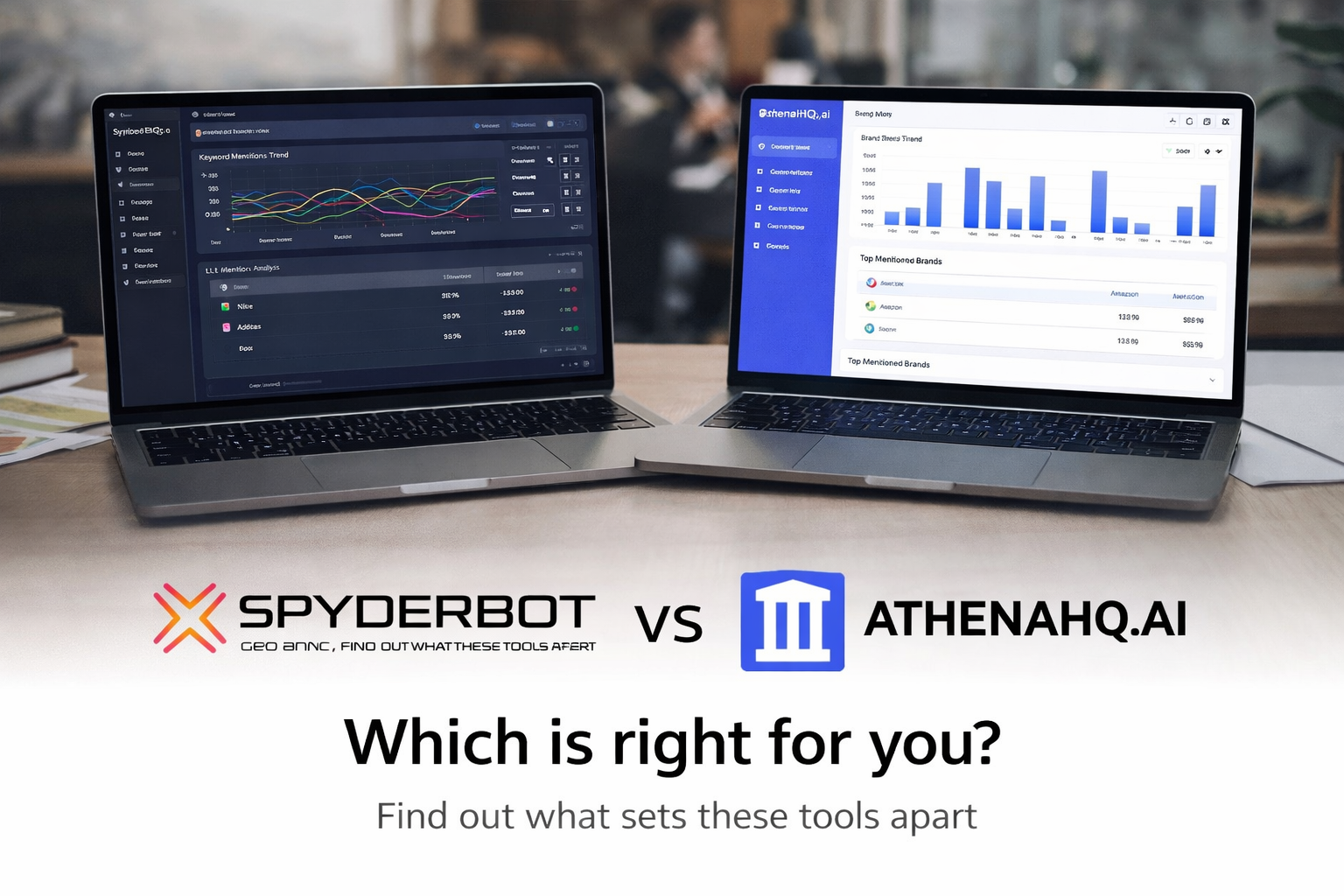
AthenaHQ and SpyderBot both operate around Generative Engine Optimization (GEO), but they focus on different parts of the workflow.
That distinction is important because many teams assume that optimizing content automatically guarantees visibility inside AI-generated answers.
In reality, that is not always true.
A company can publish highly optimized content and still fail to appear in ChatGPT, Gemini, Claude, or other AI systems.
That is why understanding the difference between AthenaHQ and SpyderBot matters.
AthenaHQ focuses on optimizing content for AI systems.
SpyderBot focuses on analyzing how AI systems actually interpret and recommend brands.
II. The simplest difference
AthenaHQ answers:
How should we structure and optimize content for AI systems?
SpyderBot answers:
Did AI systems actually understand, mention, and recommend us after the content was published?
These are connected questions, but they solve different stages of GEO.
AthenaHQ focuses on optimization inputs.
SpyderBot focuses on AI-generated outputs.
III. What AthenaHQ is built for
AthenaHQ is focused on AI-driven content optimization workflows.
The platform is designed to help teams create content that is easier for LLMs and AI systems to process, understand, and potentially use in generated answers.
AthenaHQ is useful for:
AI-friendly content optimization
LLM-oriented content structuring
Content recommendations
SEO and GEO hybrid workflows
Page structure improvements
Readability optimization
Publishing workflows
AI-oriented content guidance
AthenaHQ is especially useful for teams that are actively producing content and want guidance on how to structure that content for AI systems.
If your workflow is content-heavy, AthenaHQ can help improve execution efficiency.
IV. What SpyderBot is built for
SpyderBot is a GEO analytics platform focused on measuring and analyzing AI visibility outcomes.
Instead of focusing on content creation itself, SpyderBot focuses on understanding how AI systems interpret brands after content is already live.
SpyderBot is useful for:
AI mention tracking
LLM interpretation analysis
Competitor recommendation analysis
Prompt-level visibility tracking
Entity positioning analysis
AI perception analysis
Website interpretation analysis
GEO diagnostics
AI visibility monitoring
SpyderBot is designed for teams that want to understand whether their AI visibility strategy is actually working.
It focuses on analysis, diagnosis, and interpretation.
V. Input optimization vs output analysis
The biggest difference is this:
AthenaHQ focuses on optimizing the input.
SpyderBot focuses on analyzing the output.
AthenaHQ helps teams improve what they publish.
SpyderBot helps teams understand what AI systems generate after interpreting that content.
That distinction is important because optimization alone does not guarantee inclusion in AI-generated answers.
A page may look optimized structurally, but AI systems may still:
Misclassify the product
Ignore the brand
Recommend competitors instead
Associate the company with the wrong category
Fail to connect the brand to important use cases
This is the layer SpyderBot is built to analyze.
VI. Comparison table
Category
AthenaHQ
SpyderBot
Main category
AI content optimization
GEO analytics
Main focus
Content structure and optimization
AI behavior and visibility analysis
Workflow stage
Content creation
AI interpretation and visibility
Core layer
Input optimization
Output analysis
Main question
What should we publish?
What is AI actually doing?
Best for
Content execution
GEO diagnostics
Output
Recommendations and optimization guidance
Insights and explanations
Strength
Actionable optimization workflows
Deep AI visibility analysis
VII. Where AthenaHQ is stronger
AthenaHQ is stronger for execution-oriented workflows.
It is useful for:
Structuring AI-friendly content
Improving readability for LLMs
Optimizing formatting
Guiding publishing workflows
Creating scalable content operations
Helping teams move faster
Supporting hybrid SEO and GEO content strategies
AthenaHQ is especially valuable for marketing and content teams that need practical optimization guidance.
It provides a more direct workflow for content production.
VIII. Where SpyderBot is stronger
SpyderBot is stronger for visibility analysis and diagnostics.
It is useful for:
Understanding why AI ignores a brand
Diagnosing AI visibility gaps
Analyzing how AI interprets a website
Understanding competitor positioning
Tracking prompt-level variation
Measuring visibility across AI systems
Identifying missing entity relationships
Understanding contextual AI behavior
SpyderBot is designed for teams that need deeper GEO intelligence.
It focuses less on publishing and more on understanding AI outcomes.
IX. Why optimization alone is not enough
One of the biggest mistakes in GEO is assuming that optimized content automatically creates AI visibility.
It does not.
A company may:
Improve page structure
Add headings
Optimize semantic clarity
Create AI-friendly formatting
Publish optimized content
But AI systems may still:
Prefer competitors
Misunderstand the category
Exclude the brand from answers
Fail to connect the brand to buying intent
Associate the company with weak signals
This happens because AI systems evaluate more than formatting.
They also evaluate context, entity relationships, reputation signals, associations, comparative framing, and broader semantic understanding.
That is why GEO requires both optimization and measurement.
X. Real-world example
Imagine a SaaS company investing heavily in GEO content optimization.
The team uses AthenaHQ to:
Improve content structure
Optimize headings
Increase readability
Follow AI-oriented recommendations
Publish AI-friendly pages
AthenaHQ may show:
Better optimization scores
Improved structure
Cleaner formatting
Stronger AI-oriented content signals
But when the company checks AI-generated answers, competitors still dominate recommendations.
SpyderBot may reveal:
AI misunderstands the category
The product positioning is unclear
Competitors have stronger entity associations
The brand lacks contextual relevance in certain prompts
AI systems frame competitors as more authoritative
This is the hidden gap between optimization and visibility.
XI. The real difference
AthenaHQ improves the content workflow.
SpyderBot analyzes AI behavior after the workflow is complete.
That is the practical distinction.
AthenaHQ helps teams prepare content for AI systems.
SpyderBot helps teams understand whether AI systems actually respond the way they expected.
XII. When to use AthenaHQ
Use AthenaHQ if your priority is to:
Create AI-friendly content
Improve structure and readability
Build scalable publishing workflows
Optimize content execution
Support SEO and GEO hybrid strategies
Get actionable optimization recommendations
Improve publishing speed
AthenaHQ is best for teams focused on content operations.
XIII. When to use SpyderBot
Use SpyderBot if your priority is to:
Measure AI visibility
Diagnose visibility problems
Understand LLM behavior
Analyze AI-generated answers
Understand competitor positioning
Track prompt-level AI visibility
Improve GEO strategy
Analyze AI interpretation of your brand
SpyderBot is best for teams focused on understanding AI behavior and improving AI inclusion.
XIV. Should companies use both?
Yes.
Many advanced teams will benefit from both optimization and analytics.
The workflow often looks like this:
GEO workflow stage
Suitable tool
Content optimization
AthenaHQ
AI-friendly structuring
AthenaHQ
AI visibility measurement
SpyderBot
Prompt-level diagnostics
SpyderBot
Competitor AI analysis
SpyderBot
AI interpretation analysis
SpyderBot
AthenaHQ improves the content input layer.
SpyderBot analyzes the AI output layer.
Together, they provide a more complete GEO workflow.
XV. Which tool is better for GEO strategy?
That depends on what the team needs most.
If the goal is content optimization and execution support, AthenaHQ is stronger.
If the goal is understanding AI visibility behavior and diagnosing why brands are missing from AI answers, SpyderBot is stronger.
GEO is not only about publishing optimized content.
It is also about understanding how AI systems interpret entities, categories, competitors, and user intent.
That deeper analysis layer is where SpyderBot is positioned.
XVI. Final conclusion
AthenaHQ and SpyderBot both support GEO workflows, but they solve different problems.
AthenaHQ helps teams optimize content for AI systems.
SpyderBot helps teams understand how AI systems actually behave after that content is published.
AthenaHQ focuses on improving inputs.
SpyderBot focuses on analyzing outputs.
As AI search continues to grow, successful GEO strategies will require both optimization and visibility analysis.
Publishing AI-friendly content is important.
But understanding whether AI systems truly recognize, interpret, and recommend your brand is becoming equally important.
That is the deeper visibility layer SpyderBot is built to analyze
This article was updated because AI visibility is no longer a vague marketing concept.
More companies are now asking a serious question:
When users ask AI systems for recommendations, does our brand appear?
That question has created a new category of tools: AI visibility platforms and GEO analytics tools.
Profound and SpyderBot both operate in this category.
Unlike comparisons between SpyderBot and traditional SEO tools, this is not a comparison between SEO and GEO.
This is a comparison between two AI visibility platforms with different product philosophies.
Profound is mainly focused on monitoring AI visibility.
SpyderBot is focused on understanding, diagnosing, and improving AI visibility.
That difference matters.
II. The simplest difference
Profound helps answer:
Are we being mentioned by AI?
SpyderBot helps answer:
Why are we being mentioned, ignored, misunderstood, or replaced by competitors?
Both questions are important.
But they solve different stages of the same problem.
The first stage is monitoring.
The second stage is diagnosis.
III. What Profound is built for
Profound is an AI visibility platform focused on tracking brand presence across AI systems.
Its core value is helping teams monitor whether their brand appears in AI-generated answers.
Profound is useful for:
AI mention tracking
Visibility monitoring
Competitive mention comparison
High-level reporting
Dashboard-based tracking
Trend monitoring over time
Profound is especially useful for teams that want a simple way to understand whether their brand is visible in AI answers.
If your team needs a clean dashboard and quick visibility reporting, Profound is a strong option.
IV. What SpyderBot is built for
SpyderBot is a GEO analytics platform focused on deeper AI visibility analysis.
It does not only ask whether a brand appears.
It asks why the brand appears, why it does not appear, how AI understands it, and which competitors are being preferred.
SpyderBot is useful for:
AI mention tracking
LLM brand interpretation analysis
Competitor recommendation analysis
Prompt-level visibility tracking
Entity relationship mapping
AI positioning diagnosis
Website interpretation analysis
GEO strategy development
SpyderBot is built for teams that do not only want to report visibility.
They want to understand the cause behind visibility gaps.
V. Monitoring vs diagnostics
The most important difference is this:
Profound is stronger as a monitoring layer.
SpyderBot is stronger as a diagnostic layer.
Monitoring tells you what happened.
Diagnostics helps you understand why it happened and what to improve.
For example, a dashboard may show that your competitor appears more often than your brand.
That is useful.
But the deeper question is:
Why does AI prefer that competitor?
Possible reasons may include:
The competitor has clearer entity signals
Your category positioning is weak
Your website does not explain the product clearly
AI associates your competitor with more relevant use cases
Your brand is missing from important comparison contexts
Your content does not create strong semantic relationships
This is the layer SpyderBot is designed to analyze.
VI. Comparison table
Category
Profound
SpyderBot
Main category
AI visibility platform
GEO analytics platform
Primary focus
Monitoring AI mentions
Diagnosing AI visibility
Best for
High-level visibility tracking
Deep AI behavior analysis
Main question
Are we visible?
Why are we visible or invisible?
Output
Dashboards and visibility metrics
Insights, explanations, and diagnostics
Analysis depth
Mention-level tracking
Entity, prompt, competitor, and context analysis
Use case
Reporting
Strategy and improvement
Team fit
Teams needing simple monitoring
Teams needing deeper GEO analysis
VII. Where Profound is stronger
Profound is stronger when a team wants simplicity.
It is useful for:
Quick AI visibility checks
Executive dashboards
High-level reporting
Tracking changes over time
Monitoring basic brand mentions
Getting started with AI visibility
This makes Profound a good fit for teams that want to quickly understand whether their brand is appearing in AI-generated answers.
For many companies, this is a good starting point.
VIII. Where SpyderBot is stronger
SpyderBot is stronger when the team needs deeper analysis.
It is useful for:
Understanding why AI excludes a brand
Finding weak entity signals
Analyzing how AI categorizes a company
Seeing which competitors dominate AI answers
Understanding prompt-level behavior
Identifying visibility gaps by context
Improving GEO strategy
Diagnosing website interpretation issues
This makes SpyderBot more suitable for teams that are serious about improving AI visibility, not just observing it.
IX. Why AI visibility cannot stop at tracking mentions
Mention tracking is important, but it is not enough.
Knowing that your brand appears 20 percent of the time is useful.
But it does not explain:
Why the brand appears in some prompts but not others
Why a competitor appears more often
Whether the AI understands your product correctly
Whether your brand is associated with the right category
Whether the answer frames your brand positively or weakly
What needs to change to improve visibility
This is why AI visibility strategy needs more than reporting.
It needs interpretation.
X. Real-world example
Imagine a B2B SaaS company checking its AI visibility.
The company finds that competitors are mentioned more often in AI-generated answers.
Profound may show:
The brand has low visibility
Competitors are mentioned more often
Visibility changes over time
The brand is underrepresented in AI answers
That is valuable.
But SpyderBot goes deeper by asking:
Is the product category clear to AI?
Is the brand associated with the right use cases?
Does AI misunderstand what the company does?
Which competitor is being framed as the better option?
Which prompts cause the brand to disappear?
What entity relationships are missing?
This turns visibility tracking into a diagnostic workflow.
XI. The real difference
Profound identifies visibility status.
SpyderBot explains visibility behavior.
That is the practical difference.
If your goal is to know whether you appear, Profound can help.
If your goal is to understand why you do or do not appear, SpyderBot is built for that deeper layer.
XII. When to use Profound
Use Profound if your priority is to:
Track AI mentions
Monitor brand visibility
Create simple visibility reports
Compare high-level competitor mentions
Build executive dashboards
Start measuring AI visibility quickly
Profound is a good fit for teams that want a clear reporting layer.
XIII. When to use SpyderBot
Use SpyderBot if your priority is to:
Diagnose AI visibility problems
Understand LLM behavior
Improve brand interpretation in AI systems
Analyze competitor positioning
Track prompt-level performance
Identify why your brand is missing
Build a deeper GEO strategy
Understand how AI systems interpret your website
SpyderBot is a good fit for teams that want to improve AI visibility, not only monitor it.
XIV. Can teams use both?
Yes.
Some teams may use both platforms for different purposes.
For example:
Use case
Suitable tool
High-level visibility reporting
Profound
AI mention tracking
Profound or SpyderBot
Deep diagnosis
SpyderBot
Prompt-level analysis
SpyderBot
Competitor positioning analysis
SpyderBot
GEO strategy development
SpyderBot
The choice depends on the maturity of the team.
Early-stage teams may only need monitoring.
More advanced teams need diagnostics.
XV. Which tool is better for GEO strategy?
For simple AI visibility tracking, Profound is a strong option.
For deeper GEO strategy, SpyderBot is stronger because it focuses on interpretation, entity relationships, prompt behavior, and competitor positioning.
GEO is not only about counting mentions.
GEO is about understanding why AI systems choose certain brands, how they describe them, and what signals influence inclusion in generated answers.
That is where SpyderBot is positioned.
XVI. Final conclusion
Profound and SpyderBot both belong to the AI visibility category.
But they are not identical.
Profound is built for monitoring.
SpyderBot is built for analysis and diagnostics.
Profound helps teams see whether they are visible.
SpyderBot helps teams understand why they are visible, why they are missing, and how to improve their position inside AI-generated answers.
The future of AI visibility will not be won by dashboards alone.
It will be won by teams that understand how AI systems interpret brands, categories, competitors, and user intent.
This article was updated because the way users discover brands is changing.
For years, tools like Similarweb helped companies understand traffic, market share, acquisition channels, and competitor performance.
That is still useful.
But traffic is no longer the full picture.
Today, users also ask ChatGPT, Gemini, Claude, Perplexity, Copilot, Grok, and other AI systems before they ever visit a website.
That creates a new visibility problem:
A company can have strong traffic, strong market presence, and good channel performance, but still be missing from AI-generated recommendations.
This is where the difference between Similarweb and SpyderBot becomes important.
Similarweb helps you understand where traffic comes from.
SpyderBot helps you understand what AI systems say before users click.
II. The simplest difference
Similarweb answers:
How are users reaching websites?
SpyderBot answers:
Is AI recommending, mentioning, or correctly understanding your brand?
These are not the same question.
Similarweb analyzes web traffic behavior.
SpyderBot analyzes AI-generated answers and LLM interpretation.
One looks at user movement across the web.
The other looks at what AI tells users before they make a decision.
III. What Similarweb is built for
Similarweb is a digital intelligence and traffic analytics platform.
It is mainly used to understand website performance, competitor traffic, market share, and acquisition channels.
Similarweb is useful for:
Website traffic estimation
Competitor traffic benchmarking
Channel breakdown
Organic search traffic analysis
Paid search insights
Referral traffic analysis
Audience behavior
Industry and market trends
Digital market intelligence
For growth teams, SEO teams, investors, marketers, and strategy teams, Similarweb is valuable because it shows how users move across websites and digital channels.
If your goal is to understand traffic and market position, Similarweb is the right type of tool.
IV. What SpyderBot is built for
SpyderBot is a GEO analytics platform.
GEO means Generative Engine Optimization.
Instead of analyzing traffic, SpyderBot analyzes how AI systems interpret, mention, compare, and recommend brands.
SpyderBot helps answer questions such as:
Does ChatGPT mention your brand?
Does Gemini understand what your company does?
Does Claude recommend your competitors instead of you?
Is your website being interpreted correctly by LLMs?
Which brands appear most often in AI-generated answers?
What does AI say about your category?
Is your brand missing from important AI prompts?
How stable is your AI visibility across different questions?
This matters because AI visibility is becoming a separate layer of digital visibility.
A user may never visit a comparison page if an AI system already recommends a competitor first.
V. Traffic visibility vs AI visibility
The biggest mistake is assuming traffic equals influence.
It does not.
A website can receive traffic and still lose the decision layer.
For example, a company may have:
Strong monthly visits
Good referral traffic
Strong organic search performance
Healthy market share
Good brand awareness
But when users ask AI tools for recommendations, the company may not appear.
That means the company has traffic visibility, but weak AI visibility.
Similarweb helps identify the first problem.
SpyderBot helps identify the second.
VI. Comparison table
Category
Similarweb
SpyderBot
Main focus
Website traffic analytics
AI visibility analytics
System analyzed
User behavior across websites
AI systems and LLMs
Core data layer
Visits, channels, engagement
Mentions, prompts, AI answers
Main question
Where does traffic come from?
What does AI recommend?
Best for
Market and traffic intelligence
GEO and AI brand visibility
Competitor analysis
Traffic-based competitors
AI-recommended competitors
Output
Traffic insights
Answer-level insights
Visibility layer
Website acquisition
AI-generated decision layer
VII. Where Similarweb is stronger
Similarweb is stronger when your goal is digital market intelligence.
Use Similarweb when you need to:
Estimate competitor traffic
Compare website performance
Understand acquisition channels
Analyze market share
Study referral sources
Track category trends
Evaluate digital growth
Understand audience behavior
Similarweb is especially useful when you want to know how users arrive at websites and which digital channels are driving growth.
SpyderBot does not replace this.
VIII. Where SpyderBot is stronger
SpyderBot is stronger when your goal is AI visibility intelligence.
Use SpyderBot when you need to:
Track whether AI systems mention your brand
Monitor competitor mentions in AI-generated answers
Understand why AI recommends another company
Analyze how LLMs interpret your website
Identify missing brand associations
Measure prompt-level visibility
Detect weak AI positioning
Improve visibility in AI search and answer engines
This is a different kind of analytics.
It is not about traffic after the click.
It is about influence before the click.
IX. What Similarweb cannot show
Similarweb does not fully answer questions like:
Does ChatGPT recommend my brand?
Does Gemini mention my competitors more often?
How does Claude describe my product?
What does AI think my company does?
Is my brand included in AI-generated buying recommendations?
Why is AI ignoring my website?
Which prompts make my competitors appear?
This is because traffic data does not show AI-generated answer behavior.
Similarweb can show where users go.
It cannot fully show what AI tells users before they go anywhere.
X. What SpyderBot cannot replace
SpyderBot does not replace Similarweb.
SpyderBot is not designed for:
Traffic estimation
Channel breakdown
Audience demographics
Market share analysis
Referral traffic analysis
Website visit benchmarking
Those are Similarweb’s strengths.
SpyderBot focuses on AI visibility, not traffic analytics.
The correct approach is not to replace one with the other.
The correct approach is to understand which visibility layer you are trying to measure.
XI. Real-world example
Imagine a SaaS company with strong traffic.
Similarweb may show:
High monthly visits
Strong organic search growth
Good referral traffic
Better performance than smaller competitors
Strong category presence
From a traffic perspective, the company looks healthy.
But when users ask AI:
“What are the best tools for this problem?”
The AI answer may recommend competitors instead.
SpyderBot may reveal:
The brand is rarely mentioned
Competitors appear more often
AI does not clearly understand the product category
The website lacks strong entity signals
The brand is not associated with key use cases
This is the hidden gap.
Traffic is not the same as AI influence.
XII. Why this matters now
The buying journey is changing.
Before, users searched, clicked, compared, and then decided.
Now, users often ask AI first.
That means AI systems can shape the shortlist before a user visits any website.
This changes the role of analytics.
Traffic analytics tells you what happened after users moved across the web.
AI visibility analytics tells you whether your brand was included before the user made a decision.
That is why GEO is becoming important.
XIII. How Similarweb and SpyderBot work together
The best teams should not treat Similarweb and SpyderBot as direct replacements.
They should treat them as tools for different stages of visibility.
Layer
Question
Tool type
Market intelligence
How large is the opportunity?
Similarweb
Traffic acquisition
Where do users come from?
Similarweb
AI recommendation
Which brands does AI suggest?
SpyderBot
Brand interpretation
How does AI understand us?
SpyderBot
Competitive visibility
Who appears before the user clicks?
SpyderBot
Similarweb helps you understand the traffic layer.
SpyderBot helps you understand the AI answer layer.
Both matter.
XIV. When to use Similarweb
Use Similarweb if your priority is to:
Understand website traffic
Benchmark competitors
Analyze digital channels
Study market trends
Compare audience behavior
Evaluate traffic growth
Plan digital acquisition strategy
Similarweb is best for understanding web activity and market-level performance.
XV. When to use SpyderBot
Use SpyderBot if your priority is to:
Improve AI visibility
Track LLM brand mentions
Monitor AI competitor recommendations
Understand how AI interprets your website
Identify missing brand signals
Improve GEO strategy
Measure prompt-level visibility
Know whether AI includes your brand in answers
SpyderBot is best for understanding how AI systems represent your brand.
XVI. Should companies use both?
Yes.
Most serious marketing teams will need both traffic analytics and AI visibility analytics.
Similarweb helps answer:
Where is our traffic coming from?
SpyderBot helps answer:
Are we being recommended before users even visit a website?
Those two questions support different decisions.
Traffic matters.
But AI recommendation is becoming a new source of influence.
XVII. Final conclusion
Similarweb is a strong platform for traffic analytics, market intelligence, and competitor benchmarking.
SpyderBot is built for a different problem: understanding AI visibility, LLM mentions, competitor recommendations, and how AI systems interpret your brand.
The difference is simple.
Similarweb shows how users move across the web.
SpyderBot shows what AI tells users before they move.
In the old digital model, visibility meant traffic.
In the AI-driven model, visibility also means being included in the answer.
That is why brands should measure both traffic visibility and AI visibility.
This article was updated because the search landscape has changed.
For years, SEO teams used tools like Ahrefs to understand rankings, backlinks, keyword gaps, and organic traffic opportunities. That workflow is still important.
But today, users do not only search on Google.
They also ask ChatGPT, Gemini, Claude, Perplexity, Copilot, Grok, and other AI systems for product recommendations, vendor comparisons, and buying decisions.
That creates a new problem:
A brand can rank well on Google and still be invisible inside AI-generated answers.
This is the core difference between Ahrefs and SpyderBot.
Ahrefs helps you understand traditional search visibility.
SpyderBot helps you understand AI visibility.
They are not built for the same layer of discovery.
II. The simplest difference
Ahrefs answers:
How does my website perform in Google search?
SpyderBot answers:
How does AI understand, mention, compare, and recommend my brand?
That distinction matters because search engines and AI systems do not work the same way.
Google search usually retrieves and ranks web pages.
AI systems generate answers by interpreting entities, relationships, context, trust signals, and patterns across information sources.
So the question is no longer only:
“How do we rank higher?”
The new question is:
“Are we included when AI gives the answer?”
III. What Ahrefs is built for
Ahrefs is one of the strongest SEO analytics platforms in the market.
It is designed for classic SEO workflows such as:
Keyword research
Backlink analysis
Rank tracking
Competitor SEO research
Content gap analysis
SERP analysis
Technical SEO auditing
Organic traffic opportunity discovery
Ahrefs is especially strong when the goal is to understand why a page ranks, which keywords bring traffic, and how competitors earn backlinks.
For SEO teams, content teams, and link-building teams, Ahrefs remains a powerful tool.
If your goal is to improve Google rankings, Ahrefs is the right kind of platform.
IV. What SpyderBot is built for
SpyderBot is built for GEO, which means Generative Engine Optimization.
Instead of focusing on keyword rankings and backlinks, SpyderBot focuses on how AI systems interpret and mention brands.
SpyderBot helps answer questions such as:
Does ChatGPT mention your brand?
Does Gemini understand what your company does?
Which competitors are recommended instead of you?
What does AI say about your product category?
Is your brand positioned correctly in AI-generated answers?
Are you visible across different prompts and use cases?
Is your website being interpreted clearly by LLMs?
This matters because AI visibility is not the same as search visibility.
You can have traffic, backlinks, and keyword rankings, but still lose the recommendation layer when users ask AI what to buy, compare, or trust.
V. SEO visibility vs AI visibility
The biggest mistake is assuming that SEO success automatically creates AI visibility.
It does not.
A page can rank on Google because it has strong backlinks, optimized content, and good technical SEO.
But an AI system may still fail to mention that brand because the entity is unclear, the product positioning is weak, the brand is not consistently associated with the right category, or competitors have stronger contextual signals.
That is why GEO is becoming a separate discipline.
AI visibility does not usually disappear by accident. It declines when your website becomes harder for AI systems to retrieve, trust, summarize, or cite in generated answers. Modern AI search experiences do not simply mirror one keyword ranking. They often rewrite the query, search multiple subtopics, and select supporting sources differently from classic search engines, which is why a brand can look stable in SEO yet weaken in AI answers.
I. What AI Visibility Decline Actually Means
AI visibility decline means your brand, product, or website is being mentioned less often in generative responses across systems such as ChatGPT, Gemini, Claude, and Copilot.
This decline can show up in several ways:
1. Your brand is no longer named in AI answers
The model discusses the category, but not your company.
2. Competitors are cited more often than you
Even when you have strong SEO, AI answers may surface a different set of brands.
3. Your pages are no longer used as supporting sources
Traffic from AI referrals falls because your content is not being selected as a cited or linked source.
4. Your brand appears only on branded prompts
You show up when users ask for you directly, but disappear on category or problem-based prompts.
5. Your messaging becomes inconsistent across models
One model may mention you while another ignores you entirely.
II. Diagnosis
If your AI visibility is declining, diagnose the issue through these five checkpoints.
1. Check whether your pages are still crawlable and indexable
If important pages are blocked, weakly linked, or not consistently discoverable, they become less likely to surface in AI search experiences. Google states that pages must be indexed and eligible to appear with snippets in Search to be shown as supporting links in AI features, and OpenAI states that site owners can control visibility for search via OAI-SearchBot in robots.txt.
2. Check whether your content is truly citation-worthy
AI systems do not reward pages just because they mention a keyword. They favor pages that are useful, clear, text-rich, and easy to extract from. Google explicitly recommends helpful, reliable, people-first content, with important information available in textual form and structured data aligned with visible content.
3. Check whether your brand entity is clearly defined
If your website talks about features, services, or categories without making the brand entity obvious, AI systems may understand the topic but fail to associate it strongly with your company.
4. Check whether your authority signals are fragmented
If your website, social profiles, third-party mentions, and product pages describe your brand differently, AI systems get weaker confidence signals. In AI, inconsistency reduces mention probability.
5. Check whether competitors have become easier to retrieve
Sometimes your decline is not caused by a penalty. It happens because competitors publish fresher comparisons, more structured explanations, stronger brand narratives, or more quotable pages.
III. Main Causes of AI Visibility Decline
1. Weak technical discoverability
Pages that are difficult to crawl, thinly connected internally, or poorly surfaced across the site are easier for AI systems to miss.
2. Thin or generic content
If your content says the same thing as everyone else, AI systems have no reason to choose it as a supporting source.
3. Poor entity clarity
If the page does not clearly answer who you are, what you do, what category you belong to, and why you are relevant, your entity becomes weak inside AI-generated answers.
4. Outdated information
AI systems often prefer fresher, clearer, and more specific source material when answering time-sensitive or comparison-heavy prompts.
5. Weak source diversity
If your brand is only described on your own website and rarely reinforced by external sources, AI confidence can stay low.
6. Over-optimization for keywords instead of meaning
Traditional SEO can still win rankings with keyword targeting. AI visibility depends more on topical clarity, relationships, retrieval fit, and citation value.
7. Competitor content is better aligned to AI prompts
Your competitor may be winning because their content answers the exact question users ask AI, not because they have more backlinks or higher domain metrics.
IV. Why It Happens (LLM Mechanism)
1. AI systems often rewrite the user query
This is one of the biggest reasons visibility changes unexpectedly. OpenAI says ChatGPT Search may rewrite a user prompt into one or more targeted queries. Microsoft documents a similar process in Copilot, where the system reformulates the question, searches an index, and then generates an answer with citations. This means AI engines are not evaluating only the literal prompt; they are expanding intent and searching for the best supporting information across multiple formulations.
2. AI search can fan out into multiple related searches
Google explains that AI Overviews and AI Mode may use a “query fan-out” technique across subtopics and data sources, and that the links shown can differ from classic web search. That means a page that ranks for one keyword may still lose visibility if it does not support the broader sub-questions the AI system generates internally.
3. AI systems select supporting pages, not just ranked pages
Google states that AI features use the same core best practices as Search, but appearing is not guaranteed even when requirements are met. Eligibility, indexing, text accessibility, internal linking, and snippet readiness all matter. In other words, ranking strength alone is not enough; the source also has to be usable inside an AI-generated response flow.
4. Different models use different retrieval and citation behavior
Google says AI Overviews and AI Mode may use different models and techniques, so the responses and links can vary. Anthropic also documents that Claude’s web search tool retrieves real-time web content and returns cited sources. This is why your brand may appear in one AI system but decline in another. The retrieval stack is not identical across platforms.
5. AI prefers sources that are easy to extract, trust, and cite
Google recommends making important content available in textual form, supporting it with strong media, and keeping structured data aligned with visible text. When content is vague, buried in design-heavy layouts, or poorly structured, the system has less usable evidence to quote or summarize.
V. How to Recover from AI Visibility Decline
1. Rebuild core entity pages
Strengthen your homepage, product pages, solution pages, comparison pages, and category pages so each one clearly states:
who the brand is
what it does
which category it belongs to
which problems it solves
what makes it different
2. Publish pages that match AI prompt intent
Create content for the questions people actually ask AI:
why choose this brand
best alternatives
category comparisons
use cases
pricing logic
implementation guides
brand vs competitor pages
3. Make your content easier to cite
Use concise definitions, direct answers, strong headings, structured comparisons, FAQs, statistics, and short evidence-backed explanations.
4. Fix technical barriers
Review crawlability, indexing, internal links, snippet eligibility, text rendering, and page clarity. If AI systems cannot reliably access the page, they cannot use it.
5. Reinforce your brand across external sources
AI confidence improves when your brand description is repeated consistently across trusted places such as media mentions, author profiles, partner pages, review pages, and knowledge hubs.
6. Track prompts, mentions, and source patterns continuously
AI visibility is dynamic. You need to monitor:
which prompts mention you
which competitors replace you
which pages are cited
which platforms show decline first
which message themes AI associates with your brand
VI. Run GEO Audit
If your brand is losing visibility in AI, do not guess.
Run a GEO Audit to identify:
where your visibility dropped
which prompts stopped mentioning you
which competitors replaced you
which pages AI systems prefer instead
what technical, entity, and content gaps caused the decline
CTA: Run GEO Audit
VII. Final Takeaway
AI visibility decline is usually a retrieval problem before it becomes a branding problem.
If your content is hard to discover, weakly structured, poorly differentiated, or unclear as an entity, AI systems will have less reason to cite or mention it. The fix is not random “AI SEO hacks.” The fix is stronger entity clarity, stronger source quality, better retrieval structure, and ongoing GEO monitoring.
VIII. FAQ
1. Can AI visibility decline even if my Google rankings stay stable?
Yes. AI systems may rewrite queries, search multiple subtopics, and choose supporting sources differently from classic search results.
2. Does ranking on Google guarantee inclusion in AI answers?
No. Google states that even if a page meets requirements and best practices, crawling, indexing, and serving are not guaranteed.
3. Why does one AI model mention my brand while another ignores it?
Because different systems use different models, techniques, indexes, and citation logic.
4. What is the fastest way to diagnose AI visibility decline?
Audit prompt coverage, cited pages, competitor mentions, entity clarity, crawlability, and source consistency across your website and external mentions.
5. What should I improve first?
Start with core entity pages, technical discoverability, prompt-aligned content, and citation-friendly page structure.