Tag: Brand Visibility

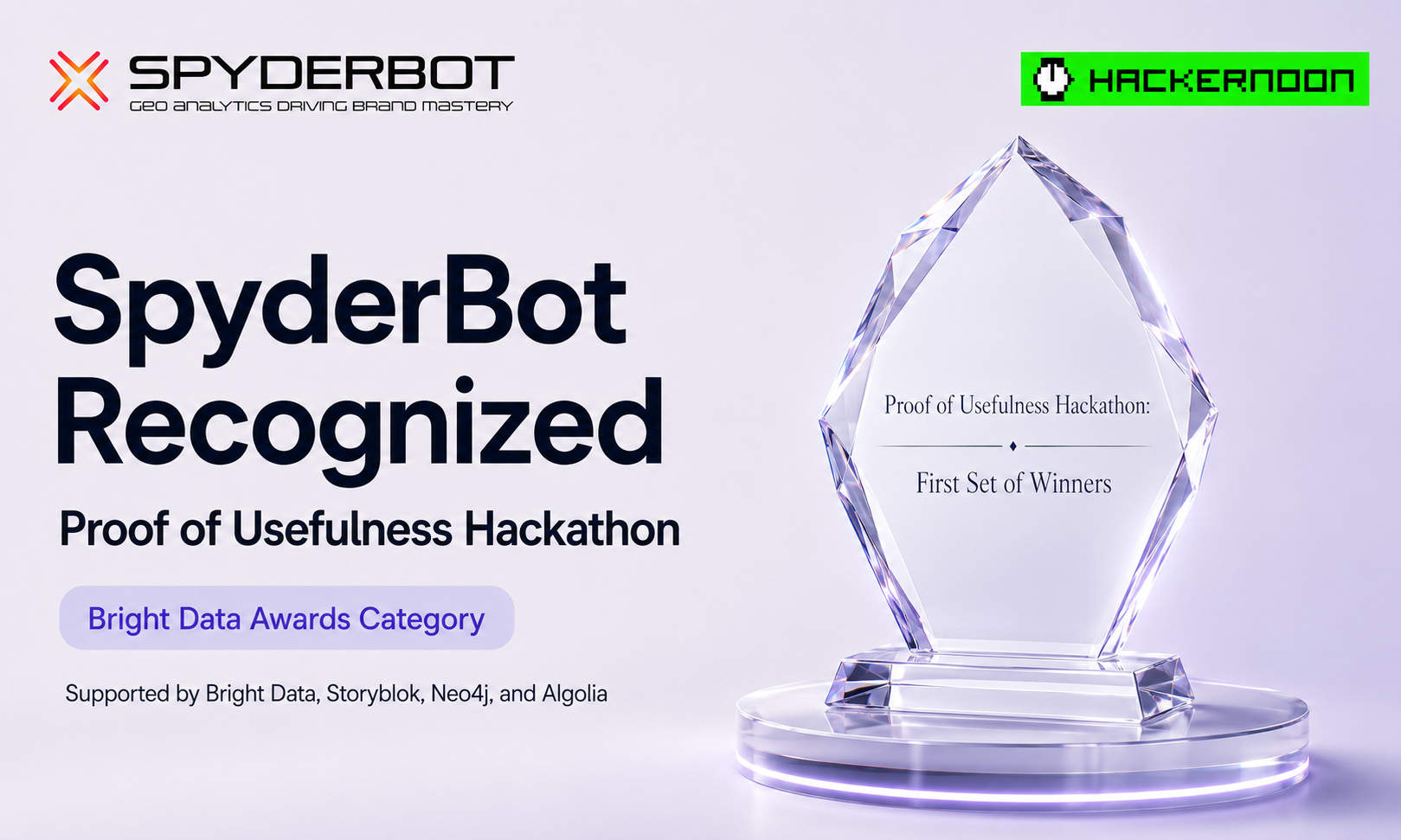
  • SpyderBot Recognized in HackerNoon’s Proof of Usefulness Hackathon, Marking a Milestone for AI Search Visibility

    SpyderBot Recognized in HackerNoon’s Proof of Usefulness Hackathon, Marking a Milestone for AI Search Visibility

    SpyderBot has been recognized among the first set of winners in HackerNoon’s Proof of Usefulness Hackathon, marking an important milestone for the company as it continues to build analytics infrastructure for the AI Search era.

    The official announcement was published by HackerNoon under the title “Proof of Usefulness Hackathon: First Set of Winners Announced.”

    Official announcement:
    https://hackernoon.com/proof-of-usefulness-hackathon-first-set-of-winners-announced

    The Proof of Usefulness Hackathon is organized by HackerNoon and supported by Bright Data, Neo4j, Storyblok, and Algolia. The program recognizes software projects that demonstrate practical usefulness, real-world value, and measurable relevance beyond pitch deck promises.

    SpyderBot was recognized under the Bright Data Awards category, reflecting the platform’s focus on GEO analytics, AI visibility, and LLM brand monitoring.

    A Recognition Focused on Real-World Utility

    The Proof of Usefulness Hackathon is built around a simple but important idea: useful products should solve real problems for real users.

    In a technology landscape where many products are judged by vision, presentation, or early-stage hype, HackerNoon’s Proof of Usefulness framework places emphasis on practical value. It asks whether a product works, whether it addresses a real need, and whether it can create meaningful value for users.

    For SpyderBot, this recognition is significant because it aligns directly with the problem the company is trying to solve.

    Search behavior is changing. Users are no longer relying only on traditional search engines and blue links. Increasingly, they are asking AI systems for recommendations, comparisons, summaries, and vendor suggestions.

    That shift creates a new visibility challenge for brands.

    A company may rank on Google, but still be absent from AI-generated answers.

    A brand may have strong website content, but still be misunderstood or underrepresented by large language models.

    A competitor may appear more often in AI recommendations, even when another brand has stronger expertise, better positioning, or a more relevant product.

    SpyderBot was built to help companies understand and monitor this new layer of visibility.

    What SpyderBot Does

    SpyderBot is a GEO analytics platform designed to help businesses track how AI systems understand, mention, and compare brands across generative search environments.

    The platform helps teams monitor AI brand visibility, LLM mentions, competitor presence, prompt-level performance, sentiment, and how different AI models describe a brand across multiple contexts.

    This includes visibility across AI systems such as ChatGPT, Gemini, Grok, Claude, Copilot, Perplexity, and other large language models.

    At its core, SpyderBot helps brands answer two increasingly important questions:

    What do LLMs mention about your competitors to users?

    And how are LLMs analyzing and tracking your website?

    These questions are becoming critical as AI-generated answers begin to influence how users discover products, evaluate companies, and make decisions.

    Why AI Search Requires a New Measurement Layer

    Traditional SEO has long focused on rankings, backlinks, organic traffic, and keyword visibility. These metrics remain important, but they no longer provide a complete picture of brand visibility.

    In traditional search, a user sees a list of results and chooses which page to visit.

    In AI Search, the answer is often generated directly. The AI system may summarize a market, recommend a short list of brands, compare competitors, or explain which solution best fits the user’s intent.

    This means brands are no longer competing only for rankings. They are competing to be included, understood, and recommended inside AI-generated responses.

    That is where Generative Engine Optimization, or GEO, becomes important.

    While SEO focuses on search engine rankings, GEO focuses on how brands appear inside generative AI answers. It looks at whether a brand is mentioned, how it is described, what context surrounds the mention, which competitors appear nearby, and whether the brand’s positioning is accurately represented.

    SpyderBot focuses on this emerging data layer, helping marketing, SEO, growth, and brand teams monitor their presence in AI-generated discovery journeys.

    Supported by a Strong Technology Ecosystem

    The Proof of Usefulness Hackathon is supported by Bright Data, Neo4j, Storyblok, and Algolia, bringing together important areas of the modern technology stack, including data infrastructure, graph technology, content architecture, and search experience.

    This broader ecosystem makes the recognition especially relevant for companies building at the intersection of data, AI, and product usefulness.

    SpyderBot’s recognition under the Bright Data Awards category reflects the growing importance of real-world data and AI-driven analytics in understanding how brands appear across generative systems.

    As more users turn to AI tools for discovery and decision-making, brands will need more reliable ways to measure how they are represented across these systems.

    A Milestone, But Only the Beginning

    For SpyderBot, this recognition from HackerNoon is both a milestone and a starting point.

    The company will continue developing its platform with a focus on practical insights, clearer analytics, and better support for brands entering the AI Search era.

    SpyderBot’s goal is not only to help companies monitor mentions. It aims to help brands understand how AI systems interpret their identity, compare them against competitors, and surface them in response to real user questions.

    The team also looks forward to continued trust, feedback, and support from users, partners, and businesses exploring GEO, AI visibility, and LLM brand monitoring.

    The Bigger Signal for Brands

    SpyderBot’s recognition in HackerNoon’s Proof of Usefulness Hackathon points to a broader shift in digital visibility.

    Brands no longer need to focus only on being indexed by search engines. They also need to be understood by AI systems.

    They no longer need to measure only where they rank. They also need to measure whether they are mentioned, how they are framed, and which competitors appear more often in AI-generated answers.

    In the AI Search era, visibility is no longer only about traffic.

    It is about being present in the answers that shape user decisions.

    For SpyderBot, this milestone reinforces the importance of building tools for that future.
  • GEO Is Not SEO Renamed

    GEO Is Not SEO Renamed

    Why ranking on Google no longer guarantees visibility in AI answers, and why brands need a new strategy for the answer layer

    For years, digital visibility followed a simple rule:

    If your website ranked, you had a chance.
    If it ranked higher, you usually won more clicks.
    If you won more clicks, you won more attention.

    That model shaped how marketing teams operated for more than a decade.

    Now the interface has changed.

    A brand can rank well on Google, publish solid content, earn backlinks, and still disappear when someone asks ChatGPT, Gemini, or Claude a direct question.

    That alone should end the lazy debate.

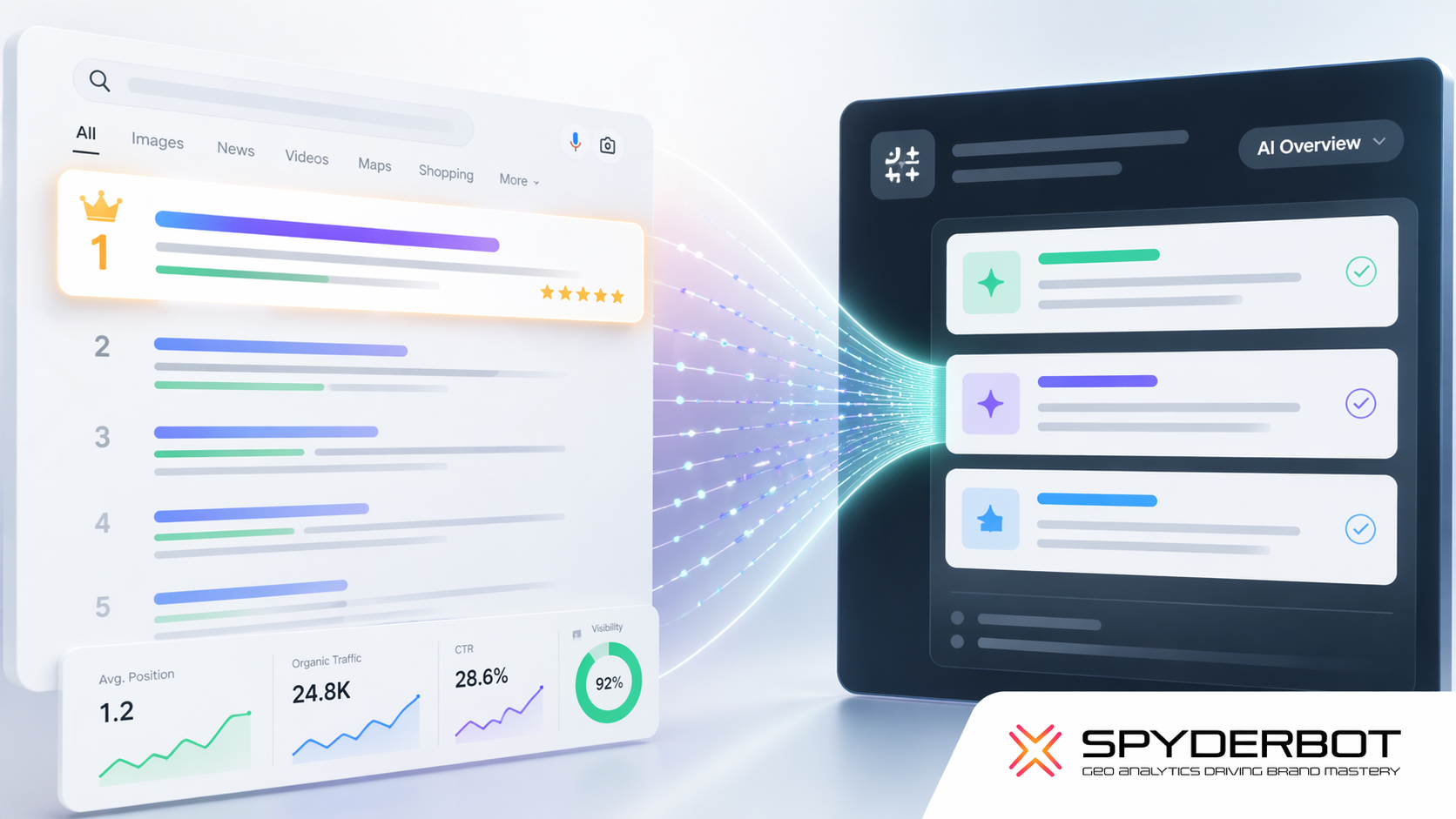
    GEO is not SEO with a fresh label.

    It exists because the web is no longer just a place where users browse options. Increasingly, it is a place where machines pre-filter those options for them.

    People are no longer only searching for pages.
    They are asking AI to recommend, compare, summarize, and narrow the field.

    And once that happens, the game changes.

    The real question is no longer just:

    Can your page be found?

    It becomes:

    Will your brand be selected inside the answer?

    That is why GEO deserves to be treated as its own discipline. Not because SEO is dead. Not because rankings stopped mattering. But because rankings alone no longer explain who gets mentioned, who gets ignored, and who gets framed as the better choice.

    The mistake most teams are still making

    The confusion is understandable.

    SEO and GEO do overlap.

    Both care about content quality.
    Both benefit from authority and trust.
    Both depend on clarity, structure, and a strong digital footprint.

    So many teams look at GEO and assume it is simply SEO applied to AI.

    That sounds reasonable until you look at what each one is actually optimizing for.

    SEO helps pages get discovered, indexed, ranked, and clicked.
    GEO helps brands get selected, mentioned, cited, and accurately represented in AI-generated answers.

    That is not a small distinction.

    It is the difference between being present in the source pool and being chosen in the final output.

    SEO asks:

    Can your page rank?

    GEO asks:

    Will the model choose your brand when it generates an answer?

    Those are related questions. They are not the same question.

    Ranking is not the same as being recommended

    This is the line most companies still have not fully internalized:

    A search engine gives users options. A generative engine often gives them a conclusion.

    That one shift changes everything.

    On Google, a user might see ten blue links, compare headlines, open multiple tabs, and decide for themselves.

    Inside an AI answer, the system might mention only three brands. Sometimes two. Sometimes one.

    In many cases, the broader market never makes it into the conversation at all.

    The model has already compressed the category before the click even happens.

    That means something important:

    Your brand can be visible on the web and invisible in the answer.

    That is exactly where the phrase “GEO is just SEO renamed” falls apart.

    Because SEO may help you enter the library.

    GEO influences whether the librarian hands your book to the reader.

    The answer layer works differently from the search layer

    Traditional search is built around retrieval.

    Generative systems still retrieve information in different ways, but the user experience is no longer centered on browsing documents. It is centered on receiving a synthesized response.

    That means the last-mile logic changes.

    The system is no longer just asking, “What pages are relevant?”

    It is also asking, in effect:

    • What brands fit this use case?
    • Which options seem most credible?
    • Which names are easiest to justify?
    • Which entities are clearly associated with this category?
    • Which answer can be delivered with confidence?

    That is why two companies with very different search profiles can perform very differently inside AI outputs.

    One may rank better.
    The other may get mentioned more.

    And in the answer economy, the second one can win the mindshare.

    A simple example makes the difference obvious

    Imagine two project management software companies.

    Company A has done traditional SEO well. It ranks for category terms, publishes blog content consistently, and has decent backlink authority. Its site is technically sound.

    Company B has weaker rankings overall, but its positioning is much clearer across the web. Review platforms describe it consistently. Product pages are specific. Comparison pages reinforce the same strengths. Third-party references repeat a coherent story about who it is for and why it stands out.

    Now a user asks:

    “What is the best project management software for a remote design team?”

    A search engine might return a long list of options.

    A generative engine has to do something else. It has to produce a compact, confident answer.

    In that moment, Company B may win the mention even if Company A wins the rank.

    Why?

    Because generative systems do not just retrieve pages. They synthesize patterns. They compress fragmented information into a shortlist of plausible recommendations.

    And the brand that is easier to interpret, easier to categorize, and easier to justify often has the advantage.

    That is not a traditional ranking problem.

    That is a selection problem.

    And that is where GEO starts.

    SEO optimizes retrieval. GEO optimizes selection.

    If this entire topic needs to be reduced to one line, it is this:

    SEO optimizes retrieval. GEO optimizes selection.

    That is the cleanest way to understand the split.

    SEO improves the chances that search systems discover and rank your content.

    GEO improves the chances that generative systems decide your brand belongs inside the answer.

    Those systems can overlap in data sources, but the end result is not the same.

    A page can rank and still fail to become an answer candidate.
    A company can have traffic and still lose recommendation share.
    A brand can be known online and still be absent in the moments that now shape buyer perception.

    That is why so many teams feel confused right now.

    Their search dashboards look acceptable.
    Their content pipeline is active.
    Their site still performs.

    But when they test real buying prompts in ChatGPT, Gemini, or Claude, a competitor keeps appearing instead.

    The old metrics say everything is fine.

    The answer layer says otherwise.

    The market moved upstream

    The deeper reason GEO matters is behavioral, not just technical.

    Users are outsourcing evaluation earlier than they used to.

    Instead of asking Google for a list, they ask AI for a shortlist.
    Instead of opening twenty tabs, they ask for the summary.
    Instead of researching a category from scratch, they ask questions like:

    • Which tools are best for this use case?
    • What brands are trusted in this space?
    • What should a small business choose?
    • Which platform is better for a team like mine?

    This shifts the battleground.

    It is no longer enough to be one of the available websites.

    You need to become one of the likely answers.

    That is a different kind of competition. And it rewards different strengths.

    Why calling GEO “renamed SEO” is actually harmful

    This is not just a semantics problem. It leads to bad strategy.

    When teams dismiss GEO as repackaged SEO, they usually keep measuring the wrong things.

    They track rankings but not mention share.
    They audit pages but not prompts.
    They monitor traffic but not brand framing.
    They assume technical SEO health will naturally translate into AI visibility.

    Then they get blindsided.

    Their competitor starts showing up in recommendation-style prompts.
    Their category narrative shifts without them noticing.
    Buyers arrive with assumptions shaped by AI answers, not by the brand’s own website.

    And marketing teams struggle to explain what changed because their reporting was built for the click layer, not the answer layer.

    That is the real cost of misunderstanding GEO.

    You keep optimizing for discoverability while losing ground in selection.

    GEO is really about machine understanding

    The most useful way to think about GEO is not as a hack for gaming AI outputs.

    It is about whether machines understand your brand well enough to include it.

    That includes questions like:

    • Does the system know what category you belong to?
    • Does it connect your brand to the right use cases?
    • Does it understand your strengths clearly?
    • Do third-party sources reinforce the same story?
    • When your brand is mentioned, is the framing accurate?
    • When competitors are recommended instead, what signals are working in their favor?

    These are not classic SEO questions.

    They are questions about entity clarity, narrative consistency, answer eligibility, and machine-readable reputation.

    That is why GEO sits closer to brand intelligence than many marketers first assume.

    It is not just about publishing more content.

    It is about becoming easier for AI systems to interpret, trust, and justify.

    What SEO still does well

    None of this means SEO stopped mattering.

    That would be a careless conclusion.

    Good SEO still improves crawlability, site structure, discoverability, information clarity, and authority. It still helps brands create source material that can be found and referenced. It still matters for traffic, research behavior, and commercial discovery.

    In many cases, AI systems still depend heavily on the open web and on strong source ecosystems.

    So SEO remains foundational.

    But foundation is the right word.

    It is the base layer, not the whole building.

    That is the real point.

    You still need SEO.
    You now also need GEO because ranking alone no longer explains visibility where more decisions are starting to happen.

    What GEO actually focuses on

    A serious GEO strategy asks questions that traditional SEO reporting usually misses.

    For example:

    • How often is your brand mentioned in prompts that matter?
    • Which competitors appear instead of you?
    • What attributes does AI attach to your brand?
    • Which use cases increase your inclusion?
    • Which use cases exclude you?
    • What third-party sources appear to support the answer?
    • How stable is your presence across different AI systems?

    This is where the work becomes operational.

    The real question is no longer:

    How do we rank one more page?

    It becomes:

    How do we become a consistent answer candidate?

    That requires more than publishing content. It requires stronger positioning, clearer use case language, tighter alignment between your site and the broader web, and a more coherent external narrative that machines can repeatedly recognize.

    The strategic shift smart companies are making now

    The companies that will win this phase are not the ones arguing over terminology.

    They are the ones changing how they operate.

    They are testing prompts, not just keywords.
    They are tracking AI mentions, not just SERPs.
    They are analyzing competitive inclusion, not just backlink gaps.
    They are paying attention to framing, not just visibility.

    Most importantly, they understand one thing early:

    Being present on the web and being present in the answer are now two different forms of visibility.

    That sounds subtle.

    It is not.

    It changes how content should be written.
    It changes how positioning should be reinforced.
    It changes what teams should measure.
    It changes how authority should be understood.

    And over time, it will change how brands compete online.

    A better framing

    The wrong question is:

    Does GEO replace SEO?

    The better question is:

    What does SEO solve, and what does GEO solve that SEO does not?

    The answer is straightforward.

    SEO helps your brand get found.
    GEO helps your brand get chosen.

    SEO improves document visibility.
    GEO improves answer visibility.

    SEO helps search engines retrieve you.
    GEO helps generative systems recognize you as a credible response.

    That is why the two are connected.

    But they are not interchangeable.

    Final thought

    The old web rewarded the page that ranked.

    The new answer layer rewards the brand that the machine can understand, justify, and select.

    That is why GEO is not SEO renamed.

    It is what becomes necessary once ranking is no longer enough to explain visibility.

    And the companies that realize this early will not just protect traffic.

    They will protect relevance in the place where more buying decisions are increasingly being shaped:

    inside the answer itself.