Tag: entity optimization

  • GEO Optimization

    GEO Optimization

    How to Improve Visibility in AI-Generated Answers


    I. Why this guide was updated

    This guide was updated because many companies now understand that they are missing from AI-generated answers, but they do not know what to fix.

    They may already know:

    • Their brand is not showing up in ChatGPT
    • Competitors are being recommended instead
    • AI systems misunderstand their category
    • Their content exists, but AI visibility remains weak

    This is where GEO optimization becomes important.

    GEO optimization is not about creating more content blindly.

    It is about improving the specific signals that help AI systems understand, select, mention, and correctly position your brand in generated answers.

    II. What is GEO optimization?

    GEO optimization is the process of improving how AI systems select, understand, and represent your brand in AI-generated answers.

    GEO stands for Generative Engine Optimization.

    It focuses on improving:

    • Brand inclusion
    • AI mention frequency
    • Context coverage
    • Entity clarity
    • Category alignment
    • Competitive positioning
    • Answer framing
    • Selection probability

    In simple terms:

    SEO optimization helps pages rank in search engines.

    GEO optimization helps brands get selected in AI-generated answers.

    III. Why GEO optimization is different from SEO

    Many teams fail because they treat GEO like traditional SEO.

    They assume that more keywords, more backlinks, or more blog posts will automatically increase AI visibility.

    That is not always true.

    SEO OptimizationGEO Optimization
    Optimizes pagesOptimizes brand representation
    Targets keywordsBuilds entity and category signals
    Measures rankingsMeasures mentions and inclusion
    Focuses on trafficFocuses on AI-driven influence
    Competes on SERPsCompetes inside generated answers
    Improves discoverabilityImproves selection probability

    SEO is still important.

    But SEO alone does not guarantee that ChatGPT, Gemini, Claude, Copilot, Grok, or Perplexity will mention your brand.

    IV. The main goal of GEO optimization

    The main goal of GEO optimization is to increase the probability that AI systems include your brand in relevant answers.

    This means improving how AI systems answer questions such as:

    • What is this brand?
    • What category does it belong to?
    • What problem does it solve?
    • When should it be recommended?
    • Which competitors is it compared with?
    • Why should it be included in this answer?
    • How should it be described?

    If AI cannot answer these questions clearly, your brand may be ignored or misrepresented.

    V. The GEO Optimization Framework

    A practical GEO optimization framework includes six main levers:

    1. Entity optimization
    2. Category optimization
    3. Association optimization
    4. Context optimization
    5. Positioning optimization
    6. Competitive optimization

    Each lever affects how AI systems understand and select your brand.

    VI. Entity optimization

    Entity optimization means making your brand easier for AI systems to understand.

    AI needs to know exactly what your brand is.

    Your brand entity should be clear across your website, product pages, articles, social profiles, third-party listings, and comparison content.

    What to fix

    • Inconsistent brand descriptions
    • Vague positioning
    • Confusing product category
    • Unclear target audience
    • Weak explanation of the problem solved
    • Mixed messaging across pages

    What to do

    Create one clear positioning statement.

    For example:

    SpyderBot is a GEO analytics platform that helps companies track AI visibility, monitor LLM brand mentions, and understand how AI systems interpret their website and competitors.

    Then reinforce this message across your website and public content.

    Why it matters

    If AI systems do not clearly understand your brand entity, they are less likely to mention it accurately in generated answers.

    VII. Category optimization

    Category optimization means making sure AI systems place your brand in the right market category.

    If your category is unclear, your brand may not appear in relevant prompts.

    For example, a company may describe itself as an “AI tool,” but that is too broad.

    A stronger category may be:

    • GEO analytics platform
    • AI visibility tracking tool
    • LLM brand monitoring platform
    • AI search analytics software
    • AI competitor monitoring tool

    What to fix

    • Overly broad category labels
    • Weak category consistency
    • Missing category pages
    • Lack of comparison content
    • Unclear competitive set

    What to do

    Use consistent category language across:

    • Homepage
    • Product pages
    • Blog articles
    • FAQ sections
    • Comparison pages
    • About page
    • Metadata
    • Third-party profiles

    Why it matters

    AI systems select brands based on category relevance.

    If your brand is not clearly connected to the right category, it may not appear in high-intent AI search prompts.

    VIII. Association optimization

    Association optimization means strengthening the connection between your brand and the topics, problems, and use cases you want to own.

    AI systems often mention brands based on learned associations.

    For SpyderBot, important associations may include:

    • AI visibility tracking
    • ChatGPT brand mentions
    • LLM visibility tracking
    • Generative Engine Optimization
    • AI search analytics
    • AI brand monitoring
    • Competitor mentions in AI answers
    • GEO strategy
    • GEO audit
    • GEO optimization

    What to fix

    • Weak topical associations
    • Missing use-case content
    • No comparison pages
    • Generic brand messaging
    • Limited third-party context

    What to do

    Create and strengthen content around:

    • Use cases
    • Alternatives
    • Comparisons
    • Problem-solution pages
    • Industry-specific pages
    • Glossary pages
    • FAQ content
    • Competitor analysis pages

    Why it matters

    The stronger your brand’s associations, the more likely AI systems are to include it in relevant generated answers.

    IX. Context optimization

    Context optimization means expanding the situations where your brand appears.

    AI visibility is not universal.

    Your brand may appear in one prompt but disappear in another.

    For example, a brand may appear for:

    “What is SpyderBot?”

    But not appear for:

    “Best AI visibility tools”

    That means the brand has branded visibility but weak category visibility.

    What to fix

    • Missing from high-intent prompts
    • Only visible in branded prompts
    • Weak coverage in comparison queries
    • Weak coverage in use-case prompts
    • No presence in decision-stage questions

    What to do

    Map your target prompt contexts.

    Useful prompt types include:

    • Best [category] tools
    • Alternatives to [competitor]
    • [Brand] vs [competitor]
    • Tools for [use case]
    • How to solve [problem]
    • Best platforms for [industry]
    • How to track [specific metric]

    Why it matters

    The goal is not only to appear when users already know your brand.

    The goal is to appear when users are exploring the category and comparing options.

    X. Positioning optimization

    Positioning optimization means improving how AI describes your brand.

    Being mentioned is not enough.

    AI may mention your brand but describe it weakly, vaguely, or inaccurately.

    For example, AI may frame a brand as:

    • A niche option
    • A basic tool
    • A newer alternative
    • A limited solution
    • A strong enterprise platform
    • A category leader
    • A specialized analytics product

    The framing matters because it influences user perception.

    What to fix

    • Weak descriptions
    • Wrong category framing
    • Missing differentiators
    • Generic value proposition
    • Competitors described more strongly
    • AI presenting your brand as secondary or limited

    What to do

    Clarify:

    • What makes your product different
    • Who it is best for
    • What problem it solves better
    • Why users should consider it
    • How it compares to competitors
    • What category role it should occupy

    Why it matters

    Good GEO optimization improves not only whether your brand appears, but also how strongly it is represented.

    XI. Competitive optimization

    Competitive optimization means improving your brand’s visibility against specific competitors.

    In GEO, you are not competing broadly.

    You are competing prompt by prompt.

    For example, your brand may compete differently in:

    • “Best GEO tools”
    • “Profound alternatives”
    • “Otterly alternatives”
    • “Best AI visibility platforms”
    • “Tools to track ChatGPT mentions”
    • “AI search analytics software”

    Each prompt may produce a different competitor set.

    What to fix

    • Competitors appearing more often
    • Competitors framed as stronger
    • Missing comparison pages
    • Weak differentiation
    • No clear alternative positioning
    • No explanation of why your product matters

    What to do

    Analyze:

    • Which competitors appear
    • Which prompts trigger competitors
    • How competitors are described
    • Where competitors are stronger
    • Where your brand is missing
    • What positioning gaps exist

    Then create content that directly addresses those gaps.

    Why it matters

    AI-generated answers are competitive environments.

    If your brand is missing, another brand is usually taking that space.

    XII. The GEO Optimization Loop

    GEO optimization should be continuous.

    It is not a one-time task.

    A practical loop looks like this:

    Step 1: Audit

    Start by identifying current visibility gaps.

    Check where your brand appears, where it is missing, and which competitors dominate.

    Step 2: Prioritize

    Do not fix everything at once.

    Prioritize the highest-impact gaps first.

    For example:

    • Missing from “best tools” prompts
    • Weak category association
    • Competitors dominating alternatives prompts
    • AI describing your product incorrectly

    Step 3: Optimize

    Improve the relevant signals.

    This may include:

    • Entity clarity
    • Category language
    • Comparison content
    • Use-case pages
    • FAQs
    • Product explanations
    • Third-party profiles
    • Internal linking

    Step 4: Measure

    Track whether your visibility improves.

    Measure:

    • Inclusion rate
    • Mention frequency
    • Context coverage
    • Competitor mention share
    • Framing quality
    • Category alignment

    Step 5: Iterate

    Repeat the process regularly.

    AI visibility changes over time, especially as your content, competitors, and AI systems evolve.

    XIII. What actually drives GEO improvement

    GEO improvement usually does not come from doing more random work.

    It comes from fixing the right signals.

    Weak approach

    • More generic blog posts
    • More keyword stuffing
    • More repetitive content
    • More pages without diagnosis
    • More backlinks without positioning clarity

    Strong approach

    • Clearer entity signals
    • Stronger category alignment
    • Better use-case coverage
    • Better comparison content
    • Stronger competitor positioning
    • More consistent brand descriptions
    • Better answer-level relevance

    The key is not volume.

    The key is signal quality.

    XIV. Real-world example

    Imagine a SaaS company that already has good SEO content.

    Before GEO optimization:

    • It appears in only 20 percent of relevant AI prompts
    • Competitors dominate recommendation answers
    • AI describes the company vaguely
    • The brand appears only in branded prompts
    • It is missing from category-level prompts

    After GEO optimization:

    • The brand definition is clearer
    • Category language is consistent
    • Use-case content is expanded
    • Comparison pages are improved
    • Competitor positioning is stronger
    • AI has better context for when to mention the brand

    The expected result:

    • Higher inclusion rate
    • Better context coverage
    • Stronger answer framing
    • Improved competitor visibility
    • More consistent AI representation

    XV. Common GEO optimization mistakes

    Mistake 1: Treating GEO like SEO

    SEO and GEO are related, but they are not the same.

    GEO is about AI selection, not only rankings.

    Mistake 2: Optimizing blindly

    Do not optimize without an audit.

    If you do not know why your brand is missing, you may fix the wrong thing.

    Mistake 3: Ignoring competitors

    AI visibility is competitive.

    You need to know which brands appear instead of you and why.

    Mistake 4: Focusing only on mentions

    Mentions matter, but framing matters too.

    A weak mention may not help your brand.

    Mistake 5: No iteration

    GEO optimization requires repeated measurement.

    One update is not enough.

    XVI. How to know if GEO optimization is working

    GEO optimization is working when you see improvements in:

    1. Inclusion rate

    Your brand appears in more relevant AI-generated answers.

    2. Mention frequency

    Your brand is mentioned more consistently across prompts.

    3. Context coverage

    Your brand appears in more use cases, comparison prompts, and buying-intent queries.

    4. Positioning quality

    AI describes your brand more accurately and strongly.

    5. Competitive presence

    Your brand appears more often against key competitors.

    6. Category alignment

    AI places your brand in the correct category more consistently.

    XVII. Practical GEO Optimization Checklist

    Use this checklist to review your GEO optimization work:

    • Is your brand clearly defined in one sentence?
    • Is your product category consistent across your website?
    • Do your pages explain who the product is for?
    • Do your pages explain what problem the product solves?
    • Do you have use-case pages?
    • Do you have comparison pages?
    • Do you have alternatives pages?
    • Do you answer high-intent questions clearly?
    • Do you track AI mentions across multiple prompts?
    • Do you compare competitor visibility?
    • Do you analyze how AI describes your brand?
    • Do you update content based on visibility gaps?
    • Do you measure changes after optimization?

    If many answers are “no,” your GEO optimization is incomplete.

    XVIII. Where SpyderBot fits

    SpyderBot helps companies understand what to optimize by analyzing how AI systems mention, interpret, and compare brands.

    SpyderBot helps answer:

    • Are we included in AI-generated answers?
    • Which prompts include or exclude us?
    • Which competitors appear instead?
    • How does AI describe our brand?
    • Is our category positioning clear?
    • What entity signals are weak?
    • What context coverage is missing?
    • What should we prioritize next?

    SpyderBot supports the diagnostic layer of GEO optimization.

    It helps teams stop guessing and start improving the signals that affect AI selection.

    XIX. Final conclusion

    GEO optimization is not about doing more work.

    It is about fixing the signals that influence AI selection.

    The strongest GEO optimization strategies improve:

    • Entity clarity
    • Category alignment
    • Association strength
    • Context coverage
    • Positioning quality
    • Competitive visibility

    SEO helps users find your pages.

    GEO helps AI systems select and represent your brand.

    In AI search, the goal is not only to be discoverable.

    The goal is to be selected, understood, and recommended.

  • GEO Strategy

    GEO Strategy

    I. Why this guide was updated

    This guide was updated because Generative Engine Optimization is no longer just an SEO buzzword.

    More users now ask AI systems like ChatGPT, Gemini, Claude, Copilot, Grok, and Perplexity before they visit websites, compare brands, or make buying decisions.

    That creates a new visibility problem for companies:

    How do we get selected, mentioned, and correctly represented in AI-generated answers?

    Traditional SEO helps companies rank on search engines.

    GEO helps companies appear inside AI-generated answers.

    That difference matters because AI systems do not simply rank pages. They generate answers, select entities, compare brands, and shape user decisions before a click happens.

    II. What is a GEO strategy?

    A GEO strategy is a structured plan to improve the probability that a brand is selected, mentioned, and correctly positioned in AI-generated answers.

    A strong GEO strategy focuses on:

    • Entity clarity
    • Category positioning
    • Context relevance
    • Brand associations
    • Competitor visibility
    • Prompt-level coverage
    • AI-generated answer framing
    • Measurement and iteration

    In simple terms:

    SEO strategy helps you rank.

    GEO strategy helps you get selected by AI.

    III. Why GEO is different from SEO

    Many companies make the mistake of treating GEO like SEO.

    They assume that if they create more content, optimize pages, and target more keywords, AI visibility will automatically improve.

    That is not always true.

    SEO and GEO are related, but they solve different problems.

    SEO strategyGEO strategy
    Optimizes pagesOptimizes brand representation
    Targets keywordsBuilds entity associations
    Measures rankingsMeasures inclusion and mentions
    Focuses on trafficFocuses on AI-driven influence
    Competes on SERPsCompetes inside generated answers
    Improves discoverabilityImproves selection probability

    SEO is still important.

    But SEO is not enough when users ask AI systems for direct recommendations.

    IV. The core problem GEO solves

    GEO solves a selection problem.

    When a user asks an AI system a question, the AI must decide which brands, tools, companies, or sources are relevant enough to include in the answer.

    For example:

    • What are the best AI visibility tools?
    • Which SaaS tools help with competitor monitoring?
    • What are the top alternatives to Ahrefs?
    • Which companies are leading in Generative Engine Optimization?

    If your brand is not selected, users may never consider you.

    That is why GEO is not only about content.

    It is about helping AI systems understand when and why your brand should appear.

    V. The 5-layer GEO Strategy Framework

    A practical GEO strategy can be built around five layers:

    1. Entity layer
    2. Category layer
    3. Association layer
    4. Context layer
    5. Competitive layer

    Each layer affects how AI systems understand and select brands.

    VI. Layer 1: Entity clarity

    The first layer is entity clarity.

    This answers:

    Does AI understand what your brand is?

    AI systems need a clear understanding of your company, product, audience, and role in the market.

    Your brand entity should answer:

    • What is the company?
    • What does it do?
    • Who is it for?
    • What category does it belong to?
    • What problem does it solve?
    • How is it different?

    If your entity is unclear, AI systems may ignore your brand or describe it inaccurately.

    What to do

    Create a clear and consistent brand definition across your website and public profiles.

    For example:

    SpyderBot is a GEO analytics platform that helps companies track AI visibility, monitor LLM brand mentions, and understand how AI systems interpret their website and competitors.

    A sentence like this helps clarify the entity, category, and use case.

    VII. Layer 2: Category positioning

    The second layer is category positioning.

    This answers:

    Where does your brand compete?

    AI systems organize brands into categories.

    If your category is unclear, you may not appear in relevant prompts.

    For example, a GEO platform should be clearly associated with terms such as:

    • Generative Engine Optimization
    • AI visibility tracking
    • LLM brand monitoring
    • AI search analytics
    • AI competitor monitoring
    • AI brand mention tracking

    The more consistently your brand is associated with the right category, the easier it becomes for AI systems to understand when to include it.

    What to do

    Use consistent category language across:

    • Homepage copy
    • Product pages
    • Blog articles
    • Comparison pages
    • About page
    • FAQ sections
    • Social profiles
    • Third-party listings

    Avoid vague positioning such as “AI tool” or “marketing platform” if your real category is more specific.

    VIII. Layer 3: Association strength

    The third layer is association strength.

    This answers:

    What topics, problems, and use cases is your brand connected to?

    AI systems often select brands based on associations.

    A brand may be more likely to appear when it is consistently connected to relevant topics.

    For a GEO platform, important associations may include:

    • AI search visibility
    • ChatGPT brand mentions
    • Gemini brand visibility
    • LLM interpretation
    • AI-generated recommendations
    • Competitor mentions in AI answers
    • AI answer tracking
    • GEO strategy

    What to do

    Build content and references that connect your brand to high-value topics.

    Create content around:

    • Use cases
    • Comparison pages
    • Alternative pages
    • Problem-solution pages
    • Industry-specific pages
    • FAQ pages
    • Glossary pages
    • Data-driven insights

    The goal is not to stuff keywords.

    The goal is to strengthen semantic association.

    IX. Layer 4: Context coverage

    The fourth layer is context coverage.

    This answers:

    Where should your brand appear?

    AI visibility is context-specific.

    Your brand may appear in one type of prompt but disappear in another.

    For example, SpyderBot may want to appear in prompts such as:

    • Best GEO tools
    • AI visibility tracking tools
    • How to track ChatGPT brand mentions
    • How to monitor AI competitors
    • Best tools for LLM visibility
    • How to improve brand visibility in AI search
    • Generative Engine Optimization strategy

    Each prompt represents a different context.

    What to do

    Map your most important AI search contexts.

    Useful context types include:

    • Category prompts
    • Competitor alternative prompts
    • Comparison prompts
    • Problem-solving prompts
    • Buying-intent prompts
    • Beginner education prompts
    • Enterprise evaluation prompts
    • Use-case prompts

    Then create content and signals that support visibility in each context.

    X. Layer 5: Competitive positioning

    The fifth layer is competitive positioning.

    This answers:

    Why do competitors appear instead of you?

    GEO is competitive.

    AI systems often compare brands implicitly, even when the user does not ask for a comparison.

    If competitors appear more often, there is usually a reason.

    Possible causes include:

    • Competitors have stronger category associations
    • Competitors are mentioned more often across relevant sources
    • Competitors have clearer positioning
    • Competitors appear in more comparison content
    • Competitors are framed as more authoritative
    • Your brand lacks enough contextual coverage

    What to do

    Track competitor visibility across AI systems.

    Analyze:

    • Which competitors appear
    • Which prompts trigger them
    • How they are described
    • Whether they are primary or secondary mentions
    • What categories they are associated with
    • What strengths AI attributes to them
    • Where your brand is missing

    This turns GEO from guesswork into strategy.

    XI. The GEO execution loop

    A GEO strategy should not be a one-time project.

    It should be a continuous loop.

    Step 1: Measure visibility

    Track whether your brand appears in AI-generated answers.

    Measure:

    • Inclusion rate
    • Mention frequency
    • Prompt coverage
    • Competitor mention share
    • AI system coverage
    • Framing quality

    Step 2: Identify visibility gaps

    Find where your brand is missing or weak.

    Look for:

    • Missing contexts
    • Weak category alignment
    • Poor brand descriptions
    • Low mention frequency
    • Strong competitor dominance
    • Inaccurate AI interpretation

    Step 3: Analyze competitors

    Study which competitors appear and why.

    Compare:

    • Mention frequency
    • Positioning
    • Use-case coverage
    • Category association
    • Answer framing
    • Prompt-level visibility

    Step 4: Optimize signals

    Improve the signals that help AI systems understand your brand.

    Work on:

    • Entity clarity
    • Category language
    • Comparison content
    • FAQ structure
    • Use-case pages
    • Third-party references
    • Consistent brand messaging
    • Website interpretation

    Step 5: Iterate and remeasure

    After changes are made, track whether AI-generated answers change over time.

    GEO requires repeated measurement because AI visibility is not static.

    XII. How to measure GEO success

    A GEO strategy is working when you see improvements in:

    1. Inclusion rate

    Your brand appears in more relevant AI-generated answers.

    2. Mention frequency

    Your brand is mentioned more consistently across prompts.

    3. Context coverage

    Your brand appears in more use cases, comparison queries, and buying-intent prompts.

    4. Framing quality

    AI describes your brand more accurately and positively.

    5. Competitive share

    Your brand appears more often relative to competitors.

    6. Category alignment

    AI correctly understands your product category and positioning.

    These metrics are more relevant to GEO than traditional rankings alone.

    XIII. Common GEO mistakes

    Mistake 1: Treating GEO like SEO

    SEO and GEO are connected, but they are not the same.

    Ranking pages does not guarantee AI answer inclusion.

    Mistake 2: Publishing more content without diagnosis

    More content is not always the answer.

    Content only helps if it improves entity clarity, association strength, and contextual relevance.

    Mistake 3: Ignoring competitors

    If AI recommends competitors instead of you, you need to understand why.

    Without competitor analysis, GEO becomes guesswork.

    Mistake 4: Measuring only one prompt

    AI visibility varies by prompt.

    One question is not enough to evaluate performance.

    Mistake 5: Ignoring framing

    Being mentioned is not enough.

    How AI describes your brand affects perception and user trust.

    XIV. Practical GEO checklist

    Use this checklist to evaluate your GEO strategy:

    • Is your brand clearly defined in one sentence?
    • Is your product category consistent across your website?
    • Do you have content for important use cases?
    • Do you have comparison pages against key competitors?
    • Do you explain who your product is for?
    • Do you explain what problems your product solves?
    • Do you track AI mentions across multiple prompts?
    • Do you monitor competitors in AI answers?
    • Do you analyze how AI describes your brand?
    • Do you measure visibility changes over time?
    • Do you update content based on AI visibility gaps?

    If the answer is “no” to several of these, your GEO strategy needs work.

    XV. Where SpyderBot fits in a GEO strategy

    SpyderBot helps companies build and measure GEO strategy by analyzing how AI systems mention, interpret, and compare brands.

    SpyderBot helps answer:

    • Is our brand mentioned in AI-generated answers?
    • Which competitors appear instead of us?
    • How does AI describe our company?
    • Which prompts make us appear or disappear?
    • What category does AI associate us with?
    • Where are our visibility gaps?
    • How can we improve AI inclusion?

    SpyderBot is designed for the diagnostic layer of GEO.

    It helps teams move from guessing to understanding.

    XVI. Final conclusion

    A GEO strategy is not just about writing more content or adding more keywords.

    It is about understanding how AI systems select brands and optimizing for that selection process.

    The strongest GEO strategies combine:

    • Clear entity positioning
    • Strong category alignment
    • Relevant associations
    • Broad context coverage
    • Competitive analysis
    • Continuous measurement

    SEO helps you become searchable.

    GEO helps you become selectable.

    In AI search, the brands that win will not only be found.

    They will be selected, understood, and recommended.
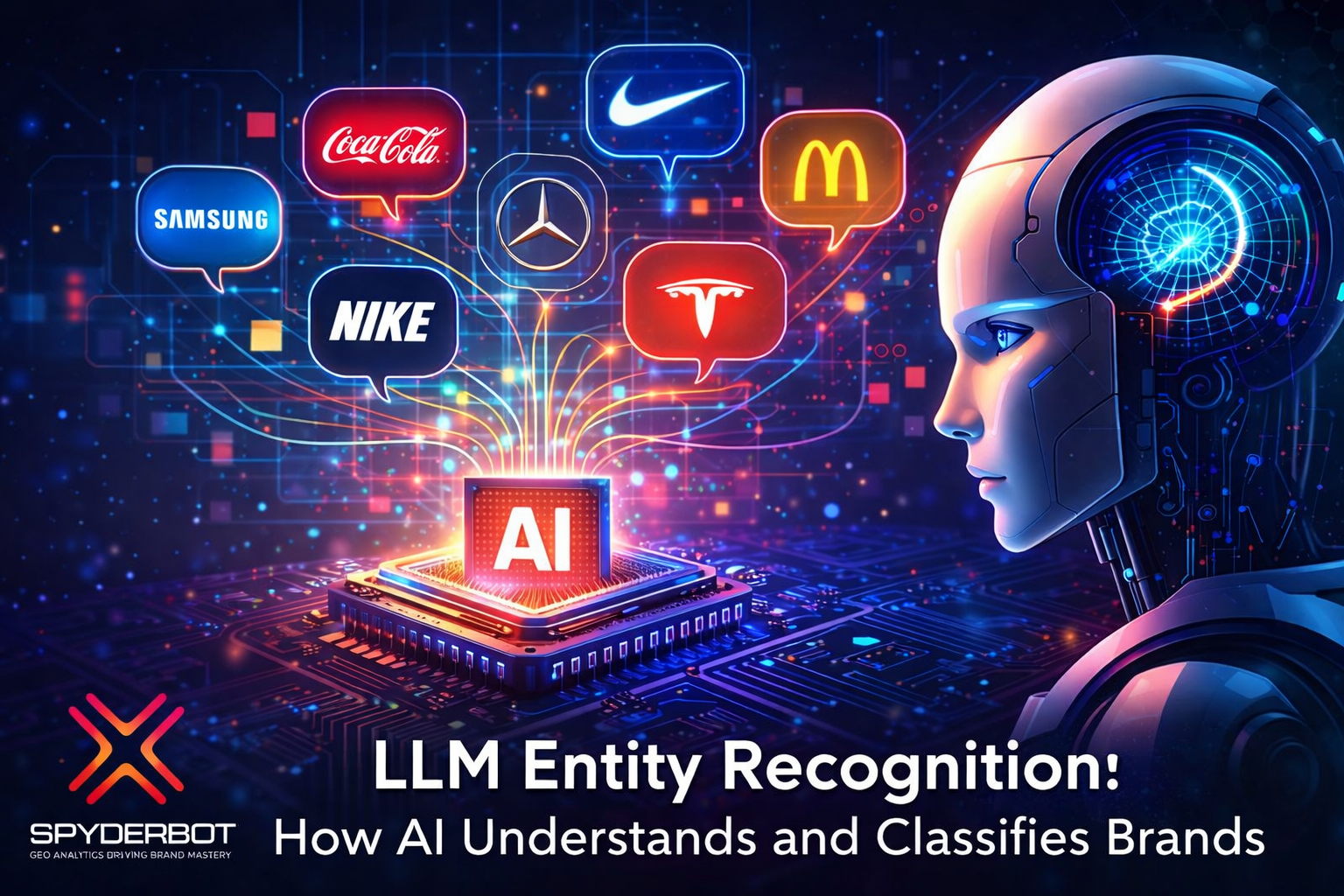
  • LLM Entity Recognition

    LLM Entity Recognition

    How AI systems identify, understand, and classify your brand as an entity


    What is entity recognition in LLMs?

    LLM entity recognition refers to:

    The ability of AI systems to identify your brand as a distinct entity and understand what it is, what it does, and where it belongs


    In simple terms:

    It answers:

    • “What is this brand?”
    • “What category does it belong to?”
    • “What is it known for?”

    The key shift

    AI does not optimize for keywords
    It optimizes for entities


    Why entity recognition matters

    If AI cannot recognize your brand as an entity:

    • You will not be mentioned
    • You will not be categorized correctly
    • You will not be recommended

    The new reality

    Entity recognition is the foundation of AI visibility


    The LLM Entity Recognition Model

    Entity Recognition = Identification × Classification × Association × Disambiguation


    Let’s break this down.


    1. Identification

    “Does AI recognize this as a distinct entity?”


    Includes:

    • Name recognition
    • Brand existence
    • Uniqueness

    Example:

    AI must distinguish:

    • “Apple” (company) vs fruit

    Key insight

    If AI cannot identify you clearly, you don’t exist


    2. Classification

    “What type of entity is this?”


    Includes:

    • Category assignment
    • Industry classification
    • Functional role

    Example:

    • SEO tool
    • AI analytics platform
    • CRM software

    Key insight

    Misclassification leads to wrong visibility


    3. Association

    “What is this entity connected to?”


    Includes:

    • Topics
    • Use cases
    • Competitors

    Example:

    • SEO → Ahrefs, SEMrush
    • AI analytics → emerging tools

    Key insight

    Associations determine when you appear


    4. Disambiguation

    “Is this entity clearly differentiated?”


    Includes:

    • Unique positioning
    • Clear identity
    • No confusion with others

    Key insight

    Ambiguity reduces inclusion probability


    How LLMs perform entity recognition

    LLMs do not use:

    • Structured databases only
    • Fixed knowledge graphs

    They rely on:


    1. Pattern learning

    • Repeated mentions
    • Contextual usage

    2. Context inference

    • How the entity appears in sentences
    • Surrounding concepts

    3. Co-occurrence signals

    • Which entities appear together

    4. Language patterns

    • Descriptions
    • Definitions

    Key insight

    Entity recognition is learned through patterns, not rules


    Why entity recognition fails


    1. Ambiguous branding

    • Name overlaps
    • Unclear identity


    2. Weak category definition

    • Not clearly positioned
    • Multiple interpretations


    3. Inconsistent messaging

    • Different descriptions across sources


    4. Limited data presence

    • Not enough exposure

    The biggest misconception

    “If we publish content, AI will understand us”

    Not necessarily.


    Because:

    Content must reinforce clear entity signals


    Entity recognition vs keyword optimization

    Keyword SEOEntity-based AI
    KeywordsEntities
    MatchingUnderstanding
    QueriesContext
    PagesConcepts

    Key insight

    Keywords trigger retrieval
    Entities drive selection


    Why entity recognition is the foundation of GEO

    Everything depends on it:


    Without entity recognition:

    • No mentions
    • No visibility
    • No authority

    With strong entity recognition:

    • Higher inclusion
    • Better positioning
    • Stronger authority

    Types of entity recognition strength


    1. Strong entities

    • Clearly defined
    • Widely recognized
    • Consistent


    2. Emerging entities

    • Partially recognized
    • Growing presence


    3. Weak entities

    • Ambiguous
    • Poorly defined


    4. Misclassified entities

    • Incorrect category
    • Wrong positioning

    A realistic scenario

    A company:

    • Strong product
    • Good SEO

    But:

    • AI does not recognize it clearly

    Result:

    • Rarely mentioned
    • Misclassified
    • Low visibility

    How to improve entity recognition in LLMs


    1. Define your entity clearly

    • What you are
    • What you do
    • Who you serve


    2. Strengthen category signals

    • Align with the right category
    • Reinforce positioning


    3. Build consistent messaging

    • Same description across sources
    • Avoid conflicting signals


    4. Increase exposure

    • Appear across multiple contexts
    • Expand presence


    5. Improve disambiguation

    • Unique positioning
    • Clear differentiation

    Where SpyderBot fits

    SpyderBot helps analyze:

    • Whether AI recognizes your entity
    • How you are classified
    • What associations exist
    • Where misclassification happens

    It answers:

    • Does AI understand your brand?
    • What category you belong to?
    • Why you are not mentioned?
    • How to fix entity signals?

    The honest conclusion

    Entity recognition is not:

    • Binary
    • Fully controllable
    • Instant

    It is:

    Gradual, probabilistic, and pattern-driven


    Final insight

    You cannot win AI visibility without being recognized as an entity


    The shift

    We are moving from:

    • Keyword optimization

    To:

    • Entity optimization
  • ChatGPT SEO Checklist

    ChatGPT SEO Checklist

    A Practical Checklist to Improve Your Brand Visibility in AI Answers

    Most companies are starting to ask a new kind of SEO question:

    “How do we optimize for ChatGPT?”

    It is a reasonable question.

    Users are now asking ChatGPT, Gemini, Claude, Perplexity, Copilot, Grok, and Google AI Overviews for answers, recommendations, comparisons, and buying advice. Instead of searching through a list of blue links, they often receive a direct answer.

    That changes the visibility game.

    Traditional SEO asks:

    “Can our page rank?”

    ChatGPT visibility asks:

    “Will AI mention our brand?”

    This is why a normal SEO checklist is no longer enough.

    You still need technical SEO, useful content, crawlability, structure, and authority. But if your goal is to appear inside AI-generated answers, you also need to think about entity clarity, category definition, context coverage, competitor alignment, and positioning.

    OpenAI explains that ChatGPT Search can provide timely answers with links to relevant web sources, while Google’s documentation explains how AI features such as AI Overviews and AI Mode work from a site owner’s perspective.

    So the question is not whether search still matters.

    It does.

    The real question is:

    Is your brand clear enough, relevant enough, and trusted enough to be selected by AI?

    This checklist helps you answer that question.


    I. Why a ChatGPT SEO Checklist Is Different From a Traditional SEO Checklist

    A traditional SEO checklist usually includes tasks like:

    • Keyword research
    • Title tag optimization
    • Meta descriptions
    • Internal links
    • Technical audits
    • Backlink building
    • Content freshness
    • Page speed
    • Schema markup

    These still matter.

    But ChatGPT does not behave like a standard search engine results page.

    There is no stable position number one.

    There is no normal SERP layout.

    There is no simple ranking report that tells you whether your brand is winning.

    ChatGPT generates answers. It may retrieve information from the web, but the final output is a synthesized response. It may mention your brand, ignore your brand, recommend your competitor, or describe your company in a way that shapes user perception before anyone visits your website.

    That means ChatGPT SEO is not really about “ranking in ChatGPT.”

    It is about improving AI visibility.

    AI visibility measures whether your brand is:

    • Recognized
    • Selected
    • Mentioned
    • Correctly described
    • Associated with the right category
    • Compared with the right competitors
    • Recommended in relevant prompts

    The original draft frames this correctly: there is no checklist for “ranking” in ChatGPT, but there is a checklist for improving AI visibility.

    That is the core shift.

    You are not optimizing only for pages.

    You are optimizing how AI understands your brand.


    II. The Complete ChatGPT SEO Checklist

    Use this checklist as a diagnostic tool, a roadmap, or a recurring monthly AI visibility audit.


    1. Entity Clarity: Does AI Understand Your Brand?

    The first question is simple:

    Can AI clearly understand what your brand is?

    If ChatGPT cannot identify your company as a clear entity, it is less likely to mention you in relevant answers.

    Your brand entity should answer:

    • What is the company?
    • What does it do?
    • What product or service does it provide?
    • Who does it serve?
    • What problem does it solve?
    • What category does it belong to?
    • How is it different from alternatives?

    Checklist

    • Clearly define your company on your homepage
    • Use one consistent brand description across key pages
    • Make your product or service easy to classify
    • Avoid vague language such as “next-generation platform” without explanation
    • Make your brand uniquely identifiable
    • Ensure your company name is not easily confused with unrelated brands
    • Add clear About, Product, Features, Use Cases, and FAQ pages

    Red flags

    • AI describes your brand inconsistently
    • AI confuses your company with another brand
    • Your website does not clearly explain what you do
    • Your homepage sounds impressive but unclear
    • Your product category is vague

    Entity clarity is the foundation of AI visibility.

    If AI cannot understand you, it cannot confidently select you.


    2. Category Definition: Does AI Know Where You Belong?

    A brand can be clear but still poorly categorized.

    That is a problem.

    AI systems need to understand not only who you are, but where you belong.

    For example, are you:

    • An SEO tool?
    • An AI analytics platform?
    • A GEO analytics platform?
    • A brand monitoring tool?
    • A ChatGPT visibility tracker?
    • A competitive intelligence platform?

    If your category is unclear, AI may not include you when users ask category-level questions.

    Checklist

    • Define your primary category clearly
    • Repeat your category language across important pages
    • Align your product with the correct market
    • Build category pages and use-case pages
    • Explain how your category differs from adjacent categories
    • Create comparison content to show where you fit
    • Make sure directory listings and social profiles use consistent category language

    Red flags

    • You appear in the wrong category
    • You do not appear in your actual category
    • Your competitors are clearly categorized, but your brand is not
    • Your website uses too many category labels
    • Different platforms describe your brand differently

    Category confusion creates invisibility.

    A brand that cannot be categorized is easy for AI to ignore.


    3. Core Associations: What Concepts Are You Linked To?

    ChatGPT does not only recognize brand names.

    It understands associations.

    Your brand must be connected to the right topics, problems, use cases, and buyer intents.

    For example, if your brand wants to appear for ChatGPT SEO and AI visibility prompts, it should be associated with concepts such as:

    • AI visibility tracking
    • ChatGPT brand monitoring
    • LLM brand mentions
    • Generative Engine Optimization
    • AI search analytics
    • Competitor visibility in AI answers
    • Entity optimization
    • AI brand positioning

    These are not random keywords.

    They are semantic associations.

    Checklist

    • Identify the main concepts your brand should own
    • Build content around those concepts
    • Use consistent terminology across your website
    • Connect product features to buyer problems
    • Publish explainers, guides, comparisons, and case studies
    • Reinforce associations through third-party mentions
    • Make sure your content answers real AI-style prompts

    Red flags

    • Your brand is not linked to important industry concepts
    • AI describes you in broad or generic terms
    • Your website focuses on features but not use cases
    • Your content does not answer the questions users ask AI
    • Competitors are strongly associated with your target topics

    This is where many brands fail.

    They optimize pages for keywords, but they do not build strong brand-concept associations.


    4. Context Coverage: Where Does Your Brand Appear?

    AI visibility is context-dependent.

    You may appear in one type of prompt but disappear in another.

    For example, your brand might appear when users ask your exact company name, but not when they ask:

    • “Best tools for [category]”
    • “Top platforms for [industry]”
    • “Best alternatives to [competitor]”
    • “Tools for [specific use case]”
    • “Best software for startups”
    • “Best enterprise solution for [problem]”

    That means your visibility is narrow.

    Strong ChatGPT SEO requires context coverage.

    Checklist

    • Identify key prompt categories
    • Test branded prompts
    • Test category prompts
    • Test competitor prompts
    • Test alternative prompts
    • Test use-case prompts
    • Test industry-specific prompts
    • Test buying-intent prompts
    • Build content for missing contexts
    • Expand use-case and comparison coverage

    Red flags

    • You appear only in branded prompts
    • You are missing from high-intent prompts
    • You appear in niche queries but not buying queries
    • Competitors dominate important contexts
    • AI does not connect your brand with key use cases

    A brand does not win AI visibility by appearing once.

    It wins by appearing across the contexts that influence buyers.


    5. Competitor Alignment: Who Are You Grouped With?

    AI systems often define your competitive set for you.

    When ChatGPT mentions your brand, look at who appears with you.

    Those co-occurring brands reveal how AI categorizes your company.

    Sometimes this is accurate.

    Sometimes it is not.

    If you are grouped with the wrong competitors, AI may misunderstand your positioning.

    Checklist

    • Track which competitors appear with your brand
    • Identify who appears instead of you
    • Compare your visibility with direct competitors
    • Check whether AI groups you with the right category leaders
    • Identify unexpected competitors
    • Analyze whether you are missing from key competitor sets
    • Create comparison pages where appropriate
    • Clarify your positioning against alternatives

    Red flags

    • You are grouped with low-value or irrelevant tools
    • Your real competitors appear, but you do not
    • AI compares you with the wrong category
    • Competitors are framed as leaders while you are ignored
    • Your brand is absent from “alternatives to competitor” prompts

    Competitor alignment matters because AI-generated answers shape buyer perception.

    If AI does not place you in the right competitive set, users may never consider you.


    6. Positioning Strength: How Are You Described?

    Being mentioned is not enough.

    How AI describes your brand matters.

    ChatGPT may describe your brand as:

    • A leading platform
    • A specialized tool
    • An emerging solution
    • A beginner-friendly product
    • An enterprise option
    • A cheaper alternative
    • A niche player
    • A limited product
    • An unclear brand

    Each frame creates a different perception.

    A weak mention can be almost as damaging as no mention.

    Checklist

    • Check how AI describes your brand
    • Identify repeated adjectives and phrases
    • Compare your framing with competitors
    • Clarify your differentiation on your website
    • Strengthen proof points, case studies, and use cases
    • Reinforce your value proposition across third-party sources
    • Avoid generic positioning language

    Red flags

    • AI describes you as “basic”
    • AI describes you only as an “alternative”
    • AI does not explain what makes you different
    • Competitors receive stronger positioning
    • Your brand is described with vague or outdated information

    Strong positioning improves selection.

    If AI sees a clear reason to recommend you, your chance of inclusion increases.


    7. Signal Consistency: Are Your Brand Signals Aligned?

    AI systems rely on patterns.

    If your brand is described differently across the web, the pattern becomes messy.

    For example:

    • Your homepage says you are a GEO analytics platform
    • Your LinkedIn says you are an AI marketing tool
    • Your directories say you are an SEO dashboard
    • Your blog says you are a brand monitoring platform
    • Third-party posts describe you as an analytics startup

    Some variation is normal.

    But too much inconsistency weakens AI confidence.

    Checklist

    • Audit brand descriptions across your website
    • Check social profiles
    • Check directory listings
    • Check review platforms
    • Check press mentions
    • Check author bios
    • Check product descriptions
    • Align category, value proposition, and use cases
    • Remove conflicting or outdated descriptions

    Red flags

    • Different sources describe your company differently
    • Your category changes from page to page
    • Old descriptions still appear online
    • Your brand is listed under irrelevant categories
    • AI gives inconsistent summaries of your company

    Consistency is not just a branding issue.

    It is an AI visibility issue.


    8. Visibility Tracking: Do You Measure Performance?

    You cannot improve what you do not measure.

    Many companies manually ask ChatGPT one or two questions and treat the answers as strategy.

    That is not enough.

    AI visibility tracking should measure:

    • Brand mentions
    • Inclusion rate
    • Mention share
    • Competitor presence
    • Context coverage
    • Positioning
    • Sentiment
    • Co-occurring brands
    • Prompt-level gaps
    • Visibility changes over time

    Checklist

    • Build a prompt set
    • Track prompts weekly or monthly
    • Measure inclusion rate
    • Compare against competitors
    • Track high-intent prompts separately
    • Record how your brand is described
    • Monitor multiple AI systems
    • Watch for visibility changes after content updates

    Red flags

    • You have no tracking system
    • You rely on screenshots
    • You test only one prompt
    • You do not compare competitors
    • You do not track changes over time

    Google’s AI features documentation makes clear that AI-powered search experiences are now part of the search environment for site owners. That makes visibility measurement more important, not less.


    9. Context Analysis: Do You Understand the Patterns?

    Tracking tells you what happened.

    Analysis explains why it happened.

    For ChatGPT SEO, you need to understand patterns across prompts.

    For example:

    • Where do you appear?
    • Where are you missing?
    • Which prompts favor competitors?
    • Which prompts produce weak positioning?
    • Which contexts show strong sentiment?
    • Which contexts show confusion?
    • Which competitor is most often replacing you?
    • Which category does AI associate with your brand?

    Checklist

    • Analyze visibility by prompt group
    • Separate branded and non-branded prompts
    • Compare high-intent and low-intent prompts
    • Identify missing use cases
    • Track competitor dominance by context
    • Review sentiment and wording
    • Identify category confusion
    • Turn insights into content and positioning actions

    Red flags

    • You only track frequency
    • You do not analyze prompt intent
    • You ignore competitor patterns
    • You do not know why you are missing
    • Your team has data but no action plan

    This is the difference between basic tracking and real GEO analytics.


    10. Iteration Process: Are You Improving Over Time?

    AI visibility is not a one-time project.

    Models change.

    Search features change.

    Competitors publish new content.

    Third-party mentions grow.

    Your positioning evolves.

    Your website changes.

    That means ChatGPT SEO needs an iteration process.

    Checklist

    • Review AI visibility regularly
    • Update weak pages
    • Add missing use-case content
    • Improve comparison pages
    • Strengthen entity clarity
    • Align external profiles
    • Build third-party validation
    • Re-test after changes
    • Monitor competitor movement
    • Document what improves visibility

    Red flags

    • You optimize once and stop
    • You never re-test prompts
    • You do not monitor competitors
    • You do not update outdated positioning
    • You do not connect insights to actions

    The original GEO research paper introduced Generative Engine Optimization as a framework for improving visibility in generative engine responses and reported visibility improvements of up to 40% in tested settings.

    The practical lesson is direct:

    AI visibility can be improved, but only if you measure, analyze, optimize, and repeat.


    III. Quick Self-Assessment

    Use this quick diagnostic.

    Answer yes or no.

    • Is your brand clearly defined?
    • Is your category consistent?
    • Is your product easy to understand?
    • Are you associated with the right concepts?
    • Do you appear in category prompts?
    • Do you appear in competitor prompts?
    • Do you appear in high-intent buying prompts?
    • Are you grouped with the right competitors?
    • Is your positioning strong?
    • Are your brand signals consistent across sources?
    • Do you track AI mentions regularly?
    • Do you analyze why competitors appear?
    • Do you update your strategy based on AI visibility data?

    If you answered “no” to most of these, your brand likely has weak AI visibility.

    If you answered “yes” to most, you are building a stronger foundation for being selected by AI.


    IV. The 3 Levels of ChatGPT SEO Maturity

    Not every company is at the same stage.

    Level 1: No Visibility

    At this level, your brand is rarely or never mentioned in ChatGPT.

    Common signs:

    • No tracking system
    • Weak entity clarity
    • Poor category definition
    • Competitors appear more often
    • AI does not know how to describe you

    Priority:

    Fix entity clarity, category language, and core positioning first.

    Level 2: Partial Visibility

    At this level, your brand appears sometimes, but not consistently.

    Common signs:

    • Appears in branded prompts
    • Missing from category prompts
    • Weak presence in competitor prompts
    • Inconsistent positioning
    • No clear visibility strategy

    Priority:

    Expand context coverage and analyze competitor patterns.

    Level 3: Optimized Visibility

    At this level, your brand has strong and consistent AI visibility.

    Common signs:

    • Appears across multiple prompt types
    • Strong category association
    • Clear positioning
    • Accurate competitor grouping
    • Consistent mentions across AI systems
    • Ongoing tracking and optimization process

    Priority:

    Maintain visibility, improve sentiment, expand use cases, and monitor competitors.


    V. What This Checklist Does Not Include

    This checklist is not about keyword stuffing.

    It is not about trying to manipulate ChatGPT.

    It is not about mass backlink tactics.

    It is not about copying traditional SEO tactics and hoping they work in AI answers.

    Those approaches miss the point.

    ChatGPT visibility is not won through shortcuts.

    It is improved through clarity, relevance, consistency, authority, and measurement.

    The goal is not to trick AI into mentioning your brand.

    The goal is to make your brand easier to understand, verify, and select.


    VI. A Realistic Example

    Imagine a SaaS company that wants to appear in ChatGPT for category-level prompts.

    The team runs an AI visibility audit and finds:

    • ChatGPT understands the company name
    • But the category is unclear
    • Competitors appear more often in high-intent prompts
    • The brand is missing from “best alternatives” prompts
    • AI describes the company as a “general analytics tool”
    • The website does not clearly explain the primary use case
    • Third-party sources use inconsistent descriptions

    At first, the team thought they needed more content.

    But the checklist shows a deeper problem.

    They need stronger category definition, better positioning, clearer associations, and more consistent third-party validation.

    After fixing those issues, they can track whether visibility improves across prompt groups.

    That is a real GEO workflow.

    Not guesswork.

    A system.


    VII. Where SpyderBot Fits

    SpyderBot helps turn this checklist into a measurable AI visibility workflow.

    Instead of manually checking prompts and guessing what happened, SpyderBot helps brands analyze how AI systems mention, compare, and represent them across major AI platforms.

    SpyderBot can help you:

    • Track brand mentions across AI prompts
    • Monitor inclusion rate
    • Compare visibility against competitors
    • Identify missing contexts
    • Analyze positioning and sentiment
    • Discover co-occurring competitors
    • Understand where AI misclassifies your brand
    • Track visibility across ChatGPT, Gemini, Claude, Perplexity, Grok, Copilot, and other LLMs
    • Turn visibility gaps into optimization actions

    This is where the checklist becomes practical.

    A checklist tells you what to inspect.

    SpyderBot helps you measure what is happening.

    The result is a clearer workflow:

    Checklist → Data → Analysis → Action → Re-test

    That is how brands move from guessing to improving.


    Final Conclusion

    There is no checklist for ranking number one in ChatGPT.

    Because ChatGPT does not work like a traditional search results page.

    But there is a checklist for improving your AI visibility.

    That checklist starts with entity clarity, category definition, concept associations, context coverage, competitor alignment, positioning strength, signal consistency, visibility tracking, context analysis, and continuous iteration.

    The old SEO question was:

    “How do we rank higher?”

    The new AI visibility question is:

    “How do we become selected?”

    That is the real shift.

    You do not win ChatGPT visibility by doing more random SEO.

    You win by aligning your brand with how AI systems understand, compare, and recommend companies.

    In the AI search era, the brands that are clearly understood will be the brands that are more likely to be mentioned.

    And the brands that are mentioned will have the first chance to be considered.

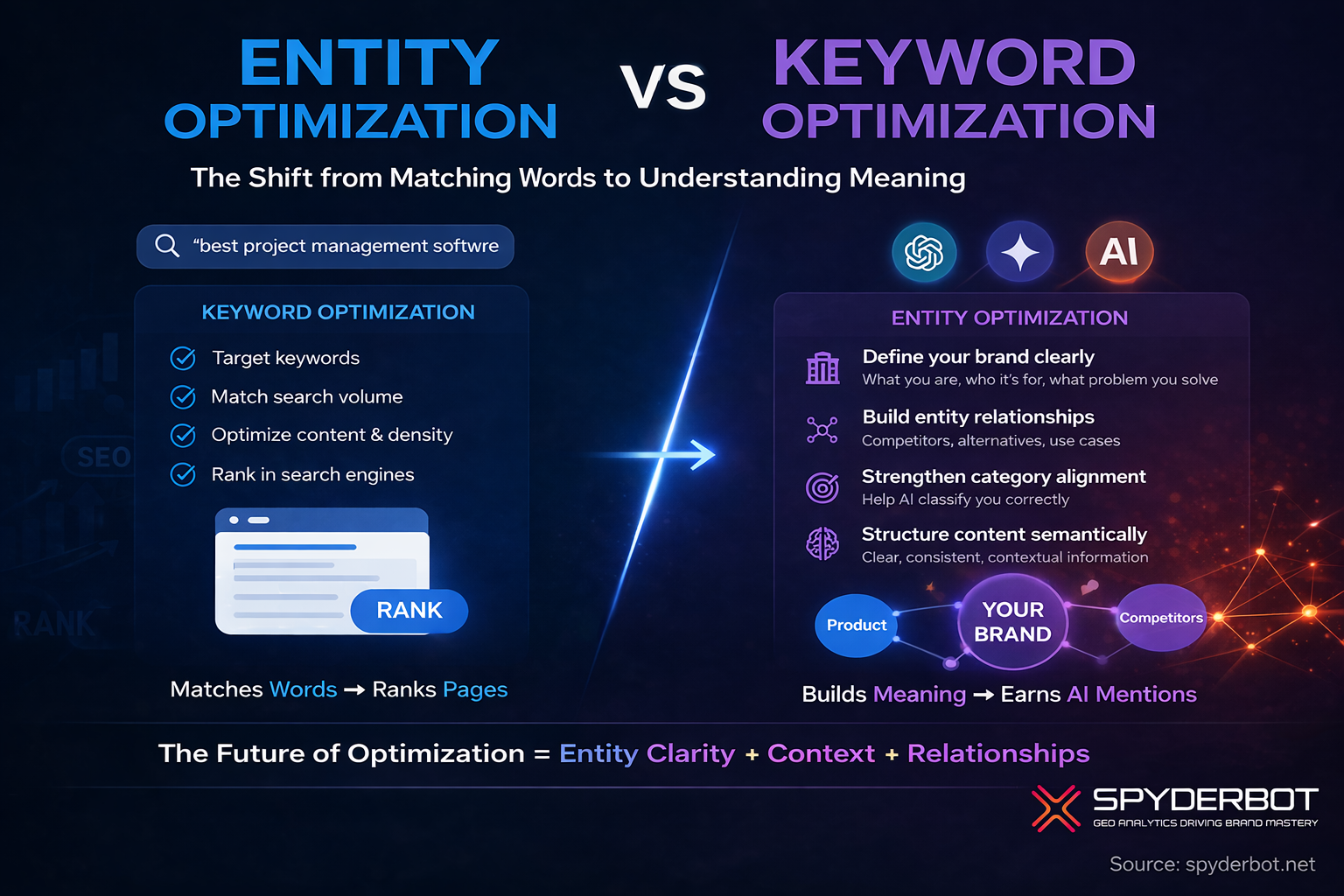
  • Entity Optimization vs Keyword Optimization

    Entity Optimization vs Keyword Optimization

    The shift from matching words to understanding meaning


    I. For years, SEO was built on keywords

    If you wanted to rank on Google, the process was clear:

    • Find keywords
    • Optimize content
    • Match search intent

    And the assumption was simple:

    If you match the right keywords, you win visibility


    II. But AI search doesn’t work that way

    AI systems like ChatGPT, Gemini, and Claude don’t think in keywords.

    They think in:

    Entities and relationships

    This creates a fundamental shift:

    From keyword optimization → to entity optimization


    III. What is keyword optimization?

    Keyword optimization is:

    The process of optimizing content around specific search terms to rank in search engines.

    It focuses on:

    • Keyword targeting
    • Search volume
    • Keyword density
    • On-page optimization

    The goal:

    Match user queries to rank higher


    IV. What is entity optimization?

    Entity optimization is:

    The process of defining, structuring, and strengthening how AI systems understand a brand, product, or concept.

    It focuses on:

    • Entity clarity
    • Relationships between entities
    • Contextual meaning
    • Semantic structure

    The goal:

    Ensure AI systems correctly understand and include your brand


    V. The core difference

    Keyword optimization matches words
    Entity optimization builds meaning


    VI. Keyword vs Entity (Side-by-side)

    DimensionKeyword OptimizationEntity Optimization
    UnitKeywordsEntities
    SystemSearch enginesAI systems
    GoalRankingInclusion
    FocusMatching queriesUnderstanding meaning
    OutputRanked pagesAI-generated mentions
    StrategyTarget keywordsDefine relationships

    VII. Why keyword optimization is no longer enough

    You can:

    • Rank for high-volume keywords
    • Optimize content perfectly
    • Drive organic traffic

    And still:

    Not be mentioned in AI answers

    Because AI does not rely on:

    • Exact keyword matches
    • Traditional SEO signals

    VIII. How AI systems understand entities

    AI systems interpret the world through:

    1. Entity definition

    What is this thing?

    • Company
    • Product
    • Category

    2. Entity relationships

    How does it connect?

    • Competitors
    • Alternatives
    • Use cases

    3. Contextual meaning

    When is it relevant?

    • User intent
    • Problem space
    • Industry context

    VIX. Example: keyword vs entity thinking

    1. Keyword approach:

    Target:

    “best project management software”

    Optimize:

    • Title
    • H1
    • Content density

    2. Entity approach:

    Define:

    • What your product is
    • Who it is for
    • How it compares

    Ensure AI understands:

    • Your category
    • Your positioning
    • Your competitors

    X. The shift from matching to understanding

    Keyword optimization is about:

    Matching queries

    Entity optimization is about:

    Being understood correctly


    XI. The shift from pages to knowledge

    SEO builds:

    Pages

    AI builds:

    Knowledge graphs of entities

    This means:

    • Your brand is not just a page
    • It is a node in a network

    XII. The shift from ranking to inclusion

    Keyword optimization leads to:

    Ranking

    Entity optimization leads to:

    Inclusion in AI-generated answers


    XIII. The rise of entity-based visibility

    We are entering a world where:

    Visibility depends on how well AI understands you

    Not just:

    • How well you rank
    • Or how many keywords you target

    XIV. How to move from keywords to entities

    1. Define your brand clearly

    Answer explicitly:

    • What is your product?
    • Who is it for?
    • What problem does it solve?

    2. Strengthen category alignment

    Make sure AI can classify you correctly.


    3. Build entity relationships

    Ensure your brand appears in contexts like:

    • Comparisons
    • Alternatives
    • Use cases

    4. Structure content semantically

    Use:

    • Clear definitions
    • Logical structure
    • Consistent messaging

    5. Monitor AI understanding

    Track:

    • Brand mentions in AI
    • Misclassification
    • Competitor positioning

    XV. Keyword optimization is not dead

    It still matters for:

    • Google rankings
    • Traffic generation
    • Discovery

    XVI. But it is no longer sufficient

    To win in AI search, you need:

    Entity optimization


    XVII. The future of optimization

    We are moving from:

    • Keyword-driven SEO

    To:

    • Entity-driven GEO

    XVIII. Final insight

    Keywords help you:

    Get found

    Entities determine whether:

    You are understood — and included


    The new model

    Visibility = Entity clarity + Context + Relationships