
Tag: generative engine optimization strategy

  • GEO Strategy

    GEO Strategy

    I. Why this guide was updated

    This guide was updated because Generative Engine Optimization is no longer just an SEO buzzword.

    More users now ask AI systems like ChatGPT, Gemini, Claude, Copilot, Grok, and Perplexity before they visit websites, compare brands, or make buying decisions.

    That creates a new visibility problem for companies:

    How do we get selected, mentioned, and correctly represented in AI-generated answers?

    Traditional SEO helps companies rank on search engines.

    GEO helps companies appear inside AI-generated answers.

    That difference matters because AI systems do not simply rank pages. They generate answers, select entities, compare brands, and shape user decisions before a click happens.

    II. What is a GEO strategy?

    A GEO strategy is a structured plan to improve the probability that a brand is selected, mentioned, and correctly positioned in AI-generated answers.

    A strong GEO strategy focuses on:

    • Entity clarity
    • Category positioning
    • Context relevance
    • Brand associations
    • Competitor visibility
    • Prompt-level coverage
    • AI-generated answer framing
    • Measurement and iteration

    In simple terms:

    SEO strategy helps you rank.

    GEO strategy helps you get selected by AI.

    III. Why GEO is different from SEO

    Many companies make the mistake of treating GEO like SEO.

    They assume that if they create more content, optimize pages, and target more keywords, AI visibility will automatically improve.

    That is not always true.

    SEO and GEO are related, but they solve different problems.

    SEO strategyGEO strategy
    Optimizes pagesOptimizes brand representation
    Targets keywordsBuilds entity associations
    Measures rankingsMeasures inclusion and mentions
    Focuses on trafficFocuses on AI-driven influence
    Competes on SERPsCompetes inside generated answers
    Improves discoverabilityImproves selection probability

    SEO is still important.

    But SEO is not enough when users ask AI systems for direct recommendations.

    IV. The core problem GEO solves

    GEO solves a selection problem.

    When a user asks an AI system a question, the AI must decide which brands, tools, companies, or sources are relevant enough to include in the answer.

    For example:

    • What are the best AI visibility tools?
    • Which SaaS tools help with competitor monitoring?
    • What are the top alternatives to Ahrefs?
    • Which companies are leading in Generative Engine Optimization?

    If your brand is not selected, users may never consider you.

    That is why GEO is not only about content.

    It is about helping AI systems understand when and why your brand should appear.

    V. The 5-layer GEO Strategy Framework

    A practical GEO strategy can be built around five layers:

    1. Entity layer
    2. Category layer
    3. Association layer
    4. Context layer
    5. Competitive layer

    Each layer affects how AI systems understand and select brands.

    VI. Layer 1: Entity clarity

    The first layer is entity clarity.

    This answers:

    Does AI understand what your brand is?

    AI systems need a clear understanding of your company, product, audience, and role in the market.

    Your brand entity should answer:

    • What is the company?
    • What does it do?
    • Who is it for?
    • What category does it belong to?
    • What problem does it solve?
    • How is it different?

    If your entity is unclear, AI systems may ignore your brand or describe it inaccurately.

    What to do

    Create a clear and consistent brand definition across your website and public profiles.

    For example:

    SpyderBot is a GEO analytics platform that helps companies track AI visibility, monitor LLM brand mentions, and understand how AI systems interpret their website and competitors.

    A sentence like this helps clarify the entity, category, and use case.

    VII. Layer 2: Category positioning

    The second layer is category positioning.

    This answers:

    Where does your brand compete?

    AI systems organize brands into categories.

    If your category is unclear, you may not appear in relevant prompts.

    For example, a GEO platform should be clearly associated with terms such as:

    • Generative Engine Optimization
    • AI visibility tracking
    • LLM brand monitoring
    • AI search analytics
    • AI competitor monitoring
    • AI brand mention tracking

    The more consistently your brand is associated with the right category, the easier it becomes for AI systems to understand when to include it.

    What to do

    Use consistent category language across:

    • Homepage copy
    • Product pages
    • Blog articles
    • Comparison pages
    • About page
    • FAQ sections
    • Social profiles
    • Third-party listings

    Avoid vague positioning such as “AI tool” or “marketing platform” if your real category is more specific.

    VIII. Layer 3: Association strength

    The third layer is association strength.

    This answers:

    What topics, problems, and use cases is your brand connected to?

    AI systems often select brands based on associations.

    A brand may be more likely to appear when it is consistently connected to relevant topics.

    For a GEO platform, important associations may include:

    • AI search visibility
    • ChatGPT brand mentions
    • Gemini brand visibility
    • LLM interpretation
    • AI-generated recommendations
    • Competitor mentions in AI answers
    • AI answer tracking
    • GEO strategy

    What to do

    Build content and references that connect your brand to high-value topics.

    Create content around:

    • Use cases
    • Comparison pages
    • Alternative pages
    • Problem-solution pages
    • Industry-specific pages
    • FAQ pages
    • Glossary pages
    • Data-driven insights

    The goal is not to stuff keywords.

    The goal is to strengthen semantic association.

    IX. Layer 4: Context coverage

    The fourth layer is context coverage.

    This answers:

    Where should your brand appear?

    AI visibility is context-specific.

    Your brand may appear in one type of prompt but disappear in another.

    For example, SpyderBot may want to appear in prompts such as:

    • Best GEO tools
    • AI visibility tracking tools
    • How to track ChatGPT brand mentions
    • How to monitor AI competitors
    • Best tools for LLM visibility
    • How to improve brand visibility in AI search
    • Generative Engine Optimization strategy

    Each prompt represents a different context.

    What to do

    Map your most important AI search contexts.

    Useful context types include:

    • Category prompts
    • Competitor alternative prompts
    • Comparison prompts
    • Problem-solving prompts
    • Buying-intent prompts
    • Beginner education prompts
    • Enterprise evaluation prompts
    • Use-case prompts

    Then create content and signals that support visibility in each context.

    X. Layer 5: Competitive positioning

    The fifth layer is competitive positioning.

    This answers:

    Why do competitors appear instead of you?

    GEO is competitive.

    AI systems often compare brands implicitly, even when the user does not ask for a comparison.

    If competitors appear more often, there is usually a reason.

    Possible causes include:

    • Competitors have stronger category associations
    • Competitors are mentioned more often across relevant sources
    • Competitors have clearer positioning
    • Competitors appear in more comparison content
    • Competitors are framed as more authoritative
    • Your brand lacks enough contextual coverage

    What to do

    Track competitor visibility across AI systems.

    Analyze:

    • Which competitors appear
    • Which prompts trigger them
    • How they are described
    • Whether they are primary or secondary mentions
    • What categories they are associated with
    • What strengths AI attributes to them
    • Where your brand is missing

    This turns GEO from guesswork into strategy.

    XI. The GEO execution loop

    A GEO strategy should not be a one-time project.

    It should be a continuous loop.

    Step 1: Measure visibility

    Track whether your brand appears in AI-generated answers.

    Measure:

    • Inclusion rate
    • Mention frequency
    • Prompt coverage
    • Competitor mention share
    • AI system coverage
    • Framing quality

    Step 2: Identify visibility gaps

    Find where your brand is missing or weak.

    Look for:

    • Missing contexts
    • Weak category alignment
    • Poor brand descriptions
    • Low mention frequency
    • Strong competitor dominance
    • Inaccurate AI interpretation

    Step 3: Analyze competitors

    Study which competitors appear and why.

    Compare:

    • Mention frequency
    • Positioning
    • Use-case coverage
    • Category association
    • Answer framing
    • Prompt-level visibility

    Step 4: Optimize signals

    Improve the signals that help AI systems understand your brand.

    Work on:

    • Entity clarity
    • Category language
    • Comparison content
    • FAQ structure
    • Use-case pages
    • Third-party references
    • Consistent brand messaging
    • Website interpretation

    Step 5: Iterate and remeasure

    After changes are made, track whether AI-generated answers change over time.

    GEO requires repeated measurement because AI visibility is not static.

    XII. How to measure GEO success

    A GEO strategy is working when you see improvements in:

    1. Inclusion rate

    Your brand appears in more relevant AI-generated answers.

    2. Mention frequency

    Your brand is mentioned more consistently across prompts.

    3. Context coverage

    Your brand appears in more use cases, comparison queries, and buying-intent prompts.

    4. Framing quality

    AI describes your brand more accurately and positively.

    5. Competitive share

    Your brand appears more often relative to competitors.

    6. Category alignment

    AI correctly understands your product category and positioning.

    These metrics are more relevant to GEO than traditional rankings alone.

    XIII. Common GEO mistakes

    Mistake 1: Treating GEO like SEO

    SEO and GEO are connected, but they are not the same.

    Ranking pages does not guarantee AI answer inclusion.

    Mistake 2: Publishing more content without diagnosis

    More content is not always the answer.

    Content only helps if it improves entity clarity, association strength, and contextual relevance.

    Mistake 3: Ignoring competitors

    If AI recommends competitors instead of you, you need to understand why.

    Without competitor analysis, GEO becomes guesswork.

    Mistake 4: Measuring only one prompt

    AI visibility varies by prompt.

    One question is not enough to evaluate performance.

    Mistake 5: Ignoring framing

    Being mentioned is not enough.

    How AI describes your brand affects perception and user trust.

    XIV. Practical GEO checklist

    Use this checklist to evaluate your GEO strategy:

    • Is your brand clearly defined in one sentence?
    • Is your product category consistent across your website?
    • Do you have content for important use cases?
    • Do you have comparison pages against key competitors?
    • Do you explain who your product is for?
    • Do you explain what problems your product solves?
    • Do you track AI mentions across multiple prompts?
    • Do you monitor competitors in AI answers?
    • Do you analyze how AI describes your brand?
    • Do you measure visibility changes over time?
    • Do you update content based on AI visibility gaps?

    If the answer is “no” to several of these, your GEO strategy needs work.

    XV. Where SpyderBot fits in a GEO strategy

    SpyderBot helps companies build and measure GEO strategy by analyzing how AI systems mention, interpret, and compare brands.

    SpyderBot helps answer:

    • Is our brand mentioned in AI-generated answers?
    • Which competitors appear instead of us?
    • How does AI describe our company?
    • Which prompts make us appear or disappear?
    • What category does AI associate us with?
    • Where are our visibility gaps?
    • How can we improve AI inclusion?

    SpyderBot is designed for the diagnostic layer of GEO.

    It helps teams move from guessing to understanding.

    XVI. Final conclusion

    A GEO strategy is not just about writing more content or adding more keywords.

    It is about understanding how AI systems select brands and optimizing for that selection process.

    The strongest GEO strategies combine:

    • Clear entity positioning
    • Strong category alignment
    • Relevant associations
    • Broad context coverage
    • Competitive analysis
    • Continuous measurement

    SEO helps you become searchable.

    GEO helps you become selectable.

    In AI search, the brands that win will not only be found.

    They will be selected, understood, and recommended.
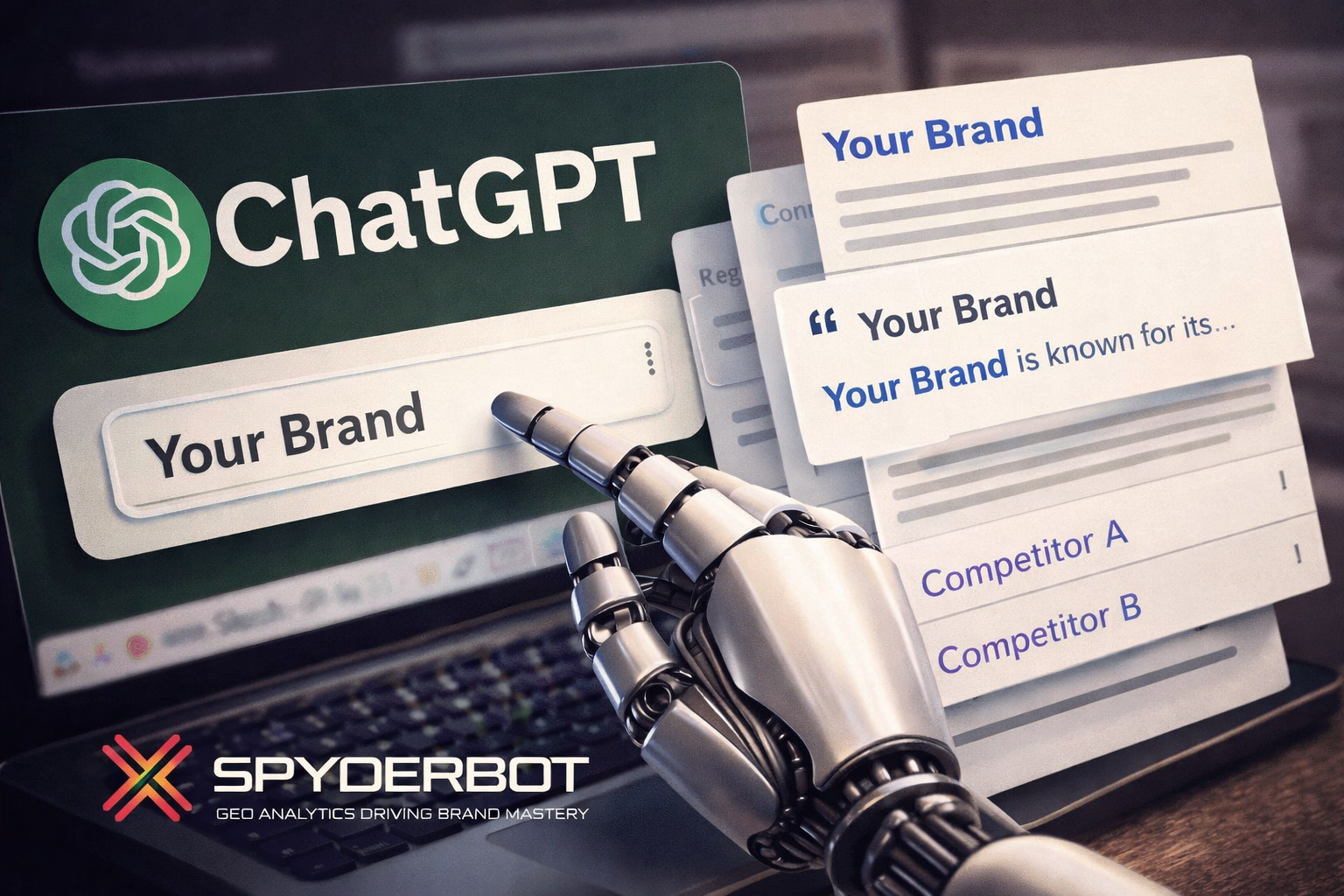
  • ChatGPT SEO Strategy

    ChatGPT SEO Strategy

    How to Get Your Brand Mentioned, Selected, and Recommended in AI Answers

    Most companies are asking the wrong question.

    They ask:

    “How do we do SEO for ChatGPT?”

    Then they apply the same playbook they have used for years:

    • Publish more blog posts
    • Add more keywords
    • Build more backlinks
    • Rewrite title tags
    • Check Google rankings
    • Wait for traffic to improve

    But nothing changes.

    Their brand is still missing from ChatGPT.

    Competitors still appear in AI-generated answers.

    The company may rank on Google, but it still does not get mentioned when users ask ChatGPT for recommendations.

    That is because ChatGPT visibility is not the same as Google ranking.

    ChatGPT does not simply display a search engine results page. It generates answers, interprets user intent, selects entities, compares options, and may mention brands directly. OpenAI explains that ChatGPT Search can provide fast, timely answers with links to relevant web sources, combining conversational search with web information retrieval.

    This creates a new strategic reality.

    The old model was:

    SEO → ranking → traffic

    The new model is:

    Data → AI interpretation → selection → generated answers → brand consideration

    That is why a real ChatGPT SEO strategy is not only about ranking.

    It is about being selected.


    I. What Is a ChatGPT SEO Strategy?

    A ChatGPT SEO strategy is a system for improving how your brand is recognized, interpreted, mentioned, positioned, and recommended inside AI-generated answers.

    It is not a keyword checklist.

    It is not a backlink campaign.

    It is not a trick to “rank number one” in ChatGPT.

    There is no traditional number one ranking in ChatGPT.

    A stronger definition is this:

    A ChatGPT SEO strategy is a GEO-driven strategy for improving AI visibility, brand selection, and competitive positioning across AI answer systems.

    GEO stands for Generative Engine Optimization.

    The original research paper on Generative Engine Optimization defines generative engines as systems that synthesize information from multiple sources to answer user queries, and it introduces GEO as a framework for improving visibility in generative engine responses. The paper also reports that GEO methods can improve visibility by up to 40% in tested generative engine settings.

    That matters because ChatGPT is not just another channel.

    It is part of a broader shift from search results to generated answers.

    The uploaded draft captures the core idea clearly: a ChatGPT SEO strategy should focus on entity recognition, context relevance, competitor positioning, and AI visibility rather than traditional rankings alone.

    That is the right foundation.

    Now let’s turn it into a practical strategy.


    II. Why Traditional SEO Strategy Is Not Enough

    Traditional SEO is still important.

    You still need crawlable pages, clear site structure, helpful content, technical quality, internal links, and credible external signals.

    Google’s documentation for AI features explains how AI Overviews and AI Mode work in Google Search from a site owner’s perspective, which confirms that AI-powered answers are now part of the search environment brands must understand.

    But traditional SEO alone does not fully explain ChatGPT visibility.

    Why?

    Because traditional SEO optimizes pages.

    ChatGPT often selects brands.

    Traditional SEO tracks rankings.

    ChatGPT visibility depends on inclusion.

    Traditional SEO targets keywords.

    AI systems interpret prompts, entities, relationships, and context.

    Traditional SEO asks:

    “Where does this URL rank?”

    ChatGPT SEO strategy asks:

    “Does AI understand this brand well enough to include it in the answer?”

    That difference changes the entire strategy.

    A brand can have strong SEO and still fail in ChatGPT if:

    • The brand entity is unclear
    • The category positioning is inconsistent
    • Competitors have stronger public signals
    • The brand is not associated with the right use cases
    • Third-party sources rarely mention the brand
    • AI systems describe the brand weakly
    • The company is missing from high-intent prompts

    This is why the goal is not only to do more SEO.

    The goal is to build a system that aligns with how AI systems understand and select brands.


    III. The ChatGPT SEO Strategy Framework

    A strong ChatGPT SEO strategy has eight parts:

    1. Entity foundation
    2. Category positioning
    3. Association building
    4. Context expansion
    5. Competitor alignment
    6. Positioning optimization
    7. Visibility tracking
    8. Continuous iteration

    Each part supports the same objective:

    Make your brand easier for AI systems to understand, trust, compare, and select.


    1. Entity Foundation: Does AI Understand Your Brand?

    Your first priority is entity clarity.

    Before ChatGPT can recommend your brand, it needs to understand what your brand is.

    This sounds basic, but many companies fail here.

    Their homepage is vague.

    Their product description is inconsistent.

    Their category language changes across platforms.

    Their brand name is not uniquely identifiable.

    Their website explains features but not the company’s actual role in the market.

    A strong entity foundation answers:

    • What is your company?
    • What does your product do?
    • Who is it for?
    • What problem does it solve?
    • What category does it belong to?
    • What makes it different?
    • Which alternatives is it compared with?

    For ChatGPT SEO strategy, this is not cosmetic.

    It is structural.

    If AI cannot clearly classify your brand, it is less likely to select it.

    What to do

    Start by rewriting your core brand definition.

    Make sure your homepage, About page, product pages, documentation, social profiles, directories, and review profiles all describe your brand consistently.

    For example:

    “SpyderBot is a GEO analytics platform that helps brands track how they are mentioned, positioned, and compared across AI systems such as ChatGPT, Gemini, Claude, Perplexity, Grok, and Copilot.”

    This type of description is clear because it defines:

    • The product
    • The category
    • The audience
    • The use case
    • The AI systems involved

    A vague description like “the future of AI-powered marketing intelligence” is not enough.

    AI visibility starts with clarity.


    2. Category Positioning: Where Do You Belong?

    Once your entity is clear, the next question is category positioning.

    AI systems need to know where your brand belongs.

    Are you an SEO platform?

    An AI search tool?

    A brand monitoring product?

    A GEO analytics platform?

    A competitor intelligence tool?

    A website analytics solution?

    If your category is unclear, AI may fail to include you in relevant prompts.

    This is especially important for emerging categories like GEO, AI visibility tracking, LLM brand monitoring, and ChatGPT SEO.

    When a category is new, AI systems need repeated, consistent signals to understand it.

    What to do

    Choose a primary category and reinforce it everywhere.

    For SpyderBot, the strongest category language should include:

    • GEO analytics platform
    • AI visibility tracking tool
    • LLM brand monitoring software
    • ChatGPT brand monitoring
    • AI search analytics platform
    • AI competitor mention tracking

    Then support the category with explainer content:

    • What is GEO?
    • GEO vs SEO
    • AI visibility vs organic visibility
    • ChatGPT SEO vs traditional SEO
    • How AI systems mention brands
    • Why competitors appear in AI answers

    The goal is to help AI connect your brand with the correct category and the correct buyer problem.

    Category clarity improves selection probability.


    3. Association Building: What Concepts Are You Connected To?

    ChatGPT does not only process brand names.

    It processes relationships.

    Your brand needs to be strongly associated with the concepts users ask about.

    For example, if users ask:

    • “How do I track ChatGPT mentions?”
    • “What are the best AI visibility tools?”
    • “How can I monitor LLM brand mentions?”
    • “Why does ChatGPT recommend my competitor?”
    • “What is the best GEO analytics platform?”
    • “How do I optimize for AI search?”

    Your brand should have public signals connecting it to those topics.

    This is not keyword stuffing.

    This is semantic association building.

    What to do

    Create content around high-intent problem areas:

    • ChatGPT brand monitoring
    • AI visibility tracking
    • LLM brand mentions
    • Generative Engine Optimization
    • AI search analytics
    • AI competitor tracking
    • AI citation tracking
    • AI brand sentiment
    • Prompt-based brand tracking
    • Entity optimization

    Each piece of content should answer a real question users may ask AI.

    Do not write only for search keywords.

    Write for prompts.

    That means using natural questions, direct answers, examples, comparisons, and clear definitions.

    A strong association strategy helps AI understand when your brand should be included.


    4. Context Expansion: Where Should You Appear?

    Many brands are partially visible in ChatGPT.

    They appear in narrow prompts but disappear in high-value contexts.

    For example, your brand might appear when someone asks directly:

    “What is [brand name]?”

    But it may not appear when someone asks:

    • “Best tools for [category]”
    • “Best alternatives to [competitor]”
    • “Best platform for [use case]”
    • “Which companies solve [problem]?”
    • “Top tools for startups”
    • “Top enterprise platforms”
    • “Best solution for ecommerce brands”

    That is not strong AI visibility.

    That is narrow recognition.

    A ChatGPT SEO strategy should expand the contexts where your brand appears.

    What to do

    Map your desired prompt universe.

    Group prompts into:

    • Branded prompts
    • Category prompts
    • Competitor prompts
    • Alternative prompts
    • Use-case prompts
    • Industry prompts
    • Problem-based prompts
    • Buying-intent prompts

    Then identify which contexts you are missing.

    For each missing context, create or improve supporting signals:

    • Website content
    • Use-case pages
    • Comparison pages
    • Case studies
    • Documentation
    • Third-party mentions
    • Reviews
    • Public reports
    • Founder insights
    • Social content
    • Community discussions

    The goal is to move from occasional visibility to broad contextual visibility.


    5. Competitor Alignment: Who Are You Competing With in AI?

    In traditional SEO, you may know your competitors from keyword overlap.

    In ChatGPT, your competitors are the brands that appear when users ask the prompts you want to own.

    Sometimes they are your direct business competitors.

    Sometimes they are not.

    AI may group your brand with unexpected tools because of overlapping descriptions, similar content, or weak category signals.

    That is why competitor alignment is critical.

    You need to know:

    • Who appears instead of you
    • Who appears with you
    • Who dominates high-intent prompts
    • Who is framed as the category leader
    • Who is recommended as the safer option
    • Which competitors are associated with which use cases

    What to do

    Track competitor co-occurrence.

    For every important prompt, record:

    • Which brands appear
    • Which brands appear first
    • Which brands are recommended
    • Which brands are described positively
    • Which brands are cited
    • Which competitors replace your brand

    Then compare how AI frames each company.

    If a competitor is consistently described as “enterprise-ready” while your brand is described as “emerging,” that is a positioning gap.

    If competitors appear in high-intent prompts and you only appear in informational prompts, that is a context gap.

    If you are not included in “alternatives to [competitor]” prompts, that is a comparison gap.

    Competitor alignment turns ChatGPT SEO from guesswork into strategy.


    6. Positioning Optimization: How Are You Described?

    Being mentioned is not enough.

    How ChatGPT describes your brand matters.

    AI-generated answers can frame your company as:

    • A leader
    • A trusted option
    • A specialized solution
    • A low-cost alternative
    • A niche product
    • A new entrant
    • A basic tool
    • A limited option
    • A risky or unclear brand

    This framing can influence user perception before the user ever visits your website.

    That makes positioning optimization one of the most important parts of ChatGPT SEO strategy.

    What to do

    Audit how AI describes your brand across prompts.

    Look for repeated phrases.

    Then compare them with how competitors are described.

    Ask:

    • Are we described accurately?
    • Are we described strongly?
    • Are we differentiated?
    • Are competitors framed as better?
    • Is our category clear?
    • Is our value proposition visible?
    • Are outdated descriptions still appearing?

    If AI describes your brand weakly, fix the public signals.

    Update your website.

    Improve comparison pages.

    Clarify use cases.

    Publish stronger category content.

    Earn better third-party references.

    Align external profiles.

    AI positioning improves when public brand signals become clearer and more consistent.


    7. Visibility Tracking: Are You Measuring Performance?

    A ChatGPT SEO strategy without tracking is just hope.

    You need a measurement system.

    Manual prompt testing can help at the beginning, but it is not enough for ongoing strategy.

    A real visibility tracking system should measure:

    • Inclusion rate
    • Mention share
    • Prompt coverage
    • Competitor presence
    • Competitor co-occurrence
    • Positioning strength
    • Sentiment
    • Missing contexts
    • Source patterns
    • Cross-model visibility
    • Changes over time

    OpenAI’s ChatGPT Search and Google’s AI Overviews both show that AI-powered answer environments are now connected to web discovery, but the experience is different from classic search results. Google describes AI Overviews as AI-generated snapshots with links for further exploration.

    That means brands need to measure not only whether they rank, but whether they are included in AI-generated answers.

    What to do

    Build a prompt set.

    Run it regularly.

    Compare results over time.

    Segment prompts by intent.

    Track competitors.

    Review sentiment and positioning.

    Then connect insights to action.

    Tracking is not the strategy.

    Tracking is the feedback loop that tells you whether the strategy is working.


    8. Continuous Iteration: Are You Improving Over Time?

    AI visibility is not static.

    Models change.

    Search experiences change.

    Competitors publish new content.

    Third-party sources update.

    Reviews accumulate.

    Your website evolves.

    That means ChatGPT SEO strategy must be iterative.

    You cannot optimize once and stop.

    What to do

    Build a monthly AI visibility workflow:

    1. Track your core prompt set
    2. Measure inclusion and mention share
    3. Identify competitor gains
    4. Review positioning changes
    5. Find missing contexts
    6. Update content and positioning
    7. Strengthen third-party signals
    8. Re-test and compare results

    The goal is continuous improvement.

    AI visibility is built through repeated signal alignment.


    IV. The 3 Phases of ChatGPT SEO Strategy

    A strong ChatGPT SEO strategy moves through three phases.


    Phase 1: Visibility

    The first goal is to get mentioned.

    At this stage, focus on:

    • Entity clarity
    • Category definition
    • Core associations
    • Website structure
    • Basic prompt tracking
    • Branded and category prompt visibility

    Questions to answer:

    • Does AI know who we are?
    • Does AI understand our category?
    • Are we appearing at all?
    • Which prompts include us?
    • Which prompts ignore us?

    Visibility is the first gate.

    If you are not mentioned, you are not considered.


    Phase 2: Positioning

    Once your brand appears, the next goal is to improve how you are described.

    At this stage, focus on:

    • Stronger differentiation
    • Better value proposition
    • Competitor comparisons
    • Sentiment improvement
    • Use-case clarity
    • Third-party validation

    Questions to answer:

    • Are we described accurately?
    • Are we positioned as a strong option?
    • Are competitors framed better than us?
    • Are we associated with the right use cases?
    • Do we appear as a leader, specialist, or alternative?

    Visibility gets you into the answer.

    Positioning influences whether users trust you.


    Phase 3: Dominance

    The final phase is competitive dominance.

    At this stage, focus on:

    • Increasing mention share
    • Expanding context coverage
    • Winning high-intent prompts
    • Improving cross-model consistency
    • Building stronger authority signals
    • Monitoring competitor movement

    Questions to answer:

    • Do we appear more often than competitors?
    • Do we dominate high-intent prompts?
    • Are we present across ChatGPT, Gemini, Claude, Perplexity, Grok, Copilot, and AI Overviews?
    • Are we consistently framed as a top option?
    • Are we improving over time?

    Dominance is not just appearing.

    It is becoming one of the brands AI consistently includes.


    V. Tactical Execution Plan

    Here is a practical execution plan.


    Week 1 to 2: Build the Baseline

    Start by measuring where you are now.

    Tasks:

    • Define your target prompt set
    • Run prompts across key AI systems
    • Record brand mentions
    • Record competitor mentions
    • Analyze positioning
    • Identify missing contexts
    • Identify competitor dominance
    • Review how AI describes your brand

    Output:

    • Baseline visibility report
    • Competitor map
    • Prompt gap list
    • Positioning diagnosis

    Week 3 to 4: Fix the Foundation

    Use the baseline to fix entity and category problems.

    Tasks:

    • Rewrite core brand description
    • Clarify homepage positioning
    • Improve About, Product, Feature, and Use Case pages
    • Align category language
    • Update external profiles
    • Remove conflicting descriptions
    • Improve FAQ sections
    • Add structured information where relevant

    Output:

    • Clearer entity foundation
    • Stronger category consistency
    • Better AI-readable positioning

    Month 2 to 3: Expand Coverage

    Now build content and signals around missing contexts.

    Tasks:

    • Create use-case pages
    • Create comparison pages
    • Create alternatives pages
    • Publish prompt-based articles
    • Build third-party mentions
    • Strengthen review platform presence
    • Add case studies or public examples
    • Improve documentation

    Output:

    • Wider context coverage
    • Stronger brand-concept associations
    • Better competitor alignment

    Ongoing: Optimize and Re-Test

    Repeat the cycle.

    Tasks:

    • Track visibility monthly
    • Compare prompt performance
    • Monitor competitor changes
    • Review sentiment shifts
    • Update weak pages
    • Improve external signals
    • Re-test after campaigns
    • Refine strategy based on data

    Output:

    • Continuous visibility improvement
    • Better prompt coverage
    • Stronger competitive position

    VI. Common Mistakes in ChatGPT SEO Strategy

    Most companies fail because they bring old assumptions into a new system.

    Mistake 1: Treating ChatGPT Like Google

    ChatGPT does not behave like a standard SERP.

    If your strategy is only about rankings, you will miss the AI visibility layer.

    Mistake 2: Focusing Only on Content

    More content is not always the answer.

    If the category is unclear or the positioning is weak, publishing more articles may simply create more confusion.

    Mistake 3: Ignoring Competitors

    AI visibility is competitive.

    You need to know who appears instead of you and why.

    Mistake 4: Not Tracking Visibility

    Without tracking, you are guessing.

    You need prompt-level measurement to know whether visibility is improving.

    Mistake 5: Expecting Instant Results

    AI visibility takes time because it depends on repeated, consistent signals across sources.

    GEO is not a one-day tactic.

    It is a visibility system.


    VII. A Realistic Scenario

    Imagine a company with strong traditional SEO.

    It has blog traffic, backlinks, and Google rankings.

    But when users ask ChatGPT for the best tools in its category, the company is rarely mentioned.

    A traditional team might respond by publishing more blog posts.

    But after deeper analysis, the real issues are different:

    • The brand category is unclear
    • Competitors have stronger third-party mentions
    • The company is missing from alternative prompts
    • AI describes the product as a general tool
    • There is weak association with high-intent use cases
    • The website lacks comparison content

    The right strategy is not just more content.

    The right strategy is:

    • Clarify the entity
    • Strengthen category positioning
    • Build use-case associations
    • Create comparison assets
    • Improve third-party validation
    • Track AI visibility over time

    That is ChatGPT SEO strategy done properly.


    VIII. Where SpyderBot Fits

    SpyderBot is designed for this new visibility layer.

    It helps brands understand how AI systems mention, compare, and represent them across platforms such as ChatGPT, Gemini, Claude, Perplexity, Grok, Copilot, and other LLMs.

    SpyderBot helps teams:

    • Track AI visibility
    • Monitor brand mentions
    • Compare competitors
    • Identify missing prompts
    • Analyze positioning and sentiment
    • Detect competitor dominance
    • Understand AI interpretation patterns
    • Turn visibility gaps into optimization actions

    This is where strategy becomes measurable.

    Without tools, teams often rely on manual prompt checks and screenshots.

    That is not enough.

    SpyderBot turns the workflow into:

    Strategy → Data → Insight → Action → Re-test

    That is how brands move from guessing to improving.

    The point is not to replace SEO.

    The point is to add the missing AI visibility layer.


    Final Conclusion

    A ChatGPT SEO strategy is not about forcing old SEO tactics into a new environment.

    It is about understanding how AI systems select brands.

    The old world was built around ranking.

    The new world is built around selection.

    The old question was:

    “How do we rank higher?”

    The new question is:

    “How do we become the answer?”

    To win in ChatGPT, brands need more than keywords and backlinks.

    They need entity clarity, category positioning, semantic associations, context coverage, competitor alignment, positioning strength, tracking, and continuous iteration.

    SEO still matters.

    But GEO is the layer that helps brands become visible inside AI-generated answers.

    In the AI search era, the brands that win will not only be the brands with the most content.

    They will be the brands that AI systems understand, trust, and select.