This article was updated because the way users discover brands is changing.
For years, tools like Similarweb helped companies understand traffic, market share, acquisition channels, and competitor performance.
That is still useful.
But traffic is no longer the full picture.
Today, users also ask ChatGPT, Gemini, Claude, Perplexity, Copilot, Grok, and other AI systems before they ever visit a website.
That creates a new visibility problem:
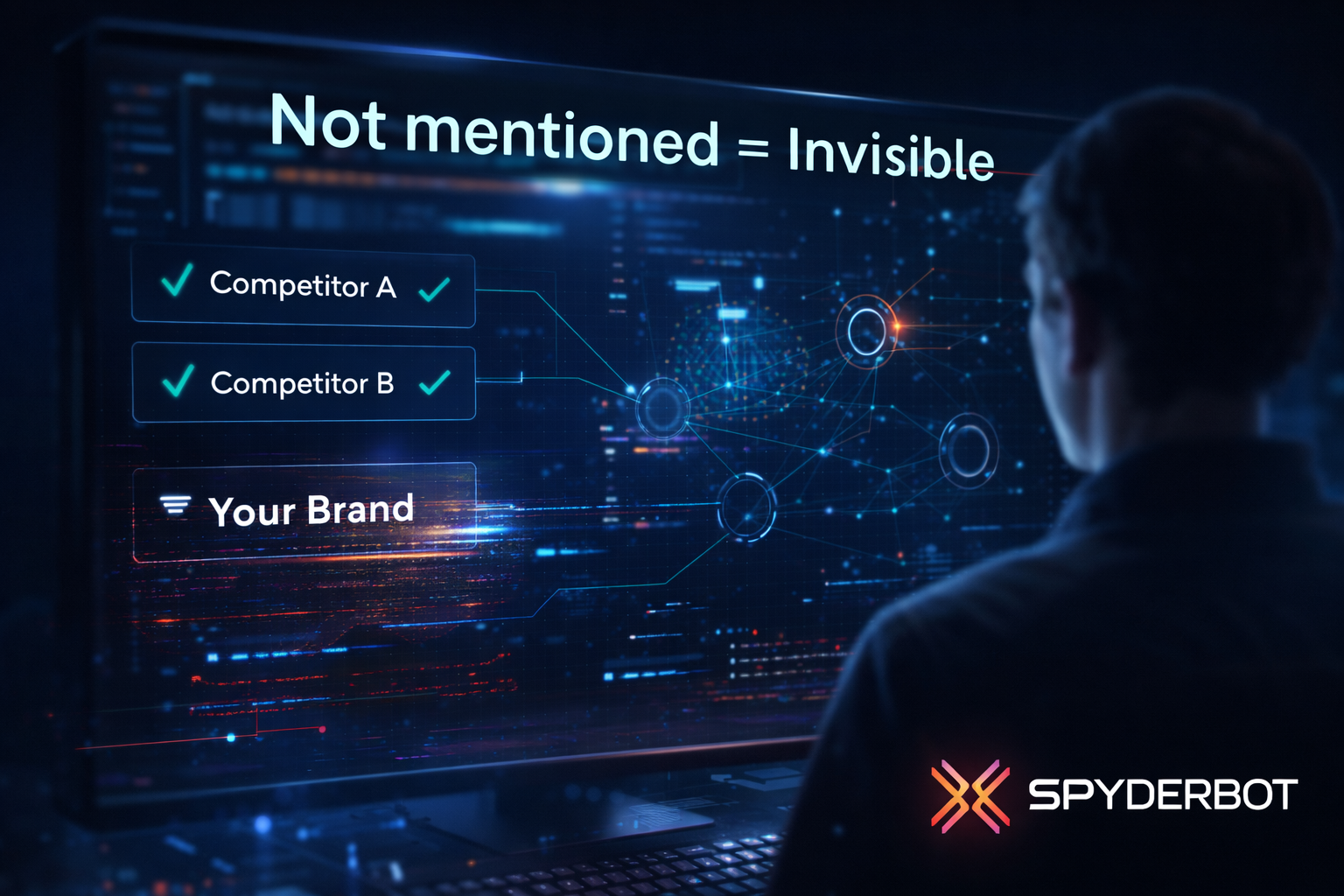
A company can have strong traffic, strong market presence, and good channel performance, but still be missing from AI-generated recommendations.
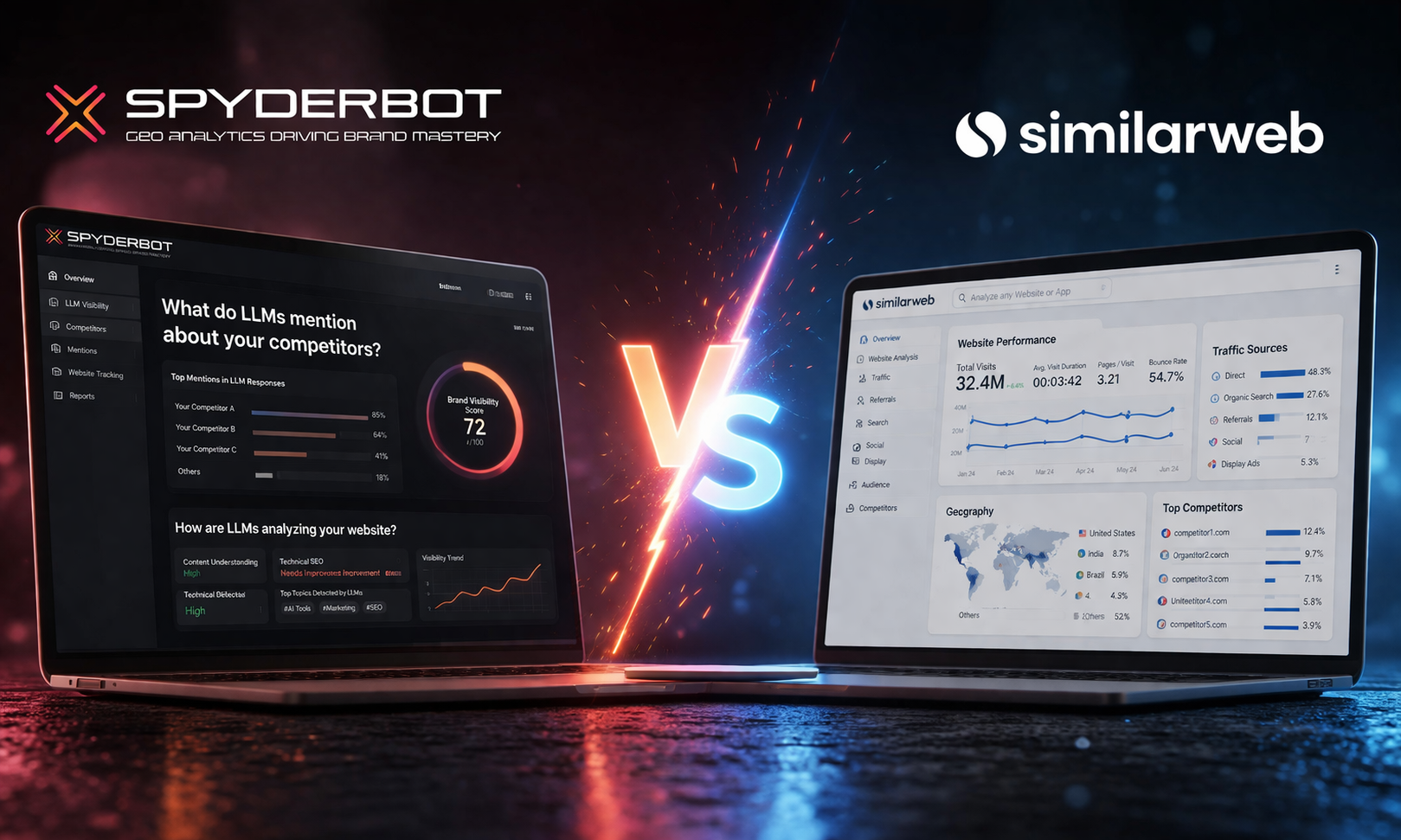
This is where the difference between Similarweb and SpyderBot becomes important.
Similarweb helps you understand where traffic comes from.
SpyderBot helps you understand what AI systems say before users click.
II. The simplest difference
Similarweb answers:
How are users reaching websites?
SpyderBot answers:
Is AI recommending, mentioning, or correctly understanding your brand?
These are not the same question.
Similarweb analyzes web traffic behavior.
SpyderBot analyzes AI-generated answers and LLM interpretation.
One looks at user movement across the web.
The other looks at what AI tells users before they make a decision.
III. What Similarweb is built for
Similarweb is a digital intelligence and traffic analytics platform.
It is mainly used to understand website performance, competitor traffic, market share, and acquisition channels.
Similarweb is useful for:
Website traffic estimation
Competitor traffic benchmarking
Channel breakdown
Organic search traffic analysis
Paid search insights
Referral traffic analysis
Audience behavior
Industry and market trends
Digital market intelligence
For growth teams, SEO teams, investors, marketers, and strategy teams, Similarweb is valuable because it shows how users move across websites and digital channels.
If your goal is to understand traffic and market position, Similarweb is the right type of tool.
IV. What SpyderBot is built for
SpyderBot is a GEO analytics platform.
GEO means Generative Engine Optimization.
Instead of analyzing traffic, SpyderBot analyzes how AI systems interpret, mention, compare, and recommend brands.
SpyderBot helps answer questions such as:
Does ChatGPT mention your brand?
Does Gemini understand what your company does?
Does Claude recommend your competitors instead of you?
Is your website being interpreted correctly by LLMs?
Which brands appear most often in AI-generated answers?
What does AI say about your category?
Is your brand missing from important AI prompts?
How stable is your AI visibility across different questions?
This matters because AI visibility is becoming a separate layer of digital visibility.
A user may never visit a comparison page if an AI system already recommends a competitor first.
V. Traffic visibility vs AI visibility
The biggest mistake is assuming traffic equals influence.
It does not.
A website can receive traffic and still lose the decision layer.
For example, a company may have:
Strong monthly visits
Good referral traffic
Strong organic search performance
Healthy market share
Good brand awareness
But when users ask AI tools for recommendations, the company may not appear.
That means the company has traffic visibility, but weak AI visibility.
Similarweb helps identify the first problem.
SpyderBot helps identify the second.
VI. Comparison table
Category
Similarweb
SpyderBot
Main focus
Website traffic analytics
AI visibility analytics
System analyzed
User behavior across websites
AI systems and LLMs
Core data layer
Visits, channels, engagement
Mentions, prompts, AI answers
Main question
Where does traffic come from?
What does AI recommend?
Best for
Market and traffic intelligence
GEO and AI brand visibility
Competitor analysis
Traffic-based competitors
AI-recommended competitors
Output
Traffic insights
Answer-level insights
Visibility layer
Website acquisition
AI-generated decision layer
VII. Where Similarweb is stronger
Similarweb is stronger when your goal is digital market intelligence.
Use Similarweb when you need to:
Estimate competitor traffic
Compare website performance
Understand acquisition channels
Analyze market share
Study referral sources
Track category trends
Evaluate digital growth
Understand audience behavior
Similarweb is especially useful when you want to know how users arrive at websites and which digital channels are driving growth.
SpyderBot does not replace this.
VIII. Where SpyderBot is stronger
SpyderBot is stronger when your goal is AI visibility intelligence.
Use SpyderBot when you need to:
Track whether AI systems mention your brand
Monitor competitor mentions in AI-generated answers
Understand why AI recommends another company
Analyze how LLMs interpret your website
Identify missing brand associations
Measure prompt-level visibility
Detect weak AI positioning
Improve visibility in AI search and answer engines
This is a different kind of analytics.
It is not about traffic after the click.
It is about influence before the click.
IX. What Similarweb cannot show
Similarweb does not fully answer questions like:
Does ChatGPT recommend my brand?
Does Gemini mention my competitors more often?
How does Claude describe my product?
What does AI think my company does?
Is my brand included in AI-generated buying recommendations?
Why is AI ignoring my website?
Which prompts make my competitors appear?
This is because traffic data does not show AI-generated answer behavior.
Similarweb can show where users go.
It cannot fully show what AI tells users before they go anywhere.
X. What SpyderBot cannot replace
SpyderBot does not replace Similarweb.
SpyderBot is not designed for:
Traffic estimation
Channel breakdown
Audience demographics
Market share analysis
Referral traffic analysis
Website visit benchmarking
Those are Similarweb’s strengths.
SpyderBot focuses on AI visibility, not traffic analytics.
The correct approach is not to replace one with the other.
The correct approach is to understand which visibility layer you are trying to measure.
XI. Real-world example
Imagine a SaaS company with strong traffic.
Similarweb may show:
High monthly visits
Strong organic search growth
Good referral traffic
Better performance than smaller competitors
Strong category presence
From a traffic perspective, the company looks healthy.
But when users ask AI:
“What are the best tools for this problem?”
The AI answer may recommend competitors instead.
SpyderBot may reveal:
The brand is rarely mentioned
Competitors appear more often
AI does not clearly understand the product category
The website lacks strong entity signals
The brand is not associated with key use cases
This is the hidden gap.
Traffic is not the same as AI influence.
XII. Why this matters now
The buying journey is changing.
Before, users searched, clicked, compared, and then decided.
Now, users often ask AI first.
That means AI systems can shape the shortlist before a user visits any website.
This changes the role of analytics.
Traffic analytics tells you what happened after users moved across the web.
AI visibility analytics tells you whether your brand was included before the user made a decision.
That is why GEO is becoming important.
XIII. How Similarweb and SpyderBot work together
The best teams should not treat Similarweb and SpyderBot as direct replacements.
They should treat them as tools for different stages of visibility.
Layer
Question
Tool type
Market intelligence
How large is the opportunity?
Similarweb
Traffic acquisition
Where do users come from?
Similarweb
AI recommendation
Which brands does AI suggest?
SpyderBot
Brand interpretation
How does AI understand us?
SpyderBot
Competitive visibility
Who appears before the user clicks?
SpyderBot
Similarweb helps you understand the traffic layer.
SpyderBot helps you understand the AI answer layer.
Both matter.
XIV. When to use Similarweb
Use Similarweb if your priority is to:
Understand website traffic
Benchmark competitors
Analyze digital channels
Study market trends
Compare audience behavior
Evaluate traffic growth
Plan digital acquisition strategy
Similarweb is best for understanding web activity and market-level performance.
XV. When to use SpyderBot
Use SpyderBot if your priority is to:
Improve AI visibility
Track LLM brand mentions
Monitor AI competitor recommendations
Understand how AI interprets your website
Identify missing brand signals
Improve GEO strategy
Measure prompt-level visibility
Know whether AI includes your brand in answers
SpyderBot is best for understanding how AI systems represent your brand.
XVI. Should companies use both?
Yes.
Most serious marketing teams will need both traffic analytics and AI visibility analytics.
Similarweb helps answer:
Where is our traffic coming from?
SpyderBot helps answer:
Are we being recommended before users even visit a website?
Those two questions support different decisions.
Traffic matters.
But AI recommendation is becoming a new source of influence.
XVII. Final conclusion
Similarweb is a strong platform for traffic analytics, market intelligence, and competitor benchmarking.
SpyderBot is built for a different problem: understanding AI visibility, LLM mentions, competitor recommendations, and how AI systems interpret your brand.
The difference is simple.
Similarweb shows how users move across the web.
SpyderBot shows what AI tells users before they move.
In the old digital model, visibility meant traffic.
In the AI-driven model, visibility also means being included in the answer.
That is why brands should measure both traffic visibility and AI visibility.
This article was updated because the search landscape has changed.
For years, SEO teams used tools like Ahrefs to understand rankings, backlinks, keyword gaps, and organic traffic opportunities. That workflow is still important.
But today, users do not only search on Google.
They also ask ChatGPT, Gemini, Claude, Perplexity, Copilot, Grok, and other AI systems for product recommendations, vendor comparisons, and buying decisions.
That creates a new problem:
A brand can rank well on Google and still be invisible inside AI-generated answers.
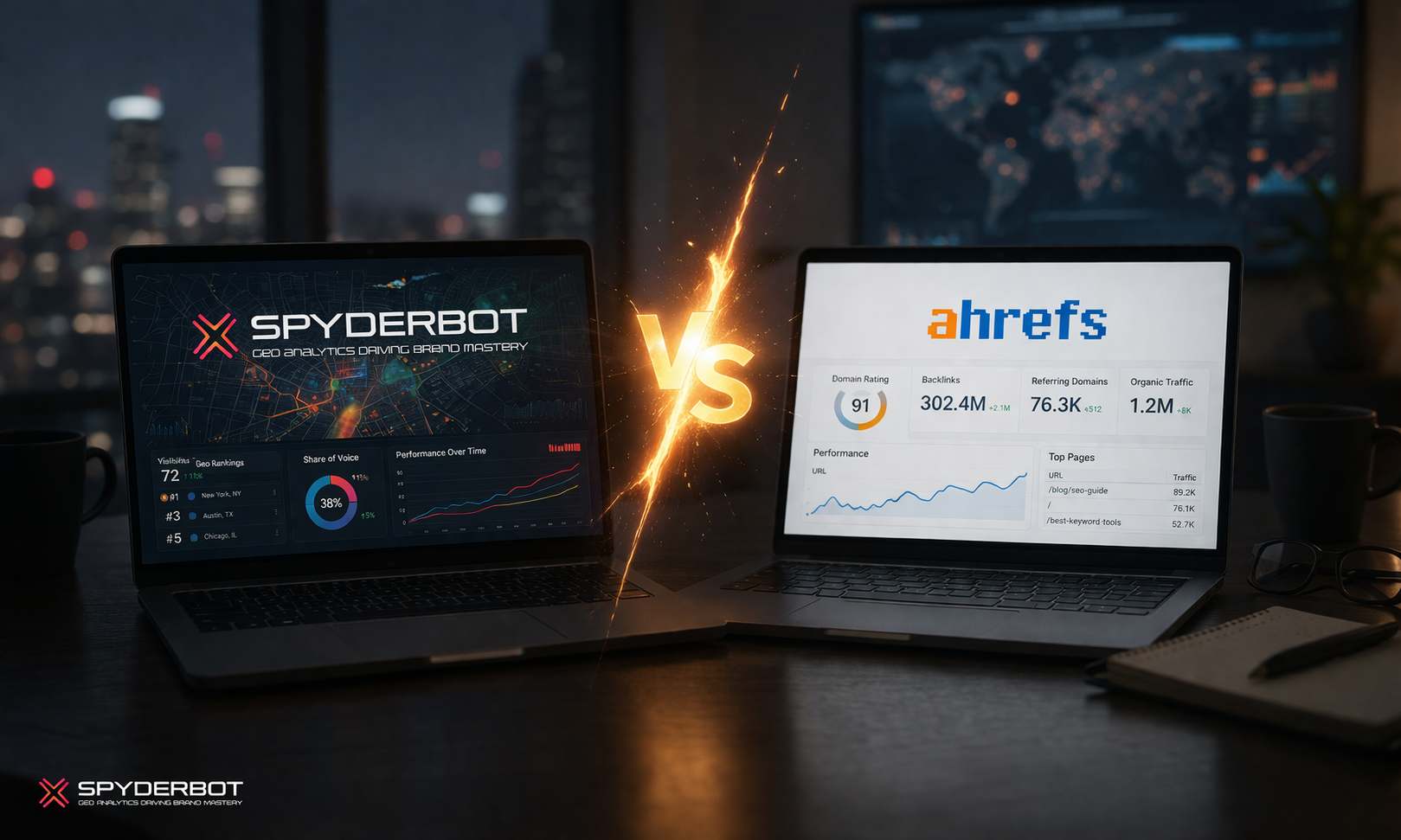
This is the core difference between Ahrefs and SpyderBot.
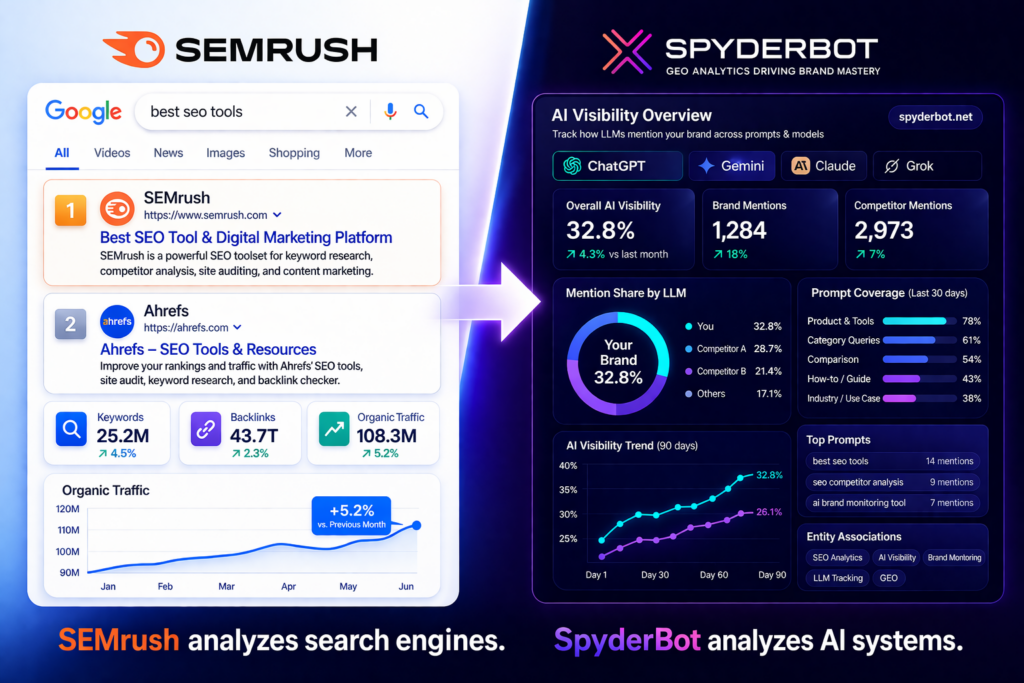
Ahrefs helps you understand traditional search visibility.
SpyderBot helps you understand AI visibility.
They are not built for the same layer of discovery.
II. The simplest difference
Ahrefs answers:
How does my website perform in Google search?
SpyderBot answers:
How does AI understand, mention, compare, and recommend my brand?
That distinction matters because search engines and AI systems do not work the same way.
Google search usually retrieves and ranks web pages.
AI systems generate answers by interpreting entities, relationships, context, trust signals, and patterns across information sources.
So the question is no longer only:
“How do we rank higher?”
The new question is:
“Are we included when AI gives the answer?”
III. What Ahrefs is built for
Ahrefs is one of the strongest SEO analytics platforms in the market.
It is designed for classic SEO workflows such as:
Keyword research
Backlink analysis
Rank tracking
Competitor SEO research
Content gap analysis
SERP analysis
Technical SEO auditing
Organic traffic opportunity discovery
Ahrefs is especially strong when the goal is to understand why a page ranks, which keywords bring traffic, and how competitors earn backlinks.
For SEO teams, content teams, and link-building teams, Ahrefs remains a powerful tool.
If your goal is to improve Google rankings, Ahrefs is the right kind of platform.
IV. What SpyderBot is built for
SpyderBot is built for GEO, which means Generative Engine Optimization.
Instead of focusing on keyword rankings and backlinks, SpyderBot focuses on how AI systems interpret and mention brands.
SpyderBot helps answer questions such as:
Does ChatGPT mention your brand?
Does Gemini understand what your company does?
Which competitors are recommended instead of you?
What does AI say about your product category?
Is your brand positioned correctly in AI-generated answers?
Are you visible across different prompts and use cases?
Is your website being interpreted clearly by LLMs?
This matters because AI visibility is not the same as search visibility.
You can have traffic, backlinks, and keyword rankings, but still lose the recommendation layer when users ask AI what to buy, compare, or trust.
V. SEO visibility vs AI visibility
The biggest mistake is assuming that SEO success automatically creates AI visibility.
It does not.
A page can rank on Google because it has strong backlinks, optimized content, and good technical SEO.
But an AI system may still fail to mention that brand because the entity is unclear, the product positioning is weak, the brand is not consistently associated with the right category, or competitors have stronger contextual signals.
That is why GEO is becoming a separate discipline.
For years, digital visibility followed a familiar pattern. A user searched for something, Google returned a list of links, and brands competed for the highest position on the results page. If your website ranked well, you had a chance to earn traffic, leads, and trust.
That model still matters, but it is no longer the full picture.
Users are now asking AI systems like ChatGPT, Gemini, Claude, Grok, and Copilot for direct answers. Instead of scanning multiple search results, they often receive a single synthesized response. That response may include a few brands, a few sources, or no external links at all.
This creates a new visibility problem.
A brand can rank on Google and still be absent when AI systems generate recommendations, comparisons, or category explanations. That gap is exactly why Generative Engine Optimization, or GEO, is becoming important.
What is Generative Engine Optimization?
Generative Engine Optimization is the practice of improving how AI systems understand, interpret, mention, and compare a brand inside generated answers.
Traditional SEO focuses on helping search engines crawl, understand, and rank webpages. GEO focuses on helping AI systems recognize a brand as a clear, relevant, and trustworthy entity when users ask questions.
In simple terms:
SEO helps your pages rank in search results. GEO helps your brand appear in AI-generated answers.
GEO includes several related activities:
Tracking brand mentions across AI systems
Monitoring how competitors are mentioned
Understanding how LLMs describe your brand
Improving entity clarity across your website and external sources
Structuring content so AI systems can understand products, categories, use cases, and comparisons
Measuring whether AI tools include, ignore, or misrepresent your brand
This is not a replacement for SEO. It is an additional layer of visibility.
Why GEO matters now
1. AI is becoming a discovery layer
AI tools are increasingly used for product research, vendor comparisons, software recommendations, technical explanations, and buying decisions.
A user may no longer search:
“best tools for AI brand monitoring”
They may ask:
“What are the best tools to monitor how ChatGPT mentions my brand?”
That difference matters.
In a traditional search result, a user can compare multiple pages. In an AI-generated answer, the system may summarize the market and mention only a handful of brands. If your brand is not included, the user may never know you exist.
2. Google ranking does not guarantee AI visibility
A website can have strong SEO and still perform poorly in AI answers.
This happens because AI systems do not simply copy Google rankings into their responses. They generate answers based on many signals, including language patterns, entity relationships, source confidence, topic relevance, and the context of the user’s query.
That means ranking for a keyword is not the same as being mentioned in an AI answer.
This is the new AI visibility gap:
Your website may be visible in search, but your brand may be invisible in AI-generated recommendations.
3. AI systems shape brand perception
AI tools do not only mention brands. They also explain them.
They may describe what a company does, who it serves, what category it belongs to, what competitors it has, and whether it is suitable for a specific use case.
That makes GEO important for more than traffic. It affects perception.
If an AI system misunderstands your brand, places it in the wrong category, omits your strongest use case, or compares you against the wrong competitors, the damage is quiet but real.
You may lose qualified users before they ever reach your website.
4. Competitor visibility is becoming harder to see
In SEO, you can usually see who ranks above you.
In AI search, the competitive landscape is less visible. One brand may appear in ChatGPT. Another may appear in Gemini. A third may appear in Claude. The wording may change across prompts, regions, sessions, and user intent.
This makes AI competitor monitoring important.
Brands now need to know:
Which competitors are mentioned more often?
Which competitors are recommended for which use cases?
How does AI describe our brand compared with others?
Are we included in category-level answers?
Are we missing from high-intent prompts?
Are AI systems using outdated or incomplete information about us?
Without tracking this, companies are making decisions in the dark.
GEO vs SEO: what is the difference?
SEO and GEO are connected, but they optimize for different outcomes.
Keywords, technical SEO, internal links, backlinks, content quality
Entity clarity, contextual signals, source consistency, AI answer patterns
User experience
Search result list
Direct synthesized answer
Competitive view
SERP competitors
Mention competitors inside AI responses
The key shift is this:
SEO competes for position. GEO competes for inclusion.
In search, being second or third can still bring traffic. In AI-generated answers, being excluded can mean total invisibility for that query.
How AI systems decide what to mention
No public AI system reveals a simple universal formula for brand inclusion. However, from observed AI behavior, search documentation, and practical testing, several patterns matter.
AI systems tend to mention brands when they can clearly understand the following signals.
Entity identity
The system needs to understand who you are.
This includes your brand name, website, product category, company description, target audience, and core use cases.
If your website gives vague or inconsistent signals, AI systems may struggle to associate your brand with the right category.
Category relevance
The system needs to understand what market you belong to.
For SpyderBot, for example, the category should be clear:
GEO analytics
AI search visibility
LLM brand monitoring
AI competitor mention tracking
AI brand analytics
If the content only says “AI tool” or “analytics platform,” the category is too broad.
Contextual consistency
AI systems learn from repeated patterns.
If your website, articles, social profiles, product pages, and third-party references describe your brand in different ways, the system may form an unclear understanding.
A brand should consistently answer:
What does the company do?
Who is it for?
What problem does it solve?
What category does it belong to?
What makes it different?
Source confidence
AI systems are more likely to include information when it appears clear, consistent, and supported by reliable sources.
This does not mean backlinks are irrelevant. It means backlinks alone are not enough. GEO requires stronger semantic clarity around the brand and its relationship to the topic.
Prompt alignment
AI answers change depending on how users ask questions.
A brand may appear for:
“best GEO analytics tools”
but not appear for:
“how to track ChatGPT brand mentions”
That is why GEO measurement should test multiple prompt clusters, not only one keyword.
The real cost of ignoring GEO
Ignoring GEO does not always create an obvious drop in traffic immediately.
That is what makes it dangerous.
A brand may still see Google traffic, newsletter signups, or direct visits, while silently losing AI-driven discovery.
The cost can show up in several ways:
Competitors are recommended before you
AI systems describe your category without mentioning your brand
Users receive outdated or incomplete information
Your strongest use cases are missing from AI answers
Your product is compared against the wrong alternatives
Your brand is excluded from high-intent recommendation prompts
The biggest problem is that most teams cannot diagnose this with traditional SEO tools alone.
Rank tracking tells you where your page appears in search. It does not tell you whether ChatGPT, Gemini, Claude, or Grok includes your brand in generated answers.
How companies should approach GEO
Step 1: Measure AI visibility
Start by checking how often your brand appears across important prompts.
For example:
What are the best tools for AI brand monitoring?
What are the best GEO analytics platforms?
How can I track brand mentions in ChatGPT?
Which tools help monitor AI search visibility?
What are the alternatives to a specific competitor?
Do this across multiple AI systems, not just one.
Track:
Whether your brand appears
Where it appears in the answer
How it is described
Which competitors are mentioned
Whether the answer is accurate
Whether your website or sources are cited
Step 2: Map your entity signals
Review whether your brand is described consistently across your website and external profiles.
Your homepage, about page, product pages, blog posts, schema markup, social profiles, and third-party listings should reinforce the same core positioning.
For SpyderBot, a strong entity description could be:
SpyderBot is a GEO analytics platform that helps brands monitor how AI systems like ChatGPT, Gemini, Claude, and Grok mention, compare, and interpret their websites and competitors.
That sentence is clear because it includes:
Brand name
Category
Core function
Platforms monitored
User benefit
Competitive context
Step 3: Build content around AI search intent
Do not create thin articles for every keyword variation.
Instead, group related queries into strong topic clusters.
For example, one strong article can cover:
What is Generative Engine Optimization?
Why GEO matters
GEO vs SEO
AI visibility tracking
How to appear in AI search results
Then supporting articles can go deeper into specific problems:
Why ChatGPT is not mentioning your brand
How to track brand mentions in LLMs
How AI systems compare competitors
How to optimize your website for AI search
Best GEO analytics tools for SaaS companies
This structure is better for readers and easier for search engines to understand.
Step 4: Add evidence, examples, and original perspective
Generic AI-written articles are easy to ignore.
A stronger GEO article should include:
Real examples
Original observations
Founder insight
Frameworks
Definitions
Use cases
Comparison tables
Clear next steps
Links to authoritative sources
This helps the article feel useful rather than automatically generated.
Step 5: Monitor changes over time
GEO is not a one-time optimization task.
AI answers can change as models update, new sources are crawled, competitors publish new content, and user behavior shifts.
A useful GEO workflow should monitor:
Mention frequency
Competitor inclusion
Prompt-level performance
Sentiment and framing
Citation patterns
Category association
Changes after content updates
Founder insight from SpyderBot
While building SpyderBot, one pattern became clear:
The future of visibility is not only about being ranked. It is about being understood.
Many brands still measure digital visibility through rankings, backlinks, and traffic. Those metrics still matter, but they do not fully explain how AI systems represent a brand.
A company can have a strong website and still be missing from AI-generated recommendations. Another company can have weaker SEO but stronger category clarity, making it easier for AI systems to mention it in the right context.
That is the core reason GEO matters.
It helps brands answer two questions that traditional SEO tools were not designed to answer:
What do AI systems mention about my competitors to users?
How are AI systems analyzing and interpreting my website?
Those questions are becoming central to modern search visibility.
GEO checklist for brands
Before investing in more content, check whether your brand has the basics in place.
Brand clarity
Is your product category clear on your homepage?
Is your brand description consistent across key pages?
Do you clearly explain who your product is for?
Do you clearly explain what problem your product solves?
AI search visibility
Does your brand appear in ChatGPT for core category prompts?
Does your brand appear in Gemini, Claude, Grok, and Copilot?
Are competitors mentioned more often than you?
Is your brand described accurately?
Content structure
Do your articles answer specific user questions?
Are your H2 and H3 headings clear?
Do your articles include examples and frameworks?
Do you link related articles together?
Do you avoid publishing many thin articles with the same intent?
Technical SEO
Is the article indexable?
Is the canonical URL correct?
Is the page included in the sitemap?
Are internal links crawlable?
Is the page accessible without login or blocking rules?
Common GEO mistakes
Mistake 1: Treating GEO as keyword stuffing
Adding phrases like “AI search optimization,” “LLM visibility tracking,” and “ChatGPT brand monitoring” repeatedly does not make a page more useful.
GEO requires semantic clarity, not keyword repetition.
Mistake 2: Publishing too many similar articles
If ten articles all explain “what GEO is” with slightly different titles, they may compete with each other.
It is better to build one strong pillar page and support it with specific problem-based pages.
Mistake 3: Ignoring competitor mentions
GEO is not only about whether your brand appears. It is also about who appears instead.
If competitors are repeatedly included in AI answers and your brand is not, that is a strategic signal.
Mistake 4: Forgetting accuracy
AI systems can misunderstand products, categories, and competitors.
A GEO strategy should monitor whether the generated answer is accurate, not just whether the brand is mentioned.
Final thought
SEO helped brands compete for rankings.
GEO helps brands compete for inclusion in AI-generated answers.
That difference matters because AI systems increasingly influence what users discover, compare, trust, and choose.
The brands that win the next stage of search will not only be the ones that rank. They will be the ones that AI systems can clearly understand, accurately describe, and confidently include.
That is why Generative Engine Optimization matters.
Soft CTA
If you want to understand how AI systems currently mention your brand, compare you with competitors, and interpret your website, SpyderBot helps you monitor AI visibility across major LLMs and identify where your brand is being included, ignored, or misunderstood.
The Definitive 2026 Guide to Optimizing Brand Visibility in AI Search
Generative Engine Optimization (GEO) is the process of improving how generative AI systems mention, evaluate, compare, cite, and recommend a brand inside AI-generated answers.
Traditional SEO focuses on helping web pages rank in search engine results pages. GEO focuses on helping brands appear inside answers generated by AI systems such as ChatGPT, Gemini, Claude, Perplexity, Copilot, and other AI search experiences.
This shift matters because users are no longer only clicking through lists of blue links. They are asking AI systems for direct recommendations, comparisons, summaries, and buying guidance. In many cases, the AI answer becomes the decision layer.
If your brand ranks on Google but is not mentioned in AI-generated answers, your visibility problem may no longer appear in traditional analytics. You may still receive impressions and rankings, but lose influence when AI systems summarize the market.
That is why GEO is becoming a critical discipline for SaaS companies, B2B brands, agencies, publishers, and any business that depends on digital discovery.
I. What Is Generative Engine Optimization?
Generative Engine Optimization is the strategic practice of improving a brand’s visibility, credibility, and positioning inside AI-generated responses.
In simple terms, GEO answers questions like:
Does ChatGPT mention your brand?
Does Gemini cite your website?
Does Claude describe your company accurately?
Does Perplexity include your content as a source?
Do AI systems recommend your competitors instead of you?
Is your brand framed as a leader, a niche option, or not mentioned at all?
GEO is not only about being discovered. It is about being represented correctly.
A brand can rank well on Google and still be invisible in AI search. This happens because AI systems do not behave exactly like traditional search engines. They synthesize information, compress sources, interpret entity relationships, and produce direct answers.
In the SEO era, visibility was often measured by position. In the AI era, visibility is increasingly measured by inclusion.
The main question changes from:
“Where do we rank?”
to:
“Are we included in the answer?”
II. Why GEO Matters in 2026
AI search is changing how people discover information, compare solutions, and evaluate brands.
When users search on Google, they usually see multiple pages, titles, snippets, and links. When users ask an AI assistant, they often receive one synthesized response. That response may include only a few recommended brands, tools, or sources.
This creates a new visibility bottleneck.
For example, a user may ask:
“What are the best AI SEO tools?”
“Which tools help monitor brand mentions in ChatGPT?”
“What are the best platforms for AI search visibility?”
“How can I track whether AI mentions my competitors?”
“What is the difference between GEO and SEO?”
If your brand is not included in those answers, you are absent from a high-intent discovery moment.
This matters especially for B2B and SaaS categories, where buyers use AI tools to summarize markets before visiting websites. AI-generated answers can shape perception before a prospect ever reaches your homepage.
GEO helps brands understand and improve:
AI answer inclusion
Brand mention frequency
AI citation visibility
Competitive share of voice
Sentiment and positioning
Category association
Entity clarity
Prompt coverage
In short, GEO helps brands compete inside AI-generated decision journeys.
III. GEO vs SEO
SEO and GEO are connected, but they are not the same.
SEO improves how web pages perform in search engines. GEO improves how brands and content are represented in AI-generated answers.
SEO is still important. Strong SEO can support GEO because AI systems often rely on web content, structured information, reputable sources, and clear entity signals.
However, ranking on Google does not guarantee inclusion in AI answers.
A page can rank well and still be ignored by an AI system if the brand lacks entity clarity, category consistency, authoritative mentions, or source-level trust.
The better way to think about it is this:
SEO helps you compete for clicks.
GEO helps you compete for presence inside answers.
Both are now part of modern search visibility.
IV. How Generative AI Systems Produce Answers
Generative AI systems produce answers by interpreting prompts and generating responses based on patterns learned from large datasets. Some systems also use retrieval-augmented generation, which allows them to retrieve information from external sources before generating a response.
A simplified process looks like this:
The user enters a prompt.
The AI system interprets the intent.
The model identifies relevant concepts, entities, and relationships.
If retrieval is enabled, the system may pull information from external sources.
The AI generates a synthesized response.
The response may mention, compare, recommend, or cite brands.
This is very different from a traditional search engine results page.
There is no stable list of 10 blue links. There is no visible ranking table. There is no single fixed position that a brand can track across all users and prompts.
AI visibility is probabilistic. It can change depending on:
The wording of the prompt
The model being used
The retrieval sources available
The location and language of the user
The freshness of indexed information
The strength of competing entities
The clarity of your brand positioning
That is why GEO requires prompt-level testing instead of keyword tracking alone.
If SEO asks, “What keyword do we rank for?”
GEO asks, “Which prompts include us, exclude us, cite us, or recommend someone else?”
V. The Core Pillars of GEO
A strong GEO strategy is built on five core pillars.
1. Entity Strength
Generative AI systems need to understand what your brand is, what category it belongs to, and why it matters.
Entity strength depends on how consistently your brand is described across the web.
A strong entity has:
A clear brand name
A consistent category description
A well-defined problem space
A recognizable product or service function
Structured data
Consistent profiles across trusted platforms
Clear associations with relevant topics
For example, if a company describes itself as an “AI visibility platform” on its website, a “brand monitoring tool” on directories, and a “SEO analytics product” on social media, AI systems may struggle to classify it precisely.
Ambiguity reduces inclusion probability.
Clear category language increases the chance that AI systems understand when your brand is relevant.
2. Authority Footprint
AI systems tend to reflect signals from the broader digital ecosystem.
A brand with a stronger authority footprint is more likely to be recognized, compared, cited, and recommended.
Authority footprint may include:
High-quality website content
Industry articles
SaaS directory listings
Third-party reviews
Research reports
Expert mentions
Digital PR
Backlinks from reputable sources
Consistent brand references across trusted domains
Authority does not come from one page alone. It comes from repeated, reliable, and contextually relevant signals across the web.
For GEO, your brand should not only publish content. It should become part of the category conversation.
3. Prompt Coverage
Traditional SEO tracks keywords.
GEO tracks prompts.
A prompt is not always the same as a keyword. A prompt may contain a full problem, scenario, comparison, or decision request.
Examples include:
“What are the best tools for tracking ChatGPT brand mentions?”
“How do I know if AI search is recommending my competitors?”
“Which platforms help monitor AI visibility?”
“How can a SaaS company optimize for generative engines?”
“What is the difference between GEO and traditional SEO?”
Prompt coverage measures how often your brand appears across a defined set of prompts.
If your brand appears in 12 out of 100 important prompts, your prompt coverage rate is 12%.
This makes GEO measurable.
Instead of guessing whether AI systems understand your brand, you can test prompts, collect outputs, and track visibility over time.
4. Citation and Source Inclusion
Some AI systems provide citations, references, or source links.
When this happens, GEO becomes directly connected to source visibility.
The key questions are:
Is your website cited?
Are your competitors cited instead?
Which pages are used as sources?
Are third-party pages describing your brand accurately?
Are AI systems citing outdated information?
Are AI answers using your content without sending traffic?
Citation inclusion is important because citations can influence trust. When a user sees your brand or website referenced in an AI answer, it strengthens perceived authority.
5. Sentiment and Positioning
Being mentioned is not enough.
The way your brand is described matters.
AI systems can frame your brand as:
Innovative
Enterprise-ready
Beginner-friendly
Expensive
Limited
Niche
Outdated
Less established than competitors
This framing can influence user perception before they ever visit your website.
For example, if an AI answer says your competitor is “best for enterprise teams” while your brand is “a newer option,” that creates a positioning gap.
GEO must track not only whether your brand appears, but how it appears.
VI. How LLMs Decide Which Brands to Mention
No public source provides a complete ranking formula for how every AI system selects brand mentions. However, observable patterns suggest that several factors influence inclusion.
These include:
Brand frequency across relevant sources
Consistency of category association
Strength of topical authority
Presence in reputable publications
Clarity of product positioning
Content structure and answerability
Third-party validation
Freshness of available information
Relevance to the user prompt
Competitive prominence
For example, when a user asks for “best AI brand monitoring tools,” the AI system needs to determine which brands are strongly associated with AI brand monitoring.
If your website does not clearly explain that category, or if third-party sources do not connect your brand with that use case, your inclusion probability may be lower.
This is why GEO is not only a content problem. It is also an entity, authority, and distribution problem.
To improve AI visibility, brands need consistent signals across:
Website pages
Blog articles
Product pages
Comparison pages
Help documentation
Schema markup
Social profiles
Review platforms
SaaS directories
External publications
The goal is to make your brand easy for AI systems to understand, classify, and trust.
VII. GEO Metrics and Measurement Framework
GEO becomes useful when it is measured.
A strong GEO measurement framework should track the following metrics.
1. Mention Frequency
Mention frequency measures how often your brand appears across a selected prompt set.
For example, if you test 100 prompts and your brand appears in 18 answers, your mention frequency is 18%.
2. Prompt Coverage Rate
Prompt coverage measures the percentage of relevant prompts where your brand appears.
This is useful because different prompts reveal different visibility gaps.
A brand may appear for category-level prompts but disappear for competitor comparison prompts.
3. Share of Voice
Share of voice compares your brand’s mentions against competitors.
For example:
Brand A: 35 mentions
Brand B: 25 mentions
Brand C: 18 mentions
Your brand: 12 mentions
This shows whether your brand is leading, following, or absent in AI-generated recommendation sets.
4. Recommendation Position
AI answers often list brands in order.
Recommendation position tracks where your brand appears when AI systems provide ranked or semi-ranked recommendations.
Being mentioned first is not the same as being mentioned last.
5. Citation Frequency
Citation frequency measures how often your website or content is cited as a source.
This is especially important for AI search platforms that display references.
6. Sentiment Score
Sentiment score evaluates whether your brand is described positively, neutrally, or negatively.
It also tracks positioning language, such as:
Best for startups
Best for enterprise teams
Strong for technical users
Good for beginners
Less mature than competitors
7. Competitive Inclusion Gap
This metric identifies prompts where competitors appear but your brand does not.
These gaps are high-priority opportunities because they show where AI systems already understand the category but are excluding your brand.
Together, these metrics can form an AI Visibility Index.
An AI Visibility Index gives teams a structured way to monitor their presence across AI-generated answers.
VIII. Optimization Tactics for AI Visibility
GEO is not about trying to manipulate AI systems. It is about making your brand, content, and digital footprint easier to understand, verify, and recommend.
Here are practical tactics that can improve AI visibility.
1. Build a Clear Category Narrative
Your website should clearly answer:
What category are you in?
What problem do you solve?
Who is the product for?
What makes your approach different?
Which alternatives are you compared against?
For SpyderBot, the category narrative should consistently connect to terms such as:
GEO analytics
AI search visibility
LLM brand monitoring
AI brand mention tracking
Generative engine optimization tools
AI competitor visibility tracking
The clearer the category narrative, the easier it is for AI systems to associate your brand with relevant prompts.
2. Publish Authoritative Definition Pages
Definition pages help both search engines and AI systems understand emerging categories.
A strong definition page should include:
A concise definition
A detailed explanation
A comparison table
Practical examples
Metrics
Implementation steps
FAQ section
Internal links to related pages
External references to credible sources
This article is an example of a definition page built for the topic “Generative Engine Optimization.”
3. Strengthen Entity Consistency
Your brand description should be consistent across the web.
Check your:
Homepage
About page
Product pages
LinkedIn page
X profile
SaaS directories
Review platforms
Guest posts
Press mentions
Author bios
If each platform describes the brand differently, AI systems may receive conflicting signals.
A simple entity statement can help.
Example:
“SpyderBot is a GEO analytics platform that helps brands monitor how AI systems mention, compare, cite, and recommend them across generative search experiences.”
This type of statement should appear consistently across key brand assets.
4. Create Comparison and Alternative Pages
AI systems often answer comparison prompts.
Examples:
“SpyderBot vs traditional SEO tools”
“Best tools for AI search monitoring”
“Alternatives to SEMrush for AI visibility”
“AI brand monitoring tools for SaaS companies”
“GEO analytics tools for tracking LLM mentions”
Comparison pages help AI systems understand your position in the market.
They also help users evaluate your product against alternatives.
The goal is not to attack competitors. The goal is to clarify category fit, use cases, strengths, and limitations.
5. Publish Data-Driven Research
Original data is powerful for GEO.
AI systems and human readers both value unique insights.
Examples of data-driven assets include:
AI visibility benchmark reports
Prompt coverage studies
Industry share of voice reports
ChatGPT brand mention studies
Gemini citation analysis
AI search competitor comparison reports
LLM sentiment analysis by category
Original research can increase citations, backlinks, and authority signals.
It can also give AI systems more concrete information to reference.
6. Add Structured Data
Structured data helps search engines understand page type, organization details, breadcrumbs, FAQs, and article information.
For this article, useful schema types may include:
Article
Organization
BreadcrumbList
FAQPage, only if the FAQ content is visible on the page
Structured data does not guarantee indexing, but it improves machine readability.
7. Improve Internal Linking
Internal links help search engines understand topical relationships.
This article should link to related SpyderBot pages such as:
ChatGPT brand monitoring tools
AI brand mention tracking
AI search analytics
GEO analytics platform
LLM brand monitoring software
How to get mentioned in ChatGPT
Why ChatGPT recommends competitors
Internal links should use descriptive anchor text.
Avoid generic anchors like “click here.”
Better anchors include:
“AI brand mention tracking”
“ChatGPT brand monitoring”
“LLM visibility tracking”
“AI search competitor monitoring”
8. Monitor and Update AI Visibility
GEO is not a one-time project.
AI systems change. Competitors publish new content. Search results shift. New citations appear. Old information becomes outdated.
A strong GEO process should include:
Weekly prompt testing
Monthly competitor tracking
Quarterly content updates
Regular entity consistency checks
Ongoing citation monitoring
Sentiment analysis
Internal linking improvements
The brands that win in AI search will be the brands that monitor and adapt continuously.
IX. Competitive GEO Strategy
GEO is competitive by nature.
When an AI answer recommends five brands, every excluded brand loses visibility. When a competitor is cited and you are not, that competitor gains authority in the user’s decision process.
A competitive GEO strategy should include five steps.
1. Define High-Intent Prompt Clusters
Start by identifying prompts that matter to your business.
For example:
“Best GEO tools”
“Best AI search visibility platforms”
“How to track ChatGPT brand mentions”
“AI SEO tools for SaaS companies”
“How to monitor AI recommendations”
“Best tools for LLM brand analytics”
These prompts should reflect real buyer intent.
2. Test Across Multiple AI Systems
Do not test only one model.
Different AI systems may produce different answers.
Test across:
ChatGPT
Gemini
Claude
Perplexity
Copilot
Grok
Other AI search tools relevant to your market
This helps you understand where your brand is strong and where it is invisible.
3. Measure Competitor Mentions
Track which competitors appear most often.
Measure:
Mention frequency
Recommendation order
Citation sources
Sentiment
Use case framing
Repeated phrases
Missing competitors
Emerging brands
This creates a clear map of your AI search landscape.
4. Identify Visibility Gaps
Look for prompts where competitors appear but your brand does not.
These are your highest-priority GEO gaps.
For each gap, ask:
Do we have a page targeting this topic?
Is our category positioning clear?
Are competitors mentioned more often by third-party sources?
Are we missing directory listings or reviews?
Do AI systems misunderstand what we do?
Do we need comparison content?
Do we need stronger internal links?
5. Publish, Distribute, and Re-Test
After identifying gaps, create content and authority signals to address them.
Then re-test the same prompt set over time.
GEO works best as a feedback loop:
Measure
Optimize
Publish
Distribute
Re-test
Repeat
X. Common GEO Misconceptions
1. GEO Replaces SEO
False.
GEO does not replace SEO. It expands the definition of search visibility.
SEO still matters because search engines remain important discovery channels. Also, many AI systems rely on web content and search indexes when generating answers.
The future is not SEO or GEO.
The future is SEO plus GEO.
2. Ranking on Google Guarantees AI Inclusion
False.
A page can rank well on Google and still be excluded from AI-generated answers.
AI systems may synthesize from multiple sources, prioritize different entities, or select brands based on broader authority signals.
Ranking helps, but it is not the same as being recommended.
3. GEO Is Only for Large Brands
False.
Large brands often have stronger authority footprints, but smaller brands can still improve AI visibility through clarity, consistency, useful content, and focused topical authority.
A niche SaaS company can win prompts where its positioning is specific and well-supported.
4. AI Mentions Cannot Be Measured
False.
AI visibility can be measured through structured prompt testing.
You can track:
Whether your brand appears
How often it appears
Which competitors appear
Whether your website is cited
How your brand is described
Which prompts produce visibility gaps
The key is to move from random testing to a repeatable measurement framework.
5. GEO Is Just Adding Keywords for AI
False.
Keyword stuffing does not solve GEO.
Generative AI systems need clear entities, trustworthy sources, consistent descriptions, strong topical relationships, and useful content.
GEO is less about repeating keywords and more about building a brand footprint that AI systems can understand.
XI. GEO Implementation Roadmap
A practical GEO roadmap can be divided into four phases.
1. Baseline Measurement
Start by measuring your current AI visibility.
Actions:
Build a list of 100 to 300 relevant prompts
Group prompts by intent
Test across multiple AI systems
Record brand mentions
Record competitor mentions
Record citations
Record sentiment
Identify missing prompts
The goal is to understand your current baseline before making changes.
2. Entity and Content Optimization
Next, improve your owned assets.
Actions:
Clarify homepage positioning
Create or update definition pages
Add comparison pages
Improve product pages
Add structured data
Strengthen internal links
Standardize brand descriptions
Improve author and organization signals
The goal is to make your brand easier to understand and classify.
3. Authority Expansion
After your owned content is clear, expand your external authority footprint.
Actions:
Publish original research
Build directory listings
Collect authentic reviews
Earn mentions from relevant publications
Create shareable frameworks
Build backlinks from industry-relevant sources
Participate in category conversations
The goal is to make your brand visible beyond your own website.
4. Continuous Monitoring
Finally, monitor AI visibility over time.
Actions:
Re-test prompts weekly or monthly
Track competitor changes
Monitor new citations
Review sentiment drift
Update old content
Add new pages for emerging prompt gaps
Report AI visibility trends to marketing and leadership teams
The goal is to turn GEO into an ongoing operating system, not a one-time campaign.
XII. The Future of AI Search
AI assistants are becoming research tools, comparison engines, recommendation systems, and decision-support interfaces.
This changes how brands are discovered.
In traditional search, users could scan multiple results and decide which links to open. In AI search, the assistant often compresses the market into a short answer.
That compression creates winners and losers.
Brands that are included gain awareness.
Brands that are cited gain credibility.
Brands that are recommended gain consideration.
Brands that are excluded may become invisible, even if they still have traditional search rankings.
This is why GEO matters.
The next phase of digital visibility will not only be about ranking pages. It will be about becoming a trusted entity inside AI-generated answers.
XIII. Frequently Asked Questions
1. What is Generative Engine Optimization?
Generative Engine Optimization is the process of improving how AI systems mention, cite, compare, and recommend a brand inside generated answers.
2. How is GEO different from SEO?
SEO focuses on ranking web pages in traditional search results. GEO focuses on brand inclusion, citations, sentiment, and positioning inside AI-generated responses.
3. Is GEO measurable?
Yes. GEO can be measured through prompt testing, mention frequency, share of voice, citation frequency, recommendation position, sentiment analysis, and prompt coverage rate.
4. Does GEO require technical SEO?
Yes, technical SEO can support GEO. Structured data, crawlable pages, fast loading, clean site architecture, and internal links help machines understand your content.
5. Can a small brand improve AI visibility?
Yes. Smaller brands can improve visibility by creating clear category content, strengthening entity consistency, publishing useful resources, earning third-party mentions, and monitoring prompt-level performance.
6. How long does GEO take to work?
GEO is cumulative. Some improvements may appear after content is crawled or cited, while broader authority signals may take months to develop.
7. Which companies should prioritize GEO?
GEO is especially important for SaaS companies, B2B technology brands, agencies, ecommerce brands, cybersecurity companies, fintech companies, and any business where users rely on AI tools for research and comparison.
8. Does ranking on Google guarantee that AI systems will mention my brand?
No. Google rankings can help, but they do not guarantee AI inclusion. AI systems may use different sources, summaries, and entity signals when generating answers.
9. What is prompt coverage in GEO?
Prompt coverage is the percentage of relevant prompts where your brand appears in AI-generated answers. It helps measure how visible your brand is across real user questions.
10. Why does AI recommend my competitors instead of my brand?
AI may recommend competitors because they have stronger authority signals, clearer category positioning, more third-party mentions, better content structure, or stronger association with the user’s prompt.
XIV. Conclusion
Generative Engine Optimization is becoming a necessary part of modern search strategy.
As users move from search results to AI-generated answers, brands must compete for inclusion, citations, and accurate representation inside those answers.
SEO is still important, but it is no longer the full picture.
The new visibility question is not only:
“Do we rank?”
It is also:
“Do AI systems mention us, cite us, compare us correctly, and recommend us when users ask high-intent questions?”
Brands that answer this question early will have an advantage.
They will understand how AI systems perceive their market, where competitors are gaining visibility, and which prompts influence buyer decisions.
GEO gives teams a framework for measuring and improving that visibility.
In the AI search era, the brands that win will not only be the brands with rankings. They will be the brands that are clearly understood, consistently represented, and confidently included inside AI-generated answers.