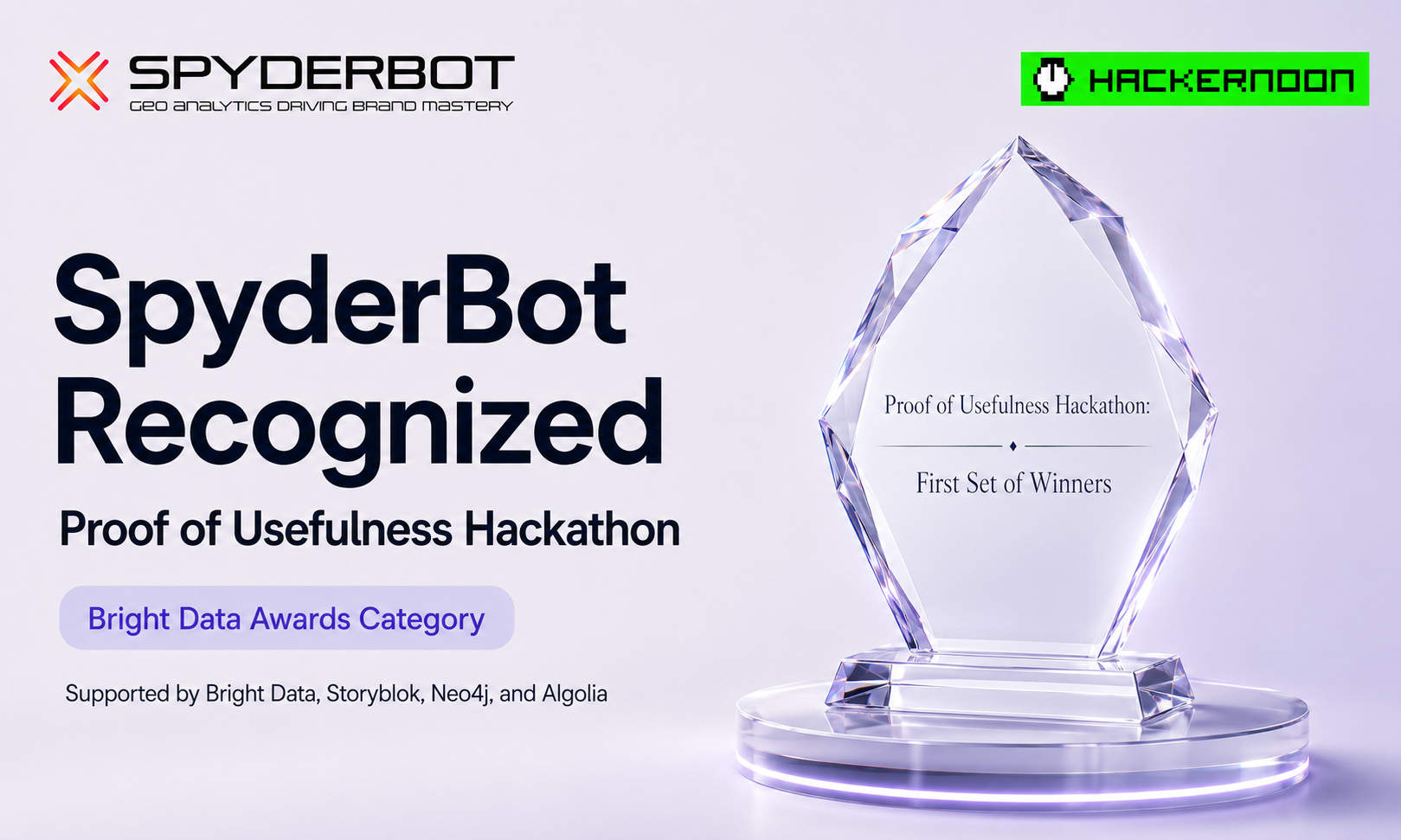
SpyderBot has been recognized among the first set of winners in HackerNoon’s Proof of Usefulness Hackathon, marking an important milestone for the company as it continues to build analytics infrastructure for the AI Search era.
The official announcement was published by HackerNoon under the title “Proof of Usefulness Hackathon: First Set of Winners Announced.”
Official announcement:
https://hackernoon.com/proof-of-usefulness-hackathon-first-set-of-winners-announced
The Proof of Usefulness Hackathon is organized by HackerNoon and supported by Bright Data, Neo4j, Storyblok, and Algolia. The program recognizes software projects that demonstrate practical usefulness, real-world value, and measurable relevance beyond pitch deck promises.
SpyderBot was recognized under the Bright Data Awards category, reflecting the platform’s focus on GEO analytics, AI visibility, and LLM brand monitoring.
A Recognition Focused on Real-World Utility
The Proof of Usefulness Hackathon is built around a simple but important idea: useful products should solve real problems for real users.
In a technology landscape where many products are judged by vision, presentation, or early-stage hype, HackerNoon’s Proof of Usefulness framework places emphasis on practical value. It asks whether a product works, whether it addresses a real need, and whether it can create meaningful value for users.
For SpyderBot, this recognition is significant because it aligns directly with the problem the company is trying to solve.
Search behavior is changing. Users are no longer relying only on traditional search engines and blue links. Increasingly, they are asking AI systems for recommendations, comparisons, summaries, and vendor suggestions.
That shift creates a new visibility challenge for brands.
A company may rank on Google, but still be absent from AI-generated answers.
A brand may have strong website content, but still be misunderstood or underrepresented by large language models.
A competitor may appear more often in AI recommendations, even when another brand has stronger expertise, better positioning, or a more relevant product.
SpyderBot was built to help companies understand and monitor this new layer of visibility.
What SpyderBot Does
SpyderBot is a GEO analytics platform designed to help businesses track how AI systems understand, mention, and compare brands across generative search environments.
The platform helps teams monitor AI brand visibility, LLM mentions, competitor presence, prompt-level performance, sentiment, and how different AI models describe a brand across multiple contexts.
This includes visibility across AI systems such as ChatGPT, Gemini, Grok, Claude, Copilot, Perplexity, and other large language models.
At its core, SpyderBot helps brands answer two increasingly important questions:
What do LLMs mention about your competitors to users?
And how are LLMs analyzing and tracking your website?
These questions are becoming critical as AI-generated answers begin to influence how users discover products, evaluate companies, and make decisions.
Why AI Search Requires a New Measurement Layer
Traditional SEO has long focused on rankings, backlinks, organic traffic, and keyword visibility. These metrics remain important, but they no longer provide a complete picture of brand visibility.
In traditional search, a user sees a list of results and chooses which page to visit.
In AI Search, the answer is often generated directly. The AI system may summarize a market, recommend a short list of brands, compare competitors, or explain which solution best fits the user’s intent.
This means brands are no longer competing only for rankings. They are competing to be included, understood, and recommended inside AI-generated responses.
That is where Generative Engine Optimization, or GEO, becomes important.
While SEO focuses on search engine rankings, GEO focuses on how brands appear inside generative AI answers. It looks at whether a brand is mentioned, how it is described, what context surrounds the mention, which competitors appear nearby, and whether the brand’s positioning is accurately represented.
SpyderBot focuses on this emerging data layer, helping marketing, SEO, growth, and brand teams monitor their presence in AI-generated discovery journeys.
Supported by a Strong Technology Ecosystem
The Proof of Usefulness Hackathon is supported by Bright Data, Neo4j, Storyblok, and Algolia, bringing together important areas of the modern technology stack, including data infrastructure, graph technology, content architecture, and search experience.
This broader ecosystem makes the recognition especially relevant for companies building at the intersection of data, AI, and product usefulness.
SpyderBot’s recognition under the Bright Data Awards category reflects the growing importance of real-world data and AI-driven analytics in understanding how brands appear across generative systems.
As more users turn to AI tools for discovery and decision-making, brands will need more reliable ways to measure how they are represented across these systems.
A Milestone, But Only the Beginning
For SpyderBot, this recognition from HackerNoon is both a milestone and a starting point.
The company will continue developing its platform with a focus on practical insights, clearer analytics, and better support for brands entering the AI Search era.
SpyderBot’s goal is not only to help companies monitor mentions. It aims to help brands understand how AI systems interpret their identity, compare them against competitors, and surface them in response to real user questions.
The team also looks forward to continued trust, feedback, and support from users, partners, and businesses exploring GEO, AI visibility, and LLM brand monitoring.
The Bigger Signal for Brands
SpyderBot’s recognition in HackerNoon’s Proof of Usefulness Hackathon points to a broader shift in digital visibility.
Brands no longer need to focus only on being indexed by search engines. They also need to be understood by AI systems.
They no longer need to measure only where they rank. They also need to measure whether they are mentioned, how they are framed, and which competitors appear more often in AI-generated answers.
In the AI Search era, visibility is no longer only about traffic.
It is about being present in the answers that shape user decisions.
For SpyderBot, this milestone reinforces the importance of building tools for that future.