Tag: SEO for ChatGPT

  • ChatGPT SEO Tracking Tools

    ChatGPT SEO Tracking Tools

    How to track your brand visibility in ChatGPT (and why most tools get it wrong)


    The problem: you can’t see your brand in ChatGPT

    Many companies are starting to notice:

    • Competitors are mentioned in ChatGPT
    • Their brand is missing
    • Or appears inconsistently

    The question becomes:

    “How do I track SEO in ChatGPT?”


    The uncomfortable truth

    There is no “SEO tracking” in ChatGPT

    Because:

    • ChatGPT does not have rankings
    • There is no SERP
    • There are no positions

    What you actually need

    What you’re trying to measure is:

    AI visibility


    Which includes:

    • Whether your brand is mentioned
    • How often it appears
    • In what context
    • How it is described
    • How you compare to competitors

    What are ChatGPT SEO tracking tools?

    “ChatGPT SEO tracking tools” are:

    Tools that attempt to measure how your brand appears in AI-generated answers


    In reality, they fall into 3 categories:


    1. Prompt testing tools

    “Run queries and see outputs”


    What they do:

    • Execute prompts (e.g. “best SEO tools”)
    • Capture responses
    • Show mentions

    Pros:

    • Simple
    • Fast

    Limitations:

    • Limited coverage
    • No aggregation
    • No real insights

    Key insight

    Prompt testing ≠ tracking


    2. AI monitoring tools

    “Track mentions across prompts”


    What they do:

    • Run many prompts
    • Track brand mentions
    • Show frequency

    Pros:

    • Better coverage
    • Some trend visibility

    Limitations:

    • Shallow insights
    • No explanation layer

    Key insight

    Monitoring shows what happens — not why


    3. AI visibility analytics platforms

    “Understand how AI represents your brand”


    What they do:

    • Track mentions across prompts
    • Analyze context and positioning
    • Compare competitors
    • Explain why results happen

    Pros:

    • Deep insights
    • Actionable data
    • Strategic value

    Limitations:

    • More complex
    • Requires interpretation

    Key insight

    Analytics > monitoring


    Why most ChatGPT SEO tracking tools fail


    1. They treat ChatGPT like Google

    They try to:

    • Track “rankings”
    • Measure “positions”

    Problem:

    ChatGPT does not rank results


    2. They use too few prompts

    Tracking 5–10 prompts is not enough.


    Because:

    • AI output varies
    • Context matters
    • Results are probabilistic


    3. They ignore context

    They track:

    • Mentions

    But ignore:

    • When and why mentions happen


    4. They don’t analyze competitors

    You don’t just need:

    • Your data

    You need:

    Relative positioning


    5. They don’t explain anything

    They show:

    • Numbers

    But not:

    • Causes

    Key insight

    Data without explanation is useless


    What to look for in a ChatGPT SEO tracking tool


    1. Coverage

    • Many prompts
    • Multiple contexts
    • Diverse use cases


    2. Accuracy

    • Reproducible results
    • Stable measurement


    3. Context analysis

    • When you appear
    • When you don’t


    4. Competitor insights

    • Who appears instead of you
    • Who dominates


    5. Actionability

    • What to do next
    • Where to improve


    What you should actually track

    Instead of “ranking”, you should track:


    1. Inclusion rate

    • % of prompts where you appear


    2. Mention share

    • vs competitors


    3. Context coverage

    • In which use cases you appear


    4. Positioning

    • How AI describes you


    5. Consistency

    • Stability across prompts


    Best ChatGPT SEO tracking tools (honest comparison)


    1. SpyderBot


    What it does best:

    • AI visibility analytics
    • Competitor co-occurrence analysis
    • Context + positioning insights
    • GEO-focused measurement

    Strengths:

    • Goes beyond mention tracking
    • Explains why you are (or aren’t) mentioned
    • Built specifically for LLM behavior

    Limitations:

    • Not a traditional SEO tool
    • Requires understanding of AI systems

    Best for:

    Companies serious about AI visibility and GEO


    2. Prompt-based tools (generic)


    What they do:

    • Run queries
    • Show outputs

    Strengths:

    • Simple
    • Cheap

    Limitations:

    • No scalability
    • No insight
    • No real tracking


    3. Basic monitoring tools


    What they do:

    • Track mentions
    • Show frequency

    Strengths:

    • Better than manual testing

    Limitations:

    • Shallow
    • No explanation
    • Limited strategic value


    The biggest mistake companies make

    They choose tools that:

    • Look easy
    • Show data

    Instead of tools that:

    Help them understand AI systems


    A realistic example

    A company uses a basic tool:

    • Tracks 10 prompts
    • Sees 2 mentions

    Conclusion:

    “We have some visibility”


    Reality:

    • Missing 80% of contexts
    • Competitors dominate elsewhere


    How to actually track ChatGPT SEO (step-by-step)


    Step 1: Define key prompts

    • “best [category] tools”
    • “alternatives to [competitor]”
    • “tools for [use case]”


    Step 2: Expand context coverage

    • Different user intents
    • Different query variations


    Step 3: Measure inclusion

    • Do you appear?
    • How often?


    Step 4: Compare competitors

    • Who appears instead?
    • Who dominates?


    Step 5: Analyze positioning

    • How are you described?
    • What role do you play?


    Step 6: Identify gaps

    • Missing contexts
    • Weak positioning


    Step 7: Optimize

    • Improve entity clarity
    • Strengthen associations
    • Expand coverage


    The shift: SEO tracking → AI visibility tracking


    Traditional SEOChatGPT
    RankingsMentions
    TrafficInfluence
    KeywordsEntities
    PositionInclusion


    Final insight

    You don’t need to track rankings in ChatGPT

    You need to track:

    Whether you are selected in AI answers


    Conclusion

    ChatGPT SEO tracking tools are not really about SEO.

    They are about:

    Understanding how AI systems see your brand


    If your brand is not showing up:

    • You don’t have a ranking problem

    You have a visibility problem
  • SEO for ChatGPT

    SEO for ChatGPT

    How to appear in AI-generated answers (and why SEO alone is not enough)


    I. The question everyone is asking

    As AI tools become mainstream, one question keeps coming up:

    “How do I do SEO for ChatGPT?”

    It sounds familiar.

    But it’s also the wrong question.


    II. ChatGPT is not a search engine

    Traditional SEO works because search engines:

    • Crawl webpages
    • Index content
    • Rank results

    ChatGPT does not work that way.

    It:

    • Interprets queries
    • Generates answers
    • Selects information probabilistically

    Which means:

    There is no ranking page to optimize for


    III. So what does “SEO for ChatGPT” actually mean?

    When people say “SEO for ChatGPT”, they usually mean:

    • How to appear in ChatGPT answers
    • How to get mentioned by AI
    • How to influence AI-generated recommendations

    The correct term for this is:

    Generative Engine Optimization (GEO)


    IV. From SEO to GEO

    SEO helps you:

    Get discovered on Google

    GEO helps you:

    Get included in AI-generated answers


    V. The new model of visibility

    In ChatGPT:

    • There is no page 1
    • There is no position #3

    There is only:

    Whether your brand is mentioned or not

    This creates a new metric:

    AI visibility


    VI. Why your brand is not showing up in ChatGPT

    Many companies assume:

    • “We have strong SEO, so we should appear in AI”

    But AI systems don’t work like search engines.

    Common reasons you are not mentioned:

    1. Weak entity clarity

    AI doesn’t clearly understand:

    • What your company does
    • What category you belong to

    2. Poor contextual signals

    Your brand is not strongly associated with:

    • Use cases
    • Problems
    • alternatives

    3. Inconsistent positioning

    AI sees mixed signals about:

    • Your product
    • Your market
    • Your differentiation

    4. Lack of semantic structure

    Your content is optimized for:

    • Humans or Google

    But not for:

    • AI interpretation

    VII. How ChatGPT decides what to mention

    How ChatGPT decides what to mention

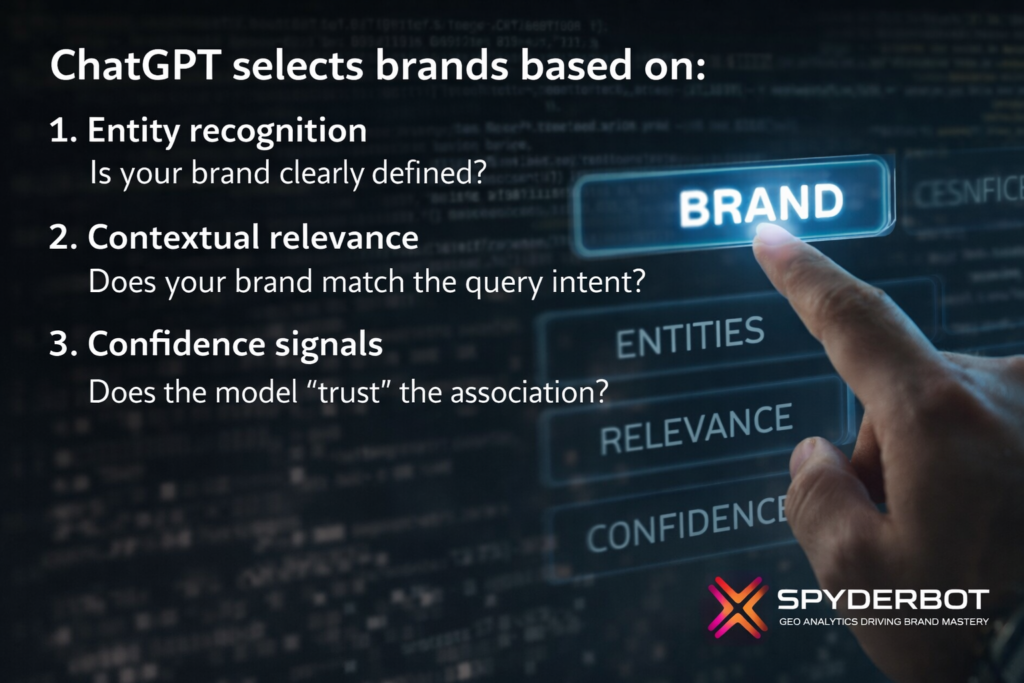
    ChatGPT selects brands based on:

    1. Entity recognition

    • Is your brand clearly defined?

    2. Contextual relevance

    • Does your brand match the query intent?

    3. Confidence signals

    • Does the model “trust” the association?

    VIII. This leads to a key insight

    ChatGPT does not rank pages — it ranks entities


    IX. How to do “SEO for ChatGPT” (the right way)

    1. Define your brand as an entity

    Be explicit about:

    • What you are
    • Who you are for
    • What problem you solve

    2. Strengthen category positioning

    Make sure AI can answer:

    “What category does this company belong to?”


    3. Build contextual associations

    Your brand should appear in contexts like:

    • Use cases
    • Comparisons
    • Alternatives

    4. Structure content for AI

    Instead of:

    • Keyword stuffing

    Focus on:

    • Clear definitions
    • Structured explanations
    • Entity relationships

    5. Optimize for inclusion, not ranking

    Shift your mindset:

    • From “how do I rank #1?”
    • To “how do I get mentioned consistently?”

    X. SEO vs SEO for ChatGPT (GEO)

    Traditional SEOSEO for ChatGPT (GEO)
    KeywordsEntities
    RankingsMentions
    PagesConcepts
    BacklinksContext
    TrafficAI visibility

    XI. The biggest mistake companies make

    They try to apply SEO tactics directly:

    • More content
    • More keywords
    • More backlinks

    But that doesn’t guarantee:

    Inclusion in AI answers


    XII. What actually works

    Companies that succeed in ChatGPT visibility:

    • Have clear positioning
    • Strong entity definition
    • Consistent messaging
    • Structured content

    XIII. The future of SEO for ChatGPT

    This is not a temporary shift.

    We are moving toward:

    AI-first discovery

    Where:

    • AI decides what users see
    • AI shapes brand perception
    • AI influences decisions

    XIV. What you should do now

    1. Audit your AI visibility

    • Are you mentioned in ChatGPT?
    • Are competitors appearing instead?

    2. Identify gaps

    • Missing contexts
    • Weak positioning
    • Misclassification

    3. Optimize for GEO

    • Improve entity clarity
    • Strengthen context
    • Structure content

    XV. Final thought

    SEO for ChatGPT is not really SEO.

    It is:

    A new discipline

    And that discipline is:

    Generative Engine Optimization