Tag: SpyderBot

  • SpyderBot Recognized in HackerNoon’s Proof of Usefulness Hackathon, Marking a Milestone for AI Search Visibility

    SpyderBot Recognized in HackerNoon’s Proof of Usefulness Hackathon, Marking a Milestone for AI Search Visibility

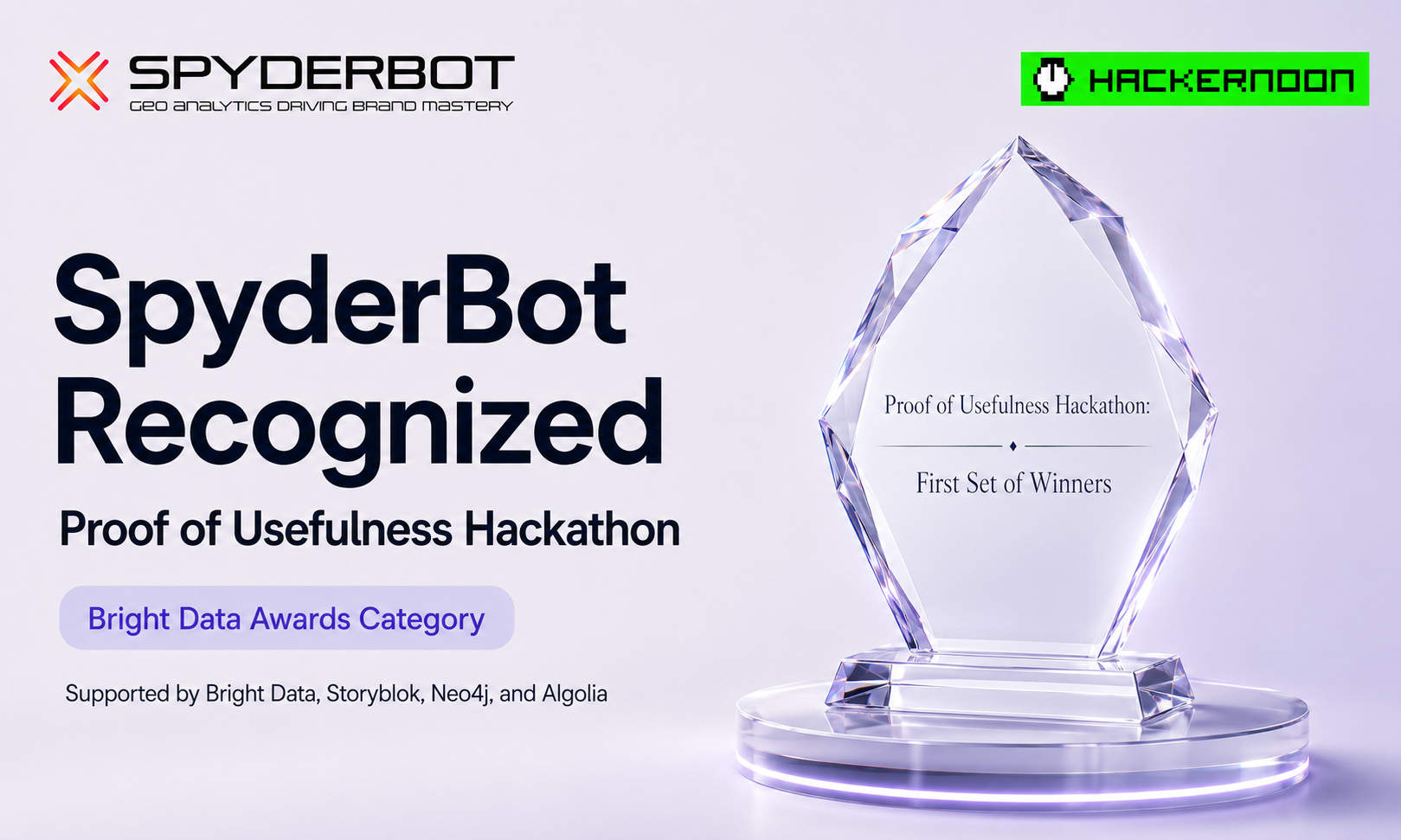
    SpyderBot has been recognized among the first set of winners in HackerNoon’s Proof of Usefulness Hackathon, marking an important milestone for the company as it continues to build analytics infrastructure for the AI Search era.

    The official announcement was published by HackerNoon under the title “Proof of Usefulness Hackathon: First Set of Winners Announced.”

    Official announcement:
    https://hackernoon.com/proof-of-usefulness-hackathon-first-set-of-winners-announced

    The Proof of Usefulness Hackathon is organized by HackerNoon and supported by Bright Data, Neo4j, Storyblok, and Algolia. The program recognizes software projects that demonstrate practical usefulness, real-world value, and measurable relevance beyond pitch deck promises.

    SpyderBot was recognized under the Bright Data Awards category, reflecting the platform’s focus on GEO analytics, AI visibility, and LLM brand monitoring.

    A Recognition Focused on Real-World Utility

    The Proof of Usefulness Hackathon is built around a simple but important idea: useful products should solve real problems for real users.

    In a technology landscape where many products are judged by vision, presentation, or early-stage hype, HackerNoon’s Proof of Usefulness framework places emphasis on practical value. It asks whether a product works, whether it addresses a real need, and whether it can create meaningful value for users.

    For SpyderBot, this recognition is significant because it aligns directly with the problem the company is trying to solve.

    Search behavior is changing. Users are no longer relying only on traditional search engines and blue links. Increasingly, they are asking AI systems for recommendations, comparisons, summaries, and vendor suggestions.

    That shift creates a new visibility challenge for brands.

    A company may rank on Google, but still be absent from AI-generated answers.

    A brand may have strong website content, but still be misunderstood or underrepresented by large language models.

    A competitor may appear more often in AI recommendations, even when another brand has stronger expertise, better positioning, or a more relevant product.

    SpyderBot was built to help companies understand and monitor this new layer of visibility.

    What SpyderBot Does

    SpyderBot is a GEO analytics platform designed to help businesses track how AI systems understand, mention, and compare brands across generative search environments.

    The platform helps teams monitor AI brand visibility, LLM mentions, competitor presence, prompt-level performance, sentiment, and how different AI models describe a brand across multiple contexts.

    This includes visibility across AI systems such as ChatGPT, Gemini, Grok, Claude, Copilot, Perplexity, and other large language models.

    At its core, SpyderBot helps brands answer two increasingly important questions:

    What do LLMs mention about your competitors to users?

    And how are LLMs analyzing and tracking your website?

    These questions are becoming critical as AI-generated answers begin to influence how users discover products, evaluate companies, and make decisions.

    Why AI Search Requires a New Measurement Layer

    Traditional SEO has long focused on rankings, backlinks, organic traffic, and keyword visibility. These metrics remain important, but they no longer provide a complete picture of brand visibility.

    In traditional search, a user sees a list of results and chooses which page to visit.

    In AI Search, the answer is often generated directly. The AI system may summarize a market, recommend a short list of brands, compare competitors, or explain which solution best fits the user’s intent.

    This means brands are no longer competing only for rankings. They are competing to be included, understood, and recommended inside AI-generated responses.

    That is where Generative Engine Optimization, or GEO, becomes important.

    While SEO focuses on search engine rankings, GEO focuses on how brands appear inside generative AI answers. It looks at whether a brand is mentioned, how it is described, what context surrounds the mention, which competitors appear nearby, and whether the brand’s positioning is accurately represented.

    SpyderBot focuses on this emerging data layer, helping marketing, SEO, growth, and brand teams monitor their presence in AI-generated discovery journeys.

    Supported by a Strong Technology Ecosystem

    The Proof of Usefulness Hackathon is supported by Bright Data, Neo4j, Storyblok, and Algolia, bringing together important areas of the modern technology stack, including data infrastructure, graph technology, content architecture, and search experience.

    This broader ecosystem makes the recognition especially relevant for companies building at the intersection of data, AI, and product usefulness.

    SpyderBot’s recognition under the Bright Data Awards category reflects the growing importance of real-world data and AI-driven analytics in understanding how brands appear across generative systems.

    As more users turn to AI tools for discovery and decision-making, brands will need more reliable ways to measure how they are represented across these systems.

    A Milestone, But Only the Beginning

    For SpyderBot, this recognition from HackerNoon is both a milestone and a starting point.

    The company will continue developing its platform with a focus on practical insights, clearer analytics, and better support for brands entering the AI Search era.

    SpyderBot’s goal is not only to help companies monitor mentions. It aims to help brands understand how AI systems interpret their identity, compare them against competitors, and surface them in response to real user questions.

    The team also looks forward to continued trust, feedback, and support from users, partners, and businesses exploring GEO, AI visibility, and LLM brand monitoring.

    The Bigger Signal for Brands

    SpyderBot’s recognition in HackerNoon’s Proof of Usefulness Hackathon points to a broader shift in digital visibility.

    Brands no longer need to focus only on being indexed by search engines. They also need to be understood by AI systems.

    They no longer need to measure only where they rank. They also need to measure whether they are mentioned, how they are framed, and which competitors appear more often in AI-generated answers.

    In the AI Search era, visibility is no longer only about traffic.

    It is about being present in the answers that shape user decisions.

    For SpyderBot, this milestone reinforces the importance of building tools for that future.
  • SpyderBot vs Ahrefs

    SpyderBot vs Ahrefs

    I. Why this comparison matters now

    This article was updated because the search landscape has changed.

    For years, SEO teams used tools like Ahrefs to understand rankings, backlinks, keyword gaps, and organic traffic opportunities. That workflow is still important.

    But today, users do not only search on Google.

    They also ask ChatGPT, Gemini, Claude, Perplexity, Copilot, Grok, and other AI systems for product recommendations, vendor comparisons, and buying decisions.

    That creates a new problem:

    A brand can rank well on Google and still be invisible inside AI-generated answers.

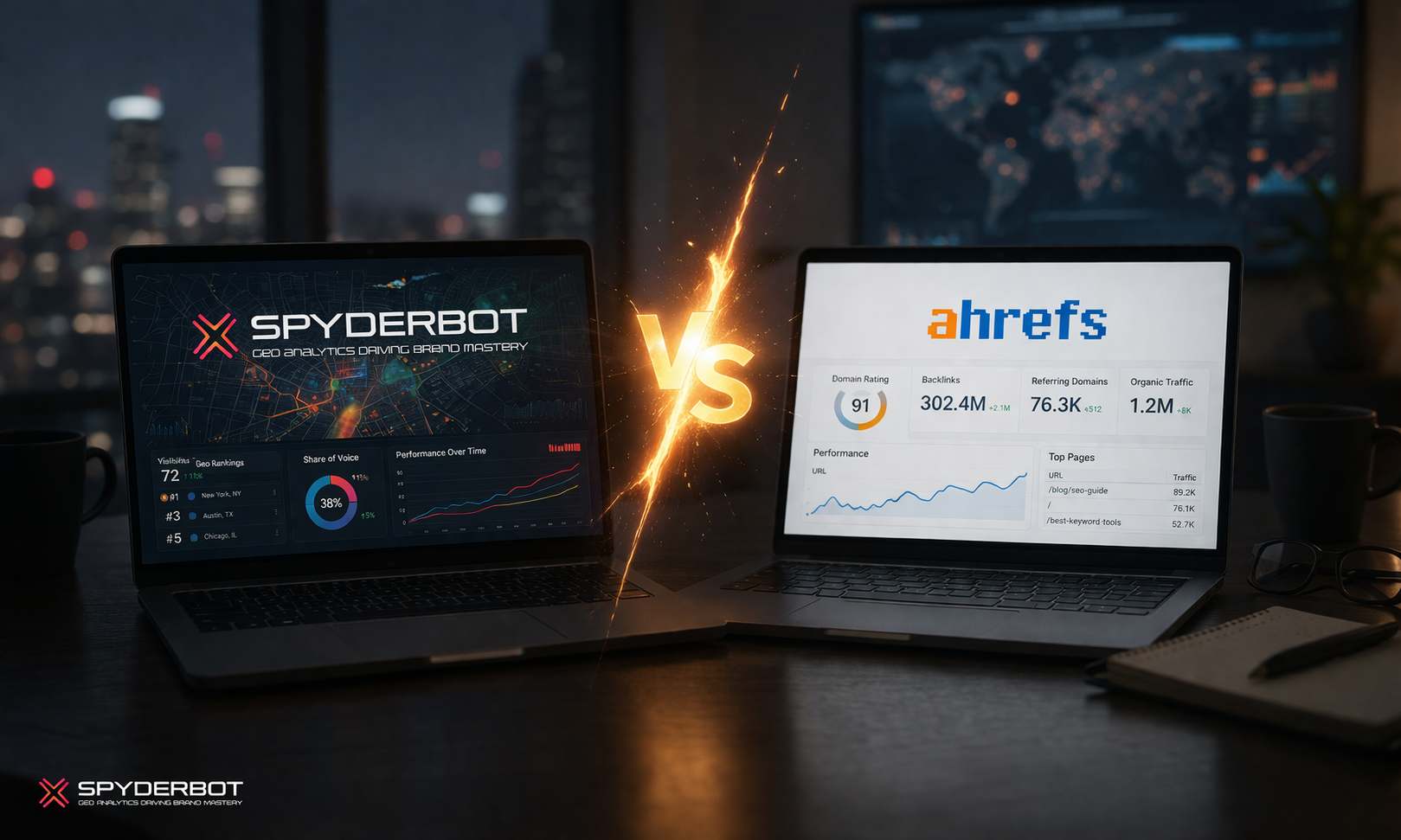
    This is the core difference between Ahrefs and SpyderBot.

    Ahrefs helps you understand traditional search visibility.

    SpyderBot helps you understand AI visibility.

    They are not built for the same layer of discovery.

    II. The simplest difference

    Ahrefs answers:

    How does my website perform in Google search?

    SpyderBot answers:

    How does AI understand, mention, compare, and recommend my brand?

    That distinction matters because search engines and AI systems do not work the same way.

    Google search usually retrieves and ranks web pages.

    AI systems generate answers by interpreting entities, relationships, context, trust signals, and patterns across information sources.

    So the question is no longer only:

    “How do we rank higher?”

    The new question is:

    “Are we included when AI gives the answer?”

    III. What Ahrefs is built for

    Ahrefs is one of the strongest SEO analytics platforms in the market.

    It is designed for classic SEO workflows such as:

    • Keyword research
    • Backlink analysis
    • Rank tracking
    • Competitor SEO research
    • Content gap analysis
    • SERP analysis
    • Technical SEO auditing
    • Organic traffic opportunity discovery

    Ahrefs is especially strong when the goal is to understand why a page ranks, which keywords bring traffic, and how competitors earn backlinks.

    For SEO teams, content teams, and link-building teams, Ahrefs remains a powerful tool.

    If your goal is to improve Google rankings, Ahrefs is the right kind of platform.

    IV. What SpyderBot is built for

    SpyderBot is built for GEO, which means Generative Engine Optimization.

    Instead of focusing on keyword rankings and backlinks, SpyderBot focuses on how AI systems interpret and mention brands.

    SpyderBot helps answer questions such as:

    • Does ChatGPT mention your brand?
    • Does Gemini understand what your company does?
    • Which competitors are recommended instead of you?
    • What does AI say about your product category?
    • Is your brand positioned correctly in AI-generated answers?
    • Are you visible across different prompts and use cases?
    • Is your website being interpreted clearly by LLMs?

    This matters because AI visibility is not the same as search visibility.

    You can have traffic, backlinks, and keyword rankings, but still lose the recommendation layer when users ask AI what to buy, compare, or trust.

    V. SEO visibility vs AI visibility

    The biggest mistake is assuming that SEO success automatically creates AI visibility.

    It does not.

    A page can rank on Google because it has strong backlinks, optimized content, and good technical SEO.

    But an AI system may still fail to mention that brand because the entity is unclear, the product positioning is weak, the brand is not consistently associated with the right category, or competitors have stronger contextual signals.

    That is why GEO is becoming a separate discipline.

    SEO helps users find pages.

    GEO helps brands appear inside AI-generated answers.

    VI. Comparison table

    CategoryAhrefsSpyderBot
    Main focusSEO analyticsAI visibility analytics
    System analyzedSearch enginesAI systems and LLMs
    Core unitKeywords, links, pagesEntities, mentions, prompts, context
    Main outputRankings, backlinks, SEO metricsAI mentions, competitor visibility, brand interpretation
    Best forGoogle SEO strategyGEO and AI search strategy
    Key questionHow do we rank?Are we included in AI answers?
    Competitor analysisSEO competitorsAI-recommended competitors
    Visibility layerSearch result pagesAI-generated responses

    VII. Where Ahrefs is stronger

    Ahrefs is stronger for traditional SEO.

    Use Ahrefs when you need to:

    • Find keyword opportunities
    • Analyze backlink profiles
    • Track Google keyword rankings
    • Discover content gaps
    • Audit technical SEO issues
    • Study SERP competition
    • Improve organic traffic

    If your growth strategy depends heavily on Google search traffic, Ahrefs is still extremely valuable.

    SpyderBot does not replace that.

    VIII. Where SpyderBot is stronger

    SpyderBot is stronger when the question shifts from ranking to AI inclusion.

    Use SpyderBot when you need to:

    • Track brand mentions in AI-generated answers
    • Compare how AI systems mention your competitors
    • Understand how LLMs interpret your website
    • Identify missing brand associations
    • Monitor prompt-level visibility
    • Detect whether your brand is being ignored, misunderstood, or replaced
    • Improve your position in AI search and answer engines

    This is where traditional SEO tools have limited visibility.

    They can show ranking data, but they cannot fully explain how AI systems construct answers.

    IX. A practical example

    Imagine a SaaS company with strong SEO performance.

    It has:

    • Good backlinks
    • Top 3 Google rankings
    • Strong blog traffic
    • Optimized landing pages
    • Healthy domain authority

    Ahrefs may show that the SEO strategy is working.

    But when users ask AI tools:

    “What are the best tools for this problem?”

    The company may not appear.

    Instead, AI may recommend competitors.

    That is the gap SpyderBot is designed to identify.

    The issue is not ranking.

    The issue is AI visibility.

    X. Why brands need both SEO and GEO

    SEO and GEO should not fight each other.

    They solve different problems.

    Ahrefs helps you win traffic.

    SpyderBot helps you understand whether AI systems include you in the answer.

    The modern visibility stack looks like this:

    LayerGoalTool type
    Search discoveryRank on GoogleSEO tools like Ahrefs
    AI recommendationAppear in generated answersGEO tools like SpyderBot
    Brand interpretationControl how systems understand youAI visibility platforms
    Competitive intelligenceKnow who AI recommendsAI mention tracking tools

    The strongest teams will not abandon SEO.

    They will add GEO on top of it.

    XI. When to choose Ahrefs

    Choose Ahrefs if your main goal is to:

    • Grow organic traffic
    • Improve Google rankings
    • Build backlinks
    • Research keywords
    • Audit your website
    • Plan SEO content
    • Monitor SERP performance

    Ahrefs is a mature SEO platform for search engine visibility.

    XII. When to choose SpyderBot

    Choose SpyderBot if your main goal is to:

    • Understand how AI sees your brand
    • Track mentions across AI systems
    • Find out why competitors are recommended
    • Improve AI search visibility
    • Measure GEO performance
    • Monitor brand presence in generated answers
    • Analyze LLM interpretation of your website

    SpyderBot is designed for the AI answer layer.

    XIII. Does SpyderBot replace Ahrefs?

    No.

    SpyderBot does not replace Ahrefs.

    Ahrefs is for SEO.

    SpyderBot is for GEO.

    The better question is not:

    “Which one should replace the other?”

    The better question is:

    “Which visibility layer are we trying to measure?”

    If you want Google ranking data, use Ahrefs.

    If you want AI visibility data, use SpyderBot.

    If you care about both search traffic and AI-driven decisions, use both.

    XIV. Final conclusion

    Ahrefs is one of the best tools for understanding how websites perform in traditional search.

    SpyderBot is built for a newer problem: understanding how AI systems mention, interpret, compare, and recommend brands.

    The difference is simple.

    Ahrefs helps you rank.

    SpyderBot helps you get included.

    In the old search model, visibility meant appearing on page one.

    In the AI search model, visibility means being part of the answer.

    That is why GEO is becoming important.

    And that is why brands that already invest in SEO should now start measuring AI visibility too.