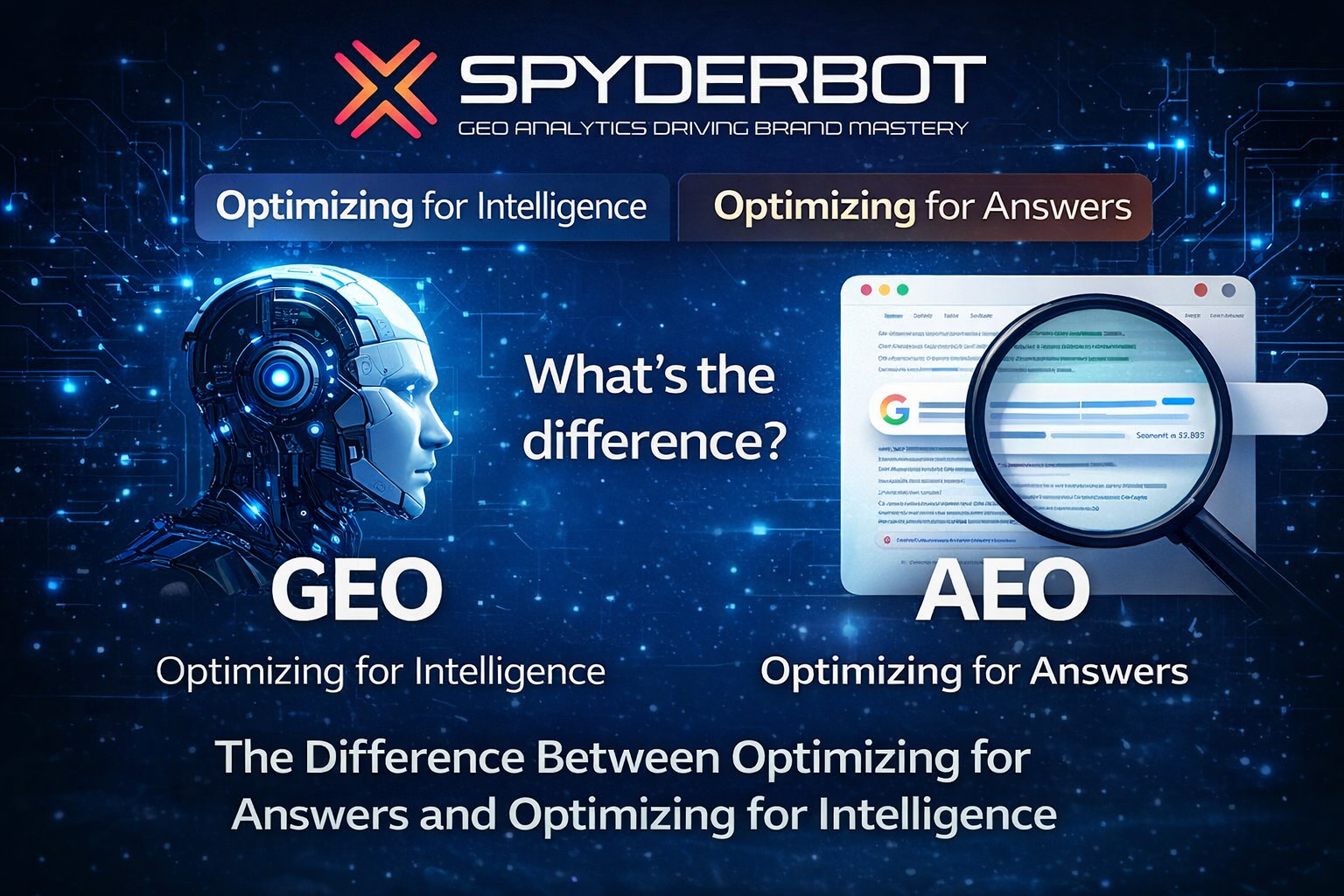
What Is the Difference Between Generative Engine Optimization and Answer Engine Optimization?
As AI search grows, marketers are using more terms to describe the future of visibility.
SEO.
AEO.
GEO.
AI SEO.
LLM optimization.
AI visibility tracking.
The terms are related, but they are not the same.
One of the most common points of confusion is the difference between AEO, or Answer Engine Optimization, and GEO, or Generative Engine Optimization.
At first, they sound similar.
Both deal with answers instead of only links. Both matter in an AI-driven search environment. Both push brands beyond traditional keyword rankings.
But they solve different problems.
AEO helps content become a direct answer.
GEO helps brands become understood, included, and represented inside AI-generated answers.
That distinction matters because modern AI systems do not only retrieve answers. They generate responses, compare options, interpret brands, and shape user perception.
What is AEO?
AEO stands for Answer Engine Optimization.
It is the practice of structuring content so it can be selected as a direct answer to a specific question.
AEO became important during the rise of:
- Featured snippets
- Voice search
- People Also Ask results
- FAQ-style content
- Direct answer boxes
- Search assistants
The goal of AEO is simple:
Answer the user’s question clearly enough to be selected as the answer.
For example, if someone searches:
“What is Answer Engine Optimization?”
AEO-focused content would aim to provide a short, clear, structured answer that search engines or answer systems can easily extract.
AEO is useful because many users want quick answers.
It works especially well for:
- Definitions
- Simple explanations
- How-to questions
- FAQ content
- Factual queries
- Step-by-step answers
- Voice search responses
AEO is usually query-level.
It asks:
How can this piece of content become the answer to this question?
What is GEO?
GEO stands for Generative Engine Optimization.
It is the process of improving how AI systems understand, mention, compare, and represent a brand inside generated answers.
GEO is broader than answering one question.
It focuses on AI visibility across many prompts, contexts, competitors, and generated responses.
GEO asks questions like:
- Does ChatGPT mention our brand?
- Does Gemini understand our product category?
- Does Claude compare us with the right competitors?
- Does Grok describe our brand accurately?
- Are we included in high-intent AI answers?
- Are competitors recommended before us?
- Are AI systems misrepresenting our website?
- Are we visible across multiple prompt variations?
In practical terms:
AEO is about being selected as an answer. GEO is about being consistently included and correctly positioned inside AI-generated answers.
GEO vs AEO: the simple difference
The simplest way to separate AEO and GEO is this:
AEO optimizes content for direct answers.
GEO optimizes brand visibility inside generative AI responses.
AEO is usually focused on a specific question.
GEO is focused on how AI systems understand the brand across many questions.
AEO is content-snippet oriented.
GEO is entity and brand oriented.
AEO helps you win a direct answer.
GEO helps you build visibility, prominence, and perception inside AI-generated answers.
GEO vs AEO comparison table
| Dimension | AEO | GEO |
|---|---|---|
| Full name | Answer Engine Optimization | Generative Engine Optimization |
| Main focus | Direct answers | AI-generated brand visibility |
| Core unit | Content snippet, answer block, FAQ | Brand, entity, product, category |
| Scope | Query-level | System-level and prompt-level |
| Goal | Become the answer to a specific question | Be included, described, and positioned across generated answers |
| Common use cases | Featured snippets, voice search, FAQ answers | ChatGPT mentions, Gemini visibility, Claude comparisons, AI competitor monitoring |
| Main metric | Answer selection | AI visibility, mention frequency, prominence, sentiment, accuracy |
| Strategy | Structure clear answers | Improve entity clarity, context, positioning, and consistency |
| Main risk | Not being selected as the direct answer | Being ignored, misrepresented, or ranked behind competitors |
Why AEO and GEO are often confused
AEO and GEO are often confused because both respond to the same shift: users want answers faster.
Traditional SEO was built around search results.
AEO emerged because search engines started showing direct answers.
GEO emerged because generative AI systems started producing synthesized responses that can include multiple brands, sources, comparisons, and recommendations.
The overlap is real.
Both AEO and GEO benefit from:
- Clear content
- Structured information
- Helpful answers
- Question-based headings
- Strong topical relevance
- Consistent terminology
- Good SEO fundamentals
Google also says its AI features are part of Search and that site owners should continue following SEO fundamentals, including making content helpful, accessible, crawlable, and eligible for Search experiences.
But the difference is still important.
AEO focuses on answering.
GEO focuses on being understood and included.
AEO is query-level. GEO is system-level.
AEO is usually tied to one question.
For example:
“What is GEO?”
AEO asks:
How can we structure a concise answer that explains GEO clearly?
GEO asks a broader question:
How do AI systems understand our brand, category, competitors, and relevance across many prompts?
That means GEO goes beyond one answer box.
It looks at patterns.
For example:
- Are we mentioned across different AI systems?
- Are we mentioned for category-level prompts?
- Are we mentioned for competitor prompts?
- Are we positioned as a leader or a secondary option?
- Are our use cases described correctly?
- Are competitors appearing more often?
- Are AI systems citing the right sources?
This is why GEO needs monitoring and analytics, not just better answer formatting.
Example: AEO vs GEO in action
Imagine a user asks:
“What is AI brand monitoring?”
An AEO strategy would help your content provide a clear answer:
“AI brand monitoring is the process of tracking how AI systems mention, describe, and compare a brand across generated answers.”
That can help your content become a direct answer.
Now imagine users ask:
- What are the best AI brand monitoring tools?
- Which platforms track ChatGPT brand mentions?
- What are the best GEO analytics platforms?
- How does SpyderBot compare with other AI visibility tools?
- What tools help monitor LLM brand visibility?
- Why does ChatGPT recommend one competitor over another?
This is where GEO becomes more important.
The goal is not only to answer one definition.
The goal is to make sure your brand is included, accurately described, and positioned strongly across multiple AI-generated answers.
Why AEO alone is no longer enough
AEO is still useful.
But it is not enough for modern AI search.
AEO works well when the user needs a clear answer to a specific question.
But AI systems now handle more complex tasks:
- Comparing products
- Recommending vendors
- Explaining trade-offs
- Summarizing categories
- Creating buyer shortlists
- Personalizing answers
- Combining multiple sources
- Generating follow-up explanations
In those cases, there may not be a single answer slot.
Instead, the AI system may generate a response that includes several entities, competitors, sources, and recommendations.
That means visibility becomes more complex.
The question is no longer only:
Did we get the answer?
The question becomes:
How often are we included, where do we appear, and how are we described?
That is GEO.
GEO expands beyond AEO
GEO includes some AEO tactics, but it goes further.
AEO tactics include:
- Using clear headings
- Answering questions directly
- Writing concise definitions
- Structuring FAQ content
- Using schema where appropriate
- Matching question-based intent
GEO strategy includes:
- Improving brand entity clarity
- Strengthening category association
- Monitoring AI brand mentions
- Tracking competitor visibility
- Analyzing AI answer framing
- Improving contextual consistency
- Building comparison and use case content
- Measuring prompt-level inclusion
- Detecting misrepresentation
- Tracking AI citations and source patterns
AEO can help make content easier to extract.
GEO helps make the brand easier to understand and recommend.
The shift from answers to narratives
AEO is about winning answers.
GEO is about shaping narratives.
This matters because AI systems do not only tell users what something means.
They also tell users which brands matter, which options are trustworthy, which competitors are relevant, and which products fit a specific use case.
For example, an AI answer may describe a brand as:
- A market leader
- A newer alternative
- A budget option
- An enterprise solution
- A niche tool
- A strong choice for SaaS teams
- A less established competitor
That framing affects perception.
A brand may be mentioned, but still lose if the description is weak or if competitors are framed more confidently.
This is why GEO is not only a content tactic. It is a visibility and brand strategy.
GEO vs AEO vs SEO
To understand the full picture, it helps to compare SEO, AEO, and GEO together.
| Dimension | SEO | AEO | GEO |
|---|---|---|---|
| Main interface | Search results | Direct answers | AI-generated responses |
| Main goal | Rank webpages | Become the answer | Be included and accurately represented |
| Core unit | Page | Snippet or answer | Entity, brand, product, category |
| Scope | Page-level | Query-level | Prompt-level and system-level |
| Main metric | Rankings, impressions, clicks | Answer selection | AI visibility, mention frequency, prominence, accuracy |
| User behavior | Search, compare, click | Ask, receive answer | Ask, compare, decide |
| Main risk | Ranking below competitors | Not being selected as the answer | Being ignored, misrepresented, or positioned behind competitors |
The best strategy is not SEO vs AEO vs GEO.
It is SEO plus AEO plus GEO.
SEO helps users and search engines find your pages.
AEO helps your content answer specific questions clearly.
GEO helps AI systems understand, include, and describe your brand across generated answers.
How companies should use AEO
AEO should remain part of your content strategy.
Use AEO when you want to answer specific questions clearly.
For example:
- What is Generative Engine Optimization?
- What is Answer Engine Optimization?
- What is AI visibility?
- How does AI search work?
- What is LLM brand monitoring?
To improve AEO, companies should:
- Use question-based headings
- Answer the question directly near the top
- Keep definitions clear
- Add examples
- Use bullet points when helpful
- Structure FAQ sections
- Match visible content with structured data if using schema
Google explains that structured data helps Google understand page content, but the markup should reflect visible content on the page.
How companies should build GEO
GEO requires a broader strategy.
To build GEO, companies should:
1. Clarify the brand entity
Make it clear who you are, what you do, who you serve, what category you belong to, and what makes you different.
For example:
SpyderBot is a GEO analytics platform that helps brands understand how AI systems like ChatGPT, Gemini, Claude, and Grok mention, compare, and interpret their websites and competitors.
That sentence is strong because it gives AI systems a clear brand-category-use case relationship.
2. Track AI visibility
Monitor whether your brand appears across important prompt clusters.
Examples:
- Best GEO analytics platforms
- Tools to track ChatGPT brand mentions
- AI search competitor monitoring tools
- How to monitor LLM brand visibility
- Alternatives to [competitor]
- How to improve AI visibility
3. Compare competitor mentions
GEO is competitive.
You need to know which competitors appear, where they appear, and how they are described.
Track:
- Mention frequency
- Mention order
- Recommendation strength
- Competitor framing
- Use case association
- Citation patterns
4. Improve contextual consistency
Your brand should be described consistently across your website, social profiles, product directories, articles, documentation, and third-party mentions.
If AI systems see inconsistent descriptions, they may struggle to classify your brand correctly.
5. Build content around AI-style prompts
AI users ask specific, conversational questions.
Create content around prompts like:
- Why is ChatGPT not mentioning my brand?
- Why does AI recommend my competitor?
- How do LLMs choose which brands to mention?
- How can brands improve AI visibility?
- What is the difference between GEO and AEO?
- How do I track brand mentions in AI answers?
Where SpyderBot fits
SpyderBot focuses on the GEO layer.
AEO can help you structure content to answer questions.
SEO can help your website get discovered and indexed.
But SpyderBot helps answer a deeper question:
How are AI systems actually interpreting your brand and competitors?
SpyderBot helps brands monitor:
- AI brand mentions
- Competitor mentions
- Prompt-level visibility
- AI answer positioning
- Brand perception
- LLM interpretation patterns
- AI visibility gaps
- Changes across AI systems over time
That matters because companies cannot improve what they cannot see.
If ChatGPT mentions your competitor more often, Gemini describes your brand incorrectly, or Claude places your company in the wrong category, traditional SEO tools may not show that clearly.
SpyderBot is built to reveal that layer.
Common mistakes when comparing GEO and AEO
Mistake 1: Thinking AEO and GEO are the same
They overlap, but they are not identical.
AEO focuses on direct answers.
GEO focuses on generated answer visibility, brand inclusion, and AI interpretation.
Mistake 2: Treating GEO as only FAQ optimization
FAQ content can support GEO, but GEO is much broader.
It includes entity clarity, competitor analysis, prompt monitoring, AI perception, and visibility tracking.
Mistake 3: Ignoring brand positioning
AEO may help you answer a question.
But GEO asks whether AI systems understand your brand strongly enough to recommend it.
That requires clear positioning.
Mistake 4: Measuring only answer selection
Getting one answer box is useful, but it does not show full AI visibility.
You need to measure how often and how accurately your brand appears across many generated responses.
Mistake 5: Ignoring competitors
In AI-generated answers, your competitor may appear before you, be described better, or be recommended more confidently.
GEO requires competitor monitoring.
Final answer: Is GEO the same as AEO?
No.
GEO and AEO are related, but they are not the same.
AEO helps content become a direct answer to a specific question.
GEO helps brands become understood, included, and accurately represented across AI-generated answers.
AEO is a useful tactic.
GEO is a broader visibility strategy.
As AI search becomes more important, companies need both.
AEO helps you answer questions.
GEO helps you become part of the answer.
SpyderBot helps brands monitor the GEO side of AI search.
If your company wants to know whether ChatGPT, Gemini, Claude, or Grok is mentioning your brand, recommending competitors, or misunderstanding your website, SpyderBot gives you the visibility layer needed to compete inside AI-generated answers.