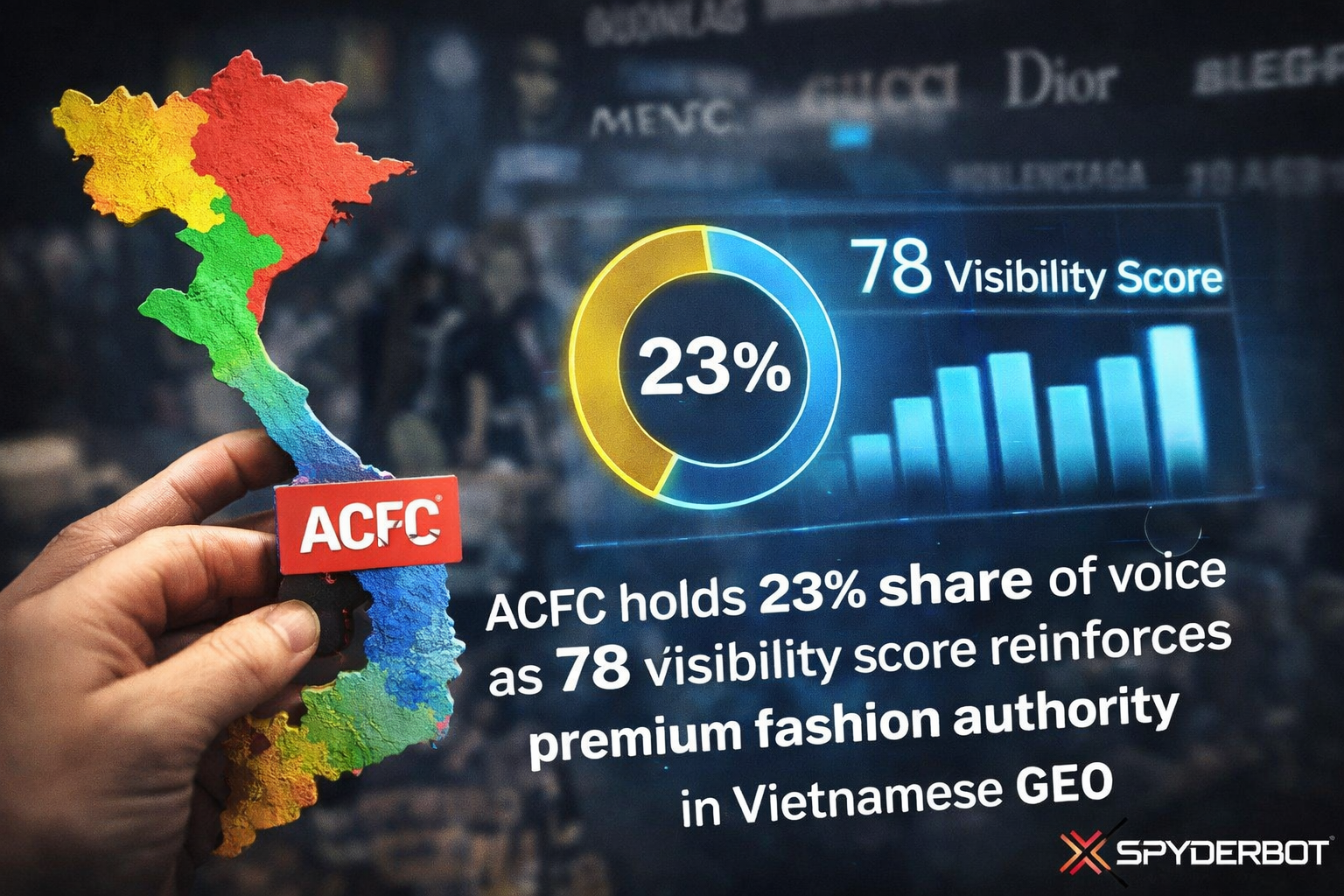
ACFC’s profile in generative search is materially stronger than its gap metrics suggest. The evidence indicates a brand that is widely recognized for authorized distribution, yet still exposed to category-specific competition where deeper product content and structured proof points determine LLM brand mentions.
SpyderBot GEO report reference for acfc.com.vn
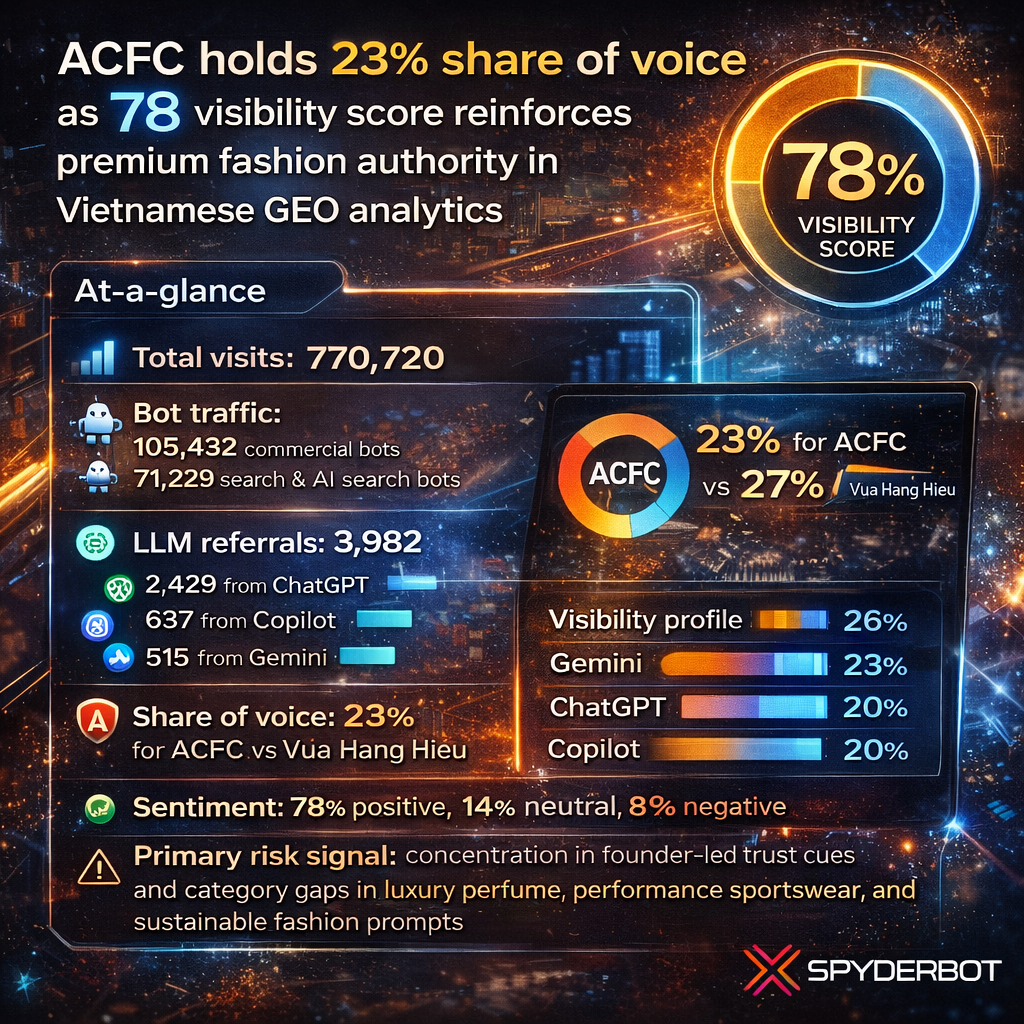
At-a-glance
- Total visits: 770,720
- Bot traffic: 285,166, including 105,432 commercial bots and 71,229 search & AI search bots
- LLM referrals: 3,982, led by 2,429 from ChatGPT, 637 from Copilot, and 515 from Gemini
- Share of voice: 23% for ACFC versus 27% for Vua Hang Hieu
- Visibility profile: 26% on Gemini, 23% on ChatGPT, and 20% on Copilot
- Sentiment: 78% positive, 14% neutral, 8% negative
- Primary risk signal: concentration in founder-led trust cues and category gaps in luxury perfume, performance sportswear, and sustainable fashion prompts
Risk signals
- The report identifies a 56-point visibility gap in luxury perfume clusters.
- ACFC trails market leaders by a 4% share of voice gap.
- Microsoft Copilot visibility remains at 20%, which is below Gemini’s 26% in the same benchmark set.
- Negative sentiment is recorded at 8%, with friction linked to mobile app checkout speed.
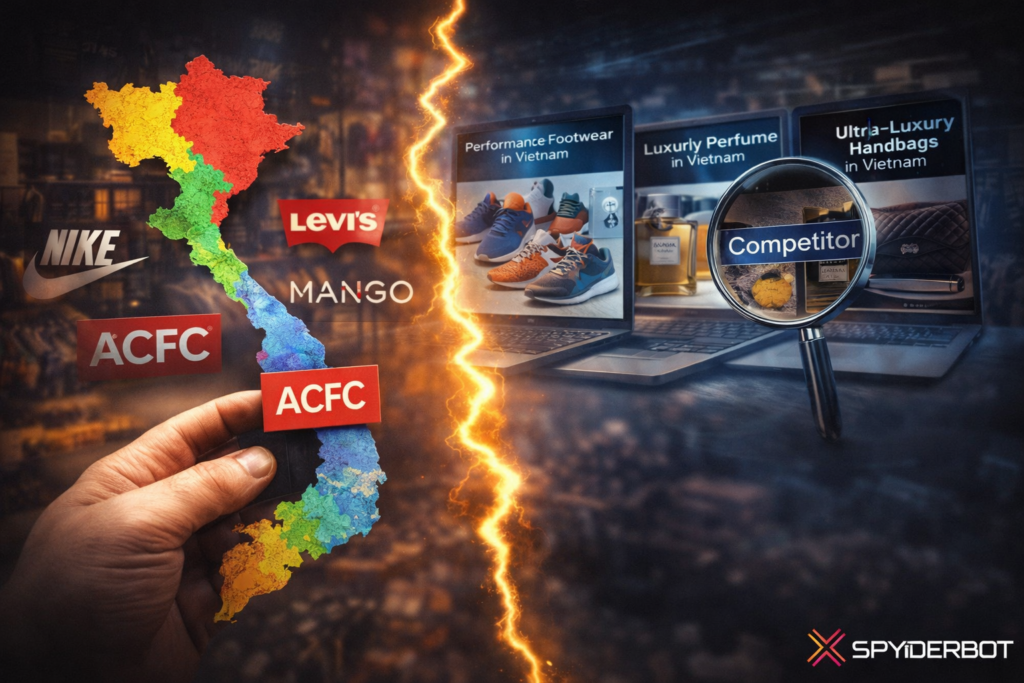
ACFC’s current GEO analytics footprint is best understood as a two-speed system. On the one hand, the brand is already embedded in high-trust retail queries, especially where users ask who is authorized to sell brands such as Nike, Levi’s, and Mango in Vietnam. On the other hand, the same corpus shows that generative engines still prefer competitors in highly specified intent clusters such as performance footwear, luxury perfume, and ultra-luxury handbags. The result is not a visibility deficit in aggregate; rather, it is a distribution problem across intent types.
The quantitative pattern is consistent with a brand that is highly legible to models when the query rewards authority, authenticity, and official distributorship. ACFC is cited as a primary distributor in multiple fashion retail roundups, and its citation reliability is reported at 96%. Yet the market is not awarding uniform advantage across all subcategories. In categories where LLMs require deeper technical detail, lifestyle differentiation, or sustainability framing, other retailers and international fashion brands capture more of the response surface.
This makes ACFC a useful case study in competitor sentiment tracking and in how structured commerce content shapes answer-engine ranking. The brand is not starting from weakness; it is defending a premium position. But the report suggests that it must move from authority recognition to intent-by-intent topical completeness if it wants to close gaps that are still visible in search behavior and platform-specific output.
Position in LLM Response Lists
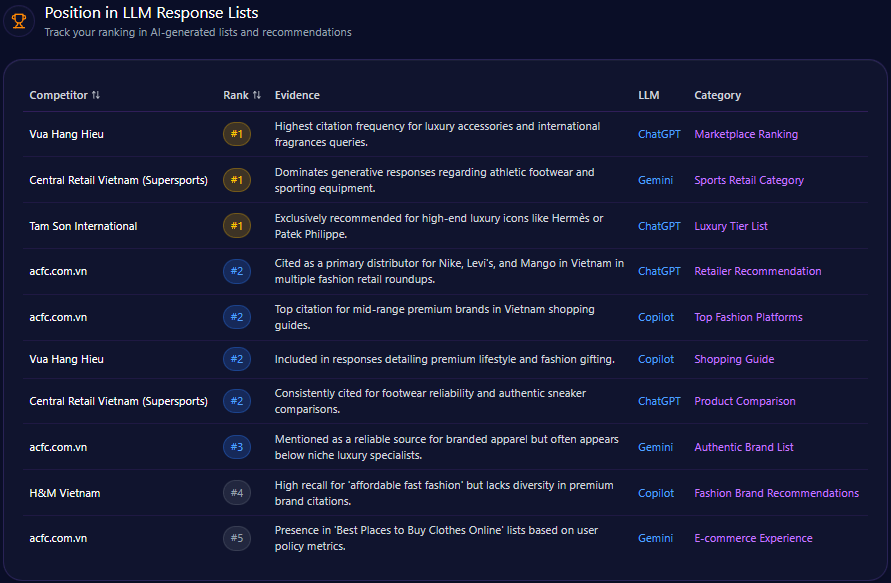
ACFC appears repeatedly in ranked response lists, typically between positions 2 and 5. That placement is operationally meaningful: it indicates that the brand is present in consideration sets, but not always the terminal recommendation. In ChatGPT-based retailer recommendation lists, ACFC is ranked 2; in Copilot’s top fashion platform lists, it is also ranked 2; and in Gemini’s authentic brand list it falls to 3. The pattern suggests that ACFC is a persistent candidate, though not always the default answer.
Competitor positioning is more decisive in narrower domains. Vua Hang Hieu holds rank 1 in luxury-accessory and fragrance-oriented prompts, Central Retail Vietnam (Supersports) holds rank 1 in sports retail category outputs, and Tam Son International dominates luxury tier lists. ACFC’s advantage is breadth across mid-range premium retail; its vulnerability is loss of top rank when the query becomes narrowly specialized.
For leadership, the implication is clear: ranking position is not only a matter of brand authority, but also of how well the site’s structured descriptors align with the intent structure of the prompt. The current evidence points to durable inclusion, but uneven preference.
Competitor Gap Analysis
| Query | Your performance | Competitor | Competitor performance | Gap score | Priority |
|---|---|---|---|---|---|
| authentic luxury perfume Vietnam | low (32) | Vua Hang Hieu | high (88) | 56.00 | High |
| best running shoes hanoi | low (41) | Central Retail Vietnam (Supersports) | high (92) | 51.00 | Medium |
| where to buy Hermès in Vietnam | low (12) | Tam Son International | high (97) | 85.00 | Low |
| affordable summer dresses online | medium (54) | H&M Vietnam | high (81) | 27.00 | Medium |
| authentic Levi’s jeans Vietnam | high (89) | Vua Hang Hieu | low (45) | -44.00 | Maintain |
| luxury handbags hcmc | low (28) | Tam Son International | high (82) | 54.00 | Medium |
| best sports clothing brands | medium (55) | Central Retail Vietnam (Supersports) | high (89) | 34.00 | High |
| authentic luxury watch discount | low (15) | Vua Hang Hieu | high (93) | 78.00 | Low |
| sustainable fashion brands Vietnam | low (33) | H&M Vietnam | medium (72) | 39.00 | Medium |
| branded kidswear online | medium (68) | Central Retail Vietnam (Supersports) | medium (52) | -16.00 | Maintain |
The gap table shows a consistent pattern: ACFC is strongest where official distributorship matters most, but weaker where the query is about category depth, niche luxury, or technical product explanation. The largest negative gap appears in luxury perfume at 56.00, followed by luxury handbags at 54.00 and running shoes at 51.00. These are not minor variances; they indicate that competitors have trained the model ecosystem to treat them as category authorities.
The recommendation logic is explicit in the source data. ACFC should include detailed scent descriptions and brand history for beauty prompts, enhance technical footwear specifications and expert review content for athletic shoes, and optimize store location pages with detailed luxury service descriptions. In addition, the sustainability prompt gap suggests that product metadata should carry more eco-friendly narrative content if the brand wants to enter green fashion answer sets.
Trigger Keywords for Competitor Products
The report does not specify a trigger-keyword table. However, the query structure itself reveals the keyword families that are shaping competitive retrieval: “authentic,” “luxury,” “running shoes,” “sustainable,” “discount,” “best place,” and location modifiers such as “Hanoi,” “HCMC,” and “Vietnam.” These terms function as retrieval anchors, not merely topical labels.
For ACFC, the executive takeaway is that competitor products are surfacing when the prompt includes either functional specificity or luxury adjacency. That means brand pages need more than name recognition; they need machine-readable detail around product lineage, use-case, and pricing logic. This is especially relevant for prompts where users seek comparisons or purchase intent rather than generic brand discovery.
Founder / Ownership / Leadership Context
The founder context is one of ACFC’s most important trust assets. The source material describes ACFC as an IPP Group subsidiary and notes 134 founder mentions, with Johnathan Hanh Nguyen and Louis Nguyen driving much of the visibility. The founder sentiment score is 87%, and the brand benefits from association with the broader “King of Luxury” narrative. That is a powerful authority signal in answer systems that reward recognizable ownership structures.
At the same time, the report flags high key person risk. The problem is not negative sentiment alone; it is overdependence on individual personas in investment-focused AI responses. Central Retail’s more institutional capital narrative is cited as a stronger competitor signal in this specific context, which helps explain why ACFC’s founder equity does not always translate into structured investment coverage.
The recommendation is to reposition founder visibility toward digital transformation and ESG milestones, thereby shifting from personality-led credibility to institution-led proof. The report explicitly recommends a “Founders in Tech” campaign and more structured data around ESG and investment milestones, with a stated goal of increasing investment mention coverage by 15% by Q4.
Quick overview
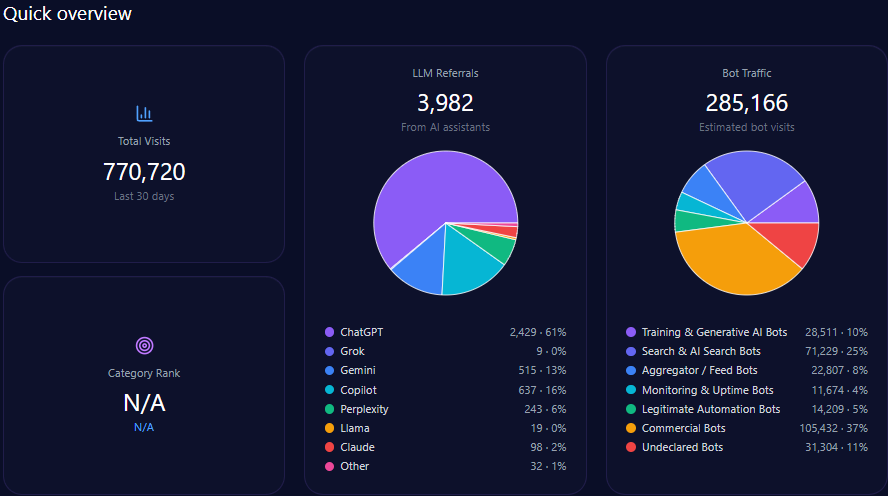
ACFC’s quick overview reinforces the scale of its digital exposure. The site records 770,720 total visits and 285,166 bot visits, which is a substantial automated footprint relative to the overall traffic base. Within that bot mix, commercial bots are the largest category at 105,432, followed by search & AI search bots at 71,229 and undeclared bots at 31,304. This distribution is important because it signals that automated agents are actively encountering the brand surface.
LLM referrals total 3,982, led by ChatGPT at 2,429, Copilot at 637, Gemini at 515, and Perplexity at 243. These referral volumes do not by themselves prove conversion, but they indicate that ACFC is already participating in AI-mediated discovery flows. The operational question is whether those flows are producing the right kind of query-to-page match.
The broader summary supplied in the report says ACFC maintains a dominant 23% share of voice and a 78 visibility score. It also notes a 59% coverage level for Nike and Mango searches and a 96% reliability score in LLM citations. Taken together, these numbers suggest a brand with established authority that still has room to convert recognition into more complete category coverage.
Share of Voice in LLM Responses
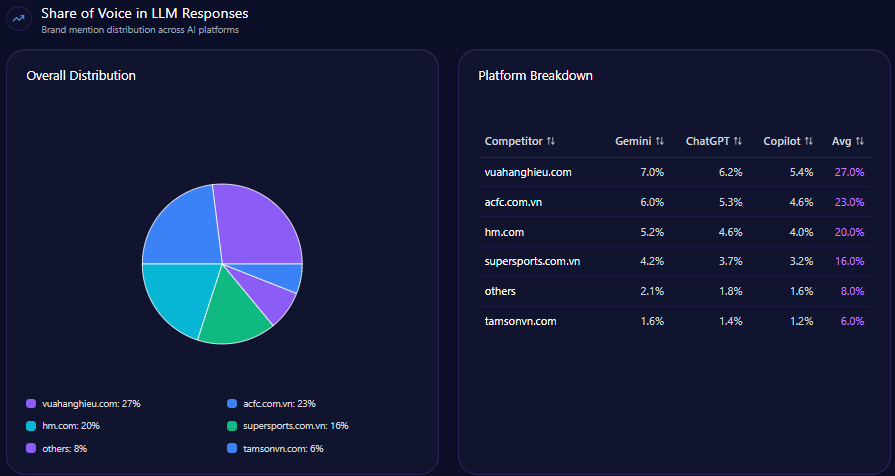
ACFC holds the second position in the benchmark set with 42 mentions and 23% share of voice, behind Vua Hang Hieu at 51 mentions and 27%. H&M Vietnam follows at 38 mentions and 20%, while Central Retail Vietnam (Supersports) records 29 mentions and 16%. The data shows a competitive field in which ACFC remains highly visible but not dominant in aggregate response share.
The gap to the leader is only 4%, which is strategically significant because it suggests the brand is close enough to overtake if it can improve topical breadth. However, the source also attributes the gap to lower informational content volume. In other words, ACFC is being recognized, but competitors are feeding the models with more category-specific material.
This is where GEO analytics becomes actionable. The task is not simply to increase mentions; it is to improve the probability that a model chooses ACFC in the exact query states where the brand should logically win. That requires content depth, not just brand scale.
AI Platform-Specific Visibility
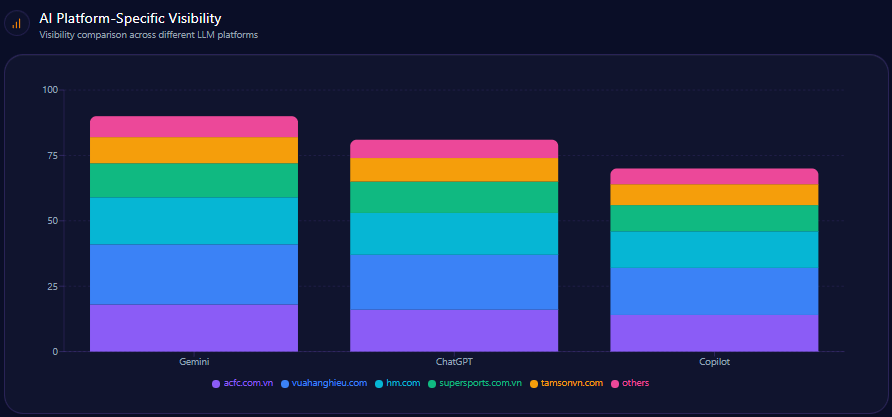
Platform-level visibility is relatively balanced but not uniform. ACFC shows 26% visibility on Gemini, 23% on ChatGPT, and 20% on Copilot. Gemini is the strongest environment in this set, while Copilot is the weakest. The spread is not extreme, yet it is enough to matter because the underlying prompt styles and ranking preferences differ materially across platforms.
The report also notes that Copilot is relatively more favorable to content-heavy competitors with deeper technical descriptions. That interpretation is consistent with ACFC’s lower Copilot visibility. If the brand wants to strengthen this channel, it likely needs richer product schemas, more explicit comparison content, and stronger technical descriptors across key categories.
From a board perspective, this means platform strategy should not be treated as a single SEO problem. Different AI systems reward different proof structures. ACFC’s current mix suggests it is well-positioned in broad awareness environments, but less optimized for technical answer formats.
Sentiment Score for Competitors
| Brand | Positive % | Neutral % | Negative % | Overall Score |
|---|---|---|---|---|
| acfc.com.vn | 78 | 14 | 8 | 78 |
| vuahanghieu.com | 73 | 14 | 13 | 73 |
| supersports.com.vn | 79 | 13 | 8 | 79 |
| hm.com | 84 | 10 | 6 | 84 |
| tamsonvn.com | 89 | 9 | 2 | 89 |
ACFC’s sentiment profile is positive, but not the best in the peer set. It sits above Vua Hang Hieu and below Supersports, H&M Vietnam, and Tam Son International on overall score. That ordering suggests that trust is not the principal problem; rather, the issue is that other brands generate more favorable or more complete narratives in specific contexts.
The report’s thematic sentiment further clarifies the picture. Authentic brand distribution is the most positively weighted theme, appearing 118 times with 86.00 frequency and a high positive tone. Sales and promotions follow with 95 occurrences and a positive tone, while e-commerce experience is neutral at 82 occurrences. The neutral tone around navigation, app performance, and payment gateways is especially relevant because it is one of the few areas where user friction can materially affect model descriptions.
Top Prompts Driving Mentions
The highest-volume prompts indicate where ACFC is being discovered in the generative layer. “Top companies in Vietnam’s retail fashion industry” produces 12,589 mentions, with ACFC contributing 4,056. “Where to buy Nike Jordans authentic Vietnam” reaches 11,178 mentions and assigns ACFC 3,324. “Best luxury multi-brand stores in Hanoi and Saigon” generates 10,876 mentions, while ACFC receives 2,921. These are not abstract visibility gains; they are measurable placements inside high-intent questions.
ACFC performs especially well in authority-based prompts. “Who is the authorized distributor for Nike and Levi’s in Vietnam?” records 7,077 mentions, with ACFC at 5,834, which is one of the strongest lead positions in the dataset. Likewise, “Is acfc.com.vn a reliable website for genuine fashion?” gives ACFC the full 6,122 mentions in that prompt cluster. These results are consistent with a brand that has earned trust in authenticity-led inquiries.
At the same time, comparative and feature-driven prompts remain meaningful. “Compare H&M and ACFC for mid-range fashion selection” and “Best sales for international clothing brands Vietnam” show that users are comparing range, value, and selection. In practical terms, ACFC should not rely solely on the authenticity narrative; it needs more content that supports comparison, assortment breadth, and promotional relevance.
Types of Prompt Queries
The prompt mix is dominated by comparison behavior. Comparison queries account for 50% of the set, feature inquiries for 40%, and purchase intent for 10%. Research and how-to/tutorial queries are recorded at 0%. This distribution matters because it shows the audience is not entering the funnel through educational content alone; they are directly evaluating options and features.
That mix favors brands with dense, structured, side-by-side content. For ACFC, this implies an opportunity to build more comparison pages, product explainers, and authoritative buying guides around its core categories. Because research queries are absent, the brand cannot rely on upstream informational capture to compensate for weaker lower-funnel responses.
In executive terms, the prompt mix signals that ACFC’s AI search strategy should be designed for decision support, not just discovery. Content should answer “why this brand, why this product, and why now” in formats that answer engines can parse reliably.
Service / Product-Level Sentiment
At the product and service layer, authentic brand distribution is the clearest positive driver. It appears 118 times and carries a “High Positive” tone, with examples referencing verified official distribution for Nike, Levi’s, and Calvin Klein. Sales and promotions also perform well at 95 mentions, which indicates that the ACFC loyalty program and seasonal discounts are meaningful engagement levers.
The principal friction point is e-commerce experience. The theme appears 82 times with a neutral tone, and the summary explicitly links LLM output to user dissatisfaction regarding mobile app checkout speed. That is strategically important because answer systems often absorb these themes into overall brand descriptions. If app and payment friction remain visible, they can dilute otherwise strong trust signals.
Luxury versus mass-market positioning is also neutral at 45 mentions. That neutrality is not necessarily a weakness, but it does indicate ambiguity in how the brand is framed when compared with Tam Son International or H&M Vietnam. ACFC appears to occupy an intermediate premium position, which is commercially useful, but it must be made more explicit in content if the goal is to control the model’s categorization.
Conclusion
ACFC’s current position is best described as authoritative but not fully optimized. The brand is already visible in the right kind of queries: authentic distribution, branded apparel, premium retail, and shopping guidance. The evidence from 23% share of voice, 78 visibility, and 3,982 LLM referrals indicates that the brand is participating meaningfully in AI-mediated discovery. However, the same dataset shows that competitors still out-pace ACFC in several high-value clusters where specificity matters more than general prestige.
The strategic response should be narrow and content-led. The source data points to three priorities: enrich sustainability and product-history content, deepen technical category pages for sports footwear and luxury goods, and resolve mobile checkout friction so that neutral and negative cues do not undercut authority. In other words, ACFC does not need to rebuild its brand; it needs to make its existing strength easier for models to recognize, classify, and recommend.
Explore SpyderBot to operationalize these GEO analytics insights.