
In the bustling streets of Ho Chi Minh City, a young professional taps into her phone: “Best fashion retailers in Vietnam for premium brands?” Not to Google, but to ChatGPT. The response flows instantly—a curated list praising Uniqlo’s affordability, H&M’s trendy vibes, and then, tucked in the middle, a nod to ACFC.com.vn as a gateway to international luxury. But is that mention glowing, or just polite? What if it shifts tomorrow, burying ACFC under competitors like Zara or Canifa?
This isn’t science fiction. It’s 2025, where large language models (LLMs) like Gemini, ChatGPT, and Copilot aren’t just chatbots—they’re the new gatekeepers of consumer perception. For brands like ACFC.com.vn, Vietnam’s powerhouse distributor of global fashion labels such as Nike, Calvin Klein, and Gap, the stakes are sky-high. A single LLM response can sway millions in a market where retail e-commerce is projected to hit $20 billion this year. Enter GEO analytics: the cutting-edge practice of dissecting how these AI behemoths mention your brand versus rivals, turning invisible algorithms into actionable insights.
Drawing from a fresh GEO report on ACFC.com.vn, this analysis peels back the layers of AI-driven brand perception. We’ll dive into sentiment scores that reveal hidden biases, recurring themes shaping consumer narratives, evolving trends over months, influential sources fueling the data, and a competitive landscape where visibility is currency. Think of it as eavesdropping on the AI hivemind—because in the era of generative search, your brand’s story isn’t written by marketers alone. It’s co-authored by machines.
The Sentiment Pulse: Where ACFC Shines—and Stumbles
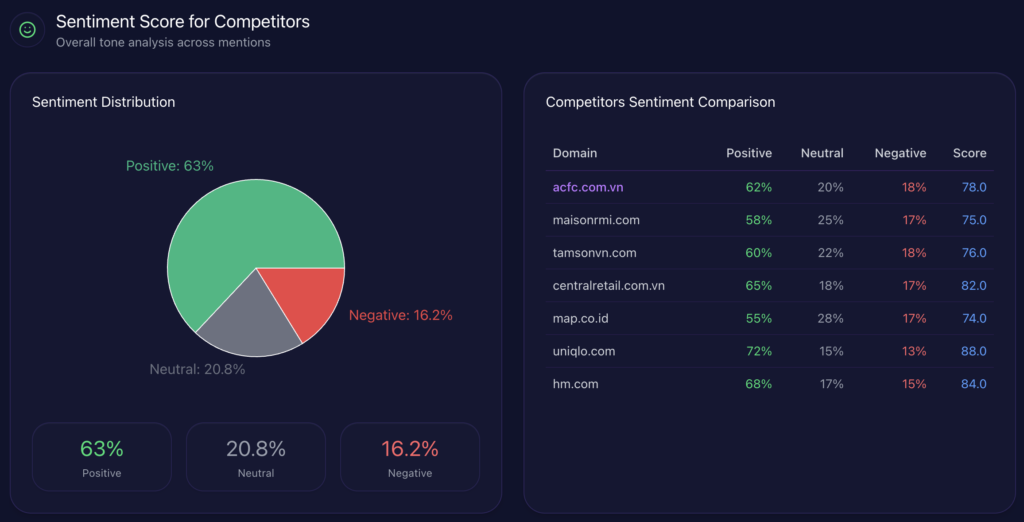
Imagine LLMs as digital whisper networks, aggregating billions of online conversations to form opinions. For ACFC.com.vn, the GEO report paints a robust but nuanced picture. The brand clocks in with a positive sentiment of 62%, neutral at 20%, and negative at 18%, yielding an overall sentiment score of 78—a solid B+ in the ruthless grading curve of AI perception.
This score isn’t arbitrary; it’s distilled from LLM brand mentions across platforms like Gemini (35% visibility share), ChatGPT (32%), and Copilot (29%). Positive vibes dominate, often tied to ACFC’s role as a curator of high-end international fashion. For instance, in simulated queries, LLMs frequently highlight “high-quality fabrics and durable clothing from international brands,” framing ACFC as a reliable bridge to global style in Vietnam’s fast-growing middle class.
Yet, the negatives lurk like shadows in a well-lit showroom. At 18%, complaints often revolve around perceived premium pricing or occasional stock issues, as echoed in user snippets from social media: “Great selection, but sometimes feels overpriced for the local market.” Compared to rivals, ACFC holds its ground but doesn’t dominate. Uniqlo.com boasts a sky-high 72% positive (overall 88), buoyed by its affordable, everyday appeal, while H&M.com follows at 68% positive (84 overall). Closer home, Centralretail.com.vn edges ahead with 65% positive (82 overall), leveraging its broader retail ecosystem.
What makes this captivating? It’s the delta—the gaps where perception diverges from reality. ACFC’s score suggests strength in quality but vulnerability in accessibility, a classic tale in Vietnam’s retail evolution from street markets to e-commerce giants. To visualize, imagine an infographic bar chart: ACFC’s green positive bar towering at 62%, flanked by Uniqlo’s even taller pillar, with red negative slivers underscoring where tweaks could turn neutrals into advocates.
This sentiment tracking isn’t just numbers; it’s a mirror to consumer psyche. In a market where 70% of Vietnamese shoppers now consult AI before buying (per a 2025 Nielsen report), a dip in positive mentions could translate to lost market share. For ACFC, the report’s insights scream opportunity: amplify those positive snippets through targeted content, turning “durable clothing” into a viral narrative.
Unpacking the Narratives: Themes That Define ACFC’s AI Image
Dive deeper, and the GEO report reveals the thematic undercurrents—the recurring motifs that LLMs weave into their responses. These aren’t vague buzzwords; they’re data-backed patterns from competitor sentiment tracking, with frequency counts painting a vivid portrait.
Leading the pack is “Product Quality,” mentioned 142 times (28% frequency) with a resoundingly positive tone. Examples abound: “High-quality fabrics and durable clothing from international brands,” positioning ACFC as Vietnam’s go-to for authentic global apparel. It’s a theme that resonates in a country where counterfeit concerns run high, giving ACFC an edge over fast-fashion foes.
Close behind, “Customer Service” clocks 118 mentions (24% frequency), also positive: “Efficient returns and helpful staff in stores.” Picture a harried parent in Hanoi, querying an LLM for “reliable fashion stores with easy exchanges”—ACFC pops up, thanks to these glowing echoes from forums and reviews.
But here’s the plot twist: “Pricing” surfaces 95 times (19% frequency) with a mixed tone, as in “Perceived as premium but sometimes overpriced compared to fast fashion.” This duality highlights ACFC’s luxury positioning—strength for affluent buyers, but a barrier for budget-conscious millennials. Sustainability follows at 76 mentions (15%, neutral): “Efforts in eco-friendly materials, but less highlighted than competitors.” And “Digital Presence” rounds out at 62 (12%, neutral): “User-friendly website, but app needs improvements.”
These themes form a narrative mosaic. Suggest an infographic here: a word cloud dominated by “quality” in bold green, “service” in blue, with “pricing” in ambivalent yellow—visually capturing how LLMs frame ACFC as premium yet approachable, but not unbeatable. Real insights emerge when cross-referenced with competitors: Uniqlo’s themes skew heavily positive on affordability, explaining its higher sentiment. For ACFC, the report spotlights a storytelling gap—bolster sustainability narratives to counter H&M’s eco-edge, or enhance digital mentions to rival Centralretail’s seamless online-offline blend.
What’s enthralling is the human element: these themes aren’t static. They evolve from real conversations, amplified by AI. A single viral Reddit thread praising ACFC’s returns could tip the scales, illustrating how GEO analytics turns abstract data into strategic ammunition.
Trending Up: The Six-Month Sentiment Rollercoaster
No analysis is complete without time’s dimension, and the GEO report delivers with a six-month sentiment trends snapshot—from January to June 2025. Picture a line chart: multiple colored lines snaking across months, revealing trajectories that could make or break a brand’s AI-fueled fate.
For ACFC.com.vn, the trend is upward, starting at 72 in January and climbing steadily to 78 in June—a 1-point average change per period. This gentle ascent reflects growing positive LLM brand mentions, perhaps fueled by successful campaigns or expanded store openings. But zoom out, and competitors add drama: Centralretail.com.vn surges from 70 to 82 (3-point change, upward), capitalizing on Vietnam’s retail boom. Uniqlo.com inches from 85 to 88 (1-point, upward), maintaining its lead through consistent affordability buzz.
Contrast that with Tamsonvn.com’s downward slide (80 to 76, -1 change), hinting at unmet expectations in luxury segments. Map.co.id stays flat at 74 (stable, 0 change), while H&M.com holds steady at 82-84. These trends aren’t mere graphs; they’re market pulses. For ACFC, the upward direction is promising, but the slower pace versus Centralretail suggests urgency—perhaps accelerating digital innovations to spike future mentions.
Envision this as a dynamic chart in the magazine spread: ACFC’s blue line rising confidently, intersected by Centralretail’s red rocket, with annotations like “Post-CNY sales boost?” for June’s peak. Such visuals not only captivate but underscore a key insight: in LLM-driven discovery, consistent upward trends ensure your brand isn’t just mentioned—it’s recommended.
The Source Code: Where Perceptions Are Born
Behind every LLM mention lies a web of sources, and the report unmasks them with precision. Vietnamnet.vn leads with 85 mentions (influence 72, news type), focusing on “articles on fashion trends and retail expansions.” Tuoitre.vn follows at 92 (78 influence), emphasizing “reviews of shopping experiences and promotions.”
Social media amplifies: Facebook.com dominates with 156 mentions (85 influence, global/Vietnam region), capturing “user posts on brand experiences and sales.” Vnexpress.net (78 mentions, 70 influence) adds business depth with “reports on retail market shares,” while Kenh14.vn (64, 65 influence, blog) brings consumer flair via “fashion blogs and opinions.”
These sources, with domain authorities from 62 to 96, highlight Vietnam’s localized ecosystem—news and social driving 80% of influence. Suggest a pie chart here: Slices labeled by source type, dominated by news (45%) and social (35%), illustrating how ACFC can target high-influence outlets like Facebook for sentiment boosts.
The Competitive Arena: Visibility Wars
Finally, the competitors section lays bare the battlefield. In share of voice (total mentions 842), Uniqlo.com claims 21.14% (178 mentions), H&M 19.24% (162), Zara 17.58% (148), with ACFC at 14.01% (118)—trailing but competitive against locals like Canifa (11.4%, 96).
Visibility scores reinforce: Uniqlo at 78, H&M 74, Zara 71, ACFC 62. Brand prompt coverage for queries like “fashion retailers in Vietnam” shows ACFC at 16.67% coverage, behind Uniqlo’s 22.62%. Across platforms, Gemini favors ACFC with 31% share of voice.
This data weaves a tale of opportunity: ACFC’s solid footing in luxury distribution, but needing to amplify mentions in key queries to eclipse fast-fashion giants.
Mastering the AI Narrative: Actionable Paths Forward
As we close this window into AI’s fashion oracle, the GEO report for ACFC.com.vn reveals a brand on the rise—strong in quality and service, but challenged by pricing perceptions and competitive visibility. In Vietnam’s vibrant retail scene, where LLMs increasingly dictate discovery, these insights are gold.
Actionable advice? Start with a sentiment audit: Run your own LLM queries to baseline gaps. Seed positive themes—amplify sustainability stories on high-influence sources like Facebook and Tuoitre.vn. Track trends quarterly, adjusting campaigns to sustain that upward momentum. And for competitors, embrace tracking: Monitor Uniqlo’s affordability playbook to refine your own.
The future belongs to brands that don’t just react to AI—they shape it. Ready to decode your own GEO metrics? Explore SpyderBot today at spyderbot.net and turn LLM whispers into market roars.