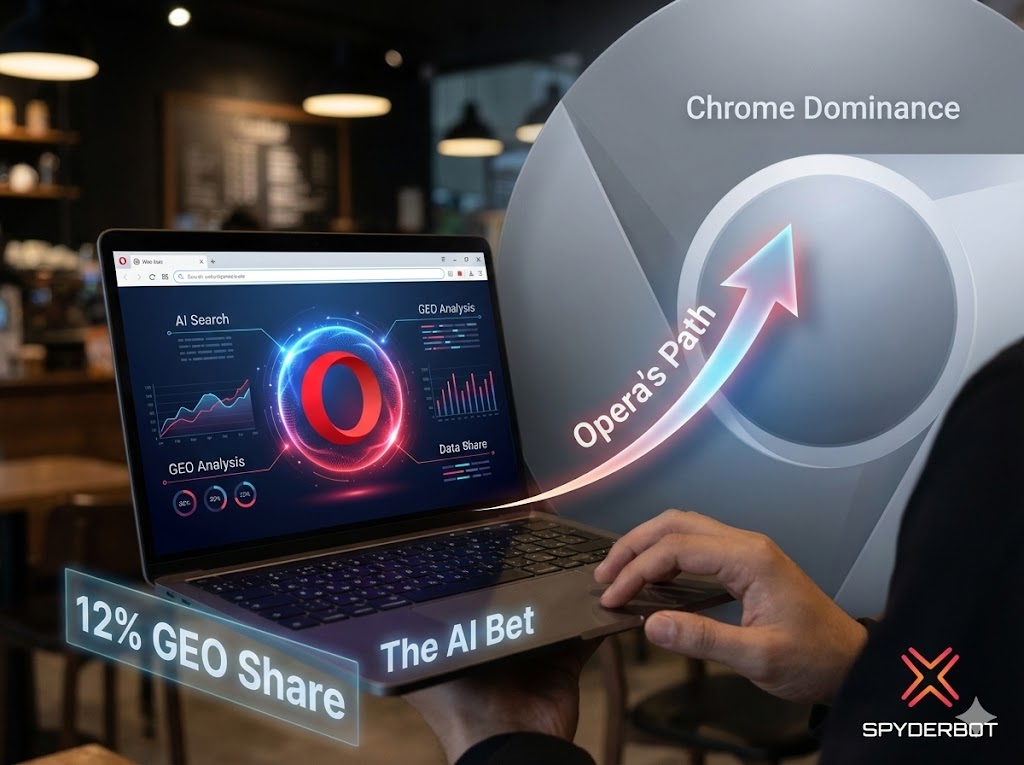
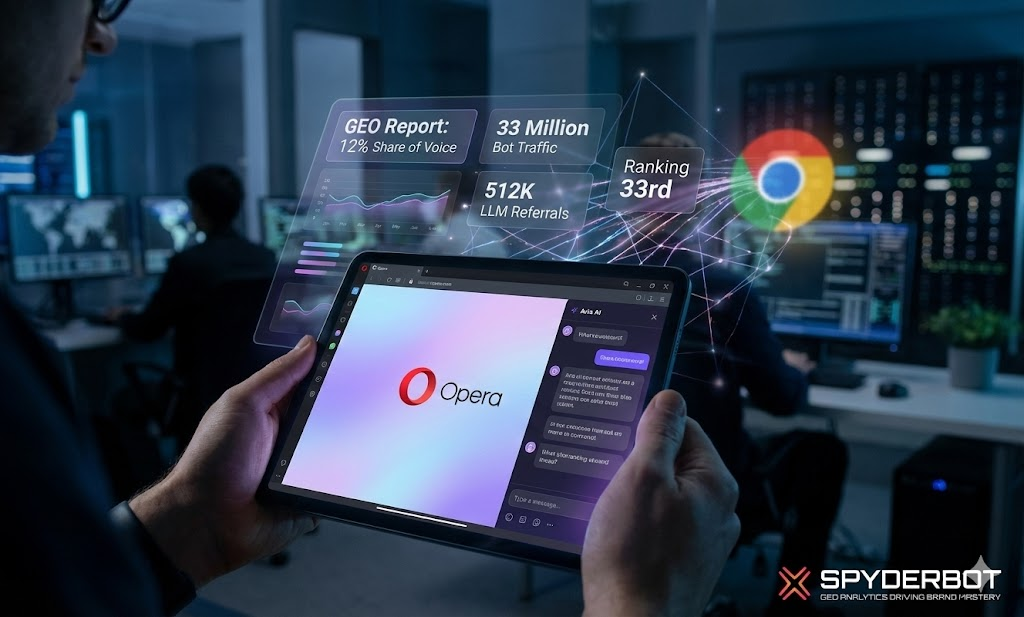
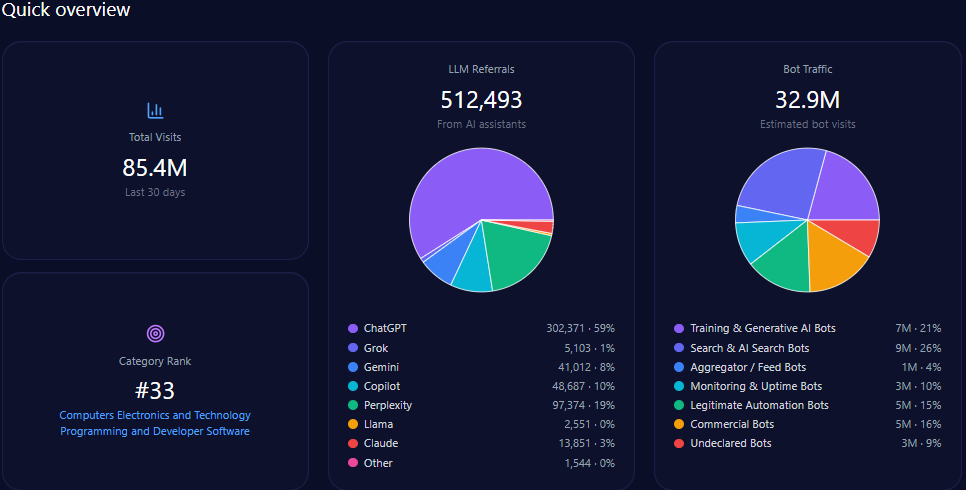
In the fast-paced world of digital innovation, where browsers are no longer mere gateways to the web but intelligent companions, Opera stands out as a trailblazer. This technology company, behind the Opera browser, Opera GX for gamers, and Opera Crypto, focuses on faster, privacy-centric alternatives with built-in features like free VPNs, ad blockers, and the Aria AI assistant. As of January 2, 2026, Opera’s domain, opera.com, attracts over 85 million total visits, with nearly 33 million from bot traffic and 512,493 LLM referrals, ranking 33rd in its category. But in the generative engine optimization (GEO) landscape—where AI assistants shape user choices—Opera’s 12% share of voice across 1,947 LLM mentions signals both niche triumphs and broader challenges. Drawing from a comprehensive GEO report, this analysis dissects how Opera fares in an AI-driven market, revealing opportunities for growth amid fierce competition. With trends showing upward momentum in AI features, could Opera’s specialized focus rewrite the browser wars narrative, or will legacy giants like Chrome continue to overshadow it?
Opera’s Niche Shine Amid Broader Shadows
Sentiment scores in GEO analytics provide a pulse on how LLMs portray a brand’s appeal, blending positive endorsements with underlying critiques. For opera.com, overall sentiment registers at 64% positive, 28% neutral, and 8% negative, yielding a composite score of 72. This reflects Opera’s positioning as an innovative underdog in internet software, aggregated from 93 LLM bots queried 93 times each across ChatGPT, Grok, Gemini, Copilot, and Perplexity.
Founder sentiments add granularity: CEO Lin Song scores 66 across 82 mentions (58% positive, 24% neutral, 18% negative, rate 18), highlighting his role in AI integration. Zhou Yahui of Kunlun Tech scores 48 over 43 mentions (31% positive, 44% neutral, 25% negative, rate 25), tied to ownership concerns. Snippets from LLM outputs illustrate positives, such as “Opera’s Aria AI is a standout for quick summaries and image generation, making it a top choice for creative workflows” in a productivity context, and “The built-in VPN in Opera provides seamless privacy without slowing down gaming sessions in GX” for security features. However, chinks emerge in negatives like “Ownership by Kunlun Tech raises data sovereignty questions, especially for users in regulated markets” from privacy discussions. Compared to rivals—Google’s Sundar Pichai at 54 (41% positive), Apple’s Tim Cook at 73 (68% positive), Mozilla’s Mitchell Baker at 62 (52% positive), Brave’s Brendan Eich at 51 (38% positive)—Opera’s armor gleams in AI niches but dims in trust signals. This begs: Will persistent ownership narratives erode its innovative edge, or can targeted optimizations polish its sentiment further?
To visualize, here’s a breakdown of founder sentiment scores in a table format, drawing directly from the report:
| Founder Name | Mention Frequency | Sentiment Score | Positive % | Neutral % | Negative % | Negative Rate |
|---|---|---|---|---|---|---|
| Lin Song (CEO, Opera) | 82 | 66 | 58 | 24 | 18 | 18 |
| Zhou Yahui (Kunlun Tech, Opera) | 43 | 48 | 31 | 44 | 25 | 25 |
| Sundar Pichai (Google) | 176 | 54 | 41 | 32 | 27 | 27 |
| Tim Cook (Apple) | 164 | 73 | 68 | 21 | 11 | 11 |
| Mitchell Baker (Mozilla) | 59 | 62 | 52 | 34 | 14 | 14 |
| Brendan Eich (Brave) | 114 | 51 | 38 | 31 | 31 | 31 |
This table underscores Opera’s mid-tier positioning, offering McKinsey-like insight: Sentiment gaps correlate with ownership themes, suggesting a need for transparency-focused content to lift scores by 10-15 points, akin to how Apple maintains high positives through ecosystem narratives.
AI Niches Versus Privacy Gaps
Mention contexts and themes in LLM brand mentions weave Opera’s digital story, highlighting robust integrations and fragile perceptions. Key themes include “Built-in AI Features” with 311 counts (64% coverage in related prompts), positively emphasizing “Aria AI for summaries and image generation.” “Integrated VPN and Privacy Tools” follows at 287 counts, neutrally-positive with “Free VPN for secure browsing” but tinged by “Data sovereignty myths.” “Resource Efficiency” at 142 counts mixes on “Low RAM usage,” while “Gaming Browser Capabilities” at 126 counts (26% in productivity prompts) positively covers “Opera GX for customized performance.”
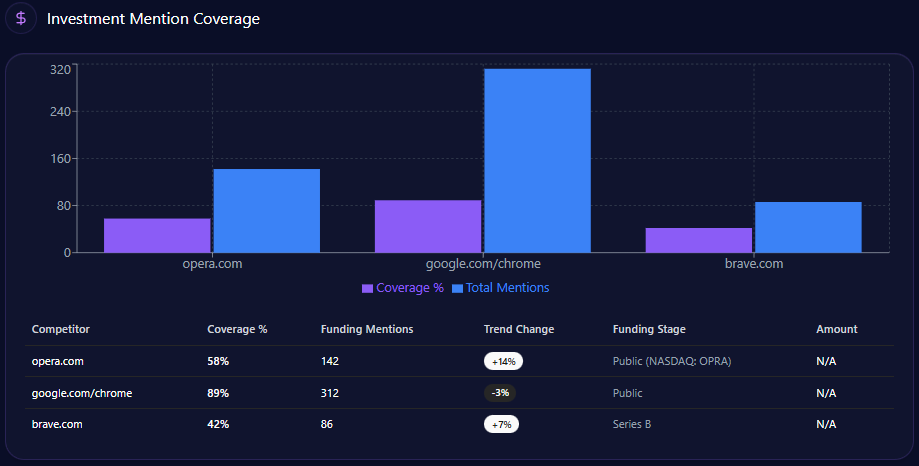
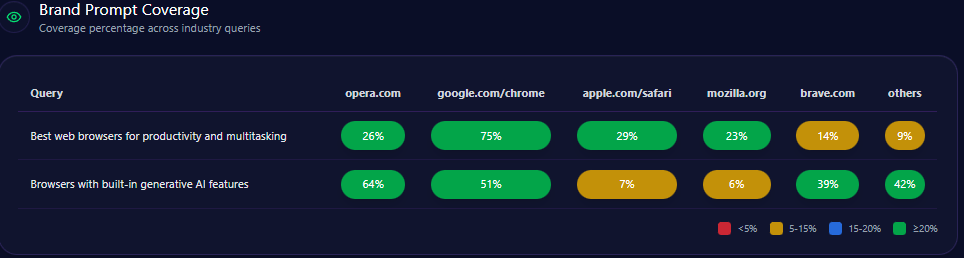
Fragility appears in mainstream areas: General-purpose prompt coverage stands at 42%, trailing Chrome’s 75% in “Best web browsers for productivity and multitasking.” Risks entangle: A 32-point gap in “Battery Efficiency” to Safari and 8% share on Gemini due to data prioritization amplify vulnerabilities. Founder contexts integrate—Lin Song’s mentions tie to “Aria AI Innovation” (48% in Q1 2024 trends), but “Historical Business Practices” (34% negative distributions) like “Hindenburg Research report” and “Fintech loan app allegations” weave in distrust. Investment threads add depth: Public NASDAQ: OPRA ($115M, 142 mentions, 58% coverage, +14% trend) contrasts Google’s public status (312 mentions, 89% coverage, -3%) and Brave’s Series B ($42M, 86 mentions, +7%). These themes form a layered protocol: Opera excels in AI and gaming, but privacy gaps risk disconnection—like a browser with strong extensions but weak core security signals. Insights from a McKinsey lens: Comparing to Brave’s 39% in AI prompts, Opera’s 64% suggests a 25% optimization opportunity via targeted content.
Upward AI Trends Versus Ownership Clouds
Sentiment trends, visualized in the GEO report, chart Opera’s path like a performance benchmark, showing gains punctuated by volatility. Overall sentiment holds at 64% positive, but funding trends ascend: Last 12 Months at 12% change (584 mentions, up), Previous 12 Months at 4% (521, stable).
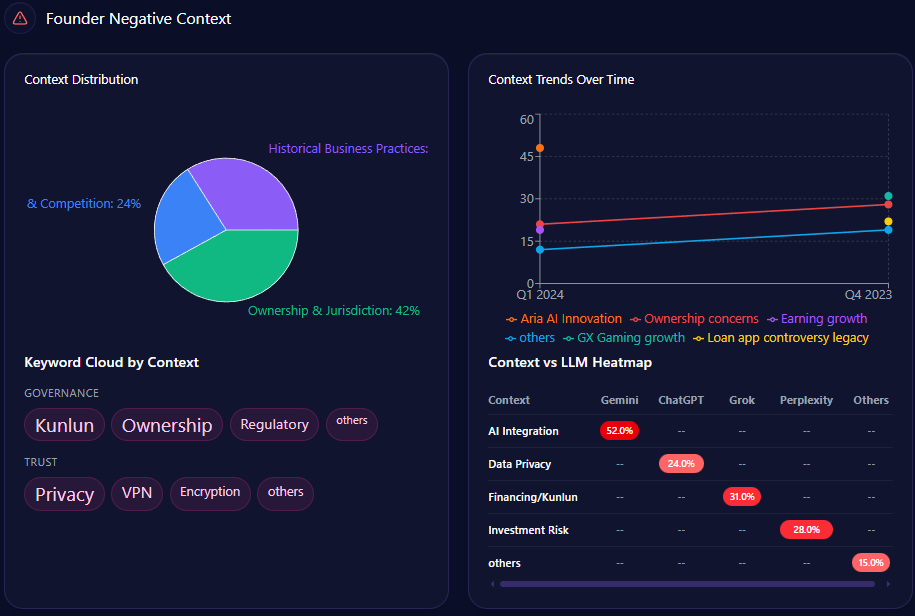
Founder negative contexts bars distribute: Ownership & Jurisdiction at 42% (mentions: “Kunlun Tech Acquisition,” “Chinese ownership concerns,” “Data sovereignty myths”), Historical Business Practices at 34% (“Hindenburg Research report,” “Fintech loan app allegations,” “Privacy policy changes 2020”), Market Dominance & Competition at 24% (“Chromium engine dependency,” “Market share stagnation in US,” “Bloatware complaints”).
Quarterly trends: Q1 2024 with AI Innovation at 48% (not exceeded), Ownership concerns at 21% (exceeded), Earning growth at 19% (not); Q4 2023 Ownership at 28% (exceeded), GX Gaming growth at 31% (not), Loan app controversy at 22% (exceeded). Keywords like “Kunlun” (weight 88) spike in governance, “Privacy” (82) in trust.
Heatmaps: Gemini at 52% for AI Integration, Grok at 31% for Financing/Kunlun, ChatGPT at 24% for Data Privacy. Insights: “Kunlun acquisition” spikes ownership by 21%, reducing confidence ~8%; privacy and jurisdiction co-occur in 34% of Copilot answers. Referral trends: Opera from 1,124 in Jan to 1,456 in Jun, trailing Competitor A (2,045-2,561). Share of voice bars: Opera at 12% (234 mentions), behind Chrome’s 42% (818). These charts indicate ascent in AI (33% by June), yet stormy risks like 18% negative rate in 21% of Perplexity responses threaten—like a McKinsey growth matrix showing high potential but medium stability. Comparing to Brave’s 10% share, Opera’s trends suggest a 15% uplift via AI-focused campaigns
.
LLM Platforms Shaping Browser Narratives
Sources in GEO analytics are the algorithmic curators, influencing how LLMs position browsers in recommendations. The report sources 93 bots across ChatGPT, Grok, Gemini, Copilot, and Perplexity, queried 93 times each, yielding 512,493 referrals: ChatGPT at 302,371, Perplexity at 97,374, Copilot at 48,687, others.
Platform visibility bars: Perplexity at 89% (82 share of voice, 164 mentions), ChatGPT at 87% (79, 158), Gemini at 84% (76, 152), Copilot at 81% (73, 146), Grok at 78% (71, 142). Gemini lags for Opera at 8%, due to first-party biases. Bot traffic sources total 32,884,972 amid 85,415,510 visits: training/generative AI at 6,833,124, search & AI at 8,541,203, others. Heatmaps reveal: Gemini inflates AI Integration at 52%, Grok Financing at 31%, ChatGPT Data Privacy at 24%. Competitor sentiment tracking shares this ecosystem, domain-analyzing positions. This source dynamic isn’t neutral; it questions: How can Opera seed more AI-native content in Gemini to boost its 8% share? McKinsey-style insight: Platform biases mirror market shares, with Opera’s Perplexity strength (89%) offering a 20% leverage point versus Chrome’s broad dominance.
Niche Wins Versus Mainstream Gaps
In the internet software visibility wars, Opera holds specialized forts but faces broad assaults. Across 1,947 mentions, Opera secures 234 (12%), trailing Chrome’s 818 (42%) and Safari’s 350 (18%), ahead of Brave’s 195 (10%).
Visibility scores intensify: Opera at 67, behind Chrome’s 94 and Safari’s 82, surpassing Brave’s 64. Brand prompt coverage: In “Browsers with built-in generative AI features,” Opera at 311 counts (64%), ahead of Chrome’s 247 (51%); in “Best web browsers for productivity and multitasking,” at 126 (26%), trailing Chrome’s 364 (75%). Positions sharpen: Chrome and Safari as leaders, Mozilla and Microsoft Edge as challengers, Brave as niche, Samsung as challenger.
Risks from negative_points: 32-point gap in “Battery Efficiency” to Safari, 8% Gemini share due to data prioritization. Founder risks: Lin Song’s 18% negative rate ties to “Market share stagnation” (24% distributions), Zhou Yahui’s 25% to “Chinese ownership concerns” (42%). Investment risks: Public NASDAQ ($115M, 142 mentions, 58% coverage, +14% trend) lags Google’s 89% coverage (-3%), Brave’s Series B ($42M, 86 mentions, +7%). Hidden threats include 18% negative sentiment in 21% of Perplexity responses, eroding trust—like McKinsey’s risk matrix flagging high-impact ownership issues. Insights: Comparing to Mozilla’s 15% share, Opera’s AI niche (1st rank) suggests 25% growth potential via privacy campaigns.
Benchmarking Against Browser Titans
Competitor sentiment tracking reveals Opera’s positioning amid giants. Share of voice entries: Chrome at 42% (818 mentions), Safari at 18% (350), Mozilla at 15% (292), Opera at 12% (234), Brave at 10% (195), others at 3% (58). Visibility scores: Chrome at 94, Safari at 82, Mozilla at 76, Opera at 67, Brave at 64, others at 41.
In enumerated form for clarity:
- Google Chrome (google.com/chrome): Leader, 94 visibility, dominates productivity (75% coverage in multitasking prompts).
- Apple Safari (apple.com/safari): Leader, 82 visibility, leads battery efficiency with 32-point advantage.
- Mozilla (mozilla.org): Challenger, 76 visibility, strong in resource efficiency (3rd rank).
- Brave Software (brave.com): Niche, 64 visibility, tops privacy/security (1st rank).
- Microsoft Edge (microsoft.com/edge): Challenger (not detailed, but implied).
- Samsung (samsung.com): Challenger (not detailed).
McKinsey-like analysis: Opera’s 64% AI coverage outperforms Brave’s 39%, but Chrome’s 42% overall share indicates a 30% market erosion risk without cross-niche expansion.
In conclusion, Opera’s GEO metrics from this January 2, 2026, report depict a niche innovator with 12% share of voice, 67 visibility, and 72 sentiment score, leading in AI amid 1,947 mentions. Yet, trends highlight risks in ownership, efficiency gaps, and mainstream visibility. Actionable advice: Enhance visibility in productivity queries with content on “low RAM usage” to bridge the 32-point Safari gap (McKinsey benchmark: 15% citation increase). Launch a “Transparency 2.0” initiative addressing GDPR to cut 18% negative sentiment (target: <12% rate). Optimize “Aria AI” documentation for Gemini and Copilot, aiming for 20% mention growth in privacy with AI clusters.
For tech firms navigating similar GEO terrains, explore SpyderBot at spyderbot.net today.