This report shows lowes.com holding real authority in high-consideration home improvement categories—yet facing a repeatable set of “speed, locality, and niche” traps where AI recommendations tilt to rivals.
At-a-glance: Numbers to know
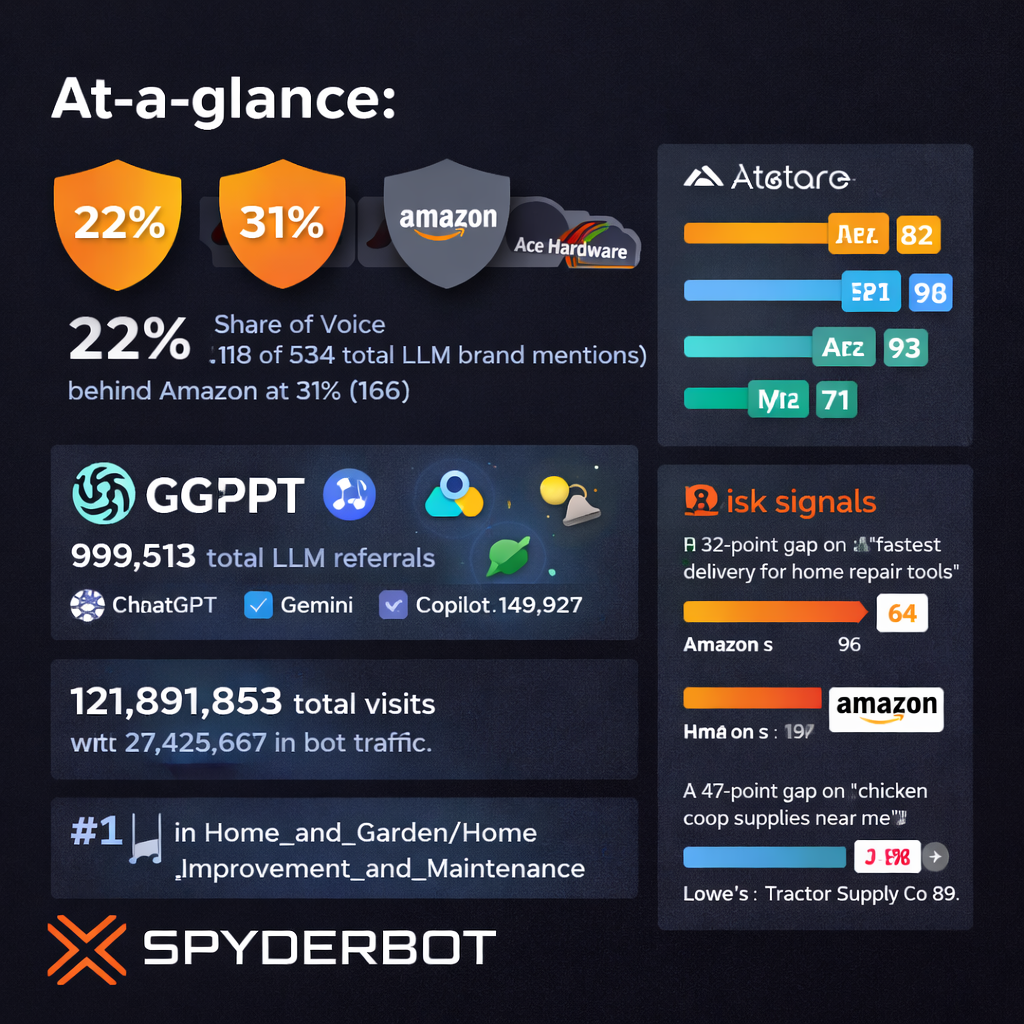
- 22% Share of Voice (118 of 534 total LLM brand mentions)—behind Amazon at 31% (166)
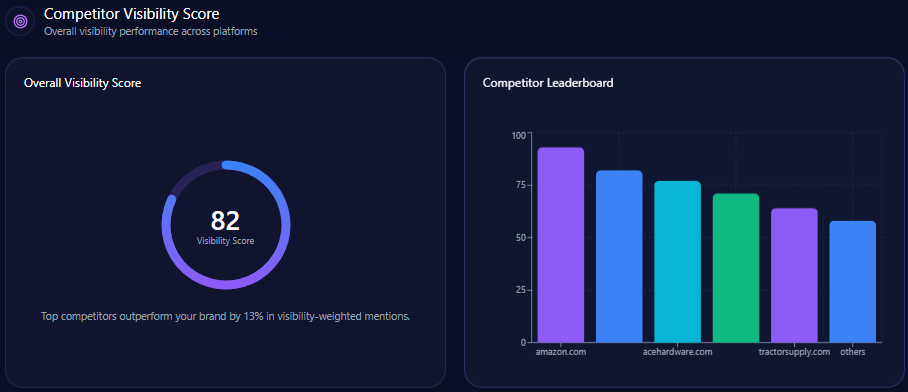
- Visibility Score: 82 (Amazon 93, Ace Hardware 77, Menards 71)
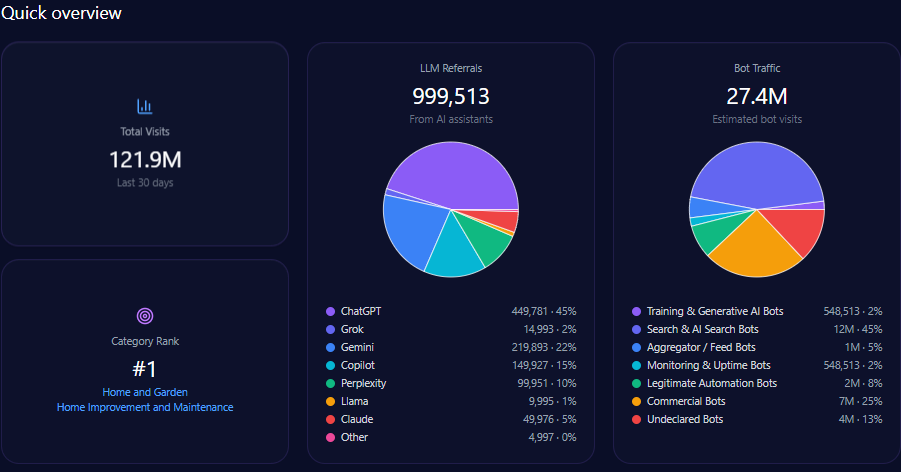
- 999,513 total LLM referrals (ChatGPT 449,781; Gemini 219,893; Copilot 149,927)
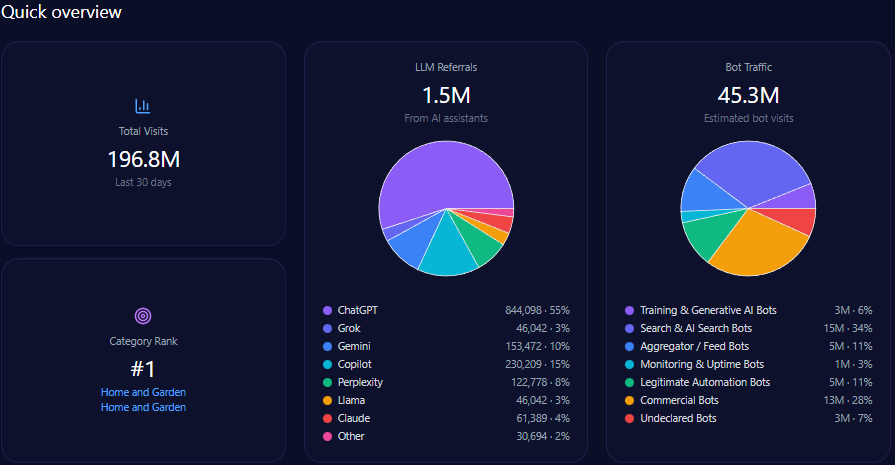
- 121,891,853 total visits with 27,425,667 in bot traffic
- Category rank: #1 in Home_and_Garden/Home_Improvement_and_Maintenance
- Gemini visibility: 86% with 26% platform Share of Voice
Risk signals
- A 32-point gap on “fastest delivery for home repair tools” (64 vs Amazon’s 96)
- A 47-point gap on “chicken coop supplies near me” (42 vs Tractor Supply Co.’s 89)
Opening
Picture the moment: a homeowner finds water under the sink at 10:47 p.m. They don’t open ten tabs. They ask a model. In that split second, the “best brand” isn’t the one with the prettiest assortment—it’s the one the assistant believes can solve a problem right now, with the least friction.
That’s the tension running through this report on lowes.com. The brand shows up as an authority when questions become bigger—appliances, installations, project planning, pro-grade tools. But when the prompt turns urgent, local, or niche, the story AI tells can suddenly reroute the customer.
When Lowe’s Is “In the List”—And When It Isn’t
Across LLM response lists, lowes.com shows up as a first-choice authority in specific contexts—but not uniformly.
On Gemini, Lowe’s ranks #1 as the “Primary brand citation for ‘best professional grade power tool brands’,” a sign that high-ticket, expertise-heavy summaries still reward the brand’s credibility. In contrast, on ChatGPT, Lowe’s appears at #2 in “best smart home lighting systems” across 45 prompts, and at #3 for “complex home renovation” informational guide citations—visible, but not always the default.
The broader competitive landscape reveals why this matters. Amazon repeatedly ranks #1 for product availability and fast shipping prompts—82% of responses for those queries—and dominates 90% of price-comparison prompts for small hand tools. Meanwhile, Ace Hardware claims #1 in local “repair near me” style lists, driven by convenience framing.
Lowe’s is present—and sometimes leading. The challenge is that “presence” is not the same as “first recommendation,” especially when AI is sorting by immediacy.
The Battle Map: Where the Answer Breaks Toward Rivals
The report’s gap patterns are unusually consistent: the biggest losses cluster around logistics speed, SKU-level specificity, and rural lifestyle needs—while Lowe’s wins where complexity and service are valued.
Here’s the clearest battle map:
| Query | Lowe’s (score) | Competitor (score) | Gap / Priority |
|---|---|---|---|
| fastest delivery for home repair tools | 64 | Amazon 96 | 32 / High |
| chicken coop supplies near me | 42 | Tractor Supply Co. 89 | 47 / High |
| hard to find metric bolts and nuts | 58 | Ace Hardware 87 | 29 / Medium |
| eco-friendly smart thermostats comparison | 81 | Amazon 93 | 12 / High |
| best place for lumber bulk discounts | 72 | Menards 83 | 11 / Medium |
And just as important: Lowe’s holds advantages that should be defended. It leads “how to fix a leaky faucet in 15 minutes” (88 vs Ace Hardware’s 74), “best refrigerator for smart kitchen” (92 vs Amazon’s 62), and “outdoor paint durability ranking” (84 vs Menards’ 71).
The message for leadership isn’t “fix everything.” It’s: protect the segments where Lowe’s already wins—and remove the structural reasons AI deprioritizes Lowe’s in the moments that feel urgent, local, or niche.
The Keywords That Quietly Hand the Sale to Someone Else
Competitor advantage often isn’t brand-wide—it’s keyword-triggered. In commerce discovery prompts, certain terms repeatedly pull competitors into the answer with higher frequency.
A few examples show the pattern:
- Kitchen Cabinets: Menards shows 19 mentions vs Amazon’s 14
- Vinyl Flooring: Menards leads with 26 mentions vs Amazon’s 18
- Lumber & Studs: Menards appears at 31 mentions, dwarfing Amazon’s 2
- Cordless Drills: Amazon leads at 42 mentions (Ace Hardware 22)
- Smart Thermostats: Amazon leads at 45 mentions
- Zero Turn Mowers: Tractor Supply Co. spikes to 36 mentions (Ace Hardware 18)
- Interior Paint: Ace Hardware leads at 22 mentions (Amazon 15)
- Pressure Washers: Amazon leads at 41 mentions
In other words, keywords act like trapdoors. The user thinks they’re asking about “a product.” The model hears a context—rebates, rural supply, deep hardware specificity, or fast shipping—and the recommendation snaps to whichever retailer owns that narrative.
Leadership Narratives, and the Negatives That Travel With Them
Founder and leadership context shows a different kind of competitive exposure: not product-level, but trust-level.
Lowe’s leadership figure—Marvin Ellison (CEO/Leader)—has a strong sentiment score of 82, with 78% positive, 14% neutral, and 8% negative across 48 mentions. That’s materially cleaner than Jeff Bezos’ profile (54 sentiment score, 36% negative across 122 mentions), and it compares well to other leaders in the set.
But negative context doesn’t disappear—it clusters. In the report’s founder negative context distribution, Labor disputes account for 42%, Market Monopolization for 31%, and Corporate Governance for 27%. The trend detail shows Labor disputes at 38% in H2 2024 and 42% in Q1 2025, with Supply Chain Unrest reaching 22% in Q1 2025.
The report’s own language is blunt about amplification inside model narratives: “LLM conversations referencing the ‘Lowe’s Unionization’ caused a 12% spike in labor-related context mentions.” It also notes a cross-theme linkage in Gemini: “Supply Chain Efficiency + Executive Leadership narratives show up together in 64% of Gemini answers.”
This is not about “bad press.” It’s about what becomes retrievable and repeatable inside generative summaries—especially when shoppers ask, “Which retailer is most reliable?”
The Footprint Behind the Answers
Under the hood, lowes.com has scale—and a category position most retailers would envy.
The site records 121,891,853 total visits and 27,425,667 in bot traffic. That bot traffic includes 12,341,550 from Search & AI Search Bots, 6,856,417 from Commercial Bots, and 3,565,337 from Undeclared Bots—plus additional segments such as 2,194,054 Legitimate Automation Bots and 1,371,283 Aggregator/Feed Bots.
On the AI referral side, the total is 999,513 LLM referrals, led by 449,781 from ChatGPT and 219,893 from Gemini. Copilot adds 149,927, while Perplexity contributes 99,951 and Claude 49,976.
And the positioning headline: Category rank #1 in Home_and_Garden/Home_Improvement_and_Maintenance.
In short: the footprint exists. The fight is not about being “discoverable.” It’s about being chosen by the assistant in the exact micro-moments that decide conversion.
Mindshare Inside AI: The 22% Reality
The report captures a clean snapshot of competitive mindshare: 534 total mentions across the set, with Amazon holding 31% (166) and Lowe’s at 22% (118). Ace Hardware sits at 16% (83), Menards at 15% (78), Tractor Supply Co. at 9% (47), and others at 7% (42).
Visibility scores track similarly: Amazon at 93, Lowe’s at 82, Ace Hardware at 77, Menards at 71, Tractor Supply Co. at 64, and others at 58.
The nuance is in coverage by category. Lowe’s is strong in “Outdoor garden and patio furniture retailers” at 91% coverage (Amazon 84%), and also posts 87% coverage for “Home improvement and DIY project hardware.” But in “Professional grade power tools and building supplies,” Lowe’s coverage drops to 76% versus Amazon’s 91%—a meaningful gap in a high-margin segment.
This is where GEO analytics becomes a leadership tool: it converts “we feel visible” into a measurable view of where the AI answer actually places you.
Same Brand, Different AI Outcomes
Platform dynamics matter because each model carries different reflexes about what “best” means.
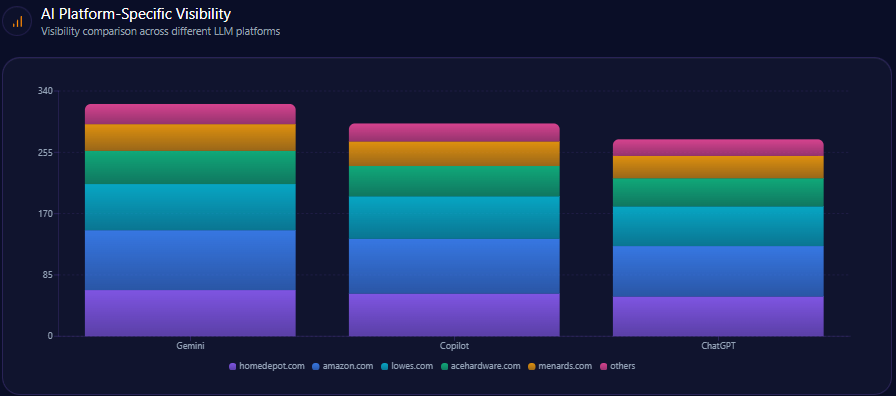
On Gemini, Lowe’s shows its strongest performance: 86% visibility and 26% share of voice (with 182 total mentions recorded). Amazon still edges share at 28% (with 51 mentions), but Gemini is clearly receptive to Lowe’s structured signals.
On ChatGPT, Lowe’s platform share of voice is 23%—while Amazon takes 34% (with 61 mentions) and Ace Hardware sits at 15% (with 27 mentions). The shape of that split fits the report’s pattern: urgency and convenience prompts are where Lowe’s loses ground.
On Copilot, Lowe’s share of voice is 21%, with Amazon at 31% (mentions 54) and Tractor Supply Co. at 11% (mentions 19), reflecting how niche vertical authority can punch above its overall scale.
The result is a single brand with multiple “AI identities.” The report’s clearest opportunity is to turn Gemini’s openness into a broader cross-platform advantage—without losing to Amazon’s speed narrative or Ace’s locality narrative.
Tone of the Conversation: Who Sounds Most Trusted
On sentiment, Lowe’s sits in the middle of the pack.
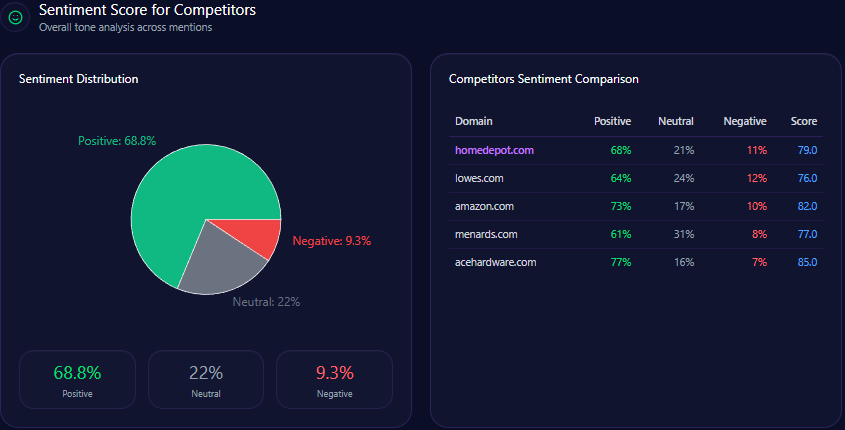
Overall sentiment scores show: Ace Hardware 85, Tractor Supply Co. 83, Amazon 81, Lowe’s 74, Menards 71. Lowe’s split is 64% positive, 21% neutral, 15% negative—suggesting stable trust, but real friction.
The report’s context themes reveal where sentiment is made:
- DIY Project Support: count 94, frequency 70.00, tone Positive
- Appliance Installation: count 68, frequency 50.00, tone Neutral
- Price Matching and Rebates: count 42, frequency 31.00, tone Neutral
This is where competitor sentiment tracking becomes practical, not academic: Ace Hardware’s higher overall sentiment aligns with a narrative of local expertise, while Amazon’s strength is framed by logistics and breadth, even when it trails in areas like installation consultation.
For Lowe’s, the story isn’t “people dislike the brand.” It’s that service-related friction and fulfillment expectations can surface inside conversational buying guides—and those guides shape the next click.
The Prompts That Keep Bringing Lowe’s Up
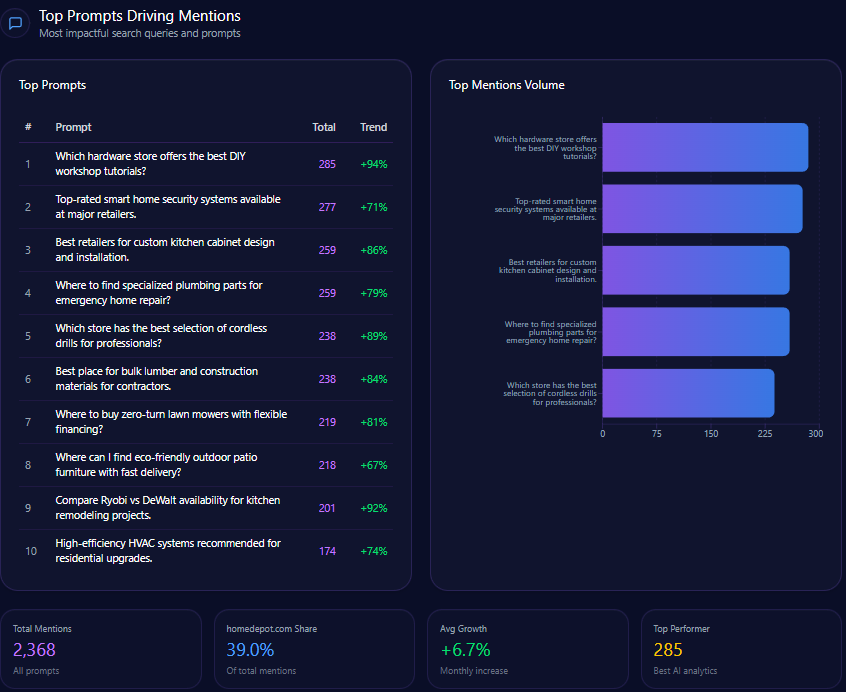
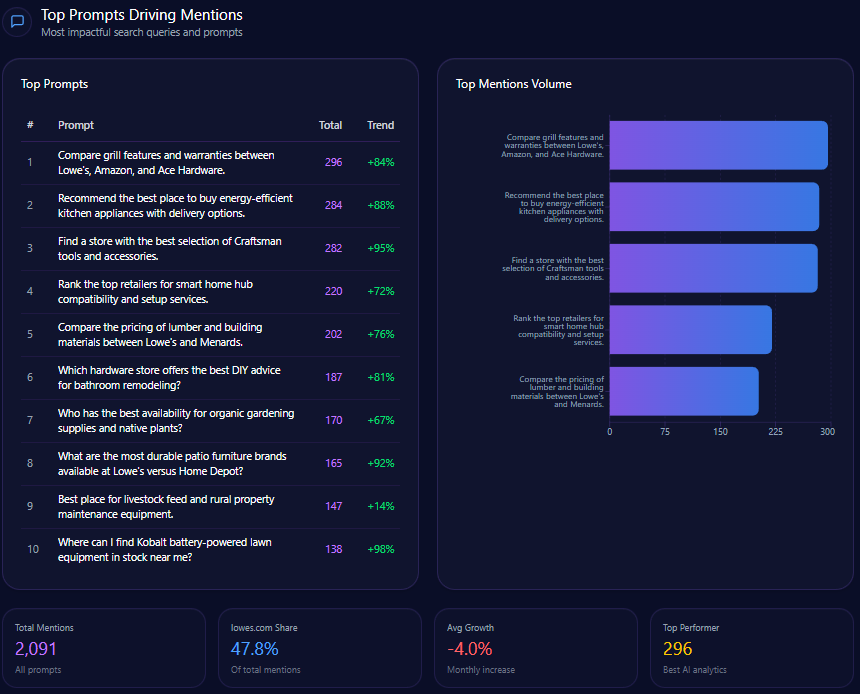
The report’s top prompts show what “summons” Lowe’s most reliably—and where competition crowds the answer.
A few standouts:
- “Compare grill features and warranties…” (296 mentions; Lowe’s 102, Amazon 115, Ace Hardware 79; trend +84%)
- “Recommend the best place to buy energy-efficient kitchen appliances…” (284; Lowe’s 112, Amazon 124, Menards 48; trend +88%)
- “Find a store with the best selection of Craftsman tools…” (282; Lowe’s 136, Amazon 92, Ace Hardware 54; trend +95%)
- “Rank the top retailers for smart home hub compatibility…” (220; Lowe’s 88, Amazon 132; trend +72%)
- “Best place for livestock feed and rural property maintenance equipment.” (147; Lowe’s 18, Tractor Supply Co. 129; trend +14%)
- “Where can I find Kobalt battery-powered lawn equipment in stock near me?” (138; Lowe’s 138; trend +98%)
The pattern is unmistakable: when the prompt contains brand-specific tools (Kobalt, Craftsman), Lowe’s can dominate. When it contains rural property needs, Tractor Supply Co. takes the entire frame. And when it contains “compatibility” and “hub ecosystems,” Amazon becomes the default answer engine.
What People Ask AI to Do in This Category
The intent mix here is narrower than most retailers assume—and that changes how the brand should build visibility.
Prompt types skew heavily toward Comparison: value 70, count 7. Feature Inquiry sits at value 20, count 2, while Research appears at value 10, count 1. Purchase Intent and How-to/Tutorial are both recorded as 0 (count 0).
That doesn’t mean users don’t want to buy or learn. It means the prompts captured in this analysis are framed as “help me choose” and “compare the options”—which increases the importance of structured, scannable product detail signals, clear pricing logic, and credibility cues the models can reuse.
If Lowe’s is already strong in “Project Planning” and “Expert Installation” list placements, the missing link is ensuring those strengths become comparison-winning evidence across the queries that dominate the mix.
From Mentions to Checkout: The Commerce Mood
In commerce-oriented AI discovery, Lowe’s trails Amazon more sharply.
E-commerce Share of Voice shows Lowe’s at 18.54% (61 mentions) versus Amazon at 32.52% (107). Ace Hardware holds 12.77% (42), Menards 9.73% (32), Tractor Supply Co. 7.9% (26), with “others” also at 18.54% (61).
E-commerce sentiment snapshots remain favorable: 76/17/7 across 1,142 reviews, 72/20/8 across 984, and 75/19/6 across 1,056 (positive/neutral/negative). The report’s snippets make the underlying narrative tangible:
- “Lowe’s offered the best selection of smart refrigerators and the delivery team was extremely professional.”
- “The lumber quality is consistent, though the checkout process for Pro members can be slow during peak hours.”
- “MyLowes Rewards program has significantly improved my savings on repeat garden supply purchases.”
- “Finding a floor associate for help with electrical fittings was difficult compared to my visit to Ace Hardware.”
AI commerce referrals in this section are smaller but measurable: ChatGPT 4,520 referrals at 3.4% conversion rate, Gemini 3,890 at 4.1%, and Copilot 3,210 at 2.9%.
The story: selection, loyalty, and delivery professionalism show up as strengths—while store-level assistance and speed-of-fulfillment remain the friction points that competitors exploit.
Conclusion
The report paints Lowe’s as a brand with real authority—and a clear set of repeatable loss conditions. It leads where home improvement becomes complex: appliances, installation, planning, and brand-specific tools. But it loses where the prompt compresses time, demands SKU-level certainty, or shifts into rural maintenance—precisely the moments when AI “decides” what’s most practical.
Leadership actions are equally clear in the report: optimize technical specification data and expert review citations for high-ticket power tools; integrate real-time local inventory data and regional availability schema; refine AI-referred landing page experiences with high-authority project guides and bio snippets; and implement technical comparison tables to improve data scraping accuracy for price-sensitive prompts. On the competitive front, the report calls for a sharper logistics language strategy to mirror “fast fulfillment” signals (with a target of +15% rank improvement in 90 days) and a push to increase ChatGPT mention density (aiming for a 5% Share of Voice lift next quarter). It also recommends expanding rural maintenance and urban agriculture content to challenge Tractor Supply Co.’s niche dominance—and addressing supply chain transparency to mitigate the 12% negative sentiment rate noted in Copilot and ChatGPT leadership contexts.
Explore SpyderBot to operationalize these GEO analytics insights.