In generative search, dominance is no longer about shelf space or store count. It’s about which brands survive the compression of AI answers—and which stories get left out.
Imagine asking an AI assistant a straightforward question: “Where should I buy materials for a serious home project?“
The answer arrives instantly—confident, compressed, and selective. It does not browse aisles. It does not compare weekly flyers. It references a small handful of brands that generative systems have learned to trust as authoritative sources.
In that moment, Home Depot still shows up. Often. But the data reveals something more nuanced than simple dominance. This is not a story of erosion, nor one of uncontested leadership. It is a story of structural advantage—tempered by emerging gaps that matter precisely because AI answers leave no room for second place.
Position in LLM Response Lists
Across major large language models, Home Depot consistently appears in high-authority positions when users ask for professional-grade solutions. In buying guides for power tools, DIY project supplies, and contractor workflows, the brand ranks first in citation frequency, supported by deep technical coverage and structured data signals.
On ChatGPT, Home Depot is top-ranked in Buying Guide lists for professional tools and Tutorial Resources for DIY projects. Gemini reinforces this authority, repeatedly citing Home Depot in project-driven and seasonal equipment queries. Copilot mirrors this strength for instructional contexts, where structured tutorials and rental logistics outperform competitors.
However, the hierarchy shifts in technology-driven queries. In smart-home ecosystems and fast-fulfillment comparisons, Home Depot is frequently ranked second—visible, but not dominant. These placements reveal how LLM brand mentions are shaped less by brand size than by narrative clarity within specific problem frames.
Competitor Gap Analysis
The competitive landscape inside AI answers resembles a battle map rather than a leaderboard. Each rival wins on different terrain.
| Query | Home Depot | Competitor | Gap / Priority |
|---|---|---|---|
| Best value kitchen cabinets | 78 | Lowe’s (86) | High |
| Fastest delivery for garden mulch | 65 | Amazon (94) | Critical |
| 11% rebate hardware | 32 | Menards (98) | Medium |
| How to fix a leaky faucet | 92 | Ace Hardware (74) | Low |
| Professional grade power tools | 95 | Lowe’s (82) | Maintain |
Amazon dominates speed-led narratives, Lowe’s owns design-forward kitchen contexts, and Menards controls rebate-centric value prompts. Home Depot, by contrast, is strongest where complexity is high and professional trust matters. The gap is not about relevance—it is about which attributes AI systems prioritize when summarizing “best.”
Trigger Keywords for Competitor Products
Certain keywords act as automatic summons for competitors inside generative responses. “Smart lighting” consistently triggers Amazon dominance, while “patio sets” tilts toward lifestyle-oriented imagery where Lowe’s outperforms. Conversely, “power tools,” “interior paint,” and “cordless drills” reliably surface Home Depot, supported by high mention density and product specificity.
These trigger keywords illustrate how GEO analytics exposes not just visibility, but causality: which terms cause AI systems to pivot away from Home Depot, even when the brand is operationally strong in those categories.
Quick overview
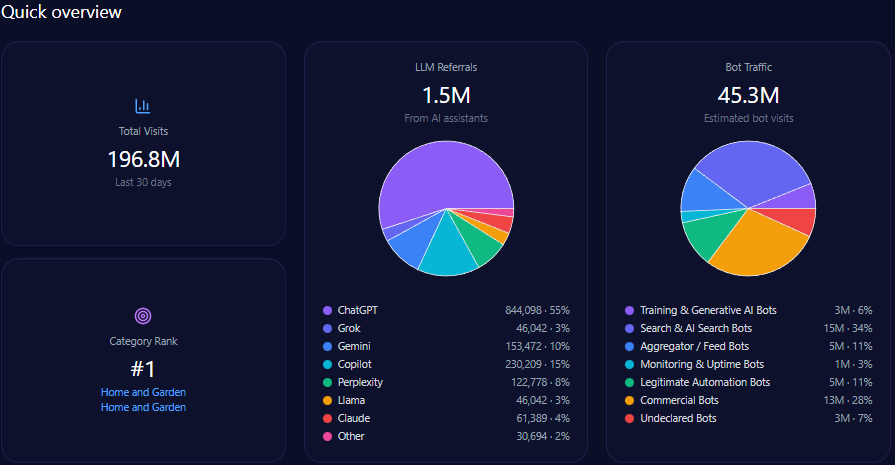
At scale, Home Depot’s GEO footprint is formidable. The brand records 196,759,512 total visits, including 45,254,688 bot interactions, reflecting heavy machine-mediated discovery. LLM referrals exceed 1.5 million, with ChatGPT contributing the largest share.
Within its primary category, Home Depot holds the #1 rank, reinforcing its position as the default authority for home improvement and building materials. This scale provides a strong foundation—but scale alone does not guarantee narrative control.
Share of Voice in LLM Responses
Inside AI answers, share of voice represents mindshare under compression. Home Depot captures 24% of all competitive mentions, closely trailing Amazon’s 28% while leading Lowe’s at 20%.
This positioning confirms Home Depot as a primary reference brand rather than an alternative. Yet the margin matters. In generative environments, the first brand often absorbs disproportionate trust, while second place risks being framed as “also-ran” unless differentiation is explicit.
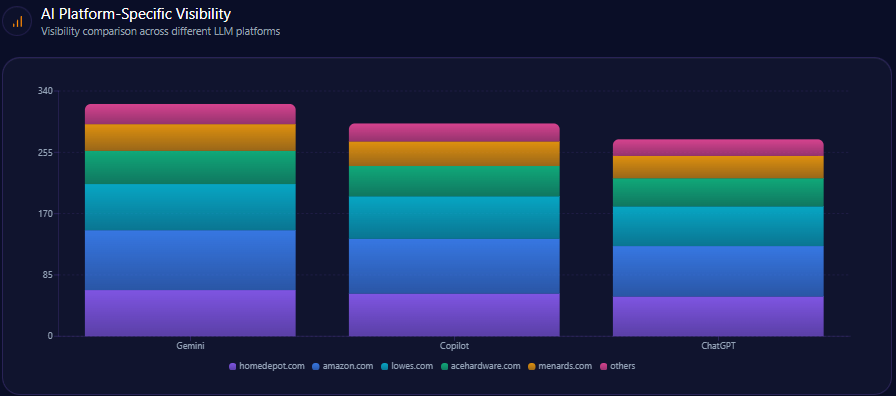
Platform bias is real. Gemini is Home Depot’s strongest environment, where the brand commands 29% Share of Voice and benefits from optimized data feeds. ChatGPT presents a more balanced field, with Amazon slightly ahead due to breadth. Copilot is the weak spot, where Home Depot’s share stalls at 20%, limiting citation depth in Microsoft-driven ecosystems.
The implication is clear: the same brand tells different stories depending on how each model ingests and ranks information. Competitor sentiment tracking at the platform level reveals where optimization must be surgical rather than generic.
Sentiment Score for Competitors
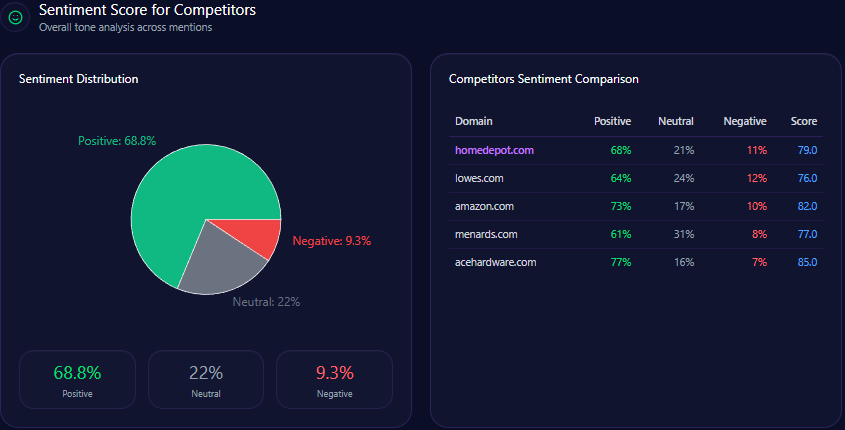
Sentiment defines tone, not volume. Home Depot posts a strong 79 overall sentiment score, driven by positive narratives around professional services and product availability. Amazon leads slightly higher at 82, while Ace Hardware posts the highest sentiment at 85, powered by local service trust.
Context themes explain the differences. Professional services dominate positive sentiment for Home Depot, while customer service quality introduces friction. Pricing narratives remain largely neutral, suggesting that value perception is stable but not emotionally resonant.
Certain questions reliably summon Home Depot in AI answers. Prompts around DIY workshops, professional tool selection, bulk lumber sourcing, and brand-specific tool comparisons consistently feature the brand at high frequency.
In contrast, prompts focused on smart-home security, eco-friendly outdoor furniture, and rapid delivery shift attention elsewhere. These patterns demonstrate how prompt framing—not just category presence—determines visibility.
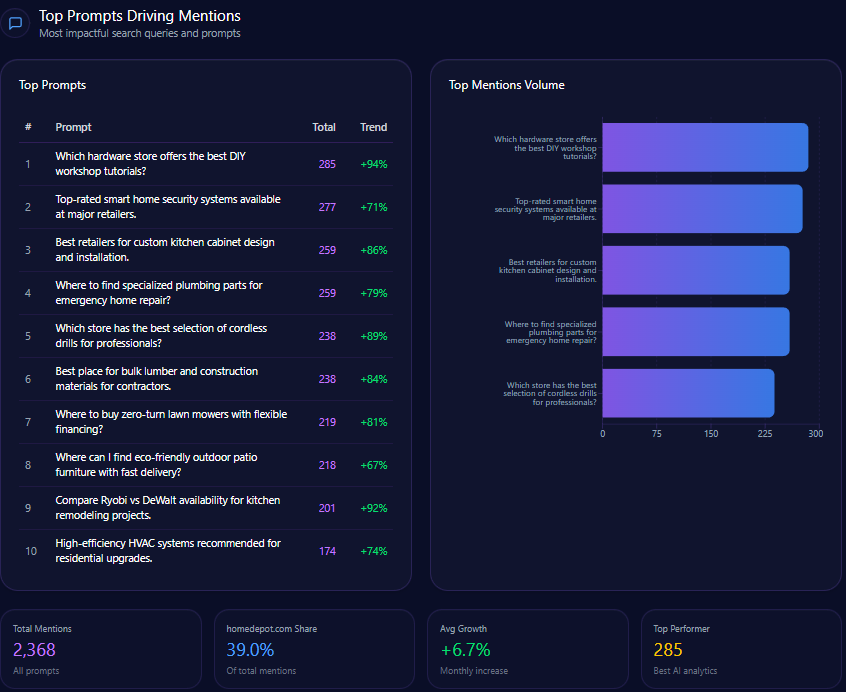
The prompt mix skews heavily toward comparison and feature inquiry queries, with limited representation from pure how-to tutorials or purchase intent. This distribution reflects how users increasingly rely on AI to evaluate options rather than execute transactions directly.
For Home Depot, this is both an advantage and a risk. Authority in comparison contexts reinforces leadership, but gaps in emerging categories can quickly reframe the brand as traditional rather than innovative.
At the product level, sentiment remains favorable. Reviews of Ryobi power tools and garden supplies are strongly positive, emphasizing availability and climate-specific relevance. Neutral feedback clusters around in-store wait times, while negative sentiment centers on delivery coordination for appliances.
Trigger keywords again shape perception. “Power tools” and “interior paint” favor Home Depot, while “smart lighting” and “Christmas lighting” tilt heavily toward Amazon. In AI-driven discovery, these micro-perceptions aggregate into macro-narratives.
Inconclusion
Inconclusion, the data does not suggest that Home Depot is losing relevance. It shows that leadership is being redefined. Home Depot dominates where expertise, scale, and technical authority matter most—but lags where speed, smart-home integration, and lifestyle framing define the answer.
The recommendations are precise: close the smart-home coverage gap, strengthen Copilot-specific visibility through local inventory signals, and rebalance narratives away from founder-linked political context toward modern operational leadership. None of these require reinvention. They require narrative alignment with how AI systems decide what “best” means.
In the age of GEO analytics, visibility is not about being everywhere. It is about being unmissable in the moments that matter.