Tag: AI search trends

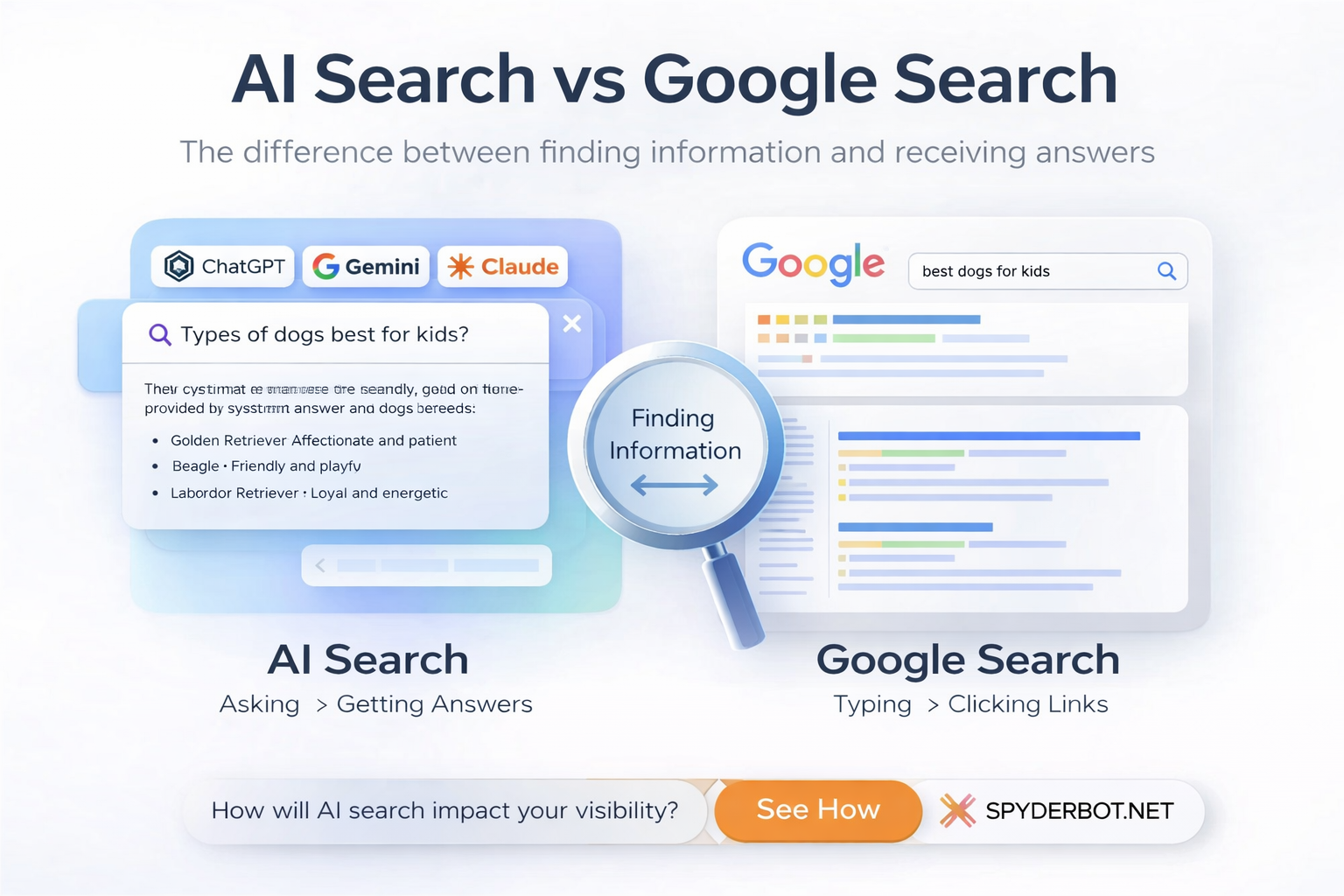
  • AI Search vs Google Search

    AI Search vs Google Search

    The difference between finding information and receiving answers


    I. Two different ways to access the internet

    For decades, the internet worked through search engines.

    You typed a query.
    You got a list of links.
    You chose what to click.

    That model is now being challenged.

    AI search systems like:

    • ChatGPT
    • Gemini
    • Claude

    are introducing a new experience:

    You ask → you get an answer


    II. The core difference in one sentence

    Google Search returns links
    AI Search generates answers


    III. What is Google Search?

    Google Search is:

    A retrieval system that indexes and ranks webpages based on relevance.

    It works by:

    • Crawling websites
    • Indexing content
    • Ranking pages using algorithms

    The output:

    A list of results (SERP)


    IV. What is AI Search?

    AI search is:

    A generative system that interprets queries and produces synthesized answers.

    It works by:

    • Understanding intent
    • Combining information
    • Generating responses

    The output:

    A single answer (or a small set of recommendations)


    V. AI Search vs Google Search (Side-by-side)

    DimensionGoogle SearchAI Search
    OutputList of linksGenerated answer
    InterfaceSERPConversational
    User behaviorClick & browseAsk & trust
    RankingExplicitImplicit
    UnitPagesEntities
    GoalTrafficInclusion
    InteractionOne query → many linksOne query → one answer

    VI. Ranking vs inclusion

    Google Search:

    • Shows multiple results
    • Lets users decide
    • Even position #5 can get traffic

    AI Search:

    • Shows limited answers
    • Makes recommendations
    • If you are not included:

    You do not exist


    VII. How visibility works in each system
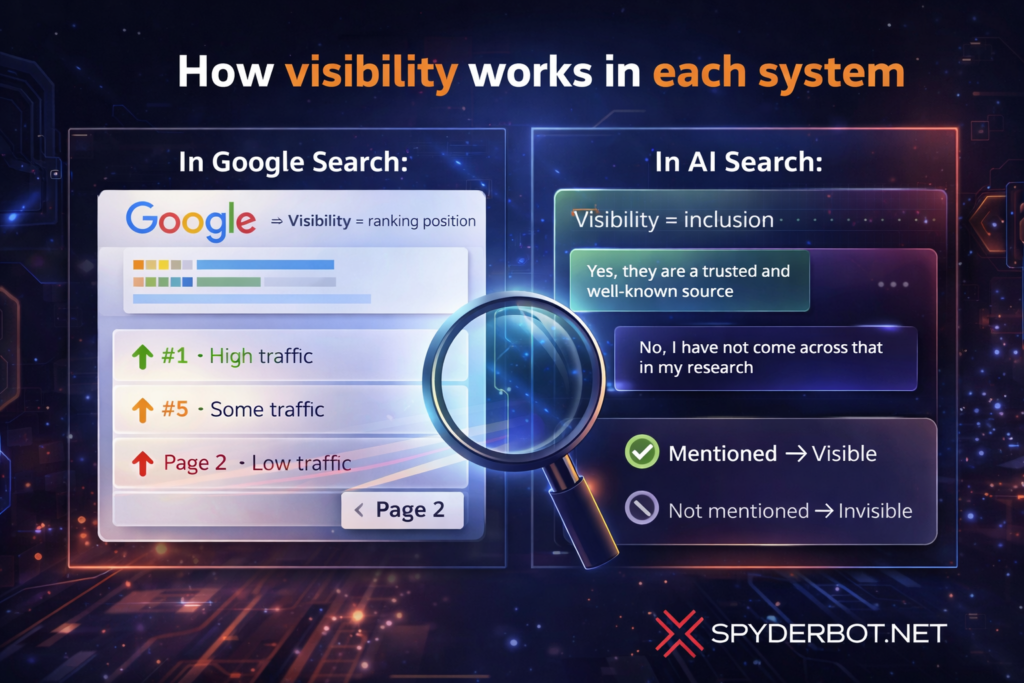
    1. In Google Search:

    Visibility = ranking position

    • #1 → high traffic
    • #5 → some traffic
    • Page 2 → low traffic

    2. In AI Search:

    Visibility = inclusion

    • Mentioned → visible
    • Not mentioned → invisible

    VIII. How decisions are made

    1. Google Search:

    • Keyword relevance
    • Backlinks
    • Page authority

    2. AI Search:

    • Entity recognition
    • Contextual relevance
    • Semantic relationships
    • Confidence signals

    IX. The shift from pages to entities

    Google Search focuses on:

    Pages

    AI Search focuses on:

    Entities

    This means:

    • Not just what you publish
    • But how your brand is understood

    X. The shift from links to answers

    Google:

    • Gives options

    AI:

    • Gives conclusions

    This changes user behavior:

    • Less exploration
    • More trust in a single answer

    XI. The shift from traffic to influence

    Google Search optimizes for:

    Traffic

    AI Search optimizes for:

    Influence

    Because:

    • Users act on answers
    • Not on links

    XII. Why this matters for companies

    If you rely only on Google:

    • You may still get traffic
    • But miss AI-driven users

    If you optimize for AI search:

    • You influence decisions
    • You control perception
    • You capture high-intent demand

    XIII. The emergence of a new discipline

    To succeed in AI search, companies need:

    • AI search optimization
    • AI visibility tracking
    • LLM brand analytics

    This is called:

    Generative Engine Optimization (GEO)


    XIV. Google is not disappearing

    Google will continue to:

    • Drive discovery
    • Power navigation
    • Support research

    But AI search will:

    • Drive decisions
    • Provide recommendations
    • Shape perception

    XV. The new stack

    The future is not:

    Google vs AI

    It is:

    • Google Search → discovery
    • AI Search → decision

    XVI. What companies should do now

    1. Maintain SEO

    Continue optimizing for:

    • Rankings
    • Traffic

    2. Start optimizing for AI search

    Focus on:

    • Entity clarity
    • Context
    • AI interpretation

    3. Measure AI visibility

    • Are you mentioned in ChatGPT?
    • Are competitors dominating answers?

    XVII. The future of search

    We are moving toward:

    A hybrid system

    Where:

    • Search engines find information
    • AI systems interpret and deliver it

    XVIII. Final insight

    Google helps users:

    Find information

    AI helps users:

    Decide what to do

    And in that world:

    The companies that win are the ones included in the answer
  • The Future of Generative Engine Optimization (GEO)

    The Future of Generative Engine Optimization (GEO)

    From ranking pages to shaping intelligence

    1. The Next Layer of the Internet Is Already Here

    Most companies are still optimizing for search engines.
    But the interface of the internet has already changed.

    Users are no longer:

    • Browsing
    • Comparing
    • Clicking

    They are:

    • Asking AI — and acting on the answer

    2. This Is Not a Feature — It Is a Shift

    AI systems like ChatGPT, Gemini, and Claude are not tools layered on top of search.

    They are becoming:

    • The primary discovery layer
    • The decision engine
    • The interface between users and information

    And that changes how visibility works.

    3. The Future Is Not About Ranking — It Is About Inclusion

    In traditional SEO:

    • You compete for position
    • You optimize for ranking
    • You win through traffic

    In the future of GEO:

    • You compete for inclusion inside AI-generated answers

    Because:

    • There are no 10 blue links
    • There is no page two
    • There is only what AI decides to show

    4. The Rise of AI Visibility as a Core Metric

    A new metric is emerging:

    AI visibility

    AI visibility measures:

    • Whether your brand is mentioned
    • How often it appears
    • How it is positioned in AI answers

    This will become as important as:

    • Traffic
    • Conversions
    • Revenue

    5. From SEO Metrics to GEO Metrics

    Companies will shift from tracking:

    • Rankings
    • Keywords
    • Click-through rates

    To tracking:

    • AI visibility tracking
    • LLM visibility tracking
    • Brand mention frequency
    • AI perception and positioning

    6. The Evolution of Optimization

    Phase 1: SEO (Past)

    • Optimize for search engines
    • Focus on keywords and backlinks

    Phase 2: GEO (Present)

    • Optimize for AI systems
    • Focus on entities and context

    Phase 3: AI-Native Optimization (Future)

    Companies will:

    • Design content for AI interpretation
    • Structure data for machine understanding
    • Build brands as entities in knowledge graphs

    7. How AI Will Reshape Competition

    In the future:

    7.1. Smaller Brands Will Win More Often

    AI rewards:

    • Clarity
    • Relevance
    • Strong positioning

    Not just authority or size.

    7.2. Categories Will Be Defined by AI

    Instead of companies defining categories:

    AI will define how categories are understood

    7.3. Perception Will Be Algorithmic

    AI will decide:

    • Who is the leader
    • Who is an alternative
    • Who is irrelevant

    8. The Future of Search Behavior

    Users will move toward:

    • Conversational queries
    • Multi-step reasoning
    • Personalized answers

    Instead of:

    • Static search results

    9. The Future of Content

    Content will evolve from:

    • Keyword-optimized pages

    To:

    • Entity-structured knowledge designed for AI systems

    Winning content will:

    • Be clear, structured, and contextual
    • Define concepts explicitly
    • Connect entities and relationships

    10. The Future of Analytics

    A new category will emerge:

    AI search analytics

    Companies will need tools to:

    • Track brand mentions in AI systems
    • Analyze how LLMs interpret their business
    • Monitor competitor visibility in AI answers
    • Understand AI citation patterns

    11. The Rise of GEO Tools

    A new ecosystem is forming:

    • GEO analytics platforms
    • AI visibility tracking tools
    • LLM brand analytics systems
    • AI citation tracking software

    These tools will become:

    • As essential as SEO tools today

    12. The Companies That Win

    The winners of the next decade will:

    • Understand how AI systems think
    • Optimize for AI interpretation
    • Control their narrative inside AI

    Not just:

    • Rank on Google

    13. The Companies That Lose

    The losers will:

    • Rely only on traditional SEO
    • Ignore AI-generated answers
    • Fail to understand AI visibility

    And the most dangerous part:

    They will not realize they are losing

    14. What You Should Do Now

    14.1. Start Measuring AI Visibility

    • Track brand mentions in ChatGPT
    • Monitor competitors

    14.2. Understand AI Interpretation

    • How your brand is categorized
    • What entities are associated

    14.3. Optimize for AI Systems

    • Improve entity clarity
    • Structure content semantically
    • Build contextual authority

    15. The Long-Term Future

    We are moving toward:

    • An AI-mediated internet

    Where:

    • AI decides what users see
    • AI shapes perception
    • AI influences decisions

    16. Final Thought

    SEO was about being found.

    GEO is about:

    • Being understood, selected, and included

    And in the future:

    • The companies that control AI visibility will control digital discovery